History, politics, people of Oly WA

Category: Olympia City Council (Page 8 of 9)

What happens on facebook doesn’t stay on facebook (city council should be blogging)

I was thinking about posting this up last night, but decided that since I really like Jeff Kingsbury as my elected representative, I’d nudge him towards blogging publicly, rather than doing this.

Be careful what you say online, even when you’re surrounded by your friends.

UPDATE: Jeff’s not on my friends list on Facebook anymore. I don’t know why. What he did wasn’t all that bad, though I can see why people are getting bent out of shape.

This thingie is an argument for more online communication by Jeff and other electeds, not less.

Randrom free PR advice to some folks who want to build a building downtown

An email I sent to a buddy awhile back that I’d meant to post here. Enjoy or not.

A little free PR advice to some folks in the development world:

In my mind the battle to build the convention center downtown was lost in August 2003 when Public Funds for Public Purposes canvassed Olympia City Council members’ neighborhoods and asked the residents what they thought of the convention center. All of the neighborhoods had a large majority against the project, with Doug Mah’s I remember being up around 90 percent.

PFPP did a lot with this information, including standing up against the wall during a city council candidate debate, holding signs saying “Doug: 90 percent of your neighbors don’t want the convention center.”

This is an important lesson for the Larida Pasage debate because it illustrates what happens when you lose control of the narrative. The council and the city bumbled around with the details of the convention center, and let opponents build a case against it as the details came to light.

We’re also getting very close to the point (maybe within days) of this happening with Larida Passage. I know its a small example, but its a bad sign that I can’t drive to the Safeway without seeing half-a-dozen signs saying “Don’t Wall of the Waterfront” or “Save our Views.” There should at least be competing signage saying “Save Downtown.”

In this case, its more of downtown residents talking about what they see as the negatives of the project. Keep in mind, downtowners’ negatives aren’t necessarily the negatives that would be seen from someone outside downtown. If the project suddenly appeared tomorrow, most Olympia residents wouldn’t see it as a big deal. Most downtowners would be apoplectic.

So, define the positives of the project from the perspective of someone living in S. Capitol, off of Cain Rd. or near Garfield School.

For example: How are walkers around Capitol Lake going see the project? The size of the buildings, from someone walking the north side of the lake or the south sidewalk of 5th would be a turn-off. To these people you need to talk about the ground floor retail and the general sprucing up of the blocks.

By and large, lake walkers are not downtowners. They come down to the lake and walk because it is a downtown feature they enjoy. You could take this same exercise and carry it with any group of people that use downtown, but do not live there. Another example would be folks who attend Lake Fair.

So, its not necessary to fight back against every negative downtowner argument (traffic, views in general, the “feel” of downtown), but rather build parallel and positive argument the project to the sections of the community that will actually decide whether this goes forward.

Strictly countering downtowner arguments will in the end give them more credence and leave the out-of-downtowners no other vision of the project then what the downtowners define it as.
I think beautiful views are killing Puget Sound [Wall off the waterfront]

Puget Sound is dying because it is too beautiful. The central issue with Puget Sound isn’t actually finding a way to fix what’s wrong. We know what’s wrong and how to fix it, its convincing people that there’s even a problem.

Most folks look at Puget Sound and see beauty, so how could there be a problem?

This is directly tied to my recent thoughts on building higher than average buildings close to the water in downtown Oly.

We have to stop thinking of the beauty of this place as an ecological function. Puget Sound can be both beautiful and dying at the same time. Why are we so worried about building bigger buildings (that would actually decrease stormwater run-off because they’d be built to modern standards) on already urban lots?

Not building them where urban growth already is would push growth further out, in rural and undeveloped areas.

So, we don’t build them because the view of Puget Sound is pretty? I think we should build them especially if they block the view so we can remind ourselves that Olympia is already big piece of concrete, and that concrete on dirt is not pretty.

Why don’t we vote to fill vacancies on local boards?

One of the things that made vote-by-mail an easy thing to do politically, was that the proponents said that it would make elections cheaper. No need for real world voting locations, everyone would just mail it in (on their own dime, btw).

So, why don’t we hold special elections to fill vacancies in local boards. Right now we’re going through the process of appointing a new city council member in Olympia. I’ve been blogging about it a lot because compared to the regular system of reviewing candidates (at least five months and two elections) the appointment process is short and undemocratic.

Which makes me wonder why we just can’t have another election. Here are more thoughts:

  • Local school boards hold elections at irregular times for citizens to consider bond measures and levies.
  • Again, if vote by mail elections are so cheap, why not hold elections to fill vacancies?
  • More democracy is a good thing.

Now, if someone quit five months before an election to fill their seat, I could see the wisdom of not holding an election. But, in Olympia we have a seat with 23 months left to go on it, so if we were to draw a line, somewhere between 23 months and nine months would be a good place to start. I’d go with nine months or a year.

Just creating an option for local governments to hold an elections somewhere in RCW 42.12 would be a good place to start.

I’m not qualified for the Olympia City Council

A post in which the blogger attempts to clean himself of the ickiness of judging eight people who applied for an open city council seat in Olympia.

I spent the last week or so writing eight posts about people that are applying for open council seat, and I’ve come to a conclusion that about half of them shouldn’t be on the council. I also concluded that I’m not worthy to judge and I only hope that the small amount of wisdom I have helped people think about who might be appointed to serve on the Olympia City Council.

And, that if I had applied, I wouldn’t have been qualified to serve. I am pretty sure I wouldn’t have even gotten through filling out the application packet. While I have some strong feelings about how Olympia can write a better budget, even thinking about the city’s compressive plan would have thrown me off.

Maybe I would have written something about trying to open that process up, make it more transparent and obvious, but that would have been a lot like my budget answer too.

Anyway, reading and writing about those applicants made me think long and hard about my own civic life.

One of the standards I used to judge was whether the applicant had served on a city advisory board, which I’ve never done. Those closet I came as an ad-hoc committee on wi-fi downtown. I think we served the council well, but that hardly gave me a deep understanding of any aspect of city management.

So, maybe next time the city recruits for their many advisory boards, I’ll be applying. Not because one day I want to apply or run for city council, but because if I’m so interesting in my city, I should try to be a bigger help.

Olympia neighborhoods, which ones are community friendly?

Over at Olyblog, we’re sort of talking about the recent election and why some neighborhoods voted one way. Former city council member Matthew Green posted up and gave a great comment. He fell apart in my mind when he said that SE Olympia lacks community because of the lack of small community businesses.

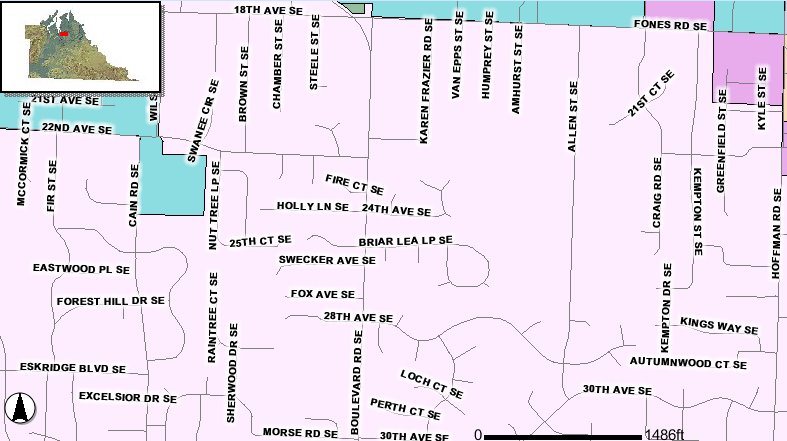
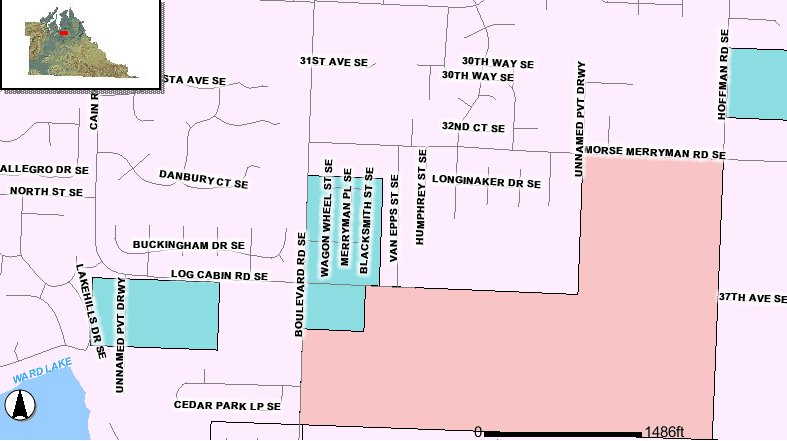
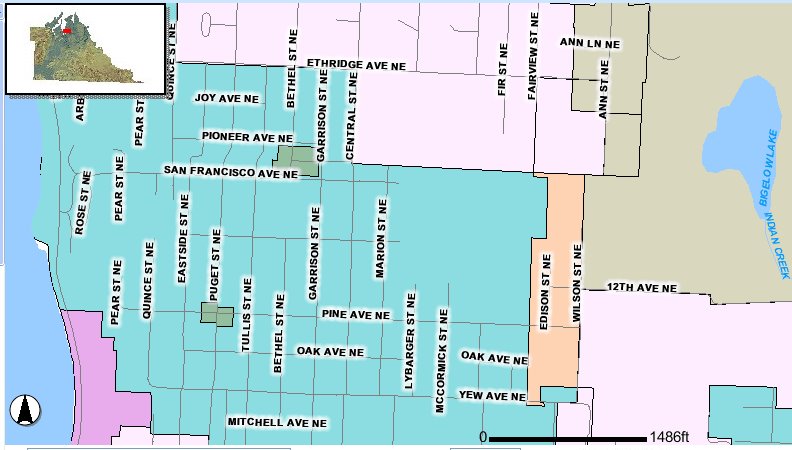
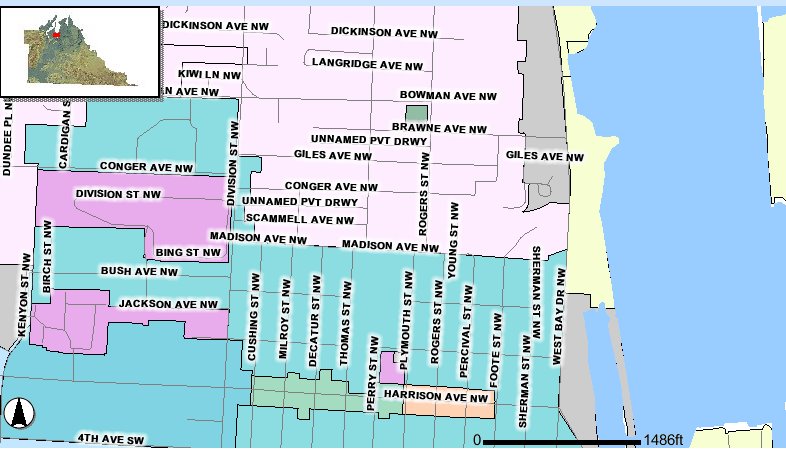
This may be a circular argument, but SE Oly lacks small businesses because it lacks the zoning for these sorts of businesses. If the city wanted small community shops down here, they could have designed them in.

Here’s what I’m talking about.

Northeast Olympia


The only color to pay attention to here is green. In this map, the green colors represent the Puget Pantry (middle of the map), the San Francisco Bakery and a corner store (both towards the top).

Northwest Olympia
This area includes the Harrison commercial area, but also the west side Food Co-op is located right in the middle of a neighborhood. Also, notice the gray zoning along the water, which is mixed use commercial.

Southeast Olympia

Two maps for this side of town, so its an even more startling example of homogeneous zoning that excludes the kind of small local businesses that Matt was talking about. Up on the north side of the top map is the Pit Stop Market, and aside from the Boulevard Nursery, there isn’t another local business on this side of town. Weird that the nursery is actually zoned residential.

So, here’s the question, which comes first: the zoning or the business? Does the zoning come along because someone wants to open a business in a particular location? Or, does the zoning allow a business to be opened? I’d say the second one is more likely in my mind.

If the city were to allow a certain number of businesses to open in residential areas, then maybe we’d see more local businesses in SE Olympia.

What about the local option? (re: special session, I-747)

Originally Initiative 747 had a local option for raising property taxes beyond the 1 percent limit. If a local government wanted to give it a try, they could put it on the ballot and see what their constituents thought.

What makes me wonder about the local option from the original 747 is that from the news coverage (and the governor’s letter), there is no mention of it at all.

I can’t tell whether the governor will introduce a bill that includes the local vote option to go above the 1 percent cap. Olympia is one of the few cities in the state thinking about moving beyond 1 percent in the next few days, and I’m not totally sure that would be “against the will of the voters.”

I-747 passed in Thurston County by 53 percent, five percent lower than the statewide margin. One could assume that Olympia was the anchor that drug down Thurston County’s percentage. One could also assume that 747 lost in Olympia, which makes our council’s inclination towards raising property taxes above the 1 percent limit politically feasible.

I emailed the auditors office for the precinct level data from the 2001 election this morning.

T.J. Johnson’s old plan for a City of Olympia blog

I knew I remembered this from back in the day:

TJ Johnson, who will be sworn in tonight, said he compiled the list after hearing residents say they wanted a more receptive council.

“It’s the sense that we need to do a much better job of communicating and engaging the public,” Johnson said Monday. “That’s the spirit in which this is offered, to rebuild trust, to rebuild the partnership with citizens and the city.”

Johnson plans to discuss the proposal tonight and ask the council to set the wheels in motion.

All e-mail communication between council members should take place in a “chat room” accessible to the public via the Internet.

All written and electronic mail sent or received by council members in their capacity as council members (i.e., not personal e-mail) should be copied to a central repository operated by the office of the city manager.

That sounds a lot like a blog. I don’t really remember the details of what happened to T.J.’s plan, but you can assume he never got the blog going.

Council vows to consider efforts to draw in public
Olympia City Council told what to change

City council blogs in Monroe?

Chad Minnick is pushing for a city council blog to replace somewhat private city council email communication:

Establish a City Council blog as an alternative to emails. There really is no need for Council members to email privately. The only reason any Council member would use email at all is because we get together just one night a week and email is one of the quickest and easiest forms of communication the rest of the time. But only a small portion of what is discussed is confidential, and that is just matters having to do with personnel, litigation, and the purchase and sale property. There is no reason Council members can’t communicate during the week on a blog. Ideas can be discussed in the broad light of day where every citizen can read it. I have purchased the domain www.MonroeCityCouncil.com and will give ownership of it to the City for this use.

He has a few other suggestions that Olympia has already implemented (such as putting the meetings online), but the blog suggestion is interesting. Olympia will of course let you see each and every email council sends and recieves, you just have to drop down to the city hall each month to pick up a copy of a cd.

Rhenda dives into the Olympian comments, does a pretty good job

I’m always impressed by elected officials who not only participate in comment threads, but stick with it, approach it maturely and get something good out of it.

The entire thread
is worth reading (start at the bottom), but here are some highlights.

Here is her eventual response to a line of questioning:

Yes, I have answers for Scott.

“Does this mean you are one of the ones who support the 50-100% tax increases on homes?”

No.

“Does this mean that you support keeping people from dividing their land as they see fit?”

Yes. I support community planning. Cities like Olympia don’t just happen. They are built by people who put a lot of effort into deciding what sort of development belongs where. The alternative to planning is not just the sort of sprawl you see in LA–which many people here cite as their nightmare planning scenario–the alternative is chaos that endangers not just our quality of life but our health and safety.

“Does this mean that you support halting most construction on private lands if there is a stream nearby that theoretically could contain a salmon?”

No.

And, what her questioner had to say:

Rhenda

Thank you.
scott

Rhenda took advantage of the comment thread not to engage in a pointless back and forth, but to answer the questions that were posed to her quickly and clearly. Its a good thing to participate in comment threads, its a bad thing to get wrapped around the axle. By jumping in she was able to knock down an untruth (that she’s a member of Futurewise) and get another commenter to thank her (bonus points)..

I set up Rhenda’s website for her, and she’s been writing on her blog semi-regularly since then. No one has come by to comment (as far as I know). This gives me hope that after she’s elected, Rhenda might use her blog as a platform for conversation with Olympia citizens.

« Older posts Newer posts »

© 2026 Olympia Time

Theme by Anders NorenUp ↑