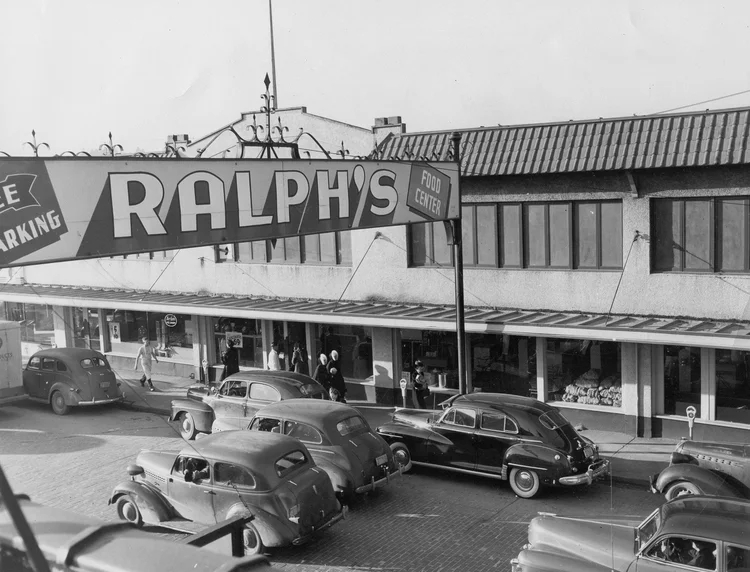
It was the sign that got me first. I found a photo of an old-style, street-spanning sign that used to be on Columbia near Legion on the Ralphs Thriftway website. I was already
It stuck with me for days. There is a kind of whimsy that survives in old street signs, even now, even after everything around them got built specifically to remove that kind of whimsy. This one hung above Fifth Avenue, behind where a J.C. Penney store used to sit, in front of the original Ralph’s grocery store. And most importantly for this essay, right in front of a parking lot at Legion and Columbia downtown.
It was cut down in February 1958. It had stood there for thirty years and advertised the old Olympia Public Market and Ralph’s grocery store after that. The reason it came down was not really about the sign at all. J.C. Penney was enlarging its building, and during construction, the company had been running its store out of temporary quarters, the old Ralph’s Food Center building sitting immediately behind the main store. The sign had to go to make room. It also violated a city sign ordinance that had been around for some years. Some people in town mourned it, apparently, the way you mourn something that has been part of the wallpaper of your life for thirty years.
This is an essay in a series I am doing on the history of parking lots in downtown Olympia. Much of the downtown landscape is dominated by large parking lots. It is important to note their history and how they came about.
This destruction of street-spanning signs happened everywhere. Arch signs like this one were common in downtowns across North America by the early twentieth century, built to welcome visitors into town, to light up the main business corridor at night, or to promote whatever local industry the town wanted you to know about. And then, starting in the late 1890s and picking up speed through the twenties and thirties, city planning commissions started calling these things clutter. The City Beautiful movement pushed for standardized streetscapes, and steel arches strung with electrical wire got lumped in with everything else that made a commercial district look disorganized.
So by the 1940s and 1950s a bunch of things were converging at once. Mid-century design wanted clean lines, and an elaborate metal arch read as a gaudy leftover from the Victorian or Edwardian era instead of a symbol of anything modern. The arches themselves were also aging structural liabilities, built over public streets without much of a maintenance plan, and rust and wind shear, and heavy snow loads added up to a real risk of one falling on somebody. Car traffic was changing the calculus too. Freight trucks and emergency vehicles needed clear vertical sightlines and higher overhead clearance, and an arch spanning the road did not fit that anymore. Cities were writing stricter sign ordinances and right-of-way rules as well, the kind that made it flatly illegal for a private structure to hang over a public street. And advertising itself was moving on, toward neon blade signs mounted on the sides of buildings and flush storefront signage, which meant the arches had lost their actual job as the thing that lit up the street and told you where to shop. A few cities kept theirs. Reno famously rebuilt its gateway arch instead of tearing it down.
In April 1934, somebody proposed a centralized Farmers’ Market for West Legion Way, a single large private building where ranchers could sell straight to local consumers instead of going through a middleman. Then in December 1935 the property at the corner of Legion and Columbia sold, in one of the biggest downtown real estate deals of the year (the paper did not say what made it so big, just that it was). The sale marked a return to local ownership for the site. Ralph Stormans was already working that block by then. He had started his grocery career around 1934, managing a chain-owned Totem store at that corner.
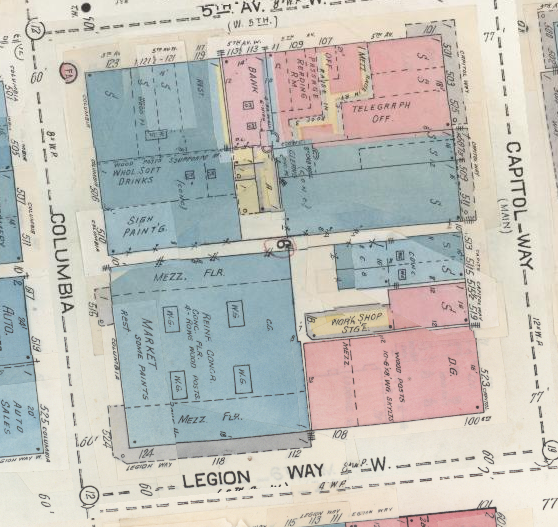
On July 28, 1944, Stormans went into business for himself. He opened Ralph’s Food Center at 114 Legion Way, inside the old Totem Market building. The store had fresh groceries, a fruit and vegetable stand, and a meat department. A month later, on August 25, 1944, a restaurant called Ralph’s Center Lunch opened inside the building too. It became the kind of place people went for a hot lunch and a slice of pie and a cup of coffee.
In January 1946, exceptionally high tides lined up with heavy rain and overwhelmed the city’s storm sewers, and the food center flooded. It damaged a lot of stock, and Stormans led a protest to the city over the downtown drainage system.
By the late 1940s, Ralph’s had become enough of a landmark that a new paint store opening nearby did not bother listing its own address in its ads. It just said it was “next to Ralph’s food center.” On June 25, 1948, the store held a grand reopening after a major remodel, with a bigger produce department, self-service delicatessen counters, new checkout stands, and a full paint and wallpaper job done by the neighboring Hartley Paint Co.
In March 1950, Ralph’s closed for a stretch to install “speed-stands,” streamlined checkout counters meant to move shoppers through faster, along with new dairy and frozen meat counters.
Then in November 1952 the store expanded again, when he bought an old oyster company’s building on Puget Sound that same year and turned that into a second store instead. The original Legion Way store continued operating simultaneously. Stormans ran more than one location at once rather than closing the first.
That finally changed on November 29, 1956, when Stormans closed the original corner store for good and replaced it with a new supermarket up the hill near the Upper Eastside, the modern-day Ralph’s Thriftway at 1908 Fourth Avenue East. The papers called it a “mammoth food emporium.” It had automatic doors, a play area for kids, and leased space for two other businesses, John Gosk’s Blue Ribbon Meats and Al Bailey’s Bailey Drugs.
Once Stormans cleared out of 114 West Legion Way, the building got leased to J.C. Penney, and that is where the story loops back around to the sign. J.C. Penney used the old Ralph’s building as temporary quarters through all of 1957, while its main store, around the corner at Capitol Way and Legion Way, got completely torn down and rebuilt. The new building was designed by the local firm Wohleb and Wohleb and Associates, and construction started in January 1957. Somewhere in that stretch, the thirty-year-old sign above Fifth Avenue came down to clear room for the expansion. The new J.C. Penney opened on Thursday, January 2, 1958, with 32,800 square feet, three times the display space of the old store, plus year-round climate control and what the coverage called shadowless lighting. The date I have for the sign itself coming down is February 1958, which is odd, since that would put it a full month after the new store already opened. I am not sure if that is an error somewhere in my sources or if the “enlargement” work genuinely dragged on past opening day.
Once J.C. Penney moved into its new building, the old Ralph’s building at 114 West Legion Way got vacated for good. Back in late December 1956, when the building first emptied out, the owners had not lined up any bids yet on who would take it next.
Before I go any further, I want to back up and talk about the forces at play here. First, let us figure out what a “Public Market” (the use of the Ralph’s building at Columbia and Legion) actually was, because the term keeps showing up in my notes and I do not think it means what I first assumed. In the 1900s and 1910s, grocery shopping in a town like Olympia meant either an independent counter-service shop, where a clerk behind the counter picked every item on your list for you, or a seasonal open-air farmers market. High overhead, limited selection, that kind of thing. A “Public Market” or “Grand Central Public Market,” the kind of building that shows up in Olympia by the 1920s and 1930s, was a step past that but still a step short of a real grocery store. It was not a single business. It was closer to a mall of independent vendors, a baker here, a butcher there, a greengrocer, a fishmonger, sometimes a dry goods seller, each one leasing a stall from a master tenant or landlord. Very, very similar to the current-day Farmers’ Market, but less niche and more mainstream. So many of the niche things we appreciate now are actually the way we used to do things. The halls ran enclosed and year-round, and while local farmers still showed up seasonally, a lot of the stalls were worked by permanent merchant middlemen sourcing from regional distributors.
Ralph Stormans’ first store is the exact hinge point where that model gave way to the next one. A single operator consolidating a whole building’s worth of formerly independent stalls into one self-service supermarket, under one owner, with one register, is exactly the shift that turned public markets into what we would now just call a grocery store.
A few things drove that shift. In 1937 the folding shopping cart was introduced, which meant a shopper could push a cart through wide aisles and grab packaged goods themselves instead of working through five separate counter clerks in a market hall. Refrigeration and better supply logistics made it possible for one owner to stock fresh meat, dairy, and produce at the same time without leaning on specialized sub-tenants.
And as car ownership and downtown parking expanded, shoppers started preferring one consolidated stop with unified pricing and volume discounts over working their way through a hall full of separate vendors.
This note on car ownership is where we get back to the Stormans’ second location. In 1952, Stormans bought a building on Puget Sound, next to the Olympia Yacht Club, from the Brenner Oyster Company, and remodeled it into what the coverage described as a state of the art supermarket. This store ran on a genuinely clever logistics setup for its time. Groceries came off delivery trucks straight onto a conveyor belt that carried them up to storage on the second floor, and a second conveyor sent products back down to the shelves whenever they were needed. That setup let the store hold more inventory at once, which meant Stormans could buy in volume and keep prices down.
But most important? The location had space for a parking lot, while Legion and Columbia’s Food Center did not. This is also true for the Fourth Avenue store, up the hill. The Storman’s tore down a handful of single-family homes on two blocks, paved a parking lot and built a modern grocery store.
Back at Legion and Columbia, once J.C. Penney cleared out of the old Ralph’s building for good in the late 50s, the corner sat there without a tenant. Aerial photos show that by the 1960s the whole site had been flattened into a parking lot.
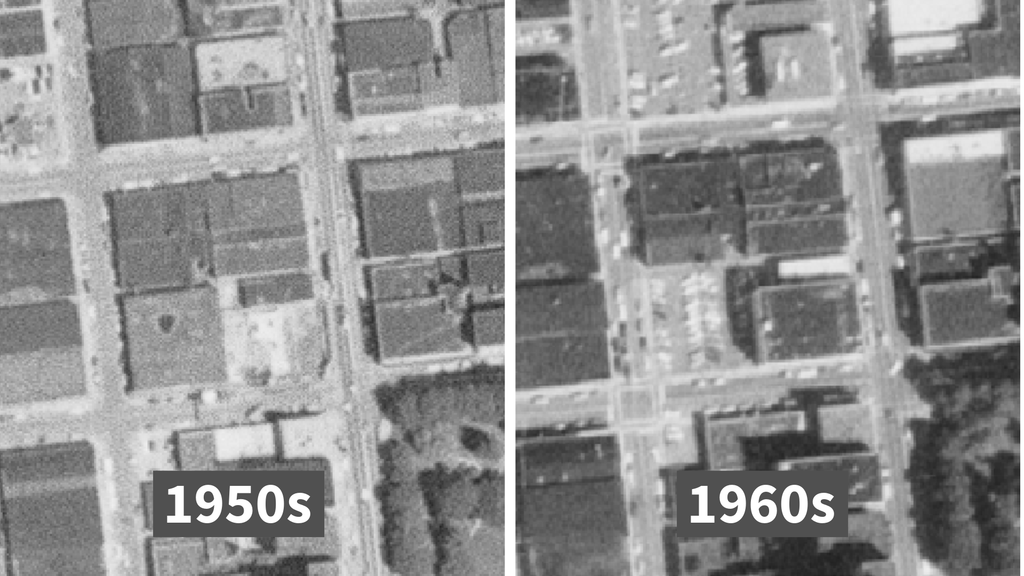
The strangest part of the whole story is what happened to J.C. Penney itself. Eventually, the store left downtown entirely and moved out to the Capital Mall, and the building it left behind, the one built specifically to be three times the size of the old store, with its climate control and its shadowless lighting, became a state office. Now, it is probably the plainest corner left in the entire downtown. And according to the historic nomination form for that old J.C. Penney building, it was that exact plainness, sitting there through the 1990s, that pushed the city to write the downtown design standards it still uses today.
Plain design in a refurbished J.C. Penney turned office building is offensive and we need to do something to make sure it doesn’t happen. But parking lots, aesthetically speaking, are the most plain and least human spaces we build. In honor of the cars and retail efficiency, we move beyond human-centered commercial designs, to build large, single-operator stores next to acre-sized parking lots. The current Stormas’ operations, even though they follow this model, are not the worst current-day offenders compared to Costco, Target and Walmart.
Thirty years after Ralph’s Food Center took over the old Grand Central Public Market, the first Farmer’s Market opened. Two years after that, the Food Coop opened their doors in a small location just a few blocks down from where the Public Market once was. Neither of these operations will ever be the center of Olympia’s food system, but they offer a return to the human-scale, community-focused operation of the public markets.