History, politics, people of Oly WA

Category: Thurston County history

Captured Current

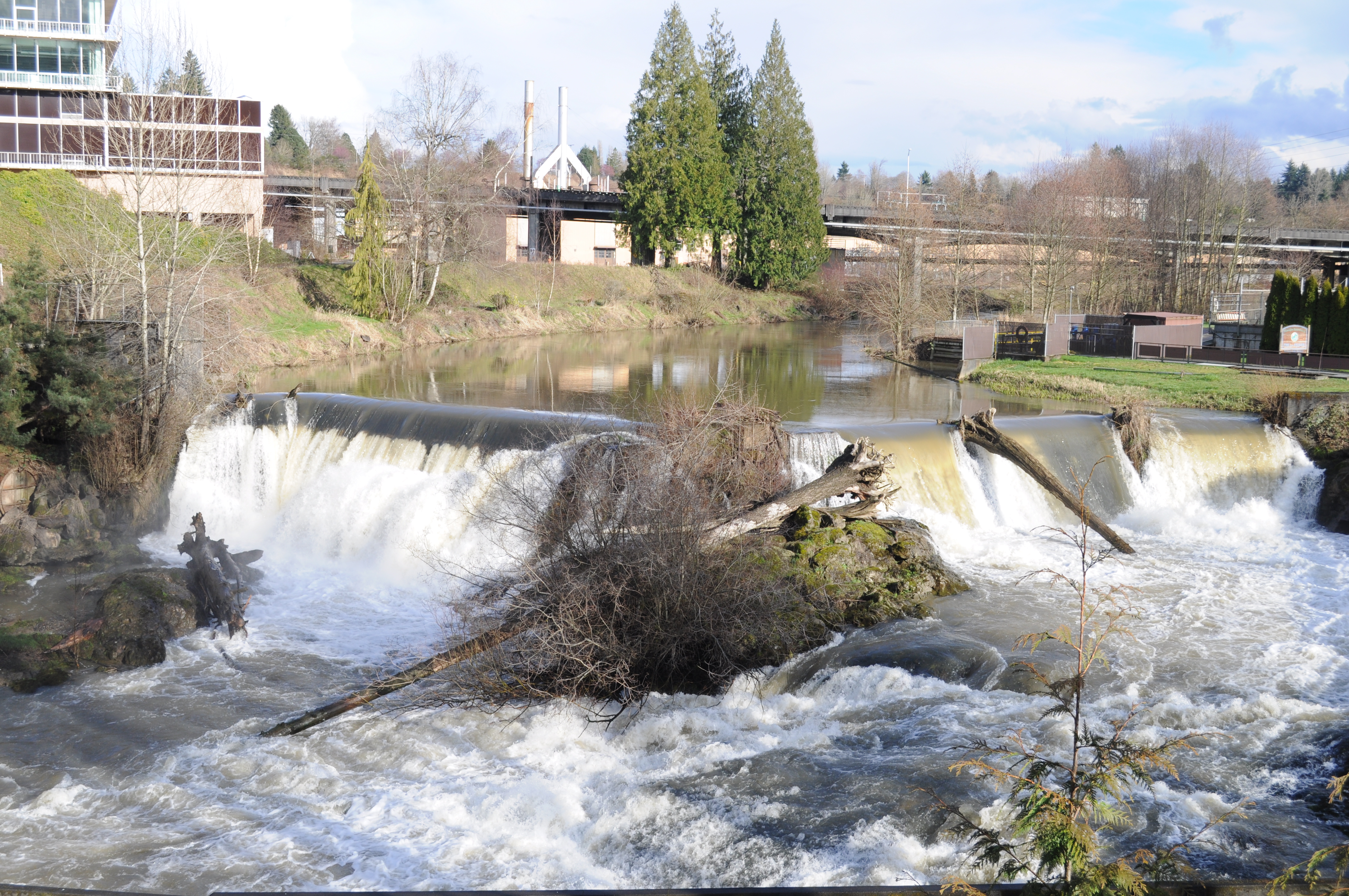
When you walk into Tumwater Falls Park, the Olympia Tumwater Foundation office is on your left and the WDFW hatchery facility on your right, directly ahead of you is the uppermost falls in the park. Google Maps marks it as a waterfall. Of course it does. Any water falling over a ledge looks like a waterfall, and this one photographs like one too.

It isn’t one. What you’re looking at is a dam.

The dam creates the waterfall, so in a narrow sense you’re not wrong to see falling water and call it that. But the structure underneath the water is not a natural feature. It was built, on purpose, by a company that needed it, and it’s worth remembering that before you remember anything else about this park.
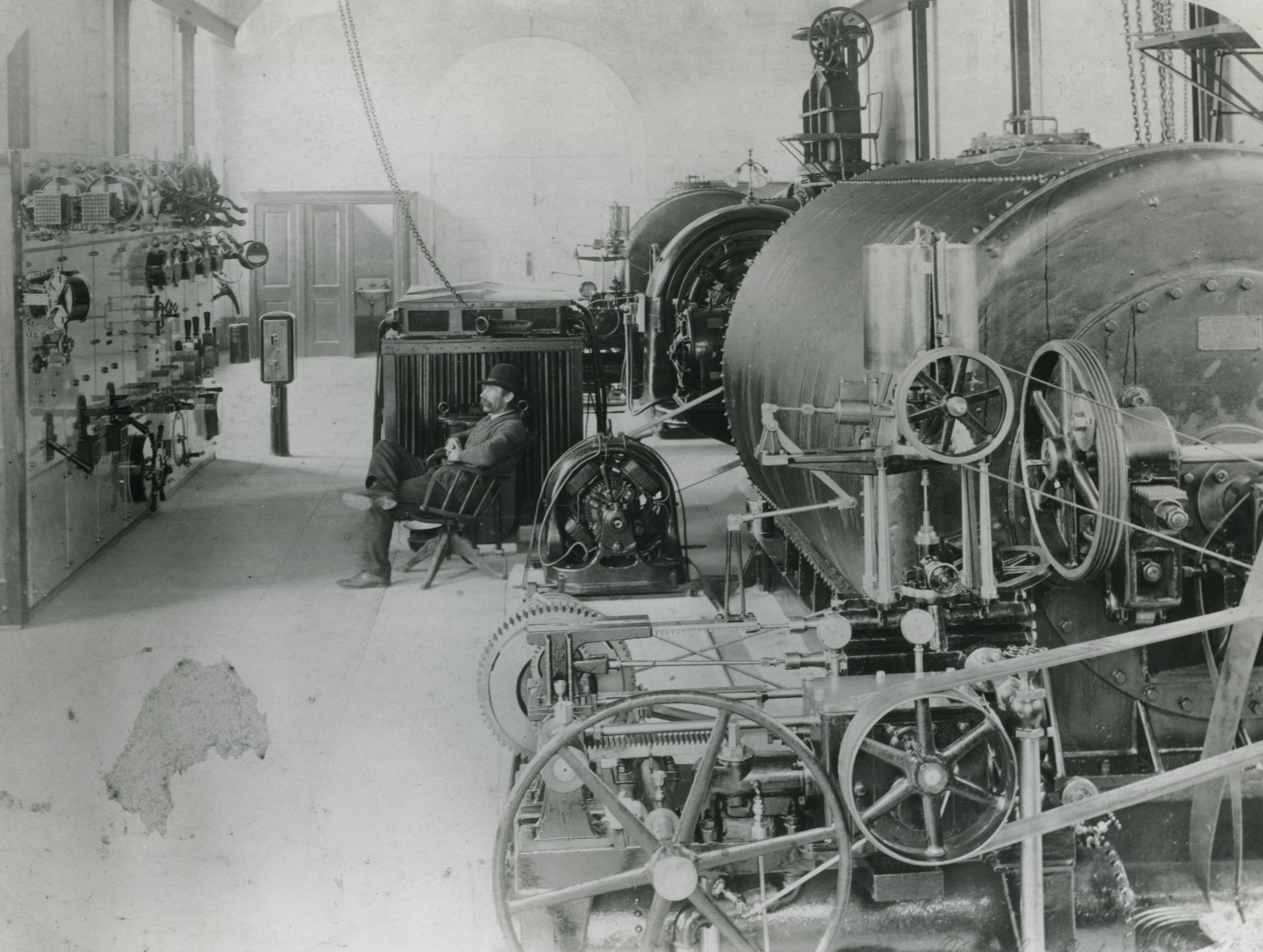
The dam went up starting in July 1900, when the Olympia Light & Power Company began work on the upper falls under engineer A.J. Gillis. The goal, in the language of the time, was to “harness the falls” for a bigger hydroelectric operation, replacing an older industrial setup on the middle falls that had produced something like 400 horsepower. The new dam and its flume cost around $13,000, real money in 1900, and by October the company had built stone walls and a flume ten feet square, a wooden pipe carrying three tons of water per foot across 700 feet to the powerhouse. That first structure raised the water level four to six feet above the natural bedrock, enough to back up a slack water pool for roughly a mile upstream. In 1903 the west wing got reinforced in concrete and masonry, built specifically to survive the river’s flood stages.

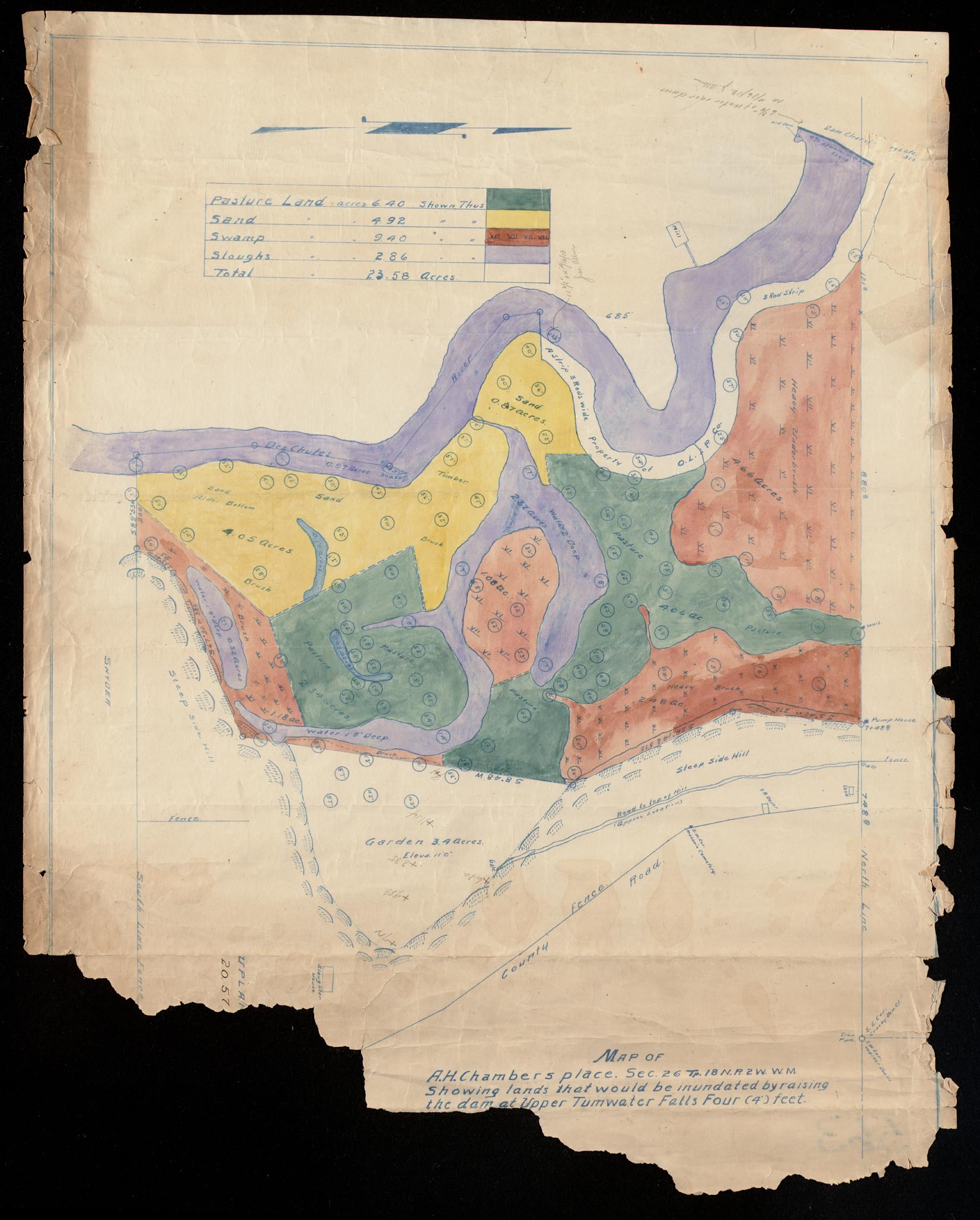
When the dam reached its full and current height, it inundated flat land that is now part of the Brewery Complex, but was then called the “Chambers Place.”
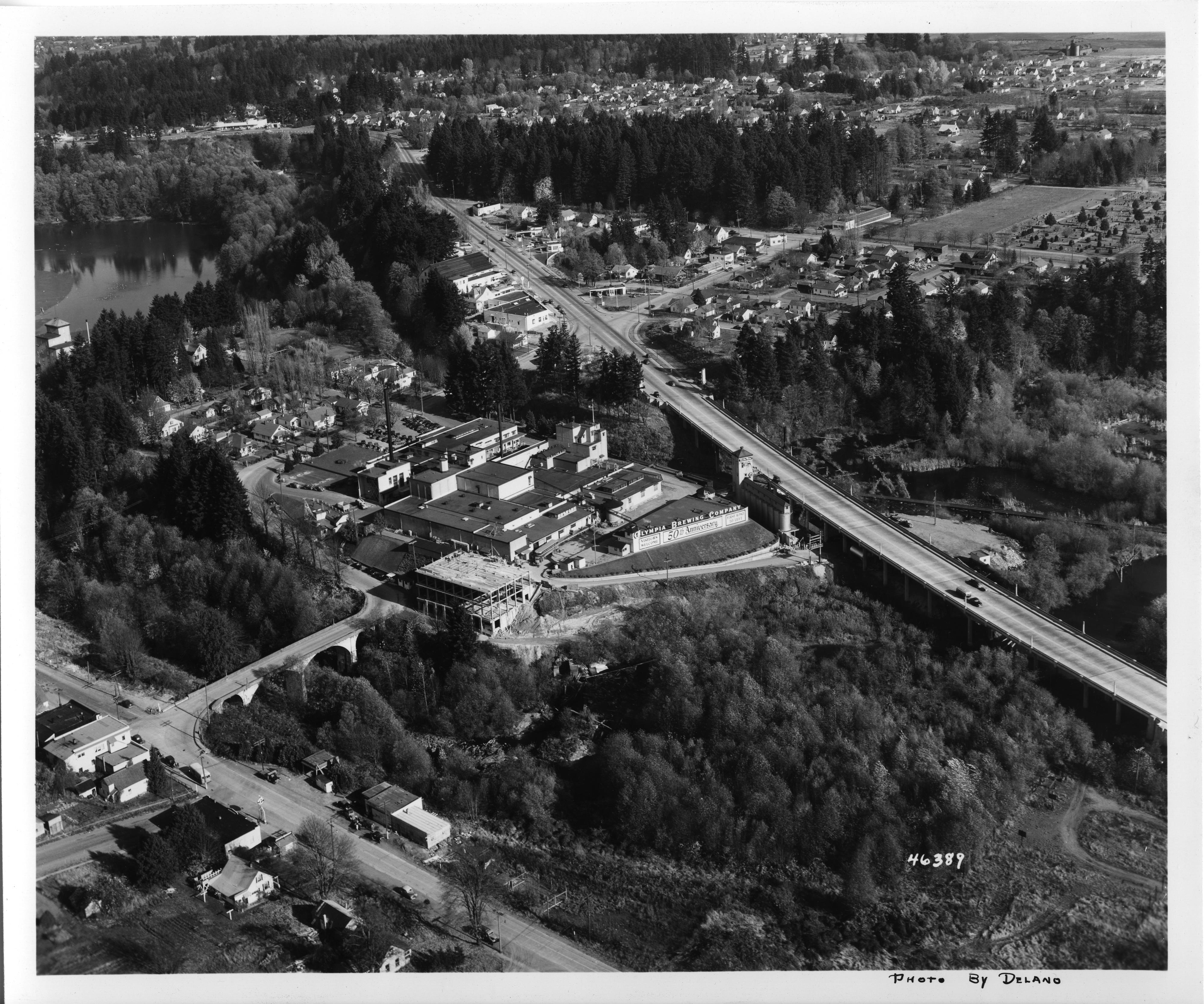
Then in 1905 things got contentious. The Olympia Brewing Company and the power company both had founding claims to the Deschutes, and a legal fight broke out over who actually controlled its flow. The brewery needed water too, and the power company was starting to realize that its dry-summer turbine problem wasn’t going away on its own.

That fight is old news, but you can still feel its outcome every time you step into the river in July.

Here’s how far the dam’s reach actually extends today. The pool it creates sits at roughly 85 feet above sea level, and the dam itself only accounts for four to six feet of that artificial rise over the natural bedrock lip.

My back-of-the-napkin math says the reason its effect travels so far upstream has nothing to do with the dam’s height and everything to do with the valley above it. Between the dam and Pioneer Park, the river drops only three to four feet per mile, remarkably flat for a stream that’s about to plunge 82 feet through a gorge. A gentle gradient means a small impoundment backs up a long way, and the standard backwater math for this stretch puts the slack water influence at roughly 0.8 to 1.2 miles upstream of the dam.

Walk that distance and you pass through three distinct stretches. From the dam to about 0.3 miles up, past the old brewery complex and under the E Street and I-5 bridges, the current in summer is close to nonexistent, more pond than river, narrow and deep and still. From 0.3 to 0.8 miles, along the lower edge of the golf course, it’s still noticeably slower than a free-flowing river, the kind of water where you drift instead of ride. Past that, from 0.8 to 1.2 miles, the backwater curve finally tapers off, the water gets shallow again, gravel bars reappear, and you start to feel actual current, riffles instead of glass.

This matters most in summer, which is exactly when people are in the water. The Deschutes’ natural flow drops during peak tubing season, low enough that the dam’s slack water effect dominates the entire lower mile of the run. Instead of a current carrying you toward the takeout, you get what amounts to a long bathtub, and tubers spend the last 4,000 feet or so paddling and pushing themselves along by hand. The dam that most people don’t know is there is the reason the last leg of their float feels like work.

The 1905 fight over water didn’t stay a courtroom skirmish. The power company’s problem was simple: the river ran low every summer, right when demand for electricity was climbing, and its solution was to treat Lake Lawrence, up in the watershed, as a kind of savings account. The plan called for a canal a mile and a quarter long, dug to divert winter floodwater into the lake, dammed at its outlet to hold that water back, then metered out over the summer to keep the Tumwater powerhouse running. It required flooding land the company didn’t own and diverting water the brewery believed it had rights to, so the fight dragged through the courts for years, what one account called a monkey wrench in the gears of the whole project. To get the land, the power company pursued eminent domain, arguing in court that because it supplied both electricity and streetcar service to the growing city of Olympia, it had the legal standing to condemn private and public land in the public interest. The argument worked. Lake Lawrence fell under company control, a 25-foot concrete dam rose at its outlet, and the diversion canal got finished. The following summer, with its water supply secured, the company rebuilt the Tumwater Falls dam itself, adding four feet of height and flooding another 30 acres of condemned land along the way. By 1914 the company had what it wanted: a stable, year-round power supply for a city growing at twice its historical rate.

It didn’t get to enjoy that win for long. In 1919, Puget Sound Power & Light bought Olympia Light & Power outright, and as regional transmission grids spread across the Pacific Northwest, a small local operation like the one at Tumwater Falls stopped making much sense. Generation was phased out gradually over the following years. The physical evidence held on longer than the business did. It wasn’t until 1962 that crews finally dismantled the stone powerhouse and the penstock below the falls, clearing the lower river corridor for what came next: the Olympia Tumwater Foundation’s Brewery Park at Tumwater Falls, opened in 1962 on the site of the old plant.

The power company’s old foe for control of the river, the Olympia Brewing Company, ended up owning the old dam site a few decades after the Puget Power sale.

Notice what got removed in that demolition and what didn’t. The powerhouse and the penstock, the parts of the complex that unmistakably read as industrial machinery, came down. The dam, the part that produces a waterfall people like to photograph, stayed exactly where it was. Whether or not that was the intent, the 1962 clearing erased the site’s industrial past and preserved its scenic present in one move.

And here’s a theory worth taking seriously: that clearing is probably what started the Deschutes’ recreational floating culture in the first place. The newspaper record doesn’t show organized river floating before the park existed. It shows up within less than a decade of Brewery Park opening, when a group called the Rough Riders started promoting floats down the Deschutes in the early 1970s. That timing reads like cause and effect more than coincidence. People don’t float for fun through a demolished industrial corridor with no public access and no destination. They float through a park with parking, a takeout, and a name.

The Rough Riders called floating “quite relaxing,” while warning newcomers about log jams and waterfalls, a warning that carried real weight given the still-recent memory of five people drowning after being swept over an unmarked falls sometime in the 1960s. They noted that a float from the East Olympia railroad bridge down to the brewery could take about eight hours during high spring flows. In June 1972, police searched for a group of missing juveniles and found them safe, floating on a raft near the brewery. By 1978 the activity had become fully organized, with the Deschutes River Float & Picnic drawing crowds for a run from the Henderson Boulevard bridge down to Tumwater Falls Park. The early 1980s brought a surge in inner tubing specifically, and with it came friction. A 1983 article described complaints from riverfront residents about trespassing and safety, and tubers who ran into trouble often ended up “bedraggled” on someone’s back lawn, looking for help. Thurston County considered putting up warning signs at the popular entry points.

In 1988, the city of Tumwater bought a stretch of pasture along Henderson Boulevard and built Pioneer Park. On paper it’s a sports and nature park, all ballfields and trails. In practice it became the unofficial starting line for the float, several miles downstream of the old East Olympia entry point, with enough parking to make the whole thing genuinely accessible for the first time. What it didn’t do was settle the question the dam raises a mile downstream. Pioneer Park sits at the edge of the slack water zone, near it or inside it depending on the flow that year and depending on exactly where within the park you put in. The 1988 purchase moved the uncertainty upstream rather than resolving it, handing the question to individual people choosing a launch spot, most of whom have no idea the choice even matters.

The dam itself is now well past a century old, built in phases between 1900 and 1913, a concrete gravity structure that at this age almost certainly carries no steel reinforcement inside it. Washington State classifies it as a Category 3, low hazard dam, meaning that if it failed, nobody’s life would be at risk and the resulting damage would be minor. That classification is its own quiet form of forgetting, a bureaucratic note that says this structure doesn’t need anyone’s attention. Structurally, though, it’s in better shape than its age suggests. Because it’s keyed directly into bedrock, it’s largely immune to the foundation scour that kills most aging dams during overtopping. Predating rebar reinforcement by decades, it’s also immune to the internal rusting and spalling that eventually destroys modern concrete. And our mild, wet climate spares it the freeze-thaw cycling that cracks concrete apart in harsher places.

It isn’t invulnerable. Vegetation works its way into old construction joints and slowly wedges them wider. Water percolating through the structure leaches calcium hydroxide out of the cement over time, weakening it. A century of silt has built up behind the dam, adding a steady load against the upstream face. None of that adds up to sudden failure. Left alone, this dam is likely good for another 100 to 200 years, wearing away slowly at its joints and spillways rather than going all at once.

I emailed the Olympia Tumwater Foundation to ask about the dam’s structural condition. That’s the organization that turned the demolished powerhouse site into a park in the first place, the one that, whether they meant to or not, decided sixty years ago which parts of this history would stay visible and which would get hauled away. They’re looking into what they might have and get back to me later. I’ll update this post if they have anything.

So the next time you’re standing in Falls Park facing that uppermost falls, know what you’re actually looking at.

It’s a dam built in 1900 to solve a hydroelectric company’s dry summer problem, expanded in 1913 after a legal war over a lake most people have never heard of, stripped of its machinery in 1962, and left standing, quietly, as the scenic backdrop for a park built on top of its own demolition.

The float culture that treats this river as a summer playground likely exists because that park got built, not despite the dam’s industrial history but because a foundation cleared away the parts of that history that looked too much like a factory. And the ambiguity never really left. Somebody launching a tube from Pioneer Park on an ordinary August afternoon has no way of knowing, without doing the math we just did, whether they’re floating on a free river or drifting through a captured pool behind a hundred-and-twenty-year-old dam. Most of them will never think to ask. The current under them, either way, carries the settled residue of a legal fight, a corporate merger, a demolition crew, and a social structure built on a slack pool and two parks.

Maytown and the Long Tide

Maytown was flooded before it had a name. Around 16,500 years ago an ice dam gave way, releasing a wall of meltwater that tore south across what would become southern Thurston County. This was the Tanwax Flood, one of the last violent acts of the Vashon Stade, and it did more than carve the ground. It wrote a script that everything afterward would follow.

The flood arrived at the tail end of the Fraser Glaciation, after the Puget Lobe had pushed as far south as Tenino and buried the site under some 200 meters of ice. When the ice began retreating and the climate warmed, the meltwater had nowhere easy to go, with the northern outlets still choked with ice. So the water was forced south instead, funneling through what is now the Chehalis River valley like water through a pinched hose. When the Tanwax dam broke, that pressure let go all at once. The surge swept across Rocky and Maytown prairies, dropping massive loads of sand, gravel, and boulders as it lost energy and spread out across the flats.

That single event set up the next 16,000 years. The flood left behind a rare glacial outwash prairie, flat and porous, resting on an estimated 20.6 million cubic yards of high-quality gravel. It carved broad paleochannels through the landscape too, the same low, open paths that railroads would later follow when they crisscrossed the county. The land was flat, well-drained, and full of raw material. That combination made it a target long before anyone thought to develop it. The flood didn’t just shape Maytown’s geology. It built the site’s entire future resume: a place suited for transit, for extraction, for anything that needed wide open space and didn’t mind a little distance from town.

For millennia, that resume sat as grass and gravel under an open sky. Then, in the 1940s, the tide came back in, this time manmade.

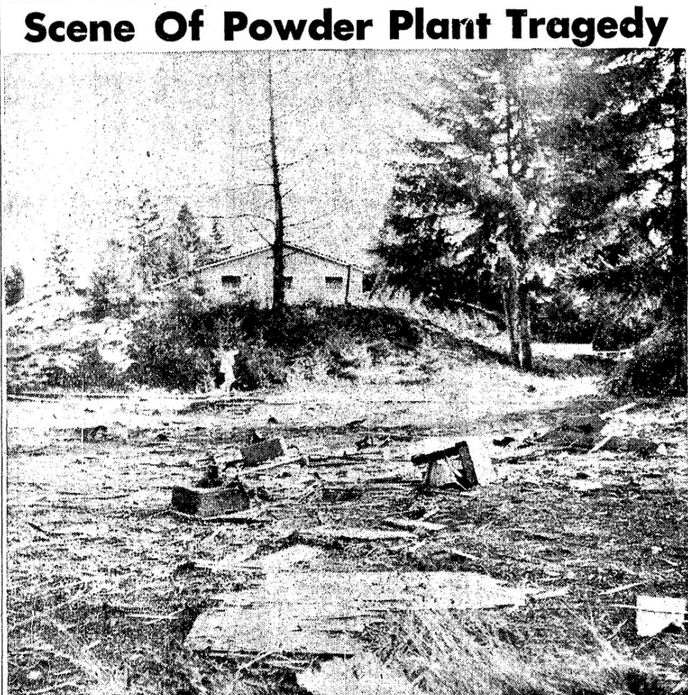
The Pacific Powder Co. began acquiring and leasing land at Maytown in the 1940s to manufacture dynamite, drawn by the same flatness and isolation that had once channeled glacial meltwater. By 1964 the operation had grown enough that the Hercules Powder Co. bought the property outright, expanding it to roughly 1,625 acres. For the next several decades, the plant was one of the region’s main suppliers of explosives for the roads, tunnels, and dams going up across the Pacific Northwest. Workers handled nitroglycerin, gun cotton, and ammonium nitrate with sparkless tools, dressed in specialized clothing, working to the sound of music piped in to mask the tension of the place.

That tension broke loose more than once. An explosion leveled a gun cotton storage house in January 1954, killing a workman named Amos George Owens. Three years later, in January 1957, a blast at the nitro facility killed 31-year-old Earl Thomas Riggs. The danger wasn’t contained to the plant grounds either. One of the company’s trucks exploded in Roseburg, Oregon, in 1959, killing 13 people and leading to an indictment of Pacific Powder Co. for involuntary manslaughter. Even after Hercules took over, the risk didn’t disappear. A 1967 explosion in a spent acid line did enough damage to shut the whole plant down for repairs.

By the time the operation wound down, the plant had left more than memories behind. Decades of manufacturing had worked lead, asbestos, petroleum products, and the carcinogen dinitrotoluene into the soil and groundwater, a kind of silt that stayed long after the industrial tide had gone out. Citifor removed more than 9,000 tons of contaminated soil in 2006 alone, and the Port of Tacoma later excavated 20 million tons more. Even with all that work, the Department of Ecology still ranked the property a high-risk hazardous waste site in the early 2000s. The powder works was gone. Its residue had settled in for good.

Before the water fully receded from the industrial era, one more wave broke over Maytown, and this one had nothing to do with commerce.

In late August 1969, the Sky River Rock Festival and Lighter Than Air Fair took over the Rainier Hereford Ranch next door to the powder works,  close enough to share its dust. Nearly 30,000 people showed up for a lineup that included Steve Miller and Country Joe and the Fish, modeled loosely on the original Sky River festival and on Woodstock. It was a rogue wave, sudden and enormous, cresting over a cattle ranch for a few days before pulling back out just as fast.

The surge met resistance almost immediately. Local residents organized as the Stop the Rock Festival Committee, led by a member of the John Birch Society. Their objections went well past noise. They worried openly about the organizers’ sympathies with the Black Panthers and what they called the glorification of communist movements. Legal challenges even argued that the music itself would cause nearby cattle to lose flesh from the stress. Once the festival was underway, open nudity and drug use gave the opposition more to point at, and the Catholic Archdiocese ran newspaper ads with photos of topless attendees, hoping to shock the public into demanding prosecutions.

The backlash outlasted the festival by years. The Thurston County Commission responded with strict new ordinances that effectively banned festival camping, building a legal dike meant to keep that particular kind of flood from ever rising again. It worked. Nothing like Sky River has happened at Maytown since.

The Thurston County Commission wasn’t done caring about what happened on that stretch of glacial outwash prairie. 

What followed instead was a slower, more bureaucratic kind of tide, rising and falling in ambition rather than water.

In 2006, the Port of Tacoma bought 745 acres of the old munitions site for $21.25 million, aiming to build the South Sound Logistics Center, a rail-served depot that would let cargo skip past I-5 gridlock. This was a sort of realization of the vision of the nearby Maytown townsite, founded as a community on the confluence of railroads.

Because a port can’t operate inside another port’s territory without permission, Tacoma entered an interlocal agreement with the Port of Olympia to develop it jointly. That agreement collapsed in 2008, after pressure from local residents and the group Friends of Rocky Prairie pushed Olympia to withdraw.

The Port tried again in 2010, agreeing to sell the land to Maytown Sand and Gravel. Thurston County officials were accused of deliberately stalling the permits needed to close that sale. The resulting lawsuit worked its way to the Washington State Supreme Court by 2018. The court found that the county had violated the company’s due process rights, and the evidence suggested commissioners had pressured staff to manufacture an emergency just to slow the project down. A jury had already awarded $12 million in damages, split between the Port and the gravel company.

Even with that ruling in hand, the current kept shifting. NorthPoint Development offered $24.8 million in 2018 for a 2.9-million-square-foot logistics complex, only to see the deal collapse in 2021 when Thurston County denied the zoning change it needed. Each attempt followed the same pattern: ambition rising, hitting the wall of local opposition or legal obstruction, then receding again, leaving the land untouched but the fight a little more scarred.

The most recent agreement, a purchase deal with Miles Sand & Gravel signed in 2026 for $17.25 million, marks the lowest water mark yet. There’s no warehouse complex in this version, no attempt to reroute regional cargo through the prairie. The plan now is simpler and, in a way, more honest about what the land has always been for: extract the 20.6 million cubic yards of gravel the Tanwax Flood left behind 16,500 years ago. Before settling on Miles, the Port gave the Washington Department of Fish and Wildlife first chance to buy the property and fold it into the adjacent wildlife area. The two sides couldn’t agree on a price. Friends of Rocky Prairie is left hoping the new owners honor the reclamation plans already on the books, which call for eventually turning the mined land into ponds and wildlife habitat.

Maytown isn’t a ghost town in the usual sense. It never had enough of a boom to leave behind the kind of emptiness that label implies. What it has instead is a long record of being processed, first by ice, then by dynamite, then by rock music and public outrage, then by lawsuits and zoning boards. Each wave has left its own layer of sediment on top of the last: some of it gravel, some of it legal precedent, some of it toxic residue still being dug out of the ground.

The current plan is to mine the very material the original flood put there, then hand the emptied land back to the prairie it once buried. Whether that actually happens is still an open question. Given the site’s history, the safest bet is that it’s less an ending than another recession, and that somewhere downstream, another wave of ambition is already gathering.

Annexing the Future

For the first time in over fifty years, more people in Thurston County live inside a city than outside one. It could be an urbanist success story, zoning reform finally winning out, transit investment tipping the scale toward density. It isn’t. The real story’s older, weirder, and a lot less democratic. Once you see how it happened, I think it’s still worth calling out the right outcome.

This is the post I’m writing about the 2026 release of population estimates by OFM. Every year, the agency releases estimates as a guide for state spending. These estimates also give a picture of the changing shape of our communities.

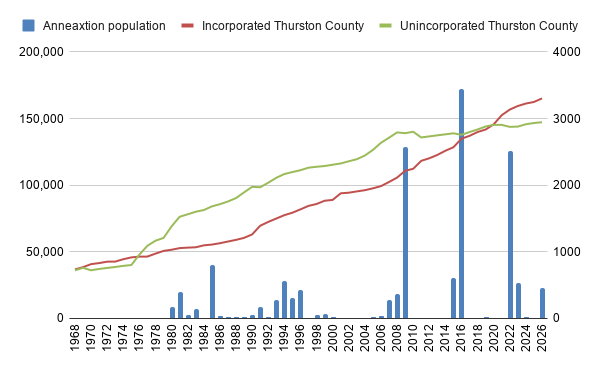
You can see the lines cross in the 1970s and in 2020. The blue bars are the population captured by annexation, and is on the right hand axis, not the left.

This year’s data shows that between 1976 and 2020, unincorporated Thurston County outnumbered the incorporated cities every single year, a run that held for four and a half decades before it broke in the space of six. The trend started in 1976 because the late 70s saw two record years (in both percentage and raw numbers) of massive in-migration, most of which apparently ended up outside the cities.

But, that trend has finally started to shift But, if this were really about people choosing city life, you’d expect a gradual climb, year over year. Folks being priced out of car dependence drifting toward Olympia, Lacey, and Tumwater one household at a time. That’s not what the numbers show. Instead you get a flat unincorporated population since 2008, a 5,000-person drop in one bizarre year, and then a string of specific years where the incorporated population jumps by two or three thousand people all at once. 2009. 2016. 2022.

Those aren’t migrations, they’re annexations.

Before 2009, annexation in Thurston County was small and constant. Cities picked up a parcel here and a parcel there, mostly empty land, occasionally a few dozen or a few hundred people riding along with it. Lacey, Olympia, Tumwater, and Yelm all added pieces most years, rarely anything anyone would call a headline. Lacey’s 1985 annexation brought in nearly 800 residents. Olympia added just over 180 in 1995. These were rounding errors against the county’s total population, just the ordinary housekeeping of city boundaries.

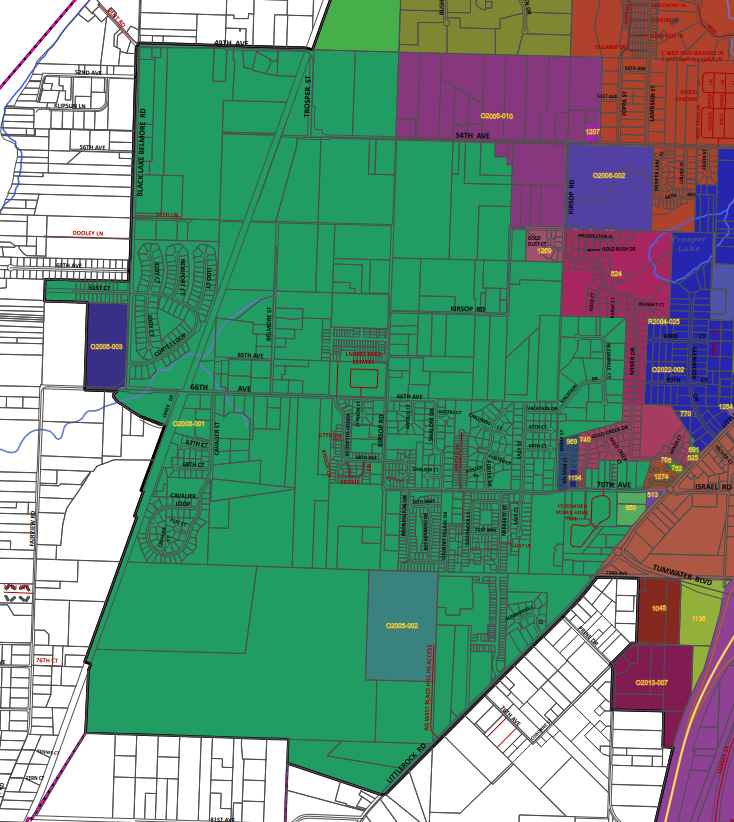
Then the housekeeping stopped and the big grabs started. Tumwater’s annexation, effective February 2008, brought in 2,553 residents in one motion. We’re going to focus on this particular annexation. In my memory, it felt like an existential change for Tumwater, we expected at the time a massive shift in population, that may have happened slower than we expected, given the housing crash a few years later.

Olympia added 562 people in June 2014, a smaller jump but still a departure for a city that usually moved in small numbers. Tumwater came back in January 2016 with the largest single annexation of the last fifteen years, 3,255 residents absorbed in one stroke. Lacey had its turn in 2021, running two separate annexations between May and September that added 1,535 and 978 residents, over 2,500 combined in a single year. Tumwater kept at it into 2022, a dozen smaller annexations in May plus a 332-resident addition in June, while Lacey added close to 100 more that spring. Lacey’s doing it again, with a March 2025 annexation projected to add 455 residents.

Cities were working through a handful of legal tools, deciding case by case and year by year when to catch up with development that had already happened around them. You see a pattern that has nothing to do with a slow cultural shift toward city living.

The old way: leverage, not consent

For most of Thurston County’s modern annexation history, the tool of choice was the Sixty Percent Petition Method. It let property owners representing 60 percent of a target area’s assessed value petition their way into a city on their own. Notice what’s doing the work in that sentence. Not 60 percent of residents. Sixty percent of assessed value. A handful of large landowners, sometimes just one or two big parcels, could decide the governmental future of everyone else living on that land, tenants included.

Where the petition method wasn’t quite enough on its own, cities reached for something even quieter: the “no-protest” utility agreement. Sign one of these to get city water or sewer, and you’d also signed away your right to fight annexation whenever the city decided to come collect.

This is coercive by design, and the state’s own Supreme Court flinched at it once. In 2002, Grant County Fire Protection District No. 5 v. City of Moses Lake found that bypassing a general vote of residents violated the state constitution. For a minute, it looked like the petition method might be finished. The court walked the ruling back not long after, and cities kept using the tool. Tumwater’s biggest annexation wave, the one that added 3,255 residents in a single stroke in 2016, happened well within this post-2002, still-contested legal window.

The fight nobody outside city hall saw

The clearest look at how contested this actually was comes from Tumwater’s 2007 annexation, 1,620 acres that went before the Thurston County Boundary Review Board on a narrow 3-2 vote. The board was one vote from saying no. What flipped it was a last-minute fire service agreement between Tumwater and the Black Lake Fire District, which stood to lose a third of its operating budget once the annexed area stopped paying into it. One dissenting board member called the deal a “shotgun marriage.” He wasn’t wrong. There are real political realities in swapping land between cities and the county, between special districts and city agencies. But, the decline of a rural special district and agreements based on you getting city water are not bad things.

Why the leverage was still the right call

Here’s where I land, and I think it’s a harder position than just cheering for density. The land inside that 1,620-acre annexation wasn’t all farmland waiting to be paved. It was already suburban, already built at a density and a distance from city boundaries  that made a rural fire district and a county road department a worse fit for it than a city government with sewer lines already running past the property. The petition method and the utility agreements were ugly tools, built to let city and landowners jump the line without asking anyone’s permission. But the outcome they produced, in this case, matched governance to a landscape that had already been built. That’s not nothing. A fire district’s claim to keep serving an area doesn’t automatically outrank the question of who can actually do the job better once that area looks and functions like a city. If a city can run water, sewer, fire protection, and roads to a piece of land more efficiently than the county patchwork that grew up around it by accident, the district losing its slice of that territory isn’t an injustice. It’s a service boundary catching up to reality a few decades late.

That’s a different claim than “annexation is democratic,” which it mostly wasn’t. It’s a claim that the state spent thirty years building an escape hatch, that city services should follow city-level density, and that the escape hatch got used, however roughly, to reach that outcome.

The state noticed too

The more interesting shift, and the one I think will matter more going forward, is that leverage isn’t the only tool anymore. After 2002, the state built the Alternative Petition Method, which requires signatures from a majority of both property owners and registered voters, a real check the old method never had. Then came the Interlocal Agreement pathways, letting cities negotiate directly with counties over revenue sharing and infrastructure before annexing anything. In 2023 the legislature revived a sales tax credit specifically to pay cities for absorbing unincorporated growth areas over 2,000 people. 

Boundary Review Boards are disappearing too. Spokane disbanded its board in 2012. Lewis County did the same as recently as 2026. The fights those boards used to referee are increasingly handled through negotiation instead of a contested vote.

Right around the time the old, coercive tools had already finished most of the job, the state built better ones.

What I can’t prove yet

I’d like to end this by telling you that all of this points toward a walkable, mixed-use future for Thurston County’s cities, third places and multimodal streets slowly replacing the cul-de-sacs that got annexed. 

I can’t actually back that up. 

Annexation moves a jurisdictional line, nothing else. It doesn’t retrofit a sidewalk or rezone a strip mall. Everything in this record shows governance catching up to sprawl, not sprawl getting undone. The most honest thing I can say is that Thurston County’s cities now have the tools, and increasingly the financial incentive, to govern the suburban land they’ve absorbed. What they choose to do with that authority, whether it produces the kind of denser, more human-scaled development that we  want, is still an open question. That part is hope, not history.

Move fast, break things: The life and times of Washington’s first black, female prosecutor

In the history of Washington state politics, some figures are remembered for their scandals, and others are remembered for their longevity. Then there is Bernardean Broadous.

In 1994, Broadous did not just win an election. She shattered a glass ceiling that had remained untouched since Washington State was founded. She was the first Black woman elected to a county office in the history of Washington, and the first African American to hold an executive county position in Thurston County.

Today, her tenure is largely a footnote. It is often treated as a failed experiment in management. Meanwhile, the man who replaced her, Edward Holm, oversaw an office that cost taxpayers millions of dollars because of his documented behavior. Looking closely at the years between 1994 and 2002 in Thurston County reveals a stark hypocrisy. We see a woman of color judged by the noise of change she was trying to force, while her white male successor was given a pass for actual, adjudicated damage to the public.

The 1994 campaign for Thurston County Prosecuting Attorney was a masterclass in grassroots disruption. Broadous was a Republican with only three years of legal experience. She ran against John Bumford, a veteran Democrat who was the hand-picked successor of the retiring 20-year incumbent, Patrick Sutherland.

On paper, Broadous was a long shot. Bumford had fifteen years in the office and the public endorsement of 26 of the 28 deputy prosecutors in the department. The institutional resistance was immediate. Before the first ballot was cast, her future subordinates called her incompetent in the local press. Bumford focused his campaign on experience. Broadous flipped that argument. She did not say she had more years in a courtroom. She said those years were spent perfecting a broken status quo. She accused the office of being too quick to settle cases and claimed that, as a deputy, cases were taken away from her when she refused to reduce charges.

Broadous used a specialized team of volunteers to bridge the funding gap. Bumford outraised her two-to-one, with the vast majority of his funds coming from his own pocket. Her campaign used a fleet of painted vans to counter the expensive bus advertisements of her opponent. They filmed Broadous in living rooms answering questions to show her forthright nature. This was a sophisticated data operation, too. Her team analyzed precinct numbers to find winnable areas in the suburbs. They timed their mailers to hit exactly when ballots arrived. This strategy worked.

Broadous pulled off a stunning upset and won by 867 votes. And, in the broader sweep of history here, it was the last stand for Republican institutional power in Thurston County before it became a Democratic stronghold. 1994 was the last high-water mark for Republicans in Washington State and Thurston County, before falling reliably into today’s pattern.

Broadous entered office in 1995 with a mandate for change. She inherited an office that had functioned under one man for two decades. She brought a focus on accountability and efficiency. Her most significant achievement was the Juvenile Diversion Reform. Before Broadous, the juvenile system was slow and lacked direction. She started a program that required offenders to face sanctions or charges within 12 days of an arrest. She used Community Accountability Boards made of local volunteers to determine punishments. This program resulted in a 50 percent reduction in felony recidivism. Broadous was also a founding architect of the Thurston County Drug Court. She pushed for a system that offered non-violent offenders treatment and testing as an alternative to jail. She believed the message of the law was lost if punishment was not swift and sure.

Just looking at the raw numbers, prosecutions in Thurston County went from around 1,000 each year before Broadous to nearly double that during her tenure.

However, we cannot ignore that these reforms created internal conflict. Broadous was a demanding manager. She restricted plea bargains to prevent deal shopping. This stripped deputy prosecutors of their autonomy. To Broadous, this was accountability. To her staff, it was a lack of trust.

In her first 19 months, 18 deputy prosecutors left the office. This high turnover became the main criticism against her. Critics claimed the remaining staff were overworked. Defense attorneys complained that her refusal to negotiate was clogging the court system. Broadous did not back down.

By 1998, Ed Holm saw the turnover in the office as a political weapon. He campaigned on a platform of restoring stability. The narrative against Broadous was cemented by two legal actions filed just weeks before the primary election. In July 1998, a former employee named Betty Benefiel filed a lawsuit alleging Broadous treated her unfairly. In August 1998, a secretary named Sheila Kirby filed a claim for emotional distress. Broadous called these attacks politically motivated. The timing was certainly suspicious, but the damage was done. Holm used the lawsuits to argue that Broadous could not lead. Broadous lost the election and received less than 40 percent of the vote.

Holm was hailed as a stabilizer.

But the stability he promised was a myth. By 2001, three female deputy prosecutors sued Holm and his management team for sexual discrimination and a hostile work environment.

The details revealed in the Holm trial were far worse than anything alleged against Broadous. The plaintiffs alleged that women were given lower pay and less desirable assignments. They described the office as a boys’ club. The lawsuit detailed inappropriate sexual comments and lewd jokes. The jury eventually found that Holm and his office retaliated against the women after they complained about the discrimination. In 2006, a jury ruled in favor of the women. They found that the county had discriminated against them based on their gender. They also found that the office had created a hostile work environment.

The most telling part of this story is the final cost to the public. The lawsuits against Broadous that dominated the news in 1998 went nowhere. They stayed in the court system for four years. In 2002, after Broadous was out of office and Holm himself decided not to run again, the parties signed an agreement to drop the cases. No money was paid to the plaintiffs. No wrongdoing was ever proven. The cost to the taxpayers for these lawsuits was zero dollars. These claims were dismissed with prejudice, meaning they could never be brought again.

Compare that to the Ed Holm settlement. The jury awarded the three women $1.52 million for the discrimination and retaliation they endured. The judge then added $1.45 million in attorney fees. By the time the case was fully settled and the appeals were finished in 2011, the total cost reached nearly $6 million. When you weigh the two administrations, the Broadous years were characterized by administrative friction and turnover that cost the public nothing in court. The Holm years were characterized by systemic misconduct that left the county with a multi-million dollar bill.

The historical memory of Thurston County should take another at Bernardean Broadous. She was a historic first who tried to modernize a stagnant system. She was a Black woman who walked into a white male-dominated field and demanded high standards. She was punished for it. We remember her for the turnover and the noise of lawsuits that ended in nothing.

Smith Troy, Trump and Telling the Truth

We’ve all heard President Donald Trump call the press “the enemy of the people.” Over the course of his terms, he repeatedly attacked news organizations as “fake,” “corrupt,” and even suggested some were engaged in illegal activity.

Beyond insults, he openly questioned the constitutional protections that shield journalists, including the landmark New York Times v. Sullivan precedent, and proposed “opening up our libel laws” so politicians could sue and “win lots of money.”

His rhetoric and actions exemplify a long-standing tension in American democracy: the fragile balance between government power and press freedom. Yet this struggle is far from new, and it is not new here at home. Nearly a century ago, in Thurston County, local politics intersected with criminal libel laws in a way that foreshadows today’s conflicts.

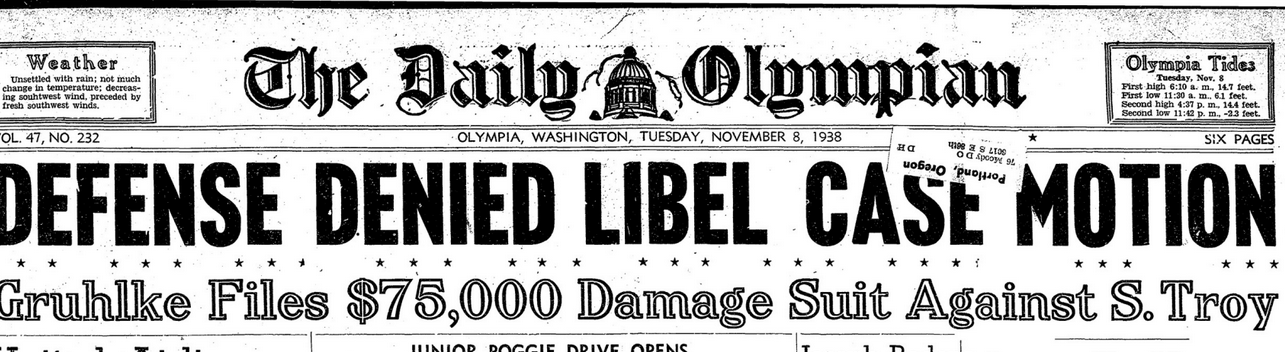
The story begins in November 1938, when Thurston County Prosecuting Attorney Smith Troy filed criminal charges against three men: Ray Gruhlke, Lester Main, and George Johnson. He accused the defendants of distributing handbills that allegedly defamed Troy and his brother Harold, who was an assistant county prosecutor. The charges contended that the statements were malicious and intended to expose the Troys to “hatred, contempt, ridicule, and obloquy,” depriving them of public confidence, consistent with the criminal libel statutes of the time.

Almost immediately, questions arose about the integrity and motives of the public officials involved. The circumstances of the arrests suggested potential overreach, and critics argued that the case may have been politically motivated to protect the interests of Smith Troy while undermining his opponents. Affidavits from law enforcement contained conflicting accounts of the arrests, raising doubts about the accuracy and impartiality of the official record. The court initially denied motions to appoint independent attorneys to investigate the charges, further highlighting the potential for bias. The case only began to take a more credible direction once a Special Deputy Prosecuting Attorney, Harry Ellsworth Foster, was appointed to replace Smith Troy, whose personal involvement as the alleged victim created an obvious conflict of interest.

Over the next several months, the Special Prosecutor’s investigation revealed that the alleged libel stemmed largely from confusion over incomplete court records. The handbills pointed to cases that the Troys were apparently prosecuting improperly, but the cases referenced in the pamphlets had been transferred, and the inconsistencies were clerical rather than malicious.

The defendants admitted their errors, tendered apologies, and Troy accepted them. By May 27, 1939, the court dismissed the case, noting that the controversy had prompted reforms to ensure future records were clearer and less prone to misinterpretation.

The Thurston County case cannot be fully understood without situating it within the broader legal context. Smith Troy would not have been able to pursue charges without statutes defining libel broadly as any malicious publication exposing living or deceased persons to hatred or contempt, or injuring any person in business or occupation. A person could be prosecuted even if the statements were true, unless published with “good motives” and “for justifiable ends.”

By the 1930s, criminal libel prosecutions had become rare, yet the statutes remained on the books through 2009, offering public officials like Troy a tool—however rarely used, to protect reputations through criminal law.

The law’s overreach and constitutional vulnerabilities became clear in 2008, when the Washington Court of Appeals struck down the criminal libel statute as facially unconstitutional. The court held that it violated the First Amendment because it punished false statements without requiring proof of actual malice and, paradoxically, could punish true statements lacking “good motives.” The legislature formally repealed the law in 2009. Modern statutes surrounding protection orders have partially revived criminalized libel in limited circumstances, primarily to address harassment and repeated false statements made with malice.

The Smith Troy case illustrates how criminal libel statutes historically empowered officials to suppress criticism, a temptation not lost on modern politicians. Trump’s attacks on the press echo the same impulse: using legal threats, regulatory power, and public shaming to undermine journalists and chill reporting. Unlike Thurston County in 1938, Trump operates on a national stage, with the ability to influence federal agencies, control access to government events, and challenge the judiciary’s interpretation of defamation law.

Yet the comparison also highlights both the fragility and resilience of press freedom. In Thurston County, the appointment of an unbiased Special Prosecutor and the eventual dismissal showed that legal checks, due process, and transparency can constrain abuses of power. Today, protections like New York Times v. Sullivan perform a similar role, ensuring that even powerful political actors cannot easily weaponize libel law against the press. Without these safeguards, the line between legitimate critique and suppression of dissent blurs, leaving citizens less informed and democracy weaker.

The trajectory from Smith Troy to Trump underscores that the press is both a target and a guardian in any democracy. Laws may criminalize speech, but misuse or selective enforcement erodes trust in both institutions and government itself. Meanwhile, as local news declines and national outlets consolidate, the onus falls more heavily on government to act transparently. A free press alone cannot ensure accountability; officials must make accurate information accessible, clear, and timely, or risk leaving the public in the dark.

History reminds us that power will always test the boundaries of scrutiny. The Thurston County libel case offers a microcosmic lesson: fair process, independent oversight, and transparent government are essential to maintaining the balance between authority and the public’s right to know. Today, as political leaders attack media and propose changes to defamation law, the stakes have moved from local to national. The core principle remains unchanged: the press must remain free to speak, investigate, and hold power accountable, and government must meet its own obligation to be transparent in a media environment that can no longer do it alone.

Some good did come from the Tyson Seafood plant purchase

We’re all arguing about the real fault for the purchase and white-elephanting of the Tyson Seafood plant, but there’s something worth pointing out. While the plant itself still sits empty, there was some good done on another piece of the property.

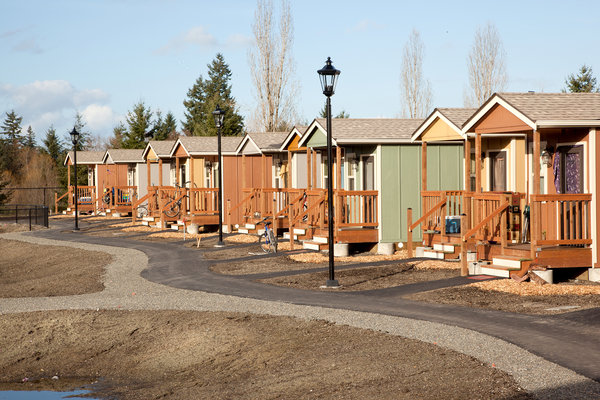
Quixote Village, an award winning and self governing homeless village, has called the site home for just over two years now. The history of Quixote Village is pretty interesting, growing out of a protest downtown and then riding the wave of local politics on homeless encampments and churches for a few years before settling down.

You can read a lot more about the Village and its history here.

So, yeah, I’ll admit it. The Tyson plant has been empty and in county hands for going on 20 years now. Some people who first purchased it now support Gary Edwards for county commission. The folks that moved on to another solution support the same people I’d vote for.

But like most history, things are never really as simple as an easy retelling. The entire property the county purchased in the late 90s did not got to waste. Obviously.

EDIT: Emmett, do more research. Gary Edwards should tell the truth about who is responsible for the Tyson Seafood plant purchase

Well, when I’m wrong, I’m wrong. I was wrong about this one.

From the Olympian in 1999.

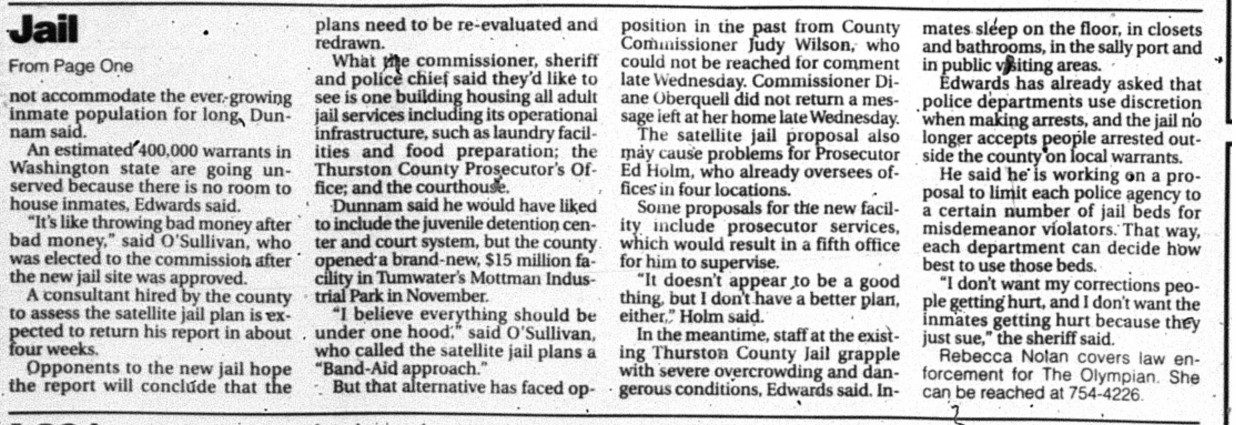
My research stopped in 1998 soon after the purchase of the property when Oberquell and O’Sullivan both made steps to move forward and Edwards was largely silent. If I took one more step into 1999, I would have seen organized and vocal opposition by both commissioner O’Sullivan and Sheriff Edwards.
I still think there’s a point to Commissioner Oberquell being involved in the original purchase of the old seafood plant. And, I think Edward’s implies too heavily that the plant was purchased under the leadership of the current commission. But, that said, I was wrong.

Gary Edwards, now candidate for county commission, gives a long-winded interview to a local conspiracy theorist. It includes this small little gem about a listless county commission, stumbling into a multi-million dollar problem:


Gary, you’re so smart. Only if we’d listen to you then. Or your supporters.


But, it turns out that not only was Edward’s complicit in the purchase of the Tyson Seafood plant in the late 1990s, but two of his supporters help guide the purchase and early development.


First though, I should back up and say that Edwards glosses over the legal situation the county was in at the time, by simply saying “I was running an overcrowded jail.”


Back in the late 90s, the Thurston County jail wasn’t just overcrowded. It was beyond that, it was inhumane. To the point that the ACLU was pressuring the county to improve the conditions in the jail. Edwards was running a bad jail.


In a letter from that era from the ACLU:

As long ago as 1996, we reported to you some of the complaints that inmates relayed to us. These included:

  • severe overcrowding, with many inmates forced to sleep so close to toilets that they were stepped on or urinated on by other inmates
  • poor sanitation and lack of access to hygiene supplies
  • infrequent changes of clothing and linen
  • denial of prescribed medications and lack of treatment for health care
  • limited indoor or outdoor exercise areas
  • lack of access to a law library
  • inmate kites or grievances not answered
  • broken plumbing and poor ventilation

Most of these problems were directly attributable to overcrowding. We received complaints from corrections officers as well as inmates, who also expressed their concerns that the dangerously overcrowded situation made their jobs unreasonably dangerous due to the enhanced risk of injury from assault, fire, and communicable disease.

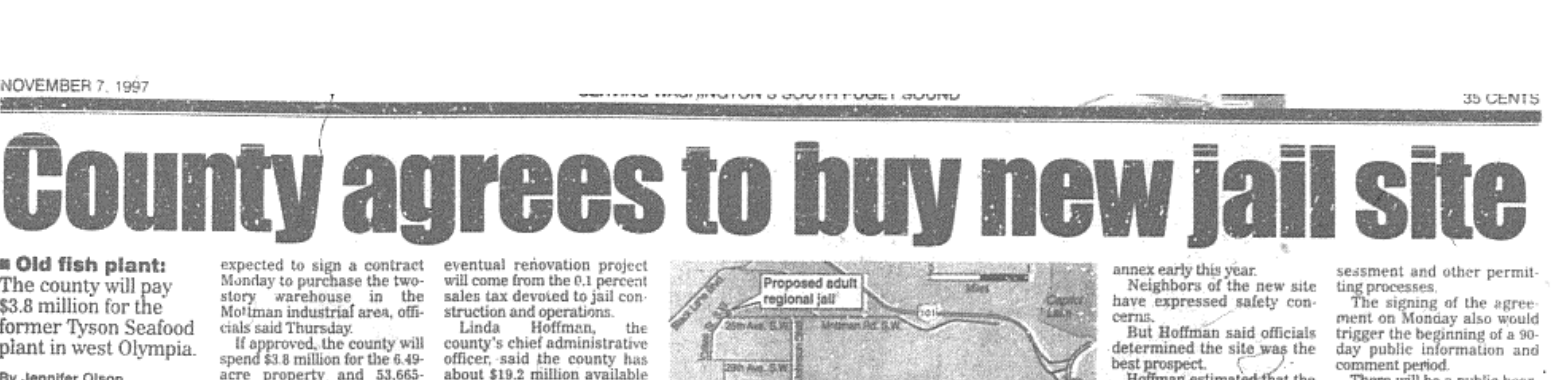
So, as a way to push back against overcrowding, the county commissioners spent $3.8 million to buy an old fish processing plant only a few miles from the current county jail.


So, who was on the county commission then? Diane Oberquell, who is listed as an Edwards supporter, Judy Wilson and Dick Nichols (both Republicans). When Edwards was serving as county sheriff at this point, he was also a Republican.


And, since even satellite jails take time to develop, the Tyson plant (though purchased by this point) was still a topic in 1999. By this time Nichols had retired from the commission and had been replaced by Kevin O’Sullivan. Commissioner O’Sullivan was part of the county commission (along with Wilson and Oberquell) that continued to push for the use of the Tyson plant as a jail. O’Sullivan also currently endorses Edwards.


I can’t find anything in the record during those years Edwards speaking up against the Tyson plant purchase. In fact, what I did find was advice by the sheriff’s office to move forward despite growing public opposition to the plan.


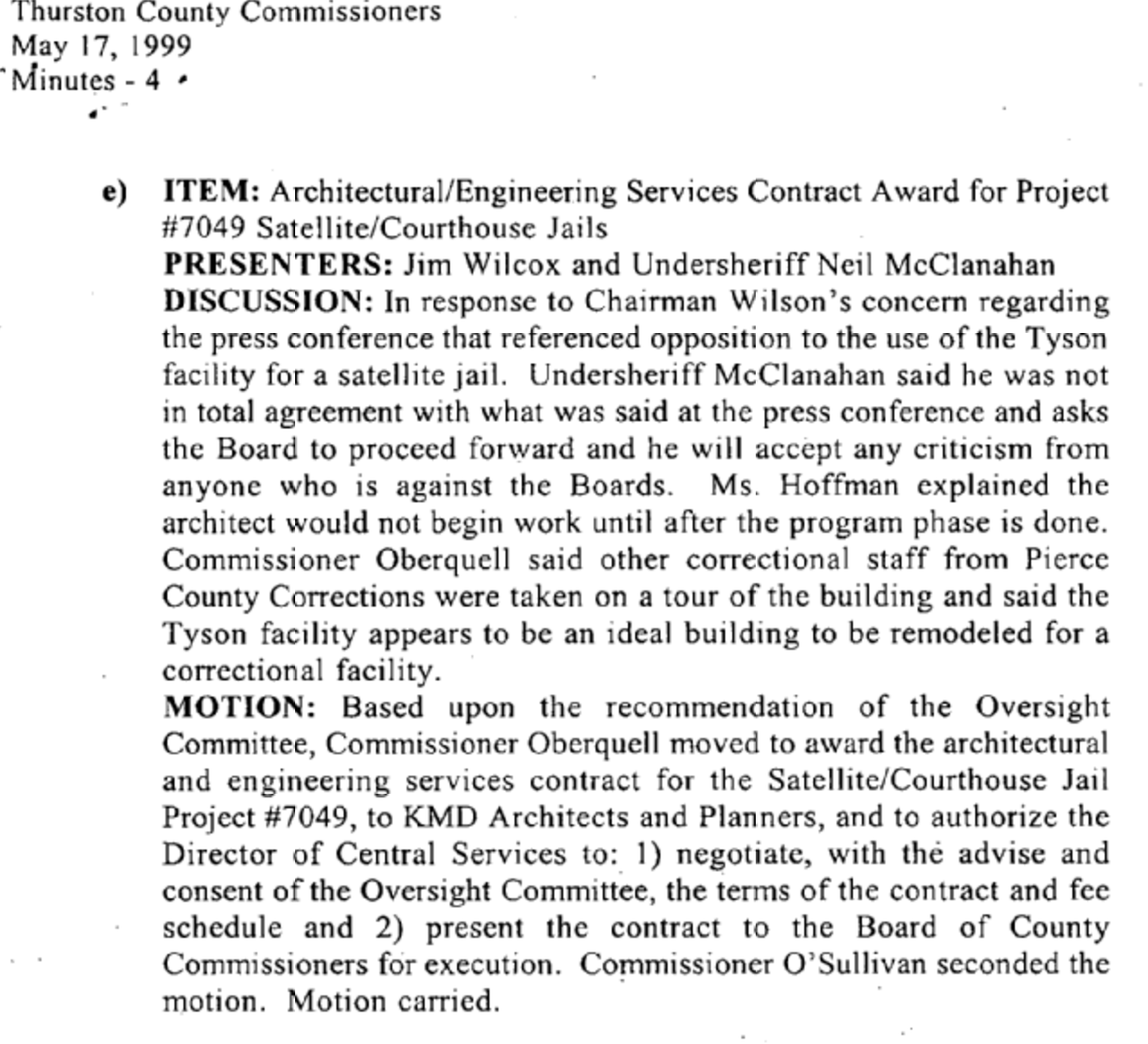
Here is a portion of county commission minutes that show not only one of Edwards’ undersheriffs pushing for the Tyson plant, but also Oberquell.


When it came time to decide whether to purchase the seafood plant that Edward’s now criticizes, it was his supporters and employees were at the helm. Also, as county sheriff, he was in a choice position to publicly call out what he says now was a horrible waste of money.


By being vague about it now Edwards seems to hint that the current commission (the longest tenure of which didn’t begin serving until 2000) is at fault. But, when you scratch the surface just a little bit, the people now surrounding Gary Edwards first dug the Tyson Seafood plant money pit.

Expanding truth behind why Ritchie Brothers moved to Napavine

One of the best-loved tales about the Thurston County commission is how they “chased” Ritchie Brothers, an auction business dealing in large equipment (cranes, tractors and such) out of the county a few years ago.

I’ve poked around before looking for evidence of this, but I never really came up with anything. But, the story keeps getting repeated (without much, if any, citation), so I thought I’d dig down into it.

But, what I’ve yet to find is any sort of smoking gun, any sort of specific example that anyone can point to as the axle upon which this County Commission vs. Ritchie Brothers narrative can turn.

There’s not expansion proposed that the county shuts down because of environmental protections. There’s no new expensive sewer system. Nothing.

So, let’s take a look back where this all begins when the Ritchie Brothers company starts talking about a possible move from Thurston County.

Centralia Chronicle in 2009:

Even with a stumbling economy, businesses and people still show up by the thousands to place their bids. If anything, Cunningham thinks the recession has helped business. 

“Instead of buying new equipment, more people are looking to buy used equipment,” she said. 

Things have picked up so much for the auction company at their location off of exit 95 in South Thurston County that they’re potentially mulling an expansion to Lewis County, due to some of the possibilities along Interstate 5. 

Unsure of when or where the auction will move to, Giroux is absolutely certain more space is needed than the current location offers. 

“It’s not nearly enough room here,” Giroux said. “We’re bursting at the seams, and we’re definitely interested in finding a much larger parcel. But whether we go north or south depends on the property availability.” 

And the price, he added.

In the Olympian, a few years later:

Co-founder Dave Ritchie was on hand for Thursday’s grand opening as was current president Rob Mackay. Mackay said the company simply had outgrown the Thurston County site.

Given the opportunity to throw shade, the Ritchie Brothers’ folks did not. At every turn when asked, they’d respond: we don’t have enough room, we want something larger. While there were likely parcels in Thurston County that could’ve been big enough, combining one that would’ve been appropriate for a commercial operation and near Interstate 5 was likely a hard find.

At least from the company itself, you can’t find the narrative that Thurston County government was being mean and chased them out.

Once you start looking down in Lewis County after the auction company moved south, you start to see a new narrative form.

Centralia Chronicle, 2012:

“We love Lewis County so far,” Mills said. 

The company moved to the new site right off Interstate 5’s exit 68 from its previous location at Maytown in Thurston County. The new 200-acre facility quadruples the size of the Thurston County site. 

“The county worked with Ritchie Bros. to get them to come here,” said Lewis County Commissioner Ron Averill of Centralia. “We worked hard to make sure we weren’t posing any unnecessary restrictions on them.” 

The county had to rezone the property for commercial use because it sat on agricultural resource land. Ritchie Bros. will now hold five auctions a year in Lewis County. 

Averill said Ritchie Bros. brought about $1 million a year to Thurston County 

“When you consider the county gets one percent sales tax, that’s significant,” Averill said.

Still the Ritchie Brothers company itself is consistent, there was more room (four times the room) for them to operate near Napavine. Being that it’s Lewis County too, the land was likely cheaper while still being right next to I-5.

What you do see is a Lewis County Commissioner throw shade north, at least indirectly. Lewis County wanted to make sure they had a smooth landing, see? But, even there, he’s not referencing any specific problem Ritchie Brothers had with Thurston County.

If anything, it was the Ritchie Brothers company that hurt the economic possibility of their old site. When they moved on, they placed a deed restriction on the parcels to ensure another auction company wouldn’t move in behind them.

From the same 2012 Olympian story:

The Thurston County buyers won’t be offering auction services on the property because of a deed restriction placed on it by RitchieBros., said Troy Dana of Olympia-based Dana Commercial Real Estate. He said his client, which offered auction services but does not compete with Ritchie Bros., declined to bid after learning about the deed restriction. 

“It took away part of the business model,” Dana said. He said his client, an undisclosed out-of-state business, was prepared to bid up to $2.5 million for the three parcels. Instead, the property sold for $1.47 million. 

“That’s the impact of the deed restriction,” Dana said.

But, despite the deed restriction that limited the use of the property, it sold anyway. And, again it became a going concern, pumping money into the Thurston County economy.

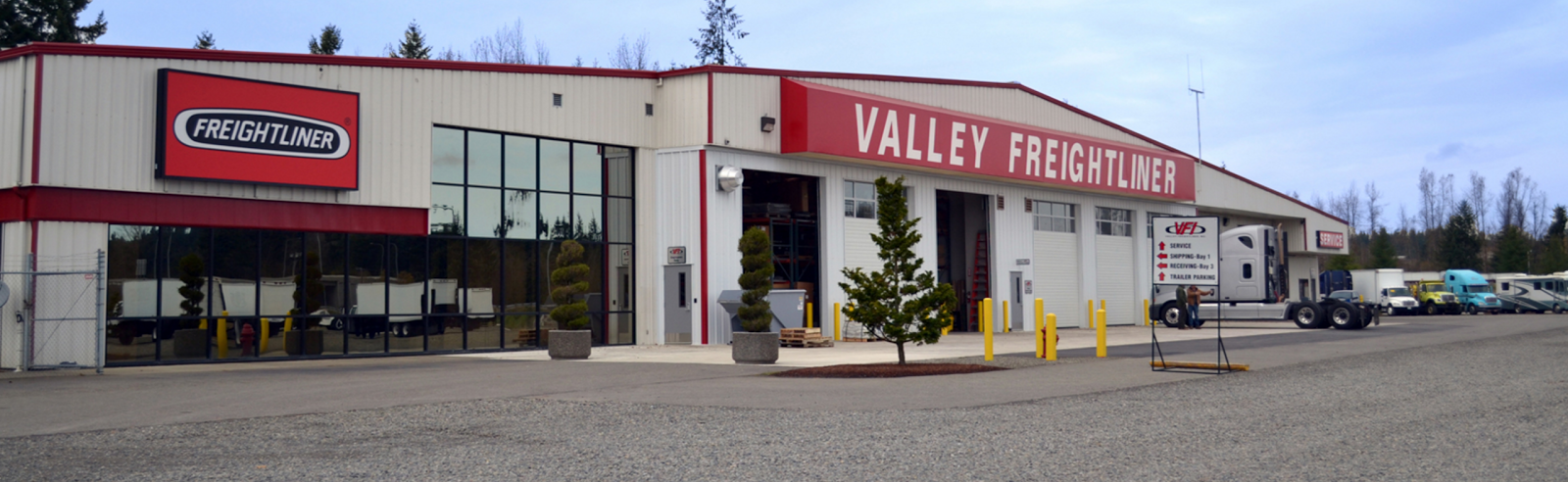
And, this is where the entire County Commission vs. Good Business thread falls apart. When you take a drive down I-5 to what was the old Ritchie Brothers site. Instead of laying empty the site is now occupied by a very similar business, Valley Freightliners. While Ritchie Brothers held periodic auctions for used large equipment, Valley Freightliners is a regular dealer in new and used semi-trailer trucks.

If it were true that the Thurston County commissioners were chasing retail large equipment sales out of the county, they were doing a really bad job of it if Freigtliner was ready to move right back in.

Thurston County EDC in 2012:

Initially VFI was searching for land when broker Don Moody of CBRE brought this high visibility site to their attention. Previously owned by Ritchie Bros. Auctioneers, VFI purchased a 34 acre parcel along with the existing high bay structures.

“It presented a great location on I-5 with an existing infrastructure that aligns with our needs,” said Bernasconi. The location has good access and visibility, along with ample parking. It also has an existing facility that fits the truck dealership model.

Some minor remodeling and basic updates will be done to optimize its use. “We’re hoping to get permit approval from the county in the next couple weeks,” shared Bernasconi.

I had one one last place to look for a smoking gun. I thought since permitting and land use records are available online, I’d find some sort of file of correspondence between Ritchie Brothers and the county.

Going through the permits and paperwork online at Thurston County, I was only able to find one active project around that same time. Ritchie Brothers was working on a permit for a septic system for a ten person office building and auction yard. You can search through the documents here (use the tax parcel number 12605330400).

From my reading of the permit file of the parcel, activity seems to drop off as Ritchie Brothers start exploring new opportunities in 2009 and then it picks back up when Valley Freightliners moves in three years later.

Either way, if they were looking to get out of the sewer/septic business by heading south, it looks like they’re out of luck.

Longview Daily News:

Two multimillion-dollar auctions that were cause for celebration last year now are the cause of a pricey renovation for Ritchie Bros. Auctioneers at its freeway site between Napavine and Winlock. 

The state Department of Health is mandating that the heavy equipment auction company upgrade its onsite sewage system, which could cost up to $70,000. During two auctions last year, the 3,500-gallon septic tank — the size usually used by small commercial businesses — was overwhelmed, said Denise Lahmann, the program and reclaimed water supervisor for the Office of Shellfish and Water Protection at the Department of Health. 

For Lewis County, the costly mistake could become a lucrative new business venture — if the Richie Bros. goes along.

According to the Lewis County Commissioners, Ritchie Bros. has expressed interest in partnering to build a commercial-level sewage system — one the county could use to encourage further development around Exit 68, where Interstate 5 and state Route 12 meet.

And, a letter to the editor in the Centralia Chronicle:

I read your article, in last Saturday’s issue, regarding problems that Ritchie Bros. are having with the State of Washington regarding its current septic sewer system. 

I have been aware, for quite some time, that Lewis County was wasting time and valuable taxpayer funds in an effort to justify a separate and additional “wastewater system” to benefit not only Ritchie Bros., but “potential” development of “new restaurants and hotels” in the Exit 68 area. 

Excuse me, but Ritchie Bros. is in the city of Napavine service area, and service to that facility is within Napavine’s State of Washington approved comprehensive, water and sewer plans. 

Additionally, Napavine has sufficient capacity within its water and wastewater facilities to service the entire Exit 68 area as is indicated in our water and wastewater plans.
It seems to me that Lewis County, rather than working with the city of Napavine, is participating in a naked power grab in the guise of “helping” Ritchie Bros.

And, lastly, if not for some mysterious sewer debacle that has been left unmentioned, what about the impact of Ritchie Brothers leaving Thurston County. Even if the county commissioners did not wage an open war against large scale heavy equipment auction houses, certainly them leaving tanked the county’s sale tax receipts.

Maybe even the appearance of Valley Freightliners didn’t save the day for the county economy.

But, if you spread out taxable activity in Thurston County from 1995 to 2014 (the most recent annual data available) the Ritchie Brothers impact in nearly invisible. Here’s the data I’m working from and here is the source.

But, this chart I think speaks for itself. It tracks taxable sales activity in unincorporated Thurston County by units and total taxable.

Certainly you do see a dip in taxable activity from 2011 to 2012, and possibly that is the time when Ritchie Brothers was wrapping up and Valley Freightliners was coming online. But, there is no blip in the units line, which consistently shoots upwards.

What this chart does show is a steep increase in taxable activity in unincorporated Thurston County since 2008. That’s when Sandra Romero was elected. Just in case you’re still tracking me.

When was the last gray wolf shot in Thurston County?

Wolves are on their way back in Western Washington.

At one point in our past, wolves roamed the place we now call home. Certainly Thurston County was on the edge of where these big dogs roamed, but obviously there were some that roamed down the Black Hills from the Olympics.

The last wolf pair was shot in the Olympics in 1938. That was the absolute end of wolfs in Washington until very recently.

But, as far as I can tell, wolfs came to an end in Thurston County maybe a few decades before. The last record I can find of a wolf being shot here was in 1909:

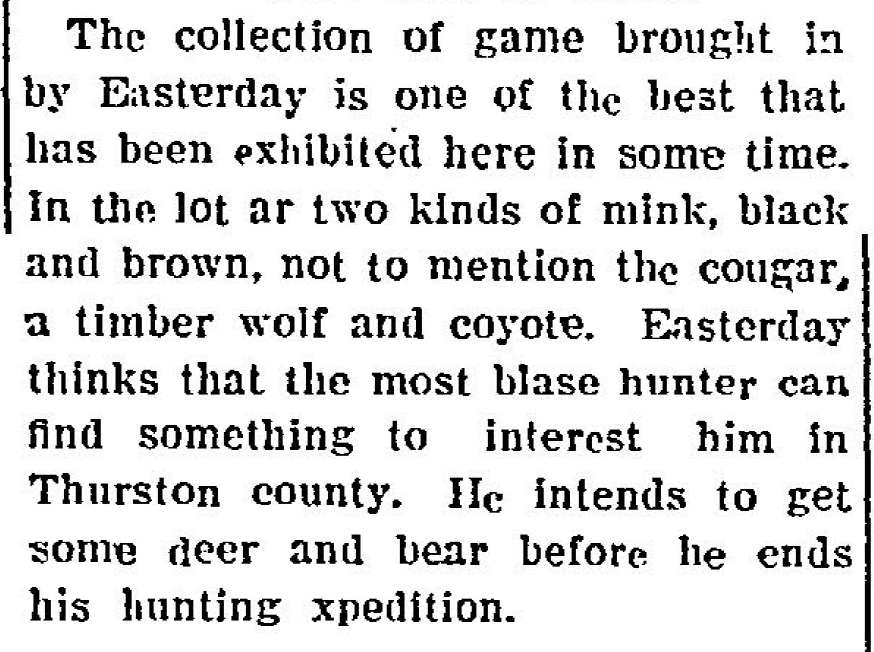
Joe Easterday came back home from a hunting trip that year, ranging from the Black Hills down to Oyster Bay. Among the dozens of animals he and his friends shot was a “timber wolf.” He pointed out that he likely would have stayed out longer, but the number of animals he had bagged was just too many to lug around.

Plus, Joe’s body had literally given out:

He says he would have been still in the woods if it was not for the fact that has shot so much that his arm is swollen and his fingers have increased to such a size that he can no longer pull the trigger. He visited a doctor to have his arm and hand attended to and while here will have his clothes padded so that his shoulder and side will not get black and blue in the future from the recoil of the weapon.

The expanding human footprint, plus “varmint hunts” and other likewise less than nice ways to say predator extermination programs, did the wolves in.

A notice for a varmint hunt in the 1911 Olympian listed the points given out by the Thurston County Association for the Protection and Propagation of Game and Game Fish. Two teams worked from May 1911 to February of the next year. The top hunter of either group would get $20, with lesser prizes for second and third. The losing team would throw a party for the winning side.

If you shot a cougar, your team would get 1,000 points. A wolf, 750 and likewise for a coyote. A fisher would get 500 points. And, last on the list of a dozen animals and their corresponding points, was the blue jay. That would get you 75 points for your team.

From the Morning Olympian, October 1909:

Just in case you’re wondering, I’m very pro-hunting. Very pro-killing animals for food. And, sport for that matter. Food is a higher moral calling though.
That said, I’m also pro-eating chocolate cake. But, no one should eat so much cake, or hunt so many animals, they literally have to go see a doctor about it.

© 2026 Olympia Time

Theme by Anders NorenUp ↑