History, politics, people of Oly WA

Author: Emmett O'Connell (Page 38 of 177)

Death, renewal, sweet death (Olyblogosphere for November 18, 2013)

1. Diggers Outlast Geoducks? Really? The entire world of clam related humor open to you and you go with Diggers outlast Geoducks?

2. Utah2 on r/Olympia went for a nice walk. I love getting to the tops of those hills. They’re small, but man, what a view.

3. Apollo’s Pizza used to be a really neat place. Somewhere along the lines, things changed. I sort of agree with welfaretaco on this one, the economy is a bit of an excuse. You changed, not us. Either way, Morty has a couple of posts on the end of the west side place. With one great memory:

One of my best recollections was around 2007 when there was a bad storm
and the power went out. Ian had a bicycle helmet headlamp he lent to you
guys so you could continue working in the kitchen since the ovens
remained hot and we all ate by candlelight. 

4. Not really a blogosphere link, but just in case you were looking for a little deep reading about Olympia, here comes the Community Renewal Area. I’d explain it, but I’m mostly just posting it here to remind myself to read. Also, Walt went to one of their meetings and taped it.

5. A starling died in Mojourner’s front yard. Good for you Mr. predator bird, kill that foreign interloper.

Regional subtext to the Boeing special session: Left Coast (Cascadia) vs. Deep South

It seems like we might be in the habit of doing this every decade or so in Washington State, bringing back the legislature to make sure Boeing doesn’t leave Puget Sound high and dry. The risk of losing Boeing to some other state is an interesting case of regional tension, especially in how Colin Woodard describes regions in American Nations. 

Right now, at least on their commercial airline business, Boeing is company with deep  Left Coast roots. But, in recent years, Boeing merged with another aerospace company from Great Appalachia (McDonnell Douglas). Since then, they have begun using the political and economic culture of the Deep South to gain concessions from their Left Coast home.

This contrast between their Left Coast origin and Deep South destiny is interesting.

On the surface, the Left Coast (home of Portlandia, hippies and Starbucks) seems like the perfect anti-corporate foil to the open-for-business Deep South. But, as Woodard points out (and the Boeing legislative package illustrates) there is a deep vein of pro-business sentiment in the Left Coast.

The Left Coast was founded in part by New England capitalists, who built the region on large timber empires. This timber baron sentiment led directly to the founding of companies like Boeing. It was also based on a close understanding with civic leaders to do what was needed to keep people at work and business growing.

The other founding group along the Left Coast is the Great Appalachians. They could also be described as pro-business, but as expressed in the founding of Oregon, not exactly pro-big business. So, while companies like Boeing stayed home grown they were happy enough to stay out of their way.

That particular brand of pro-business from the Appalachians of the Left Coast might be turning against Boeing in their post McDonnell Douglas, Chicago headquarters period. The recent legislative session in Olympia was cast in a “David vs. Goliath” light by at least one Republican lawmaker:

“Boeing is vital to our state’s economy,” said Holmquist Newbry, R-Moses
Lake. “The thousands of jobs produced by the 777X program will have a
positive economic ripple effect throughout our state. The Legislature,
however, is being asked to provide special incentives for Boeing. My
response is this: If these policies are good for Boeing, then they
should be good for all of our employers. Unfortunately, expanding these
incentives to help other, smaller businesses survive and thrive is not
even on the table right now.”

“If a Goliath multi-billion dollar company and its team of lawyers have
difficulty navigating our state’s permitting process, and need the
certainty of a four-week permitting timeline, what chance do our
Mom-and-Pop businesses have in navigating the same permitting process?
If it’s good for Goliath, it’s good for David.”

 But, along with these various pro-business strains in the region, the Left Coast also developed a strong sense of civic mission (at least in urban areas) and environmental protection.

So, where in the country can Boeing get a better deal to build planes than its home region? Well, the Deep South. Remember, if Boeing does end up expanding more in the Deep South, it will be near Charleston, SC (from Business Week):

Beginning from its Charleston beachhead, the Deep South spread apartheid and authoritarianism across the Southern lowlands, eventually encompassing most of South Carolina, Georgia, Alabama, Mississippi, Florida and Louisiana; western Tennessee; and the southeastern parts of North Carolina, Arkansas and Texas. With its territorial ambitions in Latin America frustrated, it dragged the U.S. into a horrific war in the 1860s in order to form its own nation state, backed by reluctant allies in Tidewater and some corners of Appalachia.

After successfully resisting a Yankee-led occupation, it became the center of the states-rights movement and racial segregation, as well as labor and environmental deregulation. It
is also the wellspring of African-American culture in America
and, 40 years after it was forced to allow blacks to vote, it
remains politically polarized on racial grounds.

For all our pro-business culture (we built Microsoft, Weyerhauser and Boeing), we Left Coasters also have a strong sense of unionism and environmentalism. This is the New England sense of community values expressing themselves in our culture. We also have an Appalachian sense of fair play that is questioning special deals for few large companies.

So, where is a company supposed to go to get away from all Left Coastiness? Well, Charleston, the birthplace of the Deep South!
Darren Mills’ and Mike Volz’s Olympia

At first blush, I was confused by the election results for the Olympia city council. Across the two contest races, I assumed there would be some difference between the four candidates that ranged across the city’s political spectrum. In one race, we had a fairly right candidate (Mike Volz) against a neighborhood based centrist (Julie Hankins). And, in the other, we had downtown business centrist (Cheryl Selby) against downtown business further left (Darren Mills).

Both Selby and Hankins won their races by health margins, showing an overall preference for centrist, I suppose. Even if you look at the precinct level results, both Selby and Hankins both had nearly clean sweeps across the entire city. Mills only won a handful of precincts and Volz didn’t win a single one.

What was shocking to me, was that even on the precinct levels, the margins of defeat for Mills and Volz were similar. Meaning, it is possible (though unlikely) that the same voters who chose further right Volz also chose further left Mills. I think this phenomena is more a trick of the numbers. While voters overall went for the centrists, I don’t’ think there’s much cross over between Mills voters and Volz voters.

Here’s why.

Take a look at the precincts each did well in across the city. There is a distinct geographic pattern. Mills won precincts (in green) in the upper eastside. While Volz (in light red) didn’t win any precincts, he did better than 40 percent in ones along the outer edge of the city. Even in the eastside precincts where he made a point of emphasizing his opposition to a homeless shelter, he did no better than 35 percent.

Here’s another way to look at the base of both candidates. I compared how well each one did in each precinct and charted it. Volz beating Mills in on the left, Mills beating Volz on the right.

As you can see, the votes weigh much heavier towards Mills. Across the city, many more voters and neighborhoods chose Mills when they were comparing him with Selby than Mills did against Hankins. So, I doubt there were very many voters that chose Volz and Mills on the same ballot. They just both lost to strong centrist candidates by about the same percentage..

Sue Gunn reconnected the ends of the Cascadian political spectrum

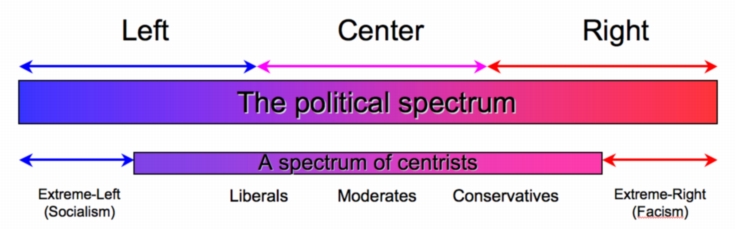
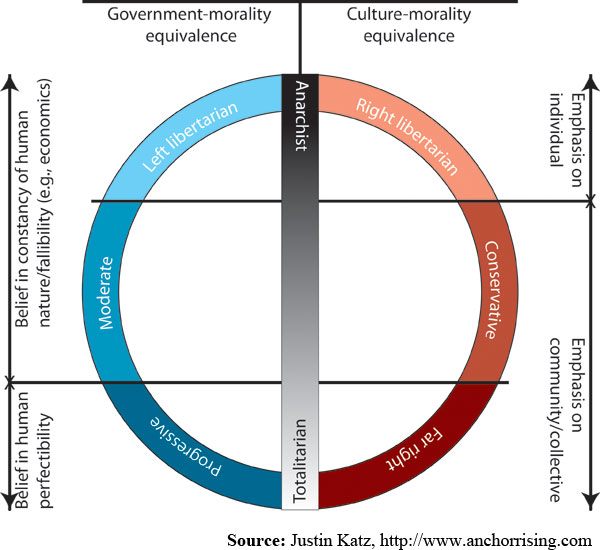
I’ve been toying with this idea of there being a special sort of political spectrum in Cascadia. It would be along the lines the circle political spectrums you see from time to time, where the conservative and liberal wings join at the top and bottom, implying there are two political centers.

Flat spectrum:

Circle spectrum:

I’ll try to explain this later, but the moderate middle right join would include elements of suburban, government and business friendly themes. Everyone works together to make a happy life.

And, where the ends meet at the bottom, the more extremes of the standard left to right spectrum would join together with elements of traditional Cascadian anti-corporate, anti-oppressive government themes. Anti-corporatism on the left and the right is actually a long held position in Cascadia. It was one of the original fights in founding Oregon.

So, while its fun to sketch out little theories like that, its even better to find real world examples. Right now, Sue Gunn is leading Jeff Davis in a tight Olympia port commission race here in Thurston County. Even though its the Olympia port, the elections is held county wide.

Over the course of the race, some political observers have had a hard time putting their finger on Gunn’s position in the political world. If she was a liberal, why is she against a tax supported county-wide port? If she’s a conservative, why is she such an environmentalist?

From a letter to the Olympian:

This year, Red Sue is a hardheaded fiscal conservative, preoccupied
with lowering taxes and running the Port of Olympia at a profit — or so
she says in Works in Progress and on her campaign website.

But on an environmentalist website, she’s Green Sue, claiming
that she’ll refuse all timber and proppant contracts because they’re bad
for the environment — thus depriving the port of several of its most
lucrative sources of revenue. This would cost quite a few jobs and
increase our taxes, the very thing Red Sue deplores. But not to worry,
Green Sue proposes to close down the marine terminal entirely and turn
it into a park.

This certainly would be true if we were on a flat spectrum, but in a round one, Gunn could find a comfortable spot near the bottom, where the libertarian left and right join together.

Coincidentally for us, its also easy to find this mapped out in the early results. The most traditionally conservative (Republican) areas of Thurston County are in the south of the county. The most traditionally liberal (Democratic and left of Democratic) areas are in urban Olympia and the west side.

So, this map showing Gunn winning in both rural south county and urban Olympia illustrates here campaign bringing together these camps. This is not a traditional election map in Thurston County, by the way.

When you zoom in on Olympia, you really see the detail of her victory. You can see a band of Jeff Davis areas surrounding Gunn’s urban vote. But, in turn, surrounding those suburban neighborhoods, you see much more conservative rural areas.

In her apparent victory, Gunn was able to move the political center from the typical moderates the lean both left and right on a political spectrum, way to the other side of the circle. Her victory was based on liberals who didn’t like the direction of the port using public money to support private interests and conservatives who felt the same way.


Read more here: http://www.theolympian.com/2013/10/14/2775183/gunns-chameleon-ruse-is-hiding.html#storylink=cpy

Whales and the fall are coming (Olyblogosphere for November 4, 2013)

1. A whale came south to Snazzy Bouquet‘s inlet.

2. Ken tracks the downward trend of the print Olympian.

3. Calavara writes about what he donated to the OFS charity auction.

4. Before the hammer came down on fall, Camille took the bikes out:

In any case, it was so much fun being out, breathing
the fresh air, feeling the wind in my face (even as frozen as it felt to
begin with), taking in the scenery in our little faux-rural community …
even the burn in my thighs felt good. Invigorating doesn’t quite say it
enough. And so hubby says we’re getting up early every morning from now
on to do it again and again and again …

5 places for local online conversation (and trolls) now that the Olympian comment threads are dead

From my Facebook news feed recently:

Sort of funny how, now that you have to pay for access to The Olympian, and they require folks to comment using real FB identities, that there are no almost no comments on the articles whatsoever.

Whatever will the trolls do amuse themselves?

The Olympian put up a bit of a paywall and moved to Facebook comments awhile back. Since then, the comment threads over there went from troll heaven to ghost town. So, where did all the online conversation (and all the trolls) go?

1. Craigslist Rants and Raves

This is the most epically troll heavy place in the world and Olympia. Not sure why anyone ever really posts here, other than self gratification. But, there even seems to be some back and forth.

2. Thurston Blog

Back when the Olympian was trying to make comment threads work on their own, several comment thread regulars broke off to start Thurston Blog. Comments seem to have pretty much dried up there, but its worth pointing out that the exodus from the Olympian comment threads has a bit of a history.

3. Olympia Memes

While engagement over at the Olympian has waned, it has waxed at Olympia Memes. This isn’t just a simple local memes site, the admin of the page has raised money for charity and taken on local debates like feeding homeless downtown. Also, making fun of Shelton.

4. Olympia subreddits (r/olympia)

Reddit has a reputation (earned) for being a sort of troll heavy site wide. But, our small corner of reddit here in Olympia is “pretty chill.” There are also several other specific local subreddits for Evergreen and jobs in Olympia.

5. Olympian reporters on twitter

Back when I was a young reporter and first thinking about publishing on the web, I thought of comment threads as a way to update stories and engage with reporters. What newspaper comment threads eventually became couldn’t be further from that. But, reporters on twitter seem to be bringing that vision to reality. Meg Wochnick and Matt Batcheldor are doing a great job engaging on twitter.

Mars Hill, other entrepreneurial Christians and the Cascadian religious landscape (Cascadia Exists)

The seemingly manufactured debate between the Mars Hill Church and Sound Transit on who should own some property in Bellevue seems out of place. When you dig into the debate, it leaves you scratching your head. Why would any organization (a church or whatever) seem to have any case when the rightful owner of a property doesn’t want to sell it to them.

But, once you take a step back and see the debate from the point of view of the religious landscape of Cascadia, it makes a bit more sense. Not much, but it helps to understand how churches like Mars Hill fit into the religious world and the broader social landscape in Cascadia.

While Catholics make up the largest single religion, there are almost actually a footnote when you see the larger religious picture here. There are two things to keep in mind when thinking about religion in Cascadia:

1. There is no more universally diverse region in the United States. That means there are more different sorts of active churches or other houses of worship in our region that any other place.

2. The most dominant sort of religious is actually the non-religious. There are more non-adherents in Cascadia than any other part of the country. And, this isn’t a new phenomena. It has been noted for at least a century that fewer people attend or are active in churches here.

You can see these trends in my first post on Cascadian religion here.

But, how does that help explain the situation with the Mars Hill Church?

Well, because Cascadia is so unchurched and so religiously diverse at the same time, it is possible for active and growing segments of religion up here (like so called entrepreneurial Christians) to become self sufficient enclaves inside the broader culture. To the point that places like Mars Hill are even more conservative than similar churches in more churches areas (like the South).

In “The None Zone” Patricia Killen explains that instead of bending towards the center left that is Cascadian social life, entrepreneurial Christians around here bend ride. In almost all political scales (aside from gay rights) they are far more conservative than there counterparts outside the unchurched Cascadia.

Because Cascadia is so religiously diverse, it doesn’t force small communities of faith to adapt to a larger religious culture. They are allowed to live and let live in their own communities. So, Mars Hill church is left alone among a sea of left leaning, non church going Cascadians, they separate themselves, and become more conservative against against the sea of let-live liberalism.

So, when it comes to a simple debate about a church wanting to buy a piece of land after a public agency buys it a few months before, there is plenty of room for each side talking past each other. Communities like Mars Hill probably and simply don’t see eye to eye with the local civic culture. So they’re way of trying to buy a piece of property for seem pretty tone deaf.

Why won’t those damn kids just obey the will of our Grecian columns?

The most hilarious part of the otherwise troubling piece about street culture downtown by Austin Jenkins was this passage:

On Washington’s Capitol campus in Olympia, sandstone buildings stand as
monuments to the rule of law. But just a few blocks away you can find a
street culture where young adults and teenagers live by their own
rules—sometimes with tragic consequences. 

I mean, for Pete’s sake! This is the state capital! While you’re within site of our capitol building, please remind yourself not to fall into criminality!

Jenkins eventually reminds us that “It isn’t just Olympia,” that many other Cascadian cities have the same problems. But, the implication from his lede is that somehow, because of our sandstone buildings, Olympia should have less crime.

As silly as that sounds, it is actually true. Or, at least true from the point of view of the people that originally designed the campus. It is practically impossible to utter a phrase in Olympia about the campus without being reminded of its city beautiful origins.

The city beautiful movement in architecture began in the 1890s as a reaction to the quick and messy growth of American cities during the industrial revolution. When the city beautiful movement came to Olympia in the 1910s, it was hardly a booming metropolis. It was still a fairly common timber town just being carved away from the forest. It wasn’t until the 1950s that Olympia would reach its industrial peak, and the campus was well settled by then.

The thinking behind the city beautiful movement was that it would not only literally reform cities themselves, but it would change citizens.

From an essay by architect Pierre De Angelis:

The Cities Beautiful movement exists as an insignificant footnote in the current discourse on urban planning. It stands as a relatively short lived movement which flourished in the 1890’s; a genuine attempt to reform the wretched conditions of inner city poverty. 

However the upper and middle classes continued to travel into the city, to attend to their businesses and participate in leisure activities. Whether out of genuine concern or simply fear for their own safety and the continued viability of their businesses, middle and upper class reformers attempted to relieve the malaise of the city and lower classes. They did so by embracing the concept of beauty as an “effective social control device”… Reformers had no interest in beauty for its own sake but in its ameliorative power which could inspire civic pride and moral rectitude amongst the impoverished and poverty stricken. It is on these principals that the cities beautiful movement was born and on which much of our contemporary thinking on urbanity finds its ancestry.

There are some interesting parallels here between this description and the city beautiful and the Olympia downtown discussion. “(S)imply a fear for their own safety and the continued viability of their businesses…” is attached to the present time with people scared too come downtown. “(I)nspire civic pride and moral rectitude amongst the impoverished and poverty stricken” attached to ending homelessness and getting people off the streets.

We’re still having the urban discussions now that we had at the dawn of the “architecture will convince the poor to be good people” ideas behind city beautiful. We’re obviously moved beyond the point that we think nice looking buildings will make people better citizen. What Jenkins did was a device to put his particular story in the place he was writing about.

So, if we do end up getting around the corner on how bad downtown really has gotten, it won’t be with building nice looking buildings.

Buy my book: Oyster Light (or download it for free or help edit it)

Over the past year or so I’ve been putting together a few longer than blog post pieces into something that just barely qualifies as book length. You’ve probably read some of what makes up the book on Olympia Time already, but in “Oyster Light” you can read them in the way that I intended, in their entirety.

There are four major pieces in here covering baseball, murderous settlers, the early lawyering life of E.N. Steele and the capitol campus.

You can certainly pay for a printed or electronic version, but you can also download it for free.

The ebook version is available as a pay-what-you -want version at Smashwords. If you really want a suggestion what you should pay, $3 sounds about right. If you have trouble downloading a clean version, let me know and I’ll hook you up over email.

The printed version is available at Lulu for $11.

An editable version is also online since I have a hard time saying this is a good or even final version of this book. Feel free to take a whack at editing a possible future version.

When the world economy came crashing down on Olympia, WA

Did the world end? Has our economy crashed? If you can read this, leave me a comment below to tell me how it all ended. I’m writing this on Tuesday night, so I’m not sure if we breached the debt limit and America’s credit crunch killed the world economic system.

Anyway, if it is alright, let’s take another look back at one of the earlier times we crashed into a failing world economy in 1933. I wrote about that last hunger march here, but that remembering was from a pro-marcher point of view.

Lora Weed’s retelling here speaks of “*(the marchers’) attackers used broom handles to beat the marchers into ending their march.” But, this telling by former Olympia mayor E.N. Steele (in his self-published memoir) tells of a more patient and then flabbergasted response to the marchers:

I shall never forget watching them come in. Police met them at the city limits and escorted them to the park. It seemed as though the end would never come. They came in every kind of a conveyance; cars old and new of every vintage, and trucks of all makes and kinds. Many had tents. Those who did not were able to provide in someway. They came in January so it was rather cold, but they soon had fires going.

These people were for the most part good citizens who needed food and comfort. Hunger makes men desperate. Part of them were farmers, but most of them were from Seattle, Tacoma, or other cities where industries had closed down, throwing them out of work. There was no social security in those days, but there are always radicals and at a time like this they stir things up and really make trouble. We did all we could to make them happy.

But, negotiations with the state legislature for some sort of economic relief were slow going and conditions at the park went downhill.

Sanitary conditions were especially bad. As mayor of the city it was up to me to get them out of town. I submitted the matter to the Director for the State Department of Health. He directed a letter to me, stating that they must move at once, in the interests of their own health as well as the entire city, should an epidemic break out. I wrote a letter fixing a date for their departure. It was sent out and served on the leaders. Copies were posted on the trees.

They sent word they would not leave. Some of the most radical made speeches trying to stir them to fight. Rumors were whispered around town indicating real trouble. I called a meeting of the businessmen and others. After advising them of the entire situation, I asked for volunteers to be sworn in as deputy police. Those present volunteered almost to a man. The new police were organized. None were to carry guns. Each of these hundred men were to assemble at 8:00 A.M., at the Chief’s office, each wearing a badge. Each of them was given a short club to be used only in emergency. By 8:30 each was at his assigned post. There was a string of men on each side of the road the trespassers were to follow. At that time the Chief of Police entered the Park. The men and women were standing around in groups but showed no signs of moving out.

They indicated that they were not leaving and tried to get the Chief into an argument. His only comment was that he had a hundred deputies and the State Police at his disposal and that unless they were on the way by nine o’clock he had instructions from higher up to place them all under arrest. Some grumbled but some began to pack, others followed and at the appointed time they were on their way.

I failed to tell you that after a meeting about midnight a State Police Officer came to me and said there might be trouble as several of the visitors had been hanging around all evening. He took me by the arm and we went down a back way that I did not know was in existence, to the garage which is in the basement where I had my car. He rode home with me and to my surprise I found a shadow police had been on guard for the protection of my family.

That was the only time in my life that I have had to be guarded by secret police.

It is striking the difference in tone and perspective between Weed and Steele. Obviously, both are coming at it from different perspectives. But, today, I keep on coming back to the “Lord of the Flies” story on KPLU this week.

It is interesting how perspective is skewing our conversations about the sitting ordinance, the lower barrier shelter and the current nature of downtown. Either the city is too accepting or the city is criminalizing the poor. We can look back into history and find strains of the same debate throughout our history.

« Older posts Newer posts »

© 2026 Olympia Time

Theme by Anders NorenUp ↑