History, politics, people of Oly WA

Author: Emmett O'Connell (Page 39 of 177)

Three Olympia local food options that aren’t the co-op or the farmers market

Don’t like shopping at Safeway or Fred Meyer? Ralphs and Bayview got you down? Tired of shopping at the co-op and the farmers market is never open?

Recently, one local email group I’m part of had a long conversation about the food co-op, whether it really serving the community and if expanding to a larger store downtown (rather than two smaller neighborhood stores) would improve things. That got me thinking about where are the other places that you can buy food around here that don’t fall in either the big store or co-cop/farmers market categories.

So, here are three local Olympia food shopping options that you might like.

1. Olympia Seafood. This is my favorite, which is why I put it on top of the list.

When I want to buy something seafoody, his is where I go. All the time. I also tend to buy gift certificates here for other locals as a go to gift. While Olympia Seafood was established less than 20 years ago, it vividly reminds me of another seafood market that I used to go to as a kid. Walking in there, it literally feels like a seafood place. Cold, wet and smells wonderful. The seafood is good too.

@olympiaseafood
411 Columbia St.

2. Spuds Produce Market.

Spud’s has only been open for a year? Feels like way longer than that. Anyway, unlike the other two listings here, Spud’s has an awesome community feel. Kids from the local school take field trips there, its in a neat old building, and I know for a fact, the food is great.

2828 Capitol Boulevard

3. Farm Fresh Market (Olympia Local Foods)

This is the place I was most fascinated with, because I didn’t even realize they had a retail store until I started poking around during the co-op email discussion. I had heard about a few local food delivery services, but Olympia Local Foods recently opened a brick and mortar retail location, sort of out of the way on the westside. But, beyond that, they seem to have a well rounded selection, plus their delivery service is still online.


2010 Black Lake Boulevard
Olympia Local Foods

Evergreen should play more games not on campus

Here’s on thing about Evergreen State College and Olympia that a recent resident here observed: You’d hardly think Olympia was a college town. Now, this guy is from the upper Midwest, went to the University of Wisconsin at Madison. So, maybe he has a different idea of what kind of college town Olympia could be. But, he mentioned Bellingham in the same breath, and I see where he’s going.

It could be the culture of Evergreen. No Greek system, a fairly young college and you know, Evergreen. So, maybe we are a college town, its just harder to see because Evergreen is different, therefore its impact on us is different.

That said, I think there’s something else to it. Evergreen in a lot of ways isn’t in Olympia. Literally a college in the woods.

So, for someone like me, getting to events out at Evergreen can be a pain. Out of site, out of mind. But, that’s sad because a lot of cool things happen out at Evergreen. If Evergreen was centered around where we all lived. Like say, in a fit of rewriting history Evergreen was where the Automall ended up, wouldn’t we as non-Greener residents be at Evergreen more often, just because it was there?

I know sports is like this for me. I end up going to more high school and St. Martins, South Puget Sound Community Colllege athletic events because they are held nearer to me.

That said, because of field conditions Evergreen soccer was forced to play at South Sound Stadium. I really wish I heard about it earlier or it was on a better night for me, because I would’ve loved to have gone.

From the Olysports Blog (an effort you should suport, by the way), it even looks like there was a crowd at the game:

I could go on longer, but we could be prouder of Evergreen around here. There are a lot of proud graduated locally, but we should be even prouder. Sports is a big part of how people think about a school, and the easier it is to get to an event, the more fans you might have.

So, that’s it. More Geoducks off campus please.

October a day early. Well, that’s a surprise (Olyblogosphere for October 7, 2013)

1. On the day before October, October Surprise uploaded Stuff with October.

2. Democracy Wall went downtown to check out the feeding the hungry debate. Very, very much worth reading the entire thing:

The bartender in the 4th Ave. Tavern looked a bit like a pirate, but he didn’t want to be identified any more than the person interviewed at The Reef or, later, the Harlequin Theater staff.  He’d worked at the tavern for over 17 years, he said, including those Thursdays the CFM held their benefit for Olympia’s hungry.  He objected more to the characterization he chose for the beneficiaries than CFM itself.  He, too, had witnessed trash piling up in the tavern’s private dumpster as well as the bed of his pickup truck when he had made the mistake of parking in the lot where the event was held.  He argued many of those attracted to CFM’s hot meals were mentally ill, drug addicts, or miscreants who caused trouble hours after CFM had struck its tents and left for the evening. “When the trouble begins, they’re already long gone,” he said.

It occurred to yours truly, in hindsight, that many businesses were reluctant to openly criticize the feeding of the poor for philosophical as well as political and practical reasons, though the owner of the adjacent quilting supply shop had no such reservations. Some business owners who have openly opposed low barrier shelters for the homeless in their neighborhood have repeatedly had their business vandalized in the wee hours. There is a reluctance to be seen/heard, especially on the record, criticizing efforts to aid or assist the poor/homeless. At the same time, there has been considerable vilification of the poor/homeless. They are genuinely loathed by those business owners who see them as an impediment to having a profitable operation or an obstacle to their customers. Moreover, they are blamed for the vandalism and trash in the City’s streets.

The depths of perfidy vs. necessity came up again during a dinner meal at the Thai food restaurant just down the street a block or two from the artesian on 4th Ave.  The waitress volunteered, when asked, that she believed many of those who took advantage of CFM’s largess weren’t ‘homeless’, or even poor, at all. She felt they were ‘lifestyle homeless’ who simply liked to hangout and had become a blight on the community.

The issue, ultimately, appears to turn on the degree of tolerance Olympia’s residents are willing to afford the less fortunate, and to some extent, the not so less fortunate. Many Olympia residents are willing to be generous, but many are not willing to risk their own safety to do so. The aggressive behavior of a few street denizens has tarred the lot in the minds of some City residents. But CFM’s “sins” are a red herring. There was not a little trash strewn about the City far from where the poor and hungry were being fed. There was even the occasional hypodermic needle on the pavement.

The stretch of 4th Avenue near the artesian has become a tenderloin district after dark. A sense of entitlement has pervaded street elements there to the point of consistently challenging a photojournalist walking through with a camera. A thriving black market in contraband and services can be seen operating there.  It is almost the diametrical opposite of the ambiance surrounding the faith based ministries outreach to the poor, hungry, and homeless through their hot meals event.

3. I’m sure Steven is implying that the Newhouse should really be the poster child of the campus.

4. I guess North Thurston and Timberline played each other last week too. Thurston Problems was having a fun time with it.

Two examples of trying to merge Olympia, Lacey and Tumwater (sort of)

Over direct message on twitter a few days ago, someone asked me if anyone had ever tried to get all three nothern Thurston County cities to join together. Off the top of my head, I could come up with two examples, sort of. As far as I know there’s been no wholesale effort to join the cities together, but I found two partial ones:

1. Fire service in 2009. As far as I know, folks just lost interest and this effort just died off.

2. Merging city and county planning in 1990. This idea went down in flames. It was part of the home rule effort that year, and with the rest of the charter, it was voted down.

This entire idea of why the cities should merge is one that comes up every once in awhile. It isn’t a bad one on its face, just one I know will never happen, mostly because there are bigger evils that three cities bordering each others.

The reasons the cities won’t merge are numerous.

Separate school districts for each city mean people grow up not necessarily crossing city borders socially.

Cities have different histories, interests and trajectories. Tumwater was founded at the base of the Deschutes River before Olympia (on the shores of Budd Inlet), but didn’t become a city until much later. Lacey on the other hand, came along almost 100 years later. And, if you look at how far down Martin Way Olympia stretches, you could almost assume Olympia tried to kill Lace at birth.

In the blocks north of North Street, you can see this kind of municipal racing laid out in the checkerboard border between Olympia and Tumwater.

These histories, interests and trajectories have created three different local cultures (political and otherwise). From Matthew Green in OP&L:

This result is no shock. Olympia voters have supported tax levies for
a new fire station, the library system, and schools by similar or
larger margins. However, it presents a contrast with Tumwater, which
approved a public safety levy by just eight votes (50.11%-49.89%), and
Lacey, which rejected a fire district levy 47%-53%, both in 2011.

This result is yet another reason (approximately reason #12,000,003) why Olympia, Tumwater, and Lacey should not merge.
A few local political leaders pop up once a year or so, like
groundhogs, to suggest that the municipalities merge into one city
government. They imply that city governance is about just managing a few
departments. They pretend that city lines are mere arbitrary
administrative boundaries.

In fact, the three cities contain electorates with distinct and often
irreconcilable political views. They fundamentally disagree about what
is important to their community – in this case, about what public safety
measures are important enough to justify raising taxes. None of them is
right… well, okay, Olympia is right, but the other cities are entitled
to decide for themselves. Rather than stuff three different electorates
into one mass, in the name of false efficiency, let each community make
its own democratic decisions.

 So, for the time being, any merging will happen under the surface. We already have our sewers all merged and transit. Other things like fire might come along, but we’ll likely always have our own cops. And, we’ll always have our borders and separate civic identifies.

Hoquiam and Aberdeen should merge. No reason why not.

Let’s not forget the bigger problem here (Briggs Village, walkable neighborhoods and urban villages)

 A few weeks ago I was quoted in the Olympian regarding my opinion about the erosion of the ideal Briggs Urban Village. First floor retail, second story office and apartments. Its a great idea, but not one apparently very popular with the people who own most of my neighborhood.

Don’t get me wrong, it is absolutely a great idea, and I would have really loved to see it happen. But, I’m okay with it not. Or, I could see myself living in a place where it doesn’t happen.

And, that’s because, despite it being a shy version of a grand vision, it will still result in some walkable commercial zoning in a part of Olympia that absolutely lacks it.

That said, I’m not satisfied if the Briggs strip mall is the only commercial we end up with out here. Allowing such a large portion of Olympia to develop without any small, walkable commercial or community spaces was one of the biggest mistakes we’ve made around here. And, Briggs won’t help solve that much.

What we really need to do is backtrack to older neighborhoods in the Southeast and encourage in-fill commercial to take over some residential along main roads and open lots. But, I’m not even sure if that’s a thing. I haven’t found an example yet of a city or county slowly breaking of a decades old expanse of low density single family residential with new commercial areas.

Cascadia Exists: Dipping my toe into Cascadian religion

Religion seems to potentially be a deep and rich topic for defining how Cascadia exists. Like many other regions (Methodists in the Midlands and Baptists in Dixie) religion seems to have a defining pull on Cascadia.

But, in a unique way, different (seemingly) than another other region.

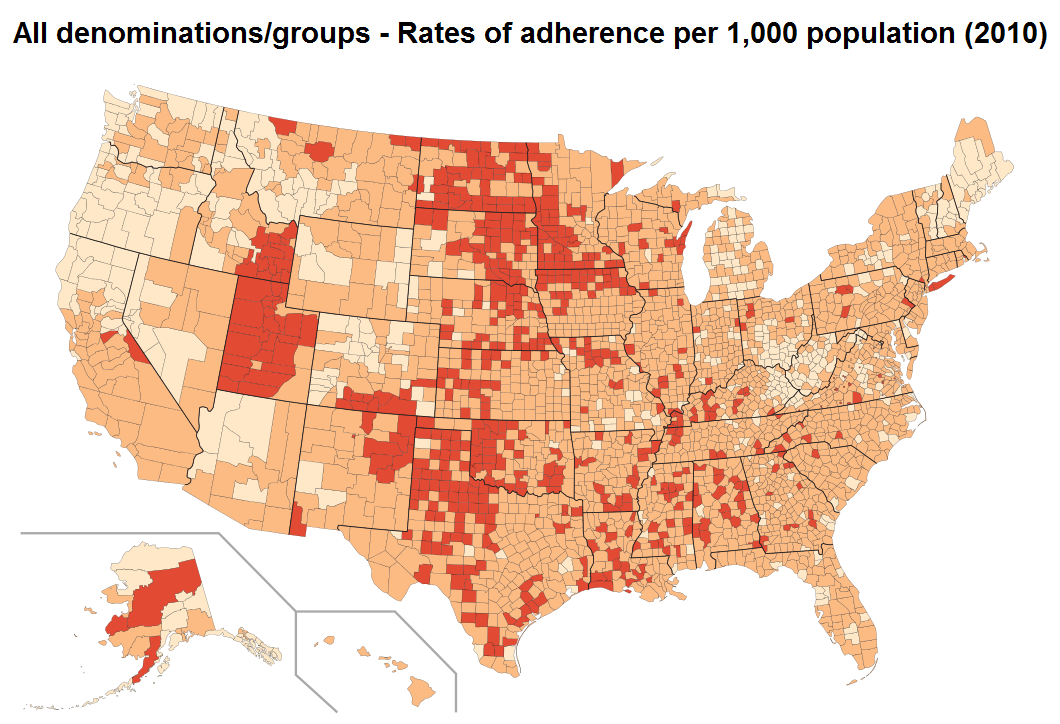
But, for now, just a couple of maps to get us going.

Cascadia has the highest level of regional diversity of religion:

Meaning, the marketplace for religion is stronger in Cascadia than any other region. There’s more competition here than anywhere else.
Also, like upper New England and the upper Ohio Valley, Cascadia has the lowest rate of adherents of any region.
This is the so-called None Zone.
So, as an opening. Cascadian religious culture is diverse, and in large part, unattached to any particular sect.

I never thought anyone would suggest not rebuilding the Oyster House (Olyblogosphere for September 23, 2013)

1. How do you take a picture of a big tree?

2. A nine year old group of women.

3. And, here’s a pretty nice piece from the OP&L on what’s going on out at Boston Harbor.

4. And lastly, speaking of the people living near the water. I scoffed at Ken’s post a few weeks back questioning whether the Oyster House would have a hard time rebuilding. No one would ever suggest leveling the building deep set in our urbanized downtown for restoration, right. Nope, Janine just did.

Draft of Call it Cascadia Manifesto

Don’t call us the Northwest. When you talk about the upper left hand corner of the United States (and possibly the lower left of Canada), go ahead and call us Cascadia.

Here are a few reasons why:

1. The current alternative is “Northwest” or the redundant “Pacific Northwest” (as if we need to distance ourselves from the Northwest of the Midwest) is colorless. It is a direction, not a region.

2. Also, the “direction from where” question is troubling. Northwest of what? Denver? What we call our region should be centered on this place, not on some other part of the world.

3. Cascadia is just a better name. Cascadia is actually where we are. It doesn’t look over its shoulder to some other place.

So, what am I missing here?

Walter Wilder shot himself in New Jersey

Prenote: If you’re thinking about suicide, talk to someone right this minute. Call 1-800-273-8255 or visit the National Suicide Prevention Lifeline.

It had been six years since the Capitol building in Olympia, Washington had been completed. Walter Wilder was in his home in Suffern New York, less than a mile from the New Jersey border.

While much of his life’s work was within a day’s travel of where he was at that moment, his and his partner’s largest work was 3,000 miles away on the the other side of the country. Also there was Florence Tunnard.

Wilder would shoot himself two years after his partnership with Harry White dissolved, after his mental health had spiralled downward and after his wife refused to let him divorce her in favor of Ms. Tunnard.

I wonder how in the day Wilder took his life if his mind wandered back to Olympia. The day the architecture firm got world over 20 years earlier that they’d won a contest for a new state capitol campus that would become their largest project. To the years he spent seeing his drawings come to life on the hill above the town on the edge of Puget Sound. And to Florence, the stenographer working at the state Attorney General’s office that he had fallen for.

At least in my part of the world, Harry White and Walter Wilder are most well known for the capitol in Olympia. It is a set of sandstone structures that to the amateur seem to emulate the national capitol in the other Washington. To the only slightly more informed, they are representations of an architectural movement called “City Beautiful.”

The dozens of other projects Wilder and White completed in their lives — houses, office buildings and college buildings — dot the New York and New Jersey region. They were successful in their own small way as architects, working consistently until the depression took hold and Wilders’ sanity lost hold.

In the end, the capitol group envisioned by Wilder and White was never built. After the construction of the original three buildings — the Temple of Justice, the domed legislative building and the insurance building — the state capitol planners took a break. The legislative building stood in the center of the unfinished group until the the middle of the Great Depression.

The state capitol commission eventually turned its attention to the back of the campus. With ample public money coming from the federal government for public works projects, the commission hired Olympia architect Joseph Wohleb to finish off the Wilder and White campus.

Wohleb is surprisingly similar to Wilder and White. If not for ignoring any contests to design state capitol buildings in eastern cities, Wohleb had a shockingly parallel career to the New York pair. His work is spread almost exclusively throughout the Northwest and mainly in Olympia. But, when it came to competing the last buildings constructed in the 1911 proposal, the state went to their home grown architect.

Wohleb had moved to Olympia just as Wilder and White had finished their original plans. As he put his head down and went on designing over 150 buildings throughout the decades. Surely, he would also look over his shoulder to watch Wilder and White at work.

But, in 1935 with Wilder dead and White still working in the east, those last two buildings were his to design. While it was outside his normal style, the stayed true to the partner’s original, classical style.

After that, the campus would turn west. forgetting the final pieces Wilder and White drew. One last office buliding (a matching pair to the insurance building, which flanks the legislative building on the east) was never built. Also, the once temporary governor’s mansion, (a permanent mansion envisioned by Wilder and White was to overlook Puget Sound on a bluff), is still hidden too far south.

In the 1950s and 1960s, the campus would creep east across Capital Way, further changing the original Wilder and White orientation from a northern facing to east. An entire neighborhood would be lost underneath new campus buildings.

One house that was eventually removed from Capitol Way — mercifully moved in one piece a mile to the south — was the Egbert-Ingham house. This house was where Walter Wilder lived when he met Florence Tunnard, the love for whom he would eventually kill himself.

Eventually, his campus would expand beyond his vision to uproot the house to the south. The owner of the house in the 1970s put it up on wheels and put it down where it still is today.

The rise and decline and possible rise again of the Olympia oyster

The history of the Olympia oyster — as talismanic center of a Puget Sound home grown industry — is one of the most fascinating stories around here.

It is literally an industry and species wiped out because of industrial pollution which itself doesn’t exist because of laws and social concerns that didn’t come about until decades later.

For decades dozens of small companies picked and packed these little native oysters and shipped them across the world. People like E.N. Steele, who wrote the book on the Olympia, dedicated large parts of their lives to the industry and the oyster.

Steele:

The oyster growers feel that the decline has been caused by pulp mill waste from the mill at Shelton.
 …

In conclusion, I must say that The Olympia Oyster industry is very sick. In fact it is, at this writing, on its death bed, unless the knife that is stabbing at its heart can be removed. Those who love the Olympia Oyster, and who grew it still have hope. In nature there is always survival; no such thing as extermination of species by nature. But trade waste is man-produced poison. There must also be progress in industry. But man has been given intelligence to find ways and means to prevent the
trade waste from destroying the natural resources so that all may survive and live together.

But, because of pollution from another home grown industry (timber), the Olympia lost its place to the immigrant Pacific oyster. While oystermen were disturbed to see that pollution was taking away the Olympia, they coolly and calmly replaced it with the more hardy Pacific.

But, now, because of impacts of ocean acidification, the tables might be turning on the Pacific. The chemistry of the oceans are slowly changing because we pollute too much. And, because of the way Pacific oysters reproduce, they’re apparently at a disadvantage to the Olympias.

From the The World in Coos Bay:

“The short answer is that the native Olympia oysters may be doing OK
and recovering in Coos Bay despite ocean acidification,” he said.

Rumrill,
currently the director of Oregon Department of Fish and Wildlife
shellfish monitoring program, was instrumental in Olympia oyster
recovery efforts at the South Slough National Estuarine Research Reserve
near Charleston.

“It may be that the shallow parts of Coos Bay may be able to act sort of as a buffer,” he said.
Oregon
State University Professor George Waldbusser said said difference in
survivability likely lies in the species’ reproductive practices.

“Olympias
are brooders,” he said, referring to the species’ trait of carrying
eggs in an internal chamber for several weeks after fertilization.

Pacific oysters, on the other hand, are broadcast spawners, meaning their eggs are fertilized and develop in open water.

Waldbusser
said the native species’ reproductive period is on the edge of the
coast’s seasonal upwelling cycle, when deep ocean currents force cold
water to the surface.

Upwelling is believed to contribute to the
acidification process by bringing oxygen-deprived, CO2-rich acidic water
to the ocean’s surface.

 We don’t dump timber production waste directly into Puget Sound the way we used to. We did it for long enough to put Olympias on their heals and the oyster world moved on to Pacific oysters.

Eventually our laws caught up to timber waste, but it was too late for Olympias. It would be supremely ironic that Olympias would stage a comeback on Pacific oysters because our laws couldn’t catch up with ocean acidification.

« Older posts Newer posts »

© 2026 Olympia Time

Theme by Anders NorenUp ↑