History, politics, people of Oly WA

Author: Emmett O'Connell (Page 37 of 177)

Political party affiliation in Cascadia

I’m not sure what I expected to find when I was looking for some data on party affiliation broken down by state. I thought it would mirror religious affiliation. Strong groups of affiliated folks along the edges, but also a broad center of non-affiliated folks who didn’t feel like they belonged to any particular party.

In a way, I did find that. Both Washington and Oregon have strong numbers (usually a majority) of non-Democratic or Republican voters.

The surprising thing for me was that New England was even independent. New Hampshire, Vermont and Maine (for example) each have strong independent numbers above both Democrats and Republicans. Outside a few other states, this pattern is pretty unique to Cascadia and New England.

So, what I set out to see was that if Cascadia’s anti-institutional and independent streak in religion extended to politics. And, maybe that’s true. There might also be a connection between religion and politics in New England. If you look at the maps here, you see large swaths of high variety and low allegiance in regions across New England as well.

I think there’s something to the way we vote in primaries around here, the actual machinations of voting, but that’s for the next post.

Duane Moore and the Black Houses

Black houses of Olympia by Jeremy Quist (via flickr)

People are trying to create a mythology around the Olympia Black Houses that simply doesn’t exist. There’s no evidence that Duane Stephen Moore is anything but a typical small business owner (in this case a dentist and a rental owner) who has unique atheistic tastes.

So, that’s my conclusion. Yesterday I put up a map I’d been working on of all the rental houses that Moore owns throughout town. Olympia’s biggest urban legend in recent years has been that there’s something sinister about the houses, that if you mapped them, they’d make a pentagram.

I don’t know what you can see, but there’s no pentagram there for me.

Take away the black paint that seems to touch almost everything (short of the Reef Bar downtown) he owns, Moore seems like a pretty typical entrepreneur. He owns over a dozen rental houses, at least three commercial properties, owns a construction company (to hire sub-contractors to take care of the rentals?) and is an active dentist in Shelton. If the color were blue or yellow (or blue and yellow), I wouldn’t be writing this post.

Also, there’s nothing in the Olympia code to prevent anyone from painting their house black. So, if the city is fining him for having black houses, I’m not sure why.

I didn’t talk directly to Duane (or indirectly) when I was putting this post together. Neither has anyone else that’s written about the black houses either. He’s been referenced a few times in the local paper, but never directly quoted. That gave me the impression that he’s someone that values his privacy.

Also, if I stand by my “regular guy, interesting tastes” position, then I wouldn’t call him, because there’d be nothing really to discuss.

Nik Neburn made the movie I linked to above about the Black Houses. He also made an interesting documentary about the Paul Ingram case. Nik quotes Norman Cohn to make a point about the Ingram case that I think applies to the black houses too:


To understand why the stereotype of Devil-worshiping
sects emerged at all, one must look not at the beliefs or behavior of
heretics […] but into the minds of the orthodox themselves.

While Olympia hipsters are hardly religious fundamentalists, the stories surrounding the black houses do more to cast Olympia overall as a weird and interesting place than to explain anything about Duane Moore or the houses themselves. Because we want Olympia to be a certain way, we make the houses seems weirder than they actually are. And, if it wasn’t the black houses, we’d find something else out there to make up stories about.

Olympia’s first collegiate soccer team and why I don’t like PLU

This is some sort of sports team, from the Washington State Historical Society:

But, I really doubt it is a basketball team, as labelled by the WSHS. Mostly because it labelled as being taken in 1885 and James Naismith didn’t create the game until six years later. I think its much more likely that what we have here is an actual soccer team.

For one thing, the year is pretty good for the spread of the game. The first nationwide soccer association launched in 1884, the first national cup in 1885 along with the first international friendly. While all three of these events occurred inside the New York/New Jersey area, soccer obviously existed while basketball did not.

You can find some trace evidence of soccer in Washington State in the same era. This 1891 newsclip from Yakima mentions soccer being played.

Now, here’s some funny history about the Olympia Collegiate Institute. At different times, appently both the Methodists and Lutherans ran the old OCI, but merged them with Tacoma-area schools at different times. The Methodists absorbed OCI into the University of Puget Sound in the 1880s. The Lutherans restarted OCI (Later the Pacific Lutheran Seminary), absorbing it into Pacific Luthern University in the 1910s.

While Tacoma couldn’t end up stealing the capital from Olympia, they did make away with two colleges.

Why does Olympia have a low immunization rate?

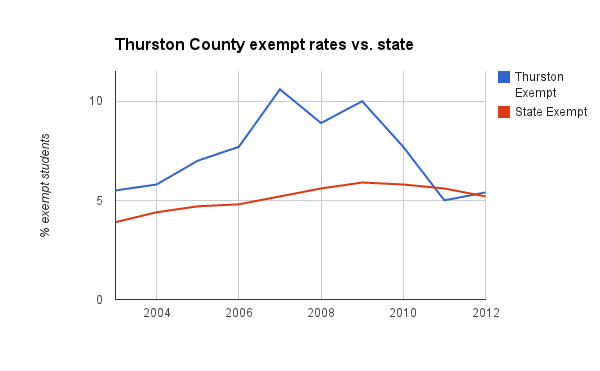
A couple of years back I was shocked (shocked!) at the high rate of immunization exemptions in Thurston County and especially the Olympia School District. Back then the state had just passed a law where parent’s have to more expressly say why they’re exempting from immunization. Apparently that extra social hurdle has worked in Thurston County.

While the countywide trend has gotten back to the statewide average, it looks like Olympia still stands out like a sore thumb in the county. All of my data came from here.

County rates are coming down:

Olympia still out there:

Cascadia is known for its high rates of people who don’t like giving their kids shots (for whatever reason), but there’s been very little explanation of why. Some people pointed to that in Washington it had been easy to get out of immunization. But, that has changed, and the rates are still pretty high.

What if there is a broader social culprit? I’d say its possibly a cause of how people on the ends of either the left or right liberal slant (traditional political spectrum) don’t necessarily feel the social pressure to conform to something getting immunized. The Inlander piece I linked to earlier points out that homeschoolers and religious schools have some of the highest rates of exemptions in 2011. Possibly our social culture of living and let living allows for people to shut themselves off from guarding the public health.

A quick look into the long history of corporate distrust in Cascadia

From Cascadia PDX:

“The corporate state is not science fiction. Corporate agribusiness is
taking over what, how, and who grows food in my community. It has become
obvious that the government isn’t going to lift a finger to stop them.
It’s clear that the people, in the places where we live, must break the
chokehold of a system of law favoring corporations to one that
recognizes community rights.”

Dana Allen of Corvallis, Oregon

Dana is not expressing an unpopular sentiment around certain parts of Cascadia. Even outside what most would consider liberal urban enclaves, most people would express at least latent mistrust of big companies.

But, like a lot of things that make up modern Cascadia, this isn’t a new thing. Early settlers to Oregon and Washington brought with them a mistrust of the new corporate model. In the creation of both major American Cascadian states, delegates from Appalachia clashed with more corporate friendly New Englanders in how corporations should be handled.

In Oregon in the 1850s:

Many of the delegates entered the convention with a strong mistrust of
corporations. They had seen abuses in the Midwest and elsewhere in which
unscrupulous corporate operators had left innocent stockholders deep in
debt and workers unpaid. Other delegates saw no way for Oregon to move
forward without easy access to “the genius of our age to incorporate.”
Some of the debate would revolve around stereotypes of corporations as
large and uncaring machines of the economy that routinely chewed up
farmers and workers.

Eventually, they landed on  a sort of homegrown middle ground for corporations:


They looked to the benefits provided by corporations that would enhance
rather than threaten the rural character of the agrarian ideal. An
example could be viewed only a short walk from the convention where the
final work was being completed on the Willamette Woolen Mills the
territory’s first large factory. This corporate endeavor was home-grown
in origin, scope, and benefit. This was proof that, within the proper
framework and regulation, corporations could benefit Oregon and free it
from the need to import expensive products from far-off factories.
Otherwise, Williams warned, “We must pay tribute to Massachusetts and
New England all our lives, unless we can devise some way here for the
erection of manufacturing establishments in this state.”

When Washington got around to drafting a constitution in 1878, a lot of these same discussions went into crafting the document. Washington Territory didn’t end up getting statehood in the 1870s (an 1889 constitution was eventually approved by Congress). What was theoretical in Oregon in the 1850s was a practical discussion in Washington during their drafting.

Some of the provisions adopted by the Walla Walla Convention reflected distrust of corporations and railroad. All charter and special privileges that had not been fulfilled in good faith were to be invalidated at the time of the adoption of this constitutions. This provision was apparently directed against the Northern Pacific Railroad whose land policy was unpopular in Washington Territory because it made no real effort to build a line in accordance with its Washington charter until after 1880.

Other provisions including making stockholders individually liable for actions of their company and outlawing banks.

New, secret and undeserving (Olyblogosphere for December 2, 2013)

1. Just when I thought there were no new Olympia blogs, Mojourners launches ArchaeOlygist! Oh my! No new bloggers, but new blogs!

2. No one knows who the secret artist is in Olympia, even Alec Clayton, other than Olympia isn’t his home, just his  canvas.

3. Do the folks who got arrested down at the old WDFW shop last spring deserve the Oly 6 name? The Birmingham Six were sentenced to life in prison for something they didn’t do. Arrested for trespassing? I don’t know.

4. Ken writes about the Ports Lies. I’ve been reading a lot of environmentalists on the other side of the political spectrum from Ken this week say the same thing. This is exactly how Sue Gunn got elected in the first place.


5. Rebels By Bus is a great blog. Finally they post again.

The time when the King County Arts Commission complained about the cultural insensitivity of the Seahawks logo

Just about a year before the Seahawks finally took the field, they were in a somewhat similar position as the Washington NFL franchise is now. The logo the Seahawks had been handed by NFL designers didn’t directly borrow from local tribal design standards. The King County Arts Commission complained that it “fails to accurately depict the art principles of Northwest coastal Indians.”

From the Northwest Indian News (a newspaper) in September 1975:

Among the differences found to be inaccurate is the characteristic eye form. The Commission enclosed a suggested correction by Marvin Oliver, Quinault… Oliver depicted regional art principles in the design.

It shouldn’t surprise me at all, but the original Seahawks design came from people working out of Los Angeles. I kid you not. I can just imagine the designers in the LA spring, cracking some books on Pacific Coast tribes, copying down ideas.


(Seahawks general manager) Thompson said the NFL firm did refer to some books on Northwest Indian culture. “Our intent was to follow the Northwest Indian culture, but there was no condition placed on them (NFL) in designing.”

The Arts Commission further stated, “As with all great art, a full understanding and appreciation does not come quickly. Hence it is not surprising that the new logo fails to depict with adequate sensitivity the arts principles of the Northwest coast Indian peoples.”

Since that first season, and the back-and-forth between the commission and the team, the logo (especially in the eyes) has strayed even further from Oliver’s suggestions (from From Rain to Shine).

Native Appropriations brings us to the today, nearly 30 years into the Seahawks design. The blogger, a tribal member and law student, is writing about a particular use of the Seahawks logo that incorporates even more tribal designs. She like it, but examines where it fits in culture:

…I question my endorsement after my analysis naturally evolves into
larger questions about art, identity, acceptance, and what happens when
Native cultures live harmoniously (or at least not so adversely) with
others?

Where we start to move away from imagery of a fan’s foam head towards a
fan’s headdress or mask is the face: the two green paint lines on the
cheek suggest the 12th Man is wearing “war paint” instead of mimicking
the black grease or tape the players use on their cheeks to cut down on
glare. Now it’s starting to look more like a hipster appropriation and
misinterpretation and I wonder – was the inspiration for this design a
transformation mask?

I’ll link again, because it is worth reading this entire post.

Driving Alone vs. Taking the Bus in Thurston County 2012

I love the data from the American Community Surveys, so much so I wish the Census started doing them in earnest earlier than 2005. So much interesting data, but only back less than a decade.

I started poking around the commuter data this week for Thurston County, and found some interesting comparisons between people who drove alone and people who took the bus (or public transportation in general).

The first comparison on income is pretty obvious. For drivers, it peaks in the middle and drops off at the ends. Nothing too interesting. For bus takers, the peaks are at the ends, with a much larger peak towards lower incomes. There is a pretty interesting spike at $75,000+ for public transportation, not sure how I’d explain that.

 
This chart I think starts to get into the deeper difference between drivers and bus riders. Again, you see a broad diversity in the drivers, they seem to leave when it is convenient. For bus riders, I think what we’re seeing is a hard pipeline of when they have to leave for work, since the buses will only get them there on time at certain times. You also don’t see commuters taking the bus early in the morning, since the bus doesn’t run that early in the morning.
  
This last one shows the greatest difference, I think, between the two groups.  Again, general diversity across the drivers. But, no one takes the bus for commutes less than 20 minutes. In fact, if you do take the bus, you’re likely taking it for at least an hour.

 I

The Olympia Yacht Club is getting their Capitol Lake History wrong

Big surprise, right? Because remember these signs that tried to connect a brackish estuary with bugs that are prevalent in stagnant freshwater?

Anyway, if you head to the section of Percival Landing that crosses the access to the yacht club, you find this sign.

The middle panel confusingly refers to the period of time in Olympia of the “long wharf,” when Olympia business interests were trying to defeat the mudflats north of downtown to find access to deeper waters for shipping. Eventually, through a combination of building the port peninsula with fill and dredging a basin, those mudflats were defeated by the 1930s.

It is pretty spurious to connect this era of filling tidelands and building the long pier to building Capitol Lake in the late 1940s.

This is really a story of two parts of Olympia, the section facing north trying to find shipping routes and the part facing south, looking at the capitol. These are really two different discussions. It took until the mudflats north of downtown were defeated in the 1930s for the discussion to build Capitol Lake to really his its stride. The Port of Olympia had been created, a channel and basin had been dug, and downtown Olympia had been filled out to meet it.

Ironically, it was keeping shipping lanes open to Tumwater that slowed down Capitol Lake for a few years. Tumwater city fathers (including the Schmitds of the brewery) didn’t think it was a good idea to dam the Deschutes to stop boats from getting to their city. They were eventually won over, but trying to connect shipping concerns with the origins of Capitol Lake is wrong.


But, that isn’t to say that the idea of creating a freshwater lake out of part of Budd Inlet didn’t have a shipping connection at one point. Strangely enough, in the long tale of where Capitol Lake came from, there was once a freshwater lake solution to the port’s mudflat problem.

Back in 1903 (eight years before Wilder and White) W.R. Brown put together a small group to try to create a freshwater harbor in Olympia, along the lines of Lake Union in Seattle. Instead of damming the Deschutes estuary at 4th or 5th Avenue, they would go out to Priest Point and build a massive berm there from shore to shore.

Morning Olympian, January 10, 1903:

Like nearly all pre-Wilder and White damming the Deschutes ideas, they were actually to facilitate commerce. The Schmidts of Olympia Beer actually dreamed a plan near to what the yacht club sign describes in 1895. The beer family thought that by creating a lake, they could ensure steady boat traffic to their brewery. But, those plans faded and by the 1910s, Tumwater and the Schmidts were opposed to any sort of damming, up to the point of roadblocking a 1915 plan.

Anyway, that’s a lot of history to unpack. You can read most of the story here at the Deschutes Estuary history page.

« Older posts Newer posts »

© 2026 Olympia Time

Theme by Anders NorenUp ↑