History, politics, people of Oly WA

Author: Emmett O'Connell (Page 33 of 176)

What makes Cascadian sports fans different?

Back mid-winter, when Seahawk fandom was hitting a fever pitch, there was a general lament among more hardened sports followers that many of the new-found fans lacked gravity. They were bandwagon fans, only interested in following a team after success has been found.

This is a common enough thing that happens when teams start to win, borderline fans start buying t-shirts, start tuning in and start learning players’ names.

But, the accusation up here was that in particular Cascadian bandwagon fans are inauthentic because of the automatic seriousness and put-on gravity they bring to their fandom. They aren’t just normal borderline fans showing a renewed and healthy interest, they are suddenly the most intense fans of a team 18 months ago they couldn’t have cared less about.

I won’t deny this. It does seem to me that most people who are interested in sports, or could be interested in sports in Cascadia, float around the surface of interest, only taking the plunge when there is enough social acceptance to do so. Like, especially, when there is a winning team to support.

But, I would argue that this isn’t an unhealthy thing. But, I’ll get to that in a little bit.

First, just a few observations about the special state of Cascadian sports.

1. We have a very short history of being major league. While most East Coast and Midwest cities have over a century of major league professional heritage, our history starts with the NBA (then not a very significant league) in the late 1960s. Seattle didn’t enter football or baseball until the 70s. So, college sports not-withstanding, we’ve been a minor league region for most of our sporting history. So while we can complain that we haven’t won much, in the grand scheme, we haven’t played for much either.

2. So, college sports still dominate our sporting culture and history. And, Husky football dominates the college sports world. The UW football program is the only tradition that even tries to reach as far back as other fan cultures around here. But, it is one program in one portion of Cascadia. Deep, but thin.

3. East coast/California bias. Our teams exist in a continental world. So, not only are we punished by being out of the mainstream of North America, we’re a second thought on our own coast. So, in terms of cutting through the noise across the continent, sporting companies from two mid-sized cities in a mostly empty corner of the country hardly stand a chance.

So, that’s what we have going against us.

Here’s what I’d argue what we have going for us. The thing that makes Cascadian sports fandom good is the exact thing that I described hardened sports fans complaining about above.

In terms of religions and politics, Cascadians are hardly joiners. Much less joiners than the rest of the country. We stand out on our own, isolated from organizations and groups. So, the loose ties of sports fandom makes a lot of sense in this way. We don’t grow strong ties to community of faith or politics, so why would the majority of us do so with sports?

But, how does that explain the intense band-wagoning when a team is good?

Well, it shows that we put our sports fandom into a decent perspective. Only the most hardened and short sighted fan would argue that sports is more important than other civic needs, like education, health care or the general economic well-being of a community.

Sports is fun, it is entertainment and it should be enjoyed. So, why agonize when your team sucks? Its better to just take your focus of it the Mariners now (or the Seahawks in the 1990s) and go climb a mountain or play ultimate.

The rise of Zach and other spring things (Olyblogosphere for April 21, 2014)

1. Zach Mandeville is the reason why I read Olympia (or Tumwater) blogs:

Tumwater is not kind to you when you’re feeling down.  It’s at a low
point these days with a lot of empty houses, empty buildings, and
snobby, eye contact avoiding state workers walking their lunch break
rounds.  But it’s also bright May.  The Japanese maple on the corner of
Hazelhurst has burnished to a beautiful red.  All the enterprising
businesses and retired neighbors cut their grass this morning, so
there’s these outpost colonies of summer every few blocks.  On the
corner of Lee street a man had cut his grass and was now throwing a ball
for his adorable lab puppy.  A few paces down was the disheveled,
cinderblock house where, every day that I pass by it, I see a man
sitting in the middle of the living room with his head in his hands. 
Then I passed the insurance company, with grass freshly cut and again
the deep full scent of summer.    I felt like I was in a Sci Fi
setpiece, adrift in a busted ship moving from oxygen tank to oxygen
tank, or maybe a deep ocean fish moving from sea vent to sea vent.

 2. Eastside Urban Farm blog has their own signs of spring.

3. Mathias at Everyday Olympia has something nice to say, apparently new shops are springing forth downtown. We may save Olympia yet.

4. The Sky Like A Scallop Shell is a blog I’ve only recently followed. Prepare yourself to be spooked.

Why can’t Olympia get some sort of semi-pro soccer going on? Or, we need the Tall Boys (someone help Brandon out)

In the next few weeks, between the Evergreen Premiere League, the National Premier Soccer League NW and the good old PDL, there will be three different non-pro/non-amateur leagues kicking off in this state.

And, none of them have a club in Olympia or even Thurston County.

The last time we sniffed at a local semi-pro league, it was the good old Tumwater Pioneers. They ended up folding after just one year. Even though the soccer was great, their results weren’t. And, apparently, the financial returns weren’t either.

We even have had Olympia semi-pro teams in the distant and not so distant past.

So, as we’ve seen teams become established in Bremerton, Bellingham, Everett and even Vancouver, Olympia has failed to put anything on the map. What is it about Olympia that has prevented anyone from coming forward with a team?

Last fall, Brandon Sparks (Oly Sports Blog Brandon) came forward with a pretty smart of thorough outline for an Olympia team in the ELPWA

Why Olympia?: The cities of Olympia, Lacey and
Tumwater are home to over 108,000 residents and Thurston County’s
population is over 250,000. There is only one professional or
semi-professional team in the area – the Tumwater Pioneers indoor soccer
team – and no direct sports competition in the summer. The area has had
great success supporting soccer over the last two summers when over
1,200 fans flocked to watch the Sounders U23s and Portland Timbers U23s
play at Tumwater Stadium. The area is home to multiple large and active
youth soccer organizations including Blackhills FC, Puget Sound Slammers
and Thurston County United and men’s college programs at Saint
Martin’s, Evergreen and South Puget Sound.

Why the EPLWA?: The first reason is simple: cost.
The EPLWA has been designed to be budget friendly charging just $1,000
in league fees. This allows for teams to put more money back into their
communities and programs and will allow teams to be more financially
stable over their first few seasons. An EPLWA team can compete at a high
level – potentially participating in the US Open Cup – for
significantly less money than a PDL team with the same opportunities for
generating revenue.

As far as I know, no one responded back to him.

I hope Brandon doesn’t lose heart. I hope he keeps his idea out there for next season, that we get a team together.

Here’s to the Tall Boys.

How downtown Olympia was almost ruined by I-5

Shanna Stevenson’s chapter in “The River Remembers” (edited by Gayle Palmer) is a thorough history of transportation through Tumwater. Most of it is a lead in to Tumwater’s most notable historic wound, the construction of Interstate 5 through the historic center of the city.

Stevenson’s history includes an interesting footnote on what could have happened if Olympia had gotten its way. Instead of going straight through the old Tumwater historic neighborhood down by the former Budd Inlet waterfront, the Olympia city leaders wanted the highway through their city.

The proposed route was to loop the interestate through the town coming from the west through the Percival Creek canyon. Then, it would go through downtown in a tunnel under 10th or an elevated roadway over 7th.

So, the two options both included a highway at the foot of the capitol campus. Option one was a new tunnel. Option two was a viaduct running just south Sylvester Park.

This overlay of Olympia in 1941 with our current roads shows exactly why this was feasible. Even though the old Swantown Slough was filled for decades by this era, very little of the south end had been developed.

http://1.bp.blogspot.com/-8lUQ5__b1Os/U0rNlNHplwI/AAAAAAAABv0/UV_sVx5csL4/s1600/1941+overlay+I-5.jpg

After finding a way through downtown, it would have been easy to route the interstate through the rest of town.

I also find it interesting that when this plan was seriously being considered (1952 through 1954), it was the early days of Capitol Lake. The city was advocating for a major interstate to loop through a place that they’d just spent more than a decade pushing to become a lake. Hardly fitting the Wilder and White vision of Capitol Lake creation, I’d say.

Of course, Capitol Lake then was hardly the park rimmed area it is now. In the 1950s, the first lake park was still ten years off. There was still a major rail yard on the south bank under the capitol and industrial buildings were still on other banks.

So, in the mind of the city leaders, in the early 1950s, the lake being the setting of a major downtown park was hardly in the plans.

Going through Tumwater ended up being cheaper, so the state highway commission chose that route. But, it wasn’t because Olympia didn’t want it.

The tragedy towards the end of the local ownership of Olympia Beer

Seattle Times, 1983

We all mourn the closure of the Olympia brewery. We all hope it comes back, at least the territory of the brewery, to become a new heart for our oldest non-native community.

Decades before our latest mourning, we mourned the sale of the company and brand to non-local owners. I wrote a bit about this history over at Thurston Talk recently. The story centered on a phenomena originating in the prohibition of tobacco advertizing in the late 1960s:

The true factor leading to the Schmidt family’s sale, in the early 80s, where market forces dating back to the ban on tobacco
advertising on television in 1971. Phillip Morris, one of the largest tobacco purveyors, decided to diversify a few years before the ban and bought Miller in 1969.
The Miller sale sounded off like a shot to the once traditional and staid brewing industry. “Budweiser met the challenge,”
Knight said. “The two companies started buying up every market in the U.S., rolling over smaller breweries.”
While it might seem like the tobacco giants were buying beer companies, what they were really buying was geography.  The
quickest way to break into new beer markets was to buy existing beer companies, gaining loyal beer buyers and their preferences, along with beer distribution arrangements.
A few years later, the Schmidt family reacted by buying Hamms (1974) and then later Lone Star (1977). “Olympia was a little late
getting into the game,” Knight said.
“They had to get bigger or get a lot smaller,” Knight said.
“Each time Olympia bought a new brand, it would give them a boost.”
Olympia’s attempt to appeal to the drinkers in the newly acquired
territories included the Artesians campaign.
But, in trying to keep up in a race of quickly nationalizing brands, the Schmidts eventually ran out of family talent and stock. In 1983 Paul Kalmanovitz (who owned Pabst and had also bought other Washington brands like Lucky Lager) bought Olympia Brewing
Company.

This is a totally plausible and realistic story that is backed up by other histories of the era, which additionally cite legal troubles brought on by the mergers. But, this business-centered history runs counter to the local knowledge of why Olympia was sold. Because the then president of the company was caught having sex with another man in the Capitol Lake bathrooms.


This did happen. In early 1980, in the twilight of locally-owned Olympia Beer, Rick Schmidt and two other men (a state legislator and a state agency director) were arrested for lewd conduct. The three non-out-of-the-closet men quickly faded from their public lives. All three quit their jobs and disappeared for awhile. Eric Rohrbach (the former state legislator) is back involved in local politics.

Both Schmidt and Joseph “Dean” Gregorius (as far as I can tell) never reentered public life.

The question is, whether Schmidt resigning had much to do with the eventual sale of the family firm. I’d say very little. The Schmidt family was doomed by nation-wide forces, not by the fall of the scion.

Research has pointed out that family-led companies have a particularly bad time reacting to industry-wide change:

The cultural view of family firms implies that these firms might be less willing to make changes to their overall strategy even when market pressures ask for such changes. Out of a sense of duty and respect for their elders, younger generations might find it difficult to change decisions such as where to locate, what to produce, or which customers to serve.

Just being a family-owned company is bad in the long run:

This paper provides strong evidence that promoting family CEOs in publicly traded corporations significantly hurts performance even after controlling for firm and industry characteristics, and aggregate trends.

I find that, consistent with wasteful nepotism,declines in performance are prominent in firms that appoint family CEOs who did not attend a selective undergraduate institution. In contrast, comparable firms that promote non-family CEOs do not experience negative changes in performance, even when incoming unrelated CEOs did not attend selective colleges.

So, what is the tragedy here? Sure, its bad that Rick Scmidt left the company. And, its bad that Olympia Beer had to be sold, instead of surviving as one of the few family owned breweries.

But, the real tragedy is that Schmidt, Rohrbach and Gregorius were arrested and publicly outed in the first place.

Let’s go back to Olympia in 1980. According to this history, the “Capitol Lake Bathroom Bust” followed “a period of harassment and police targeting of Gay men.” This also isn’t a time when men with public profiles could live out of the closet.

The reason the arrests of these three men was news was because they had public profiles, but also because the arrests were of gay men.

And, let’s put into perspective the operation that brought them in. The Olympia Police Department spent two weeks looking into the bathrooms before coming up with anything.

These type of operations, where police would stakeout homosexuals, hoping to come up with an arrest, has been called harassment by activists. The time spent by OPD in 1980 to come up with a few lewd conduct arrests certainly makes it seem that way.

Arrests like this also had deep social wounds. From a San Antonio library blog (of all places):

“I am primarily concerned with this grieving family in my parish, with
the fact that we have lost such a wonderful man, and the news media
played such an important part in driving him to suicide. There is no
question but that his learning that his name had been published was the
direct cause of his jumping off a bridge. . . .I also would say very
strongly that a society that pays its policemen to spend hours on their
haunches or lying prostrate on the top of a building peering through a
hole to spy on men is a very sick society.”

This excerpt from an
anonymous letter that appeared in a 1966 issue of Christianity and Crisis  captured
the devastation exacted on men who were caught having sex in public
restrooms and had their names published in the newspaper after being
arrested. Sting operations by law enforcement officials against
homosexuals in public places were nothing new. In San Antonio, police
had been ferreting out gay cruisers in Travis Park–located in the heart
of the city–since the 1940s. But were undercover operations
and demonization of those caught in the web of such actions indicative
only of the era that predated Stonewall in which homosexual harassment
was part and parcel of urban life?

We are a different town now. Our police are much more honorable. We are much more fair. But, we have to get our stories right.

The Olympia Brewing Company was caught in an economic storm that was swamping family breweries. That Olympia went down is nothing special. Rick Schmidt wouldn’t have saved them.

Blaming the loss of the brewery on him is unfair. It also takes blame off of us, the way our community was not at all accepting of homosexuals. The sting operation, the public castigation, the disappearance from public life of these men. That’s the sad story we should tell, the cautionary tale.

Signs of spring (Olyblogosphere for April 7, 2014)

1. Sue Gunn, despite sounding environmentalist, is still holding the conservative line in Thurston County. At least according to Ken of Lacey.

2. One little post about Moving to Olympia becomes the meta-fight of the city.

Says one:

Statistically we have a much higher population of youth homeless than is common.

Says another:

You’re still focusing all of your energy onto the symptom and not the problem.

And, another:

Young people choosing irresponsibility in life shouldn’t be the burden
to bear of those who are responsible enough to pay our own way through
life.

 Move to Olympia. Get more of this. Just don’t move here without a job. Seriously.

3. Ryan Williams lives around here and he’s a pretty good writer. The Myth of the Day Off. Look, here are all of the books by him.

4.There are a lot of local guys in professional baseball. More than you think.

5. Via Olyblog, through a tweet by me, copying and pasting an email I got which included an attachment of an essay by Bethany Weidner. Things are getting warm in the Planning Commission.

Cascadia, the (urban) region of the Big Sort

This was a stupid blog post.

In it, I was trying to prove a point. That even though there is from time to time a surge of new people coming in to Cascadia, that the population already settled here is so big, that our regional personality (the Cascadia Calm) wouldn’t be usurped by Southern Charm.

I still don’t think Southern Charm is going to take over, but I ignored one specific piece of important information in that post. Most of the net migration in Cascadia is going to two places, Portand and Seattle.

So, if you’re moving to Cascadia, you’re much more likely to move to an urban place or somewhere near an urban place.

So, the question remains, are all those new residents changing the urban areas or Cascadia? Well, sure. But, you have to ask yourself, why are they moving their in the first place? Because they want to change it, or because it is the type of community they like to see themselves in? I’d bet it was the latter.

I’d also argue that Cascadia was particularly well positioned to take advantage of the Big Sort, the drastic demographic shift post 1965. Millions of people uprooted themselves and moved to places like Seattle and Portland, and still do. When the economy is good here, people come flooding in to our cities.

We were well positioned because our regional personality was literally open to it. We’re a business friendly crowd, so new ventures are typically seen as a good thing. This goes back to our New Englander capitalists origins. We’re also a live and let live sort. This goes back to our Appalachian, Ohio Valley farmer origins.

The data backs this up. When you rate regions by “openness,” Cascadia floats to the top. The same study points out that open people (creative, patent pending sorts) migrate to an open area, the effects tend to build on themselves. When the good times roll in Cascadia, more open people show up and “that change may lead to an increase in liberal public opinion and patent production and, thus, to a more open culture.”

So, we get even more urban, even more liberal, open and creative cities. Our cities are recruiting people because we’re Calm and the Calm builds because we’re recruiting more urban people.

The deep politics of Oso

The thousands of tons of mud aren’t dry, the recovery isn’t complete. But, people are alrady scratching their heads why more wasn’t done to warn or prevent people from living beneath “slide hill.”

When I look at the hear of the area covered by the slide, a neighborhood along Steelhead Road in an oxbow of the Stillaguamish River, I can see a neighborhood already familiar with the perils of living at the business end of nature.

Riverside living and the floods that go along with it is already ignoring the risk that you’ll face floods every once in awhile. Living in an oxbow is just asking for floods.

So, asking why the county didn’t do more to warn or move these people from the riveside or from below the slide area is asking a big question. It centers on the difference between the perspective of rural landowners and suburban and urban people that make up of Snohomish county civic life.

Plainly said, the people who run the county and the people who lived on Steelhead Road are the faces of two radically different parts of Cascadia. This is more than a traditional right/left or red/blue political and social divide. While in many ways it follows that dichotomy, it has its own Cascadian flavor to it.

And, the answer goes back to the founding of the non-native society out here. There are two major groups that put down early roots and still define much of our society: New England capitalists and Appalachian farmers (mostly from the Ohio Valley).

For much of our history out here, the New Englanders migrated to the urban Puget Sound. They founded timber companies, ran the Republican political machines and owned the newspapers. Before the Democratic surge in the 1930s that wiped away the Republican political advantage, these New Englanders were political life in Cascadia.

But, the Appalachians were always there. While they identified as Democrats nominally early on, they stuck to the well-spaced rural areas of the state. Their influence on our political culture has been the strain of what we’d now call libertarianism that stretches pretty far across our political spectrum. In the recent election returns on gay rights and marijuana (that included both rural and urban votes) and one recent local election for me, it is possible for this libertarian strain across both liberal and conservative politics in Cascadia to unite.

So, back to Snohomish County and the folks on Steelhead. What was it about our political origins that caused this tragedy?

 
…there were
discussions over the years about whether to buy out the property owners
in the area, but those talks never developed into serious proposals.

“I think we did the best that we could under the constraints that nobody wanted to sell their property and move…”

Take a simple look at it like this. Urban and suburban Snohomish County (and Cascadia) are the decedents of townie Republican New Englanders. They’re business friendly and with a deep seeded civic mindedness that has sprouted a sense of environmentalism. That sense of doing what is right for the good of the community brought them to point out that slides happen were they do and to map flood areas.

But, the ability to do anything about it stopped where it became obvious that no one wanted to listen to them. The deep sense of individualism that came west with the Appalachians in Cascadia still rules the point of view, especially along the Stillaguamish River.

Sadly, one of the former political leaders on the Appalachian end of the spectrum likely died in the Oso mudslide.

Sure, it is possible to offer enough money to make anyone want to move. But, it isn’t like Snohomish County had magic public funds growing fairy dust. And, when it came to spending that limited public money on someone that really didn’t want to move in the first place. Well, you see where the attention of Snohomish civic leaders can be distracted.

Its easy to point to the available evidence and blame well intentioned people for not doing more. But, it is worth looking back at our origins here and seeing that it isn’t simple.

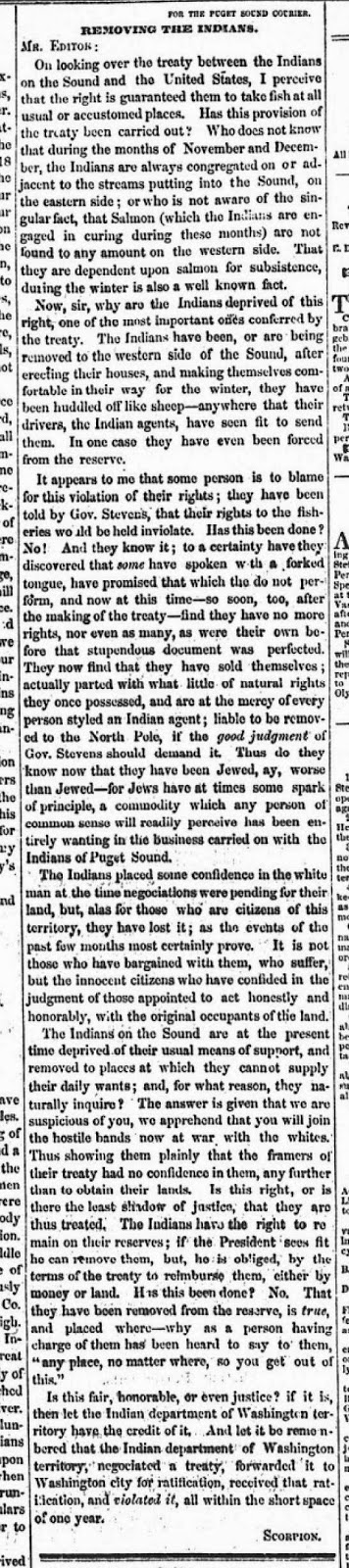
I’m not sure if it is true, if it matters. But, in any case, people of Chinese descent have had a long history on one particular block of downtown

This letter to the editor (actually just one passage of it) in Olympia Power and Light bothers me more than it should:

Columbia Heights Partners LLC, a Chinese backed company…

 Backed by the Chinese? Why does that matter? Is it the implied xenophobia that matters to me? Probably.

Yes, the major investors behind the project have Chinese names, but live in Washington.

The person seemingly managing the project was born in China, but went to school in North Carolina and is an American citizen.

But, now in terms of who builds what downtown, we’re concerned about what country they come from?

Especially when the Chinese connection to that particular block of downtown runs way deeper than I assume the letter writer knows. If there’s one particular block of Olympia where people with Chinese names should build, its that one.

Ed Echtle, as always:

As downtown expanded in the late 1880s, Chinese relocated their
businesses to the corner of Fifth Avenue and Columbia Streets, on what
was then the waterfront.  Five two-story wood frame buildings, housing
the Hong Yek Kee Company, the Quong Yuen Sang Company and the Hong Hai
Company were built on piles over tide flats.

Here’s a couple other views of the block, where you can see the layout of Chinese businesses on the block where now a group of Chinese-American businessman want to build a new building:

1888, mostly down on 4th Avenue, ironically where the New Moon Cafe is located.

And now, just one labelled “old Chinese” in 1896 on the southwest corner of the current parking lot:

By the way, these maps are Sanborn maps and are available online at the Timberland Regional Library.

Everyone hates the Olympian, everyone hates Nazis. These two things are very much not the same, obviously (Olyblogosphere for March 24, 2014)

1. On one hand the pro-People’s House people hated the Olympian’s editorial.

2. On the other hand, the anti-People’s House people hated the Olympian’s editorial. At least we all can agree on something.

3. Here’s Rick taking us on a ride around South Puget Sound CC.

4.The person who runs the Nuit House (who knew it existed?) points out that 200 people would like to relocated to a low cost home for artists.

5. Hey, go back up to #3 and think to yourself, speaking of old time Olyblog people. Our favorite Sarah from McCleary is back. Apparently spurred by the reappearance of Nazis in Olympia, which is obviously a sad event. But, its good to have Sarah back in the saddle. Boy, it was almost 8 years ago now that the Nazis and Sarah first crossed swords.

« Older posts Newer posts »

© 2026 Olympia Time

Theme by Anders NorenUp ↑