History, politics, people of Oly WA

Author: Emmett O'Connell (Page 34 of 176)

Empty downtown Olympia

No one lives there:

Seriously, downtown Olympia is in the same category as my neighborhood, and I live in an unbuilt wasteland where people wish there were taller buildings

 WastBut, of course, when someone talks about building a seven story building in our empty-of-people downtown, people speak up, because this is some sort of horrible thing. Like we should be protecting parking lots from the evil expansion of multistory housing.

I can’t speak to his stats, but David Scherer Water, makes a striking point about how downtown has changed as Olympia has expanded:

Less than four percent of Olympia’s population lives downtown. This is
the lowest this ratio has been in the City’s history. A hundred years
ago more than half the population of Olympia lived downtown. Fifty years
ago it was about ten percent. Today 96% of our population comes
downtown to visit, to shop, to party and they leave. I believe this is
the source of most if not all of the complaints commonly made about
downtown. We need more people to live downtown.

 Density is good. People living downtown is good. More people living in a dense neighborhood means fewer cars, more people walking and more services and good things downtown.

Happy Irish Day, Seattle Celtic were local champs 99 years ago

Back in the dark forgotten history of Cascadia, soccer used to be a pretty big thing around here. In the first decades of the 20th century, there was a thriving local soccer culture. There were several clubs in Seattle and the surrounding towns, especially logging or coal towns dotted around the cities.

Seattle Celtic lifted the cup in March of 1915:

You can read my much longer birds-eye-view piece about the early history of Puget Sound soccer over at GoalWa. Here is a peak into the period of the Celtic club’s championship run:

The Post-Intelligencer Cup was won by the Seattle Celtics; Tacoma
was second, Carbonado third, and Black Diamond fourth and last. These
teams and the Seattle Rangers and Woodland Park clubs competed for the
McMilan Cup. Both cups are played for in the league system.

The McMilan Cup competition was a seesaw affair from the
beginning to the end, and the winner was only decided after the last
game had been played. The Tacoma team finished ahead of the Celtics by
one point ; Black Diamond, Carbonado, Rangers and Woodland Park followed
in the order.

Boy, lifting the knockout tournament cup, but missing the league title by one point to Tacoma? Ugh. I feel for the Irish today.

Mostly because I assume the Celtic brand is a powerful one (that goes way further than the borders of Glasgow), there is a Seattle Celtic club still.

Why one issue elections are the dark side of local politics

Karen Veldheer signed to put R-71 on the ballot, to overturn same sex domestic partnerships in Washington State. But, when talking about equal rights during her city council campaign, she failed to mention this.

I was thinking about five years ago in Olympia recently. At the time I was posting a lot about Karen Veldheer’s candidacy, and some other folks were responding:

I hope you can look past a candidate’s religion, and not stereotype
conservative Christians as a people unable to accept or respect
homosexuals, or uphold legislation or benefits that aid others who hold
differing beliefs.

During campaign, Veldheer clarified in a closley phrased manner that even then seemed to contradic. someone that signed an R-71 petition:

I support the city policy for equal benefits for same sex domestic
partners.  I am a member of the orthodox Presbyterian church and my
religious faith will have no bearing on the decisions I will make as a
civic leader on the Olympia city council.  I believe in a separation of
Church and State.  Further, the state of Washington provides over 200
civil rights, many of which are very important to the Gay, Lesbian,
Bisexual and Transgendered communities, and I support these laws as
well. 

 But, she was willing to work towards overturning one of those rights.

Anyway, Veldeer lost that November to Karen Rogers who maybe even better embodies what I’m actually trying to write about. That when politics of a community are narrowed down to a single issue, you get really crappy politics.

2009 in Olympia politics was all about development on a strip of land downtown called the isthmus (its really an urbanized earthen dam, but who’s really counting?). Even the secondary issue of council relations with the public was also about the isthmus, because some in the public thought they weren’t being listened to.

Both Karen Rogers and Karen Veldheer came from the side of town politics that were hard against the isthmus development and thought the council was being pretty tin-eared. But, Veldheer would have been an odd fit in Olympia politics had she won or continued being involved. And, Karen Rogers really did end up being an odd fit.

As she settled into her seat, Rogers eventually became the lone vote against any sort of government activism. Its hard to think that Olympia had elected a small government, fiscal conservative, but there she was. The fog of the isthmus issue had obscured Rogers’ politics.

Too the point that when she ran for county commissioner, Rogers sometimes acted more conservative than the Republican:

Her initial campaign spin for county commission builds common cause with conservatives and south county residents. In an interview with Janine Unsoeld,
Rogers even played up how STOP Thurston organizers thanked her for a
city council vote. While this may disturb lefties who supported her
mayoral run, pivoting to the right makes electoral sense because that
could discourage a Republican candidate from entering the race. Rogers’
chances increase from iffy to decent if she doesn’t have to run against
both Wolfe and a Republican candidate in a primary.

Then again, some described Rogers  then (where libertarian left and right meet) the same way I described Sue Gunn here. And, Gunn did pretty well in Olympia against a typical business friendly Democrat.

That said, I still think local elections are better when they’re broader than one issue, one building or what we should do on one single block. We elected local politicians to do a lot of things. And, with the collapse of the economy in 2008 and the quick council action, it didn’t take long for any development in downtown to disappear.  We still expect these people to govern well outside of hot button issues.

Spring is rebirth and passing (Olyblogosphere for March 10, 2014)

1. Everyday Olympia is back! And, pointing to a really nice Sunday morning conversation about Olympia.

2. Berd’s ears were hurt by the fairly common sign of spring, the Pacific tree frog.

3. The late Joe Dear honored in a Youtube upload at Evergreen. Apparently Dear didn’t like being called “John Dear.” I once heard about an interoffice delivery that was sent back from the governor’s office because it was addressed to John Dear. Nope, no John Dear here.

4. There was a stickup at out SPSCC and some sort of system didn’t work.

5. And, the rebirth of a massive awesome building project in downtown Olympia, covered by Janine’s Little Hollywood.

The biggest issue with the bioregional map of Cascadia

Is that it isn’t a bioregional map of Cascadia. Fellow Olympian Matthew Green commented awhile ago:

The upper Columbia watershed has more ecological similarity to the upper
Colorado watershed than to the lower Columbia. Consider that a
relatively modest (geologically speaking) change in topology could join
them into a single watershed, thus radically altering the
watershed-defined “bioregion” but without fundamentally changing their
ecology.

 So, to illustrate this, here’s that classic map of the Cascadian bioregion:

Here’s the Forest Service map of eco-regions, zooming into Cascadia:

  
This map looks much more like the coastal Cascadia map I was rooting for here.
The larger bioregional map, I think, is a much more expansionist idea of Cascadia, pushing the borders out towards where Cascadia doesn’t really exist right now. Or may ever. I don’t think its a coincidence that this map is also more attached to those folks that are also expressly seccesionist. These are both Cascadia’s that don’t yet exist.
But, I’m more worried about Cascadias that already exist, socially, politically and ecologically. Or, at Matthew would say:
I don’t think it’s a coincidence that the map which emphasizes human
cultural similarities actually does a better job of showing ecological
zones than the bioregion map does.

The paywall to public records in Washington State

If you request a digital public record from a city, ditch district, or state agency in Washington State, they’re instructed to turn it over to you for free.

If you request a public record from a court, say a 16 page court filing on a medical marijuana case, that is going to cost you nearly $30. For a record that already exists in a database.

Until recently I’d assumed Thurston County was a special case. That our clerks office was one of the few charging outrageous fees for public records. But, because of a bill passed in 2005, every county clerk in Washington State is required to establish a paywall to digital public records.

Being able to read a 16 page public document shouldn’t cost almost $30.

Court funding in 2005

SB 5454 was introduced to the legislature in January after years of discussions and meetings by judges and other court officials throughout Washington. The Board for Judicial Administration established a task force on court funding in 2002. At that point, judges had complained that local governments routinely stripped courts of funding when times got tight.

The idea was to give local and other courts more stable and dedicated funding. After just over two years of meetings, the end result was a bill that increased existing fees established a long series of new fees for citizens interacting with the courts.

One of the fees included being able to access county clerk records:

For preparing a certified copy of an instrument on file or of record in the clerk’s office, for the first page or portion of the first page, a fee of five dollars, and for each additional page or portion of a page, a fee of one dollar must be charged. For authenticating or exemplifying an instrument, a fee of two dollars for each additional seal affixed must be charged. For preparing a copy of an instrument on file or of record in the clerk’s office without a seal, a fee of fifty cents per page must be charged. When copying a document without a seal or file that is in an electronic format, a fee of twenty-five cents per page must be charged. For copies made on a compact disc, an additional fee of twenty dollars for each compact disc must be charged.

Certified copy for lawyers vs. non-certified for me

I highlighted the passages up there that I consider important for this discussion. The fee for a “certified” copy many be high, but that is because there is an extra level of human review for those copies. Only certified copies of court records can be used in courts, so lawyers accessing those records need to have them looked at by a clerk official before they’re deemed certified.

On the other hand, non-certified digital versions (which can’t be used in court and are only informational) have a fee of 25 cents per page. This is where the paywall to public records goes up.

Let’s take a step back and talk about what sort of records we’re talking about. Clerk records include any sort of action or filing with a local court. These could be a lawsuit filed against your town’s largest employer. It could be a court order against an elected official. These are the raw data or an entire portion of our government, and they are hidden behind a special paywall that no other public record in Washington is allowed to use.

Like the Thurston County Clerk’s office, many county clerks maintain a database of all clerk records. If you made a similar request to a non-court government agency with a similar database, the Washington Administrative Code strongly suggests that “(t)he agency cannot attempt to charge a per-page amount for a paper copy
when it has an electronic copy that can be easily provided at nearly no
cost.”

PRA vs. Common Law

As surprising as it may sound, court records are not covered under the Public Records Act. That said, “common law right of access to judicial records is well recognized in this country.” This means, that while no legislation exists specifically allowing public access to these kinds of public documents, enough traditional and case law exists to assume there is a right.

That said, there obviously isn’t enough of a right to make it easy for citizens to access their own court records. You should have to pay almost $30 to read a 16 page court filing in a case regarding statewide ballot initiative.

Easy fix

The fix is easy. All we need to do is drop the fee for non-certified copies of court records that already exist in a digital format.

This wouldn’t exactly be a hit to the budget of county clerks throughout the state. When I contacted my clerk last summer, I learned that while it cost $60,000 to maintain the entire records system, requests only brought in about $40,000. And, just over a quarter of those documents came through the sytsem’s online database (or ecommerce system).

Even if half of the e-commerce documents were non-certified, then it would be a very small portion of the income coming from citizens literally looking to read a public document. The vast majority of the fees would be from lawyers or other folks looking for useable in court certified documents.

Public information should be free and why I’m watching the Thurston County clerk race

If we pay to maintain a database of public information, we should charge prohibitive fees to simply access that information.

Some background at “The paywall to public records in Thurston County” Part 1 and Part 2.

For the first time since 1990, there will be an open race for Thurston County Clerk. The clerk is the interdependently elected official who provides administrative support for our local court system. So, if you want a copy of court fillings or some other court record, you go through the clerk.

But, like I pointed out in the links above, that could run you $30 for a 16 page document. And, this is just for downloading the file.

So, the clerk’s race is the one race I’m watching this year.

Right now there are two candidates filed at the Public Disclosure Commission, Yvonne Pettus and Linda Enlow. Both Pettus and Enlow have years of experience in county clerk like offices, both of whom serving as chief deputy clerk under the current clerk at different points. Actually it seems like Pettus replaced Enlow in 2012 as chief deputy clerk.

In case you were wondering, Gould made a $200 donation to Pettus, so she’s apparently endorsing her current chief deputy.

Pettus’ website is pretty stale and Enlow currently has no website at all. So, trying to figure out which one puts more emphasis on public access is pretty hard.

The people behind the RECAP project talk a lot about why public access to court records matters. They’re of course talking about federal courts, but even in our medium size Puget Sound community, this should matter.

I’d argue that it matters more here because there are a lot more resources to create an popular tool like RECAP to open up a closed system like PACER (the federal court record database). But, here in Thurston County, I doubt we’d be able to muster that kind of support.

So, we would depend on a good county clerk to ensure public access to public documents.

Good view, love day and things open or turned on (Olyblogosphere for February 24, 2014)

1. Now, this view is surprisingly nice.

2. Happy sappy love day from the re-use folks.

3.Ken went to the Olympian, along with tons of other folks apparently. Not to knock on the Olympian doing a good thing like inviting the public in to talk to news staff, but I remember when the Olympian literally had a public newsroom. Back in the late 90s, I remember you could walk straight back into the newsroom without having to check in.

4. Janine’s Little Hollywood turned her RSS feed back on this week. Which is great for someone like me. Showing how much I care, here’s a great post on some Tumwater brewery planning.

Enoch Bagshaw collapsed and died in Olympia, the state and region collapsed around him

It was a strange road that led Enoch Bagshaw, the legendary Husky football coach, to Olympia in 1930. But, it was specifically and literally a road.

Bagshaw had been a young public works man in Snohomish County before his life’s vocation found him taking up the position as Everett High School’s gridiron football coach. His success at Everett led him to succeed the four coaches in four years that had attempted to replace UW’s first great coach, Gil Dobie.

Welsh born Bagshaw was not friendly. He won games, and led the high powered Husky offense to two Rose Bowls (tying one, losing the other).

Washington as a state was flying high through the 20s. And, if Bagshaw was the symbol of Washington’s sporting accent throughout the decade, Gov. Roland Hartley was the political embodiment. Laissez-faire to Hartley would be putting it mildly. Hartley wanted to cut down government to a size in which it would not interfere with timber men like himself, or any other capitalist.

And, like Baghaw’s Huskies, Hartley played rough and tumble, ignoring the polite insider politics that often made things happen in the state.

Hartley would also turn out to be Bagshaw’s last benefactor. Both men hailed from Everett (though both were born elsewhere). After Bagshaw finally left the Huskies, Hartley brought him down to Olympia to serve as a transportation administrator.

The Enoch Bagshaw that moved from Seattle to Olympia in the spring of 1930 was not a well man. The 1920s had been hard on his body. He probably didn’t know it, but his road was a short one.

As Seattle progressed towards the Great Depression in the summer and fall of 1930, there was a lot of doubt that Cascadia couldn’t keep on growing as it had in the 1920s.

Seattle Times in July:

“Seattle looks very good, said Mr. Oakes. “Your shops and stores and your industrial activity indicates that your people are not paying much attention to the toalk of business depression that is so much the topic of conversation in other centers at this time. You seem to go serenely on your way…”

And, in in November:

As in all depressions, much of this depression is psychological. People in Seattle are unduly depressed because they hear exaggerated rumors that people elsewhere are depressed. What people really ened is to know the facts. When these facts sink in, our people will realize that things are, as Mr. Coue said, “getting better and better” — and then, they, too, will feel better and better.

 By 1931 only 62 percent of those employed in Washington two years before still had jobs. Timber exports in 1933 were half of what they were in 1929.

Neither Bagshaw nor Washington may not have realized its heart was ready to go out.

It is ironic that the building in which Bagshaw died (today where the Office of the Superintendent of Public Instruction is located), then called the “Old Capitol Building” was also a symbol of our own economic over exuberance here in Thurston County.

Its its first life, the Chuckanut stone building was the Thurston County Courthouse. Built in the high flying days following statehood, Thurston County soon ran out of money, and sold it to the state, which was looking for decent quarters.

And, a final note, Hartley, who lost in 1932 to Clarence Martin, was fond of tearing down portions of state government. 1932 would be a highwater year for Democrats in Washington State. Both Hartley and the U.S. Senate seat would be turned over to Democrats that year. To give you a good sense of the how much 1932 change politics in Washington State, there were 41 Republicans in the legislature to one Democrat. In 1933 there were 21 Republicans and 25 Democrats. A couple of years later there were 41 Democrats and five Republicans (the total number of seats had gone up).

Last, what is one of the agencies that Hartley went after in his high tide days in the mid 1920s? OSPI.

The mystery of the capitol gulch, a surprise stadium and what it means to be a capital city

Sometimes I think about what it means to Olympia to be a Capitol City. I’m not sure how many times in history it has happened, but I’m sure at least once a city has lost that status. Throughout the early history of Olympia, that tension, the possibility that Walla Walla or Yakima or Tacoma might snatch the seat of government seems to be overpowering.

It has been decades since anyone has thought about moving the capitol or even a good amount of state employees out of northern Thurston County. But, we still make civic decisions based on our status as the seat of government. The debates about issues like restoring Budd Inlet or downtown development are influenced by the gravitational pull of the state government.

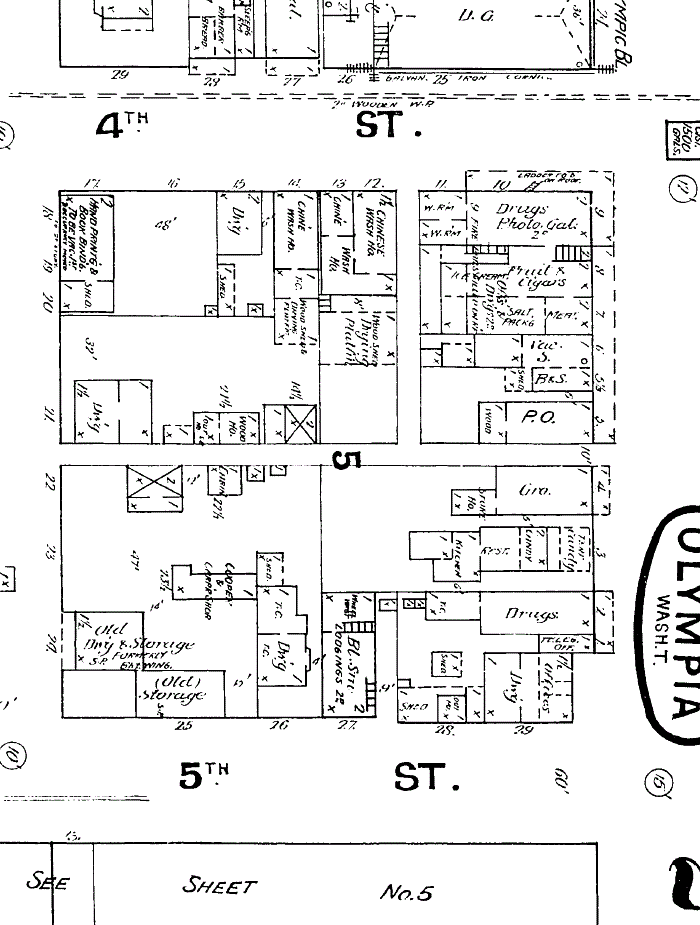
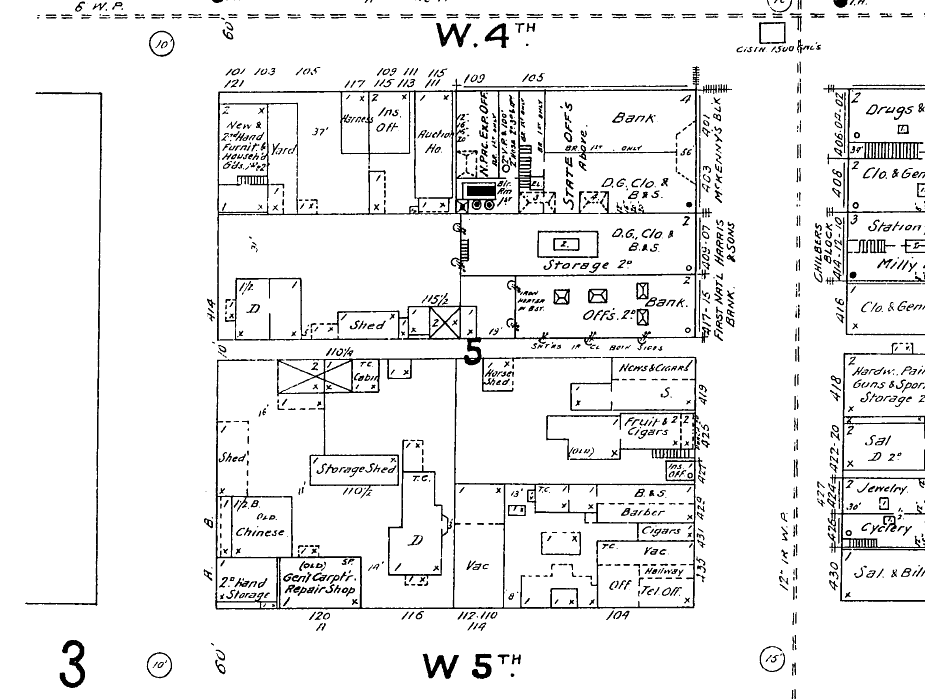
If I haven’t changed the header of this  blog by the time you read this post, you’ll see the graphic is a detail of a Sanborn map of Olympia. You’ll notice a gulch that no longer exists running through what is now the capitol campus.

Here’s another map from 1919 that show it in much better detail (via Washington State Digital Archives):

The history of this gulch has always fascinated me. I’ve always wondered where it went, who decided to fill it in. It seems pretty straight forward given the context of history. In the early 1920s the campus was being developed. The gulch was in impediment to that development, so it was filled in.

But, I could never find a record of when or how it was filled.

Recently I learned the gulch had a bit more interesting of a history than just a former ditch in the way of a beautiful campus. As state leaders were gathering ideas for the layout of the modern campus in 1911, they decided a stadium would be built inside the gulch

The Olympian, April 1911:


The Stadium Bowl had just been finished in Tacoma inside a similar Puget Sound gulch, and local leaders imagined the Olympia Bowl as a smaller version.

But, as the capitol plans were slowly rolled out over the years, no stadium was ever included.

The proposed stadium was almost totally forgotten until local leaders tried to bring it back up in 1921. They not only wanted a stadium, but to save what was left of the gulch itself, which had been used as the trash bin for the capitol builders.

The Olympian, September 1921:

But, obviously the gully was filled and the stadium was never built. In 1922 30,000 yards of dirt were hauled to the gulch by the contractor who was grading the campus, finishing off the gulch for good.

Now, obviously the gulch still haunts us. All that fill is slowly working its way downhill, to the point that the beautiful greenhouse that sites right on the crest of the fill closed six years ago.

Filling the gulch to create a even lawn running up to the campus and not building a stadium is the type of choice that capitol cities make. Olympia did need a stadium. The old Athletic Park  wasn’t much. And, even Stevens Field (new in the early 1920s), when compared to a possible Stadium Bowl on Budd Inlet, doesn’t exactly shine in comparison.

A nice clean campus is good for state government, it just looks nice.

A utilitarian and centrally located stadium would’ve been good for Olympia. These are the things we give up when we decide to fight to be state capitol.

« Older posts Newer posts »

© 2026 Olympia Time

Theme by Anders NorenUp ↑