Olympia Time

History, politics, people of Oly WA

Page 45 of 178

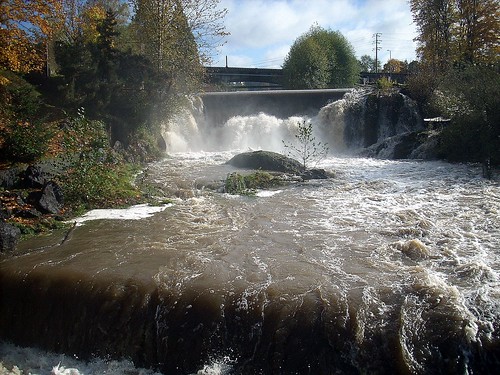
This is not a waterfall, but a dam. All about Thurston County Dams

By Waponigirl on Flickr.


Now, I’m sure you see it clearly now. But, what a lot of people call the upper waterfalls on the Deschutes in Tumwater is actually a derelict dam. It is also (according to my list) the oldest dam in Thurston County by nearly 40 years.

There are a surprising number of dams in Thurston County (35 total), now that I think of it. All but one were built in the last 100 years. The busiest decade for dam building was the 1960s (with eight built). I’m also surprised by the number built in the 1980s and 90s (five each).

The stormwater pond dam over at SPSCC has a surprisingly high risk rate, “From 7 to 30 lives at risk.”

Most of the dams — 15 out of 35 — are both earth fill and were built to create recreational reservoirs. Three of these actually have “ski” in their names.

There are also dams in surprising places, Grass Lake for example. This is a small lake surrounded by a City of Olympia park. The dam was built in 1966 for the original purpose (I assume) of irrigation.


View Larger Map

Grass Lake dam illustrates what I take away from the list of Thurston County Dams. Most of us read the word dam and see the Elwha dams, the Grand Coulee or even our own La Grande Dam. Something big, blocking a big river. But, most of these dams are smallish, practically fading into the landscape. You don’t even know a dam is there.

May Day! (Olyblogosphere for May 15, 2013)

1. Just a little old (vintage 2008), but the insight is pretty interesting on downtown and how to make it better. Some people are happy the way downtown is now.

2. May Day report #1 (from Mr. Tom Hyde): “As the TV news crews and other journalists trailed in their wake or
marched along the sidelines with phalanxes of police, I couldn’t help
think it was all so … pointless, and more than a little pathetic – for
the disorganized protesters with an incoherent message and seemingly
absent worldview (“fuck everything” is neither a particularly brilliant
nor achievable solution)…”

May Day report #2: Dumb Kid with a Skateboard.

May Day report #3: And, no Olympia event would be complete without Your Daily Hour With Me.

And, the fellow who had the run in with the anarchists at Evergreen posts his own May Day report.

3.  Ducks reclaim the west side streets a few days early.

4. Also, one of the most sad posts ever on one of the most common feelings in Olympia ever (over at r/olympia): Why People Leave Olympia.

Earl Newell Steele comes to Olympia, 1903

Doan’s Cafe, Olympia, WA 1906 (UW Digital Collections)

From a longer piece I’m working on about E.N. Steele, Olympia lawyer, civic leader, oyster booster and treaty rights activist:

Earl Newell was born outside of Des Moines, Iowa in 1881. After graduating from State University of Iowa, he made a short tour of the west. Once in Olympia, he sat down for a dinner of oysters. That meal sealed Olympia for Newell.

Steele tells the story in his unpublished manuscript, “Letters to Grandpa” about a chance meeting with an old friend and an oyster lunch kept Steele in Olympia:

I again met people from Seattle who strongly advised me to locate in Seattle. Two of my classmates in college had located. But again some thing told me “No, see Olympia first.” So I listened, but I had to change at Centralia to get to Olympia. And that proved to be the most fortunate decision of all. We arrived there about noon. Not knowing where I was going I started toward what appeared to be the business district. I had not gone more than a couple of blocks till I met a young man. We took a good look at each other.

Then he stopped facing each other and he almost shouted at me “Pete Steele, where did you come from?” “Roy MacRenalds, where did you come from?” I then recognized him, for he said “Pete”, and I had not heard that since I left school in Perry, Iowa, We had been friends in school. We had both lost track of the other. After a little chatter he said he was on his way to lunch and asked me to go with him. We went to Doan’s Oyster House. He ordered Doan’s oyster pan roast. As they served it he said, “Pete, after you eat this you will never want to leave Olympia.” He had spoken more than he knew. I had never eaten any thing I enjoyed so much.

So Steele stayed. He started out as a teacher in Tenino, but eventually entered the law practice in Olympia in 1903.

Steele’s love for Olympia is obvious in his writing. He was either a great salesman for Olympia or the rest of his Iowa-based family (four brothers, sister and mom and dad) had tenuous ties to Iowa. Within months of Earl settling in Puget Sound, all seven of them made the trek west to Washington State.


The past and future are right now (Tacoma newspapers and Joint Base Lewis McCord)

A Swarner Communications arts and entertainment (and some news) publication folds back into the mothership, as noted by Mathias:

The Weekly Volcano, a alternative newspaper serving the Tacoma, WA and
the greater South Sound, including my little city Olympia, folded this
week.

…

With the growth of the JBLM military base, it’ll be interesting to watch how our area will change over the next few years.

 1. It isn’t all that surprising that Swarner Communications (the owners of the Ranger and the Airlifter) folded the  Volcano back further into their main publications. They made the decision in 2009 to take what was the stand-alone Volcano and revert it back into an insert of their main publications. When the Volcano launched in 2001 as an insert, it was actually the re-branded Tacoma City Paper.

2. And, to say Joint Base Lewis McCord will grow is to be saying something true in 2000. JBLM has grown, and its influence has obviously grown (past tense) in Thurston County.

Just for reference, here’s a map of the 33 minute driving distances from the JBLM main gate, which brings in much of north Thurston County.

Here’s also some old stuff where I point out at least our congressional political world will probably have a lot to do with JBLM politics. Our congressman’s tour of post sequester life focused unsurprisingly on the impacts of federal spending cuts on the military.

But, when it comes to actual numbers, I’m not actually sure if JBLM has made that much of an impact on Thurston County. Here’s my working spreadsheet and charts.

Sure, Thurston County is in the top five of above average counties in terms of percent of military population:

Island 8.13
Kitsap 5.5
Pierce 3.48
Thurston 2.04
Spokane 1.04
Wash. 1.03

And, the Old Navy at the Capital Mall has a large sign announcing special 10 percent off for active duty military families. I’d use those facts and anecdote to say that we are already a military community, at least in part. And, the growth of the military population has been largely consistent, with no real drops since for over two decades.

But, in terms of real number, the military population in Thurston County is so small compared to that of Piece (28,000 to only 5,000). So, maybe I wouldn’t be so brave as to say we’re really a military county, but you’d have to recognize that JBLM’s growth has been happening for a long time.

3. Extra bonus thought: yesterday I was driving through town (after I saw the Welcome Military Families sign at Old Navy) and was thinking of intersections between military folks and typical progressive Olympia folks. I could think of very few on the car ride. But here’s one from Berd (who probably represents one extreme of the equation).

Berd (A story from the Peace Vigil):

I went to look at the fire that had broken out in the area of West Bay Marina, and struck up a conversation with an Army Ranger veteran who had toured Iraq and Afghanistan. 

He was initially quite aggravated and offended by the sign I was carrying, but once I explained in my own words what I thought the sign meant, he was in complete agreement.

May 1, 2000: A look back at my first and only go as an online reporter

Thank you, Internet Archive. You Rock.

Olympia Today: May Day Marchers Head to Westside Streets 

I wrote this piece when I was running the above Olympia Time website. At the time, the site was actually owned by a small web design firm that I approached as part of an independent contact at Evergreen. Ah, the independent contract… boy, those were the days.

My idea was to add regular content to a site that was already sort of useful (with a perl weather script and a series of interesting maps) and watch what happened. I think I called the project an online community newspaper.

The run up to May Day 2000 in Olympia was stressful. It would come only five months after the WTO protests paralyzed Seattle and no one knew if these sort of things were rising to some crescendo. In the end, I think it would be remembered as a big and long, if otherwise uneventful and typical Olympia protest. Traffic was tied up, but no lasting impact.

May Day 2000 turned out to be (as I remember it) the high water mark for the site under my control. It was certainly the most interesting day for me and the highest web traffic day too.

My goal was to head over to the west side, watch May Day unfold, take notes and pictures, and then go home and put everything online. My ultimate goal was to beat the Olympian online with a final report, and I think I really did do that.

Obviously, I tried to strike a straight up newsy tone:
Celebrants and protestors marched
this afternoon from the Value Village at Division and Harrison to the corner
of Black Lake and Cooper Point. The marchers took the intersection in what
they call an act against global capitalism. 
 

I was also more interested in the other people not taking part of the march (like me), but were there to watch in some official capacity:

No local politicians were
recognized, but Olympia’s Police Chief Gary Michel was present, standing
with other senior officers north of the intersection on Black Lake.


I love my third person reference, no politicians were recognized, instead of “I didn’t see anyone I recognized.”

I was also fascinated by the media response:

The march attracted
much of the regional media, including Olympia bureau chief for the Seattle
Times David Postman (who also brought a photographer), an AP photographer,
KING 5, KOMO 4, KGY’s Doug Adamson, the Olympian, and helicopters from
KIRO 7 and Fox’s Q13.

KGY was the most active among
the media, interrupting their regular broadcast to bring updates. Adamson
road shotgun on a specially outfitted truck in which he broadcasted updates
and followed the march. The Olympian also did their first midday update
on their website to cover the story.

Doug Adamnson really did do a massive job that day, I mean check him out.

And, I suppose I really didn’t “beat” the Olympian, they did do a midday update. But, it is worth noting that if I read myself right, it was their first midday website update ever. That’s certainly something.
Water, wells (Olyblogosphere for April 28, 2013)

1. The most quintessential of Olympia discussions over at /r/Olympia: state office work versus regular office work. Discuss.

2. Wondering what’s up with Make Olympia. Well, that’s what’s up.

3. HA! I feel the same way at Mathias: “…we just had about a dozen cupcake shops open up in the last 24 months.”

4. Oh my God.

5. From Marcus Lane: Water.

6. Jinkies! College students (no Greeners) are all up to hijinks!

7. Makes sense that we’re talking about, but gun ban at SPSCC is controversial.

Tumwater Towers, once you know they’re there, you see them everywhere

Where else in Tumwater have copies of this tower spread?

Encouraged (at least in part) by actual City of Tumwater code:

To encourage design elements that convey the historical theme of Tumwater. Pitched or mansard metal roofs, decorative brick facades, and ornamental towers with pitched roofs and decorative cornices are examples of design elements that reflect the history of Tumwater. Several of these elements are incorporated into the designs of civic and commercial buildings along Israel Road, including Tumwater City Hall, Tumwater Headquarters Fire Station and the Tumwater Timberland Library.

Right nearby the actual brewery, for one.


View Larger Map

A sort of not-obvious one, but one that got me thinking:


View Larger Map

Another one, down the street:


View Larger Map

The ordinance above actually lists a few examples of public buildings, so I’m just going to skip those ones and look for some other examples that might not be so obvious.

Do you think this qualifies? I’m almost sure I’ve seen this chain of hotels with a similar design.


View Larger Map

Kind of an easy one, really:


View Larger Map

Olympia Beer, looking at a budget Puget Sound culture from Los Angeles

The headquarters of the Olympia Brewing Company, literally on Santa Monica Boulevard.


View Larger Map

Just a bit different than the original headquarters.

Since the 1980s, the Olympia Beer brand has been passed around several national beer companies, landing with Pabst in 1999. By the time Pabst bought Olympia, it was already a virtual brewer. A maker of beer in name only, or simply a company that owned the intellectual property of branding and making beer, and not the means of brewing itself.

That year was the same year that Olympia the beer was separated from Olympia the brewery, as the building was passed to SABMiller. That outfit ended up closing up shop in Tumwater in 2004.

So, the idea of “Olympia Beer,” “It’s the Water” (which still weighs pretty heavy around here) is owned out of Los Angeles and is likely controlled by some sunny Southern California creative firm. So, what does that mean?

Actually, does anyone want to be the brand manager at Pabst? Looks like they’re hiring.

Well, when they try something new, they kind of get it wrong.

Back in 2010, Pabst launched a sort of rebrand of Olympia Beer. The cans went retro (which only just satisfied the hipsters in Seattle) and the attitude of the brand itself seemed to move to some sort of grittier version of hipster PBR.

And, I’ll be honest. I’m confused by this Sasquatch (Bigfoot) contest. It seems to have satisfied the minimum requirements of a beer brand game, it got attention with minimal effort by giving a large reward for something that will never happen. It also seems to tap into the sporting nature of drinkers, but I’m not really getting a good idea of how much participation they’re getting. Really, most of the “sightings” on their map seem oddly fake.

This guy I think says it best, though.

Also, to me, Bigfoot is what people from outside the Northwest call Sasquatch. Which absolutely makes sense.

What I left unsaid about baseball, ambition and community


I recently submitted a rough outline of Olympia’s minor league baseball history to the local historical society newsletter. It was based on a longer piece that I really hadn’t put finishing touches on, so I took out some thoughts that strayed off the historically cite-able path. They were mostly thoughts on the communities that made up the well defunct Southwest Washington League.

Here’s the piece in the Olympia Historical Society Newsletter: Olympia in Minor League Baseball.

Here are my extended editorial thoughts, in rough form:

(League organizer John P.) Fink first reached out to organizers of local teams in the timber towns early in 1903, asking them if their communities had it in them to step up to professional baseball. First on his list were Olympia, Chehalis, Centralia, Montesano, Aberdeen and Hoquiam. 

These six cities were at the time very similar. Today, they stand apart culturally and demographically, Olympia in particular. In more than a century, Olympia has gone from a timber town in the same classification as Aberdeen and Chehalis (with a state capitol) to a city on the southern edge of the Puget Sound metroplex. Olympia grew from just under 4,000 to more than 10 times that size. Today, you can put Olympia together with neighboring Lacey and Tumwater and get more than 100,000 people living in and around Olympia. This is more people in either of the individual county’s that also made up the Southwest Washington League in 1903.

The 1903 cities of the old league almost seems like ghosts now. Olympia has grown outside its 1903 version, practically leaving nothing behind of its former self. The other cities have grown, seeing high times after World War II. Through the 1930s and World War II Olympia lagged behind cities like Aberdeen and Hoquiam. It wasn’t until 1960 that Olympia was the largest in population. It was the 1980s that Olympia started putting real distance between itself and its former league-mates.

While state government grew and Olympia took advantage of its connection to the urban centers of Washington, the other cities in the old Southwest League suffered from the decline of the timber and other resource industries.

Olympia became even more distant as it got more liberal relative to its neighbors. Being the home of state government and the politically and culturally liberal Evergreen State College, the old Southwest League towns turn their ire at Olympia. The infamous “Uncle Sam” highway billboard in Chehalis has included many anti-Olympia messages over the years, including “Evergreen State College – Home of Environmental Terrorists and Homos?”

But, as Fink sent out his inquiries in early 1903, these really were cities of the same league.

Views and shorelines (olyblogosphere for April 15, 2013)

1. Not really from the blogosphere, but I’m not sure if anyone else has pointed to the really interesting videos the city posted from their shoreline discussions. These are two visualizations side by side of what certain regulations would look like in terms of actual buildings.

2. Speaking of views, both Stevenl (at Morty and Olyblog) and CIAguy have been sharing historic views of the Capitol from various vantages and vintages.

3. Mojourner Truth blogs about the impacts of the coal port in the future of the northwest in someone’s community:

I’ve never lived by a coal port, and Olympia is too small to be in the race. But I do drive Route 14 up the Columbia from time to time, I have tried to sleep in Stevenson as the plains rumble through, horns blasting, and it’s hard to imagine how a massive increase in traffic would be tolerable.
…
If a coal port happens–and the relentlessness of North American capital suggests it will–the lucky winner will likely learn some hard lessons. Many of the construction jobs will go to outsiders, and operations won’t generate the employment or revenue expected. At Cherry Point, we’ve already learned that the proponents’ initial statements about the volume were a fraction of what they really plan, that there will be twice as much traffic and pollution. Friendly promises will be reneged. Coal, being a global commodity, may become more profitable (leading to increased shipping), or the bottom may drop out (causing jobs to disappear from time to time). Even if you support coal power, does it make sense to sell our reserves to China, whose import policy is partly to protect their own for the future?

« Older posts Newer posts »

© 2026 Olympia Time

Theme by Anders Noren — Up ↑