Olympia Time

History, politics, people of Oly WA

Page 44 of 178

Better Bob Bunting

Joseph Bunting is largely believed to have killed Quiemuth in Olympia in 1856. It’s assumed Bunting killed the Quiemuth because he believed the Nisqually had a hand in his father-in-law’s death. More than 20 years later, Bunting’s daughter Blanche and son-in-law Lorenzo Perkins were killed. His son Bob Bunting brought the last of the murderer to justice.

The most interesting thing about the death of Blanche (Bunting) Perkins and Lorenzo Perkins is that when several rounds of of white men went out to look for their killers, Blanche’s dad wasn’t among them. Her older brother Bob eventually put the entire episode to bed. Her uncle John was part of one of the early groups that went looking for her murders. But her dad, Joseph Bunting, is never mentioned in the aftermath of her death.

Bluntly, the death of Blanche and Lorenzo was an unfortunate, incredibly violent and insignificant detail in the history of the greater West. They were literally in the wrong place at the wrong time when a group of Indians bent on killing any white person found found them.

Just one day before the Perkins murder, Lt. Mellville C. Wilkinson commanded the gunboat Northwest as he and his crew patrolled the Columbia River. Wilkinson’s mission was to prevent a tribe from the Oregon side from crossing to Washington.

What he ended up doing was to commit one of the countless under-recorded massacres of Indians by American soldiers.


Michael McKenzie writing in the Columbia magazine in 2008:

Steaming down from Wallula, he fired his artillery and Gatling gun without the slightest provocation into a group of peaceful natives camped there, killing at least two men and one woman, wounding others, and laying waste to the entire camp. Even some of the settlers of the period reacted to his action with distaste, (A.D.) Pambrun calling it a “massacre” and stating flatly that “there was no excuse” for what Wilkinson had done. The following month the Walla Walla Union heaped scorn on the lieutenant’s action…

Jim Soh-yowit in 1917 told his story to historian L. V. McWhorter

…a band of Indians crossed the Columbia at Oom-i-tal-lum and pitched camp on the Washington shore. There were women and children in this camp, all peaceable, the men not having many arms. A steamboat came down the river, and without any warning opened fire on us with what seemed a machine gun. A man named Wah-la-lowie, belonging at La-qwe on the Columbia, was shot in the belly and killed. He was a middle-aged man. A middle aged women named Wah-lul-mi from Ti-che-chim, on the Columbia, was shot in the forehead, and fell dead. The Indians scattered and hid.

I had a single breech-loading rifle which I grabbed and ran among the rocks and lay so they could not see me. A few horses were killed. They fired at where I lay hid but did not reach me. Finally the boat went away without landing. Indians lost a lot of things, for they did not try to gather up their belongings.

Shaw-ou-way-coot-shy-ah to McWhorter:

The white people from The Dalles, they all organized and got guns and got a steamboat and went up to the village and they killed all the old people, [who] don’t do nothing, all the old ladies and all the old men and before these Indians got back to their home they were all dead so part of them went up to the Umatilla River and then part of them went up the Columbia River and crossed the Columbia River…and they came there to a white man and his wife and some of the Indians says, “Here the white people have killed our fathers and mothers and they were not doing any harm, now I am going to kill this white man to make even.”

Wilkinson and his crew murdered Indians on Monday, July 8. Chuck-Chuck, Moos-tonie, Wi-ah-ne-cat, Shu-lu-skin, Te-won-ne, Kipe, and Ta-mah-hop-tow-ne met up with the Perkins’ couple on Tuesday, July 9.

Compared to the gunboat Northwest massacre, the story of the Perkins’ murder is well known and well detailed. This is because the story was literally told by an Indian who was there and white authorities repeated his story often. In the aftermath, Shu-lu-skin gave 17 pages of testimony to prosecutors.


He talked about how the group that killed the Perkins were made up of two groups of Indians. One group were the survivors of the gunboat attack, the other a group they’d met later in the day. After the survivors shared the story of the massacre, all seven planned to kill the next white people they found as vengeance.

Shu-lu-skin talked about how they waited by Rattlesnake Spring, an important way station for travelers, because someone would show up eventually.

They let the Perkins couple dismount, Lorenzo took care of the horses while Blanche cooked. They both at while they went for a walk.

The Indians thought far enough ahead to come up with a cover story. They planned on saying that the Perkins couple had attacked them and they’d only defended themselves.

A.J. Splawn, who wrote history and had acted as interpreter during the trials, recounts details that made the revenge mission sound much less organized:

When they found the man and his wife at the springs, they said, Wi-ah-ne-cat suggested that they kill them. Ta-mah-hop-tow-ne said that two of their own people had been killed by the gunboat, one of them a friend of his, and that he wanted revenge. During their argument Perkins and his wife, no doubt becoming alarmed, began to saddle their horses. Wi-ah-ne-cat and Ta- mah-hop-tow-ne drew their guns and ordered Perkins to stop. He had his own horse saddled by this time and mounted. Mrs. Perkins, who was a splendid horsewoman, did not wait to saddle, but mounted her mare bareback, and with only a rope around her neck to guide her, they started on the run. A shot from Ta-mah-hop-tow-ne’s gun wounded Perkins, but he kept on till a shot from Wi-ah-ne-cat reached him. when he fell from his horse and soon died.

Mrs. Perkins’ mount now began to run and was outdistancing her pursuers, when a deep ravine appeared, which the brave little mare failed to clear. The animal fell, throwing her rider, who lay stunned until the Indians came up. She raised her hands, they said, as if in prayer, then begged them, if they must kill someone, to let it be her. and to save her husband, she not knowing that he was already dead. While the Indians who had come up with Mrs. Perkins sat upon their horses, undecided. Wi-ah-ne-cat rode up and asked why they sat there like women, instead of killing her. He promptly drew his gun and fired.

From gunboat attack to murders, this is a story told by Indians. No white soldier on the gunboat ever faced trial and had to retell exactly what happened. Instead of being hunted down, these men worked their way through history.

On the other hand, the white response to the Perkins murder was drawn out and intense. At its highest point it included over a 100 person posse standing off with Indians before the majority of the accused were brought in. One of the accused committed suicide, several escaped at different points and only two out of the seven eventually faced the gallows.

The last mention of the Rattlesnake Springs murderers was in 1881 when Blanche’s older brother Bob brought in Ta-mah-hop-tow-ne.

Similar to McAllister, Riley and his father over 20 years earlier, Bob Bunting decided that tricking his target would be the best. After hearing where Ta-mah-hop-tow-ne was living, Bunting went to find him, bringing a friend along.

The rouse was that Bunting and his partner were looking to buy horses.

While discussing exactly which horses he wanted from Ta-mah-hop-tow-ne Bob Bunting bent down to scratch a brand design in the dirt. Ta-mah-hop-tow-ne bent down to all fours to take a closer look and that’s when Bunting and his friend tackled him, trying to tie him up to bring him back to Yakima.

Ta-mah-hop-tow-ne yelled out to his wife to bring him a gun while he wrestled with the two white men. Two other Indians joined the fray. It was probably Bunting or his friend that fired first, but both Ta-mah-hop-tow-ne and his wife ended up with gunshot wounds. The retelling of the story in the newspapers that covered the capture don’t mention if she survived, but Ta-mah-hop-tow-ne was brought in. It took over a month for the authorities to hang him.

Ta-mah-hop-tow-ne was the subject of some coverage before his death. In one story, he gives his point of view:

Since my confinement I have been thinking of all the good words I have spoken and the good deeds I have done. I believe in the law of the land and the law of God. I know that those who sin against God should be punished. The Lord guards over both the Indians and the whites.

…

When I was brought before the court, I expected to have a talk, but the whites did all the talking.

In fact, Ta-mah-hop-tow-ne was tried and convicted two months before his capture.

I had no chance to say anything. I want to say that while growing up from my boyhood I missed the trail, the good trail and by doing so I fell over the bank. I told the judge I was very sorry. I knew that I did wrong, I am now sorry for my soul after death.

On the day of his death, speaking from the gallows, he was much more hopeful about the prospects for his soul:

You all see me, I have your brother. I hope you have no ill feelings toward me. I love you all and I am ready to die this day. I shall go to heaven and I hope to meet you all there.

The paywall to public records in Thurston County (Part 2)

Read part one here. But, just in short court records are somewhat public in Washington State. Protected if not by written law, but by legal tradition. Also, they’re expensive in Thurston County. To the point that they might be providing more revenue to the Clerk’s office than they cost to provide.

So, here’s some additional additional thoughts about how to change and what to change:

1. Other portions of Thurston County provide public records in a similar fashion at no direct cost to the user. For example, the Board of County commissioners provides records going back through the early 20th century online for free.

2. Possibly provide non-certified court documents for free. Currently, there are two types of documents provided by the Clerk’s E-commerce system: certified (which are mailed) and non-certified (which can be downloaded. Certification is important to legal professionals, because it means the document is a true copy of the original. I suppose non-certified would be more important to folks like me, who are curious and would only read the documents as reference.

I also suspect that this wouldn’t cost much to implement. Because of the high barrier to access right now, most likely the bulk of the revenue from the E-commerce system comes from lawyers seeking certified copies.

3. If not on the open internet, make non-certified copies available through the library. Timberland Regional Library (of which I am currently a trustee, so full disclosure there) provides access to closed databases.

4. Apparently, the Clerk’s office has digitized documents going back to 1847. I cannot imagine the wealth of historic value locked up there. Currently though, you can only access documents back to 2000.

But, because the database in only usable on one browser (which is used by less than a third of internet users) and you can only search by case number, the historians use of this system is seriously limited.

5.  There is hope.

The County Clerk is an elected position. And, the current clerk is retiring. Her former deputy (Linda Enlow, no website) and current deputy (Yvonne L. Pettus) are both running for the position.

It is possible that our access to public records of the local courts could become a campaign issue. And, modernizing our access and making the system more usable could be possible under a new clerk.

The paywall to public records in Thurston County (Part 1)

Should it cost almost $30 to save a digital version of a 16 page public document?

While court records aren’t specifically referenced in Washington State’s public record laws (and here), there is a fairly well understood common law provided access to court filings. So, in short, there’s a public access right that predates Washington’s PRA. But, since courts aren’t cited in the PRA, they can set down pretty strict rules about what we have access to.

Now, let’s backtrack a little bit. Back in 2009, the Thurston County Clerk (the county-wide elected administrator of the courts) started a project to make court records available online. Horribly named the “E-Commerce” system, it only works (sometimes) on one browser (Microsoft Explorer), has only limited search options and it prohibitively expensive for anyone not willing to plunk down hundreds of dollars to access public records.

When I made a search back in February for records about a case concerning the legalization of marijuana, one 16 page filing would have cost me almost $30 just to view. This seems absurd for a transaction with minimal costs.

And, let’s be blunt. Even if court records are exempt from the PRA, the courts are an essential part of our government. So, if “(t)he people of this state do not yield their sovereignty to the agencies that serve them,” this should include the courts.

But, this Thurston County isn’t at all unique in asking for inordinate sums for courts records. In fact, the federal court system (using a tool call PACER on the web since 2001) that has been similarly criticized for its  cost to the user and arcane interface.

From Reason Magazine in 2012:

Not everyone, however, is so pleased with PACER, which is an Internet-based service that allows attorneys, litigants, and other interested parties to access docket sheets, judicial opinions, and other documents related to federal cases. “Its user interface sucks,” says Carl Malamud, an open government gadfly and founder of public.resource.org. “Browsers aren’t supported properly. There’s no API. There’s no batch access.” 

But perhaps what galls Malamud and other PACER critics most is the system’s access fees. For the last several years, Malamud and various others, including Steve Schultze, associate director of Princeton University’s Center for Information Technology Policy, have been insisting that the government is spending way too much to develop and maintain PACER given its limited functionality, while charging users way too much to access it.

The same Reason article points out what a cash cow PACER has become for the federal courts, bringing in millions of each year. Ironically, a significant portion of that is from Justice Department lawyers, making the PACER system a defacto tax payer supported system.

In a similar vein, Thurston County’s E-commerce system (despite the high costs to access) could apparently be paying for itself. From a 2013 budget document, the total cost of records keeping in the Clerk’s office is about $60,000. According from an answer emailed to me by the Clerk’s office, the total revenue from the E-commerce system has grown slowly from about $41,000 in 2010 (its first full year) to $48,000 in 2012 (the last full year).

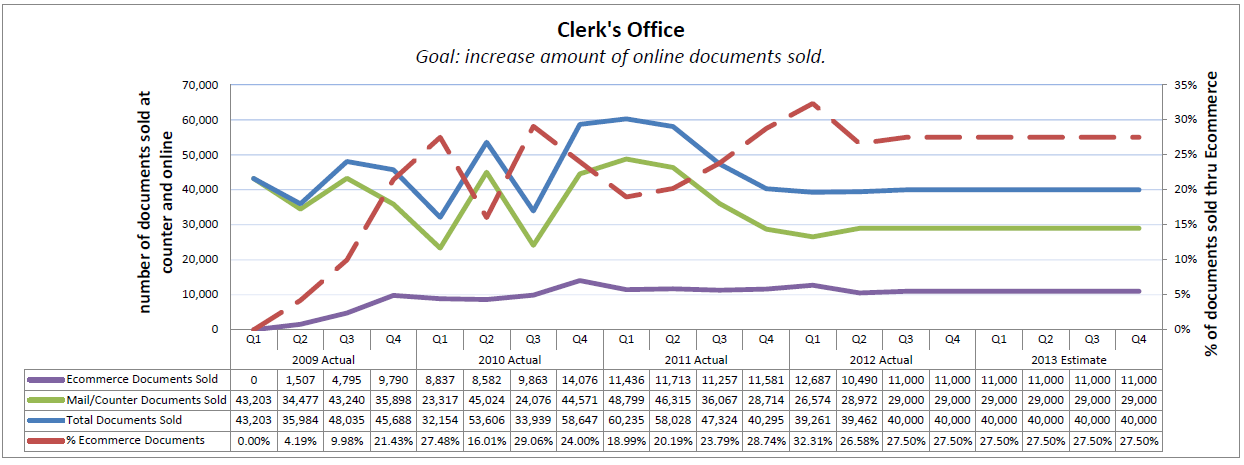
Now, it occurs to me that the E-commerce system is just a small portion of the records keeping system at the Clerk’s office. This graph from another budget document would seem to back up the split between the E-commerce documents and other documents provided by the Clerk.

While the number of documents provided dropped off significantly in 2011, the number of E-commerce documents has stayed steady. Despite this, E-commerce documents only make up less than a third of the overall load. This would seem to indicate that the system providing less than a third of the load is paying for more than two-thirds of the budget.
I could be wrong, but that’s what it looks like to me.

The long history of the Seattle Freeze (A regional Cascadian personality exists, “Cascadian Calm”)

DK wasn’t happy. He moved to Seattle, took a new job, settled in and looked around for a social life. He didn’t find what he thought he’d find. He tried the neighborhood hangout, he tried his work buddies. He even tried church, but he couldn’t seem to settle in anywhere socially. And, the women were shallow too. Even though he said he had a good job, DK said the women he dated were more interested in whether a fellow brought home a good paycheck.

His problem, he concluded, was the city. “Seattle is a cold city,” he wrote.

In other parts of the country, it was different.

(In other non-Seattle cities) (t)he people’s spirits… seem to go out to one another in friendship. They are interested in others interested in doing things together. They feel that a stranger has something to offer in their social life and they give him the opportunity to do so. 

Conversly in Seattle, most people live in a house and their spirite of friendship fails to go beyond the boudnary of their own home or intimate circles of friendship. The viewppoint of the average person in Seattle is “My home and friends are the world — beyond them there is no worth — beyond Seattle, there is no world.”

This Seattle is Unfriendly theme (or Seattle Freeze) isn’t very rare. You hear it from time to time as people get acclimated to the area. But it is amazing how far back this complaint goes. DK was a World War II veteran writing to the Seattle Times after settling in Seattle after his service in the Navy Reserve.

While more recent complaints have blamed technology for the phenomena, DK probably didn’t have to fight a smartphone to make friends. The overall cause is probably something a bit more ancient, so blame the Nords or the climate.

Either way, you can track the Seattle Freeze consistently through the decades. Rick Anderson wrote in the Times in 1979: “Seattle is no — NOT — a friendly city.”

Fred Moody, writing in “Seattle and the Demons of Ambition,” specifically cites the Seattle Freeze as one of the reasons people moved to Seattle in the 1980s (or, more traditionally, had a hard time fitting in).

The two terms you heard over and over again when newcomers rhapsodized about their new Seattle home was “laid back” and “nice,”the clear implication being that, outside the Northwest, people where “agressive” and “mean.”

Again and again I heard transplants describe the same rite of Northwest passage. In talking about how hard it was to make friends when they moved to Seattle, then invariably described an episode in which, after a few akward months here, they were taken aside by a kindhearted, more Seattle-savy acquaintance at work or in their neighborhood, and told that hey had to “tone it down,” “dial back,” or “turn down the agression” in order to survive socially.

But, this flip side of the Freeze, the non-Seattle Crazy, is just as important as the Freeze. Because, if you’re insane, maybe it really isn’t us. Maybe it’s you.

Going all the way back to 1946, a letter in response to DK makes this very case:

I most certainly do not agree with DK when he speaks of Seattle’s unfriendly attitude toward outsiders. Since the first day I arrived in Seattle a year ago, I have been treated with the greatest courtesy and kindness.

I would like to know what DK wants. Maybe he needs a few lessons in “correct approach” when he comes to a new city.

In fact, published complaints about the Freeze seem to correlate with new people coming in. Take a look at our migration rates for Central Puget Sound (Population Change and Migration, Puget Sound Regional Council), there are three peaks since the Boeing bust: the late 70s, early to mid-90s and post 2005. It might be cherry picking, but Anderson wrote about Seattle being unfriendly in 1979, here’s one piece from 1994 and the original Seattle Freeze article from 2005.

The Seattle Freeze might be our social disease, but it’s a condition that only seems to appear when we mix with new folks. So, why is that?

Maybe, in fact, we’re sane and you’re all crazy. In fact, maybe you come here, act all neurotic (a tendency to experience unpleasant emotions easily, such as anger, anxiety, depression, or vulnerability; sometimes called emotional instability), and expect us to be able to deal with that.

Here’s a study that backs up what my point is (via here).

The darker the color on the map, the more easily the residents of your state experience unpleasant emotions easily. The lighter the states, the more relaxed the people are.

The same study pointed out that the typical Northwesterner was very open, but also very introverted. So, take that with the “very sane” label, I could see why crazy extroverts from other parts of the country would have trouble here.

So, long story short: we have a regional personality here in Cascadia. It is open, quiet, and sane. It isn’t for everyone, but it was what defines us. There’s Southern Charm, Northeast brashness and up here we have Cascadian Calm.

Three geologic features in Thurston County that are more awesome than Mima Mounds

Mima Mounds? Over rated! They aren’t special!

Much of Thurston County’s landscape was shaped by glaciers, melting or otherwise. So, while the Mima Mounds may be cool, there are other totally awesome features that you should take notice of.

1. For example, did you even see before that southeast Olympia is basically full of small lakes that were created by massive chunks of broken off piece of glacier? Lakes, created by massive pieces of ice.

Some Kettles from Southeast Olympia (from Geodata):

Can you imagine the block of ice that created Ward Lake?

How Kettles form:

2. So, in addition to dropping massive pieces of ice making massive holes in the ground, melting glaciers also created rivers that don’t exist anymore. And, if you look closely, you can find out where these old river channels are. Probably the easiest to spot is Spurgeon Creek just south of Lacey.

You can see exactly what I’m talking about on Spurgeon Creek Road, just south of the intersection with Fox Ridge Lane. To the west, you can see the Spurgeon Creek valley. But modern Spurgeon Creek is much too small for its creek valley. After the last time glaciers retreated from here, they created a massive meltwater river that carved the valley, eventually meeting up with the glacier swollen Chehalis River.

This detail of this map show exactly how the water flowed in the ancient Spurgeon Creek.

The Washington Landscape Blog has a great explanation of how these glacier meltwater rivers were different than today’s:

One is the lower Chehalis occupies a valley that it did not carve. The Chehalis follows the former valley of a much larger river. During the maximum ice extent during the last glacial period melt water from the Puget lobe ice sheet drained to the ocean via what is now the Chehalis River. The river that carved that valley was a much bigger river than the Chehalis.

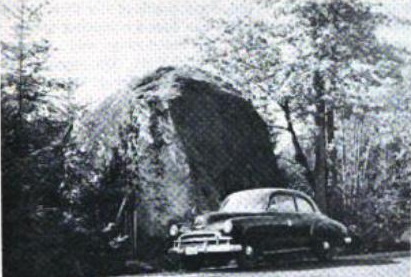
3. Lastly, there is at least one massive rock that was brought to Thurston County by a freaking massive sheet of ice. Glacial erratics are pretty awesome on their own, and there seems to be plenty in the Puget Sound area.

So, I don’t know if it’s just me, but I think it’s pretty cool that we have one here.

The massive rock brought here by a sheet of ice is pretty far out of town on 153rd Avenue off of Vail Road.

It’s a Massive Rock brought here by a Massive Sheet of Ice!
An old photo of the erratic from “ The Natural History of Puget Sound Country”  by Arthur R. Kruckeberg
One last shot of the erratic, from “Ground Water in the Yelm Area Thurston and Pierce Counties Washington,” USGS, 1955.

And, here, as an extra special bonus is a tour of the three geologic features that are more awesome that Mima Mounds.

Olympia’s enclaves (not verified)

It struck me about a year ago that depending on where were socially or geographically in Olympia, you saw Olympia differently. You could see it as “the hippest town in the West,” the home of progressive politics, or just a town full of boring state workers.

This made me think then think about how many different Olympias there were, almost self contained communities that each had a different perspective on Olympia when they say in a blanket statement “Olympia is so…”

 Anyway, here’s my back of the napkin list. I’m prepared for people to not like this list, so be warned, I’m very open to not really fighting for the truth of this.

1. Hipster Village
In short, just google “Hippest Town in the West.” K Records, LadyFest and hey, did you know Kurt Cobain lived in THAT house? Or, what people mean when they talk about the downtown arts scene. This enclave is somewhat Evergreen State College related.

2. Public Employment Neighborhood 
Broad swath of state employees. Do I really need to explain this?

3. Progressive Politics Parkway
This one is also Evergreen related. It would include OMJP, the county Democrats (the folks that aren’t members of the Kiwanas) and various protests at various times.

4. Born Fere Town


The people that would attend the Spaghetti Bowl after they were 25 or so. Obviously these folks bounce around through the other enclaves, but there’s something different not having shown up here as an adult. If the next two enclaves are the most exclusive, this one is the least.

5. Christian Ghetto
Very small overall, but also one of the most exclusive and worth mentioning because of politics. This one is the Church of the Living Water, Evergreen Christian Center and the explanation why a candidate like Ira Knight (city council candidate, circa 2005) thought he could win.

6. Military Fog

This is probably the most exclusive enclave, and worth mentioning because of the growth of JBLM in the recent decade. In short, probably not from here, probably not staying here. But, here for the time being.

The devil and soccer rivals (Olyblogosphere for May 27, 2013)

1. Remember the time in the mid-90s that a Thurston deputy sheriff confessed to being a devil worshiper and sexually assaulting his daughters? Then he recanted, but was found guilty anyway? The Olympia Satanist Blog points to a documentary (the entire version is pretty easy to find after a couple of links) on the somewhat forgotten episode in our town.

2. These flew over my house a few days ago too, it was pretty impressive.

3. A blog post all about the South Sound Shock, which are mostly a Tacoma team, and very little about the hometown Pioneers.

4. Ken has a pretty solid run down of the primary ballot scene.

5. Ramblings of Spring blog brings us tales of getting a building permit in Tumwater.

6. And, lastly, I’ve been remiss on not ever featuring Jerry Farmer’s “America Ya Gotta Love It” blog. Mostly because of the name and his apparent fear of blank lines between paragraphs. That isn’t to say that there aren’t good posts there. This is a good one, for example.

Cascadia exists (an introduction to a theme)

If you spend a dollar in Olympia, it will only go so far. In a study of how far money travels, Cascadia is one of the most well defined regions of the country. So, if we network with only people within our region and our money only goes so far, what makes us different?

If you’re half politically (or otherwise) engaged and you’re half paying attention in these parts, you’re probably heard about Cascadia.

On its fringe, the idea is of a regional breakaway from the United States and Canada. The idea is the create a country of Cascadia by calving off the northwest section of the United States and a connecting portion of western Canada. Like I said, this is an extreme idea.

But, in a series of posts (with maybe no end), I’m going to point out that Cascadia already exists. And, that its different from the squishy regionalism around the idea of the “Pacific Northwest.”

This is the same sort of difference that my mind makes when I compare my own concepts of “the South” and Dixie. For me, while the South certainly has its own regional connotations politically and culturally, the differences become much sharper when you refer to Dixie. It is likely the racist, seceded from the Union and burning crosses stuff, but it’s there.

So, in these posts, the Northwest will become Cascadia. I’ll discuss what makes Cascadia special. What makes it different from Ohio and Virginia and why those differences should matter to you.

It seems to me when we talk about the Northwest (Cascaida) we talk about mountains, rain, salmon and coffee. But, we imply these are small, seemingly insignificant differences from the rest of North America. What I want to talk about is that we’re a fundamentally different, the same way Ludlow, Massachusetts is different than Greenwood, South Carolina.

My big questions about Big Mike

Just over two decades after following the same trail up from the Columbia River to Puget Sound, the body of “Big Mike” Simmons entered the county that almost bore his name. Simmons died on November 15, 1867 at the land claim farm he took after failing at being a timber man in Mason County.

Michael Troutman Simmons is certainly one of the giants of Thurston County history. Leader of the first group of Americans to settle in Puget Sound, delegate to the territorial convention, Indian agent and businessman. Yet, he died poor and almost anonymous in Lewis County.

We seem to know everything about Michael Troutman Simmons. But, for me, there are as many questions as facts about Simmons that I need answered before I get a true image of him.

First off, what is it about Clanrick Crosby?


Soon after this other founder of Thurston County and Tumwater arrived in 1851 (some would say the founder of Tumwater, since he did more to move New Market to Tumwater than Simmons) the two men filed suit against each other. Both men claimed ownership of the land around the Deschutes falls, which would prove to be the economic heart of Tumwater. According to at least one source, the first lawsuit spawned additional lawsuits that lasted beyond Simmons’ death.

Why did he leave Olympia?


His first venture out of Olympia and Tumwater was a mill on Skookum Bay in Mason County he started in 1853 with Wes Gosnell. A newspaper article announcing to Simmons’ new mill, also noted that the valuable land near Tumwater was “no longer entangled in vexatious chancery.” The courts had apparently settled in Crosby’s favor by 1853 (for the moment), and Simmons had taken his enterprises north.

By 1857 he is listed as a property owner in Sawamish (before it was called Mason) County.

For a man whose legacy is tied so closely to Tumwater, he spent more of his time in Washington away from Tumwater then in it.

What about his race for congress?


Is there more to know about Simmons’ failed campaign in 1854 for territorial delegate? He ran in the general election as an Independent and lost by a landslide.

The nomination of Columbia Lancaster as the Democratic candidate in 1854 was one of territorial unity over sectionalism, according to the papers. Lancaster was a resident of the Columbia portion of the new territory. The newspaper in 1854 writes about the state having two centers, one on Puget Sound, the other on the Columbia. Lancaster brings those two together. “The first blow of union and democracy of the territory has been struck”

Simmons wasn’t nominated (or possibly even present) at the Democratic convention that chose Lancaster. James Patton Anderson of Tennessee (who later served in the Confederacy) was the strong runner up in four ballots. Anderson would be elected delegate a year later and serve until Issac Stevens himself was elected in 1857.

Yet, a letter written arguing for Simmons’ independent candidacy pointed out that five of the six who had been nominated were new to the territory and all were lukewarm for the recent split from Oregon. On the other hand, Simmons had lived on Puget Sound for almost a decade by that point and was an early advocate for a split from Oregon.

There’s not a shred of irony from Simmons or his supporters when he mentioned that newcomers were taking over territorial politics.His ten years (compared to the centuries of the Indian tribes) were apparently to him, the most important ten years.

This feud with the Democrats in 1854 would eventually spill into other contests when Simmons apparently even supported the growing Republican party in the territory (as noted in “Confederacy of Ambition”). Political pressure was put to local civic leaders to force Simmons out as Indian agent because of his partisan disloyalty.

Was their economic pressure put together with political pressure to keep Simmons from finding success in the territorial capital? He apparently outlasted all that pressure though, and was only replaced when Lincoln’s administration replaced him with a loyal Republican.
« Older posts Newer posts »

© 2026 Olympia Time

Theme by Anders Noren — Up ↑