History, politics, people of Oly WA

Category: Washington Politics (Page 4 of 27)

It isn’t about a primary vs. a caucus, it really just is about what’s best for the party

The proposal by Secretary of State Kim Wyman to hold a presidential nominating primary in Washington came with one interesting wrinkle. The partisan preferences of individual voters would become public. 

Now, I am leaning on my memory of previous caucus vs. primary fights, but this is the crux of the debate. Primaries are fine (according to the parties) but, they should serve the parties, not the voters. In this case, its a matter of making the primaries closed to only partisans. Or, at least partisans that will declare themselves publicly. 

In that case, the parties get nice updated lists of registered voters that will pick a side. And, those voters will get mailed to, hit up for donations and cajoled into supporting the parties and candidates.

And, unless those lists are strong (and with cross over voting allowed under the old system, they’re not) its not worth it for the parties to go along (at least in large part). And, this is how we get the caucuses.

Because, if the parties can’t get mailing lists, they should at least get volunteers.

This old presentation from the 2007/08 presidential season really spelled it out for me. While partisans will often talk about the grass-roots and participatory nature of the caucuses, what they’re really about is foot soldier recruitment. If you find someone who is excited to attend a caucus, a good number of those folks will be good for other work.

From the presentation: 

Every four years thousands of new Democrats attend the caucuses.

Hundreds of them work on that year’s campaign for President, Governor, Congress, Legislature, and down the ticket.

After the election dozens of these new recruits come around to our monthly meetings.

By February or March or April a handful of new recruits are active in their local Democratic party.

Don’t get me wrong. I’d rather have this political party than one that depends on mailings and over the air ads. It isn’t bad to get people involved in politics and recruit foot soldiers. Some of my happiest and fulfilling public moments were at Democratic party meetings. Its good stuff.

But, don’t also mistake that if the parties do commit to closed primaries here, that they’re going to replace the excitement of the caucuses with some other sort of grass-roots event. It will not happen. They delegates will be chosen by a state-funded primary, all the energy from the caucuses will be lost.

Let’s bring HB 1711 back from the dead and unleash municipal broadband in Washington

A couple of days ago, the White House called out 19 state laws that inhibit local governments from tearing down barriers to internet access. Embarrassingly, one of those laws is in Washington State. Sprinkled throughout our RCWs are specific prohibitions preventing local governments (like PUDs or port districts) from selling internet access directly to consumers.

While local governments can set up internet networks, they have to find a middleman (like a local ISP) to take a cut and then sell to consumers. These are the same customers that (as taxpayers) are paying for the backbone of these networks anyway.

While a few local PUDs are getting around these prohibitions by providing free public wifi, this retail prohibition is a major stumbling block to broadband access in Washington State.

Now, President Obama wants it gone. And, it turns out that in 2011 a handful of Washington legislators wanted it gone too. HB 1711 would have erased the prohibitions to local governments to provide internet access to their citizens. The bill saw public hearings during the 2011 and 2012 legislative sessions. But, it never even received a vote out of committee.

Muninetworks wrote a nice roundup of who opposed the bill then:

The bill’s opponents may be separated into two groups. The first is the usual gang of big, absentee corporations like CenturyLink, Frontier, and Comcast that typically oppose any legislation that could create competition to their services. They have a ton of lobbying power and very little desire or capacity to solve the rural broadband problem in Washington state. 

The second group is more interesting. It is a collection of local businesses that are actually rooted in the community. Many are ISPs that operate on existing wholesale-only networks owned by public utility districts. They are afraid of either being kicked off the network or having to compete against the PUD itself in provisioning services. These are certainly legitimate fears. 

Unfortunately, the small providers are also limited in the capacity to build the necessary networks needed to bring modern connections to everyone in the state. Offering service on an existing PUD network requires far less capital than building their own network. If the state wants to move toward a Washington where all residents and businesses have fast, affordable, and reliable access to the Internet, it has to risk upsetting the small ISPs. They do not have the capacity to connect rural Washington; the public utility districts and local governments have not just the capacity, but also the responsibility. It is time for the state to stop making it all but impossible for them to do so.

But, now the debate has changed. It isn’t just an argument about whether areas can be served by internet providers. Even in cases where a local ISP provides access to publicly provided infrastructure (not even considered data on cell phones and satellite internet), people are getting online. Largely.

The debate now is about net neutrality. Corporate providers are throttling speeds, giving preference to the data they want to see go through. This is antithetical to the idea of the free flow of information in our country.

We have free public libraries and an open public postal service because information has to flow in a democracy. In Washington, we don’t have to wait for the FCC to do the right thing. We can do it right now by bringing the ideas behind HB 1711 back.

Previous posts:
Olympia and Thurston should follow Poulsbo and Kitsap’s lead (at the very least) and what your PUD candidates think about that

The Thurston County PUD, local internet, net neutrality and the next fight

Because of Sue Gunn (not Bud Blake), maybe an independent can win in the 22nd LD

When Budd Blake won a county commission seat in Thurston County after running without a party label, it got me thinking again about political labelling and political organizations. From what I can tell, Blake wasn’t a true independent. He won with the backing of what really is the conservative organization in Thurston County, nominally Republican, pro-growth (building industry) and pro-property rights.

On the other hand, in a non-partisan race recently, another sort of independent won. Sue Gunn was pretty much an antiestablishment candidate. From what I found when I looked at her returns was a candidate that spanned both traditionally very liberal and very conservative voters.

Just some background reading before we get into the meat of this post:

Sue Gunn won uniting the non-establishment middle in Thurston County, traditional Republican voters who didn’t like public subsidies for private business and traditional Democrats who felt the same.

This is pretty different than the type of voter that I see going for Budd Blake. Granted, there were a few traditional Democrats, but they were further in the establishment middle, the ones who were comfortable voting for a business friendly centrist against an environmentalist liberal.

But, now look at Sue Gunn’s returns in 2013 when you narrow them down to the 22nd LD. Its a given that Gunn was running in a local only election in 2013, there was very little on the ballot that drove partisan leanings. But, she did eke out an 51 percent victory in the precincts that make up the 22nd LD.

And, if you assume that the current seat-holders in the 22nd are more like Jeff Davis (who lost to Gunn), you could see a roadmap of how a Gunn-like independent could win.

There’s probably a lot more I could do with the data, finding out exactly how Gunn won how she did in the 22nd. Did she win over both traditional Republican and Democratic voters? Or did all of her support in the 22nd come from traditional Democrats? I’d assume if it was the latter, it would be harder to pull enough support in a partisan race.

Just because Bud Blake won a county commission seat doesn’t mean an independent can win in the 22nd LD

When you think about politics in Thurston County, the 22nd legislative district is the Democratic liberal juicy middle in what is a pretty typical rural or suburban western Washington county. This is where the urban communities are, this is where the liberals are.

This is a district that hasn’t elected a Republican since 1980 when W.H Garson of Tenino went to the legislative building. This is also when the 22nd LD was big enough geographically to send someone from Tenino to the legislative building.

Just a side note: since Thurston County population shot through the roof in the 1970s, I’d assume that redistricting was particularly unkind to Republicans in the 22nd in the 1980s. What probably happened was the district shrank geographically given the boost of urban population, giving it its liberal contour today.

Anyway.

Bud Blake was the first conservative to win a county commissioner seat in Thurston County for a long time, most likely because he ran as an independent against a Democratic. And, he won in a convincing fashion.

I was wondering if a county-wide election for a Republican in independent clothing meant the same sort of strategy could equal the same result in the smaller, liberal 22nd LD. Well, it does not.

But, man, it would be close. If you isolate the 22nd LD precincts (the way I did in that link above), you see a pretty tight race. Democrat Karen Valenzuela would have won with just over 51 percent, or 2,000 votes out of over 40,000.

But, a win is still a win.

That said, I think a legislative race would have been even harder for an independent (especially a conservative one) to win over a Democrat. I suspect that strictly partisan issues (like abortion, environmental protection, taxes) could be isolated in a way that they couldn’t be on a local general government election.

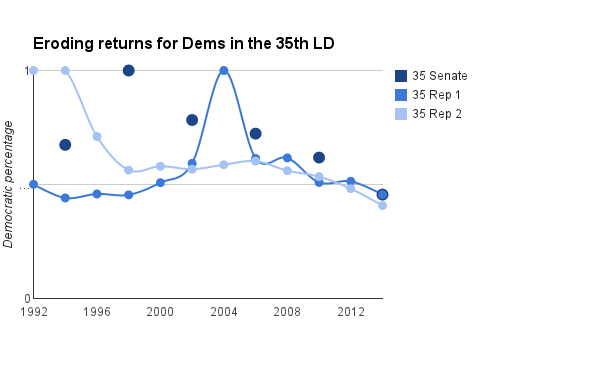
What do you see in this chart? Mason County changing?

This is a chart tracking partisan returns in the 35th legislative district between 1992 and 2014. The lines track the two house seats and the dark dots, the senate. What I’m tracking here is how successful Democratic branded candidates have done over the past 20 years.

An important note before you look any further. For 2014, I switched Sen. Tim Sheldon for his challenger Irene Bowling. In you own consideration, feel free to totally ignore that, but for the sake of argument, and to make an interesting chart, I did that.

So, here’s what I see: Throwing out two uncontested years, the Democratic brand in the 35th (greater Mason County) has been eroding.

Mason County always struck me as an interesting place, the furthest inland outpost of the “Coastal Caucus” political type. I sort of wrote about this, the most non-partisan of Washington’s political regions, here.

I’ve also been thinking a lot about two other rural western Washington counties, Lewis and Grays Harbor. These two places share a river (the Chehalis), but party speaking, one is very Democratic, the other is very Republican. I’ve been wondering (baring very few other differences) why Lewis votes almost always Republican and Grays Harbor even more often Democratic.

And, I think we might be seeing that difference in action in Mason County. In the past, it seems that Shelton was very much like Grays Harbor. But now, as we move through several elections, Mason County is becoming more dependably Republican. This is the first time since at least 1992 that the 35th have returned three state legislators that won’t caucus with the Democrats.

But, what are the factors behind this label change? You can argue that the Democrats Mason County sent to the legislator were always more conservative. Sure, I can take that. Other coastal Democrats were always different than King County Democrats. At least in the modern sense.

But, why the label change? Here’s on theory: one other thing has happened in the last 10 years, urban Democrats have been focussing energy on Mason County and Tim Sheldon.

Sheldon’s break with urban Dems has been at least ten years in the making, since he chaired Democrats for Bush in 2004. He also led a rebellion against a Democratic budged in a few years ago and then famously caucused with Republicans during the last two legislative sessions. And, since then, Democrats in other parts of Puget Sound have been taking a harder and harder aim at him. The high point was this year when a traditionally funded Democrat faced off with Sheldon in the general, and lost.

So, maybe this really isn’t an act of Mason County voters changing their stripes, but a slow-motion erosion of the old-style coastal Dem with a modern conservative Republican.

Low voter turnout and why aren’t we celebrating Washington’s 135th anniversary?

Two big surprises this week. Well, they aren’t big surprises at all. Washington State turned 125. Also, voter turnout during this off year election in the second term of a Democratic president was really low in the same state.

These two things are actually connected in a very interesting way. The reason we’re not celebrating the 135th anniversary of Washington is the same reason voter turnout is down to historic levels this year in Washington.

It was political division and apathy that kept Washington out of the union in the late 1870s, ten years before their successful 1889 effort.

Robert Fricken in Washington Territory:

Washington Territory was divided, rather than united, upon the question of statehood. Longtime, often bitter, points of contention remained paramount, setting westerners against easterners, Republicans against Democrats, and Portland influence against the challenge of Puget Sound.

Fricken is the bomb, by the way. Everyone should read every one of his books.

Washington remained a state in uretero for so long, because it wasn’t a single cogent state. As Fricken points out, the Puget Sound was an economic colony of San Francisco and Eastern Washington was controlled by the Willamette. Also, decades and decades of rule by the east compounded on themselves, and the political culture that would grow with the promise of self rule never flourished.

Voter participation also dropped off significantly from areas that supported statehood at the time (Puget Sound) to places where it wasn’t supported (east of the mountains). In places where there was little engagement for the goal, voters overall failed to answer the question.

It wasn’t until the 1880s when Washington’s population went from 75,000 to over 300,000 did the question come up again. Also, because of a rail connection through Washington to the rest of the country, the territory was at last united.

That 1870s apathy towards statehood, driven by disunion and apathy, is the same sort of thing we face today.

While we lacked a railroad to throw off the shackles of Portland and San Francisco, today we shackle ourselves away from each other. Our redisticting process, at both the legislative and Congressional level, has shifted partisans into seperate districts. If we ask voters to vote in races that don’t matter, they won’t vote.

Jim Bruner in the Seattle Times back in 2012:

In an interview, Milem said the commission’s priority of protecting
incumbents was evident in the new maps, as incumbents of both parties
got safer seats.

Milem is correct on that point.

Just look U.S. Rep. Dave Reichert’s 8th Congressional District.
Previously a suburban swing district, the 8th was redrawn by the
commission to become solidly Republican. The new district lost its
Bellevue and Mercer Island portions and now crosses the Cascades to pick
up Wenatchee and Ellensburg.

Similarly, the 2nd and 9th Districts were redrawn to be safer for their Democratic incumbents, Rick Larsen and Adam Smith.

“We’ve lost electoral competition in those districts as a result of the plan,” said Milem.

That holds true for many state legislative districts too. Milem says
partisan considerations trumped the goal of drawing logical district
boundaries, leading to some strange contortions.

For example, Milem describes the shape of the 18th legislative district near Vancouver as “one arm short of a swastika.”

Sure, we’re also sorting ourselves out in a larger sesnse. But, in the least, creating as interesting and compelling political boundaries in the first place would help.

Washington Poll, “rest of Washington” and their lack of Partyism

In the most recent episode of the Slate Political Gabfest, the hosts discussed the recent phenomena of Partyism.

This would be a sort of prejudice or bigotry based on the political affiliation of someone. I assume this has been around for awhile (seeing how people didn’t like Socialists or Communists going back 100 years or so), but apparently this has recently crept into mainstream politics. Republicans being partyist towards Democrats and vice versa.

David Plotz (at some point I think it was David) wondered where exactly this phenomena hasn’t taken hold in American communities. Where the parties and partisanship hasn’t warped politics and public discourse. Taking a look at the recent “Washington Poll,” I think I have a local example.

The Washington Poll divided the state into three parts: Eastern Washington (beyond the Cascades), Puget Sound (self explanatory) and the rest of Washington. It is this “rest of Washington) category that I found fascinating. In most cases, Eastern Washington presented itself as the furtherest right wing, while Puget Sound served as its liberal foil. You’d assume “rest of Washington” would be somewhere stuck in the middle. And, you’d be right, for the most part.

While the poll isn’t very clear, it seems like the “rest of state” category includes the counties on the west side that don’t border Puget Sound. Basically the Olympic Peninsula and the Lower Columbia. Except for a few traditionally conservative and Republican counties towards the Oregon border on I-5, most of these counties are old-style Democrat timber communities.

They have voted Democratic since the Depression, while at the same time aren’t pulled into the gravitational pull of liberal Seattle. They are Democratic on their own.

So, to start, these “rest of state” counties have a higher voter participation and seemingly deeper culture of civic engagement.

For just voter registration, we see better than average for the rest of state: 92.2 ROS compared to  88.0 for Puget Sound and   87.2  for Eastern Washington.

The same pattern holds for turning in your ballot this year: 20 percent compared to 17.7 or 16.5 for Puget Sound and Eastern Washington.

And, in terms of health of the community, rest of state was the only group over 50 percent on the question of right track/wrong track. Even though many of these places have unemployment higher than Puget Sound,  voters here still have faith in the future.

Also, they also have more faith in the process. Compared to Puget Sound and Eastern Washington, which neither could get above 38 percent favourably rating for the state legislature, rest of Washington rated their locally elected legislators at almost 50 percent very or somewhat favourable.

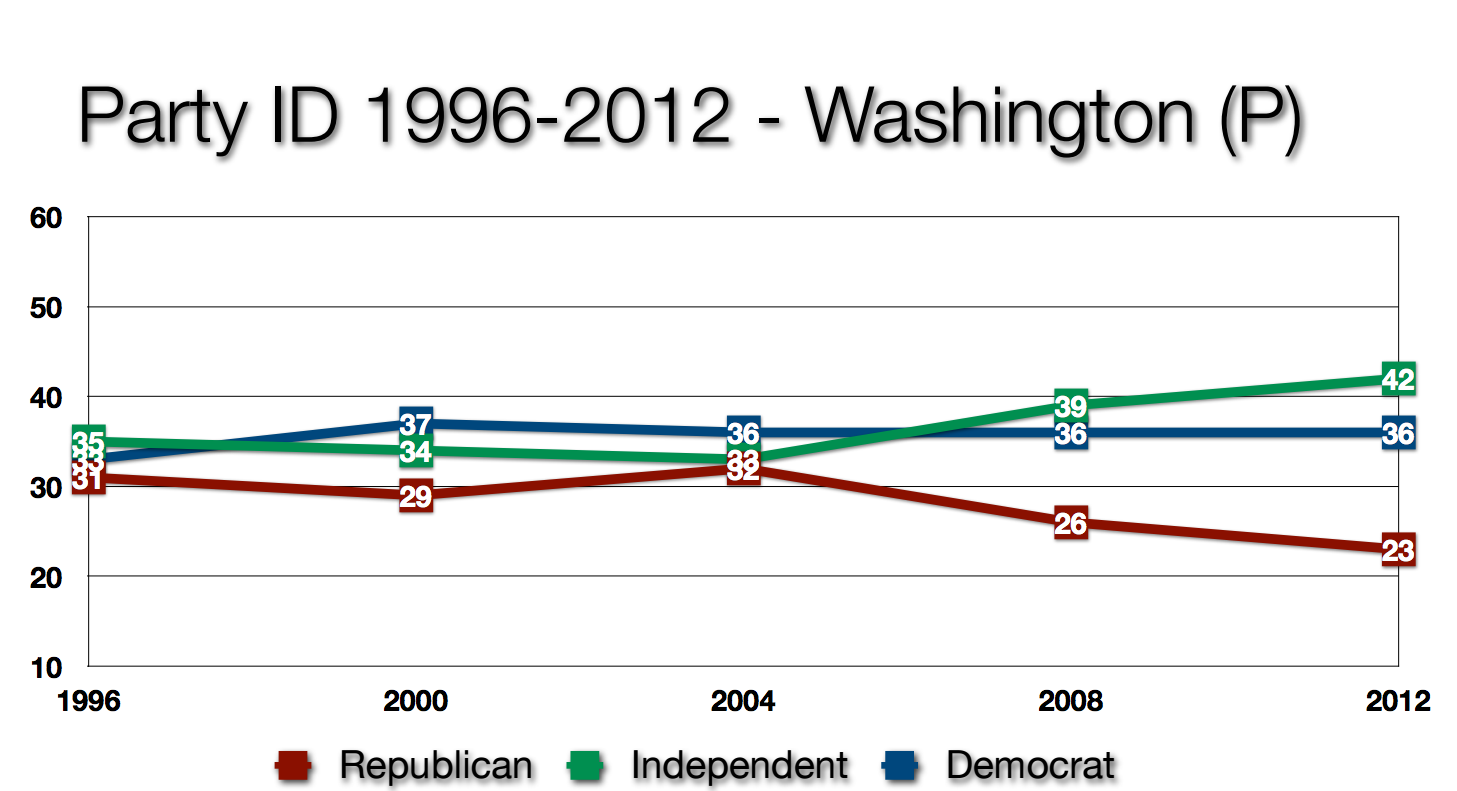
In terms of partisan ID, these communities are almost evenly split. While Democrats dominate Republicans by 20 percent in Puget Sound, and Republicans by 10 points in Eastern Washington, Republicans lead Dems by only about 3 percent in these other counties. And, the highest number of voters describe themselves as moderates in rest of Washington (a plurality).

And, lastly, even more than conservative Eastern Washington, rest of Washington is rooted in its present. It doesn’t face the future, it faces the now. Question 34 “The America that you know and love isn’t changing too fast, and will never change” (as badly phrased as that is) illustrates this. Eastern Washington and Puget Sound both strongly or somewhat disagreed with this statement 65 percent of the time, while “rest of Washington” got over 70 percent.

While you’d assume “rest of Washington” would fall somewhere along the same lines as the other two, it actually showed itself to be more conservative. Or, at least, more rooted in what is going on their now.

“Rest of Washington” falls outside the right/left dualism that Puget Sound and Eastern Washington represent. It has higher civic participation, more faith in the process and thinks of itself as more moderate. It also isn’t looking to the future for either doom or success. Right now, the way things are and the people who are here now as neighbours will have the answers.

There are a few reasons why this is the way things are out there:

1. These areas (except the Republican/conservative counties like Lewis and Clark along I-5) are out of the way counties. Counties like Pacific, Grays Harbor and Wahkiakum counties are literally geographically split off from anywhere else in Washington.

2. They represent a “way it used to be.” While the decline of the logging industry overall has hit these counties hard, there is still a core element here that depend on resource extraction (anything like logging or fishing). And, this is the way it used to be in all of Washington. But, times have changed in places like Puget Sound, and the regional culture that you can still see in Aberdeen or Raymond is hard to find in Seattle or Everett.

3. We call them Democrats, but they’re much more conservative than that. That label is pretty flexible. Take Tim Sheldon, a Democrat from Shelton in Mason County. He even went as far as caucusing with Republicans, but it isn’t that uncommon for Democrats from the coast to vote against their Puget Sound party-mates. That still said, Democrats still dominate politics out there, it is hard for a Republican to get elected in any local office.

Do we have to wait until Dan Evans dies before someone writes a biography?

Scoop Jackson, Warren Magnuson, and Tom McCall all have biographies.

The Secretary of State’s Legacy Project has released biographies of Slade Gorton, Booth Gardner and John Spellman.

Cecil Andrus has a really good biography. “Fire at Eden’s Gate” about McCall is better. But, the Andrus one is really good.

Scoop and Maggy cast a longer shadow in Washington, sure. McCall is probably the most inspiring Cascadian politicians. But, at least in terms of 20th century executives in Washington State, none is more powerful and interesting that Dan Evans.

And, there is no biography. Hell, even Nancy Evans had a full oral history.

Dan Evans is a totem in our politics. A “Dan Evans” Republican or a “Dan Evans” anything is the symbol of a rational, friendly to the environment, good for business politician. Evans served three terms and has been the only governor to serve three consecutively.

Biographies are oftentimes the best history. People moving through history, changing the context around them. It can be pretty good reading. And, arguably, no single governor has guided Washington through more interesting times that Evans.

So, why no Evans book? 

UPDATE 7/17/14 12:43 p.m.: Apparently Evans has been working for decades on an autobiography (thanks Deb Ross). From the Nancy Evans oral history:

…the week before Scoop died Dan had called the chair of the Evergreen trustees, Thelma  Jackson, because he wanted to write this autobiography he’s been working on for so long.  He had actually started doing some research, and started organizing the governor’s years, and going back into his own childhood – those sort of things.  So he had gott en that far, but not really doing research like he is now.  So he asked for an appointment with her.  And he was going to tell her that he would work unti l the following June, but then he wanted to leave Evergreen. He wanted to write his book and then do something else. He didn’t know what – just something else.

 I’ll be honest though. What I want isn’t what I want. What makes a book like Fire at Edens Gate so good isn’t just that it tells you the facts of a politicians life, but that it carries that life through the broader context of our communities and does it honestly. More honestly than could be done for an authorized biography (Shelby Scates on Magnuson or even John Hughes on Gardner) and much more honest than the subject can do on themselves.

It is great Evans is working on his autobiography. I want someone else to take a crack at it too.

Reagan won both Thurston and King counties in 1980 and 1984. Why is that?

1984 presidential results in Washington State.

The 1980 and 1984 elections in western Washington baffle me a little bit. The Reagan Revolution was strong throughout the entire Cascadian coast, except for a few counties at the mouth of the Columbia River.

Both Thurston and King counties (among other Puget Sound counties) are traditionally Democratic now. But, just about 30 years ago, they were heavily in Reagan’s camp. I’m trying to figure out why this is. But, I’d appreciate anyone that has a more precise explanation.

So, working down from the things I know:

1. Dan Evans, John Spellman (and other moderate Republicans like Slade Gorton) that started their careers in the 1950s and 60s came from out of King County. Both Gorton and Spellman were elected in 1980, so (even though Spellman lost in 1984 to Booth Gardner) its likely that the “main stream” Republican mojo in Puget Sound was strong in the early 1980s. From what I’ve read, Spellman’s loss to Gardner had more to do with Spellman being a bad manager than party identification.

2. Republicans (even Reagan) weren’t attached to social politics like abortion) in 1980 and 1984. I-471, which would have prevented public funding for abortion, failed statewide in 1984, with major losses in both Thurston and King counties. Reagan won in counties that voted against an anti-abortion initiative. Not what you’d really consider possible now 30 years on.

3. The social conservative wave didn’t seem to crash in Washington State until the 1988 Republican presidential caucuses. That year, conservative Christians took over the party caucuses and threw off the moderate business friendly brand, voting for Pat Robertson. Eight years later, Ellen Craswell repeated history, taking the Republican nomination for governor (but getting beat by a lot by Gary Locke).

So, to me, the two statewide elections in the early 80s seems like the lag time between the Evans revolution in the 1960s and the Christian social conservatives catching up in the late 80s. The memory of Reagan’s is of a stalwart social conservative. But, at least in Washington, it seems like the momentum of more moderate Republicans carried him through two elections.

Does that make sense?

A data-based perspective on racism in Gonzalez v. Danielson

My historic look didn’t drill down very far, just looked back in time a bit. But, if you do look down into the voting precincts, as this paper does very well, you find racism present in the vote:

The Yakima and Grant County results indicate that racially polarized voting exists in Central Washington and crosses party and ideological lines. While voters in these counties have consistently voted for more conservative candidates in most recent elections, Danielson outperformed all other candidates, and by very large margins. This is remarkable considering he did not campaign at all. In a similar Supreme Court election, conservative candidate Douglas McQuaid, who also did not campaign at all, received only 28 percent of the vote in Yakima, compared to 64 percent going for Danielson. Not only did Danielson significantly outperform McQuaid, but he also won more votes than the leading Republican candidates for U.S. Senate and Washington Governor who both campaigned vigorously during the election. The data show that Danielson received votes from the same precincts who preferred Cantwell to Baumgartner and Inslee to McKenna. This is in spite of Danielson raising no money, holding no campaign events, making no public statements, and receiving no meaningful endorsements. Voters in Central Washington, who were not provided a voter’s pamphlet, preferred Danielson to González in a party-neutral contest. This patterns revealed here a are textbook definition of racially polarized voting.

« Older posts Newer posts »

© 2026 Olympia Time

Theme by Anders NorenUp ↑