History, politics, people of Oly WA

Category: Washington Politics (Page 3 of 27)

How our history of downzoning is an argument against “local control” in the legislature and has huge impacts on racial discrimination in housing


Eastside Olympia in the midst of large downzone.

As the legislature discusses zoning reform that would allow for modest density increases in exclusionary singe family neighborhoods, it is important to focus on the history of so-called “local control.”

The ability for local governments to determine their own zoning fate has become the primary argument against statewide zoning reform. But the history of neighborhood and city-scale decision-making (aka “local control) puts a sharp focus on housing discrimination and how we’ve excluded people from our communities.

When we discuss racist housing discrimination in the Northwest, we talk about racially restrictive covenants that flourished through the 50s and redlining during the 30s. We skip past the successful whisper campaign that sunk Seattle’s first attempt at an open housing ordinance in the mid-1960s, and head straight towards the Fair Housing Act and the state and local versions of the same law.

After that, our history tells us, housing discrimination has been against the law, and we’ve been slowly bending towards justice. Leftovers like exclusionary single family zoning are artifacts of time before the 1960s civil rights campaigns and are the high hanging fruit after years of struggle.

But when I think about housing discrimination in the Pacific Northwest, I usually start with the 1970s. That is when you see the term “downzone” show up in our regional press. Before that time, there was no single word for taking a neighborhood that was zoned for a mix of densities and only allowing single family zoning.

In response to the outlawing of outright housing discrimination, local governments turned to tools like downzoning to restrict growth and prevent the continued construction of housing that would be affordable across incomes. Exclusive single-family zoning began replacing higher density zoning across the region.

This era of downzoning after the Fair Housing Act begs for more historic understanding. As a community historian, I am most familiar with downzoning efforts in Olympia from the late 1970s to the 1990s. But in a cursory look at other western Washington communities, you can see the same pattern. I can trace stories of Individual neighborhoods starting in the 1970s lobbying for downzones from high density to middle density and any middle density options being chased out of neighborhoods in exchange for single family zoning.

I have done a fairly deep dive into the Olympia history of downzoning, which I’ve written about here. But with the debate over local control in the legislature, there is a need for a deeper understanding of how our communities reacted to the passing of strict housing discrimination laws and why so many decided to push to decrease densities.

There is a classic example on Queen Anne Hill where neighbors fought to downzone in the early 70s. Throughout the 1950s, the City of Seattle planned higher and higher densities in neighborhoods around downtown, including Queen Anne Hill. Just months after Seattle’s open housing ordinance went into effect, Queen Ann neighbors were at city hall, fighting for fewer neighbors to come to their streets.

In Olympia, the downzoning battle began on the Eastside in what is now one of the most exclusive single family neighborhoods. A developer proposed a series of fourplexes, but ended up igniting years of struggle, which resulted in a citywide reassessment of high and middle density housing. A few years later, neighbors of another inner, Eastside neighborhood, fought to further downzone their part of town to “stabilize” the neighborhood.

You can see similar examples across the country of communities picking up downzoning as a tool to implicitly preserve racial divisions when other methods became illegal. Arlington, MA (a Boston suburb) wrote its own history of downzoning, pointing out that before the 1960s, they zoned for plenty of apartments. But, according to a city-written FAQ: “…as segregation in greater Boston was challenged and integration became a real prospect across the region, Arlington’s attitude toward development shifted. Concerted opposition to development projects began in the 1960s and became more organized in the early 1970s. Activists used both explicit and coded anti-integration language to rally opposition to apartment development and the related effort to downzone portions of the town.”

Unlike earlier efforts in the Pacific Northwest, other than coded references to “ghettos,” our downzoning efforts are largely absent of on the surface racial animus. I’m not saying that these neighborhood activists weren’t trying to keep their neighborhoods white. In fact, I think you can draw a pretty clear conclusion to what many of them were up to. I’m just saying there isn’t anything clear in the historical record.

What I am saying is that you don’t have to look very far to see downzoning in the Pacific Northwest tied directly to the broader civil rights struggle. When you pull back out from these small-scale, downzoning efforts to a nationwide view, you see single family zoning being discussed in a much different way. When Pacific Northwest communities were downzoning, the NAACP was struggling to find inroads in the courtrooms to fight against exclusionary single family zoning.

HUD Secretary George Romney (and former Michigan governor) went to Warren, Michigan in 1970 to attempt to force the Detroit suburb to strike single family zoning and allow smaller, more affordable (and therefore affordable to racial minorities). His effort failed, his political career ended, and the civil rights organizations retrenched and fought unheralded courtroom battles over single family zoning in the Midwest, the South and the East Coast.

According to the NAACP, in the early 70s: the suburbs are “the new civil rights battleground” and we should do battle out in the townships and villages to lower zoning barriers and thereby create opportunities for Negroes seeking housing closer to today’s jobs at prices they can afford and pay.”

National Committee Against Discrimination in Housing (also in the early 1970s): segregation won’t stop until “local governments have been deprived of the power… to manipulate zoning and other controls to screen out families on the basis of income and, implicitly, of race.”

What we can say for sure, that our decreasing densities through downzones had very real impacts on the racial makeup of our neighborhoods.

In Seattle, the end result of five decades of downzoning is white-majority neighborhoods expanding across the city. One collection of blocks in the Leschi neighborhood went from over 90 percent black in the 1970s to 11 percent black today. The black population of King County was pushed south and out of Seattle as the white residents in downzoned neighborhoods looked for housing further and further south.

In Olympia (that never had a substantial racially diverse neighborhood like Seattle) neighborhoods that downzoned saw a smaller increase in racial diversity over the last 10 years. Not only did these neighborhoods stay whiter, in the middle of a historic housing crisis, these neighborhoods actually had fewer people living in them in 2020 than they did in 2010.

There are few open racists left. That is obviously an advancement in my lifetime.

You don’t have to be racist to benefit from racist outcomes and a racist system. There is a huge layer of people who will tell you they are not racist but participate in racist systems before you get to people working to dismantle racist systems.

We know the current landscape of dominant, exclusionary single family zoning in our region happened at the same time the last tools to legally and openly discriminate in housing were taken away. We also know the nation’s leading civil rights organization has actively worked against exclusionary single family zoning.

Our history is not at all unique, but we should keep in mind as the legislature takes another attempt at creating a minimum zoning standard for Washington State. Local control is the tool that low density neighborhoods used for five decades to sustain racially discriminatory impacts of city-scale zoning.

We have to face Slade Gorton’s legacy, not bury it

The evil that Slade Gorton did lives after him.

In the weeks following his death, I think it is a good time to relitigate the legacy of Slade Gorton. It isn’t only about damning the man himself and whether he has a “racist bone in his body.” It is also about how we as a region understand our own fairly recent history. It is also about how we will continue to understand racism in the Pacific Northwest. If we can let Slade Gorton off the hook, we can continue to let ourselves off the hook.
The Boldt Decision is the big case that everyone points to when we talk about Slade Gorton, Indian Fighter. I spent nearly 20 years working at the Northwest Indian Fisheries Commission blinking at the public retelling of Slade’s time as Attorney General. I didn’t get into it then, but I was also part of a team on which picking a fight with an elder statesmen was a particularly bad strategic move. 
There also was not a lot of love in that world, if any at all, for Gorton. He was pretty hated and I don’t think I need to explain that.
1. Not Boldt, but around Boldt.
I am not going to relitigate Boldt, that is for much smarter people than me. And in the end, Gorton lost that case. His office and the institution of the state itself (different independent offices) spent years fighting federal court orders. But again, in the end, he and his fellow travelers lost. After the Supreme Court finally weighed in in 1979, the state and the tribes set up a system of co-management that stood Gorton’s understanding of tribal sovereignty on its head. 

Let’s backtrack a little though. Let’s talk about the time between the Boldt Decision and the decision in Washington State Commercial Passenger Fishing Vessel Association. This second case is where the Supreme Court finally put its stamp of approval on the Boldt Decision. But why isn’t it called “U.S. v. Washington” (which is the official name of the case in which Judge Boldt decided)?

Because when the two agencies that managed fisheries in Washington wrote rules to implement Boldt, they were sued by fishing organizations (like the Passenger Fishing Vessel Association). They argued that allowing tribes to catch 50 percent of the salmon violated the equal protection clause in the state constitution. 
I don’t want to get into the legal arguments here. I’m going to give you a huge spoiler: The Supremacy Clause. It’s a thing.
But, while Passenger Vessel was winding its way first through Thurston County Superior Court, up to the state Supreme Court and eventually on the U.S. Supreme Court’s docket, a lot of shit was going on.
I think the 9th Circuit’s decision in Passenger Vessel (as quoted by the Supreme Court) says it best:

The state’s extraordinary machinations in resisting the [1974] decree have forced the district court to take over a large share of the management of the state’s fishery in order to enforce its decrees. Except for some desegregation cases …, the district court has faced the most concerted official and private efforts to frustrate a decree of a federal court witnessed in this century. The challenged orders in this appeal must be reviewed by this court in the context of events forced by litigants who offered the court no reasonable choice.”

“Except for some desegregation cases…”

That should ring in your ears. 

That was in 1979. For decades, federal courts had been hearing segregation cases and forcing local school boards and states to impliment Brown vs. Board of Education. In one line, the federal courts compared Slade Gorton to segregationist John Ben Sheppard. 

In the South, this local and state defience meant that President Eisenhower would send the 101st Airborn into Arkansas to open the schoolhouse doors. In Washington, we would need to have the U.S. Coast Guard and the Federal Marshals acting as game wardens.

It wasn’t the arguing of the orignal case that dooms Gorton. Granted treaty fishing rights was probably new territory back then and deserved an honest fight in court. But the disengenous route to Supreme Court, plus the stoking of violence and disent is what tells you what kind of Attorney General he was.

In the mid-1970s as federal marshals and the Coast Guard attempted to implement court decrees, non-tribal fisherman rammed their boats and physically blockaded their work. Tear gas was fired at non-treaty fishing boats. At one point a gillnetter was shot when he tried to ram an enforcment boat.

At the end of the day, these fishing groups had an ally in the state’s top attorney, who took their arguments about federal supremacy and treaty rights to the Supreme Court and lost.

2. Oliphant, the nut of Gorton’s arguments and the downstream impacts

Outside of Boldt, there has not been a lot of (if really any) discussion of Gorton’s record regarding treaty rights and tribal sovereignty. I’ve seen brief references that Gorton argued in front of the Supreme Court fourteen times (fourteen times!), but little discussion of what he actually did with his time.

Fun fact, of the fourteen cases that Gorton argued in front of the Supreme Court, five were cases against tribes. One of those cases was Oliphant vs. Suquamish Indian Tribe. This case has become a classic in Indian law because of how it limited tribes’ ability to enforce criminal law on their reservations. The basic crux of the case is that Oliphant was arrested by Suquamish cops. He appealed, not because he was innocent of whatever he did, but because he claimed the tribe could not enforce criminal codes against non-tribal members. 

And of course, in the same way Gorton inserted the state Attorney General of Washington State into Passenger Vessel on behalf of non-tribal fisherman, he interserted the office into this case. His office was not a party to the case, but he had a chance to limit tribal sovereignty, so he took it.

And, while this argument is present in other Gorton tribal arguments, I want to point it out here. In Oliphant, Gorton argued:

The Sovereignty of the United States over the area which is now the State of Washington under the concepts of sovereignty which have always been accepted in western country, in western civilization in the United States came from explorations beginning with those of Robert Gray and from a series of treaties, the Louisiana Purchase Treaties with Spain and Great Britain culminating in the treaty with Great Britain of 1846 under which we settled the northwest frontier of the United States.

At that point, the United States’ claim to the sovereignty over the Washington area was total, absolute and complete.

This is the smoking gun.

In Gortons’ legal mind, the tribes in fact do not exist. Tribal sovereignty as a thing itself does not exist. His arguments in front of the Supreme Court were a forearm crashing of all the place settings off the table. All of this we are arguing about is totally pointless because, at the end of the day, it was the sovereignty of the United States that is “total, absolute and complete.” He thought he was arguing with non-entities.

Even though Gorton won in Oliphant, tribes continued to exist as governments. They continued to have the ability to prosecute their own members, and despite efforts in his legislative career, grew in capacity. But Oliphant hung around the neck of the tribal legal system and had real-world impacts on tribal members.

In 2011, the Bureau of Justice Statistics reported: 

  • 55 percent of American Indian and Alaska Native women experienced physical violence from an intimate partner in their lifetime.
  • 90 percent of American Indian and Alaska Native female victims of intimate partner violence report an inter-racial perpatorator.
And these cases were not being prosecuted on the federal level, the default jurisdiction for non-tribal members in Indian Country.

We’ve recently begun pulling back on the strings of Oliphant. In 2013, Congress passed an update of the Violence Against Women Act which specifically gave tribal courts jurisdiction over non-tribal defendants in domestic violence cases. 

When we talk about Gorton’s legacy, the unbearably high rate of Native women that are beaten and raped by their partners is as worthy of discussion as to when he “saved baseball.”

3. Not a racist bone in his body

At the end of the day, I don’t care if it really was true whether Gorton held racist anger in his heart. The question is whether he supported racists in his actions as Attorney General and (more importantly for us today) whether he put together an institutionally racist system.

The former is obviously true in the role he took as Attorney General during the lead up to Passenger Vessel. He had the opportunity for years, but especially during the at-sea riots in 1976, to pull the state back and negotiate a settlement. He had a choice to insert himself and the state of Washington into a Supremacy Clause fight alongside non-tribal fishermen and he decided to fight a losing battle. We waited for years until we began to set up the co-management system.

The former is even more true with his arguments in Oliphant and the impacts it had for decades. Gorton argued as an instrument of the state that tribal sovereignty doesn’t exist. 

He had a choice to insert himself and the state of Washinton into a case whether someone like me can punch a tribal police officer in the face, and he won that case. The downstream impacts of that case meant that thousands of sexual violence victims that are also tribal members never received justice. 

That is a racist system that Slade Gorton built.

Is the Independent era in Thurston County (and Washington) over?

Buried deep inside the results of the recent Crosscut/Elway poll was a surprising result, something that hasn’t happened in over four years, and not with any consistency since the Bush administration.

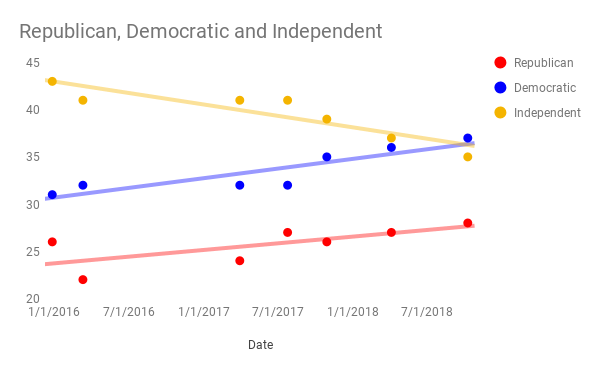
For the first time since January 2014, more respondents in a state wide poll said that they were Democrats and not Independents. In the last 12 of 15 polls taken since the beginning of 2008 that I’ve been able to track down, self identified Independents have been the plurality in Washington State.

Here is the data I’m working with.

The results in the Crosscut/Elway poll are not unexpected. Since 2015, the strength of Independent identification has been slackening. This narrow plurality of Democrats (37 percent to 35 percent Independents) falls into an ongoing trend.

On the surface, it seems like the strong hand of national politics is having a lot of influence in Washington State. While we saw a “normal” order of political identification in Washington during the Bush years, Independents started cropping up after President Obama was elected. And then, given the choice of another unpopular Republican president, Washington voters have begun to flock back to the Democratic label. It seems like the Democratic label in Washington is strongest when in resistance against an unpopular Republican administration. But, that support relaxes when a Democrat is in office.


I was able to track down some partisan identification data from the late 1990s, and it seems like you can see this trend is now repeating itself between the Clinton and Bush years. In 1996, 35 percent said they were Independents in Washington, but after Bush was elected Democrats were the plurality consistently through 2008.

So, bringing it home to Thurston County, what does this mean for our all Independent county commission? At the very least, not anything good. We’ve already seen that in the primary election, Independent Bud Blake has a much harder task to gather votes this time around. It seems clear to me that in our local elections, using the Independent label has allowed candidates like Blake (and Gary Edwards and John Hutchings two years ago) to obscure where they sit on the ideological spectrum.

How else can you explain Edwards, who literally does not believe in land use regulation, winning alongside Hillary Franz, a Democratic candidate for lands commissioner. There is literally no policy overlap between the two candidates, yet enough people made a contradictory choice of both Franz and Edwards to push him over the top.

It will be interesting to see with the power of the Independent label waning, what will happen with Bud Blake.

Shelton is the hotbed of Sanders to Trump voters in Washington State

A few days ago Brian Schaffner broke down some pretty deep data from the Cooperative Congressional Election Study to figure out that 12 percent of Sen. Bernie Sanders primary voters ended up voting for Donald Trump last November.

Most of the attention on this data so far has focussed on three rustbelt states where the Sanders voter splitting would have put Hillary Clinton over the top.

But the data set also attached locations to each voter it tracked, so it was possible to draw a map of where these Sanders-to-Trump folks lived.

And, guess what, Shelton I’m looking at you.

Overall, there were very few Sanders to Trump voters. Only 2.3 percent of voters in Washington that said they voted in a primary or precinct caucus for Bernie Sanders said they voted for Trump. That’s obviously way less than the national average.

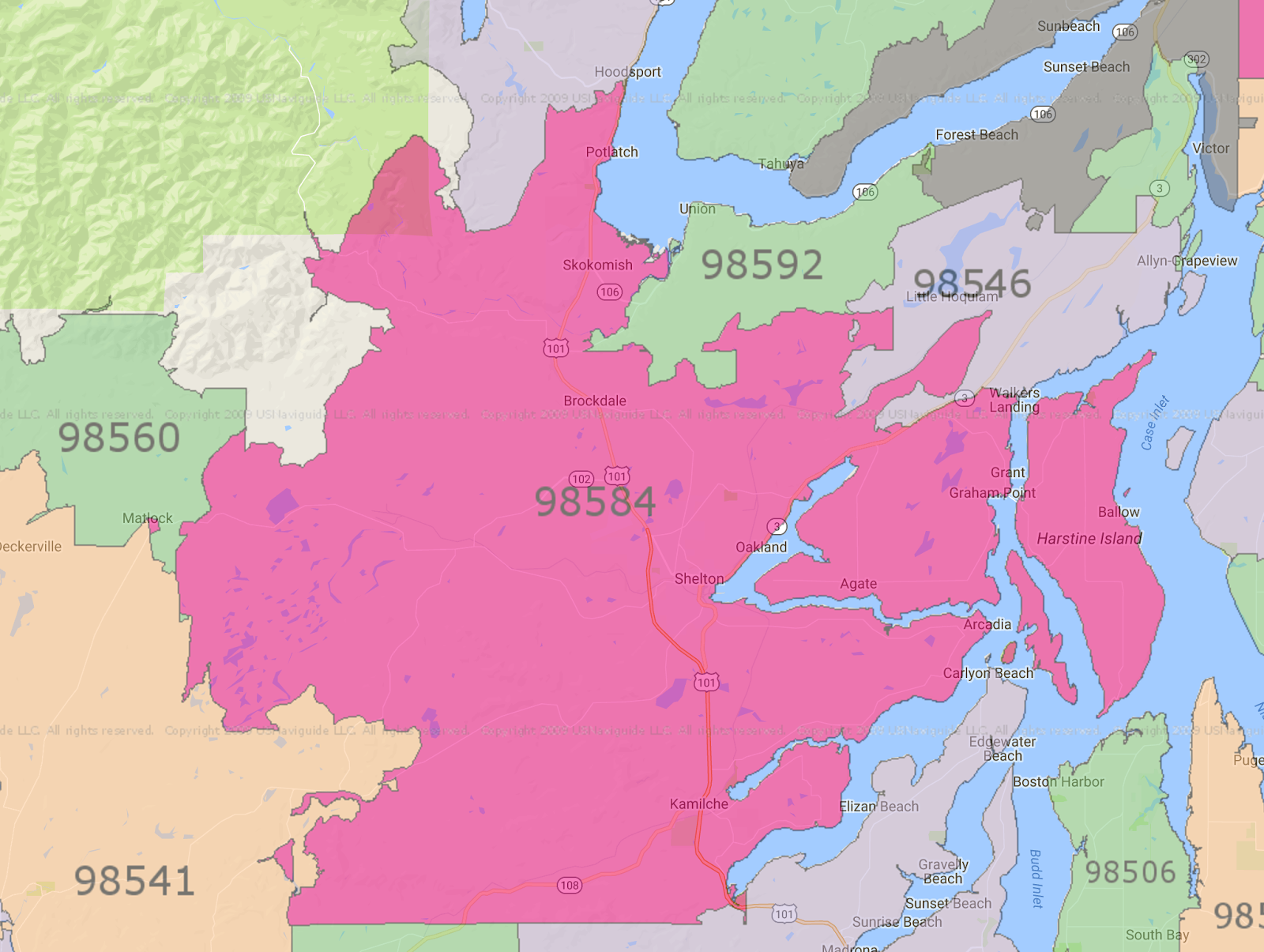
But you can read a few lessons from the map. Because of the low number of Sanders/Trump voters, most zip codes only had one survey respondent. Except for Shelton, which had three.

I was surprised that Grays Harbor and Pacific counties didn’t report back any Sanders/Trump voters. One of storylines from last year was that those counties especially were attracted to Trump because of how his rhetoric lined up with their traditionally Democratic roots.

I also noticed a pattern in the Puget Sound zipcodes that recorded a Sanders/Trump voter. Only two of them were urban zip codes, despite having most of the population. The majority of them were in rural areas near the urban core. I wonder if there’s something to read into that.

If only the KKK had been worse at lobbying, Honeyford wouldn’t have to worry about unmasking anarchists

So, it’s possible that running around with a mask on and smash things is impolite and already illegal. But making it illegal additionally to do it while masked is probably a bad idea.

It isn’t even a new idea though.

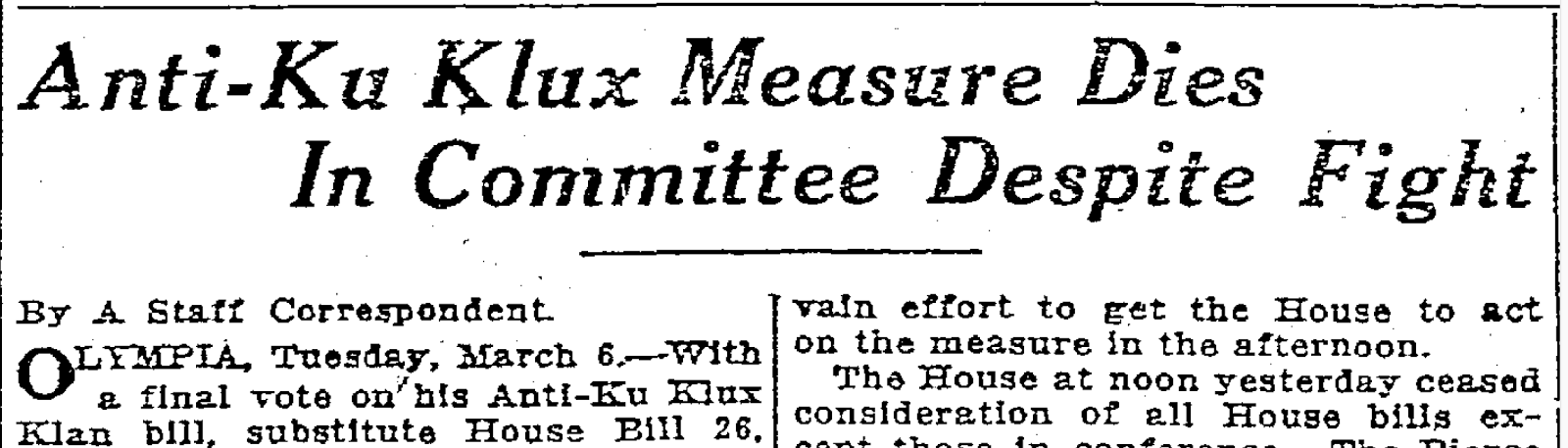
Rep. O.R. McKinney of Pierce County made a valiant effort in 1923 to rip the mask off the Klu Klux Klan in Washington. His bill would have made wearing a mask during a public protest illegal. In the 1920s the Klan was leaking across the border from Oregon and at the time of McKinney’s bill, was just about to hit their zenith.

But, in March of 1923 they were strong enough to stand in the way of an unmasking bill.

The Klan was so powerful apparently, that it is almost painful to watch McKinney contort himself not cast shade on them:

I did not introduce the bill as a religious fanatic or because I wish to do away with an klan or any other organization. We have an organization in this state called the Klu Klux Klan. I am not opposed to it, but it is important to have the state regulate such organizations. 

It is a dangerous thing to allow masked men to parade over the country. If we were sure that no one but members of the Klu Klux Klan wore masks we could put our fingers on the men who committed depredations, but the failure to pass this bill opens the way for depredations by masked persons who are not members of the Klu Klux Klan.

When McKinney’s bill was first introduced in January, the chair of the house judiciary committee was greeted on his homecoming to a “sheaf” of telegrams from Klan members opposing the bill. “Throughout the entire country we are being persecuted,” said at least one.

Honeyford’s bill isn’t going to pass just like McKinney’s wasn’t going to pass. But, that is where the comparisons end for something like this. Both groups use masks. But, the Klan was an evil group founded by the powerful to keep people and religions they considered impure out of the American mainstream.

No one is backing up anarchists or trying to bend over backwards saying they aren’t opposed to anarchists while trying to pass an anti-mask bill. The power dynamics behind punching up to attack the clan in the 1920s and punching down to the attack the anarchists almost 100 years later is totally different. 


The anti-mask bill won’t pass this year because it is a low priority policy for a legislature that needs to deal with real school funding, culvert repair and budget issues. It is a cheap trick. In the 1920s the bill was introduced in the early part of the session and had a real run out before the Klan killed it.

Anarchists won’t kill this bill, they can’t hardly engage in the legislative process. Good government and higher priorities will kill this year’s unmasking bill.

Washington had a surge of Independent voters. What does that mean?

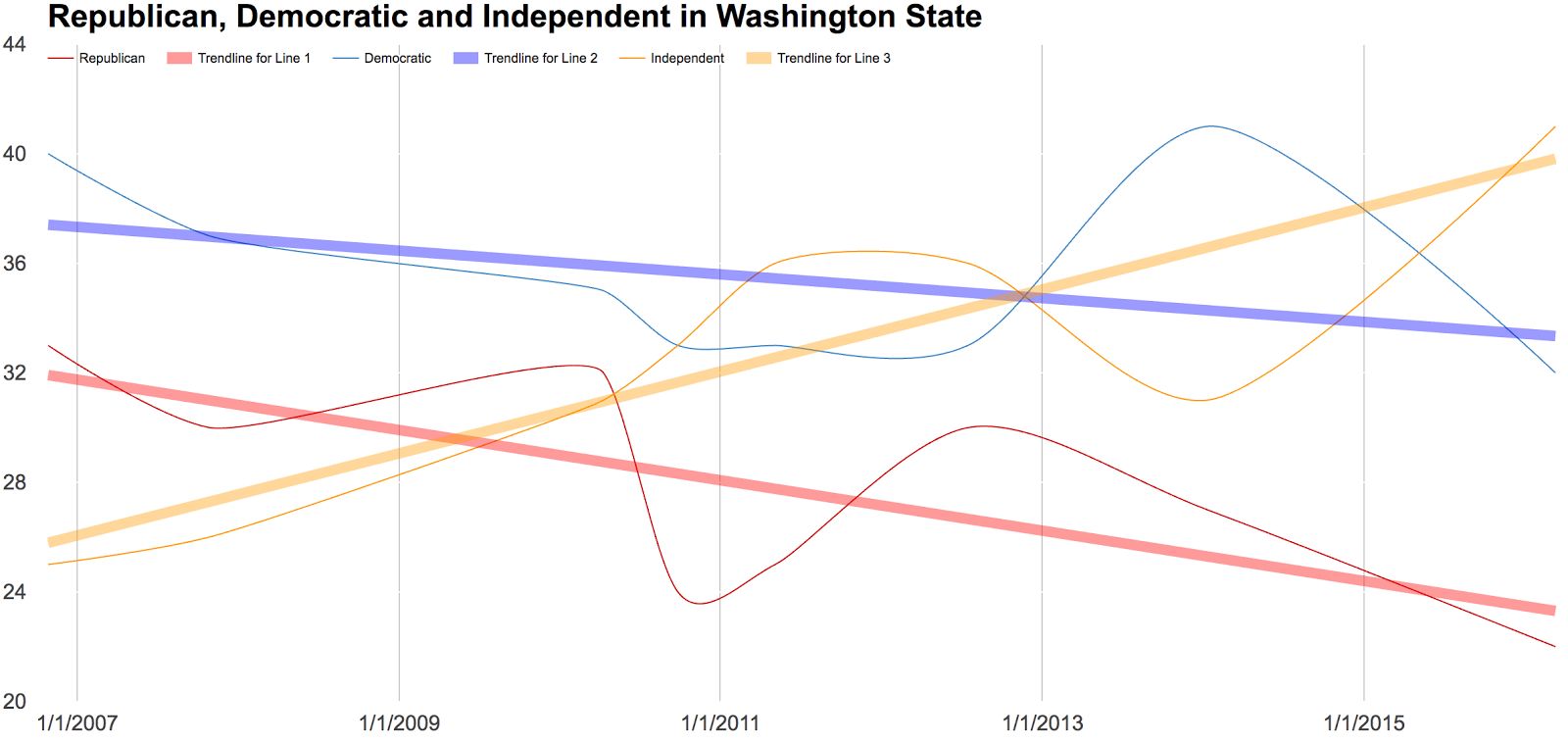
Here is the last 10 years of Survey USA statewide poll results charted out (background data), focussing only on how the respondents identified their partisan affiliation.

Basically, following the trendlines, both the Republican and Democratic parties have lost marketshare and three times since 2006 there have been more identified independents than anything else. Also, in the most recent survey from last fall, the independent identification has a big lead.

It is worth noting that independents have always been strong in Cascadia, but I’m convinced we’re seeing something different in this trend here.

What could have caused this?


I have a couple of theories, but I’m far from totally convinced by them.

I think the Top Two primary had something to do with this. Especially, in combination with a redistricting process in 2010 that had a lot to do with protecting incumbency and not with creating competitive districts between the traditional left and right.

So, since the first Top Two primary in 2008 and redistricting races in 2012, we’re seeing more legislative level races that aren’t competitive between the two major parties. So what do member of a minority ideology do when left in the cold without a standard bearer? I think it’s possible they drop the partisan standard all together.

I think there’s also something wrong with how we structure party politics around here that encourages not identifying as a partisan. Basically, political parties, the local county and legislative district ones, aren’t forces in the lives of most voters or even most activists.

Campaigns can be built, volunteers recruited and advertising funded, without a lot of help from local party officials. The web has a lot to do with this, but the fact that the basic party structure is an obscure elected official called a precinct committee officer probably doesn’t help.

What does this mean?


I think we’re already seeing the impacts of what a possible non-partisan identifying stable plurality or even majority could mean in Washington State. With little buy-in with their actual policies, the Thurston County commission is now made up of conservative independents. There is was also an independent election on the Grays Harbor County commission, a more conservative but still usually solidly Democratic county.

Also, in Grays Harbor, you saw them support a Republican for president for the first time since the Democratic party was near its death in the 1920s in Washington State. My guess is that they voted for Trump not because was running as a Republican, but because he was running as a non-partisan under a partisan label.

What could this mean in the future is two things:

One, maybe Bill Bryant could have won if he’d shed the partisan banner. With 41 percent and growing, the independent population in Washington serves as a much handier base than a shrinking third place identification. It also seemed to me that Bryant ended up not running as really a conservative, but as a better version of the centrist pro-government governor we already have.

And two, on the local level, even more independents. I hope.

 It is one thing for three anti-growth regulation independents to be elected in a county that voted overwhelmingly for an urban environmentalist of lands commissioner. That (plus the way we voted for the independents across the county), means that enough voters didn’t know what policies they were actually supporting and just pulled the lever for the non-partisan.

But, what happens when there are two non-labeled candidates in the race? What shortcuts do the voters use to make their decision? Or do low information voters drop out and leave the election to the voters who have their minds made up?

Why lying is legal in politics here (or isn’t, but the courts will probably make it legal again)

One quote from the robo-call dustup made me think:

You could read this (as did I) as a simple statement of “I’m telling the truth” or at least “I think I’m telling the truth,” but in Washington State that isn’t necessarily true.

In Washington State, Glen Morgan and Karen Rogers could well be lying, and know their lying, and still not run afowl of state law.

Twice now the state legislature has tried to outlaw lying in political speech, and twice the state Supreme Court has sent them back.

In the 1990s, there was a state law that barred candidates and campaigns from sponsoring “with actual malice” lies.

The first case that struck down these rules involved an assisted suicide initative, specifically one flier that the proponents of the intiative said were innaccurate about suicide safeguards.  The second had to do with one of Tim Sheldon’s state senate races in which his opponent tried to make hay over his weak defense of Mission Creek.

Between the two cases the state legislature tried to clean up the law, making it possibly better able to survive court challenge.

The bottom line of these cases is that the Public Disclosure Commission, which usually regulates political and campaign speech in Washington, can’t get into the lie vs. truth business.

The deeper reading of these cases shows a divided court weakly coming to this conclusion. Both cases show a small majority coming to a very thin legal conclusion that the state has no part in the lie vs. truth business.

Justice Talmadge in 1998, writing (sort of) with the majority:

I agree with the majority that RCW 42.17.530 is facially unconstitutional because it sweeps protected First Amendment activity within its provisions by penalizing political speech, even if knowingly false, regarding an initiative measure.   I write separately to emphasize that I am not convinced that the same is true where a statement contains deliberate falsehoods about a candidate for public office.   In my view, there is merit to the contention that the Legislature may constitutionally penalize sponsorship of political advertising of such a nature by enacting a narrower statute than RCW 42.17.530.

And Alexander in 2007:

Chief Justice Gerry Alexander joined the majority as well, but in a separate concurrence. He wrote that “the majority goes too far in concluding that any government censorship of political speech would run afoul of the United States and Washington constitutions,” but he agreed that the law was unconstitutional because it was overbroad.

But, then, two years later, the legislature again tried to clean up the law to make it illegal to maliciously defame a politician running for office. From the final bill report of SHB 1286:

It is a violation of the campaign laws for a person to sponsor, with actual malice, a statement
constituting libel or defamation per se under certain circumstances: the false statement is about a candidate and is in political advertising or electioneering communications; a person
falsely represents that a candidate is an incumbent for the office sought in political
advertising or an electioneering communication; or a person directly or indirectly implies the
support or endorsement of any person or organization in political advertising or an
electioneering communication when in fact the candidate does not have such support or
endorsement.  

A candidate is also prohibited from submitting a defamatory or libelous
statement to the Secretary of State for inclusion in the voters’ pamphlet about his or her
opponent.
For the purposes of this act, “libel or defamation per se” is defined as statements that tend: to
expose a living person to hatred, contempt, ridicule, or obloquy, or to deprive him or her of
the benefit of public confidence or social intercourse; or to injure any person, corporation, or
association in his, her, or its business or occupation. 

 If a person makes a false statement,
with actual malice, about himself or herself or falsely represents himself or herself as an
incumbent, it is not libel or defamation and is not a violation of the campaign laws. It is also
not a violation of the campaign laws for a person or organization to falsely represent that the
person or organization supports or endorses a candidate as persons and organizations cannot
defame themselves. If a violation is proven, damages are presumed and need not be proven. 

So, there. Clear as mud. Each time the legislature tries to make it unlawful to lie, then the courts kick it back and the legislature tries again. If we were to take a broader view in our historical circle, we’re at the point where we wait for a case attempting to enforce this law makes it back to the Supreme Court.

Where does Bill Bryant’s 100,000 come from?

Not since 2004 when Dino Rossi got within a hair of non-incumbent Christine Gregoire has a Republican gotten close the governor’s mansion.

This year Bill Bryant is making his run and he’s staking his election on the turnout of 100,000 extra conservatives:

His path to victory, Bryant explained, hinges on turning out some 100,000 Washingtonians — mostly likely-Republicans or conservative-leaning independents — who failed to vote in the 2012 election but probably would have backed Rob McKenna, Washington’s last GOP candidate for governor.

This 100,000 is pretty core I suppose to Bryant’s math, because seems to talk about them a lot.

“Who do you think elected Jay Inslee?” Bryant asked volunteers at the Clark County Republican Party headquarters Sunday evening. It wasn’t just Democrats, he said.

 There were more than 100,000 voters in the 2012 election who would have picked Inslee’s Republican opponent Rob McKenna but who didn’t vote, Bryant said. McKenna lost to Inslee, a Democrat, by about 94,000 votes.

So, as I understand his argument, his goal is the turn up turnout among conservatives (who identify as Republicans or not) while hoping Democratic turnout stays flat.

I tried to simulate a couple of ways he could do that. Here is my math. Feel free to check my work, I’ve been wrong before. 

First, among the counties that fell below the average turnout in the gubernatorial election in 2012, I turned the turnout among Republican voters up to the average of all the counties. The above average counties I let stay the same.

This results in Bryant just barely losing to Inslee 1,506,000 votes to 1,582,000 votes.

Second, I took Republican turnout and pumped it up to the highest turnout of 87 percent in the gubernatorial election. This is incredibly pie in the sky since a lot of counties have turnout much lower than that. But, in this case, the Republican wins with 1,652,166 votes. Way more than enough.

The third one was trying to find the Goldylocks solution, how far you’d need to pump average voter turnout to just the right level to get Bryant over the finish line. This turns out to be 84 percent across the board, assuming Democratic turnout stays the same. This still sounds like a lot of turnout.

But, none of these are the reasons why I think the 100,000 voters are bunk.

The chart below illustrates the second option, 87 percent turnout across the board. It shows you the actual votes (in blue) and the new votes (red).

King County is still very much king.

There are more new votes (via math) to be had in King County then there are in the most Republican of Republican counties. But, I don’t think these votes actually exist. Churning up new voters in King County (and other large Puget Sound counties) would only churn up new Democratic voters.

So, I’m not sure I think the 100,000 voters Bryant and the Republicans are looking for exist.

Lastly, I hope everyone appreciates the irony of Republicans talking about the benefits of higher voter turnout.

5 reasons Bill Bryant could run as an Independent

It sure is a little (R) up there:

1. Use Bud Blake as a template.

A couple of years back an unknown Independent, with deep support from conservatives throughout Thurston County, upset a sitting county commissioner. How did Bud Blake do it?

Basically, in every precinct in Thurston County, from the most liberal to the most conservative, he used the Independent brand to beat the average Republican vote just two years before. In fact, some of Blake’s best returns vs. a stand-in Republican average came in some very liberal districts.

The short lesson of Budd Blake in 2014 in Thurston County: party ID can mean a great deal to voters. And, people like the idea of an independent.

It seemed that there was a group of voters that didn’t like the idea of voting for a Republican, but were plenty happy to vote for someone who acted and talked like a Republican, but called himself and independent.

2. Bill Bryant is not locked in as a Republican.

He has until the filing deadline on May 20th to lock in his actual party preference.

3. Bryant could use the Top Two primary to build a financially formidable independent campaign.

And because Washington uses a Top Two primary, Bryant doesn’t actually need to be affiliated with a major party to move along. He simply needs to build a financially stable campaign and build his name recognition statewide to get through the primary onto the general election ballot. And, Bryant has raised $1.4 to Governor Jay Inslee’s $4 million. So, at least he’s in the ballpark.

The problem is timing. The May 20th deadline for filing is just four days before the Presidential primary in Washington State. If Trump is predicted to win the Washington Primary, would Bryant buck the tide of Republican primary voters?

4. Organized Republicans aren’t exactly running towards Trump.

The Democratic Party in Washington State ready to tar him with his party’s presumptive standard bearer. But, it seems like a lot of Republicans are trying to keep their distance from Trump.

No doubt their reticence was influenced by the polls and prognostications that a Trump candidacy could have a damaging domino effect on them and other GOP candidates. The theory is independent voters will be turned off by Trump and vote for a Democratic president, then continue voting against Republican candidates down the ballot.

An Elway Poll released earlier this month found 55 percent said they would vote against a congressional candidate in Washington who endorsed Donald Trump. 

Although the poll didn’t ask about candidates for state offices, Democratic Party operatives drool at the possibility of a coming landslide of victories in legislative races.

At every opportunity, they are pressing Republican candidates to reveal their presidential choice.

“If you’re a member of the Democratic Party state committee, every Republican candidate’s middle name is Trump,” pollster Stuart Elway said.

Unless of course, Bryant doesn’t end up becoming a Republican candidate.

So, possibly Bryant could still raise money from conservatives not hung up on party names. And, even though I doubt the Thurston County Republicans were super happy Bud Blake spurned their party, conservatives in the county still gave him enough to win.

5. The ultimate non-establishment candidate

So, here’s the crazy thing, and I admit this doesn’t exactly make sense, but what better way to show that you’re surfing into the anti-establishment wave by dropping your major party identification? Even when the party is nominating the establishmentarian-in-chief? Bill Bryant is such a rebel, he’s going to rebel against the rebel.


Here’s one last sort of bonus thought.

Between Republicans, Democrats and Independents, what is the largest political group in Washington?

According to a 2012 poll (I know, four years ago), the largest group is Independents. And, that number has been growing steadily since 2004. They’ve actually been in first place in Washington State since 2008 and in the mix since the start of the poll period.

More importantly, actual Republicans only made up 23 percent.

Did Washington State politics change been 1928 and 1930?

Before the 1932 election, there was hardly a Democrat in the Washington state legislature. One Democrat in the senate in 1929, eight in the house (compared to 89 Republicans). Everything chanted in 1932 when the landslide went to the Democrats.

By 1935 (after the entire Senate has seen an election since 1932), the partisan split in the legislature was 37 to 9 Dems over Republicans in the senate and 91 to 8 in the house.

This isn’t a new story in Washington State history, but one that bears investigating.

I’m mostly interested in this political flip because of my interest in Smith Troy. His political life began in the early 1930s. His brother’s election as Thurston County prosecutor began with this Democratic wave.

One of the things I’ve read about the difference between 1928 and 1932 was voter turnout. Prior to 1932, Washington (as the story goes) was a politically ambivalent state. Its long history as a territory when leaders were appointed, not elected, led to a political culture in which most people stayed home. Our live and let live attitude extended to politics.

But, apparently, that all changed in 1932. People who did not vote in 1928 stormed the polls in 1932  in reaction to Republicans not handling the dire economic times well (both back east and at the state capitol),.

But, I’m not so sure its that, or if the vast majority of voters actually changed their votes to Democratic.

I’m not able to find some actual voter turnout data between 1928 and 1932, but I was able to figure out a raw voters per thousand number. They were 32.29 percent in 1928 and 38.81 percent in 1932. So, a bump of roughly 6.5 percent. I’d assume most of those 100,000 plus new voters went Democratic.

But, there also seems to be an erosion of traditional Republican voters between those four years. Republican votes declined by over 100,000 between the two elections, despite a modest increase in the state’s population.

So, it was probably a combination of factors, including a wave a new voters. Anyway, just thinking out loud.

« Older posts Newer posts »

© 2026 Olympia Time

Theme by Anders NorenUp ↑