History, politics, people of Oly WA

Category: Washington Politics (Page 5 of 27)

Historic perspective on the Gonzalez-Danielson race

UPDATE 9/29/12: A few smart folks took a close at the precinct level numbers and came up with some pretty solid evidence about race based voting patterns. I stand by my take below, but this research is much more significant and relevant to the election.

Since State Supreme Court Justice Steve Gonzalez won a full term last week, there have been questions about how Bruce Danielson — who didn’t raise or spend any money in a campaign — was able to get more than 40 percent of the vote.

Initially mentioned by Eli Sanders, there have been claims that Gonzalez didn’t get more of the vote because of racist tendencies of rural Washington voters against candidates of Hispanic background. Here are clips from Tacoma News Tribune, Seattle Times and the Everett Herald that show some of the discussion.

It may very well be true that a certain percentage of people voted against Gonzalez because they don’t like minorities, but this doesn’t necessarily bear out against historical context. In two other state Supreme Court races in 2000, candidates that spent no money at all got at least 38 percent of the vote.

Here is a spreadsheet that puts these three races (two in 2000 and Gonzales vs. Danielson this year) in terms of vote percentages and campaign expenditures. Just a side note, these two 2000 races were the only two when one literally unfunded candidate opposed a well funded candidate in a state Supreme Court race.

One of the 2000 races, Jim Foley lost to Tom Chambers, but received over 43 percent of the vote in the November general election.. Similar to Danielson, Foley was ranked as not qualified to serve on the bench. But, in a sort of opposite name phenomena of Gonzalez-Danielson, the scuttlebut in 2000 was that Foley did so well because voters confused him with former Spokane congressman and Speaker of the House Tom Foley:

Chambers, 57, who raised more money, $355,947, than any of the other candidates, said he at times found himself hard-pressed to compete with Foley’s familiar name. 

Although he beat Foley by a wide margin, he said he wished the margin had been even greater.
“It would give me greater comfort,” he said. 

When Foley ran unsuccessfully against Faith Ireland in 1998, he said he had a “million-dollar name” because voters mistakenly link it with former U.S. House Speaker Tom Foley, to whom Jim Foley is not related.

Here is another Seattle Times story that discuss the dynamics of that race.

In the other race (the deciding vote took place in the September primary), Bobbe Bridge defeated a Tacoma lawyer Scott Schweiger. Like Gonzalez, Bridge has earlier been appointed and had already been serving on the court when she won. She also spent $153,000 in a race that ended months before November because she was able to knock off her only opponent in the primary. But, despite her opponent not raising or spending any campaign funds, Schweiger received 38 percent of the vote, very close to Danielson’s total. This article indicates that there was little, if any, discussion at the time how Danielson finished so well against a well-funded candidate.

A significant difference between the 2000 races and Gonzalez-Danielson is the lack of a statewide voters pamphlet. It is hard to gauge the impact of the lack of this information had on voters this year, but you also can’t discount information available now more readily available from the internet and from newspapers.

What we should be able to take from this information is that there seems to be a floor that literally unfunded state Supreme Court candidates won’t fall below. And, Danielson performed within the normal range of similar candidates in recent years.

PCO Wars! (also update on PCO history project)

I haven’t gotten very far on my PCO history project, only up through the 1940s with 2010 as a bookend. If I was to come up with a conclusion so far, I’d say compared to today, there have been decades of high participation in the PCO process, much higher than today. But, you can find years when our average now wasn’t out of the ball park.

What I do find striking is the years when every single PCO slot had at least one candidate. Competitive races were somewhat rare (though sometimes as high as almost 70 percent), but the full ballot implied a desire on the parties’ behalf to have as many PCOs as possible.

Anyway, seems like this year on the Republican side, the PCO races are of high interest across the Northwest again. Here are some links noting the PCO battles that are going on between Ron Paul supporters and long time Republicans.

Ridenbaugh Press: The Precinct Wars.

In Twin Falls County, the Republican Liberty Caucus ran a slew of challenges to often-veteran precinct officers, and won almost a third of the seats. The mainstream party leaders expressed relief that the challengers hadn’t won a majority, but they’d better not count on the fermet to ease off soon. Many races were competitive; one was decided by a coin flip.

Spin Control: County awash in PCO candidates

In theory, Democrats and Republicans should each elect a PCO for each of Spokane County’s 314 precincts every two years, although in many years the parties often go begging for willing candidates, and when they find one, there’s no contest for the job.

Not this year. In 105 precincts, about a third of the county’s total, there will be contested elections. Almost all, 101 races, will be for Republican positions. In one precinct, a South Hill precinct near Roosevelt Elementary School, both parties have contested PCO races with two Democrats and three Republicans.

Clark County Politics: My Mistake: a FOUR way race in the 620 precinct.

New project: history of the Washington State Precinct Committee Officer

Someday soon, the sun may set on the precinct committee officer in Washington State. Stemming from various lawsuits connected to primary elections, the PCO seems to be an endangered species. The two major parties are suing the save the PCO-as-is.

So, it seems like a good time to start reviewing where exactly the PCO came from and how it has evolved in Washington State.

First, I want to explore the evolution of the PCO from creation to today. At minimum, I want to track the interest in the PCO position by looking at historic election results. The data I’ll look at is the only historic archive of county level election results I could find from a major Puget Sound county.

Snohomish County election results, 1892 to present

I’ll use this spreadsheet to parse out the PCO results by the number of people who filed compared to the total number of PCO positions and also the number of races that had more than one candidate (so were actually competitive). I suspect we’ll find a steady decline in participation and interest in PCO elections between 1908 and today. Feel free to dive right into the data and help out.

Secondly, I want to track the origin of the PCO in policy. So far, I’ve come up with this speech which explains the impact and origin of the “direct primary” in Washington State. The creation of the direct primary was a direct cause of the PCO, so I hope it’ll help out.

I have my own history with the PCO position. Here’s a peak at how I actually feel about the PCO. One blog post from 2007 where I blast the PCO as “undemocratic” (Undemocratic nature of PCO elections and how it could impact the state central committee). Also, an archive of posts from earlier in the year in chronicling an effort I helped with to create a membership-based county Democratic organization (Olympia Time: PCO label). Some might say I wanted to dilute the power of the PCO, and some might be right.

Not so sure about the “Denny Heck” district either

In the business, they’ve called the new 10th CD the Denny Heck district, but I’m thinking Alex Hays might be more right. It could also be the Dick Muri district:

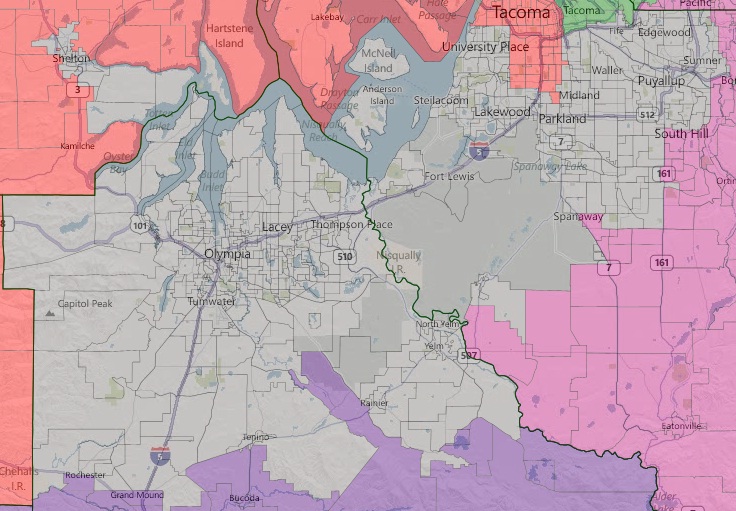
Muri is a Pierce County Council member who lost handily to Smith last year, but his campaign chairman Alex Hays said the 10th – which ranges from Shelton to Olympia, Lacey, Tumwater and then north to Lakewood, Sumner and University Place – favors Muri.  

“They think they’ve drawn a Denny Heck district but they’ve accidentally drawn the perfect Dick Muri district. It’s roughly two-thirds in Pierce County and he’s a Pierce County councilman …” Hays said by telephone. “Even against Adam Smith who outspent Dick by [five] to one, he prevailed in Pierce County … The voters in the county have a really positive view of Dick Muri.’’

Last time around, Muri actually beat Adam Smith in the Pierce County portions of the old 9th CD.

On the Thurston County side both Democrats (Smith and Heck) did much better, but there are fewer votes to share on that side of the map. Also, there are some precincts that were in play in 2010 that won’t be in play this year. I’d be interested in seeing a precinct by precinct breakdown, comparing 2010 Heck with 2010 Muri in the new 10 CD districts.

Forget centered on Parkland or Olympia, the 10th CD will be centered on JBLM

Months ago I read “Patchwork Nation,” one of those books that takes a long swipe at American Politics and creates an alternative to the Red vs. Blue model. I think it did a pretty good job, until I flipped forward to where it put Thurston County.

Instead of putting my home county in Campus and Careers (state capitol, four year college, Arts Walk, Procession, come on!) the authors put us in Military Bastions. Fort Lewis is nextdoor and militarily folks do live around here, but it just didn’t resonate with me.

Huh, I thought. Well, they’re model falls apart there, I’ll quit reading this book

But, now that I take a closer look at the map of our new congressional district, I think they might have hit something I didn’t see until now. Earlier I said that the new 10th CD will center on the Pierce County suburbs. But, now I think it’ll center on Joint Base Fort Lewis McCord.

While the early scuttlebut is that the district is centered on Olympia, the nature of the district will be that of a military base town. Let’s take a closer look.

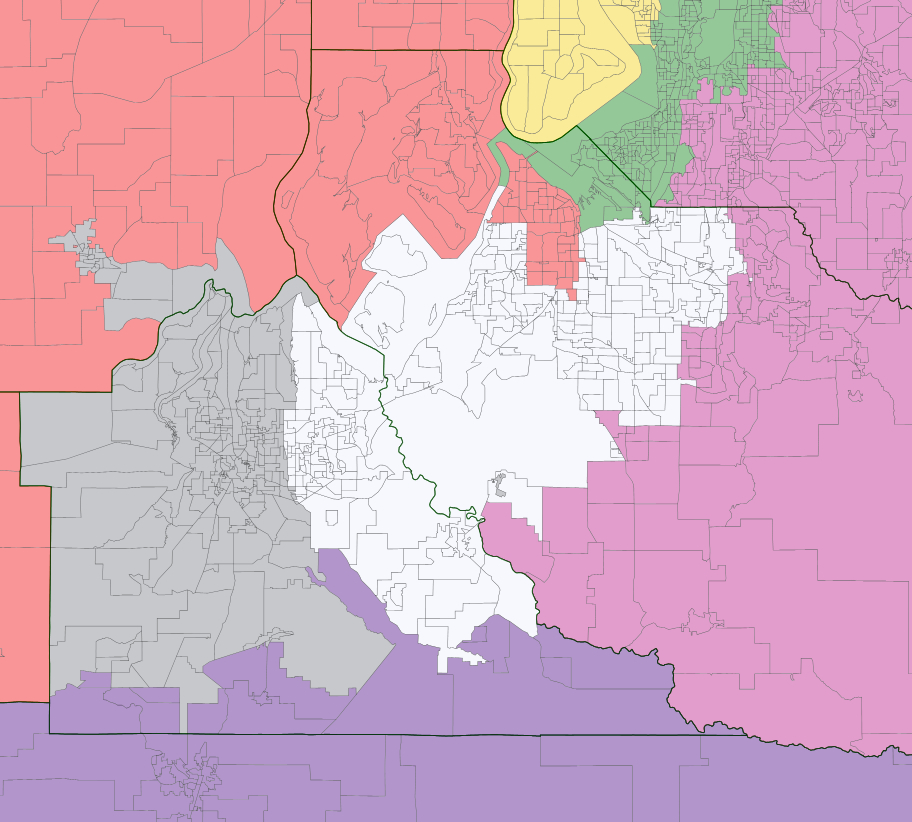
Here’s a map where I split the district into two parts.

Basically, the gray area is the Olympia influenced side (hippies, state government). The white side is the Fort Lewis influenced side. I did allow for a lot of cross over into Thurston County, but I’m pretty sure that’s accurate.

The Olympia influenced side is 59.4 Democratic (from the 2010 Senate race) and is pretty small, only 148,000 of the more than 600,000 in the district.

The JBLM side is much much larger (521k) and only barely Democratic at 50.3 percent.

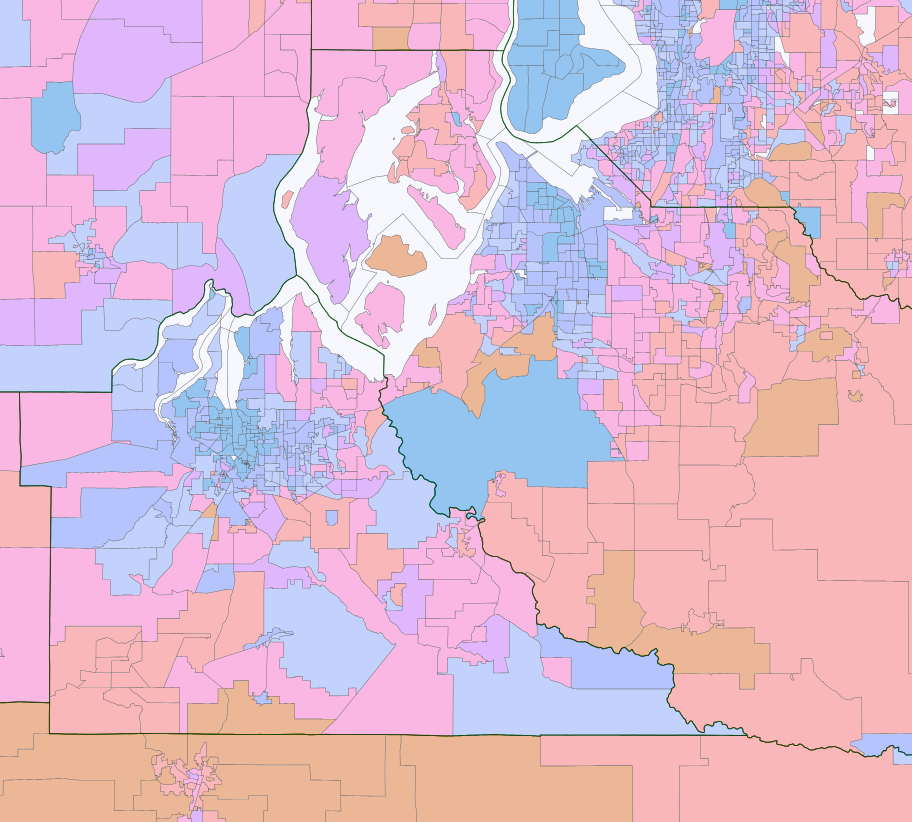
Here’s a map of the district by how it voted in the last Senate election. The deeper the blue, more Democratic, the more red, Republican.

You can clearly see the heart of Olympia in the middle left is pretty blue. But, as you go out toward Lacey (especially the new Hawks Prairie neighborhoods) and into the suburbs around Lakewood and Parkland, the district gets pretty red. 
The district as a whole still leans Democratic, but it’ll be interesting to see the politics that can shaped by the politics of a base community. What are the issues that specifically impact these sorts of towns?

New congressional district to be centered on Olympia? (no wait, Parkland!)

Despite the observations that Washington’s new 10th Congressional District will be “centered on Olympia,” it actually won’t be.

While it really does look like the district is geographically centered on Olympia. But, in terms politics and population, the district is firmly centered on the Parkland/Midway/Puyallup metro area.

And, just a short note. If, in this redistricting process, if you haven’t discovered Dave’s Redistricting Tool, I’d suggest you check it out. Dave Bradlee has done a great service to all of us who like to tinker with this sort of stuff.
So, anyway, while the map puts Olympia at the center, the south Pierce County suburbs are the defining feature of this district. Just about two-thirds (415,000+) of the people in the almost 670,000 living in the district are in Pierce County.
The heart of the 10th CD
While the district as drawn is marginally Democratic (53 percent according to Dave’s tool), a lot of that is sitting in the non-Pierce County areas. Without Pierce County, the district is more safely (56 percent) Democratic.
While there has been a lot of talk about how this Olympia-centered district will behave (Thurston County is heavily Democratic, did you know that?) there’s not very much talk about how this suburban Pierce County boarding on JBLM district will behave.

And, don’t get me wrong, I am happy to be separate from the almost Oregon that was the 3rd CD, but the one we’re in now is a far cry from being “centered on Olympia.” We’ve just traded one set of noisy rural conservatives for less noisy suburban moderates.

What will Washington State do with the congressional seat we’re getting from New Jersey?

In the data release today, New Jersey is losing and Washington has gained (you know, among other states).

I’m hoping that Dave Bradlee updates his very useful tool soon with the new data, but in my first go round, it really looks to me like the new district will be centered on Olympia, and bring in mostly Democratic coastal and rural counties like Mason, Grays Harbor and Pacific.

And, if you aren’t satisfied with the online tool, there’s a boardgame for you and your nerdy friends to help redistrict Washington State (via @epersonae)

Washington historic districts that have crossed the Cascade Curtain

Yesterday, I took a look at “Historical Atlas of United States Congressional Districts” at the Olympia Timberland Library and answered a question I had last time I thought about congressional districts.

As far as I can tell, there aren’t any online digital historic congressional district maps online, so the 24 year old atlas is the best resource I could find.

So, in the past hundred years or so, since Washington gave up on at-large districts, there have been three instances where a congressional district spanned the Cascade Curtain:

  • In 1909 the 2nd CD
  • 1969, the 3rd CD
  • 1973, the 4 CD

All three crossed the Cascades along the Columbia, so there is no historic parallel what I do with the 8th CD (link above). Both the 1909 and 1969, it was the historic parrelell of the current 3rd crossing over, taking in a couple of east side counties. The 1973, an east side district came west and took in Vancouver.

I redraw your congressional districts so you don’t have to (Olympia is the center of the universe, no?)

I know I said I’d avoid politics on this blog from now on, but this really isn’t politics as much as its playing around with cool maps. It all starts with this cool tool by Dave Bradlee that lets you manually redraw congressional lines. Its a bit clunky at first, but as soon as you get a handle on how it works, it is pretty awesome.

First, consensus is that Washington is getting an additional district after the census is done.  Dick Morrill up at the UW makes a pretty good argument that the new district would be centered on Olympia (hey, have to be happy about that, right?).

What he doesn’t really do is show you how that Olympia-centric district would shift all the other districts around. So, after about an hour or so of tinkering, here’s what I came up with.

Statewide

Puget Sound detail

New 10th detail

Where I fudged the most, between Yakima and the Tri-Cities, using the population out there to balance out three districts.

A handful of thoughts on the work the redistricting commission has to undertake to actually redraw the districts next year.
Also, the here’s the actual file that you can upload to the tool above to really see the detail of the work I did. Its certainly not perfect, there are some unassigned areas still and likely some islands.
1. Morrill understates the impact the new district will have on the west side of the state. I used up all of Mason, Grays and Pacific counties, including all of Thurston and a lot of Pierce to get the new district.
I did take his advice and moved the 3rd across the Cascade Curtain towards Yakima and the Tri-Cities. But, I didn’t really need to take up much of those urban areas to balance out the 3rd. 
The real impact came when I started balancing out impacts to the 6th and 9th made by the new 10th. I made up most of those eventually with the 8th, which in turn I made up by again crossing the Cascade Curtain into the Cle Elum and Ellensburg areas.
2. So, in the end, I solidified Republican seats in the 8th and 3rd by crossing over the cascades. Both east side districts were way over, so taking from them was easy. But, what I’m not sure of is whether a Washington congressional district has ever crossed the Cascades.

Will having two members of the federal caucus working for both sides of the Cascade Curtain help bring that division down?

3. On the other hand, I think I created a pretty safe Democratic 10th. Even though it seems pretty rural, except for Pierce and Thurston counties, the three rural counties mostly elect Democrats to the state legislature.

4. And, yes, I balanced this out by playing fast and loose with the area between Yakima and the Tri-Cities. Since I have the 9th CD currently breathing down my neck a few miles away, I don’t feel too bad about the crowded Interstate 82 corridor.

One county commissioner, 10 city council-members, three school board members (and some more) come out for Stew Henderson

The list is long and deep and it looks like local Dems are lining up behind Stew Henderson for the 22nd LD:

The full list of endorsements announced today include:
• Karen Valenzuela, Thurston County Commissioner
• Doug Mah, Olympia Mayor
• Karen Rogers, Olympia City Council
• Joe Hyer, Mayor pro tem, Olympia City Council
• Cynthia Pratt, Lacey City Council
• Andy Ryder, Lacey City Council
• Mary Dean, Lacey City Council
• Ron Lawson, Lacey City Council
• Joan Cathey, Tumwater City Council
• Betsy Murphy, Tumwater City Council
• Ed Stanley, Tumwater City Council
• Eileen Thomson, Olympia School Board
• Mark Campeau, Olympia School Board
• Allen Miller, Olympia School Board
• George Barner, Olympia Port Commissioner
• Chris Stearns, Public Utility Commissioner
• Jay Manning, Chief of Staff to Gov. Chris Gregoire and former Director of Ecology
• Karen Messmer, former Olympia City Council Member
• John Cusick, immediate past Chair, Thurston County Democratic Party
• Debby Pattin, WA State Democratic Party Committeewoman for Thurston County
• Roger Erskine, WA State Democratic Party Committeeman for Thurston County

Here’s what Jay Manning has to say:

“I’ve known Stew for years, both personally and professionally. He will be an outstanding legislator, bringing excellent judgment, honesty and a great work ethic to the table,” said Jay Manning, former Director of the state Department of Ecology and current Chief of Staff to Governor Chris Gregoire.

Here’s his full list of endorsements.

« Older posts Newer posts »

© 2026 Olympia Time

Theme by Anders NorenUp ↑