Memories of a younger Olympia life. I did live here before.
Category: Uncategorized (Page 31 of 49)
Some online communities are self regulating, others not so much. At work, I read a few message board communities, and very much enjoy the civility and level of conversation on them. Several things contribute to the lively and informative conservation.
Most of the people on these boards have been posting for awhile, so they know each other fairly well, and know what they’re talking about (these are necessarily politics boards). Since they’re familiar with each other, they have developed a level of respect, and aren’t likely to lash out at someone that they’re going to have another conversation with later on.
Also, most people know what they’re talking about, so there is a level of respect in terms of what everyone brings to the table.
There are also several “everyday” users that moderate the boards. Cutting off a conversation, moving it to another section of the board, editing profane comments are all part of the moderators role. They are the grown ups in the room, and if you don’t play nice, you can be asked to leave.
On at least a few progressive blogs in the Puget Sound, there are sometimes very raucous comment threads that I find tiring and pointless. The same folks end up commenting and each thread gets way out of control. Washblog should be credited with being highly commented site that doesn’t fall into this category.
One site, the Northwest Progressive institute’s blog, which in the past has had some pretty heated (and from my point of view) pretty pointless comment threads, is moving to change the tone. Starting today, the NPI blog will have a comment thread policy. Its pretty general, but it will hopefully be very effective:
We do not have comment threads on this blog so that Republican hacks and members of the 101st Fighting Keyboardists can drop by and leave RNC talking points, or deliberately trash this organization and the progressive movement.
The comment threads exist for intelligent discussion, and to allow readers to point out mistakes in our posts or offer additional information.
From here on out, the comments policy is as follows:
- No profanity. We don’t care what your political persuasion is – no profanity, please. There is no need for it. The radical right is trying to engage in a culture war. Their goals are to divide and disrupt. When swearing matches erupt, that’s a victory for them.
- Don’t type in all caps. Over the past year, we’ve observed that a couple commenters deliberately type in ALL CAPS. All caps is equivalent to shouting. Again, (as you may have noticed) the right is trying to engage in a culture war. When shouting matches erupt, they win. Commenters who type in all caps will be first warned and then banned if they continue to comment in all caps.
- Have something of value to say. We’re going to be flexible with the definition of what we consider to be value. Value could be humor (including snark and satire), a polite correction, a personal viewpoint, new information, and so on. Value is a broad definition. For our policy, it covers everything that we don’t consider trolling (or disruptive behavior).
The only addition I would make would be to include arguments that fall into a very general “logical fallacy” category. The downside would be that it would be hard to enforce, but every so often you come across a “Your only arguing that point of view because you’re a poop-head” comment, which while it would fall under “not having something of value to say,” I think it would be better to moderate that comment based on it not being a good enough argument.
A few months back I emailed this idea to the Olympia City Council. I haven’t heard much feeback, other than they’re thinking along these lines during their council retreat next month. I’m wondering if anyone out there has any feedback.
Civic Olympia Library Project
The purpose of this proposal is to outline why the Olympia Library Board should be reestablished to:
1. Build on the already existing “town hall” meetings to create
dialog within the city;
2. broaden our community’s civic discourse;
3. and, establish the Olympia Library as a center of non-partisan
civic involvement.
Despite being the largest city in the Timberland Library system, Olympia does not have an active Library Board. Other similar-sized cities, (Lacey and Tumwater, for example) have active boards that act as intermediaries between their city councils’ and the system-wide Timberland Library Board.
In addition to fulfilling the roll of ambassador between the city and library system, the Olympia Library Board should be established as a “working board” to plan and carry out regular town meetings and topic-based public forums.
The Olympia Library Board civic dialog effort would build on the success of city’s existing and successful town meetings. These efforts can be expanded on through the library by hosting topic based discussions, public forums and lectures.
There has been recent discussion on how libraries, as welcoming institutions in the civic tapestry, can fill the void of civic dialog and engagement. American public libraries were originally established to provide for general education to help citizens become well-informed. The Olympia Library can start broadening civic dialog by hosting non-partisan, educational forums. The attached readings speak for themselves, but here are two examples of ongoing library-based civic projects:
Johnson County (KS) Library “Community Issues 101“
Lawrence (KS) Public Library Forums:
To Inform Democracy, by John N. Berry III, Editor-in-Chief
From “Library Journal,” November 15, 2004
Can Libraries Save Democracy? by Michael Baldwin
From “Library Journal,” October 15, 2002
While we’re nominating a presidential candidate that can’t learn from the internet experiment, all of Chile’s presidential candidates took part in online dialog:
…the Digital Nation Foundation was born with the mission of developing a digital culture in Chile that joins the government, business world, civil sector, and education system together in order to promote greater information, communication, and development for everyone. And it is that foundation which today, has helped make Chile the first country in the world to have each of its presidential candidates blogging their platforms, promises, and news items on what has turned into a always-running, weblog-based, presidential debate open to whoever would like to participate.
Here is a badly translated post from one of the successful candidates, Michelle Bachelet, who is facing a run-off vote in January:
I have impelled from the beginning of my campaign spaces of citizen dialog in which all can be expressed to construct diverse, pluralista and democratic a proposal, and is for that reason that I have supported with pleasure the initiative of this forum-blog of the Foundation Digital Country, as complement to the one of my Web site, blogeando . Although I think that the direct bonding with people is irreplaceable, Internet finishes and the geographic distances with time.
The point is that good dialog can exist online. It can be good for the political process, it can drive civic engagement. But, there has to be buy-off from the current top of the pile so that folks at the bottom can be heard. I’m specifically thinking of the political parties right now, but this is a good criticism for state and local governments too. You can develop and moderate web products that engage people in politics and their communities.
A little while back I got into a discussion down south on whether Major League Baseball should be allowed to come into the Portland market. My argument is two-fold. No, because it would split the Mariners’ tv market and create two bad teams rather than one OK one. No, because no one it talking about expanding MLB to Mexico or Latin America, which is the next logical move for the sport.
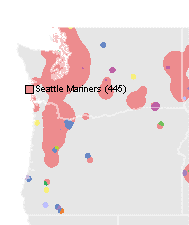
Here are a couple of maps from the CommonCensus Map project that illustrate my first point.

This version of CommonCensus tracks your zip code and then your preference for sports teams. What we see with the baseball map is preference for the Mariners in the Puget Sound region, Yakima and the Tri-cities, the Inland Empire and Portland/Willamette Valley.
For the Sonics, that preference is cut-off at about the Clark County line, and the metro Portland area and the rest of Oregon prefer the Trailblazers.
In addition to that obvious observation, you also see smaller basketball blobs in eastern Washington than you see baseball blobs. The existence of a competitive team in a region seems to drives down the preference for either team. That said, preference for the Blazers seems more widespread and uniform in Oregon than support for the Mariners.
So, I’m still going to go with the “a baseball team in Oregon would hurt the Mariners” argument. Totally selfish, but I’m convinced that Portland is well served rooting for a team in Seattle.
A comment I just posted at betterdonkey.org, but I think it should be repeated, just for kicks:
I don’t have anything against Peltz or Rodriguez at all, but I was just thinking that it might be a good idea to look outside King County and maybe even the Puget Sound for a party chair.
Maybe someone like Tom Keefe, former Spokane County chair, former Bumblebee and spearhead of the recall West campaign, would make a good, outside of Seattle choice. I’m not advocating Keefe specifically, but I think it would have a leader of the state Democrats that could help us build the party statewide, not just between Federal Way and Shoreline.
Notes from the Chambers Lake Association meeting on December 6. It took me awhile to get these up, but hey, they’re just notes:
What is the smell north of Morse-Merriman and Boulevard? It’s holding tanks for a “step system” type sewage system that holds septic effluent until it is pumped out. Those tanks breath.
13 folks where there.
The main purpose of the group, according to Keith Johnson, are habitat preservation (maybe restoration) and roads. More directly they are flooding, ground water contamination, surface water contamination and traffic.
Most folks live off of Wiggins Road, immediately around the lake(s), southeast side, which would make sense since that is where the developments are. What does 3,500 square feet translate into acres? Less than a tenth of an acre it turns out.
They’re putting together a new members’ handout so people can get up to speed, which is a good idea.
What is the Chambers Lake Diversion? The LOTT has planned for some infrastructure development in the the basin.
Lou attended the Neighborhoods Presidents’ Coalition meeting. Whatever happened to those guys? I remember Jeff Jasich getting that together back in the 90s, seemed to be an important group in city-wide issues.
Should people that want to give public testimony to the Olympia city council clear their testimony with the group?
Get some GIS data on the basin. What sort of data is there in terms of habitat info for the Chambers Drainage?
How to we get Chambers Ditch changed to North Fork Chambers Creek?
Next meeting: Thursday, January 12, 6:30-8:30, Grace Community, Room J.
Our political leaders may aim to spread democracy abroad, but the lessening role of government in the lives of Americans – as manifested by recent cuts to the federal budget – does little to nurture the democratic process here at home. …the budget emerging from Congress reduces spending on social and educational programs while extending tax cuts to the wealthiest Americans.
These budget cuts continue a quarter century of governance guided largely by the idea that, in Ronald Reagan’s words, “Government is not the solution … government is the problem.” But an assessment of these decades reveals that as government’s role in citizens’ lives diminishes, so, too, does active civic engagement.
While I agree that trust in government is linked to civic engagement, I never thought of government engagement as being linked directly to greater civic engagement. I’ve thought that private industry, government and the civic sectors as being seperate spheres competing for attention. But, I can see how good government, not necessarily bigger government, can lead to more civic engagement.
Whether people believe that they trust each other enough to develop a government that serves the needs of everyone in society would have a lot to do with whether they want to engage in that society.
It’s a good read overall:
For these citizens, to whom government seems at best irrelevant, political participation makes little sense. In return, they are easily forgotten by political leaders paying attention to the needs of the affluent and organized.
Until liberals realize that government exists not only to extend rights and social services but also to foster active citizenship, and until conservatives learn that market institutions alone fail to engender that outcome, democracy at home will continue to diminish.
What are all these people doing downtown with laptops? Craziness:
“It creates a third place,” Olson said. “You’ve got your office and your home. Sometimes you need to get away from the distractions and escape.”
Wi-Fi hot spots aren’t widely publicized — though Zhonka publishes a list online — but people have found a way to locate them. Banner said she looks for the distinctive “Zhonka” sticker in shop windows or looks for other laptop users. Word has spread through word of mouth for Caffe Vita, Fink said.
Two years ago, the city of Olympia studied the idea of a fiber optic network and Internet access, but officials aren’t actively pursu-ing it now, said Subir Mukerjee, assistant city manager. A new technology known as Wi-Max is surfacing that would have an extended range at a lower cost. Because the technology is advancing so fast, the city is taking a wait-and-see stance, he said.
One half of my humble proposal came true on Monday when the Tumwater, Olympia and Lacey libraries all launched wireless networks:
Timberland Regional Library (TRL) is pleased to offer free wireless Internet access to patrons in 24 TRL libraries in Grays Harbor, Lewis, Mason, Pacific and Thurston counties. Service began Monday, December 12. Access is available during each library’s regular open hours.
Wireless networking in the library offers patrons numerous benefits:
It allows patrons to bring their own laptop computers to the library where they can access the Internet and the library’s research databases, catalog, and other TRL Web page resources.
Patrons do not need to wait for an available library Internet computer.
It allows the public more computer and Internet access in the library, while saving the library the cost of buying additional computers.
Patrons can use their wireless computers in most areas of the library; they are not restricted to the designated library computer areas.
There is no charge for the service and it is not necessary to schedule time in advance.
This also an important step in making libraries greater centers of civic culture here, that libraries become functional in a real way for citizens. Libraries shouldn’t just become repositories for books and agencies established to aid in recreational reading. They should be active agents in encouraging civic dialogue.
I know my train of logic from wireless network all the way to civic libraries isn’t all together obvious. But, having wireless in our libraries increases their viablilty as Third Places.
Wireless Internet Access – General Setup Information
Wireless Internet Access – Frequently Asked Questions
