History, politics, people of Oly WA

Category: Olympia (Page 6 of 13)

Let’s not forget the bigger problem here (Briggs Village, walkable neighborhoods and urban villages)

 A few weeks ago I was quoted in the Olympian regarding my opinion about the erosion of the ideal Briggs Urban Village. First floor retail, second story office and apartments. Its a great idea, but not one apparently very popular with the people who own most of my neighborhood.

Don’t get me wrong, it is absolutely a great idea, and I would have really loved to see it happen. But, I’m okay with it not. Or, I could see myself living in a place where it doesn’t happen.

And, that’s because, despite it being a shy version of a grand vision, it will still result in some walkable commercial zoning in a part of Olympia that absolutely lacks it.

That said, I’m not satisfied if the Briggs strip mall is the only commercial we end up with out here. Allowing such a large portion of Olympia to develop without any small, walkable commercial or community spaces was one of the biggest mistakes we’ve made around here. And, Briggs won’t help solve that much.

What we really need to do is backtrack to older neighborhoods in the Southeast and encourage in-fill commercial to take over some residential along main roads and open lots. But, I’m not even sure if that’s a thing. I haven’t found an example yet of a city or county slowly breaking of a decades old expanse of low density single family residential with new commercial areas.

Olympia’s enclaves (not verified)

It struck me about a year ago that depending on where were socially or geographically in Olympia, you saw Olympia differently. You could see it as “the hippest town in the West,” the home of progressive politics, or just a town full of boring state workers.

This made me think then think about how many different Olympias there were, almost self contained communities that each had a different perspective on Olympia when they say in a blanket statement “Olympia is so…”

 Anyway, here’s my back of the napkin list. I’m prepared for people to not like this list, so be warned, I’m very open to not really fighting for the truth of this.

1. Hipster Village
In short, just google “Hippest Town in the West.” K Records, LadyFest and hey, did you know Kurt Cobain lived in THAT house? Or, what people mean when they talk about the downtown arts scene. This enclave is somewhat Evergreen State College related.

2. Public Employment Neighborhood 
Broad swath of state employees. Do I really need to explain this?

3. Progressive Politics Parkway
This one is also Evergreen related. It would include OMJP, the county Democrats (the folks that aren’t members of the Kiwanas) and various protests at various times.

4. Born Fere Town


The people that would attend the Spaghetti Bowl after they were 25 or so. Obviously these folks bounce around through the other enclaves, but there’s something different not having shown up here as an adult. If the next two enclaves are the most exclusive, this one is the least.

5. Christian Ghetto
Very small overall, but also one of the most exclusive and worth mentioning because of politics. This one is the Church of the Living Water, Evergreen Christian Center and the explanation why a candidate like Ira Knight (city council candidate, circa 2005) thought he could win.

6. Military Fog

This is probably the most exclusive enclave, and worth mentioning because of the growth of JBLM in the recent decade. In short, probably not from here, probably not staying here. But, here for the time being.

Olympia Beer, looking at a budget Puget Sound culture from Los Angeles

The headquarters of the Olympia Brewing Company, literally on Santa Monica Boulevard.


View Larger Map

Just a bit different than the original headquarters.

Since the 1980s, the Olympia Beer brand has been passed around several national beer companies, landing with Pabst in 1999. By the time Pabst bought Olympia, it was already a virtual brewer. A maker of beer in name only, or simply a company that owned the intellectual property of branding and making beer, and not the means of brewing itself.

That year was the same year that Olympia the beer was separated from Olympia the brewery, as the building was passed to SABMiller. That outfit ended up closing up shop in Tumwater in 2004.

So, the idea of “Olympia Beer,” “It’s the Water” (which still weighs pretty heavy around here) is owned out of Los Angeles and is likely controlled by some sunny Southern California creative firm. So, what does that mean?

Actually, does anyone want to be the brand manager at Pabst? Looks like they’re hiring.

Well, when they try something new, they kind of get it wrong.

Back in 2010, Pabst launched a sort of rebrand of Olympia Beer. The cans went retro (which only just satisfied the hipsters in Seattle) and the attitude of the brand itself seemed to move to some sort of grittier version of hipster PBR.

And, I’ll be honest. I’m confused by this Sasquatch (Bigfoot) contest. It seems to have satisfied the minimum requirements of a beer brand game, it got attention with minimal effort by giving a large reward for something that will never happen. It also seems to tap into the sporting nature of drinkers, but I’m not really getting a good idea of how much participation they’re getting. Really, most of the “sightings” on their map seem oddly fake.

This guy I think says it best, though.

Also, to me, Bigfoot is what people from outside the Northwest call Sasquatch. Which absolutely makes sense.

Beautiful Olympia sea level rise design

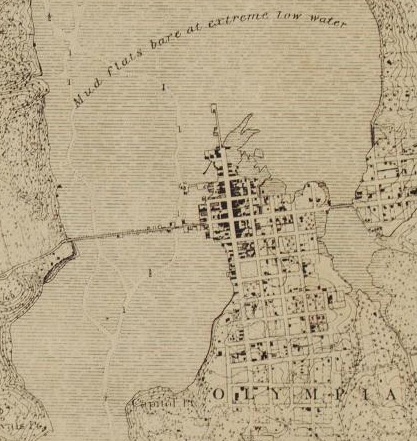
Sea level rise has been a doing discussion in Olympia for the last few years, and to this point, we seem pretty clear on the implications. At some point, the last century of working towards reaching towards the deep water will be reversed in Olympia. Much of Olympia’s history has been defined by expanding our shorelines, slowly replacing 4,000 foot long wharf with dry land.

A map of map of sea level rise implications in Olympia…

Looks a lot like a historic map of our shorelines:


The most facinating thing I’ve read about the future/past of Olympia’s shorelines has been a master’s thesis from a student in California. It really is a beautiful thing.

The thesis by Brenda Lorene Snyder in urban design at University of California, Berkeley is fascinating.

Snyder does a great job laying out the natural and built history of Olympia and Puget Sound. But, the meat of the thesis, the picture of Olympia after a century of sea-level rise starts here.

Off the top, she assumes the restoration of the Deschutes River estuary. Despite some city maps that imply saving the lake, her vision simply allows for an open estuary with little if any discussion.

Here is Snyder’s map of post sea level rise Olympia:

I’d suggest reading the entire thing, there are more than a few beautiful nuances to appreciate. Here are a two of my favorites though:

  • Aqua blocks. Snynder proposes creeks running through several current alley ways to deal with stormwater runnoff.
  • Replacing the historic long warf with an extended Capitol Way with artisan structures over water.
She also gives a walking tour of the new Olympia downtown:

After perusing Creek Street we turn right onto Legion Way SE, headed towards Olympia’s historic town square, Sylvester Park. Significant growth has occurred within the downtown neighborhood over the past decades and Olympia has been able to manage this growth to its own benefi t. Strategic infill has strengthened the continuity of its human scale walk-able blocks. Through thoughtful design and attentiveness to the scale and style of historic structures Olympia has been able to maintain and strengthen the character of livability it’s become known for – a cozy yet lively village tucked away along the shores of the Puget Sound.

Despite the birds eye view seeming like this is a proposal to walk back from the impacts of nature, the closer in look shows a much more balances approach. She does propose a long berm (hidden as a new urban street) to protect downtown blocks. But, at the same time, she proposes using urban design techniques to provide clean water. She also protects our deepwater port.
But, this certainly isn’t slapping up bare earth berms and hard walls to protect the blocks we have now.
This may not be exactly what we end up doing, but this is the kind of beautiful urban design we need to approach the hard questions we’ll have to answer in the next century. We have to be able to see the solutions before we make them happen.

Why don’t we worry about the South Sound Mall as much as we do downtown (and I want a soccer stadium!)


This is a post born out of this question at Mark’s Notes on the State of Olympia blog on what places in Olympia (and I assume broader urban North Thurston) are too empty for my tastes.

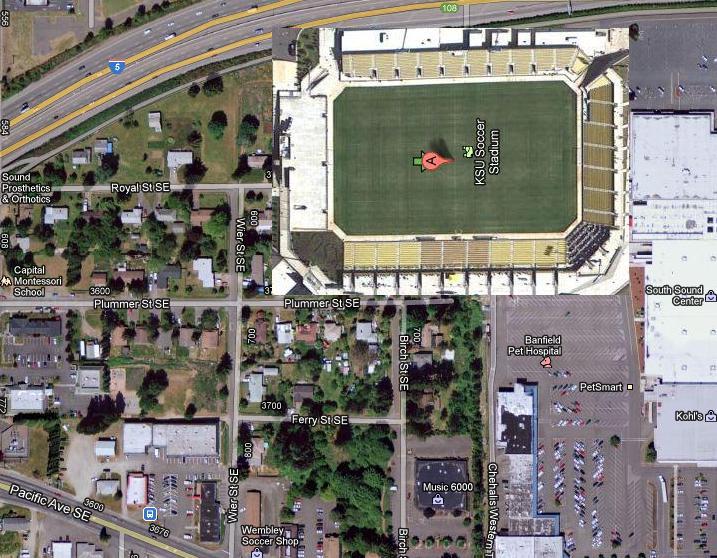
The almost empty parking lot in the north west corner of the mall is a forgotten little pocket of Lacey. It used be to where the Woolworth’s backed up into that side of the mall. I also remember Olympic Comics starting on that side.

Anyway, its empty now, except for maybe people learning to ride motorcycles on Sunday, the parking lot is a waste of impervious surface, reflecting the dead commercial nature of that part of Lacey.

It is also now left without its only lasting civic contribution, as the host of Lacey’s July 3rd Fireworks.

The owners of the mall seems to realize the lost potential back there. Coincidentally, they also own a few properties in the residential neighborhood right next door in Olympia. And, in 2008 CDC proposed to the city to redevelop that neighborhood into a south Tumwater-like collection of state office buildings.

The proposal didn’t get picked up by the city, but I’m sure the need is still there. It wasn’t that solid of a proposal, not even a project. Just a request for a designation that could mean state office buildings would be built there at some point.

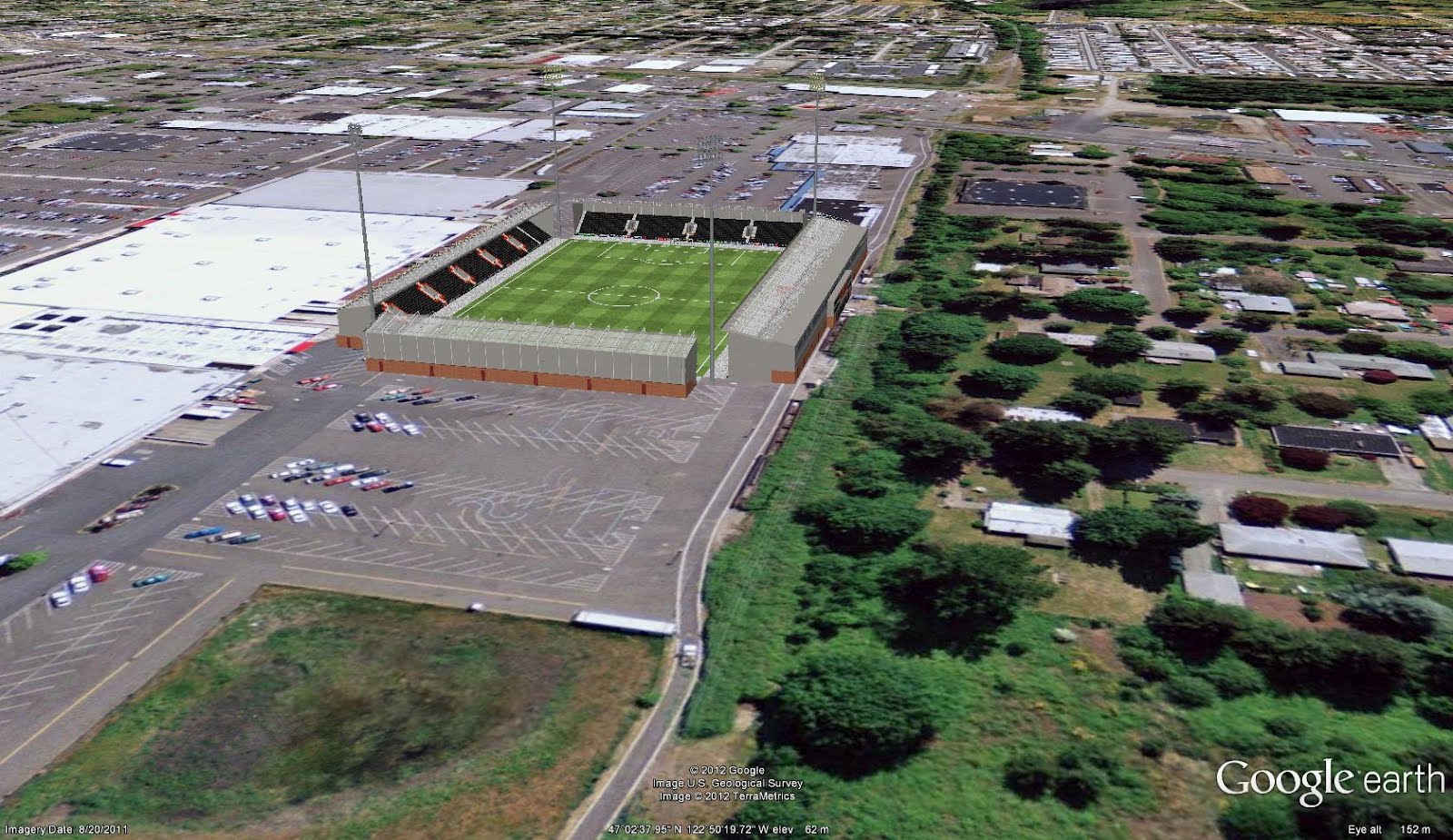
But, for me, obviously, the best and highest use of the space would be a soccer stadium. Nothing fancy, 2,000 seats would make me more than happy.

But, what gets me about the empty back corner of west Lacey, is that while it remains very paved and very empty, no one seems to care. We wring our hands over anything relating to downtown, but this part of Lacey is all but ignored.

$4+ million for the arts, not for sports

Let’s quickly forget about the meaningless distinction between someone that dances and receives academic credit and someone that swings a bat and does not.

Let’s also forget that our schools maintain facilities for both artistic and athletic pursuits.

Starting from here then, how do you think the public would react if the city of Olympia announced it was spending $4.4 million to upgrade a field at Yauger Park to a 1,500 seat capacity soccer stadium? Or, baseball stadium, I suppose (even though we’d never get a real minor league team here).

Under certain circumstances, a 4,000 seat baseball stadium could be had for around $4.3 million.

You think the public reaction would be supportive? Actually, I think the public reaction to a larger (much larger) athletic facility would be overall negative. Possibly very negative.


As opposed to $4.4 million spent on reburbing an existing arts center? Granted, we already own the Washington Center for the Performing Arts.

But, I think this imaginary distinction might tell you something about the nature of Olympia. Ken Balsley calls this elitism.

But, I wouldn’t go that far. We have plenty of people around here that spend a lot of their time dedicated to sports. There are plenty examples of this sort of dedication, families at Black Hills FC, hundreds of kids turning out for Olympia Bears football.

The question is, in Olympia given $4 million in public funds, the most likely end result is something for the arts, not sports. And why is that?


I’ve been pondering it for days now, and I can’t really give you a good answer.

Numbers, natural resources management and Olympia

Happy Friday the 13th!

Somewhere in the bowels of the state Department of Fish and Wildlife and the Department of Ecology, there is a long running conspiracy. Hoods, nocturnal rituals and numerology.

The evidence is plain to see and the goal is some sort of curse on Olympia and nearby communities:

Olympia as a brand never left

O’Bee Credit Union reconnected with its roots by coming out with a credit card that attempts to bring the Olympia Beer brand back to its local roots. O’Bee is of course the old brewery employees credit union, so its pretty fitting that they’d launch an Olympia Beer themed card. O’Bee as in O.B. as in Olympia Brewery.

But, bringing back a local brand to its roots? Sure, they stopped brewing Olympia Beer here years ago, but the brand itself hardly left.

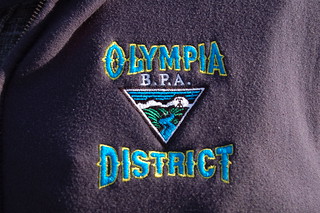
I started collecting examples of the use of the Olympia Beer font last November (well, I only have three so far), but they range from the local Bonneville Power Administration to a burger place on the westside. And, of course there is Olympia Lowlife and the Oly Rollers.

That brand hasn’t gone anywhere, its practically the most popular way to put the word “Olympia” in print.

« Older posts Newer posts »

© 2026 Olympia Time

Theme by Anders NorenUp ↑