History, politics, people of Oly WA

Category: Olympia (Page 5 of 13)

Why can’t Olympia get some sort of semi-pro soccer going on? Or, we need the Tall Boys (someone help Brandon out)

In the next few weeks, between the Evergreen Premiere League, the National Premier Soccer League NW and the good old PDL, there will be three different non-pro/non-amateur leagues kicking off in this state.

And, none of them have a club in Olympia or even Thurston County.

The last time we sniffed at a local semi-pro league, it was the good old Tumwater Pioneers. They ended up folding after just one year. Even though the soccer was great, their results weren’t. And, apparently, the financial returns weren’t either.

We even have had Olympia semi-pro teams in the distant and not so distant past.

So, as we’ve seen teams become established in Bremerton, Bellingham, Everett and even Vancouver, Olympia has failed to put anything on the map. What is it about Olympia that has prevented anyone from coming forward with a team?

Last fall, Brandon Sparks (Oly Sports Blog Brandon) came forward with a pretty smart of thorough outline for an Olympia team in the ELPWA

Why Olympia?: The cities of Olympia, Lacey and
Tumwater are home to over 108,000 residents and Thurston County’s
population is over 250,000. There is only one professional or
semi-professional team in the area – the Tumwater Pioneers indoor soccer
team – and no direct sports competition in the summer. The area has had
great success supporting soccer over the last two summers when over
1,200 fans flocked to watch the Sounders U23s and Portland Timbers U23s
play at Tumwater Stadium. The area is home to multiple large and active
youth soccer organizations including Blackhills FC, Puget Sound Slammers
and Thurston County United and men’s college programs at Saint
Martin’s, Evergreen and South Puget Sound.

Why the EPLWA?: The first reason is simple: cost.
The EPLWA has been designed to be budget friendly charging just $1,000
in league fees. This allows for teams to put more money back into their
communities and programs and will allow teams to be more financially
stable over their first few seasons. An EPLWA team can compete at a high
level – potentially participating in the US Open Cup – for
significantly less money than a PDL team with the same opportunities for
generating revenue.

As far as I know, no one responded back to him.

I hope Brandon doesn’t lose heart. I hope he keeps his idea out there for next season, that we get a team together.

Here’s to the Tall Boys.

Empty downtown Olympia

No one lives there:

Seriously, downtown Olympia is in the same category as my neighborhood, and I live in an unbuilt wasteland where people wish there were taller buildings

 WastBut, of course, when someone talks about building a seven story building in our empty-of-people downtown, people speak up, because this is some sort of horrible thing. Like we should be protecting parking lots from the evil expansion of multistory housing.

I can’t speak to his stats, but David Scherer Water, makes a striking point about how downtown has changed as Olympia has expanded:

Less than four percent of Olympia’s population lives downtown. This is
the lowest this ratio has been in the City’s history. A hundred years
ago more than half the population of Olympia lived downtown. Fifty years
ago it was about ten percent. Today 96% of our population comes
downtown to visit, to shop, to party and they leave. I believe this is
the source of most if not all of the complaints commonly made about
downtown. We need more people to live downtown.

 Density is good. People living downtown is good. More people living in a dense neighborhood means fewer cars, more people walking and more services and good things downtown.

How much does the Thurston County economy benefit from the legislative session

I suppose the best I can say is that it seems to take the edge off.

What I wanted to find out was what kind of impact the legislative session (hundreds of lawmakers, staffers and policy wonks coming to Olympia and Thurston County for at least two months every year) has on our economy. You could easily assume that it has some.

When people are in town for session, they have to eat, pay rent, entertain themselves and (I suppose) shop. Even just the work of lobbying, taking lawmakers out to eat, has to produce some economic benefit.

So, the best indicator I could find for economic activity by date was retail sales tax paid in each quarter. You can find the data I used here. Here are the spreadsheets I used.

First, I took all retail sales tax paid in the four quarters between 2005 and 2012 averaged out. I compared Olympia, Lacey and Tumwater with Bellingham. I used Bellingham as a stand in for a similar community to Olympia that doesn’t have a seasonal political population.

You can see a similar curve across both communities. Economic activity rises through the year, dropping back down each first quarter.

The curve from low activity first quarter to higher activity through the fourth seems to indicate that in terms of the broader economy, the legislative session doesn’t have much impact in Olympia. Despite the people visiting and temporarily living here for a few months, the economy here (which is still supported by the broader government) is too large to really for use to really see the impact of session.

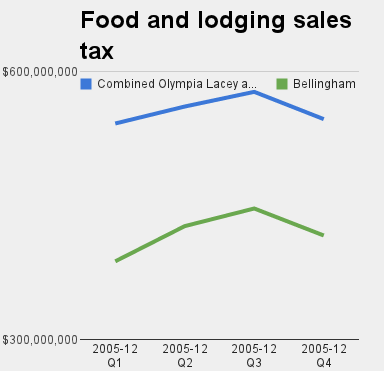
But, if you take a closer look at just one aspect of the economy here, say food and lodging, you start to see some sort of impact. The chart below shows just the sales taxable activity in places like restaurants and hotels.

Again, you see a similar curve in both urban Thurston and Whatcom counties. But, the Olympia, Lacey and Tumwater curve is less pronounced, especially in terms of the first quarter. You could almost say the session (which would increase spending in the first quarter) takes the edge off lower first quarter spending on food and overnight rooms in Olympia.

Still though, even this kind of spending in the average first quarter isn’t as high as the third quarter. So, while there’s some benefit, it still seems smaller than what people often imply it to be.

Duane Moore and the Black Houses

Black houses of Olympia by Jeremy Quist (via flickr)

People are trying to create a mythology around the Olympia Black Houses that simply doesn’t exist. There’s no evidence that Duane Stephen Moore is anything but a typical small business owner (in this case a dentist and a rental owner) who has unique atheistic tastes.

So, that’s my conclusion. Yesterday I put up a map I’d been working on of all the rental houses that Moore owns throughout town. Olympia’s biggest urban legend in recent years has been that there’s something sinister about the houses, that if you mapped them, they’d make a pentagram.

I don’t know what you can see, but there’s no pentagram there for me.

Take away the black paint that seems to touch almost everything (short of the Reef Bar downtown) he owns, Moore seems like a pretty typical entrepreneur. He owns over a dozen rental houses, at least three commercial properties, owns a construction company (to hire sub-contractors to take care of the rentals?) and is an active dentist in Shelton. If the color were blue or yellow (or blue and yellow), I wouldn’t be writing this post.

Also, there’s nothing in the Olympia code to prevent anyone from painting their house black. So, if the city is fining him for having black houses, I’m not sure why.

I didn’t talk directly to Duane (or indirectly) when I was putting this post together. Neither has anyone else that’s written about the black houses either. He’s been referenced a few times in the local paper, but never directly quoted. That gave me the impression that he’s someone that values his privacy.

Also, if I stand by my “regular guy, interesting tastes” position, then I wouldn’t call him, because there’d be nothing really to discuss.

Nik Neburn made the movie I linked to above about the Black Houses. He also made an interesting documentary about the Paul Ingram case. Nik quotes Norman Cohn to make a point about the Ingram case that I think applies to the black houses too:


To understand why the stereotype of Devil-worshiping
sects emerged at all, one must look not at the beliefs or behavior of
heretics […] but into the minds of the orthodox themselves.

While Olympia hipsters are hardly religious fundamentalists, the stories surrounding the black houses do more to cast Olympia overall as a weird and interesting place than to explain anything about Duane Moore or the houses themselves. Because we want Olympia to be a certain way, we make the houses seems weirder than they actually are. And, if it wasn’t the black houses, we’d find something else out there to make up stories about.

Why does Olympia have a low immunization rate?

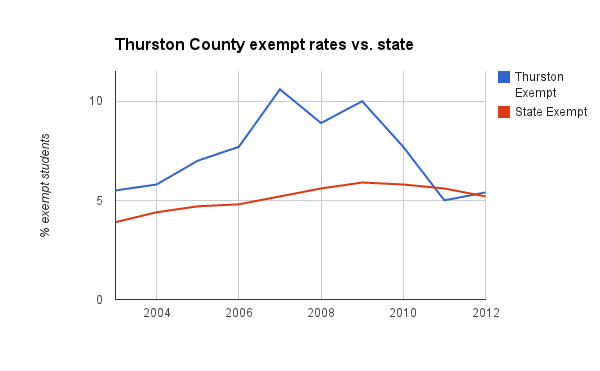
A couple of years back I was shocked (shocked!) at the high rate of immunization exemptions in Thurston County and especially the Olympia School District. Back then the state had just passed a law where parent’s have to more expressly say why they’re exempting from immunization. Apparently that extra social hurdle has worked in Thurston County.

While the countywide trend has gotten back to the statewide average, it looks like Olympia still stands out like a sore thumb in the county. All of my data came from here.

County rates are coming down:

Olympia still out there:

Cascadia is known for its high rates of people who don’t like giving their kids shots (for whatever reason), but there’s been very little explanation of why. Some people pointed to that in Washington it had been easy to get out of immunization. But, that has changed, and the rates are still pretty high.

What if there is a broader social culprit? I’d say its possibly a cause of how people on the ends of either the left or right liberal slant (traditional political spectrum) don’t necessarily feel the social pressure to conform to something getting immunized. The Inlander piece I linked to earlier points out that homeschoolers and religious schools have some of the highest rates of exemptions in 2011. Possibly our social culture of living and let living allows for people to shut themselves off from guarding the public health.

Darren Mills’ and Mike Volz’s Olympia

At first blush, I was confused by the election results for the Olympia city council. Across the two contest races, I assumed there would be some difference between the four candidates that ranged across the city’s political spectrum. In one race, we had a fairly right candidate (Mike Volz) against a neighborhood based centrist (Julie Hankins). And, in the other, we had downtown business centrist (Cheryl Selby) against downtown business further left (Darren Mills).

Both Selby and Hankins won their races by health margins, showing an overall preference for centrist, I suppose. Even if you look at the precinct level results, both Selby and Hankins both had nearly clean sweeps across the entire city. Mills only won a handful of precincts and Volz didn’t win a single one.

What was shocking to me, was that even on the precinct levels, the margins of defeat for Mills and Volz were similar. Meaning, it is possible (though unlikely) that the same voters who chose further right Volz also chose further left Mills. I think this phenomena is more a trick of the numbers. While voters overall went for the centrists, I don’t’ think there’s much cross over between Mills voters and Volz voters.

Here’s why.

Take a look at the precincts each did well in across the city. There is a distinct geographic pattern. Mills won precincts (in green) in the upper eastside. While Volz (in light red) didn’t win any precincts, he did better than 40 percent in ones along the outer edge of the city. Even in the eastside precincts where he made a point of emphasizing his opposition to a homeless shelter, he did no better than 35 percent.

Here’s another way to look at the base of both candidates. I compared how well each one did in each precinct and charted it. Volz beating Mills in on the left, Mills beating Volz on the right.

As you can see, the votes weigh much heavier towards Mills. Across the city, many more voters and neighborhoods chose Mills when they were comparing him with Selby than Mills did against Hankins. So, I doubt there were very many voters that chose Volz and Mills on the same ballot. They just both lost to strong centrist candidates by about the same percentage..

5 places for local online conversation (and trolls) now that the Olympian comment threads are dead

From my Facebook news feed recently:

Sort of funny how, now that you have to pay for access to The Olympian, and they require folks to comment using real FB identities, that there are no almost no comments on the articles whatsoever.

Whatever will the trolls do amuse themselves?

The Olympian put up a bit of a paywall and moved to Facebook comments awhile back. Since then, the comment threads over there went from troll heaven to ghost town. So, where did all the online conversation (and all the trolls) go?

1. Craigslist Rants and Raves

This is the most epically troll heavy place in the world and Olympia. Not sure why anyone ever really posts here, other than self gratification. But, there even seems to be some back and forth.

2. Thurston Blog

Back when the Olympian was trying to make comment threads work on their own, several comment thread regulars broke off to start Thurston Blog. Comments seem to have pretty much dried up there, but its worth pointing out that the exodus from the Olympian comment threads has a bit of a history.

3. Olympia Memes

While engagement over at the Olympian has waned, it has waxed at Olympia Memes. This isn’t just a simple local memes site, the admin of the page has raised money for charity and taken on local debates like feeding homeless downtown. Also, making fun of Shelton.

4. Olympia subreddits (r/olympia)

Reddit has a reputation (earned) for being a sort of troll heavy site wide. But, our small corner of reddit here in Olympia is “pretty chill.” There are also several other specific local subreddits for Evergreen and jobs in Olympia.

5. Olympian reporters on twitter

Back when I was a young reporter and first thinking about publishing on the web, I thought of comment threads as a way to update stories and engage with reporters. What newspaper comment threads eventually became couldn’t be further from that. But, reporters on twitter seem to be bringing that vision to reality. Meg Wochnick and Matt Batcheldor are doing a great job engaging on twitter.

Three Olympia local food options that aren’t the co-op or the farmers market

Don’t like shopping at Safeway or Fred Meyer? Ralphs and Bayview got you down? Tired of shopping at the co-op and the farmers market is never open?

Recently, one local email group I’m part of had a long conversation about the food co-op, whether it really serving the community and if expanding to a larger store downtown (rather than two smaller neighborhood stores) would improve things. That got me thinking about where are the other places that you can buy food around here that don’t fall in either the big store or co-cop/farmers market categories.

So, here are three local Olympia food shopping options that you might like.

1. Olympia Seafood. This is my favorite, which is why I put it on top of the list.

When I want to buy something seafoody, his is where I go. All the time. I also tend to buy gift certificates here for other locals as a go to gift. While Olympia Seafood was established less than 20 years ago, it vividly reminds me of another seafood market that I used to go to as a kid. Walking in there, it literally feels like a seafood place. Cold, wet and smells wonderful. The seafood is good too.

@olympiaseafood
411 Columbia St.

2. Spuds Produce Market.

Spud’s has only been open for a year? Feels like way longer than that. Anyway, unlike the other two listings here, Spud’s has an awesome community feel. Kids from the local school take field trips there, its in a neat old building, and I know for a fact, the food is great.

2828 Capitol Boulevard

3. Farm Fresh Market (Olympia Local Foods)

This is the place I was most fascinated with, because I didn’t even realize they had a retail store until I started poking around during the co-op email discussion. I had heard about a few local food delivery services, but Olympia Local Foods recently opened a brick and mortar retail location, sort of out of the way on the westside. But, beyond that, they seem to have a well rounded selection, plus their delivery service is still online.


2010 Black Lake Boulevard
Olympia Local Foods

Evergreen should play more games not on campus

Here’s on thing about Evergreen State College and Olympia that a recent resident here observed: You’d hardly think Olympia was a college town. Now, this guy is from the upper Midwest, went to the University of Wisconsin at Madison. So, maybe he has a different idea of what kind of college town Olympia could be. But, he mentioned Bellingham in the same breath, and I see where he’s going.

It could be the culture of Evergreen. No Greek system, a fairly young college and you know, Evergreen. So, maybe we are a college town, its just harder to see because Evergreen is different, therefore its impact on us is different.

That said, I think there’s something else to it. Evergreen in a lot of ways isn’t in Olympia. Literally a college in the woods.

So, for someone like me, getting to events out at Evergreen can be a pain. Out of site, out of mind. But, that’s sad because a lot of cool things happen out at Evergreen. If Evergreen was centered around where we all lived. Like say, in a fit of rewriting history Evergreen was where the Automall ended up, wouldn’t we as non-Greener residents be at Evergreen more often, just because it was there?

I know sports is like this for me. I end up going to more high school and St. Martins, South Puget Sound Community Colllege athletic events because they are held nearer to me.

That said, because of field conditions Evergreen soccer was forced to play at South Sound Stadium. I really wish I heard about it earlier or it was on a better night for me, because I would’ve loved to have gone.

From the Olysports Blog (an effort you should suport, by the way), it even looks like there was a crowd at the game:

I could go on longer, but we could be prouder of Evergreen around here. There are a lot of proud graduated locally, but we should be even prouder. Sports is a big part of how people think about a school, and the easier it is to get to an event, the more fans you might have.

So, that’s it. More Geoducks off campus please.

Two examples of trying to merge Olympia, Lacey and Tumwater (sort of)

Over direct message on twitter a few days ago, someone asked me if anyone had ever tried to get all three nothern Thurston County cities to join together. Off the top of my head, I could come up with two examples, sort of. As far as I know there’s been no wholesale effort to join the cities together, but I found two partial ones:

1. Fire service in 2009. As far as I know, folks just lost interest and this effort just died off.

2. Merging city and county planning in 1990. This idea went down in flames. It was part of the home rule effort that year, and with the rest of the charter, it was voted down.

This entire idea of why the cities should merge is one that comes up every once in awhile. It isn’t a bad one on its face, just one I know will never happen, mostly because there are bigger evils that three cities bordering each others.

The reasons the cities won’t merge are numerous.

Separate school districts for each city mean people grow up not necessarily crossing city borders socially.

Cities have different histories, interests and trajectories. Tumwater was founded at the base of the Deschutes River before Olympia (on the shores of Budd Inlet), but didn’t become a city until much later. Lacey on the other hand, came along almost 100 years later. And, if you look at how far down Martin Way Olympia stretches, you could almost assume Olympia tried to kill Lace at birth.

In the blocks north of North Street, you can see this kind of municipal racing laid out in the checkerboard border between Olympia and Tumwater.

These histories, interests and trajectories have created three different local cultures (political and otherwise). From Matthew Green in OP&L:

This result is no shock. Olympia voters have supported tax levies for
a new fire station, the library system, and schools by similar or
larger margins. However, it presents a contrast with Tumwater, which
approved a public safety levy by just eight votes (50.11%-49.89%), and
Lacey, which rejected a fire district levy 47%-53%, both in 2011.

This result is yet another reason (approximately reason #12,000,003) why Olympia, Tumwater, and Lacey should not merge.
A few local political leaders pop up once a year or so, like
groundhogs, to suggest that the municipalities merge into one city
government. They imply that city governance is about just managing a few
departments. They pretend that city lines are mere arbitrary
administrative boundaries.

In fact, the three cities contain electorates with distinct and often
irreconcilable political views. They fundamentally disagree about what
is important to their community – in this case, about what public safety
measures are important enough to justify raising taxes. None of them is
right… well, okay, Olympia is right, but the other cities are entitled
to decide for themselves. Rather than stuff three different electorates
into one mass, in the name of false efficiency, let each community make
its own democratic decisions.

 So, for the time being, any merging will happen under the surface. We already have our sewers all merged and transit. Other things like fire might come along, but we’ll likely always have our own cops. And, we’ll always have our borders and separate civic identifies.

Hoquiam and Aberdeen should merge. No reason why not.

« Older posts Newer posts »

© 2026 Olympia Time

Theme by Anders NorenUp ↑