History, politics, people of Oly WA

Category: Olympia (Page 4 of 13)

Why not punch a nice passenger line straight into downtown Olympia through Lacey?

Connect one of those green lines up with the light blue line: BANG. Passenger rail!

I swear I was going to write this piece way before the Olympian had a story yesterday. But, here it is: you know there used to be a rail line that passed through Lacey from a connection with a major line and into downtown Olympia?

Did you know that that rail line closed down in the 1990s and was eventually turned into a walking trail? And, did you know this sort of railbanking is sometimes reversed, trails back into rails-style?

Unfortunately, what was eventually turned into the Woodland Trail wasn’t railbanked at all, it was abandoned and taken over by the cities. Railbanking implies a continued ownership by a railroad company and a temporary use as a public trail.

From what I can tell, Burlington Northern totally walked away from the old line.

There is one section at the edge of the Lacey border that is still owned by Burlington Northern, but the rest of the old rail line is now owned by Lacey and Olympia.

And a discussion between local leaders about 10 years ago about local rail options didn’t cover reactivated this line much at all.

Here’s what I don’t get about what was going on in Olympia and Thurston County in the early 1990s. Why not use the old rail line as a passenger terminal, a way to bring Amtrack into Olympia proper? 

This is the is the same era that saw the old Amtrack shed at East Olympia replaced with a semi-useful station at Yelm Highway. The Centennial Station is still way out in the sticks though. So, instead of taking of half-step with Centennial, why grab the old Burlington line through Lacey and into Olympia and go whole hog and bring Amtrack Trains downtown?

I’m sure there would have been logistical challenges with turning a passenger train around Union Pacific line south of town, and possibly other logistical challenges I’m not getting. But, the history I’ve found no discussion at all about the idea. We seemed stuck on having passenger rail all the way out beyond Lacey and turning over an urban rail line to a trail.

Just seems weird to me.

Does anyone have a nice drone they’d like to take out and recreate Olympia’s famous bird’s eye view?

Wouldn’t you want an updated version of this view?

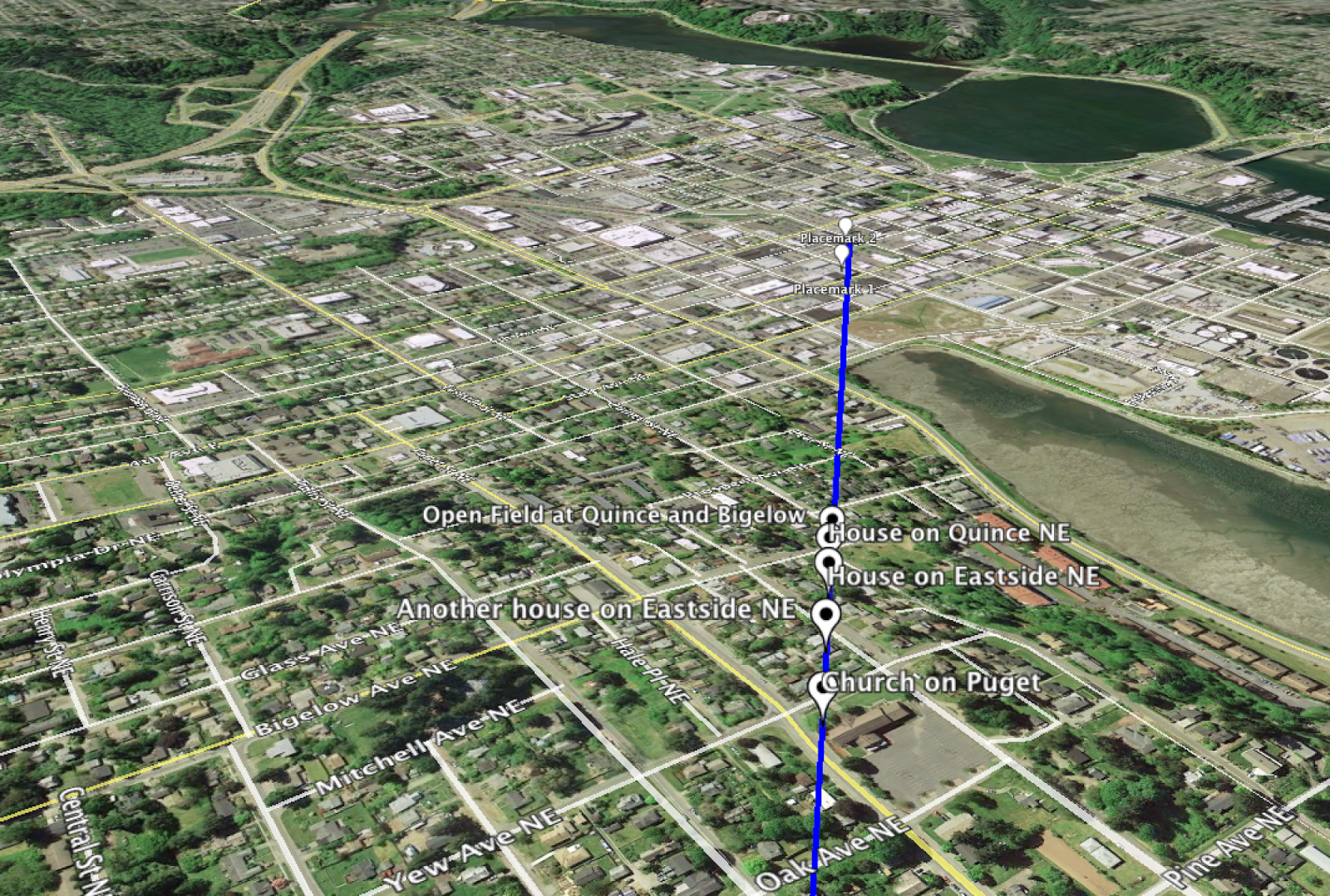
You don’t need me out there with you. But, let me show you what I came up with about seven years ago:

The only real hard thing was coming up with where today you’d need to be to find this view. The change in the city’s shoreline since the 1870s makes it almost impossible to spit ball it. But, if you take a look at this KMZ file in Google Earth, you can find a nearly where the perspective of the original birds eye view takes you.
Now seven years ago I poked around, trying to find a nice perch to take the same perspective from. I came up with a few good options, but ran out of time and interest to follow any of them up.
So, this is where you come in dear anonymous drone owner.
Since 2007, drones have arrived. Nice, inexpensive (somewhat) drones that people own and use. So, taking an hour or so, flying around the perspective line, I bet someone could come up with a nice recreation of the birds eye view photo.
And, when you do, would you mind emailing it to me? That would be awesome!

How we’ve biked and walked around Olympia since 1990 has changed

I love the different ways you can poke around census data anymore. One of the coolest of these little tools is the commuter edition of the Census Explorer.

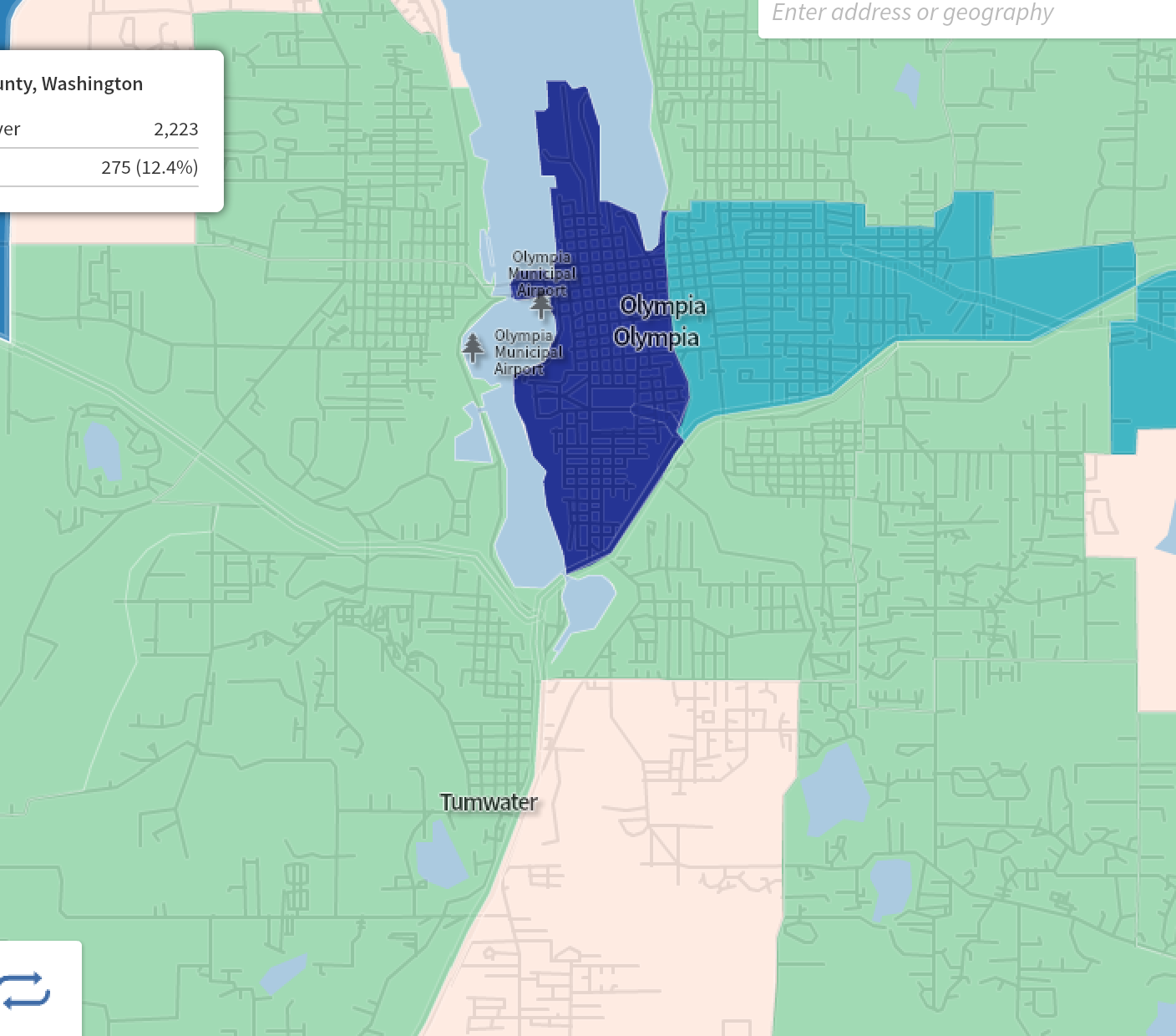
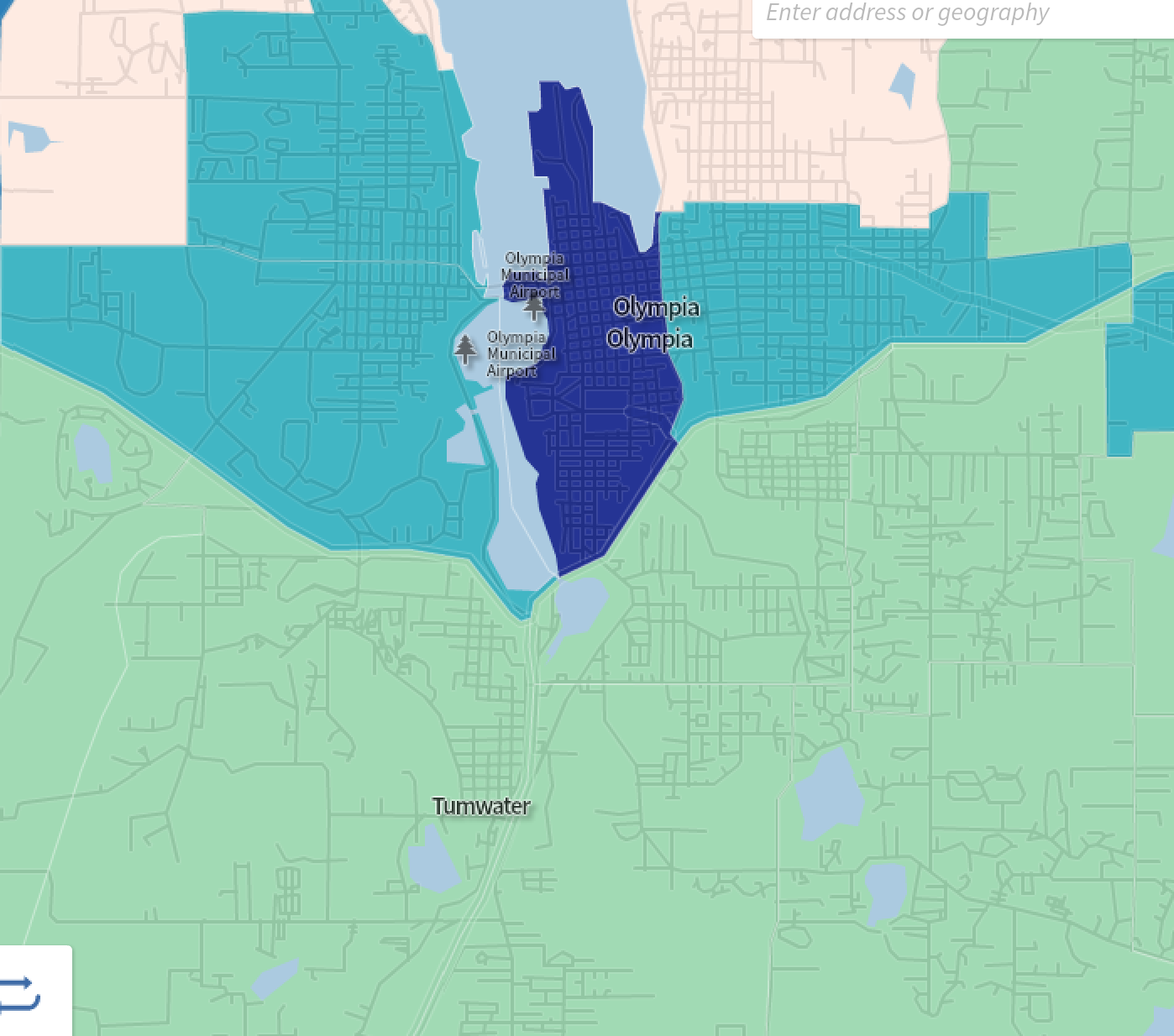
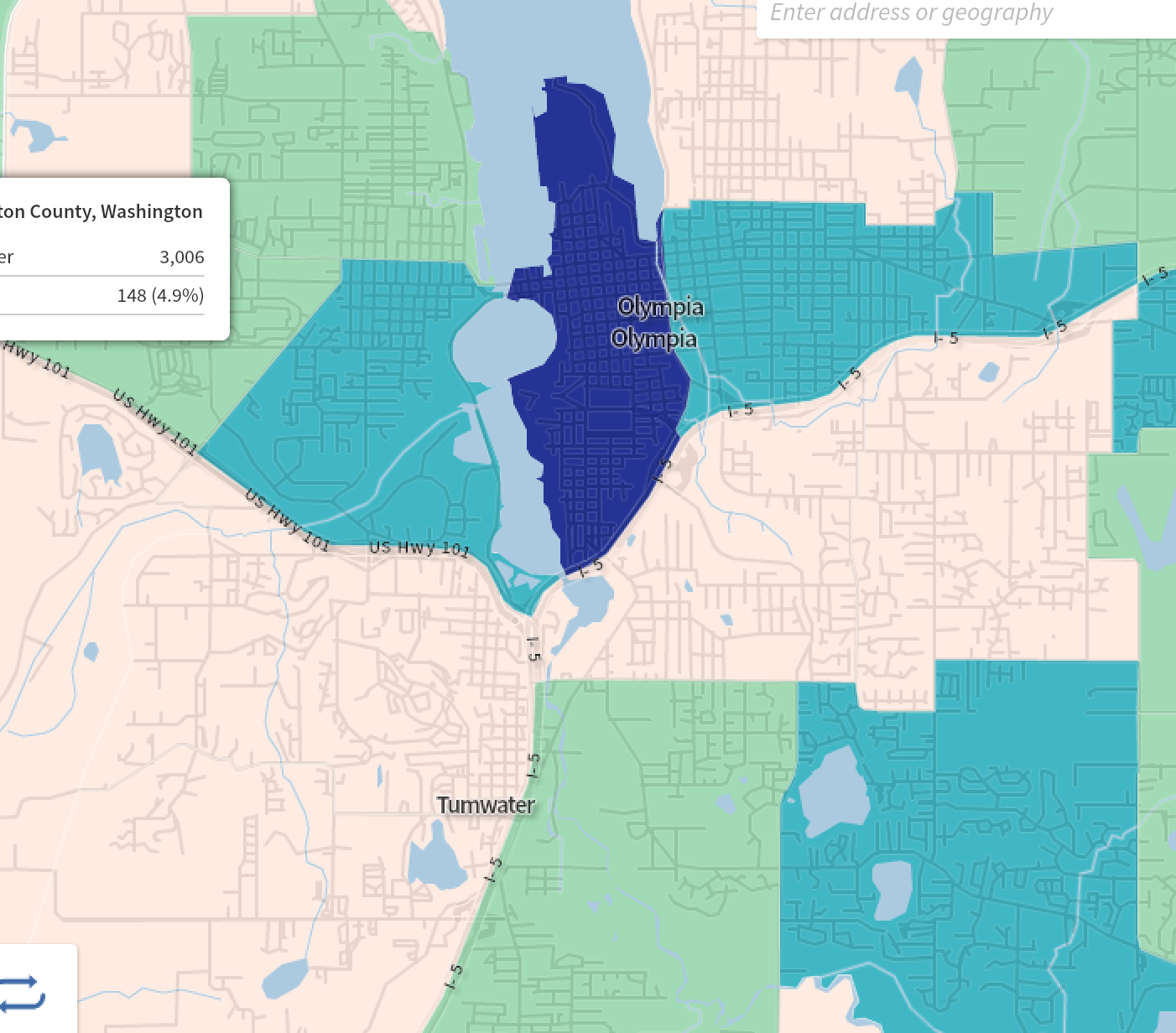
Take a few screen shots from the tool, and you get a clear look at how our ways of getting to work and around town has changed since 1990.

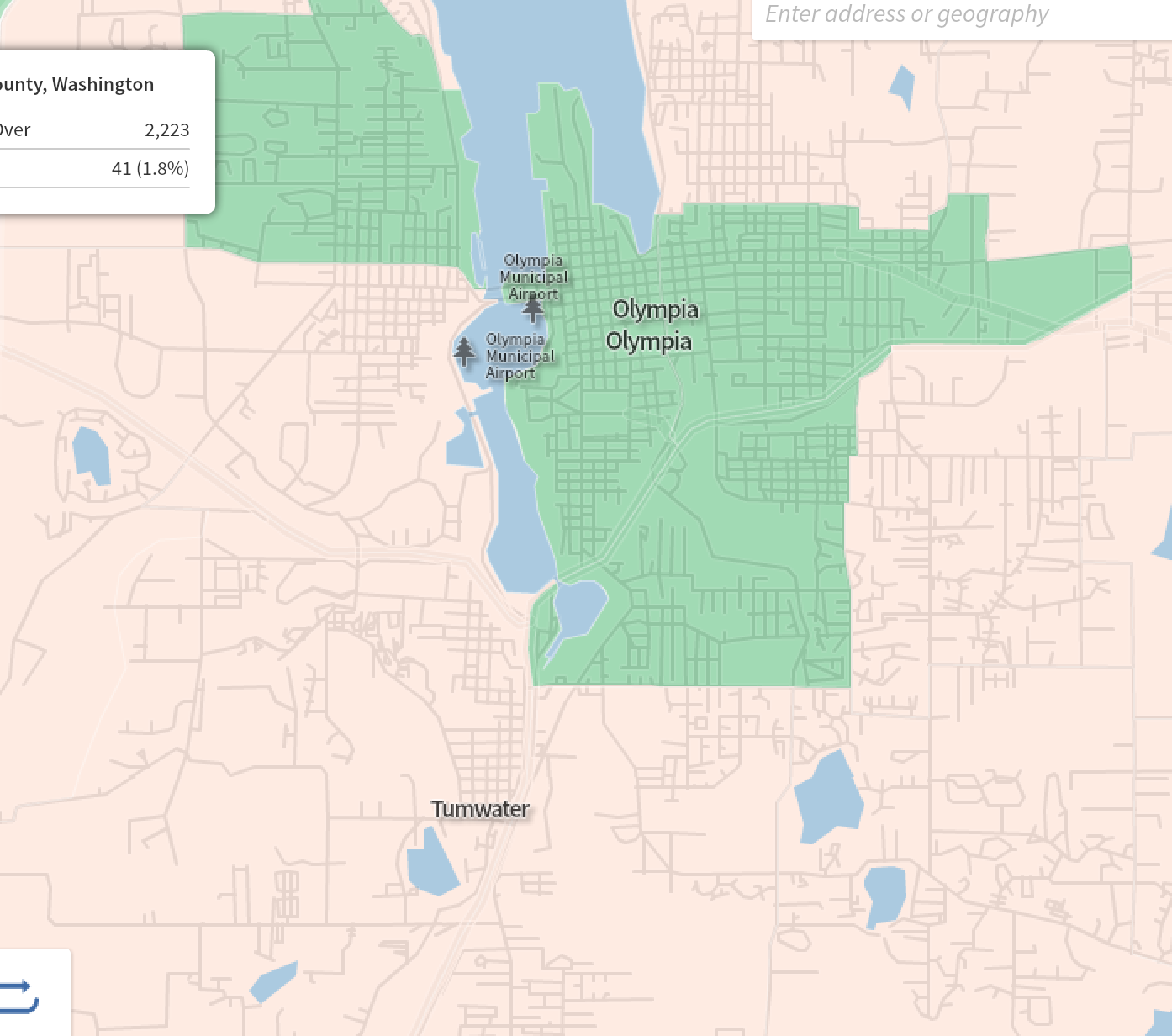
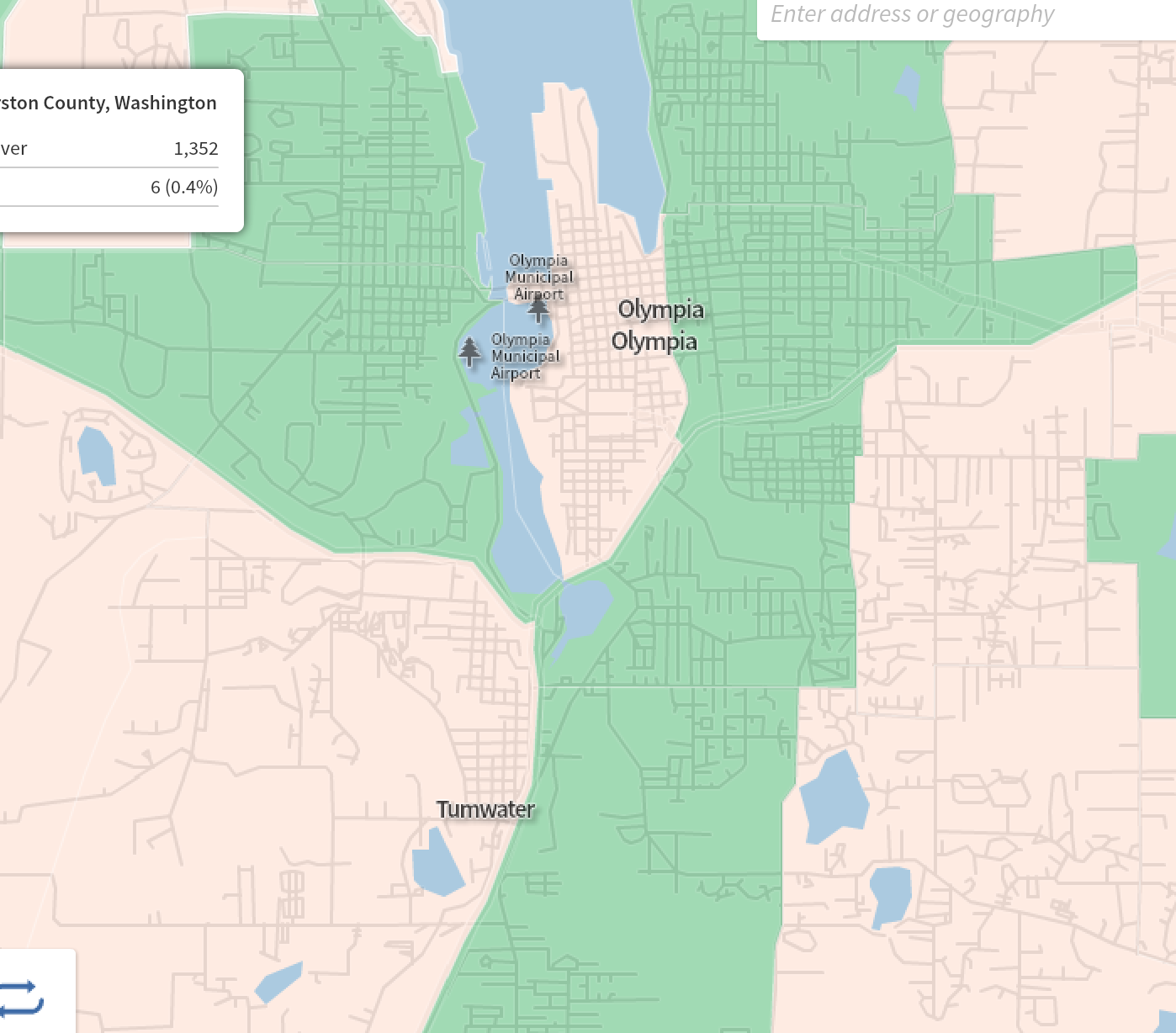
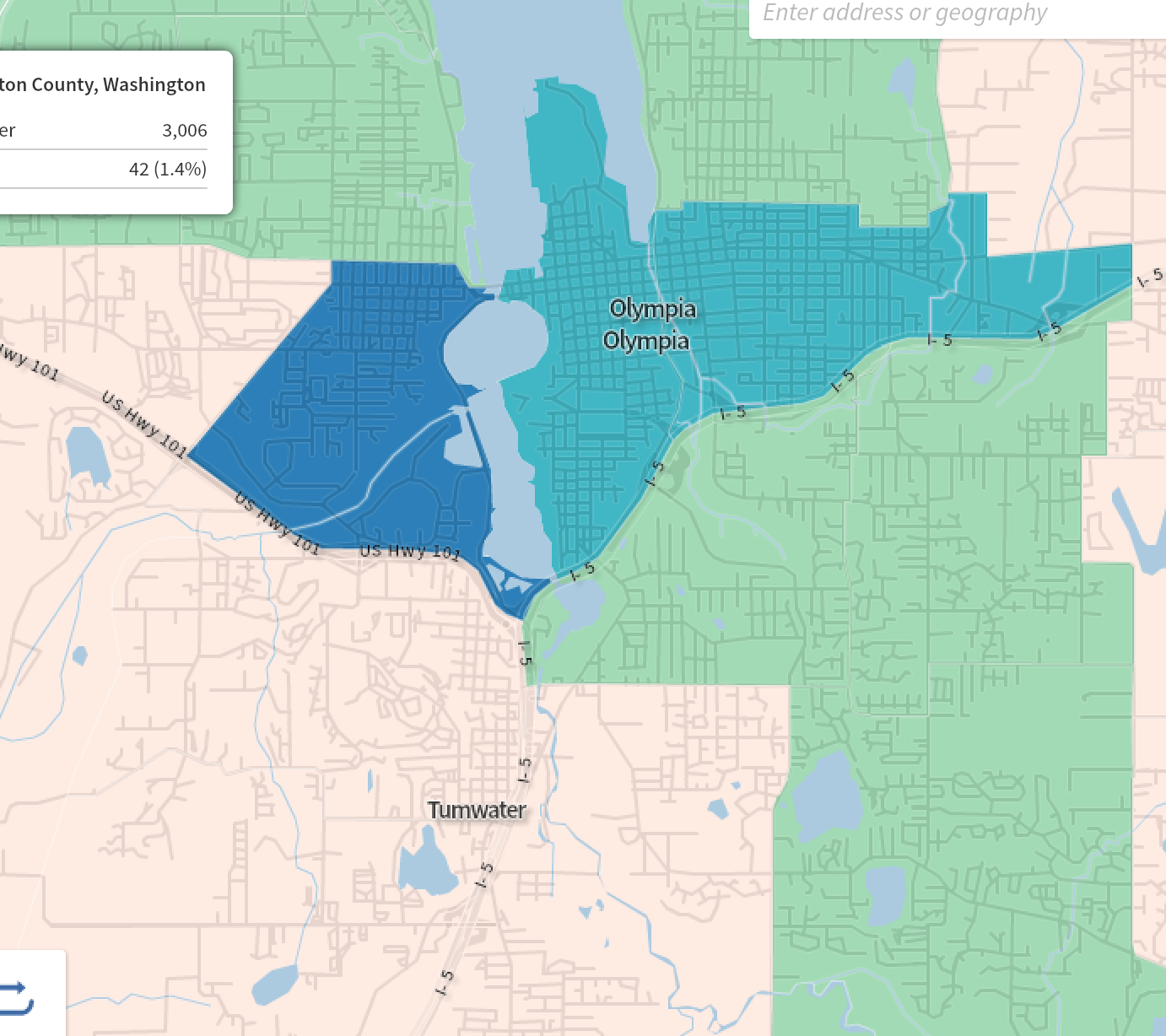
Take walking around town.

1990:

2000:

2000:

The darker the color, the more people who walk, the highest concentration being in the central part of town, where over the decades about a quarter of people walk to work. But, over time in the outlying areas, fewer people walk. This is except for a couple of neighborhoods (far Southwest and nearby Westside) where a few more are walking.

For me, walking to commute means that over time we’re building walkable neighborhoods, places where people can find what they need on foot. While downtown and South Capitol seem to be a stronghold like this, the rest of town seems to be getting worse.

Now, for bikes, the story is different.

1990, starts out very slow, hardly anyone bikes (light green is less than 5 percent, tan less than 1 percent):

2000, not much better. Actually, kind of worse:

2012 shows a real marked increase. A full 10 percent of Westsiders bike commute, while 5 percent of downtown and 7 percent in the near Eastside bike.

So, while we seem to be going backwards in terms of promoting walking, biking seems to be getting a boost from public policies around bicycles.

I didn’t realize this, but Olympia has a fairly short history in carving out space for bikes, the first bike lane was up East Bay Drive in 1984. Today, there are more than 30 miles of bike lanes. And, almost every single major plan developed by the city in terms of city growth and capital spending has included a bike component.

Bikes at least on the surface, seem to be a replacement for cars. At least for people who would be driving themselves. Biking can be encouraged through infrastructure changes it seems. But, walking is a different beast. You have to have someplace to walk (in addition to a nice sidewalk) somewhere near you. So, we need to encourage bigger things, like putting businesses near homes, services near where the people are. Which seems different than adding bikes lanes.

Ebenezer Howard, 3 Magnets and the bad bad City Beautiful

Just below the surface of the best new place in Olympia, the 3 Magnets Brewpub, is a fascinating way to look at cities and communities.

One of the 3 Magnets owners vaguely references the ideas of Howard here:

“Three Magnets is based on a 115-year-old book called Garden Cities of To-morrow by Ebenezer Howard,” explains Sara. ”Basically, Ebenezer considered himself an inventor of the perfect community. He thought he could take the best of both rural and urban living and blend them into a perfect town-country. When reading this, everything called out to us as Olympia, either what we are or what we strive to be.”

So, to delve more specifically into the imagery, the three magnets are “Town,” “Country,” and “Town Country.”

More:

It proposed the creation of new suburban towns of limited size, planned in advance, and surrounded by a permanent belt of agricultural land. These Garden cities were used as the model for many suburbs. Howard believed that such Garden Cities were the perfect blend of city and nature.Howard believed that a new civilisation could be found by marrying the town and the country.The towns would be largely independent, managed by the citizens who had an economic interest in them, and financed by ground rents on the Georgist model. The land on which they were to be built was to be owned by a group of trustees and leased to the citizens.

So, in at least not in an intentional way, this sounds a lot like what people in Olympia would like Olympia to be, post Growth Management Act. Lots of rural space around us for small scale agriculture, vibrant urban community on a human scale.

So, if you’re following me so far, this sounds pretty typical. Nothing special here, just a reference back to a nice idea that we might draw from.

But, then there’s the City Beautiful Movement. If you’ve listened for more than five minutes about any discussion about Capitol Lake or the so-called isthmus, you’re familiar with this term. I think its a bunch of bunk myself. It was a short lived, classist and based on importing old world esthetics and pasting them onto North American cities. Just dumb.

Both the Garden City (Howards’) and the City Beautiful movement came along at the same point in history, when people were facing the pressures of dealing with industrialization and urbanization:

While the Garden City movement shaped a design aesthetic and pattern for satellite towns, the City Beautiful movement was aimed at restructuring American downtowns around a coordinated ideology and strategy. Just prior to the 20th century, America was becoming an international economic power, and its cities were in need of an urban form indicative of the new national identity. America’s cities were fraught with problems, and the City Beautiful movement helped provide a physical form for the previously established Public Health Movement. The City Beautiful movement envisioned the city as an entire work of architecture; its practitioners insisted that all construction conform to a singular vision. They believed that cities had failed and that a new expression of values would inspire good government and public stewardship.

He envisioned Garden Cities as compact, transit-oriented communities surrounded by greenbelts of natural landscape; they were to contain all the pieces of a town, integrating residential, commercial, industrial, landscape and agricultural uses. Howard authored the first radial city plan, which is a useful diagram for city planning even today. Garden City architectural styles were diverse but inspired by expressive, picturesque and romantic designs appropriate to natural settings.

We’re not facing the same pressures that urban leaders in the 1890s faced. Instead of trying to make urban areas livable because of pressure from industrialization and population growth, we’re trying to make them vibrant to fight against suburbanization. Thurston County is already one of the most sprawled counties in the country. We want people to be in downtown Olympia because it is a nice place to be.

And, it seems like the diversity offered in the Garden City ideal, rather than the monolith of the City Beautiful Movement, offers a much better answer. It speaks to making the country productive while also making our city livable.

“We’ve now got TONS of houses and nowhere to walk”

Read the results of the new Olyspeak.org survey. It is fascinating to read people chatting about what kind of things they like to see in a “community center” in their neighborhood.

Hopefully, the new comprehensive plan moves our neighborhoods into creating more of these vibrant areas. Think of the Wildwood building on Captiol Way, the Co-op on the west side or the San Francisco Bakery on the Northeast.

Or the desert of any sort of walkable community on the Southeast side.

At least on my side of town, there has been some serious real politics dealing bad news to this sort of thing. In my neighborhood, Briggs Village, the developer seriously dialed back what on paper was supposed to be a pretty impressive urban village. Some apartments over commercial. Some multistory commercial. Maybe even parking basements. But, now we’re likely going to get a shiny strip mall sort of thing.

Hopefully, it turns out okay. But, in the long term at least, it was supposed to be a move to develop the area quicker. For now, we have no movement on those lots yet.

A few miles away, the LBA area was supposed to see a similar development with a nice walkable commercial/community area. But, neighbors to the proposed development rose up and stopped it.

Ironically, those very neighbors live a massive wasteland of walkable community areas. Between the Pit Stop Market (on 18th) and the Chevron on Yelm Highway, there is literally no place to buy a gallon of milk on foot for thousands of Olympians.

We want community. We want places to walk. We want to have tight neighborhoods that are forward facing and nice. We want character.

But, developers dial back grand plans and suburban car house dwellers defend trees in the face of new diverse neighborhoods.

However we advocate for neighborhood centers needs to realize the real politics that have created acres and acres of houses with nowhere to walk.

All a place (Olympia in my case) needs to be is No. 1 in your own heart

Olympia is Americ’a’s #3 Friendliest Small City!

Olympia is America’s #55 Most Liveable City, and #3 in allllll of Washington!

Ugh.

Olympia is the town I love best, but seeing these lists being spread around always leaves me empty.

The problem with these rankings, is that they’re subjective in the mix. Sure, they’re usually pretty clear about what criteria they use to make up their rankings. But, the conclusions to me seem a stretch.

At least a stretch in that they should matter to any particular person. That friendly list up there especially. What makes a person friendly in Olympia is totally different that Grapevine, TX. We have a different history, different social structure and different culture. So, how can you really determine if we’re any more of less friendly?

You really can’t. People come up here from the deep South and find us off putting and cold. We go down there and find people overbearing and rude. But, both are considered friendly in their own context.

Or exciting. Someone considered Olympia exciting.

Its interesting to look back at this cottage industry of place rankings. David Savageau and Richard Boyer wrote the first “Places Rated Almanac” in 1983. The Almanac marked nearly the 20 year anniversary of the beginning of the Big Sort, a large demographic change.

According to the great book, Big Sort, Americans began unhinging themselves from diverse and deep rooted communities in the 1960s. They would find new homes in politically and socially homogenous communities.

It makes sense that book suggesting The Best Places, creating an idea that divergent communities could be objectivity ranked (and ranked and ranked) is a centerpiece of the idea of demographic sort. People who began shifting back and forth across the country began looking for rational reasons to pick one place over another. But, this rational sorting of communities lacks a coherence of place.

Toronto found itself on this lists regularly, and a local committee there decided to take a close look at what it takes to put these lists together. The committee (which focused on economic development) wrote a report that poked holes in how these reports are written.

Are they comparing apples to apples?

Is the data old? Has it been massaged?

Is the ranking consistent? Meaning, is #1 really one spot away from #2. Or is #2 really #432?

The lists really try to make what is a series of complicated and human topics clean and easy. We should never do that. It is too subjective.

So, as long as we’re talking subjective, we might as well go all the way. What determines what is the best place should be inside of you. You might as well rank cities in America by “Top Cities Where My Friends Live” or “Top Cities Where My Kids Are Growing Up.”

Doc “Moonlight” Graham in Field of Dreams put it best:

“This is my favorite place in the whole world,” Doc says quietly. “I don’t think I have to tell you what that means. You look like the kind of fellow who has a favorite place. Once the land touches you, the wind never blows so cold again. You feel the land like it was your child. When that happens to you, you can’t be bought.”

A place may be a good place based on a series of what look like objective criteria, but these can all end up being baloney if a place doesn’t mean anything to you.

Why I’m really excited about the Oly Town FC Artesians. Even if I don’t like indoor soccer

Sure, I’m not the biggest fan of indoor soccer. Sure, its fun. Its no futsal.

That said, I couldn’t be more excited for the Oly Town FC Artesians this year.

First off, Brandon Sparks is pretty awesome. He’s the hard worker behind Olysports, a very worth your time local sports blog that does all of the little things right.

So, secondly, if you remember the Tumwater Pioneers, then (in my opinion) everything good associated with that team had something to do with Brandon. He didn’t run that team the way he’s been put in charge of the Artesians, so we can expect to see more of the good with this new effort.

But, yes. Brandon is a good thing.

Otherwise, its great to see organized semi-pro soccer of any sort back in Olympia or Tumwater or Lacey. Especially, this sort of league. I love that we’re coming into the Western Indoor Soccer League, and mostly because it has a home-brew feel to it. The league was formed by a group of owners that were upset by the politics involved in a more national league.

A lot of these same owners just got done with their first season in a sister outdoor league called the Evergreen Premier League. This is another home-brew league born out of frustration with national systems. And, for me, this is the real target: a semi-pro outdoor soccer team in northern Thurston County (hopefully Olympia).

I’m not too picky about where an Olympia soccer team should land, but if its a bunch of local Cascadian soccer entrepreneurs going their own way. Then that’s the way for me too.

There are of course some other considerations too. The Artesians indoor have their own very nice facility. But, an outdoor team would have to play in a high school stadium for the time being. Or, a recreational soccer field. We don’t have a soccer specific facility in Thurston County that could support crowds of more than a few dozen.

We should address that (possibly build stands next too one of the fields out at the Thurston RAC), but in the short term the Oly Town FC Artesians sound like a great idea. I can’t wait.

Here we are now in Olympia (Charles Cross left something out of Kurt Cobain’s cities)

Here We Are Now by Charles Cross is a fascinating book. Twenty years after Kurt Cobain’s suicide, Cross takes a look at how Nirvana and Cobain changed the world, from music to our own region to how we talk about suicide.

For me, the most fascinating chapter was where Cross took a look at the towns most associated with Cobain, his birthplace in Aberdeen and the city he’s most associated with, Seattle. Of course, Olympia is in that mix too. Cross’ own biography of Cobain includes five chapters set in Olympia, spanning arguably Cobain’s most formative years between 1987 and 1991.

Screen shot of Nirvana – Live in Olympia

But, in this trio, Olympia has always been the silent partner. Olympia isn’t like Aberdeen, it isn’t the town that he was born in, isn’t the town that is the source of Cobain’s legendary youthful angst. It also isn’t Seattle, a town with a profile large enough to envelope Cobain’s legend as soon as it was ready.

Cross seems to acknowledge this silent partnership when he mentions Olympia only in passing in his chapter on how Seattle and Aberdeen have been impacted by Cobain twenty years on. In this chapter, Olympia is a bridge between Cobain’s Aberdeen roots and his false association with Seattle. At least using Cross’ logic, if Aberdeen spit Cobain out and Seattle sucked him up (once he was good and famous), Olympia was the only place Cobain was truly at home as an artist.

But, that is a pretty over-wrought statement.

Cross in Here We Are Now wasn’t making a point about what city impacted Cobain the most. He covered that in Heavier Than Heaven. In this most recent book, the equation is the opposite, what city was most impacted by Cobain?

And, it is worth asking that question about Olympia.

So, if Aberdeen has finally come to terms with their troubled product and have embraced him as a part of their own culture. And, Seattle has become one and the same with a certain type of everyman do it yourself music culture. What is Olympia’s Cobain impacted legacy? How did 1987 through 1991 and Kurt Cobain impact Olympia?

Why does the Olympia Oyster House mean so much to us?

The Oyster House will open back up tomorrow after more than a year closure because of a fire.

After a false start of an announced opening near Lakefair weekend, the Oyster House posted up last week August 12. And, Olympia caught fire.

I don’t think it would be a stretch to expect a line out the door when they reopen.

But, why does the Oyster House, seemingly more than any other restaurant (short of maybe the Spar) hold such a high place in Olympia?

It certainly isn’t the food. I’d agree with most that the food there is good, decent, but generally unexciting. I suppose that works because it remains accessible to most people. It is a pretty standard, fairly priced, Cascadian seafood place. But, certainly below the standard of the other shoreline seafood places even in Olympia.

You have to admit, the Oyster House has a pretty nice location. Practically all the traffic crossing Olympia is funneled right in front of the Oyster House. And, no other business on that stretch (sorry green Vietnamese place) has the sense of the Oyster House looming over that corridor, sitting crisp and smartly on the southern edge of Puget Sound. Everyone who lives here passes by the Oyster House often enough to get it stuck in their head.

Unlike a lot of place, the Oyster House has grown up with Olympia. Other places that compete with the Oyster House’s stature in Olympia either stayed stale for too long (the Spar, only recently updating under new ownership, aren’t that old (Darby’s) or appeal to a broad enough group (Ben Moore’s).

The Oyster House has evolved, is widely acceptable and has a long history.

A history so long, I’d say it is effectively been the restaraunt that grew up with Olympia.

My unified field theory of Cascadian history holds that (come on now, stay with me) that we either turned a major corner or that our history really started in the 1940s. While the foundation of the region was set in the first 100 years, my theory is that we didn’t really start building the house until World War II crossed off all the failed efforts in our start and stop history after statehood.

Since the 1940s, our history (even locally here in Olympia) has been a straight shot in one general direction. We’ve left behind the resource extractive industries, and grew in at a regular pace into a generally professional, quasi-government and college town.

And, the Oyster House has been there since our growth started. It left its own resource extractive history behind, switching fully from an oyster plant to a restaurant. Three since then, the restaurant was destroyed by fire. Each time, it came back, updating itself as it went along.

The most recent update in the early 1990s, when the now ubiquitous floor to ceiling windows and clean floor plan were added, were reactions to the closure of the Oyster House that I remember as a kid. I only went in there only once or twice, mostly because it wasn’t a place for families.

Tall backed chairs, hardly any windows and dark. It seemed like a place where men and women would come together outside of a family setting and speak as men and women do. It was a cigarette era place and by the 1980s, that sort of place was not the centerpiece of our town.

This was the Olympia that in the 80s had won the Olympia marathon trial, had build the Washington Center and shelved their old form of city government. Finally, the added benefit of Evergreen was growing shoots in town, and we’d moved past the Oyster House being a smokey dark gathering place.

And, after this most recent fire, the Oyster House is coming back again. It looks like the same general layout is still being used, the large windows are still there as well. Which makes sense. I feel like Olympia is so much more of the family centered place that killed the old cigarette Oyster House in the 80s.

I understand that the Oyster House isn’t accessible to everyone. For a town that isn’t very diverse, it is diverse enough in taste for
people not to like the Oyster House in the same way they don’t like Lakefair. In exactly the same way. But, Lakefair is crowded and so will the Oyster House tomorrow.

What Southeast Olympia needs is fewer cars, not another park

The fight to expand LBA park is on. I’m not against parks, I’m a big fan of parks near where people live. But, I’m also a fan of libraries, stores and services near where people live. Its probably the biggest reason I moved where I did, because of the promise that I’d be a part of an urban village with commercial and multi-densisity housing.

But, what would have been built where people now want to expand a park would have included the most commercial development anywhere in Southeast Olympia. And, it wasn’t much. It could have used a lot more.

  
All that pink and blue is residential. There is only one small zoned parcel of commercial at 18th and Boulevard.
In turn, this makes Southeast Oly a very unwalkable part of town. 
 

Meaning, if you live in Southeast Olympia, and you need anything more than to get to a school, go to a park or walk your dog, you need to get in your car and drive. This car dependency makes it that much more unfriendly to the few pedestrians who do make it out.

Keeping open space open and building more parks is an easy thing to get around. But, to really make a place livable is to accept that some development will happen. But to make sure that development gives us what we actually need as a community.

« Older posts Newer posts »

© 2026 Olympia Time

Theme by Anders NorenUp ↑