History, politics, people of Oly WA

Category: Olympia (Page 3 of 13)

Geography of Opportunity for Olympia

If Opportunity for Olympia gets a little less than 5,000 people to sign a petition by the middle of June, we’ll be voting on an income tax to fund at least one year free community college tuition.

The income tax would only be levied on households making more than $200,000 a year. So, my immediate reaction was wondering where those rich folks lived in Olympia.

Here is a map of median income  by neighborhood:
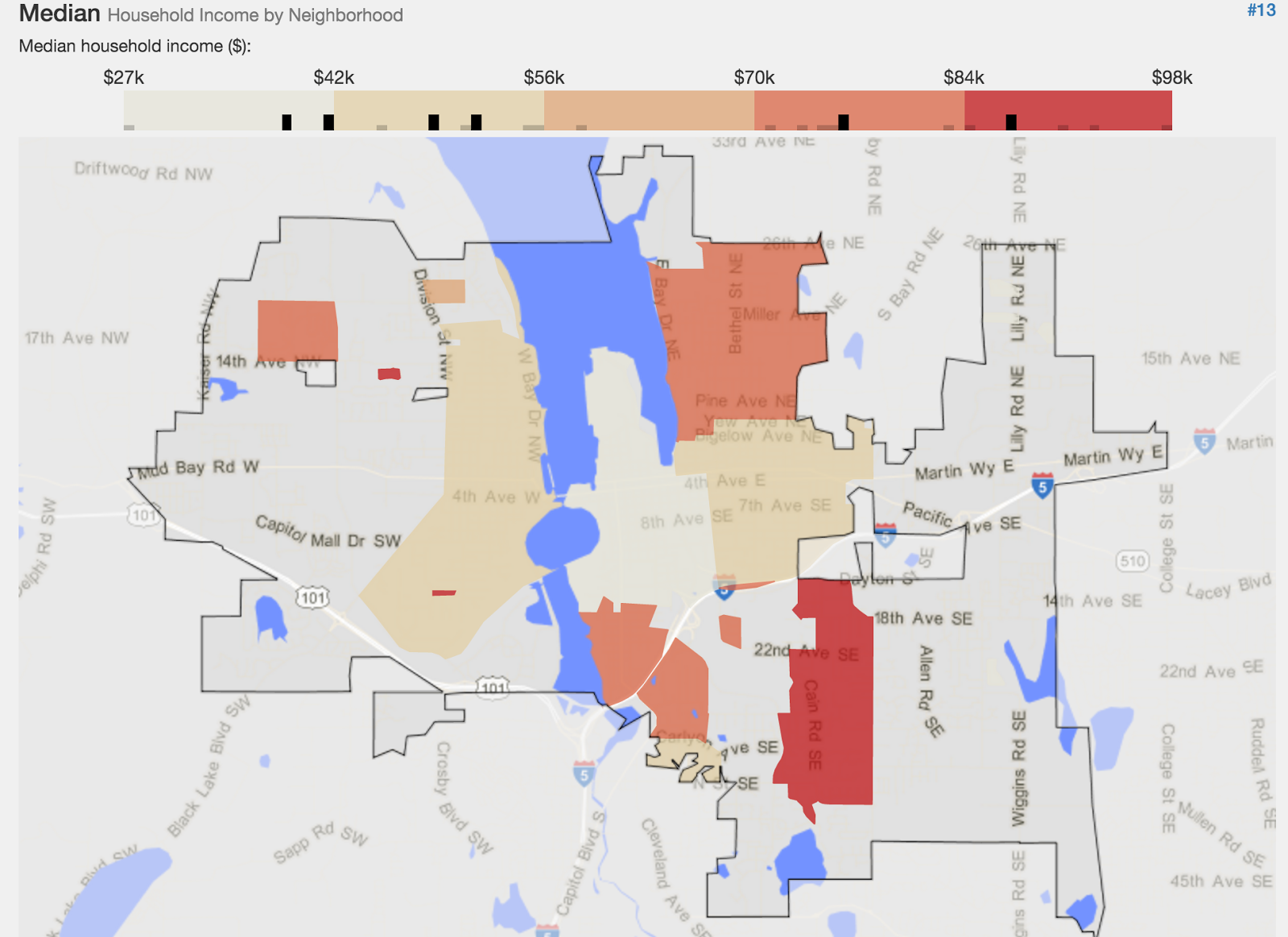
This map tells you what neighborhoods are richer, but not necessarily where the households above $200,000 are concentrated.

Here’s a map of the top five percent of household incomes across the city.
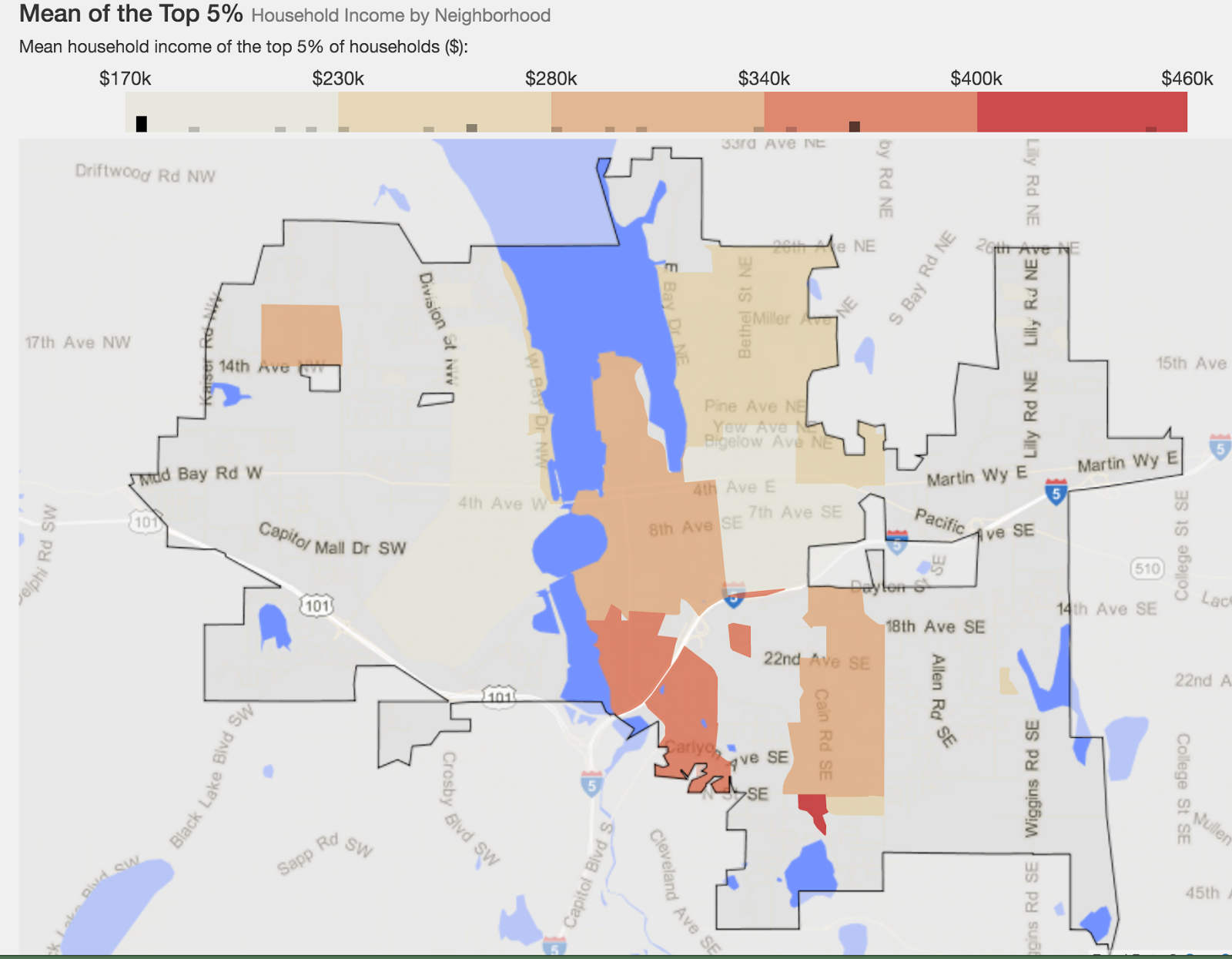
Because this map slices away the bottom 95 percent and deals only with an average of the top five percent, I think this is a better map of how the geography of the initiative rolls out.
I’ll admit, a lot of this map seems counter intuitive to me. While I get the South Capitol and Governor Stevens are obviously the dead center of the top 5 percent in Olympia, that East Bay Drive didn’t do better was surprising. 
Also, Holiday Hills being the most rich? Driving through that neighborhood, it seems like a fairly unimpressive collection of split levels. But, at the same time, there might be a few lakeside or near lakeside households that drive that smallish neighborhood up.
Interestingly, if you slice the geography by block group, you come up BG 011710-2, where the highest proportion of plus $200,000 families live in Olympia (though it includes some streets outside Olympia). Again, this is the area surrounding Ward Lake in southeast Olympia.
But, again, the general trend of the south and east of Olympia being where wealth is concentrated.
The problem is being that these are also the neighborhoods where the most people vote
Granted, there’s a reason why this initiative in in Olympia, we tend to support school levies (via property taxes). And, so even rich folks voted their pocketbook, they don’t hold enough sway to defeat school levies.
I will say this though: I wonder about the psychology of voting for a school levy that supports the district itself and its operations against voting for individual students.

If you can walk to your park in Olympia, you like it. Drive? Hate it

Because OlyJeff asked in the comment thread, I did a similar precinct map on the park vote in Olympia.

I did it measuring where the vote did the worst. So, in the map, the darker the marker, the more no votes there were. The highest no vote was just over 50 percent, so really, almost everywhere in Olympia wanted their parks to get more money.

But, it is still fun to make maps.

This seems like I’d pretty much expect it.
Generally, the closer you are to Budd Inlet, the more you want parks. Or, rather, the more you want to raise taxes for parks. This follows the typical pattern for voting in Olympia. Progressive (because you can’t just say liberal in Olympia to mean people further left) voters are thought to be in the older neighborhoods around downtown and the nearby Eastside and Westside.
When Olympia Pop Rocks asks “Westside or Eastside” they don’t mean down off Boulevard Road or out past Kaiser.

There’s another thing about those neighborhoods that I think might be more telling than just the way people vote on a progressive to liberal (to maybe conservative) scale. The inner neighborhoods are also generally walkable. They’re older, and since people can get out and use the parks near them without getting in a car, maybe they have a more everyday experience with them.

I’m just spitballing here. But, maybe a more personal “that’s my park right down there” experience means you’re more likely to vote for parks in general.

But, this measure passed nearly everywhere, so it’s almost meaningless to quibble.

Lastly, you see three precincts in the far South Eastside that have lighter reds than the ones immediately around them. These are standouts on that side of town in support of the park levy.

This I would say is NIMBYism at work. These are the precincts that are nearest LBA park, which has been the center of the most vocal pro-park, anti-house/neighborhood development debates in recent years.

The passage of the park levy made it more likely LBA would expand, so they voted yes.

How much cross over was there between the OK Boys Ranch and the Paul Ingram’s case?

I’m not going to go back and explain the Paul Ingram case. Or, the OK Boys Camp scandal/tragedy.

But, suffice to say that both of those events were insane shocks to the core of the Thurston County power structure about 25 years ago. I’d highly suggest reading the links above, just to get an idea of what I’m talking about.

What I really didn’t realize until right now, but that these two seemingly independent events (though similar in content) overlapped a lot.

At the center of this overlap is Ingram himself. Just a note: this is the point that I’m going to start writing as if the reader knows a few details about both Ingram and OK Boys Camp.

As Ingram’s life began dissolving toward his eventual guilty plea, the subsequent retraction of that plea, his prosecution and conviction, he also had a front seat to what was going on a the OK Boys Camp. Ingram was a member of the Kiwanis (not a big surprise as a deputy sheriff and former county Republican chair). But, well into 1989, he was on the board of the OK Boys Camp.

Ingram’s daughter made her first accusation in August of 1988, he was arrested in late November, and the investigation was in full swing the next spring when Ingram was finally removed from the board in March.

It is odd enough for Olympia to have one odd abuse case, it is another for it to have two. And, also two that in hindsight land fairly well on opposite ends of the the varsity scale. The Thurston County criminal justice system went hard at Ingram and the fantastical tales levelled against him, to the point of digging up his entire back yard looking for the remains of babies. But it took a few more years to catch up with the actual abuse happening at the OK Boys Ranch.

And, the question that keeps rolling around in my brain: how much was known (but not approached) by folks about the horrible conditions at the ranch. And, how much of that community knowledge morphed into the fantastical accusations against Ingram by his daughters? Had they heard about the crimes at the ranch? Had they been to the ranch and heard them first hand from residents?

Downtown is a donut hole filled with subsidized housing (according to the maps). How’d we get to this point?

Here’s my donut hole of Olympia population post from a little while back. I observed:

Density is good. People living downtown is good. More people living in a dense neighborhood means fewer cars, more people walking and more services and good things downtown.

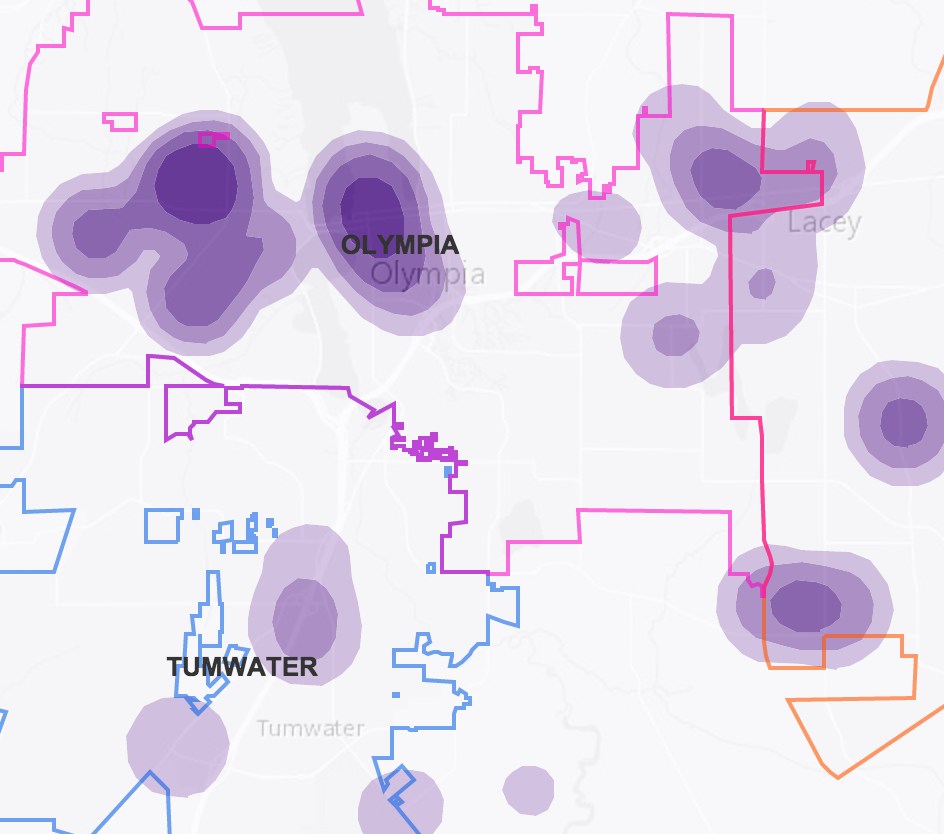
There might not be a lot of people living downtown compared to other parts of the city, but take a look at this map that Brian Hovis put together this week:

Hovis writes:

The highest concentration were in downtown Olympia and west Olympia. There are two different reasons. In downtown Olympia there are lots of sites in close proximity. In west Olympia the sites are fewer, but there are more units.

The density in west Olympia may increase soon. A new subsidized housing site is being planned near Yauger Park. The Copper Trails Apartments will add 260 more units to west Olympia, according to data from The Department of Commerce. Also recently reported in The Olympian there are proposals for new subsidized housing for the Drexel House and conversion of the Holly Motel.

Also in flux is whether or not the Boardwalk apartments will continue to be subsidized housing for seniors. The Boardwalk apartments are a big part of the density of subsidized housing downtown. The outcome of that question may change the density of subsidized housing in Olympia.

Brian is pointing out something here that we have pretty much accepted around here as true, but seeing it in maps is really pretty cool.

I’m wondering about the history of this phenomena. If there’s anything to understand about the apparent emptying out of downtown as a residential neighborhood. And, if the replacement of what we call market rate housing now with subsidized housing has any particular historical narrative.

Downtown Olympia obviously went through a transition in the late 70s and early 80s. I’m wondering if the mix of housing also shifted during those years and what forces were at hand.

An Olympia for all who want to vote. And, where they don’t vote

From Ray Guerra via Facebook:

Olympia for All is a great idea. A non-partisan slate of candidates pushing progressive ideas will at least make this year’s city campaigns interesting. At best, we’ll be able to push the city council to be much more engaged about deep civic issues than they’ve been willing to be in recent years.

But, the “for all” language got me thinking. Specifically, in the “if you don’t vote,  you don’t matter” sort of way. Because while we’d like to think all elections are the results of a uniformly involved citizenry, they are certainly not. And, this is especially true in low profile city-wide elections.

So, here are the neighborhoods that drop off when Olympia votes on its own leaders (darker blue, more voters):

Basically, the westside generally doesn’t show up and the far east towards Lacey doesn’t engage. The only part of Olympia that really matters is South Capitol, down across the highway and then north of Ward Lake.

Usually local campaigns try to focus on these sorts of neighborhoods (at least in my experience). And, within precincts, they try to focus their attention on activating voters that have already shown a likelihood of voting and voting the right way.

In this way, if Olympia for All is a typical campaign, it won’t really be “for all” because it will need to lean on dependable voters. But, if they are more about Everyone, they’ll head out to the light colored dots and try to boost turnout.

Imagine a different Olympia, without the capitol

When I think about my little kick about the metonymy of Olympia, I usually eventually think about how much of Olympia’s identity is really tied up with state government. The legislature, the governor lives here and a lot of the people you know have some connection to state government.

But, what if it wasn’t like that?

What if, before the current state capitol was built, some other city (let’s say Tacoma for the sake of hating on Tacoma) was successful in swooping in and stealing the seat of government. How would have Olympia been different.

Here’s my brainstorm:

1. The power of the Light and Power company. 

Instead of limiting themselves to diversion on the lower Deschutes, the Olympia-based power utility takes to the countryside and claims a project in the upper Nisqually. Driven by Hazard Stevens in the last years of his life, they shut out what would have been projects by both Tacoma and Centralia, Olympia Power and Light eventually becomes the sole hydropower purveyor on the Nisqually River.

2. Consolidation

Instead of Tumwater and Olympia staying separate (and Lacey growing out of Olympia’s eastside), there is only Olympia. Tumwater soon sees the benefits of joining with Olympia, cooperation to save the greater Thurston County after Tacoma’s treachery!

3. Smaller, yet still largest city in the deep South Sound


And, obviously, we don’t grow as large. Maybe 40,000 people in the entire area around Budd Inlet. I don’t know why I’m guessing this. Maybe even fewer.

4. Streetcars Stay


Now, this is a total fantasy, but the Olympia Light and Power Company keeps the streetcars, updating and improving the system while most urban transit utilities go to busses. So, currently, there is a long east to west line going from Cooper Point Road out to Phones Road. Another line up Puget Street and then down Eastside and looping around to Boulevard, back up to Pacific. And, a line going down Capitol Way, possibly over to Tumwater Hill. And, some odd arrangement on the Westside.

I don’t know, total fantasy.

5. The old capitol campus area becomes one ritzy neighborhood

You think the South Capitol neighborhood is nice, check out what they do when they sell off the old campus that never was. Larger lots, bigger homes. Palatial.

6. I-5 never comes close to town. 

Instead of cutting through Tumwater and bumping into Olympia, the interstate highway cuts well south of town, turning east just south of the airport, following the railway route generally into Pierce County.

7. Just a few more smaller notes:

  • Olympia High School stays where it was on Capitol Way (I mean Main Street)
  • Capitol Lake is never built, because Wilder and White never showed up!
  • Evergreen still gets built. Just because. But, maybe its closer into town. Like where the Capital Mall is.
  • So, if the lake is never built, there is an actually impressive bridge across Budd Inlet.
  • The old state capitol becomes city hall.

Downtown Olympia in context

One of the things that strikes me about the dialogue about downtown is how the people with different perspectives about it seem to talk past each other. One side seems to discount anyone’s fears about being downtown. The other side discounts the other’s want of a vibrant, real and therefore not necessarily clean and refined downtown.

I think one of the reasons for this is how each frames downtown. What context they put the oldest part of Olympia into.

1. For people who fear downtown, their context is literally other places they could go to buy things. The newish commercial westside. Lacey. Commercial area of Tumwater or Hawks Prairie. These areas also have bookstores, movie theaters and restaurants. They’re convenient because there is ample free parking and people know what they’re getting.

Downtown on the other hand is inconvenient and vibrant to the point of unknowing. You can’t know what to expect, so you choose a more convenient option. There are plenty of places to go that aren’t downtown, so they just go there.

And, when it comes time to think about downtown at all, the easiest thing to go to are the reasons not to go there at all.

2. For people who love downtown, they also think about it in context of the extreme local options. But, they also think about it in terms of the regional. Seattle and Portland are two remarkably great cities. And, are a lot of which Olympia strives to be, but on a more local scale. Downtown Olympia (and its nearby west and east side institutions) define Olympia for folks who like downtown. Olympia is the quirky little artsy city because we have what we have downtown. This is true even though the combined acreage of downtown and nearby neighborhoods is a small fraction of the North Thurston urban area.

These people are literally seeing different places.

If you want to win an election in Olympia, get either a Lacey city-councilmember or an out of towner to contribute to your campaign

So, if you took a list of contributors of the last two rounds of successful city council elections, what kind of list would you come up with?

Well, something like this. These are the 15 people (or unions) that contributed to more than half the successful council campaigns in the last two cycles:
Contributor


Cynthia Pratt
Campaigns contributed to
7
Christine Garst 7
Sandra Romero 6
Emily Ray 6
Joyce Kilmer 6
Kris Goddard 6
Mary Wilkinson 5
WA FED OF ST EMPLOYEES LOCAL 443 5
Karen Valenzuela 5
Sarah Segall 5
OLYMPIA FIREFIGHTERS IAFF LOCAL 468 5
Walt Jorgenson 5
Jewel Goddard 5
Mark Dahlen 5
Judy Bardin 5

Here is the entire list, plus a few other spreadsheets to show you how I got there.

And, while Chris Garst lives outside of Olympia, it is pretty just outside Olympia. And, Chris is really good people. So, don’t get me wrong with that headline. Chris Garst is good.

This isn’t a list of who contributed the most money, but rather a list of who contributed to the most successful campaigns for city councils. I didn’t take a close look at the contribution totals, so many on this top 15 list may have contributed little compared to someone who maxed out on one candidate.

But, by a certain measure, these people are more influential than a theoretical single candidate max contributor. In addition to their financial support, every single one of these folks or organizations gave their personal time and civic reputation to the candidate.

Some additional thoughts:

  • I’m surprised by the number of elected officials, public officials, former and current. This includes Pratt (Lacey city council), Romero, Valenzuela (Thurston County commission), Walt Jorgenson (former Tumwater city council) and Judy Bardin (Olympia planning commission). Joyce Kilmer, the wife of Olympia city council member (and mayor) Steve Buxbaum is in there too.
  • Only one of the locals that has contributed to the most campaigns is a union bargannign unit that deal directly with the city. While the IAFF Local 468 contributed to five campaigns,  the other seven are not on the list. The only other union in the top 15 is a state employee union.
  • Judy Bardin is on the list, and seems uniquely poised to make a run for council, which she recently announced.

The other side of the Sound Transit to Olympia coin: Olympia is an Island, leave us alone

The brainstorming about getting passenger rail into Olympia is alive!

Olympia’s best blog took their crack earlier and the Seattle Transit blog did their’s yesterday.  All smart people all say, sure it could happen. But, there are obstacles. Sure, that makes sense. It hasn’t happened, so obviously there are reasons why it hasn’t.

I was going to reserve this post for a exploration into the past of the old Lacey to Olympia line that was ripped up and turned into a sidewalk. Alright, a glorified sidewalk.

But, after all this discussion, I think we need to bring up another topic. Should Olympia be connected by rail to Seattle?


You’re going to say: Of Course! State Capitol Right??

And, I’m going to respond with a selfish rejoinder. Well, its not like anyone is going to steal the state capitol from us anytime soon. So, why make it easier for people to get here?

Right now Olympia’s economy is supported by a steady flow of tax money into our community to support fairly well paying and stable state jobs. That’s not going anywhere. Jobs come and go, but overall, state work is pretty stable.

We’re also on the far southern edge of Pugetopolis. So, if overgrowth is going to happen, it’ll come from the north. But, in a way, we’re buffered from that because back 100 years ago Pierce County stole more than half of the Nisqually Reservation and gave it to the Army. Joint Base Lewis McCord sits out there like a massive empty breakwater against King/Pierce County growth.

Eventually Sparkland will reach around through Roy and Yelm and connect with Lacey. But, for the time being, we’re safe.

Connecting us to Seattle via convenient rail is just one more way to make Olympia a bedroom community living in the shadow of Seattle and King County.

And, in at least one part of my brain, more people living in Olympia and commuting up to Seattle for work is not a good thing.

Now, using that old Lacey to Olympia rail line that we turned into a glorified sidewalk for light-rail, a way to just get around town? Thats a great idea?

Maybe just using the old spur of that lost rail line as a Sound Transit alternative to Centennial Station. I don’t know, maybe? Better than downtown Olympia, I suppose.

« Older posts Newer posts »

© 2026 Olympia Time

Theme by Anders NorenUp ↑