History, politics, people of Oly WA

Category: Olympia City Council (Page 2 of 9)

Ghettos and lost quadplexes at Nut Tree Loop: Our conversations 40 years ago around multifamily housing and how we got here

If you go up Eastside Street from downtown, it will eventually curve to the east and become 22nd Avenue. As 22nd Avenue approaches Boulevard, there is a small neighborhood on the left-hand side of the road called Nut Tree Loop.

This area around 22nd, Cain Road and Boulevard was the neighborhood I grew up in. I was born in 1976, so in my mind’s eye, I kind of remember Nut Tree Loop being built in the late 70s. And, I’ve always thought about it as a much nicer neighborhood surrounded by blocks of split-level ranch homes and older craftsmen. I think if you take a walk through Nut Tree now, that impression by Kid Emmett still holds true. Two homes recently sold in there for over $700,000 (in 2017) and $800,000 (last May).

So then, I was startled to find out when Dan Beuhler first envisioned Nut Tree Loop in 1976, he sketched out a neighborhood of 21 fourplexes “across one section of landscaped grounds.” Beuhler had already built a smaller development of apartments around the corner from Nut Tree. At the time called Eidleweiss, they are currently known at the Chateau Townhomes.

 Where 40 or so nicer single-family homes now sit, 84 multi-family units would have been built, if Beuhler got his way. But instead, the Nut Tree fourplexes kicked off several years of debate in Olympia around multi-family housing, the results of which are still felt today.

And the nature of those conversations tells us a lot about why Olympia shut down the development of smaller multi-family housing since the 1980s.

I’ve written about this period of history in Olympia before. First I tracked the sharp decline in small multifamily housing in Olympia since an explosion in the mid-70s. Second, I took a look at zoning maps since the 1960s to the current day and found a declining area that allowed anything but single-family homes. Lastly, I charted the sprawl of single-family homes that resulted since Olympia downzoned.

In this look, I want to explore how we were talking about the change in the city that at one point allowed duplexes and small apartments and then outlawed them.

Beuhler’s proposal set off a series of contentious public meetings where the city planning commission (on which Beuhler inexplicably sat)  decided the fate of the Nut Tree quadplexes. Over 500 individual Olympian’s testified to the city planning commission and the city commission itself (Olympia was not yet governed by a city council).

Times were tense when the city commission finally took up the Nut Tree fourplexes. When one city commissioner pointed out that in the late 70s incomes were not increasing at the same rate as the price of a single-family home and therefore it made sense to allow for denser, more affordable options in new construction, an audience member shouted: “Why don’t you move to New York?”

New York in the 1970s not necessarily being an example of a humming urban community. This fear of the urban, the denser and poorer community coming into newer single-family neighborhoods underlined the public debate around Nut Tree. While most of the top-line conversation was simply about the power of zoning and the expectations of homeowners that their newer neighbors would have the same zoning, when you dug down, you go the fear of the urban.

Facing that level of fire over one development was not something the city commission had experienced before, and they quickly put the Nut Tree quadplexes on the shelf.

After Nut Tree Loop, the city took a step back and began to examine multifamily housing across the city. The Citizen’s Multi-Family Housing Taskforce began meeting in January 1978 and worked throughout the spring and summer to deliver a zoning package to the city council.

But, like Nut Tree along 22nd, this proposal met with fierce opposition across the city.

As the city considered a plan that would expand multifamily housing throughout the city (even further than the citizen’s taskforce had intended), an unsigned editorial in the Olympian captured the mood of those opposed to denser housing: It isn’t our job to look after anyone but families and experts that disagree with us are bad.

Those who participated in seven months of hearings by the task force evidently want nothing of the philosophy that holds a community responsible for providing the kinds mixed housing needed by today’s mixed lifestyles — the singles, the elderly and the divorced for instance. 

The planners are coming at the problem as theoreticians, as we see it, and they’re not handling the grassroots thinking very well at all… The latest effort to insert recommendations into a citizens report had too much of the smell of “we know what’s best for you” thinking about it.

The commission approved plans that would, on the one hand, allow multi-family housing, but, on the other, only after it was approved on a case-by-case basis. Even then, the economic class of the folks sitting on the Task Force was brought up.

From the city commission minutes in August 1978:

Paul Sparks said his concern is that we would be isolating the lower income families to certain areas away from services and from the city center. The people who are most affected by (the multi-family plan) were not involved on the Task Force. 

Two unidentified women then entered into a heated discussion about the makeup of the Task Force, one asking how come low income people had not been considered and involved; the other replying the Planning Commission has asked for volunteers to serve on the Task Force and all this was in the papers and the radio.

The city commission passed a version of the Task Force recommendations, but they failed to turn on the spigot of multi-family housing.

By 1980, the planning commission had again passed a package that would expand multi-family housing across the city.  The idea would have been in the early 80s to allow multifamily housing in all areas of Olympia, essentially banning single-family zoning.

And, again the residents of single-family neighborhoods stood up.

Multi-family housing in otherwise single-family neighborhoods will foster “the diverse kind of community that makes this community interesting and makes it rich,” (Raven Lidman) said.  

She said when it comes to the good points of living in single-family neighborhoods, “tenants have those same desires.” 

But Virginia Baxter, speaking after Lidman, said “The existing inviting neighborhoods will be destroyed, and there will be an exodus of homeowners” if multi-family housing comes to neighborhoods. 

… 

But Susan Hirst, protesting the proposal, said that multi-family renters will not gain much by being located inside single-family neighborhoods. 

They will still be living in apartments, she said, and “you will simply be placing them into a neighborhood where other people have” the style of life the renters want.

But you have to look no further than Bill Grout to find the dark corner of the urbanism discussion in 1980 Olympia. In one article on the 1980 multi-family plan:

“You have increased police activity, increased crime, increased vandalism,” with multi-family housing, said Bill Grout.

Later that summer, as the city commission itself considered the plan, Grout crossed swords with a county leader in a discussion that might as well come out of our current conversation about Missing Middle housing:

Bill Grout, who said he represents Olympia’s homeowners, labeled the proposal one which “would turn Olympia into a ghetto.”  

… 

(County Commissioner George Barner) said the measure would build up the dwindling rental housing market and would enable low income and young persons to afford a place to live. 

He said such housing should be encouraged in the urban areas because most conveniences are located there. He added it would also prevent urban housing sprawl. 

Grout contradicted Barner, saying out that multi-family housing would drive down property values in single-family residential areas because renters generally do not take care of their property.

And, so the city turned the proposal down. Not actually turned it down, but rather just put it back on the shelf. A year later the city would approve a townhome ordinance that would allow a certain kind of multifamily housing throughout the city, though one that seemingly favored homeowners.

But, the time of multi-family housing tracking with population increase was over. Olympia would go through several incremental downzones to tighten up single-family zoning areas through the 80s and 90s
Reducing impact fees will be great, but we need to talk about how we built our city

Next week the Olympia City Council will talk about an ordinance that will lower impact fees for affordable housing.

More specifically, the ordinance will lower impact fees for “housing with a monthly housing expense that is
no greater than 30 percent of 80 percent of the median family income.” The idea is that since developers make the most money building high-end housing for people that can afford it, this will create an incentive to build less expensive housing for those who can’t.

But in the short term, I think we should pull back and take a look at impact fees in general and what kind of housing this ordinance is likely to encourage.

First though, let’s say that impact fees are a one time fee for initial impacts that a new house will have on Olympia. Things like new roads, new parks, new schools are paid for out of these fees. But, long-term maintenance of these public assets come out of property taxes that end up being paid on the value of each home. So, while the initial burden of new homes can be blunted by impact fees, long term maintenance is everyone’s problem. And, that is when we get into choosing what kind of housing we choose to build.

Up until very recently, most of Olympia was locked into single family home only zoning. Now, more neighborhoods are open for what is called Missing Middle housing types, like duplexes, townhomes, etc. And, a lot of people are connecting this impact fee proposal to the Missing Middle proposal. Larry Dzieza’s post on Nextdoor about the cut in impact fees is even called “Missing Middle Tax/Fee Cut for Developers.”

What people aren’t talking about is that so-called Missing Middle development leads to higher valued properties, which leads to more taxable value for the city in the long run.

Here is how that works.

Generally, downtown Olympia is pretty valuable to the city and produces a lot of tax revenue (here and here). This is generally because the auto-centered suburban development style just isn’t as valuable.

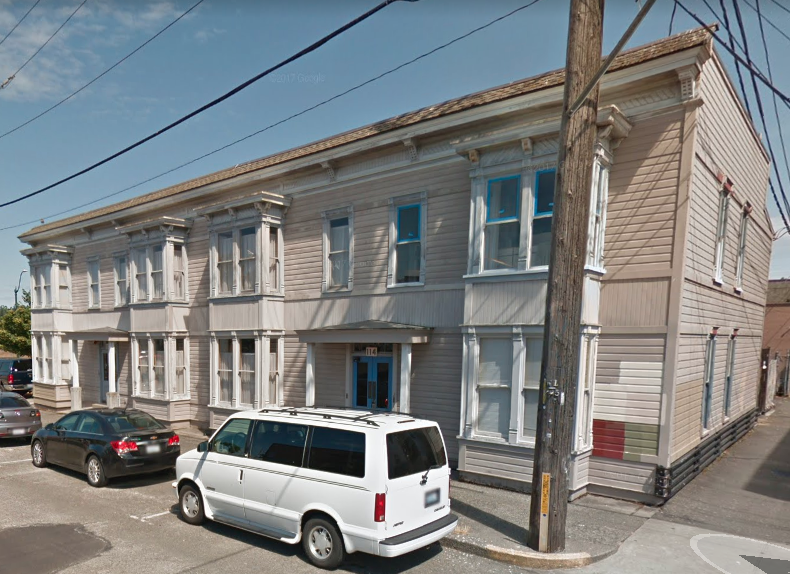
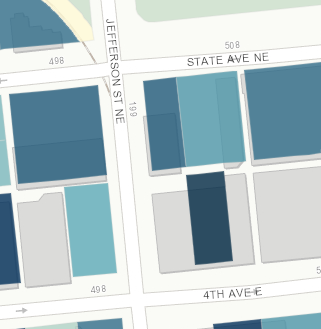
Let’s get to another good example of how this is working in Olympia. Take this block of densely packed housing along Jefferson:

This isn’t likely anyone’s favorite place in Olympia, it sits on a stretch of Jefferson that has train tracks and is just a good example of what kind of housing we used to build downtown. At at just less than 10 percent of an acre it is valued at $2,661,538.46 per acre. When you look at the map, you can see it isn’t even out of the neighborhood in terms of value per acre.

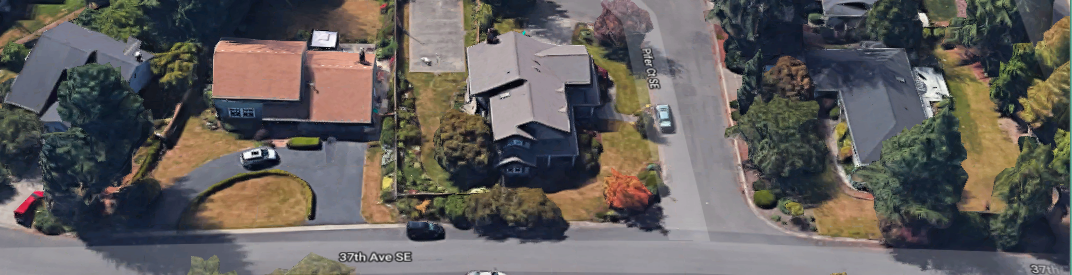
Let’s go a few miles south on 37th Street, south of Olympia High School a block or so. This is a neighborhood of single family homes in a neighborhood with no sidewalks, and though it is walking distance to two schools and a couple of churches, isn’t really what anyone would consider walkable in general.

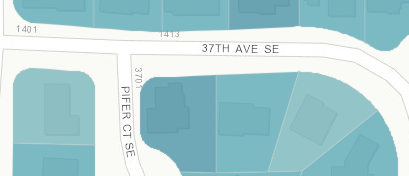
And, these four house, clocking in at just over an acre, are valued at 1,617,475.73 per acre.

And, looking at this map, you see very similar values per acre among the neighbors.

Another way to look at it is to think about what value is being lost to the city of Olympia by sea level rise. Downtown Olympia by 2095 (if we don’t do anything) will lost about 370 acres and about $600,491,269 in total value. The land in low lying Olympia is valued at $1,631,769.75 per acre, Compared to the value of the land outside the inundation zone at $494,018.11.
So, coming back to the finances of the city. In the short run, we want more walkable neighborhoods filled with affordable housing of various sizes and types. So, we want to cut impact fees to help this happen. Single family housing is more expensive to the consumer (even using the data provided by opponents of the Missing Middle). But, because high density housing uses the land more efficiently, it ends up providing more taxes to the city itself, blunting the need for impact fees anyway.

What happened after we downzoned and the middle went missing in Olympia?

In the last post I showed how a series of zoning changes in the 1980s and 1990s

But Olympia continued to grow. Where did all those people move?

It seems obvious to point out, but they moved it mostly single-family zoned neighborhoods.

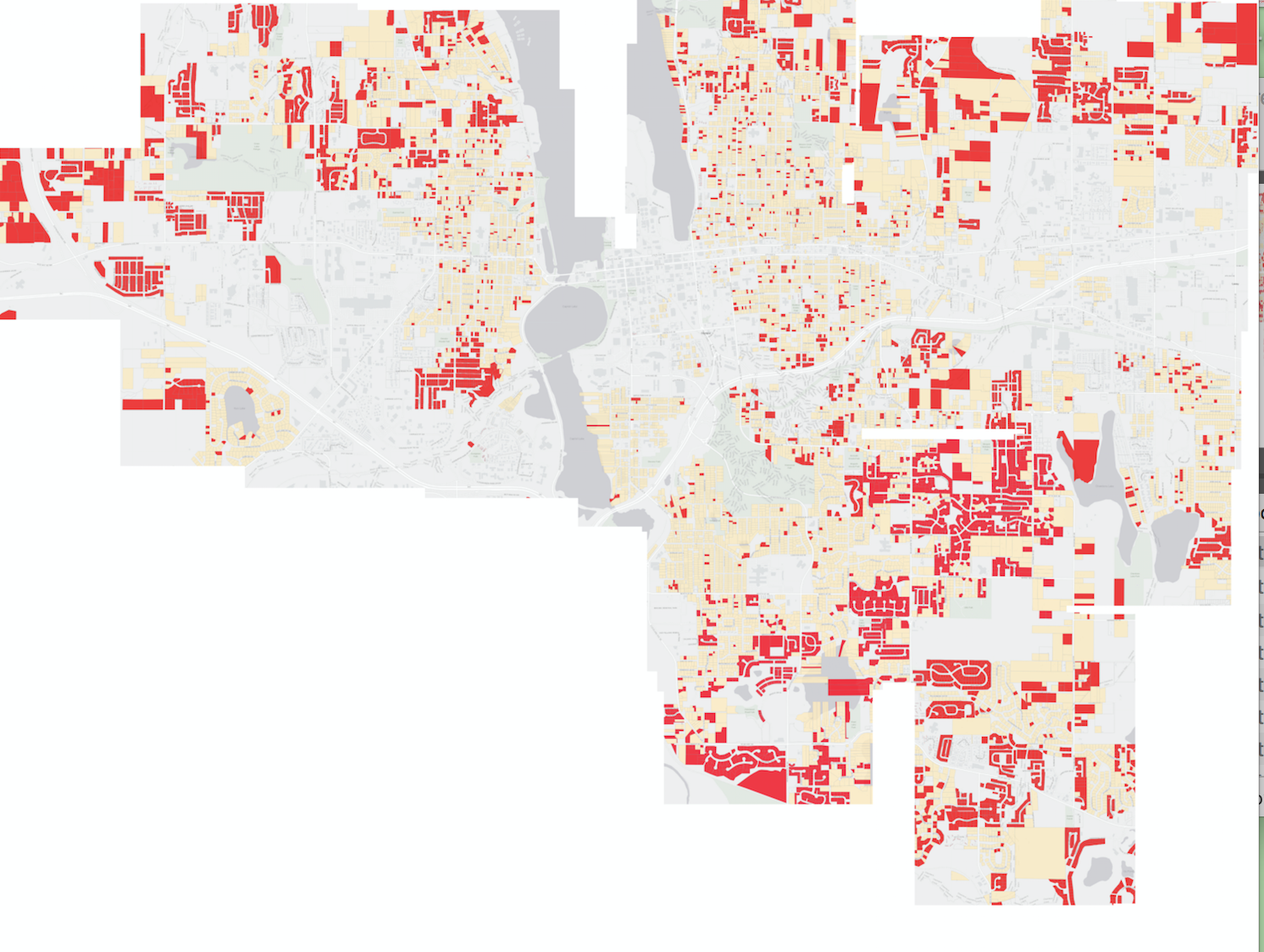
More people came to Olympia, so if we weren’t getting denser, we sprawled. This map shows every parcel that had a new structure in residential type (even including multi-family) after the 1988 downzone. I pieced it together from a series of webmaps from the Thurston Geodata Center.

Instead of densifying the places where we’d already built, we expanded our footprint over the last few decades, cutting down more trees, paving over more open land. People continued to move into town, and as our interior neighborhoods “stabilized,” new neighborhoods continued to be cut out of the woods and farms around Olympia.

Here is the Google engine timelapse from 1984 to today, you can see the exact same thing.

Southeast Olympia:

Westside:
 

I hope this doesn’t really need pointing out, but if we’re worried about the impact of new growth or preserving natural resources, we would be concerned about sprawl. Again, not new news guys.

From City Observatory:

Cities incur substantial expenses to build roads, transit systems and parks to enable development in a neighborhood. Downzoning automatically increases the per capita costs of all of those investments, because each road, park and bus line can serve fewer people. It also pushes additional development to the urban fringe, where some municipality must build entirely new infrastructure at high cost, and where not incidentally individual households will have to drive more, creating more pollution and congestion plus incurring more transportation costs. Ultimately, downzoning is a recipe for more sprawl: if you can’t build as many apartments, you’ve got to build more single family homes, and you’ll end up consuming a lot more land in the process.

Even if the new roads and utilities we used to enable the post-downzone sprawl was paid for at one point with impact fees, we designed a system to fail. The impact fees only pay for the initial setup of these road and utility systems. Eventually, they’ll reach the end of their useful lives and we’ll have to pay to replace them. At that point, we’ve cooked into our zoning a limit on how many taxpayers will be on the hook to replace them. We’re essentially pushing the expense of low-density, unwalkable single-family neighborhoods onto the next generation.

When Olympia downzoned and gentrified

In the early 1960s and through the 1970s, most of Olympia’s residential neighborhoods allowed housing types that are now included in the city’s Missing Middle proposal. The most common of these zones was the RD (Duplex) zone that allowed for single-family homes and duplexes in the same neighborhood. In various generations of Olympia zoning codes, this later became known as R2 and then R 6-12 (meaning six to twelve dwellings per acre). 
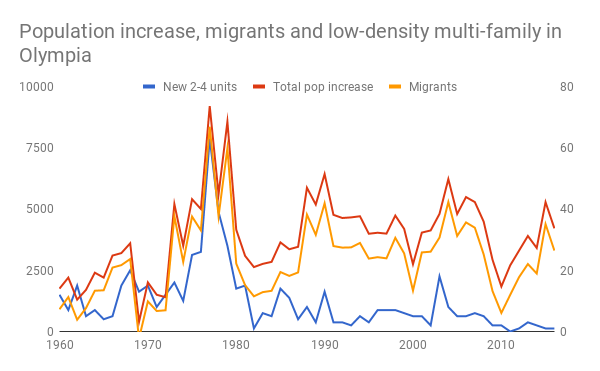
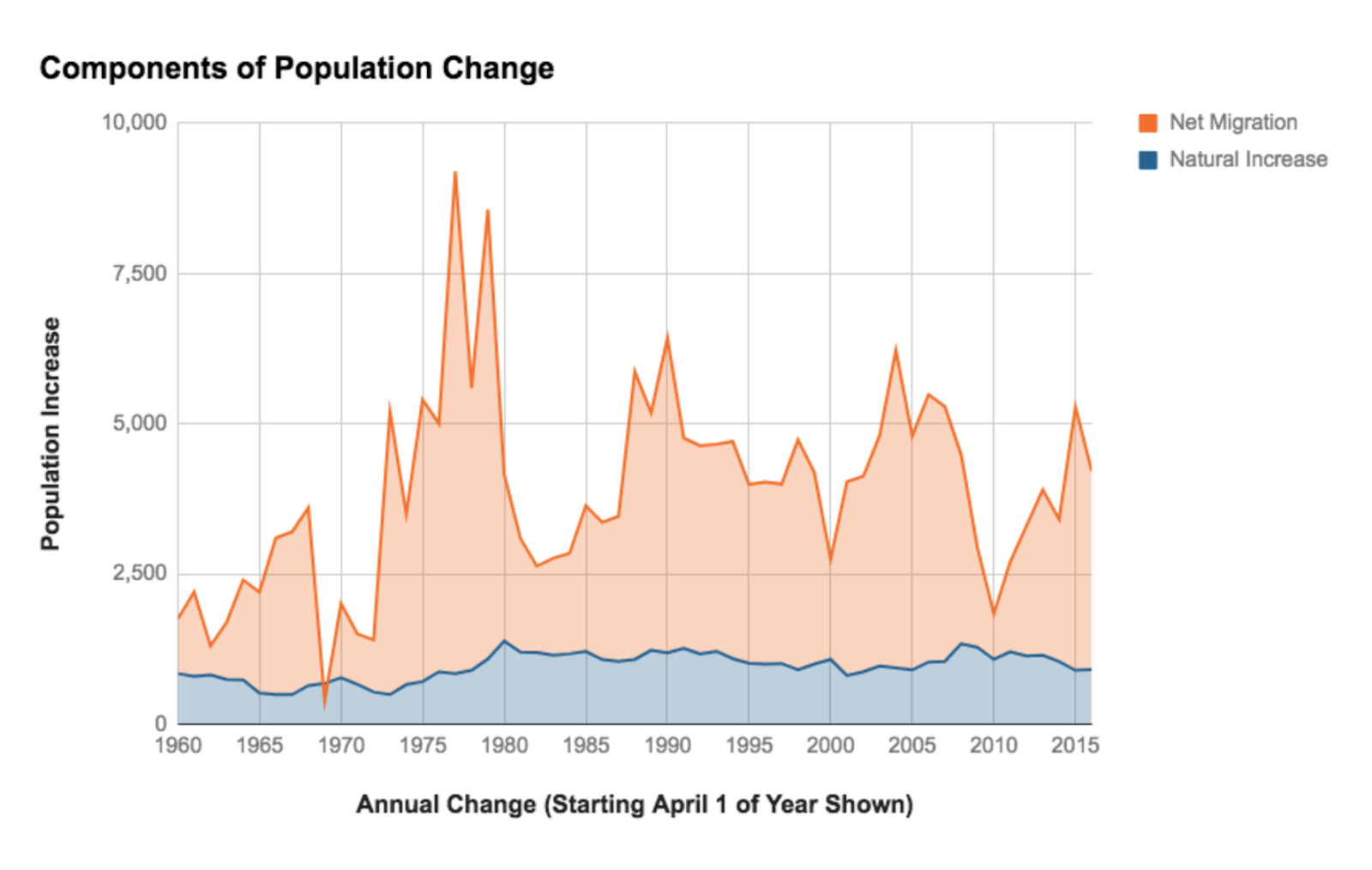
In an earlier post, I pointed out how Olympia (and Thurston County) saw its largest influx of new residents in the late-70s. Even the yearly migration of today does not match the spike in new residents between 1977 and 1979. Before and during the 1970s, the construction of 2-4 unit housing pretty much tracked with population growth in Olympia, but in the early 80s, they became unhinged.

This is because Olympia downzoned a series of once density friendly neighborhoods, pushing new growth into largely single-family home zoned neighborhoods on the fringe of the city.

Through the 80s and 90s and to today, the city decreased to the area duplex-friendly zoning covered. This led to examples of places where duplexes had been built, but they weren’t actually technically allowed by the zoning rules. In fact, because of persistent downzoning in recent decades, there are literally hundreds of examples of non-conforming missing middle housing throughout the city. 
According to the city’s tally, there are over 200 non-conforming duplexes, 462 non-conforming tri/fourplex units, and 89 non-conforming 5-12 unit apartments. All of these were allowed under zoning rules when they were built, but the rules changed over time.
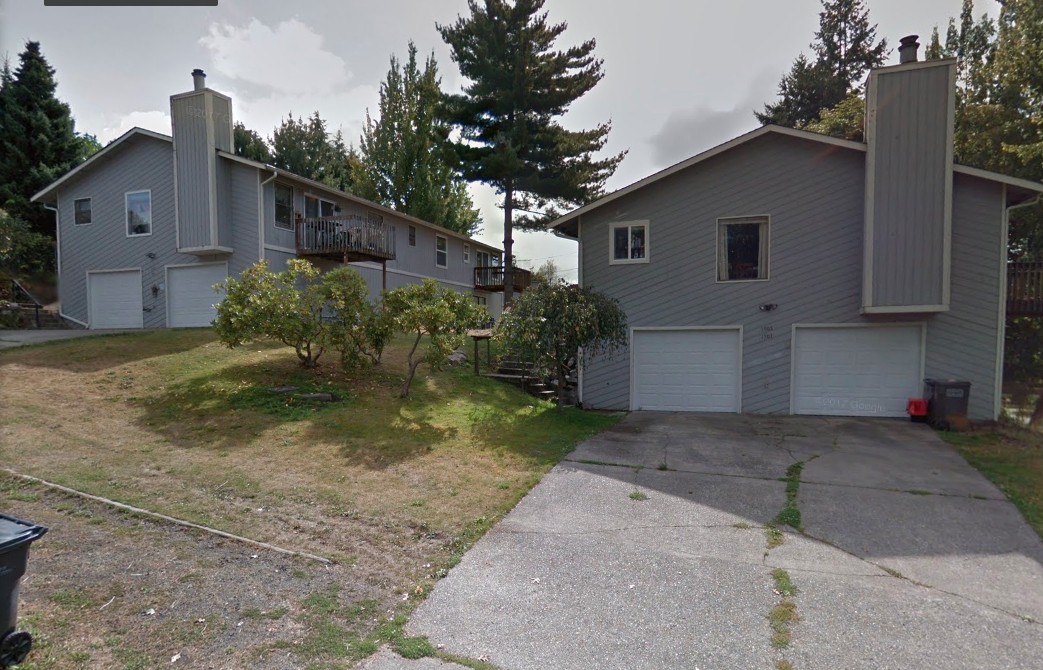
Here is a great example of two non-conforming duplexes at Legion that were allowed in 1978, but not a few years later:

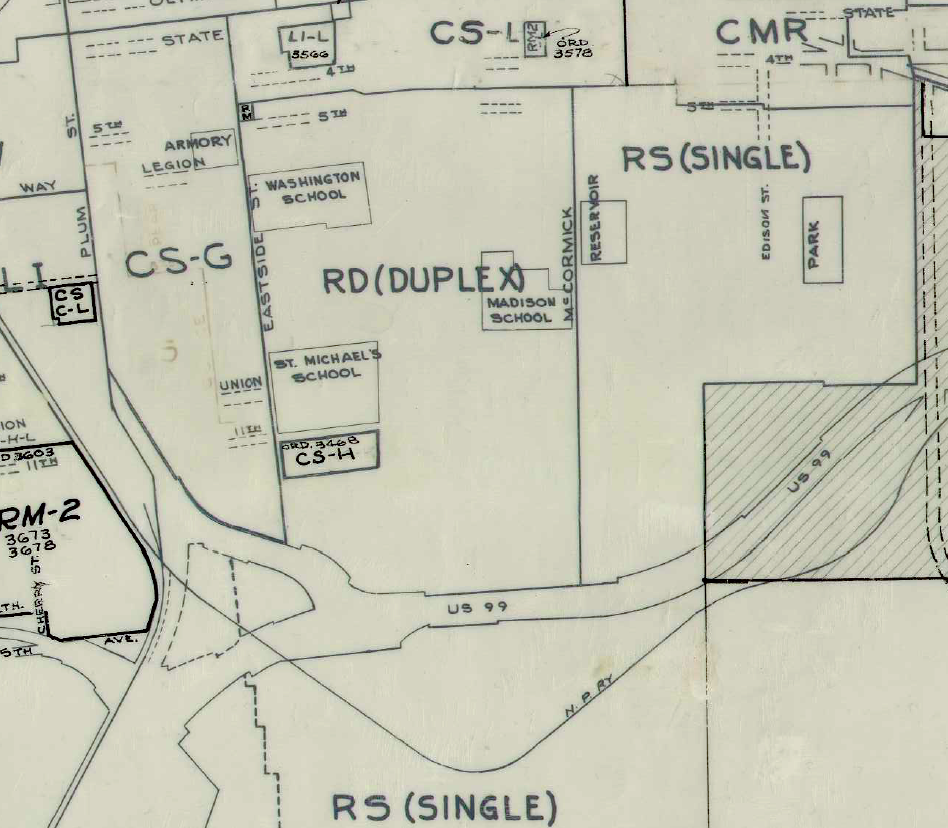
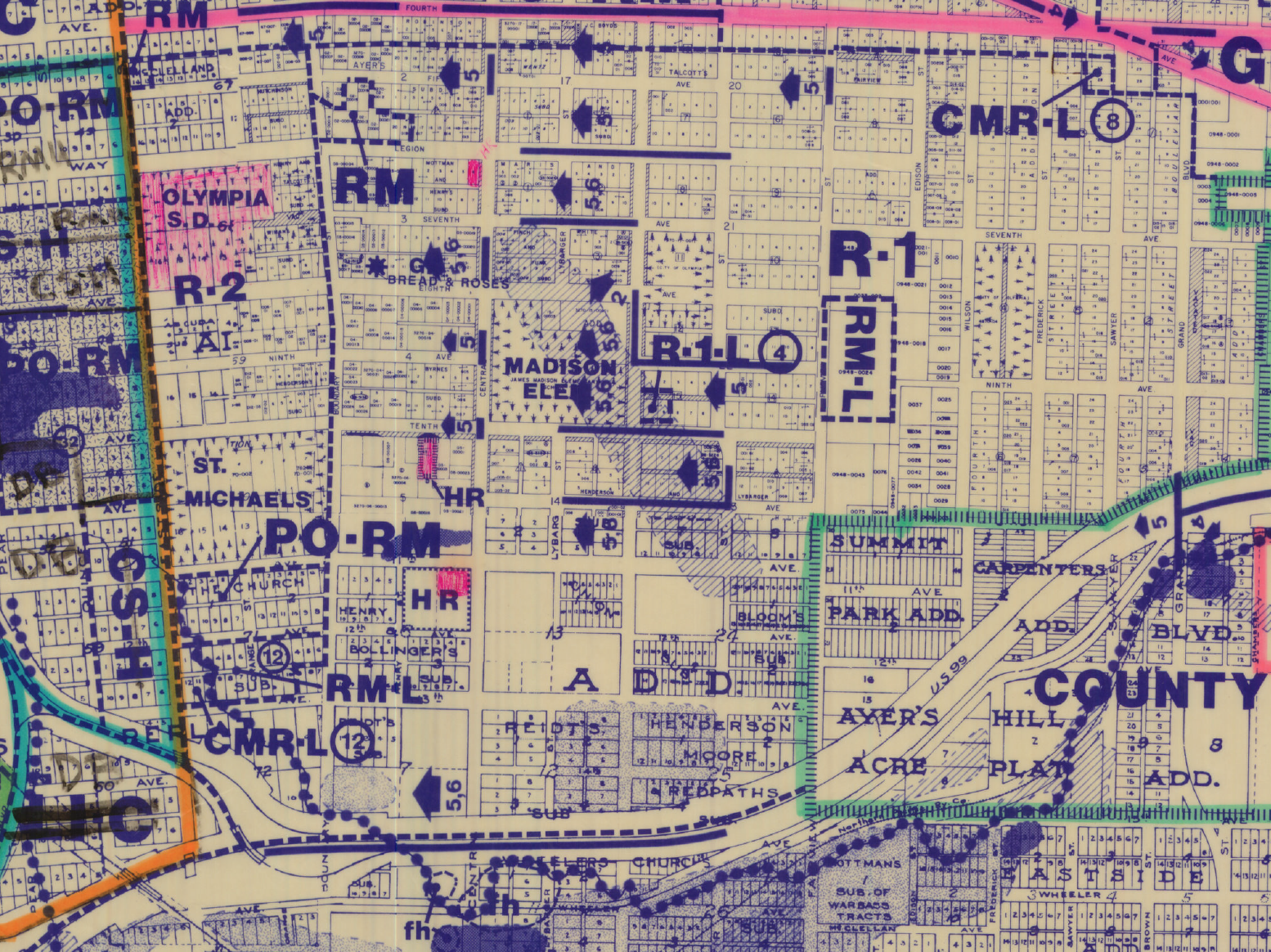
It’s worth your time to watch how the zoning maps changed over time. In 1962, the Eastside duplex zone stretched from Eastside up to McCormick.
Then twenty years later (as R-2 zoning), it became much smaller, stretching only to Boundary.

In 1994 it expanded again, but..

It (this time as R 6-12) shrunk back down in 1995 through to today.

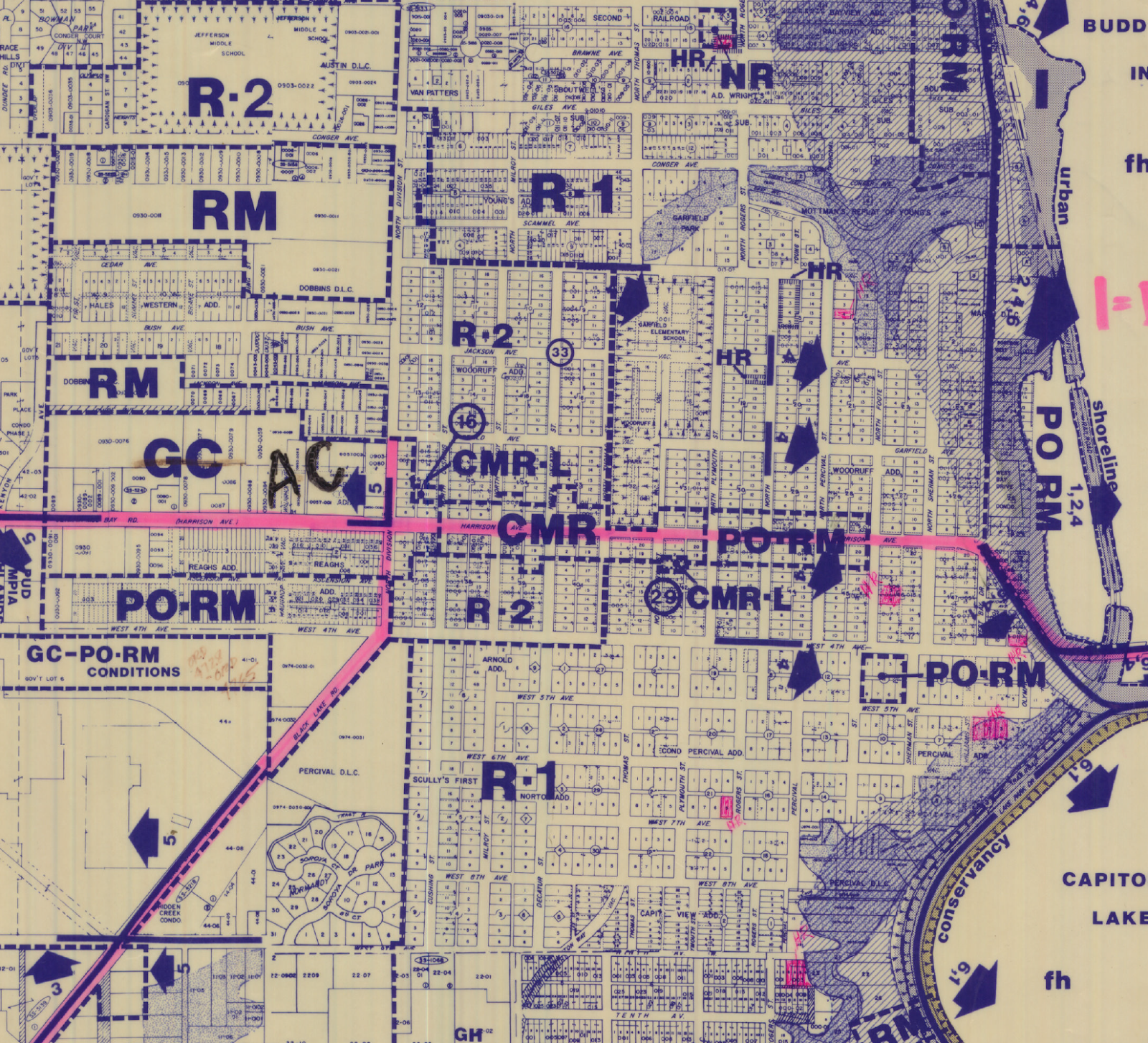
We can see the same thing on the Westside. The duplex zone dominated most of the hillside over there in the 1960s and 70s.

Then in the early 80s, the zone shrunk as most of the area downzoned.

And, again in 1994…

But in 1995, the area for duplexes expanded again, taking back a bit of what it used to be.

The most interesting downzone example was in 1988 when the city, downzoned a portion of each of these neighborhoods from a zone that would allow duplexes to a single-family home only zoning. 
There is nearly zero coverage of the 1988 downzone, the only real reference I found to it was in the city minutes. It seems odd to me that of the 18 people that testified on the downzone, 13 were against it. Despite the opposition, the massive downzone went from the planning commision to approval by the city council in four short months.
Here is a map of the downzoned areas:

According to the ordinance, the reason for the downzone was to align the zoning in those neighborhoods with this policy in the then Comprehensive Plan: “Older neighborhoods which are predominantly single family should be zoned single family to encourage home ownership and rehabilitation.”
In terms of how people remember downzones of that era, this checks out. Here is Jim Keogh talking about the Eastside:

The neighborhood stabilized. It became nicer. It also (seemingly) became more expensive. 

Taken from a different perspective, what happened to the Eastside is called gentrification. 
Jim doesn’t really go into why this would happen, but it seems like once you stop allowing more residents to move into a neighborhood and make housing the more exclusive, the neighborhood becomes more gentile genteel.
The result of this sort of zoning experiment would be a mystery if we haven’t seen it play out on a grand scale across the country. For example, Los Angeles conducted this sort of downzoning writ-large over the same timescale as Olympia:

The city of Los Angeles has tested this theory by downzoning
the city to permit fewer dwellings. In 1960, the city was
zoned to support 10 million people. By contrast, today the
city is zoned to support only 4.3 million people — just slightly
more than its current population. So if excluding housing made housing cheaper, Los Angeles
land prices would have fallen, causing rents to fall. And
yet rents, adjusted for inflation, have risen by 55 percent,
while median renter income has grown by only 13 percent. Rather than declining, land prices quintupled, from just over
$86,229 per house in 1984 to $483,692 in 2014.

Less access to housing over a finite area leads to a higher cost to access that housing. Seems pretty simple. The purpose and the result of the downzoning in Olympia was the gentrification that we’ve seen over the last few decades. Rather than allowing the neighborhoods to absorb the growth that was coming, we allowed it to do something totally different.

When middle went missing in Olympia

At some point, Olympia stopped building low-density multi-family housing.

In older neighborhoods, you can find duplexes courtyard and mansion apartments dotted along blocks. Even in blocks built in the 1960s and 1970s,

you can see duplexes interspersed between single-family homes.

But as you get into newer neighborhoods, it is harder and harder to find examples of affordable, low-density multi-family housing. I can show you when this happened, but I can’t show you why.

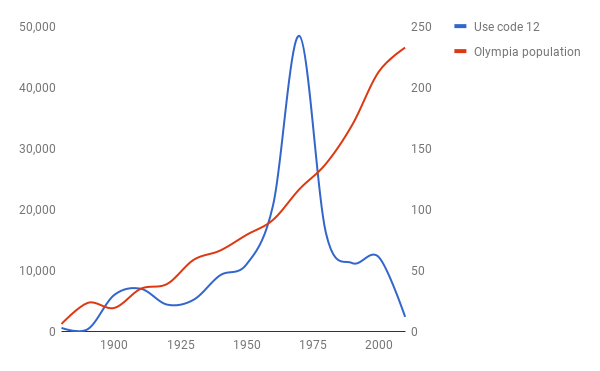
EDIT 10:18 a.m.: Ignore that chart down below. It isn’t detailed enough. This chart really shows a population spike in Thurston County in the mid-70s and how low-density multi-family housing tracked with migration until the 1980s. Then they became untethered.

What this chart shows you is the population of Olympia by decade plotted against the construction decade of structures with two to four housing units (Use Code 12). This would cover anything from a duplex to a fourplex and some kinds of smaller apartment buildings. I think this use code is a good stand-in for what we now call the Missing Middle in Olympia.

It seems like that for most of Olympia’s history, the construction of these low-density multi-family buildings pretty much tracked with population growth in Olympia. But in the 1970s they took off, far outpacing population growth. And, then construction of these units crashed and never recovered.

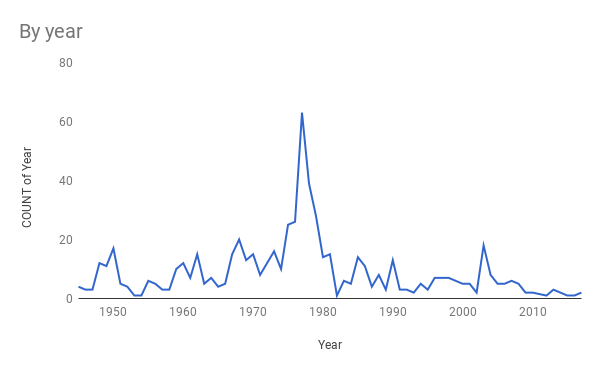
Because the above data is aggregated by decade, it looks like most of the growth is happening in the 1970s. But if you look at it in more detail, you see something else happening.

Multiplex housing spiked in the mid to late 1970s and then crashed in the early 1980s. While there have been spikes in construction since then, it never really recovered to even the levels that we saw after World War II. The boom in the late 1970s and crash in 1980 coincides with the boom in migration into Olympia and the early 1980s recession that stopped it. The late 1970s still stands as the largest ever influx ever of new residents into Thurston County.
I’d like to chase down exactly what happened to low-density multi-family housing after the 1970s. Based on my post last week and the numbers I’m seeing here, it seems like that at some point after the early 1980s recession that slowed migration Olympia, we changed our zoning laws to clamp down on duplexes. Then we likely experienced a few decades of slower growth where we exacerbated the ends of our housing options (single family homes and multilevel apartments).

How the history of our neighborhoods points to our Missing Middle past

At one time in Olympia, and most other cities, neighborhoods grew one house at a time and they grew with different needs in mind. Mixed-density housing was prevalent prior to World War II and was exactly the kind of development that originally encouraged walkable neighborhoods. 
The Carylon neighborhood is a great example of this. A month ago I took a look at a duplex in Carlyon that I was interested in renting. It was a bit outside my price range at the time, and to be honest, I was surprised it was even available in that neighborhood.
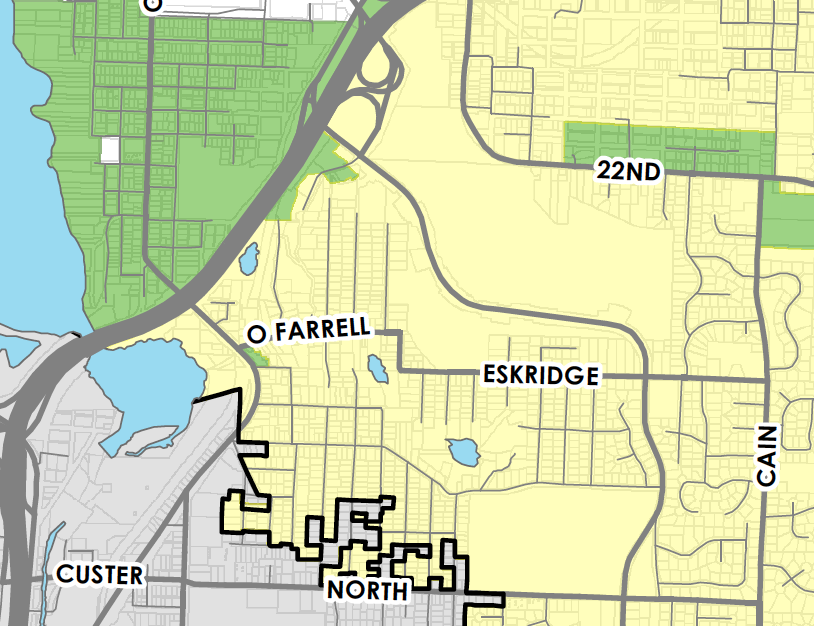
Because it shouldn’t have been allowed (yellow means no duplexes under current zoning):
Also interestingly, I thought that it was a single family house that had been split into a duplex, but I researched the history of the structure, and it had always been a duplex. 
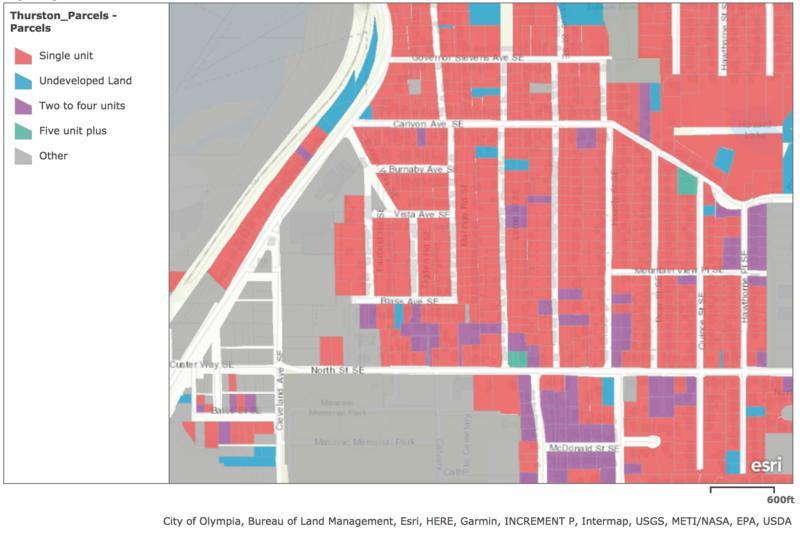
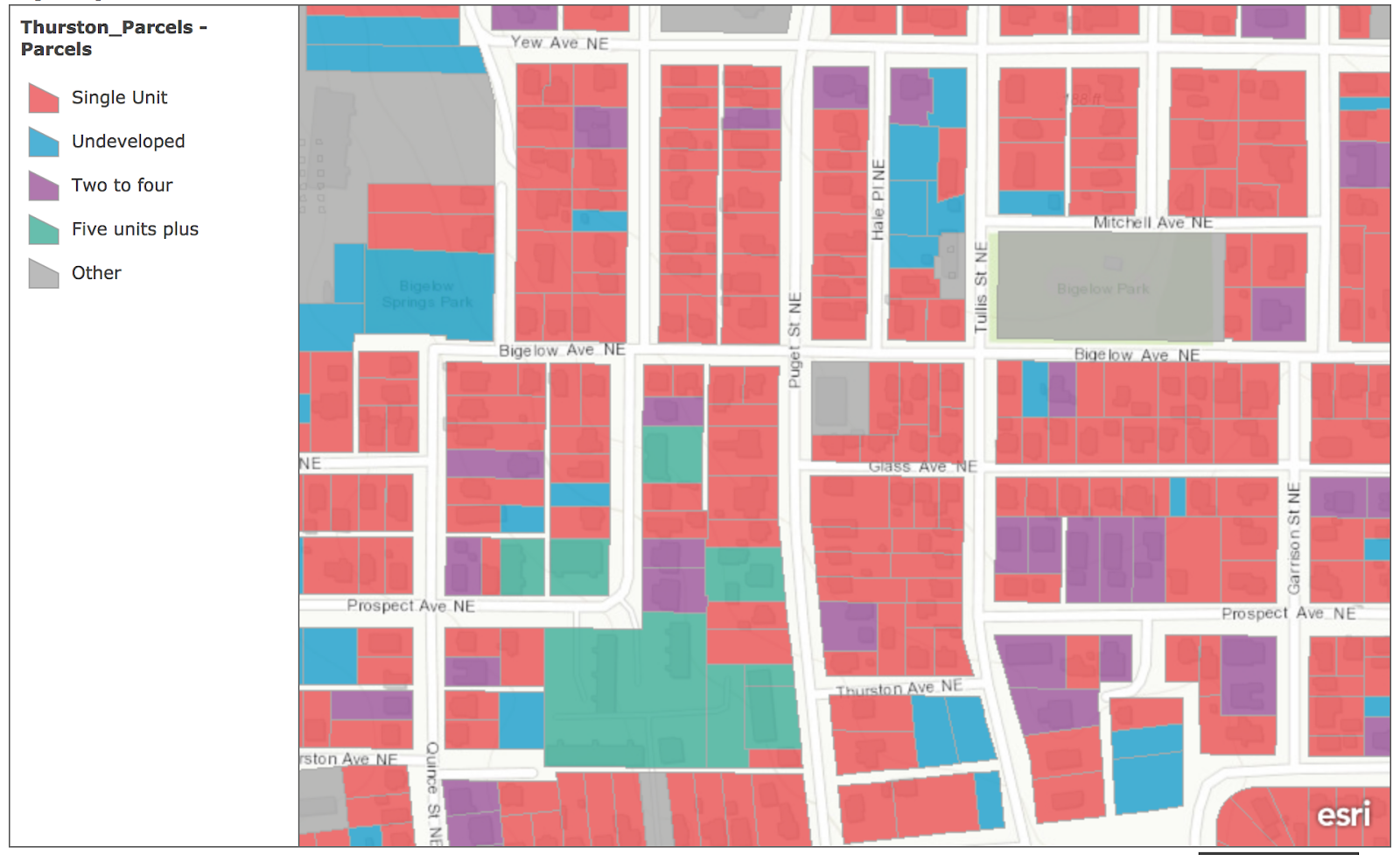
And, it turns out, that one duplex was not as rare as I thought in Carlyon. The map below shows the different use codes for the buildings in the neighborhood. Red is single family homes, purple are duplexes and blue are apartments:
There are not only duplexes spread throughout the neighborhood, there are even a couple of small apartment buildings. This shows how Carlyon, before zoning in our neighborhoods became more restrictive, was able to provide housing for residents across the economic spectrum.
There is a section of the Bigelow Neighborhood that is also a good example of this:
While still mostly single family homes, these neighborhoods have a decent mix of middle-density housing options. And, a lot of it is illegal under current zoning. That if we tried to build a lot of the housing now available in these neighborhoods, it wouldn’t be allowed.
And, I don’t think anyone can say that these sections of Olympia are unlivable. All in all, they probably represent some of the most economically accessible, livable and walkable neighborhoods we have. And, this is no small part because of the diversity in housing options they offer.

And, they also represent a way of building homes in this city that we don’t have anymore because of the restrictive way our zoning works. The traditional manner of regulating neighborhoods was to allow for a diversity of housing types on a block. The way we do things now, with restrictive zones that allow for very few housing types in neighborhoods, is relatively new and experimental. It is also, in my opinion, largely unsuccessful. It has created neighborhoods that are economically stratified and car-dependent.
It wasn’t until after World War II that a single developer would take on building all the homes in a neighborhood, which cut down on the diversity of home types.

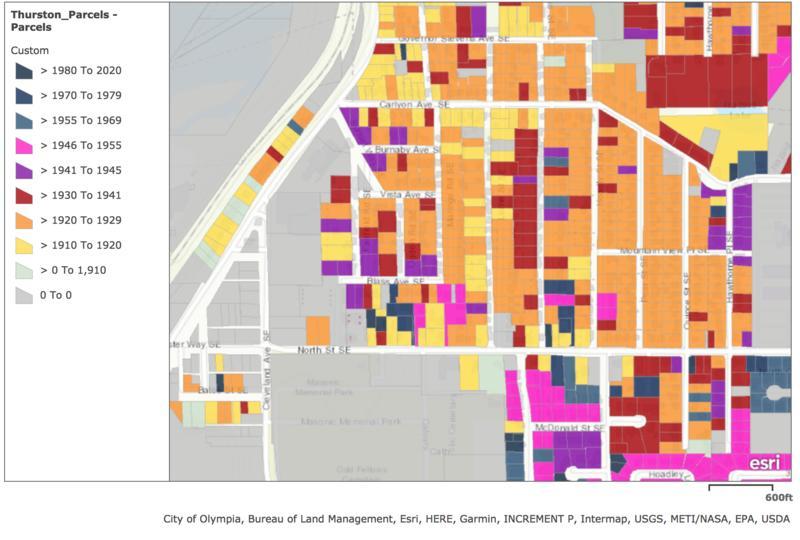
In this next map, you can really see how the houses were built in the Carlyon neighborhood over a long period of time. It took several decades for this neighborhood to transition from a former cattle ranch into a residential neighborhood. When it was making that transition, it was part of neither the city of Olympia or Tumwater. In fact, it was the uneven development of the neighborhood that gives it it’s most unique characteristic, the jumpy city border between Olympia and Tumwater. But that is more trivia than something underlying my bigger point.

While diversity is present in the neighborhood I live in, Briggs Village in Southeast Olympia, my neighborhood is the exception that proves the rule. Diversity isn’t usually a mark of planned development. The helter-skelter of the market historically has allowed builders to offer what was needed on a neighborhood scale when they were able to sell it. 
This incredible story at Sightline shows how single-family zoning became more prevalent over time in Seattle, that neighborhoods at one point had been able to be fitted with more than one sort of housing option. While the Missing Middle recommendations we’re considering in Olympia now are not an up-zone, the city of Seattle conciously downzoned most of the city in the 20th century, outlawing options like townhomes and neighborhood scale apartment buildings.

What would it mean for the nature of our city that the Missing Middle would have the biggest impact on Southeast Olympia?

Southeast Olympia is already wealthy and conservative. Would allowing more housing types down there change that?
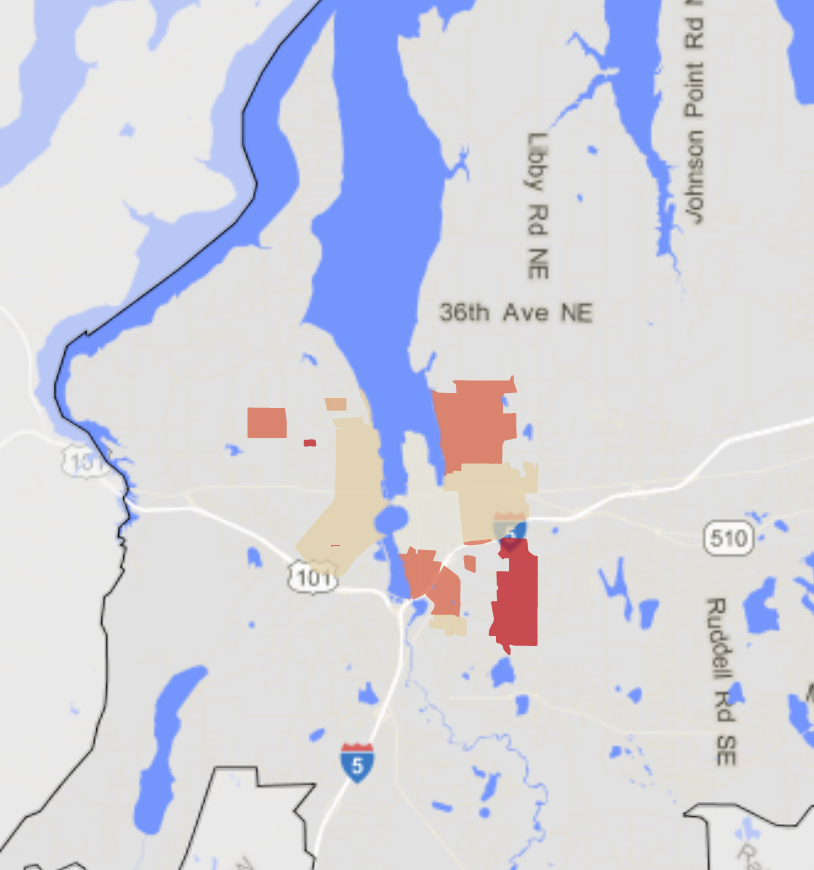
The above map is a mashup of two different maps. 
The first is a parcel density map of where the Missing Middle recommendations would have the greatest impact. It shows where the buildable parcels left to be developed match up with the potential for Missing Middle housing. For those just showing up, Missing Middle is the variety of housing between an apartment and a single-family home, such as a townhouse, duplex or courtyard apartment.
The second map (which is displayed in white to red placemarks) is the election results from the Lisa Parshley vs. Allen Miller race last November. Miller districts (more conservative) are lighter, Parshley districts (more progressive) are darker.
Now, this isn’t an exact science but what this map tells me is that the neighborhoods with the greatest potential for growth from Missing Middle housing are far more conservative.
To me, it totally follows that neighborhoods that are less dense, with bigger yards and longer commutes, would be the more conservative. And, it turns out, much wealthier.
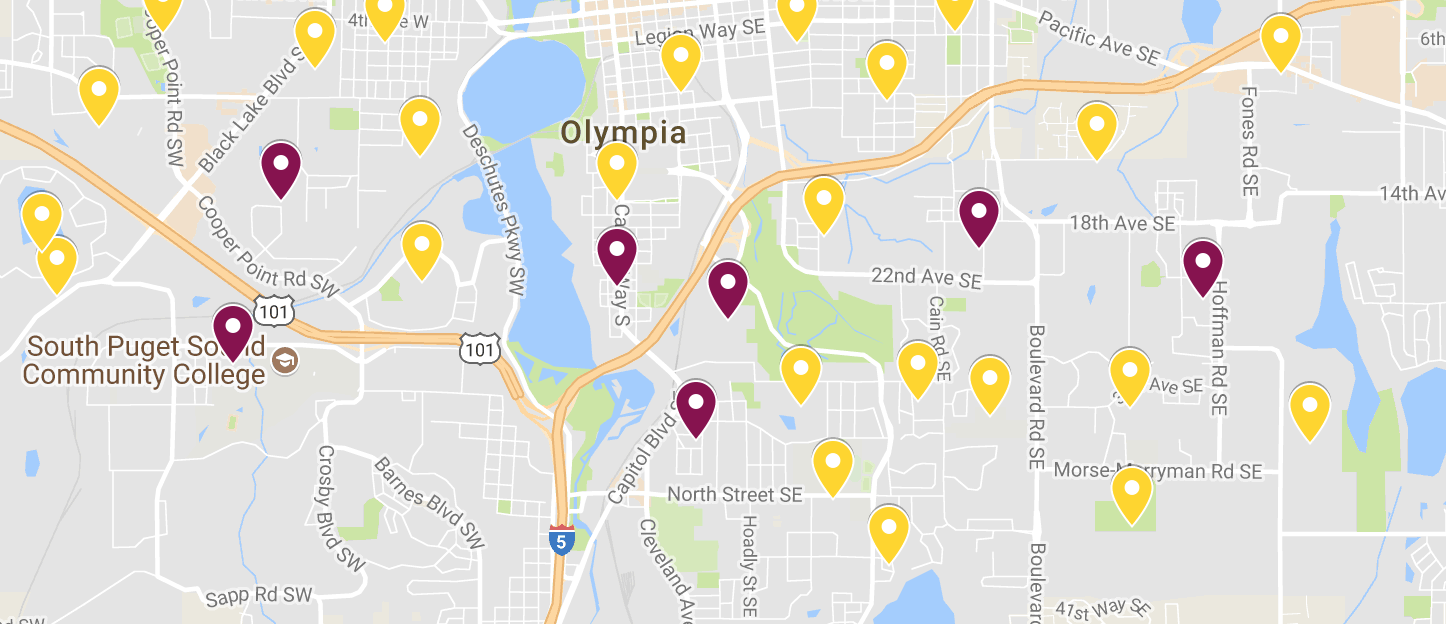
This next map is a selection of a map that shows how income really is distributed across the city. Some of the wealthiest parts (here in deep red) are in the same sections, down in the Southeast side of town where Missing Middle is hard to find, but the potential is the greatest.
So, imagine a scenario where Missing Middle housing becomes available across the broad swath of Southeast Olympia. What happens to the grassy, large single family home dominated section of Olympia? Does it become more progressive? Does it become more egalitarian? 

Renters are nice people and other thoughts on the demagoguery of the Missing Middle

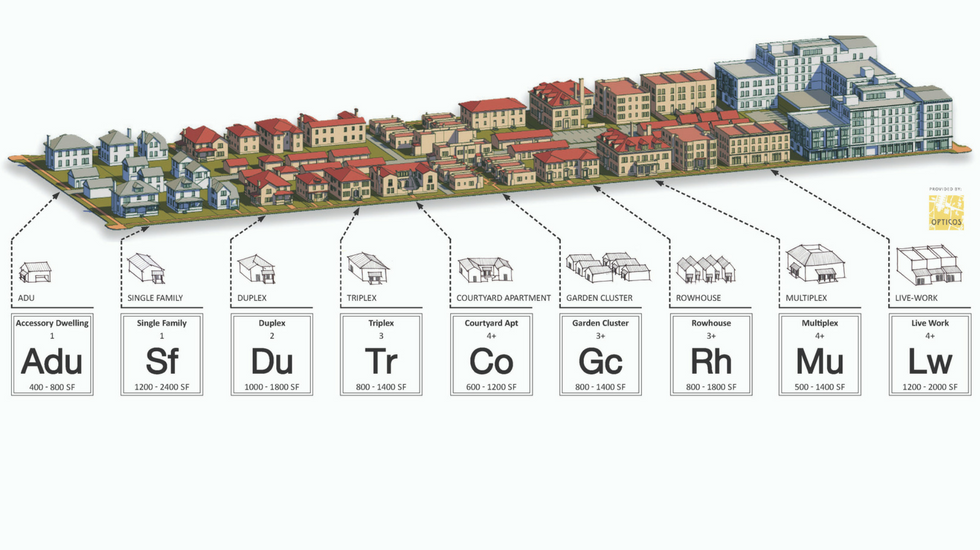
Missing Middle from AIA Austin

Right now the Olympia planning commission is considering a list of recommendations about the so-called Missing Middle. These recommendations would hopefully increase density in Olympia’s least dense neighborhoods by allowing duplexes, townhomes, courtyard apartments and ADUs in the mostly the upper elevation swaths of single-family homes neighborhoods.

As you would expect, there are a bunch of people who are not fans of this idea. And as you might expect, they belong to existing neighborhood organizations in well established (but I would argue not traditional) residential neighborhoods. As Whitney Bowerman argued in this excellent email she sent to the planning commission, these organizations represent mostly older homeowners who want to preserve the low-density character of their neighborhoods.

This testimony to the planning commission I think almost perfectly encompasses this attitude.

First off, she makes a point that we shouldn’t follow the example of Seattle. Implying that by increasing density you don’t do much to decrease housing costs. The fact is that rents and housing costs have started to decline in Seattle, mostly because of all those cranes on the skyline are starting to make a dent in demand.


Renters are not bad, I’m a renter

About two minutes into her testimony, she starts to get into a caricature of homeownership. “For generations, working people have dreamed of owning a house,” she said. Specifically a house, and in her mind, a detached single family home. Which is also a specific type of home that hasn’t been historically accessible to many people or even now.

“It is not just a financial investment, it is an emotional investment and a social investment as well,” she said. Apparently, when you own a home, your emotions should matter more and your memories are deeper and richer.

“Outside those walls and over the fences, they (homeowners) create social networks,” she said. “Perhaps not in the days of old when someone was home and could build social capital in the neighborhood, but people do participate in Nextdoor, attend annual meetings… they are literally invested in their neighborhoods.”

This is all a slam on the nature of renting a home. Personally, I’ve done both. I’ve rented in almost every quadrant of Olympia and owned two homes in East Olympia. Currently, I rent an apartment in Southeast Olympia and hope one day to own again, but not a single family detached home. My goal is a townhouse with as little yard as possible.

But this belies the philosophy behind this anti-density testimony. The neighbor I had that called me a piece of shit while I was outside with my toddler owned his home. He still owned it when the police arrested him for waving a gun at his wife. I’m sure he had memories in my neighborhood, but they weren’t more meaningful because he paid a mortgage.

I’ve also had a series of neighbors that have quickly moved in from out of state, bought a home and relatively quickly moved out without making a dent in my community. They were not literally invested in anything and their presence, while pleasant, did not have a deeper impact on the neighborhood.


It isn’t about renters vs. homeowners, it’s about density and affordability

I agree the research indicates that homeownership by-in-large means better things for a community.

The testimony is also moving the ball from a debate on increasing density in Olympia’s low-density neighborhoods to a debate over the value of homeowners vs. renters. At least in the examples of townhomes and possibly courtyard apartments, the Missing Middle will be the only actual path to homeownership that some people can ever use. And, the option of duplexes and ADUs will possibly allow some folks, who would like to set down permanent roots in a neighborhood, stay in a neighborhood.

Imagine for a moment a single mother who got a late start on retirement. She has an addition in her small home that she can easily transition into an ADU if it was allowed by the city. That would keep her in her home past retirement.

Currently, a lot of neighborhoods in Olympia fail the test of liveability in two major ways. They are too low density to really be considered walkable. Even if a small neighborhood center like Wildwood did want to located inside some of these neighborhoods, it wouldn’t survive because single-family neighborhoods simply aren’t dense enough.

Also, we fail in terms of variety of housing types, especially in the car-dependent SE neighborhoods. A good neighborhood ensures that multiple generations of the same family can live in the area, that people from a variety of backgrounds can come together. Large swaths of single-family homes, while protecting the nature of a neighborhood, does not promote diversity.

If you work outside Thurston County, you’re more likely to not like downtown Olympia

The city of Olympia commissioned a public opinion poll in December. The poll mostly covered concrete things like how important various city services are and how well they’re being delivered.

But the survey also got into an interesting line of questioning about how residents perceive safety in Olympia. The pollsters asked whether we feel safe in our neighborhoods during the day and night, and more important, how we feel downtown during the day and at night.

Here are the totally unsurprising results:

Most people felt most safe in their own neighborhoods, and then less safe in Olympia in general and then even less safe downtown and especially at night. There were several groups that drove down the results for downtown. If you were from the Northwest neighborhood, if you thought the quality of life in Olympia was low, if you only had a high school education or if you worked outside of Thurston County, you feared downtown more.

The last one is the one that I’m most interested in exploring. If you commute outside of Olympia on a daily basis, I’m going to assume other things about you. You probably also shop in between home and work. Which likely means that at best you do most of your shopping on the Westside, but more than likely you shop in Lacey or in Tumwater. Your daily habits are tied to the freeways your commute doesn’t take you downtown.

Here’s an interesting tidbit, 17.2 percent of Olympians commute outside of the county for work, according to the American Community Survey. This is up from 16.9 percent in 2015, but the census bureau has only asked this question in the last two years. If you take commute times though, 22.8 percent of Olympians have a commute over 30 minutes. For most people, I’d assume this takes them out of the county, but at least well outside of Olympia so it might as well be out of the county. And, this number took a significant jump between 2011 and 2013 when it went from 18.8 percent to 22.8 percent (it’s remained steady since then).

This wrinkle with long-distance commuting and downtown combined with another result of the city survey makes me think that familiarity of Olympia is a leading indicator of how people perceive their own safety. Literally not one of the survey respondents said they feel very unsafe in their own neighborhoods during the day.

So, what does this mean for governing Olympia? A good majority of the complaints about downtown come from people who are obviously not familiar with downtown. They are fearful about downtown, but I doubt very much that they’re even downtown at night. Is it the responsibility of the city to govern in the direction of unfamiliarity with reality?

2017 election lesson number 2: How the Oly Progressives boxed them in


This post will play off my last one where I talked about how the power elites (a term coined by Steve Salmi at Green Pages to describe non-progressive or transactional candidates) could not expand their geography after the August primary. What was the most important geography for the slate of progressive candidates in Olympia, especially compared to other recent progressive candidates?

Before I start (again), here is some deeper reading for you (again):


Here are all the spreadsheets and map I’ve been working from. The data is from only a day or two after the election, so as counts march on, things will change obviously. But in terms of making maps, I think these will more or less stand pat.


For further reference, Adam Peterson did some really great shapefile based maps that he posted to Thurston Progressives.

Marco Ross ran for mayor against Cheryl Selby in 2015. He is the most recent progressive candidate for city council and I’m using his results to compare to this year’s successful slate.

Literally, the answer to where they did better is: everywhere in Olympia. The smallest margin of difference between the average progressive percentage two years ago and this year was 14 percent. But even taking that into consideration, there is still a geographic story to tell.

So what I did with this map was isolate the top 14 of 57 precincts (in total) by how much better they did this year than two years ago:


What I see is a band of precincts above the SE Olympia core along the highway on the Eastside (extending to a couple on the westside. Then a series of precincts running up the spine of the upper Eastside and then a few out on the rim of the city.

Progressive candidates this year did do well everywhere, but where they did best was not in their core areas along the water or inside the SE Olympia bubble of their opponents. They carved out their greatest success between the two geographic powerbases along the interstate and then in far outside neighborhoods.

« Older posts Newer posts »

© 2026 Olympia Time

Theme by Anders NorenUp ↑