History, politics, people of Oly WA

Category: Olympia City Council (Page 3 of 9)

2017 election lesson 1: Olympia power elites really were boxed in

Where atmforcouncil failed

After Tuesday’s election, I did my typical copy and paste job on the precinct-level data and came up with a handful of lessons on local Thurston County politics. I talked about these maps in the latest episode of The Olympia Standard. But because visuals like maps don’t play well over the podcast, I’m putting them up here.

Before I start, here is some deeper reading for you:

Here are all the spreadsheets and map I’ve been working from. The data is from only a day or two after the election, so as counts march on, things will change obviously. But in terms of making maps, I think these will more or less stand pat.

For further reference, Adam Peterson did some really great shapefile based maps that he posted to Thurston Progressives.

Back in August, after some concern that the progressive candidates really wouldn’t have a good time in November, I predicted that “power elite” candidates like Allen Miller and Jeanine Roe (and likely Max Brown) wouldn’t be able to break out of their friendly SE Olympia neighborhoods to find a majority in November. By “power elite,” I’m borrowing a phrase coined by Steve Salmi over at Green Pages when he described the August results.

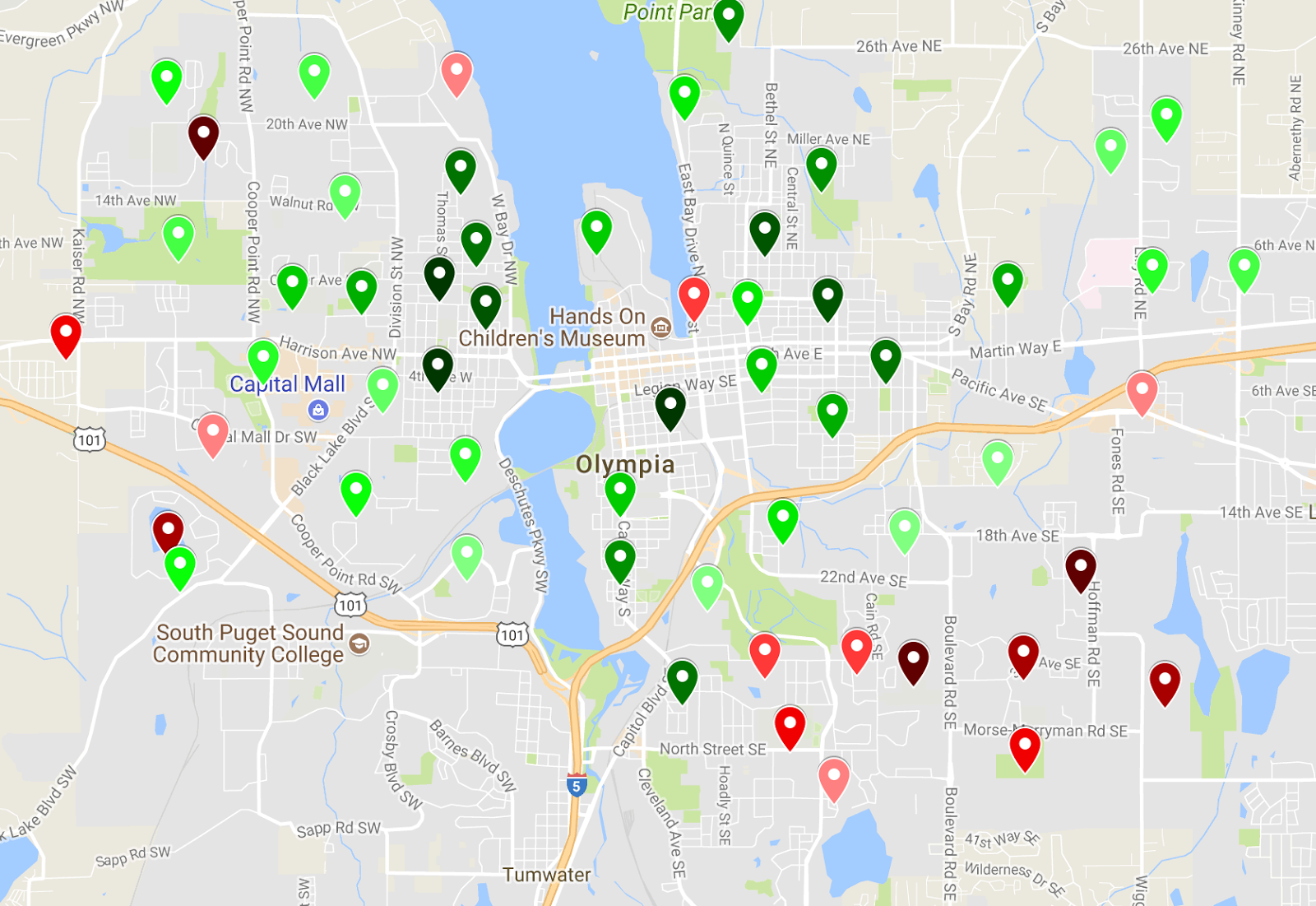
And, this happened because most of the places were Miller in particular picked up better percentages in November were places he already did well, as illustrated by this map.

Miller picked up more votes along the edges of town, places similar and including his SE Olympia power base. He lost support as a percentage throughout most of Olympia, towards the center of town in older, more walkable neighborhoods.

Compared to Brown and Miller, Jeanine Roe did better, but still not well enough to keep her seat. This map shows where she did better than Miller and Brown, which was slightly further in than the edge of town, making second ring neighborhoods more competitive.
“Olympia’s power elite” is probably boxed in

Steve Salmi has a great rundown of yesterday’s results in local elections over at Green Pages. But I think that his “rather groggy” assessment of how well progressives did in Olympia might be overblown.

In fact, what Salmi describes as Olympia’s “power elite” are probably boxed in.

Take Position 5 as an example, where you see the power elite Allen Miller facing more usual pair of progressives, Deborah Lee and Lisa Parshley. Miller and Parshley will face off in the general in November, but together Parshley and Lee took 55 percent of the total citywide.

November will be a much different election than August. Voter turnout will be up throughout the city in the fall, but not in a uniform manner. Each precinct behaves different and if you look at where Miller did well, the future doesn’t bode well.

In the sixteen precincts that Miller won, taking into consideration voter turnout in 2013 and 2015, he can expect a 64 percent increase in turnout. But in the precincts he lost, the turnout would go up 71 percent. If you just narrow that down to his 16 bottom precincts, where he’d do the worst, turnout goes up 79 percent in November. The further Miller goes from his base of support, the more turnout will go up in November. This isn’t good news for a candidate who didn’t break 50 percent in the primary.

Despite besting his opponents, Miller also seems boxed in geographically:

Here is the clickable map:

Basically, Miller’s base of support is on the far edges of the Westside or in the traditionally conservative (for Olympia) unwalkable neighborhoods in the Southeast. He did take a couple of neighborhoods near Budd Inlet, but these were two of his worst performing precincts. Lee and Parshley not only did better citywide, but their geographic spread goes much further, covering practically the entire city, short of the Southeast.

If you take a quick look at Position 6 race where power elite Jeanine Roe and progressive Renata Rollins are both advancing, you see Roe in nearly the same position as Miller. She won the primary, but without cracking 50 percent. Again, the precincts that she won will see a smaller increase in November (62 percent) vs. the ones she lost (73 percent). Also, the geography of her win is isolated to nearly the same precincts won by Miller (plus South Capitol vs. minus a couple of Budd Inlet precincts).

Is Capitol Lake done as a local issue?

Allen Miller scrubbed Capitol Lake from his city council campaign website recently. Does this mean that defending Capitol Lake is no longer an important issue in Olympia?

As recently as June 14, this is how Miller’s website read:

How it reads this morning:

He still refers to a Percival Cove Coho Habitat Restoration Project, which is a way that Capitol Lake defenders wrap themselves in pro-salmon rhetoric. But, he took away any actual reference to the lake itself.

This is just less than a year after Miller switched his endorsement from Jim Cooper to John Hutchings in the county commission race almost solely on the lake issue:

I have endorsed John Hutchings in the general election since his views are more in sync with voters. This was a difficult decision, since I am friends with Jim Cooper and worked with him on the successful Olympia Metropolitan Parks District measure last year. But Jim’s advocacy for an unconstitutional city income tax and to return Capitol Lake to mud flats is troubling.

Six years ago Miller went as far as declaring that Capitol Lake was THE election issue in town. In that election, lake supporters Dick Pust, Rhenda Strub and Brian Tomlinson all lost.

And now it seems like the tide has turned for the issue of whether we should restore the Deschutes Estuary where Capitol Lake now is. Both of Miller’s opponents are pro-estuary restoration. Jim Cooper likely will retain his seat and is pro-estuary. Both Max Brown and Clark Gilman have endorsed some level of estuary restoration. In the last position, Jeannine Roe (the incumbent) has been historically pro-lake, but certainly hasn’t been making an issue of it on her website or voter statement. Both of her opponents though, Renata Rollins and Michael Snodgrass, are pro-restoration.

All of this really shouldn’t be that surprising because a 2009 public opinion poll by the city of Olympia laid out the raw material for what we’re seeing now. Back then it was clear that eventually the tide would turn against the lake.

The poll showed that while Olympia residents weren’t lining up explicitly behind estuary restoration, the values they brought to the debate certainly did. In the Olympia survey, 70 percent said that water quality, fish and wildlife was their most important consideration, and 74 percent said it was “extremely important.”

Fifty-nine percent said that keeping the cost the taxpayers low was either important or very important (44 percent). Only 11 percent said that maintaining the look of the lake was important, 36 percent said it was very important.

Eight years later we see a city that is much more well versed on the estuary vs. lake issue and lake defenders that have stopped mostly talking about the beauty of the lake and are trying to defend it as a good thing for nature.

But, if even Allen Miller is removing references to the lake from his website, what good is Capitol Lake as an issue?

Disclaimer: I work for the Northwest Indian Fisheries Commission and indirectly for the Squaxin Island Tribe, who has a dog in the estuary fight. The above opinions are mine and not necessarily those of the commission or the tribe.

Opportunity for Olympia for All

A week or so ago I took a look at the geography of the failed income tax in Olympia.

And a while back I looked at the geography of voter drop-off in citywide elections.

Now this week, I put them together!

The exercise I did on drop off was to figure out if there were neighborhoods that were more robust in their support of the original statewide income tax and the local version. Where did the vote for the first tax (which passed in Olympia) drop the least when it came to the second vote (which failed in Olympia)?

The purpose is to find out if there is a correlation between a neighborhood a robust supporter of an income tax and a neighborhood where fewer people would vote in a city council election.

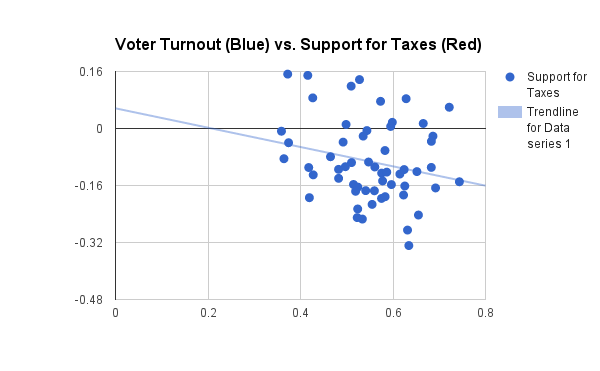
It looks like there is a “slight” correlation (in the words of a smarter person that I asked to take a look at the numbers for me):

This chart is not mine (that smarter person did it), but I did collect the data:

So, if you’re a local political group that is interested in progressive politics, changing city hall and increasing participation in local elections (like Olympia for All, amiright?) these precincts that ranked both high in tax support and low in local voter turnout would be your main targets, right?

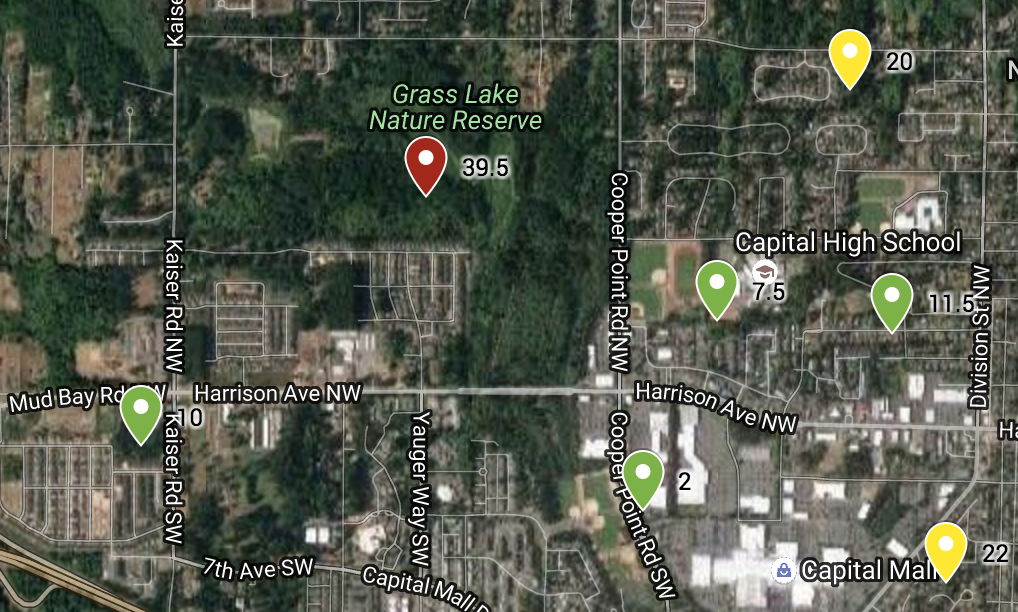
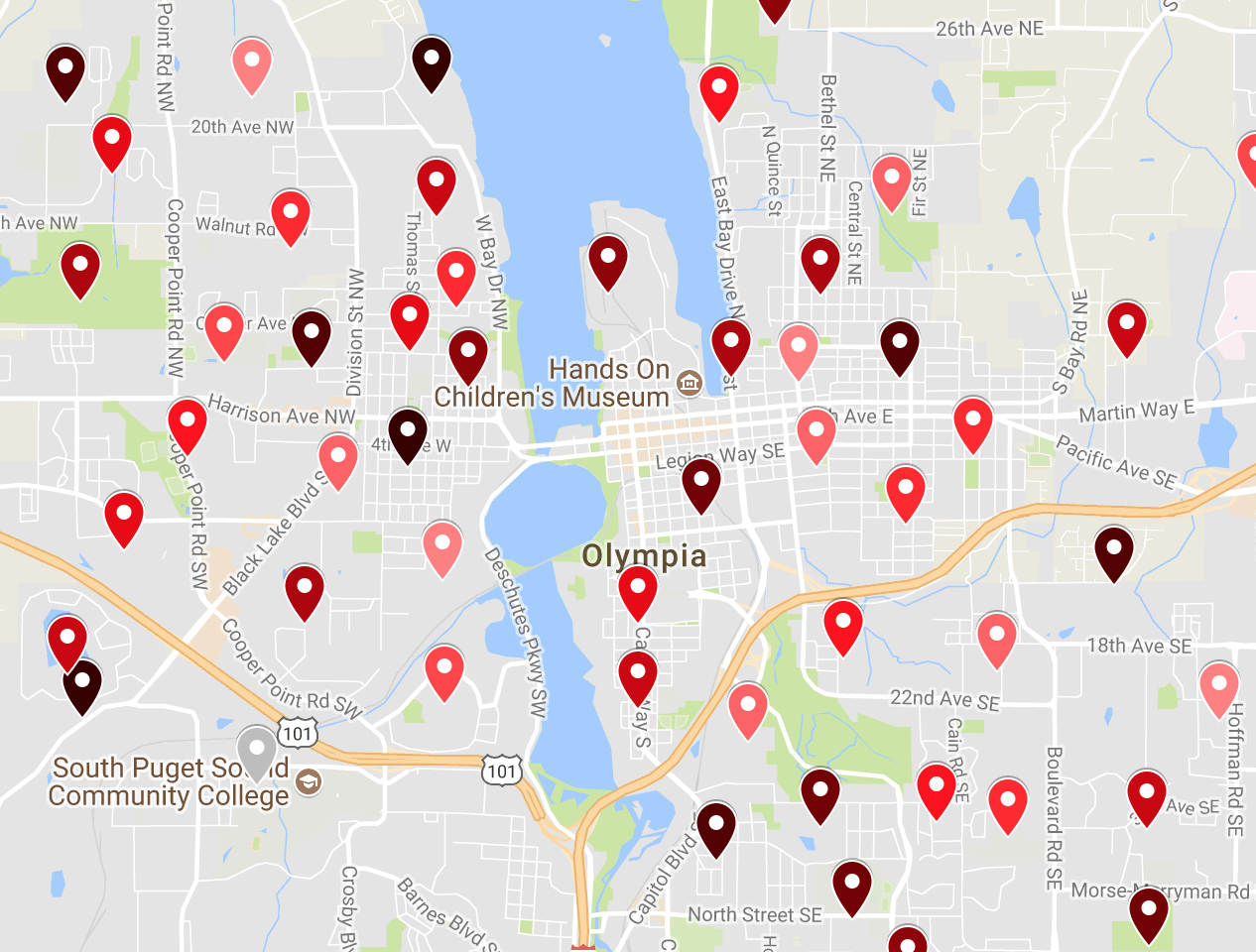
In the map below, I categorized the neighborhoods, combining their rank in voter turnout with tax support, and came up with four categories. Green is the best, then yellow, orange and red.

Except for downtown, this is a very interesting map to me. Southeast Olympia as a broad swath of orange, that’s not surprising at all. That’s where you’d expect higher turnout and a lot of side-eying of progressive ideas.

But, the green neighborhoods are fascinating. They’re mostly newer, non-walkable and high density neighborhoods on the edge of Olympia.  There is a large collection of them along Harrison Avenue west of division and the most of the ones on the east side are east of South Bay Road.

And, a lot of the typical close-in, very walkable neighborhoods rank very poorly. And, this isn’t just because they retain participation in local elections. If you go back to the Opportunity for Olympia map, you see less support for the local property tax.

There is opportunity out there, but it’s among the newer apartment buildings and neighborhoods on the edges of town.

Drive-throughs are worth it if it means doing something in Briggs Village

Something is better than nothing at all and we’ve been waiting a really long time.

Update (11/22/16 (9:22 a.m.): the planning commission voted in favor of the amendment to allow drive-throughs last night.

Last night the Olympia planning commission held a public hearing on allowing drive throughs inside the commercial portion of the Briggs Urban Village. Long the dream of walkability and livability in the SE Olympia sprawl, Briggs has been an urban village in name only. It has been a moderate mix of mixed density housing. But even there, the real diversity of single family homes and high density apartments are kept well separated. Lots of great townhouses though. That’s a plus.

Anyway, lacking a core tenant like a grocery store in the commercial core of the neighborhood/development, the idea to encourage smaller junior anchor tenants was put forward. Ralph’s Thriftway was supposed to move in at some point, but apparently that plan has fallen off the table. So, these kind of tenants would be drugs stores or coffee shops. In our case, Bartels or Starbucks.

But these folks need drive throughs. From a letter written (pdf) by the commercial broker currently selling Briggs Village locations:

As part of our efforts to attract junior anchor retail tenants, we have had several conversations
with representatives of Starbucks and Bartell Drugs. Starbucks has had an interest in the site for
quite some time, but the company will not consider new locations without a drive-through, especially in suburban areas.

While Briggs is an “Urban Village” under City of Olympia
regulations, as a practical matter it remains a suburban site
for purposes of retail site selection
criteria.
An anchor tenant with wide brand recognition like Starbucks or Bartell Drugs would draw other
brands and businesses such as restaurants and service oriented businesses, as well as
professional office tenants. The variety of such a tenant mix will create synergy thus attracting
customers. 

Essentially, you can put an urban village inside a suburban sprawl, but that doesn’t mean the suburban sprawl will suddenly be urban. Southeast Olympia is the least walkable part of town. To get anything done, short of going to school or maybe a park, you need to drive. There is a YMCA down here, but unless you’re literally me or my immediate neighbors, you’re probably going to drive there too. Also, you’re likely to use a vehicle to get to school or the park. Just saying.

Also, this is not a lecture on the value of walkability. You can find that elsewhere.

So, while Briggs without coffee shop or drugstore drive throughs would be nice, in the current reality, we’re never going to get a real urban village with houses, townhomes, apartments and commercial development without them.

But, we should still work to infill and rethink the entire landscape of SE Olympia to make it more walkable and more diverse, we should do that too. But, that is a much bigger piece of work. Maybe some day, we’ll abandon the drive throughs.

An Olympia for all who want to vote. And, where they don’t vote

From Ray Guerra via Facebook:

Olympia for All is a great idea. A non-partisan slate of candidates pushing progressive ideas will at least make this year’s city campaigns interesting. At best, we’ll be able to push the city council to be much more engaged about deep civic issues than they’ve been willing to be in recent years.

But, the “for all” language got me thinking. Specifically, in the “if you don’t vote,  you don’t matter” sort of way. Because while we’d like to think all elections are the results of a uniformly involved citizenry, they are certainly not. And, this is especially true in low profile city-wide elections.

So, here are the neighborhoods that drop off when Olympia votes on its own leaders (darker blue, more voters):

Basically, the westside generally doesn’t show up and the far east towards Lacey doesn’t engage. The only part of Olympia that really matters is South Capitol, down across the highway and then north of Ward Lake.

Usually local campaigns try to focus on these sorts of neighborhoods (at least in my experience). And, within precincts, they try to focus their attention on activating voters that have already shown a likelihood of voting and voting the right way.

In this way, if Olympia for All is a typical campaign, it won’t really be “for all” because it will need to lean on dependable voters. But, if they are more about Everyone, they’ll head out to the light colored dots and try to boost turnout.

If you want to win an election in Olympia, get either a Lacey city-councilmember or an out of towner to contribute to your campaign

So, if you took a list of contributors of the last two rounds of successful city council elections, what kind of list would you come up with?

Well, something like this. These are the 15 people (or unions) that contributed to more than half the successful council campaigns in the last two cycles:
Contributor


Cynthia Pratt
Campaigns contributed to
7
Christine Garst 7
Sandra Romero 6
Emily Ray 6
Joyce Kilmer 6
Kris Goddard 6
Mary Wilkinson 5
WA FED OF ST EMPLOYEES LOCAL 443 5
Karen Valenzuela 5
Sarah Segall 5
OLYMPIA FIREFIGHTERS IAFF LOCAL 468 5
Walt Jorgenson 5
Jewel Goddard 5
Mark Dahlen 5
Judy Bardin 5

Here is the entire list, plus a few other spreadsheets to show you how I got there.

And, while Chris Garst lives outside of Olympia, it is pretty just outside Olympia. And, Chris is really good people. So, don’t get me wrong with that headline. Chris Garst is good.

This isn’t a list of who contributed the most money, but rather a list of who contributed to the most successful campaigns for city councils. I didn’t take a close look at the contribution totals, so many on this top 15 list may have contributed little compared to someone who maxed out on one candidate.

But, by a certain measure, these people are more influential than a theoretical single candidate max contributor. In addition to their financial support, every single one of these folks or organizations gave their personal time and civic reputation to the candidate.

Some additional thoughts:

  • I’m surprised by the number of elected officials, public officials, former and current. This includes Pratt (Lacey city council), Romero, Valenzuela (Thurston County commission), Walt Jorgenson (former Tumwater city council) and Judy Bardin (Olympia planning commission). Joyce Kilmer, the wife of Olympia city council member (and mayor) Steve Buxbaum is in there too.
  • Only one of the locals that has contributed to the most campaigns is a union bargannign unit that deal directly with the city. While the IAFF Local 468 contributed to five campaigns,  the other seven are not on the list. The only other union in the top 15 is a state employee union.
  • Judy Bardin is on the list, and seems uniquely poised to make a run for council, which she recently announced.

Why one issue elections are the dark side of local politics

Karen Veldheer signed to put R-71 on the ballot, to overturn same sex domestic partnerships in Washington State. But, when talking about equal rights during her city council campaign, she failed to mention this.

I was thinking about five years ago in Olympia recently. At the time I was posting a lot about Karen Veldheer’s candidacy, and some other folks were responding:

I hope you can look past a candidate’s religion, and not stereotype
conservative Christians as a people unable to accept or respect
homosexuals, or uphold legislation or benefits that aid others who hold
differing beliefs.

During campaign, Veldheer clarified in a closley phrased manner that even then seemed to contradic. someone that signed an R-71 petition:

I support the city policy for equal benefits for same sex domestic
partners.  I am a member of the orthodox Presbyterian church and my
religious faith will have no bearing on the decisions I will make as a
civic leader on the Olympia city council.  I believe in a separation of
Church and State.  Further, the state of Washington provides over 200
civil rights, many of which are very important to the Gay, Lesbian,
Bisexual and Transgendered communities, and I support these laws as
well. 

 But, she was willing to work towards overturning one of those rights.

Anyway, Veldeer lost that November to Karen Rogers who maybe even better embodies what I’m actually trying to write about. That when politics of a community are narrowed down to a single issue, you get really crappy politics.

2009 in Olympia politics was all about development on a strip of land downtown called the isthmus (its really an urbanized earthen dam, but who’s really counting?). Even the secondary issue of council relations with the public was also about the isthmus, because some in the public thought they weren’t being listened to.

Both Karen Rogers and Karen Veldheer came from the side of town politics that were hard against the isthmus development and thought the council was being pretty tin-eared. But, Veldheer would have been an odd fit in Olympia politics had she won or continued being involved. And, Karen Rogers really did end up being an odd fit.

As she settled into her seat, Rogers eventually became the lone vote against any sort of government activism. Its hard to think that Olympia had elected a small government, fiscal conservative, but there she was. The fog of the isthmus issue had obscured Rogers’ politics.

Too the point that when she ran for county commissioner, Rogers sometimes acted more conservative than the Republican:

Her initial campaign spin for county commission builds common cause with conservatives and south county residents. In an interview with Janine Unsoeld,
Rogers even played up how STOP Thurston organizers thanked her for a
city council vote. While this may disturb lefties who supported her
mayoral run, pivoting to the right makes electoral sense because that
could discourage a Republican candidate from entering the race. Rogers’
chances increase from iffy to decent if she doesn’t have to run against
both Wolfe and a Republican candidate in a primary.

Then again, some described Rogers  then (where libertarian left and right meet) the same way I described Sue Gunn here. And, Gunn did pretty well in Olympia against a typical business friendly Democrat.

That said, I still think local elections are better when they’re broader than one issue, one building or what we should do on one single block. We elected local politicians to do a lot of things. And, with the collapse of the economy in 2008 and the quick council action, it didn’t take long for any development in downtown to disappear.  We still expect these people to govern well outside of hot button issues.

Look at this cool thing, you can embed city of Olympia council meetings now

I’m mostly posting this because I think its exciting that the city of Olympia’s vendor finally caught up and now allows you to not only embed city council videos, but choose where you want the video to start. This is something little old TVW has been doing for a couple of years now, but I’m glad the vendor folks have caught up.

For some reason, this embedding thing seems to be working here and not over at Olyblog, which is a shame, because I think there will be more people interested in watching these clips over there.

And, if you’re really interested in this particular topic, read Janine Gate’s blog. She’s good.


Get Microsoft Silverlight

Anti-Tim Sheldon bill would make Joe Hyer choose a position

While SB 6588 (pdf warning is aimed at Mason County commissioner/State Senator Tim Sheldon, it would also force Joe Hyer to choose to be a city council member or county treasurer.

Hyer, who sits on the Olympia city council, is also running for county treasurer. He also might be applying to temporarily fill the position that is already being vacated by the sitting treasurer.

The proposed bill does have some built in wiggle room:

Any elected official holding two positions prior to this bill’s effective date may continue to serve out the remainder of each term. At the expiration of each term, that elected official may subsequently only hold one elected office at a time.

So, if the law becomes effective this summer, Hyer is appointed to fill out the remainder of the open treasurer term and is elected in November, it sounds like he’d need to resign the city council soon after that.

« Older posts Newer posts »

© 2026 Olympia Time

Theme by Anders NorenUp ↑