History, politics, people of Oly WA

Author: Emmett O'Connell (Page 52 of 176)

Occupy Little Hollywood

Another look back at the historic space being occupied in time and theme by Occupy Olympia, given the commentary by Ken Balsley and the news this morning.

Ken acknowledges the historic parallels between the Occupy camp and Little Hollywood, and even gives a short history of the end of the shack-town:

Some 80 years ago, Capitol Lake was the home to a similar type of resident. Shanties and shacks lined the shores of lower Budd Inlet, as the area now known as Capitol Lake was called. These hovels were known by the collective name of “Little Hollywood”. For years those living in the area were allowed to exist, but eventually, authorities moved in moved out the residents and burned down the shacks.

His history doesn’t contradict the closer details, but his telling is a bit more tame than histories written closer to the closure of Little Hollywood. From “Rogues, Buffoons and Statesmen” by Gordon Newell:

It was felt, unless the outbreak of war interfered, the long discussed Capitol Lake would soon become a reality and the city father decided, as a preliminary step, to eliminate Little Hollywood from the shores of the Deschutes waterway along the Northern Pacific railyard.

The capture of two kidnapper-rapists of the town’s last sensational crime in one of Little Hollywood’s shacks had given the place a bad name and it was undeniably a civic eyesore. The residents were, in fact, mostly decent poor and elderly people trying to hold onto the last of their independence. Most had bough their shoreside shacks and floathouses from previous owners from $10 to $50. There were about 50 WPA families, 30 old age pensioners and a few direct welfare recipients. some of the more able bodied supported themselves with odd jobs and scavenging. One resident was said to be a formerly prosperous farmer who had lost everything except $50 in the depression. He had spent his remaining fortune on the floathouse he occupied.

The city had been offered federal funds to provide low-cost housing, but Mayor Trullinger didn’t believe in federal handouts. Besides, low rent housing might bring an undesirable class to town… the kind who had the bad tase and judgement to be aged, handicapped, poor or some color other than pure white.

The people of Little Hollywood were served eviction notices and the civic authorities turned a deaf ear to their please for someplace to go. One after another, the shack-town and its occupant surrendered and went away… some to rundown rooming houses, and fleabag hotels, some to other towns. A few of the old age pensioners moved to a modernized version of the old fashioned poor farm which was appearing on the Northwest scene. First euphemistically called “havens for old folks,” they later became “nursing homes.” The proprietors of some of them, then as now, adopted the adage of the poor farm supervisors… “The less you feed ’em the better the profit.”

One after another the shacks and floathouses were burned or demolished and a civic eyesore vanished and was forgotten… just like the people who had been driven from it.

It was listed as one of the proudest accomplishments of Mayor Trullinger’s administration.

From Dean Shacklett’s “Little Hollywood Era In Olympia Recalled”:

…city officials who barely had tolerated Little Hollywood during the worst depression years decided in 1938 that the shacks had to go. The sizable job of carrying out that order was given to W.R. Turner, building inspector.

Turner enlisted the aid of Beale Messinger, city police lieutenant at the time, and the two set to work. First, the ownership of each of the shanties was determined. This was no small job in itself. Then, each of the owners was served with condemnation papers.

As Little Hollywood’s residents were evicted, their shacks were burned. Two years after Turner and Lieutenant Messinger started their chore, the torch was applied to the last shanty.

As Turner recalls, “Some of Little Hollywood’s residents were pretty nice people, but most of them were bums.”

The condemnation proceedings were carried out with a minimum of fuss and fury, the building inspector remembers. “There was one guy who let me inside his shack and then took a swing at me with a two-by-four,” said Turner, “but that only happened once.”

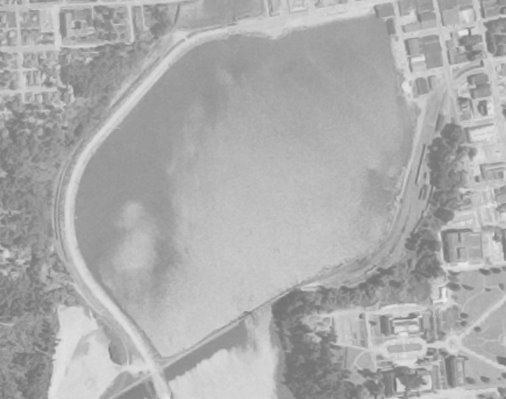
Couple of more points to make, this time with some old aerial photos from USGS’s Earth Explorer.

One, while everyone points out that Little Hollywood was ironically located below the capitol campus, even if the shacktown didn’t exist, the land below the dome would’ve still been unsightly to some. In fact, Little Hollywood likely owed its existence to the location of railyard that Newell refers to.

In this aerial from 1941, you can see fairly well how the railyard lays in between the settlement and Olympia proper.

So, while Little Hollywood itself might have been seen as a civic eyesore, it was the industrial use of the Deschutes waterway and poverty in general that put it where it was. Is it any wonder that the real modern version of Little Hollywood has been moved permanently to an industrial park? Even as late at 1957, we see Capitol Lake, lakeside industrial buildings and a fully functional rail yard.

It wasn’t until 1964 that any sort of park was built on Capitol Lake, and when it was, it only occupied a small corner.

Occupy Olympia, Little Hollywood and 1933 at Priest Point

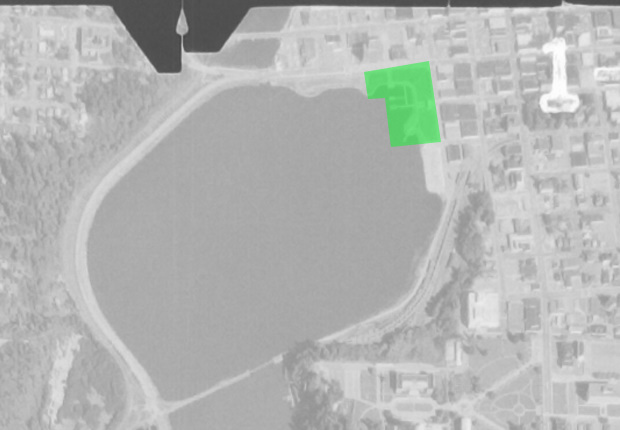
Little Hollywood in the late 1930s (from here) overlaid with Occupy Olympia (from here). Click on image for larger version:

Since Occupy Olympia moved down to Heritage Park, I’ve been reminded about how fitting the location is for them. Before Capitol Lake, that particular place was home to Little Hollywood, Olympia’s depression era shacktown. It was probably the most visible evidence of the Great Depression in town.

Slog also reminded me of the 1933 Hunger March, an important event in Olympia history. It should be remembered at least for the violence brought down upon the marchers by locals:

In March of 1933 several demonstrators from Seattle organized a march in which they demanded food relief for the unemployed. Once the marchers reached East bay Drive they were met by the police and vigilantes calling themselves the American vigilantes. Both the vigilantes and the police surrounded the marchers pushing them back to Priest Point Park. Once the marchers were in the park their attackers used broom handles to beat the marchers into ending their march. The attacker’s actions made sure the second march never reached the Capitol Building. All though the second march failed to generate legal changes the march altered the way history is told.

Little Hollywood and the Hunger Marches of 1933 are two important aspects of Olympia’s past that is commonly misrepresented. The Thurston County website claims that the Hunger March of 1933 was a protest of 5,000 out-of-work men who threatened to take over the Capitol building and according to the Daily Olympian “terrorize the town.” Sheriff Havens and his Deputies meet the unruly group with a cadre of deputized citizens.

There is no mention of the corralling of the marchers nor is there any evidence that the protestors aimed to be violent. This is the accepted history of Thurston County, not the accepted history of many historians. The importance of Olympia’s past is not being represented and we must not let those who suffered be forgotten. As a lifelong resident my call to action is clear. I must not only tell Olympia’s past but I must urge others in supporting a historical revolution.

Hello to Olympia Views, bye to Jim Anderson and a few other Olympia blogs of note

One of the best local blogs to come along in awhile is Olympia Views.  I’m not sure if the blogger is trying to hide their identity, but I if not I haven’t been able to find out who is writing it.

My favorite post so far is this one on the possible impact of a Republican governor on Olympia:

This is a story that — at least in Thurston County — should not wait until the election season heats up next fall. Part of McKenna’s platform is governmental reform. The candidate is fairly vague on what that means, but at the very least one can anticipate that an entire generation of managers who have gotten comfortable working for a succession of Democratic governors may worry about finding themselves out of a job.

You also have to love a blogger that puts so much thought picking up my thread on a new library in Olympia.

On the other hand, its sad to see local blogging great Jim Anderson of decrobilia bow out. In addition to decrobilia, Jim also wrote the great 5/17 blog, probably the best education blog I’ve ever read.

There are a few other newish blogs worth mentioning: OlyEats and Purehunger (a local food blogs that are actually updated every so often) and Bibliosnack (a local librarian vlogs and blogs book reviews).

Why living in a college town is awesome (because we get Olympia Winter Nights)

I’m not saying this is most awesome thing in the world, but its pretty darn awesome and this is the sort of thing we get because we live in a town with a pretty darn good college.

Olympia Winter Nights, a concert series put on last year at Evergreen that I really hope will be coming back:

Olympia Winter Nights is a live concert series created and produced by the 2010/2011 media interns of The Evergreen State College. …Olympia Winter Nights will be an intimate listening and viewing experience for those attending the in-studio performances. Additionally, the concerts will be viewable by the entire world via a live stream on the internet!

Inspiration for this concert series comes from the long running PBS broadcast “Austin City Limits”, the 1990’s MTV broadcasts of “MTV unplugged” and the recent in-studio broadcasts of KEXP radio “Live on KEXP”. The artists to perform in this concert series will be drawn largely from the rich community of local talent. In true Evergreen State College tradition, Olympia Winter Nights will be complemented with experimental lighting techniques and infused with imaginative, real time MAX/MSP/JITTER light projections. A truly Olympian concert experience!

I especially like the opening, it really reminds me of Olympia and our winter season. Makes me think of home.

Also, in the tradition of things I like, Olympia Winter Nights posted up a free Season 1 compilation album. And, damn, you have to love that theme music.

Its like audio oyster light.

Making up for history

Tacoma expelled Chinese residents in 1885, so Tacoma dedicates a park and a Ting:

“This has been a long, long time in coming,” said Gregory Youtz, who chairs the Tacoma-Fuzhou Sister City Committee and emceed the event. “We hope this helps Tacoma tell its story to the world.”

“This will become an icon in the community,” project manager Lihuang Wung said. “This is where people can get together, get married, think about our history and think about the future of our community.”

Lewis and Clark stole a canoe, so the decedents of Captain William Clark gave one back:

More than 200 years later, William Clark’s descendants will make amends by presenting a 36-foot replica of the canoe to the Chinook Indian Nation during a ceremony here Saturday.

“We talked about what happened 205 years ago, and we believed that things could be restored if something like this were done,” said Carlota Clark Holton of St. Louis, Mo., seven generations removed from William Clark.

“I think everyone acknowledges that it was wrong, and we wanted to right a wrong,” she said. “The family was very much behind it.”

And, of course, we put Leschi on trial again and exonerated him:

The reason it is so important to exonerate Chief Leschi is for the multiple generations of tribal ancestors who have lived a lifetime with the frustration and anger of knowing what happened to the last Chief of Nisqually.

I like this idea of returning to history, pulling back how the people came before us acted, and attempting to recognize and repair. Its a short-sighted point of view to say that none of us alive today were responsible for expelling the Chinese, stealing a canoe or killing Leschi, so why should we go through the process of honoring the better choices our ancestors could have made?

We do because history matters and its worth pointing out in a very deliberate (a ceremony or historic trial) and long lasting (a park) manner that something bad happened and we’d like not to repeat it.

That said, Olympia has some very dark acts near our founding that we should deal with. Olympia in the 1850s wasn’t a very nice place at all:

Also worth noting is that Thurston County was named for a person who once said this:

[It] is a question of life or death to us in Oregon. The negroes associate with the Indians and intermarry, and, if their free ingress is encouraged or allowed, there would a relationship spring up between them and the different tribes, and a mixed race would ensure inimical to the whites; and the Indians being led on by the negro who is better acquainted with the customs, language, and manners of the whites, than the Indian, these savages would become much more formidable than they otherwise would, and long bloody wars would be the fruits of the comingling of the races. It is the principle of self preservation that justifies the actions of the Oregon legislature.

King County changed its name to elegantly avoid being named for a historic racist, might be worth an effort in Olympia.

I know I don’t live in Tumwater, but why does the Post Office think I do? And, what can I do about it?

I live on the yellow side of the line:

Since we moved a few miles last year, I’ve noticed that there seems to be some confusion about which city I now live in. Not confusion by me, but by the U.S. Post office. Its kind of annoying to get junk mail labeled with my address as being in Tumwater, but I know that it really doesn’t matter. If someone addresses something to me in Olympia, it’ll get to me no problem.

The problem has become when we contact the city over something, we have to first clear up where we actually live. Apparently because the post office thinks I’m in Tumwater, Olympia isn’t always convinced which side of the line we’re on.

Last year I emailed the city about an erosion problem on a nearby construction site and I had to email them a screenshot like the one above to clear it up. Now, a neighbor is being told she needs to register their home business in Tumwater.

Briggs Village is very much part of Olympia (heck we’re in the municipal code).

So, how does one get the post office to change their mind about what city you live in?

Where Quiemuth was murdered in Olympia and why it doesn’t really matter because we still need to deal with Bunting

The last few years I’ve been strangely fascinated with finding out where in Olympia Quiemuth was murdered. I mostly wanted to find out because I think its an under heard story in Olympia, especially the reaction of our citizens that lead to the murderer getting off.

Drew Crooks will present his findings on probably the same topic (at least the location) next week, so now’s a good as time as any to put out what I found. In short, I probably disagree with Drew about where Quiemuth died.

There are a few resources that firmly pin the location at the old Stevens house on the Capitol Campus (this one and Rogues, Buffoons and Statesmen), but I think they’re mistaken.

The more I’ve plugged into this Quiemuth topic, the more I find the history of the area a lot darker than what is commonly known. When I read Mighty Mountain, it seemed that Binns was making dramatic statements about how some folks were back then. But, now, it almost seems like he was pulling his punches.

There was a least a minority of people for whom killing Indians was not a big deal, or at least part of why they came West. The rest, while they did complain a bit, did very little to bring the murderers to justice.

Read Sarah’s Olympia 1853 and my Murders in Thurston County, 1854 to 1857 for more context, but killing Indians was a majority of crime in our early days.

In terms of Quiemuth, it all started out with trying to find where exactly in Olympia he died, with the the intent of possibly memorializing his murder. There are two possible options from my
research.

These clips (One, Two and Three) put the murder either at Gov. Stevens’ first offices where the Olympia Center is now or at his newly constructed house on the NE corner of the Capitol Campus. Because of references to an alley way in clip 4, I tend to think its the original offices references in clip 1.

Also, the timeline moves very quickly in terms of where Stevens’ and his family lived and when Quiemuth was killed. The murder occurred on November 19 and the family moved into the new house in December. Makes me think it is very unlikely the family would move so quickly into a house that was the scene of a violent murder.

Also, interesting enough, there is no mention by Hazard Stevens in his biography of his father there is no mention of Quiemuth being brought to the new (or under construction) house. There was obviously an office in the house at some point, but its more likely its the offices referred to in clip 1.

Then, I got onto the topic of who killed Quiemuth. There is a lot of thought that Joeseph Bunting was obviously the killer, but that the political sentiment in Olympia led him to get off. Bunting, though, was not done after Quiemuth. These clips (Five, Six, Seven) tell the story of a later murder by Bunting and family. Clip 8 fingers Bunting years later as Quiemuth’s murderer, without any hint of controversy.

No direct evidence, but its pretty clear that if Bunting isn’t our man, someone like him was. And, Olympia at the time failed to turn him in.

So, in my mind, a few questions remain. Where did Quiemuth die (hopefully we can figure this one out) and do we memorialize where he died?

And, does Olympia owe anything for Bunting? In memorializing Quiemuth, should we take the blame for our city not turning in the murderer?

What’s going on with a home rule charter in Thurston County right now

Last year, the Thurston County League of Women Voters updated their historic study on county-wide governance and made the case for a more responsive and financially stable county government through a home rule charter. The study is worth the read, by the way.

More recently, a group formed around the league started getting together to talk about the possibility of a home rule charter campaign. Here are the notes from their April meeting. While the notes indicate they were meeting again, no other meeting notes or notices are available.

The local Sustainability Roundtable seems to involved, making some moves in this direction as well. Here is a proposed position paper on local governance, which builds off the effort by the league.

Here is a version of the notes above from the April meeting, but with more references on the back end.

Here is where the roundtable will be putting their sustainable governance information.

So, it seems there is a new born effort between the League of Women Voters and the Sustainable Roundtable to create a home rule campaign. Nothing since the April meeting has happened, but I’m still poking around, seeing what I can find.

« Older posts Newer posts »

© 2026 Olympia Time

Theme by Anders NorenUp ↑