Two videos that perfectly contrast Olympia vs. Portland.
Both cities care enough about the waste stream management to make fun of it, but Olympia’s version is more hyper and homespun.
History, politics, people of Oly WA
Two videos that perfectly contrast Olympia vs. Portland.
Both cities care enough about the waste stream management to make fun of it, but Olympia’s version is more hyper and homespun.
Both Olympia and Lacey have at least one planning commissioner blogging about public issues. That’s where similarities diverge. For example, take the posts from each on December 5, 2011.
Lacey’s Raymond Payne: Politicians Should Be Honest About New Norm:
Our politicians continue to sock it to us with higher taxes and fees, then still expect us to go out and spend. Spend what? We saw that during the LFD 3 levy lid lift request. Supporters said, “you can give up that latte to pay for this added tax.” Maybe they drinking a Latte a day, but most people don’t.
Olympia’s Mark Derricott: OPC: December 5, 2011 Regular Meeting Agenda:
The major item is the Shoreline Master Program with the setbacks and potentially heights along the shoreline as presribed in the draft chapters of 5 and 6 of the SMP. Most of the deliberation will be comprise a vote on setback limits that did not result in consensus in the previous SMP Subcommittee meetings.<
Whereas both cover public issues, Derricott’s posts almost rabidly focus solely on his role as a planning commissioner (sometimes in very deep detail). Payne has almost never talked about the planning commission, and as of tonight, never actually talked about the business of the Lacey planning commission.
Just on the face, Derricott is the planning commissioner who blogs while Payne is the local political blogger who is also a planning commissioner.
Welcome to Olympia kind legislature, crafty lobbyist, wise reporter, diligent blogger and temporary Olympia-area resident during legislative session,
Here is your handy guide to keeping me calm for the next 60 days or so. First, here’s your new word of the day: metonymy.
You’ve seen metonymy used before, even if you are unfamiliar with the term. Here’s a short definition:
Metonymy is a figure of speech used in rhetoric in which a thing or concept is not called by its own name, but by the name of something intimately associated with that thing or concept.
More on the actual mechanics of the word metonymy later, but first just a simple request. While you’re here in town, please do not say or write “Olympia,” when what you really mean is “state government,” “the state legislature,” “governor’s office,” or “legislative leadership.”
1. Why this is a bad idea (for liberals, conservatives and reporters)
I understand metonymy, probably more than most people should. I understand the purpose of using a specific term for a broad topic, like “press” for the “news media,” especially in a time when there are fewer and fewer “presses” in the “news media.”
But, the use of Olympia for “state government” or “state legislature” is a hugely inaccurate and damaging
metonymy, because it misstates the nature of our government.
Because we elect our representatives from proportional districts, most of the people who serve in the state
legislature come from the urban Puget Sound (not unlike the makeup of the Senate Transportation Committee). So in this example, its more like the urban Puget Sound telling Seattle to “drop dead.”
I don’t have a problem with language short cuts. I have a problem with language short cuts that are dangerous.
You see, I read a lot of political stuff and I keep an eye out for metonnymic uses of Olympia (or people
who I know do so for me now). And, I’ve seen a lot more liberals use Olympia to mean the state government or the state legislature than conservatives.
Might just speak to my reading list which has a lot more liberal outlets than conservative, but I don’t avoid right wing blogs and sources by any means. It just surprises me any time I hear a liberal use the metonymic Olympia.
And, this is why it surprises me and I think its dangerous: It gets back to the othering of government. That if your state government is “Olympia,” some distant crap-ass place where crazy people make decisions for you, you really aren’t to blame for what’s going on.
But, if Olympia is just another town, and the state legislature is made up of locally elected folks and the governor is elected by a statewide popular election, then we’re all to blame for what goes on inside our government.
Conservatives like othering government because they don’t trust government and don’t want it to work. You’d think liberals would be of a different mind.
But, it isn’t “those in Olympia” and it isn’t “Olympia’s” anything. Legislators are elected from communities all over Washington State.
While they may work in Olympia from time to time, they still come from places not near Olympia.
Calling the state legislator down the road from you as being “from Olympia” or part of “Olympia” makes
them a distant other that has little connection to you or your community. Which isn’t true.
2. You think I care about Olympia? Look what happens when you try to use Oly as a world to mean “state government”
I get all Oly-er than though:
Olympia is the capital of the state of Washington, identifiable on maps in classrooms and travel lodges nationwide. It is a city that every elementary school kid memorizes (do they still do that?) as a state capital of a state near the end of the list of states. It was the first state capital and through a hard fight with Yakima and Ellensburg, stayed the state capital. Now we have fancy greek type buildings on a hill. It is home to state agencies, even the ones that are in Tacoma. And, for a couple months or so every winter, we’re home to folks like Josh Feit, though we actually try hard to ignore them.
3. So Emmett, I agree with you. Your minor pet peeve is a horrible, horrible thing. How can I reform myself?
You’re in luck. Here are some tips on how to say Olympia in the context of Washington State government without being a bad person.
There are ways to the use of Olympia in regards to state government that is not metonymy.
Basically, the rule is you’re safe if you are saying “in Olympia” and not “Olympia did this.” So, if you’re making a geographic distinction, you’re fine.
For example, Sen. Steve Hobbs (of some place up north I guess):
I fought hard to carry out the wishes of my district,” Hobbs said. “When we come to a consensus as a community, I am able to carry our message to Olympia and work for the necessary results.
Sen. Hobbs’ example is great because he even cites “my district” and “to Olympia,” making the obvious point that although he works “in Olympia” for a few months a year, he is actually from somewhere else in Washington. This is often something missed or fuzzed over when Olympia is metonymized.
And, an update from Rep.Reuven Carlyle at MyBallard. The headline states “from Olympia.” The report
itself says things like “in Olympia” and “visitors to Olympia.”
Of course the trains leaves the tracks in the comment thread below when a commenter says “people in Ballard are compassionate and will enjoy giving their money to Olympia.”
God, don’t I wish.
In the business, they’ve called the new 10th CD the Denny Heck district, but I’m thinking Alex Hays might be more right. It could also be the Dick Muri district:
Muri is a Pierce County Council member who lost handily to Smith last year, but his campaign chairman Alex Hays said the 10th – which ranges from Shelton to Olympia, Lacey, Tumwater and then north to Lakewood, Sumner and University Place – favors Muri.
“They think they’ve drawn a Denny Heck district but they’ve accidentally drawn the perfect Dick Muri district. It’s roughly two-thirds in Pierce County and he’s a Pierce County councilman …” Hays said by telephone. “Even against Adam Smith who outspent Dick by [five] to one, he prevailed in Pierce County … The voters in the county have a really positive view of Dick Muri.’’
Last time around, Muri actually beat Adam Smith in the Pierce County portions of the old 9th CD.
On the Thurston County side both Democrats (Smith and Heck) did much better, but there are fewer votes to share on that side of the map. Also, there are some precincts that were in play in 2010 that won’t be in play this year. I’d be interested in seeing a precinct by precinct breakdown, comparing 2010 Heck with 2010 Muri in the new 10 CD districts.
Months ago I read “Patchwork Nation,” one of those books that takes a long swipe at American Politics and creates an alternative to the Red vs. Blue model. I think it did a pretty good job, until I flipped forward to where it put Thurston County.
Instead of putting my home county in Campus and Careers (state capitol, four year college, Arts Walk, Procession, come on!) the authors put us in Military Bastions. Fort Lewis is nextdoor and militarily folks do live around here, but it just didn’t resonate with me.
Huh, I thought. Well, they’re model falls apart there, I’ll quit reading this book
But, now that I take a closer look at the map of our new congressional district, I think they might have hit something I didn’t see until now. Earlier I said that the new 10th CD will center on the Pierce County suburbs. But, now I think it’ll center on Joint Base Fort Lewis McCord.
While the early scuttlebut is that the district is centered on Olympia, the nature of the district will be that of a military base town. Let’s take a closer look.
Here’s a map where I split the district into two parts.
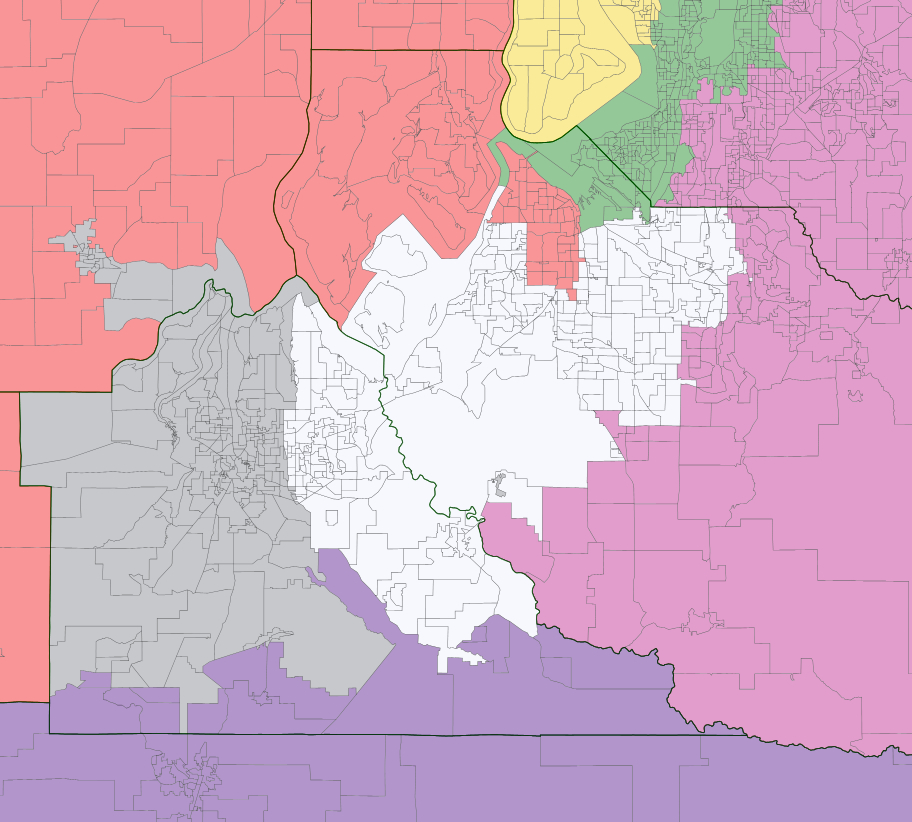
Basically, the gray area is the Olympia influenced side (hippies, state government). The white side is the Fort Lewis influenced side. I did allow for a lot of cross over into Thurston County, but I’m pretty sure that’s accurate.
The Olympia influenced side is 59.4 Democratic (from the 2010 Senate race) and is pretty small, only 148,000 of the more than 600,000 in the district.
The JBLM side is much much larger (521k) and only barely Democratic at 50.3 percent.
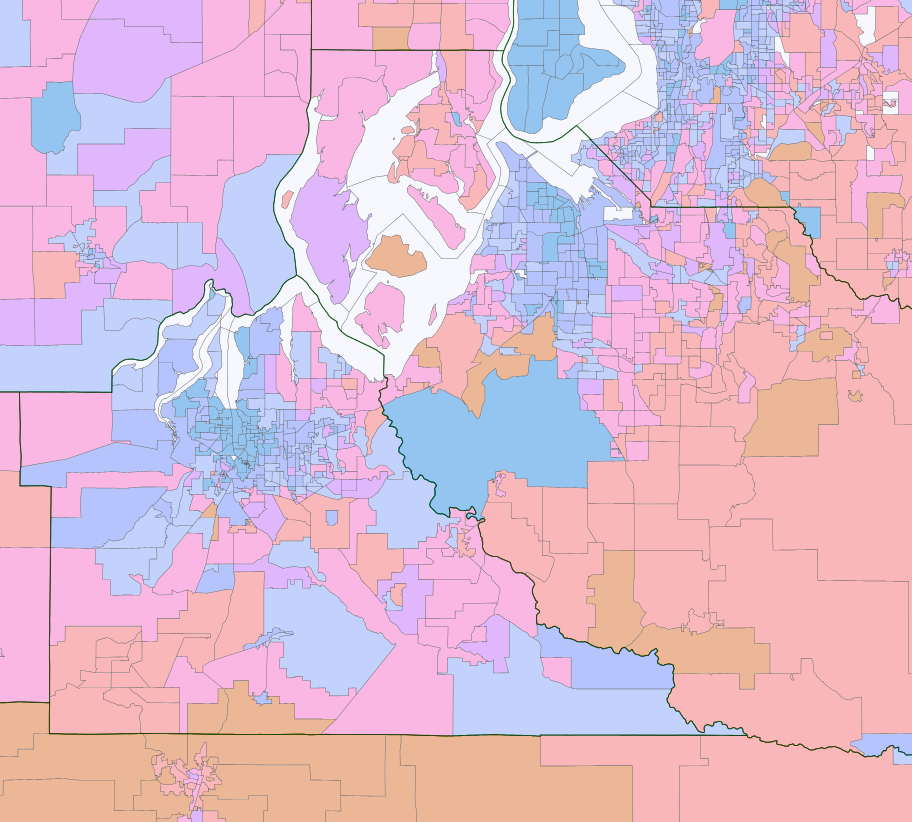
Here’s a map of the district by how it voted in the last Senate election. The deeper the blue, more Democratic, the more red, Republican.
As you go down Capitol Way, before it turns slightly to the left into Tumwater is renamed Capitol Boulevard, it almost seems like it could continue straight. That little spur of a very wide street is actually a continuation of Capitol Way. It continues for just over a block and then just stops.
I’ve wondered why that road was as wide and significant seeming as the main drag, if it just served a few homes and ended. It was possible that at one point, that had been the main drag.
Here’s the intersection I’m talking about:
In the 1930s, the Capitol Way to Tumwater route was significantly different. In the Sanborn Map below (via TRL) you can see how the old neighborhood was configured, with one of the numbered cross streets jogging over further south and connecting with Tumwater.

Here you can see it in greater detail with the current arrangement.

Just catching up on things. I marked tons that aren’t getting in this time around
1. Great youtube video from jopomojo of the old Olympic Skate Park, that closed in 1982.
2. Walt Jorgenson filmed a lot of holiday light displays over Christmas. The best part is the Oly liberal chatter in the background.
By the way, “liberal” to me is not a perjorative. I just found the chatter entertaining.
3. Tobi Vail over at jigsaw is featuring a lot of Top lists recently. Two of the best are by some of our local librarians, Sara and Kelsey.
4. Campfire Island has a top 5 list as well.
5. Janine’s Little Hollywood had been one of the best news blogs in town for awhile there. She went blog silent in May and recently updated the blog to explain why. Lots of work and getting married are good reasons!
6. Logo update for the Food Co-Op.
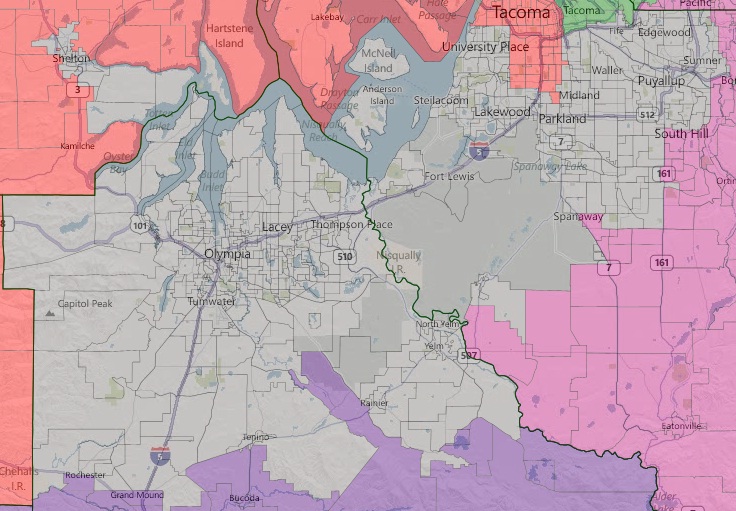
Despite the observations that Washington’s new 10th Congressional District will be “centered on Olympia,” it actually won’t be.
 |
| The heart of the 10th CD |
And, don’t get me wrong, I am happy to be separate from the almost Oregon that was the 3rd CD, but the one we’re in now is a far cry from being “centered on Olympia.” We’ve just traded one set of noisy rural conservatives for less noisy suburban moderates.
I like that I end up doing this on Friday. Seems like a regular thing almost.
1. A little history from Accidental Initiations 2 of those days in the early part of the last decade. Olympia newly minted as “hippest in the west” and other things:
During the show’s run we sold out The Capitol Theater every night but the impact was even greater than that. Like The Spearhead Sound Hours Benefit, The Transfused involved so many people that it felt like the whole town was in on the ritual. There was talk of taking it to Broadway and I am sure if they had, it would have stood a shot at Hedwig-style success. Sadly, like so many Olympia projects, The Transfused and its creators could not contend with the dangers of commercial success, so the production went no further than the city limits, and today it lives on only in the videos from its one production, and in the memories of those who were there. Even more disheartening for me, once the production ended, that sense of inclusion I had enjoyed dissipated and I faded back into the white woodwork of Olympia with most of my former collaborators walking past me on the street without any sense of kinship between us.
There is no actual evidence of this on the internet, but I remember one of the last (or maybe THE last) performances, the cast and audience of The Transfused invaded Lake Fair on an early summer evening and goofed around. Before 9/11, before the Nisqually quake that changed downtown Olympia forever. Boy, those were the days.
2. Yodelling Lama wonders (as do the rest of us) why Fish is the only microbrewery in town. There used to be that racing place in Lacey, but I don’t think that really counted.
3. Alice (@wazzuoly) on her blog writes about the KRS-One show:
This pleasant night on the town taught me an important lesson. Every once in a while, I need to step outside my comfort zone. And I am going to do it. Too often we stay in our own little box, never taking the time to experience something different. It’s sad really. And it has driven this country so far apart.
4. Go Thurston, Sam Garst, environmental protection video:
5. Pretty picture of Grass Lake by Paul T.Marsh from the Olympia flickr pool.
Since the redistricting commission technically still has time, they might as well take it:
Having already surpassed their self-imposed deadline of finishing in November, members of the Washington State Redistricting Commission said there is still more work to do and that a final deal likely wouldn’t come before next week. The commission has an official New Year’s Day deadline, or else the duty is sent to the state Supreme Court.
 |
| Gov. Dan Evans signing the eventual redistricting law in 1965. |
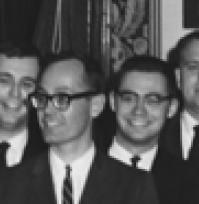 |
| Highlight showing Gorton and Foster looking over his shoulder. |
Both Foster and Gorton were young participants during the contentious 1963 redistricting effort. Gorton was the redistricting leader for the Republicans in the legislature while Foster worked as a vital young staffer for the Democratic leadership.
Late last night I read the portion of the new book on Gorton that covered his role in the 1963 session (a pdf of the book is available free at the Secretary of State’s website):
(Democratic senate leader Bob) Greive consigned the House bill to committee. The sorcerer had a gifted apprentice of his own. Young Dean Foster ran the numbers, tweaked the majority leader’s plan and gave him something to shop around on the
House floor. (Slade) Gorton warned that two could play that game.A lot of people, including some members of his own party, were wary of Slade “because he could just outsmart anybody,” Don Eldridge said. But Greive had way more detractors and clearly had met his match in Gorton. “I tell you, the two of them, that was a combination,” the GOP caucus chairman said. “I’d liked to have been a little mouse in the corner at some of those sessions.” 18 Pritchard said Greive was “Machiavelli on redistricting. He was too smart for everybody . . . until he ran into Gorton,” who “knew every jot, diddle, corner — whatever it was.
Grieve himself had some observations of the 1963 during his own oral history with the Secretary of State’s office. Foster was so important that he would send state patrol cars from Olympia to Bellingham to pick up Foster from college:
Ms. Boswell: Dean Foster has told some humorous stories about you coming to pick him up in Bellingham and sending an escort to get him when you needed him to work. He was still a college student right, during much of it?
Sen. Greive: As I understand it, he was. I don’t think he was going to school while we were in the session, but I’m not sure. The other thing about Foster is that he had a tremendous capacity for work, as did Hayes. In other words, he understood what was important. He understood the question of timing and everything else.
Ms. Boswell: Do you remember sending some state patrolman to get him? Tell me about
that.
Sen. Greive: In those days we had control of the state patrol’s very existence and anything that we wanted that dealt with the Legislature, they were “ours.” They were most accommodating as long as it was something in an official capacity. If the majority leader in the Senate, or the chairman of redistricting or whomever, had something he had to have, they would accommodate you. They did that for a lot of other things. I wasn’t the only one who did it. But I did send the state patrol up to get him and take him down there to Olympia if I needed him. Of course I’d phoned them first and cleared it with them.
I really doubt Foster is getting rides from the state patrol this time around.
 |
| Foster pictured from this 1965 article. |
Its amazing now with the aid of freely available tools like this, that seemingly everyone (including me) can produce their own set of maps. The process this year even included a DIY section for the rest of us. But, almost 50 years ago, the data was so difficult to parse and the politics so divisive (the legislature itself drew the maps), you almost have to wonder why it even takes as long as it does today.
In the end, how did all that effort in the 1960s work out? Well, let’s just say that hopefully we do better this time:
It was unlikely in such a contentious political climate that legislators could come to a decision on a partisan issue like redistricting, and indeed, the regular session closed without any agreement. Governor Albert Rosellini immediately called a special session, but after 23 days, it, too, ended with no redistricting plan.
The Court demanded a speedy solution to the redistricting roadblock, but the order did not guarantee that one would be found. Weary legislators also wanted to establish a redistricting plan as quickly as possible, but knew it had to be acceptable to elected officials as well as the voters.
After forty-seven days of debate, discussion, compromise, and open hostility, the Legislature finally passed a redistricting plan. The measure called for forty-nine senatorial districts, with one member elected from each district, and fifty-six legislative districts

© 2026 Olympia Time
Theme by Anders Noren — Up ↑