History, politics, people of Oly WA

Author: Emmett O'Connell (Page 53 of 177)

Making up for history

Tacoma expelled Chinese residents in 1885, so Tacoma dedicates a park and a Ting:

“This has been a long, long time in coming,” said Gregory Youtz, who chairs the Tacoma-Fuzhou Sister City Committee and emceed the event. “We hope this helps Tacoma tell its story to the world.”

“This will become an icon in the community,” project manager Lihuang Wung said. “This is where people can get together, get married, think about our history and think about the future of our community.”

Lewis and Clark stole a canoe, so the decedents of Captain William Clark gave one back:

More than 200 years later, William Clark’s descendants will make amends by presenting a 36-foot replica of the canoe to the Chinook Indian Nation during a ceremony here Saturday.

“We talked about what happened 205 years ago, and we believed that things could be restored if something like this were done,” said Carlota Clark Holton of St. Louis, Mo., seven generations removed from William Clark.

“I think everyone acknowledges that it was wrong, and we wanted to right a wrong,” she said. “The family was very much behind it.”

And, of course, we put Leschi on trial again and exonerated him:

The reason it is so important to exonerate Chief Leschi is for the multiple generations of tribal ancestors who have lived a lifetime with the frustration and anger of knowing what happened to the last Chief of Nisqually.

I like this idea of returning to history, pulling back how the people came before us acted, and attempting to recognize and repair. Its a short-sighted point of view to say that none of us alive today were responsible for expelling the Chinese, stealing a canoe or killing Leschi, so why should we go through the process of honoring the better choices our ancestors could have made?

We do because history matters and its worth pointing out in a very deliberate (a ceremony or historic trial) and long lasting (a park) manner that something bad happened and we’d like not to repeat it.

That said, Olympia has some very dark acts near our founding that we should deal with. Olympia in the 1850s wasn’t a very nice place at all:

Also worth noting is that Thurston County was named for a person who once said this:

[It] is a question of life or death to us in Oregon. The negroes associate with the Indians and intermarry, and, if their free ingress is encouraged or allowed, there would a relationship spring up between them and the different tribes, and a mixed race would ensure inimical to the whites; and the Indians being led on by the negro who is better acquainted with the customs, language, and manners of the whites, than the Indian, these savages would become much more formidable than they otherwise would, and long bloody wars would be the fruits of the comingling of the races. It is the principle of self preservation that justifies the actions of the Oregon legislature.

King County changed its name to elegantly avoid being named for a historic racist, might be worth an effort in Olympia.

I know I don’t live in Tumwater, but why does the Post Office think I do? And, what can I do about it?

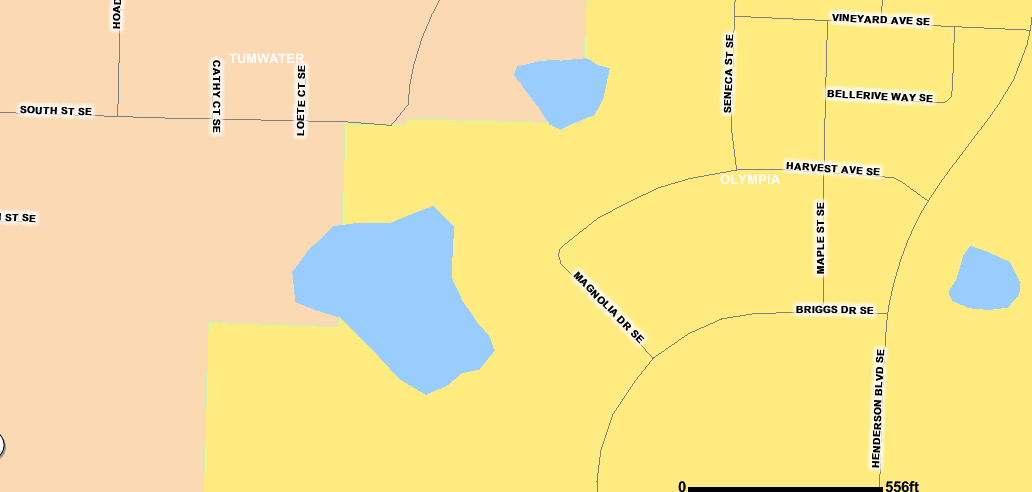
I live on the yellow side of the line:

Since we moved a few miles last year, I’ve noticed that there seems to be some confusion about which city I now live in. Not confusion by me, but by the U.S. Post office. Its kind of annoying to get junk mail labeled with my address as being in Tumwater, but I know that it really doesn’t matter. If someone addresses something to me in Olympia, it’ll get to me no problem.

The problem has become when we contact the city over something, we have to first clear up where we actually live. Apparently because the post office thinks I’m in Tumwater, Olympia isn’t always convinced which side of the line we’re on.

Last year I emailed the city about an erosion problem on a nearby construction site and I had to email them a screenshot like the one above to clear it up. Now, a neighbor is being told she needs to register their home business in Tumwater.

Briggs Village is very much part of Olympia (heck we’re in the municipal code).

So, how does one get the post office to change their mind about what city you live in?

Where Quiemuth was murdered in Olympia and why it doesn’t really matter because we still need to deal with Bunting

The last few years I’ve been strangely fascinated with finding out where in Olympia Quiemuth was murdered. I mostly wanted to find out because I think its an under heard story in Olympia, especially the reaction of our citizens that lead to the murderer getting off.

Drew Crooks will present his findings on probably the same topic (at least the location) next week, so now’s a good as time as any to put out what I found. In short, I probably disagree with Drew about where Quiemuth died.

There are a few resources that firmly pin the location at the old Stevens house on the Capitol Campus (this one and Rogues, Buffoons and Statesmen), but I think they’re mistaken.

The more I’ve plugged into this Quiemuth topic, the more I find the history of the area a lot darker than what is commonly known. When I read Mighty Mountain, it seemed that Binns was making dramatic statements about how some folks were back then. But, now, it almost seems like he was pulling his punches.

There was a least a minority of people for whom killing Indians was not a big deal, or at least part of why they came West. The rest, while they did complain a bit, did very little to bring the murderers to justice.

Read Sarah’s Olympia 1853 and my Murders in Thurston County, 1854 to 1857 for more context, but killing Indians was a majority of crime in our early days.

In terms of Quiemuth, it all started out with trying to find where exactly in Olympia he died, with the the intent of possibly memorializing his murder. There are two possible options from my
research.

These clips (One, Two and Three) put the murder either at Gov. Stevens’ first offices where the Olympia Center is now or at his newly constructed house on the NE corner of the Capitol Campus. Because of references to an alley way in clip 4, I tend to think its the original offices references in clip 1.

Also, the timeline moves very quickly in terms of where Stevens’ and his family lived and when Quiemuth was killed. The murder occurred on November 19 and the family moved into the new house in December. Makes me think it is very unlikely the family would move so quickly into a house that was the scene of a violent murder.

Also, interesting enough, there is no mention by Hazard Stevens in his biography of his father there is no mention of Quiemuth being brought to the new (or under construction) house. There was obviously an office in the house at some point, but its more likely its the offices referred to in clip 1.

Then, I got onto the topic of who killed Quiemuth. There is a lot of thought that Joeseph Bunting was obviously the killer, but that the political sentiment in Olympia led him to get off. Bunting, though, was not done after Quiemuth. These clips (Five, Six, Seven) tell the story of a later murder by Bunting and family. Clip 8 fingers Bunting years later as Quiemuth’s murderer, without any hint of controversy.

No direct evidence, but its pretty clear that if Bunting isn’t our man, someone like him was. And, Olympia at the time failed to turn him in.

So, in my mind, a few questions remain. Where did Quiemuth die (hopefully we can figure this one out) and do we memorialize where he died?

And, does Olympia owe anything for Bunting? In memorializing Quiemuth, should we take the blame for our city not turning in the murderer?

What’s going on with a home rule charter in Thurston County right now

Last year, the Thurston County League of Women Voters updated their historic study on county-wide governance and made the case for a more responsive and financially stable county government through a home rule charter. The study is worth the read, by the way.

More recently, a group formed around the league started getting together to talk about the possibility of a home rule charter campaign. Here are the notes from their April meeting. While the notes indicate they were meeting again, no other meeting notes or notices are available.

The local Sustainability Roundtable seems to involved, making some moves in this direction as well. Here is a proposed position paper on local governance, which builds off the effort by the league.

Here is a version of the notes above from the April meeting, but with more references on the back end.

Here is where the roundtable will be putting their sustainable governance information.

So, it seems there is a new born effort between the League of Women Voters and the Sustainable Roundtable to create a home rule campaign. Nothing since the April meeting has happened, but I’m still poking around, seeing what I can find.

Thurston County home rule, STOP Thurston County and diluting political influence

One thing I’ve been wondering about STOP Thurston County, a local franchise of the Evergreen Freedom Foundation, is why they’ve focused with such laser intensity on particular environmental rules. I’d assume that if these rules were up for a county wide vote, they’d pass.

I mean, across the entire county, Thurston County is pretty liberal. And, the reason isn’t necessarily that Thurston is liberal to the core. It literally matters how you carve up the county.
If Thurston County were to pass a home rule charter and create more elective districts, you could see how the balance of power in the county could change. Currently, all three seats on the Thurston County commission are held by Democrats. And they were elected by an average vote percentage of 56 percent.
Using Dave’s Redistricting Tool (which has a county level redistricting option based on 2010 census data) you can start coming up with options. Here is what a five seat county council might look like:

Here is the Democratic vote in the 2010 U.S. Senate election (Murray-Rossi):

  • Olympia 70 percent
  • West Thurston 52 
  • North Lacey 54
  • South Lacey 54
  • Yelm/Tenino 49
So, the geographically small urban district is still largely Democratic, but every single other district is balanced. If Republicans did everything right, you could easily see a 4-1 advantage on a county council.

Here is what a seven district option looks like:

Again, the Democratic percentage in 2010:

  • Northwest Thurston 65
  • Olympia 68
  • West Lacey 58
  • North Lacey 52
  • South Lacey 50
  • Yelm Tenino 48
  • Rochester 46
So, in this option, you have three strong Democratic districts and then four which are balanced, with an equal number of those leaning Democratic or Republican. So, in a “Republicans do everything right” scenario, you could have a 4-3 advantage on a county council. On the other hand, in a Democrats do everything right, you have a 6-1 or 7-0 advantage.
I made a couple of assumptions that could be played with with these maps:
  • I will admit to trying to game the map by a little by keeping Olympia as whole as possible, thereby not spreading Democratic influence across the northern districts. But, I was just trying to illustrate how home rule would spread influence. You can download the .drf files I linked to under the maps to change my assumptions.
  • I also assume that the way county leaders are elected would change from a in-district vote in the primary and a county-wide vote in the general to in-district all the way
Either way, both scenarios show how creating more representation on the county level (more than our three current commissioners), you dilute the Democratic influence across the county. If STOP Thurston (arguably the most vibrant county level conservative movement in a decade) worked on governance issues, they could change the rules to make it more likely they could change the rules.

Immunization exemption rates in Thurston County and the Olympia School District (or 41 percent of kindergartners in Ferry County don’t have shots)

This foul-mouthed post on Washington leading the nation in people who don’t get their children immunized made me wonder about the more local data. How many people send their kids to school without the right shots, thereby making it more likely that not only will their kids get sick, but the entire school will be less healthy.

Turns out, Thurston County has one of the highest rates of immunization exemptions in the state. Or, the highest number of parents and guardians consciously sending their kids to school without shots.

Here is a map by county, and by school district and a spreadsheet with all the data. Not only is Thurston County a leader, but Olympia School District is in the worst category as well, rating over 10 percent exemptions of the kids entering kindergarden.

By no means is Thurston County on the fringe here, there are some much worse offenders. Like Ferry County, where 41 percent of kids entering kindergarden have signed exemptions in the 09-10 school year. And, that was after the rate increased from 8.9 percent in 2004 to over 50 percent in 2008.

Also, Klickitat County’s rate went from 5.5 percent in 2008 to 21.6 percent in 2009. As the post at the start points out “(t)he national target is 95 percent” immunized.

Here’s a run down on the current situation of how a parent can enroll and child in public school without a full set of immunizations from a legislative staff report:

…a parent or guardian may exempt a child for one of several reasons including if a physician advises against a specific vaccine for a child, parents certify that the vaccine conflicts with their religious beliefs, or parents certify that they have philosophical or personal objections to the child’s immunization.

The staff report is on ESB 5005, which made the following changes to the requirment to be excempt from immunization:

…a parent or guardian must present, to exempt a child from school immunization requirements. The form used to certify the exemption for either medical, religious, or personal objections must include a statement, signed by a health care practitioner, that the parent or guardian has been informed of the benefits and risks of the immunization to the child. Health care practitioners may sign forms at any time before the enrollment of the child in a school or licensed day care.

The old wetlands below the brewery (Unpacking the Olympia Brewery Visioning, Part 2)

This image, from the Washington State Historical Society, shows an obvious wetland in the lower right hand corner.

From the current layout of the brewery, this is where most of the warehouses constructed in the post World War II era of the plant are located. These are obviously the most recent additions, and geographically, the most expansive.


View Larger Map

So, what I’ve been wondering is, since we know what was there pretty recently, what do we do with the area? Is it a good place to restore? Do we focus our commercial restoration on the old brewhouse and pre-World War II structures on the bluff on the northwest side of Capitol Way? Or, since this is a large flat area that’s already been developed, do we right it off?

Why Olympia will never have a minor league baseball team as you know it (unpacking Olympia Brewery Visioning, Part 1)

Tonight was pretty fun on twitter, with the Olympia Brewery visioning event going on. The folks from Einmaleins.tv attended and got us all going on the #olympiabrewery hashtag.

The first take away for the night for me was running down the rule I knew existed (but didn’t have bookmarked) between major and minor league baseball on how teams on the various levels are located. This is the rule that I repeat to folks like Rob Richards when they go on about building a waterfront minor league baseball stadium.

Short of it is, as long as Tacoma has a minor league baseball team, we won’t.

Please consult your most recent version of the Professional Baseball Agreement. While this document is also the heart of darkness that is Organized Baseball and the great horrible monopoly that it is, it also includes Rule 52 “Major and Minor League Territorial Rights.”

Please flip to page 151 of the pdf file (or page 130 of the paginated document). Rule 52 states that every club is given a territory of their own, in which certain rules apply to teams that want to operate inside those territories.

Basically, the rules are:

  • A major league team can enter a minor league’s team territory for a price. 
  • A minor league team can be inside a major league team’s territory with consent or by being grandfathered in (and paid off, see Rule #1). 
  • But, a minor league team holds a veto for any other minor league franchise wanting to locate inside their territory.
And the Rule 52 Attachment lists Tacoma’s home territory as Pierce County. And, when you add on the Rule 52 15 mile buffer, you cannot locate an affiliated minor league franchise within Lacey, Olympia or Tumwater. You could get a team along I-5 just south of 93rd, but that would be way out of town. You certainly aren’t building a minor league baseball stadium anywhere on the old brewery property and expecting an affiliated minor league team to play there.
That said, there is an exception to this rule. Just ignore the rule. There are many independent leagues that play professionally. Sadly, none of these operate in the Pacific Northwest.
Then again, we do have a league of our own in town. They play semi-pro collegiate ball, but they do play with wood bats. And, they’re the best you’re going to get for awhile if you want to watch baseball down here inside Tacoma’s home territory.

Capitol City Bombers and Thurston County Senators (my baseball summer)

In addition to one Mariners game with the family, my baseball summer will be solely around two teams: the Capital City Bombers and Thurston County Senators. As mentioned before, the Senators are the all-star traveling team portion of the local Puget Sound Collegiate League.

The Capital City Bombers are the local representatives in the Roy Hobbs system and, most importantly, they play a few minutes from my house at Olympia High School.

« Older posts Newer posts »

© 2026 Olympia Time

Theme by Anders NorenUp ↑