History, politics, people of Oly WA

Author: Emmett O'Connell (Page 44 of 176)

How much contemporary knowledge of the Mashel Massacre was there?

I’ve reread Stephen B. Emerson’s essay at Historylink.org about the Mashel Massacre about five times. Each time I’m fascinated by his treatment of otherwise respected historic figures, most prominently Ezra Meeker.

Meeker’s description of the Mashel Massacre, in which up to 30 Nisqually tribal members were slaughtered by Washington territorial volunteers, is one of the popularly cited resources of the event. But, Emerson questions the honest of Meeker and another historian in the late 19th century James Wickersham. He calls them “men of questionable integrity.”


Emerson goes into detail taking apart Wickersham’s admittedly shaky proof and Meeker’s less questionable motives. He also does a pretty good job presenting the tribal oral histories about the massacre. 


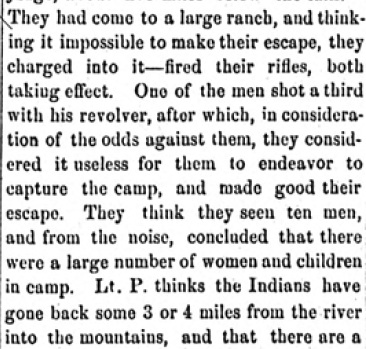
Where Emerson falls short is other references to the massacre in contemporary media. While he cites this April 11, 1856 story on volunteer maneuvers in the upper Nisqually around the Mashel, he misses this one from April 25.

That sounds like a very polite, not talking about the bodies reference to what we call the Mashel Massacre today. Without warning a group of volunteers storm an Indian camp in the upper Nisqually filled with “a large number” of women and children.
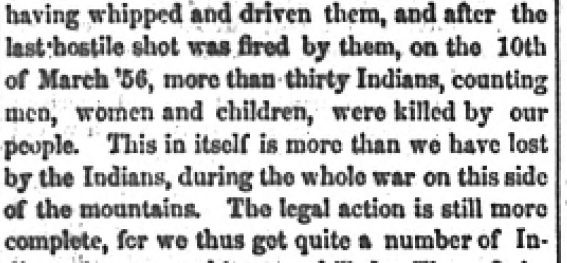
Then, we find a very reference to 30 dead Indians on March 10, 1856 three years later in a much larger story in the Puget Sound Herald about a rash of white on Indian revenge killings.
Granted, the article doesn’t say “Maxon’s troops on the Mashel in March 10, 1856,” but the passing reference makes you assume that it was pretty well known what happened in the upper Nisqually.


You can’t go home again if you’re this dramatic (Olyblogosphere links for February 11, 2013)

Yes, it has been a few months. But, there has also been very little to link to.

1. Neat little what I would say is a oral history on pre-2010 Olympia. Protests and the Reef before the fire.

2. Gosh darnit, I want to have an Oyster Christmas!

3. Holy cow. How about a really long post about Olympia music starting in 1971.

4. And, with all this talk about homeless downtown, let’s look at what Sarah at Olyblog has for us from 1883 Olympia and how they took care of vagrants.

The Los Angeles Sonics and the lies of legacy

1.

When the Supersonics first came to Seattle in the late 1960s expansion of high level basketball, they were the first major professional team in Seattle. Sure, I suppose the Seattle Metropolitans count, as they won the Stanley Cup in 1917. But, for the growth of modern Seattle, the Sonics are the first team that really matters.

Soon after the the Sonics came the Pilots (which quickly moved to Milwaukee) and then ten years later the Mariners and Seahawks. But, by the time professional baseball and football were getting their feet set in Seattle, the Sonics had already built a championship team by 1979.

As seems to be tradition in Seattle sports, a rich Californian was behind it all. Sam Schulman bought into the NBA in the late 60s and ended up with the Seattle franchise. Schulman made most of his money making movies (though he himself was rarely listed in credits). He was also part of a group that bought the San Diego Chargers in 1966. When you look for him now, he’s most well known for his early ownership and stewardship of the Sonics and his impact on professional basketball.

And, it was Schulman, not Clay Bennett, that first threatened the move the Sonics out of Seattle.

While Schulman was eager to buy into the NBA, he seemingly had no particular love for the institution. His early years as a professional basketball executive were spent trying to reform the game. His struggle to bring together the NBA and the rival American Basketball Association and change how player contracts were handled.

Schulman’s primary battle with the NBA (over player contracts) culminated in the 1971 Supreme Court decision in Haywood vs. National Basketball Association, which ended up allowing teams to sign players with less than two years of college experience. Schulman had signed Spencer Haywood, who had left college after less than two years. The NBA sanctioned the Sonics, and Schulman took it to court.

Schulman’s primary antagonist throughout the Haywood saga and the effort to bring ABA teams into the NBA fold was Jack Kent Cooke, who owned the Los Angeles Lakers. it was in this context in the early 70s that Schulman threatened to move the Sonics.

Steve Pluto quoted Dick Tinkham’s telling of the threat in his history of the ABA:

There were a lot of crazy things going on. (Seattle owners) Sam Schulman and I were on a merger committee and Sam told me that if the NBA teams wouldn’t support our merger agreement, he was going to sign Haywood, move his franchise to Los Angeles and join the ABA! He told Jack Kent Cooke that his was what he planned to do. He said he would move right into Cooke’s backyard if Cooke didn’t back him. But, like everything else that was talked about and threatened, nothing came of it.

This threat was made in private as it was not reported in the Seattle media, as far as I can tell. But, if Tinkham’s retelling is correct, it says a lot about Schulman, who has been remembered as one of Seattle’s most important and loyal sports executives. We can’t doubt his California roots, he had already had interest in the Chargers before he came up to Seattle.

The story also fits the geography of sports at the times. The ABA’s franchise in Southern California, the Los Angeles Stars, had moved to Utah in 1970. Their new San Diego team wasn’t established until 1972. The NBA’s San Diego Rockets has also moved to Houston in 1971. And the Buffalo Braves wouldn’t move to San Diego as the Clippers until 1978 and Los Angeles until 1984.

If Haywood had lost in the Supreme Court and Cooke had worked successfully to keep the ABA at arm’s length, Schulman moving the Sonics to Los Angeles seems much more likely. But, history turned out differently. Haywood won his case and most of the ABA came into the NBA in 1976.

And, three years later, the Sonics beat the Washington Bullets in five games and the commuting owner of the Sonics enshrined into Seattle sports history.

Wrote Steve Kelly of the Seattle Times:

For the 16 years he owned the Sonics, Schulman turned sports ownership into a thrilling high-wire act. 

He took chances. He made headlines. When he failed, it was colossal. But when he succeeded, it stirred this city like nothing Seattle sports has seen. 

Schulman was a showman. He came to Seattle with all the elan and marketing chutzpah of a Hollywood pitchman. He knew how to win games, win hearts and fill seats.

Sam Schulman was also the first person to threaten to take the Sonics away, if only in private. If he’d been driven to it, the Sonics would’ve been the second professional team to leave in a few years. After only one season on Major League Baseball, the Seattle Pilots left to become the Brewers. Losing the Sonics would have been a major sporting crisis in Seattle.

With the Sonics seemingly secure in Seattle, civic leaders battled with professional baseball to eventually bring the Mariners. They also brought together the community to fund a multi purpose stadium for football and baseball before a major league franchise was secured in either sport.

It certainly wasn’t easy going for sports boosters during the Boeing Bust era:

By 1971, many people had had enough. Although community activists like Frank Ruano continued to lob complaints at the County Council, bids for the new stadium on the King Street site went out. Despite disapproval and concerns from International District groups, the commissioners stuck to the findings of an environmental impact study which claimed minimal damage to the Asian enclave lying to the east of the proposed site.

During the Kingdome’s official groundbreaking ceremonies on November 2, 1972, some 25 young Asian protesters hurled mudballs at the dignitaries in attendance. Several hundred spectators watched as County Executive Spellman’s speech drew chants — “Stop the Stadium!” — from agitators. Dissenters booed other speakers, including a Seattle Kings representative seeking to attract a professional football franchise. Spellman hastily planted the gold home plate on the field, but the ceremony was a bust.

In this climate, jobs walking out of Seattle as Boeing shrank for seemingly the first time ever, and vocal opposition to a new stadium, the Sonics skipping town would’ve been a death blow. It isn’t likely we would have ever ended up with the King Dome, the Mariners, Seahawks or the modern Sounders.

2.

Where Sacramento sits now — about to lose their only major league sports franchise in their history — is almost a perfect bookend to the history of Seattle sports and the city’s self image. In the late 1960s and early 1970s, Seattle was ten years off the World’s Fair when city leaders made a strong argument to the world that Seattle mattered. Sports teams are a major part of that argument. Simply put, towns with teams matter.

In the 40 years since Schulman made the threat in private to move the sonics and mudballs were launched at people for suggesting even more major league sports, Seattle is well established. Sacramento is hanging on by a thread. If we end up getting the Sacramento Kings and turning them back into the Sonics, we’ll put Sacremento back in the place Seattle was in 1966.

The hopes for Sacramento in 2014 would be a lot less bright than for Seattle in 1966. The sports scene is a lot less fluid now. Rival national leagues just aren’t founded anymore and the current leagues don’t expand all that often. And, its not often you can beat a city like Seattle in a struggle for a team.

Clay Bennett and the OKC Thunder notwithstanding, Seattle has come a long way since 1966. The Sonics leaving hurts so much maybe because it has been one of the city’s’ few civic failures in recent years. The Pilots leaving certainly hurt the city’s pride, but it wasn’t treated like the mortal sin like the creation of the Thunder.

The fact is, Seattle has become a city secure with major league sports. If Seattle’s civic leaders want a NBA team enough, they’ll get it. Seattle has become that kind of city. If not Sacramento, then maybe New Orleans. Some other lesser city will give up its franchise to us eventually. And, in doing so, we’ll drop that other city back into the sports franchise oblivion Seattle last saw almost 50 years ago.

Why I hope “the 206” fails and Local Brew wins

I have nothing but love for Almost Live and John Keister in general. In my childhood memory, I recall the original Ross Schafer talk show version. And, one of my happiest memories was my first July 4 back in western Washington in 1997. I had been back in the state for only a few days and found myself in an apartment over lake Union waiting for the fireworks, and a rerun of Almost Live was on. It is pretty cliche, but I felt more at home in that moment.

All that said, I really hope The 206 doesn’t last long. For years I had pined for John Keister and other Almost Live cast members to make it back somehow. I always thought the show was cancelled unfairly and I really did like the first comeback effort with the John Report with Bob. But, it is hard to imagine that if Almost Live had evolved over the past 14 years, it would’ve ended up like the 206.

The promos so far seem far too self-knowing that people like Keister and Pat Cashman have been off television locally for the past decade. They seem to reference a need for local comedy that hadn’t existed since they were canned. That’s not acknowledging the local internet comedy that has sprung up since then. Local Brew is one obvious example (I’ll get back to them), and Seattle Untimely was another healthy effort worth pointing to.

I’d be lying if I didn’t admit that Keister’s ad for Renton still hurts a bit. Its hard for me to know that exists and to be able to hear Keister make fun of another town, if that’s still part of his schtick. There’s a certain level of authenticity needed to be funny in the way that Keister is funny. And, by making that ad, he lost some of that.

There’s also this: Keister has grown out of being the the 90s era local hero and has become an icon 20 years later. You just take icons seriously. We took Emmett Watson seriously and he was funny from time to time. But, we also didn’t think he was funny in a way that a clown or local television comedian is funny.

I wish I could find an example to link to, but the KCTS commentaries Keister did about five years or so back (somewhat serious, still funny) were more fitting the back on the heals and wise stature that he has earned.

Now, it all needs to be 1990 again, but it can’t be 1990 again.

If you want it to be 1990 (or the year when you were young and funny) you have to go to some place like Local Brew. Instead of putting up vague (and obviously shilling for Cadillac) promos, Ross Asdourian of Local Brew just now successfully raising $10,000 on Kickstarter for the show’s second season. That on its face shows the understanding and social connection it needs to produce local and funny content.

But, the best argument for Local Brew and against The 206 comes from the cast of Almost Live:

The city has lost its oddball manner and its regional distinction, he said, in ways that have muted much of “Live’s” local flavor. Former “Live” cast member Nancy Guppy agreed.
“I don’t know if it could exist now,” she said.  

Everything is becoming more homogeneous, with condos stacked on Subways, luxury markets, Pottery Barns. Said Guppy: “I’m not sure who cares about the local thing — the Seattle thing.”
Or as Keister put it: “Ballard was old Scandinavians. Fremont was hippies. Capitol Hill was gay. Kent was where whites of modest means moved to escape Seattle school busing. Bellevue was the same for the rich.

“Today, you can make a joke about Ballard but it’s a bunch of wealthy people who work in the information industry. You make a joke about Wallingford and it’s a bunch of wealthy people who work in the information industry. 

Fremont? That would be a bunch of wealthy people who work in the information industry.
“And Belltown is a bunch of wealthy people who live in luxury condos … who work in the information industry.”

Obviously, Keister think there’s enough there to make a comeback. But, his comment speaks to a certain element of comedy of living in the moment. Being able to see the authenticity of a place right in front of you and knowing how to make fun of it. Keister mocking Ballard was funny because he obviously loved Seattle and loved Ballard. Keister making fun of the new “information industry” Seattle would be sad.

Keister’s assesment of Seattle is spot on. But, he’s also the wrong person to make fun of it. Transplants and folks who grew up in that new Seattle certainly can and do mock it.


Local comedy is dead. Long live local comedy.

Draft: Midsummer curse and Olympia minor league baseball

John P. Fink, a newspaper man and promoter, had an idea for a baseball league.

Fink seems to a jack of all trades sort of promoter in the era. Mostly mentioned in that gray area between public relations and newspapering. He covered sports, worked for newspapers, but also ran teams and leagues. In 1903 he is also noted in the first ever mention of the Southwest Washington League as “the manager of the Tacoma druggists” baseball team.

This is the same era that saw the consolidation of the Pacific Coast League between California and Pacific Northwest teams. The highest level of baseball on the west coast to that point had been split between Pacific Northwest and California. In 1903 the two warring baseball regions joined together, in an outlaw league.

Was it because of the attention being paid to the Portland Browns, Tacoma Tigers and Seattle Siwashes in the press that Fink saw opportunity in a baseball circuit throughout timber towns in bottom left hand corner of Washington?

The Pacific Coast League was no small undertaking.

Baseball had been growing along the west coast since after the civil war, with Portland teams playing since the late 1860s. It slowly expanded from a game played between clubs and soldiers to a game of semi-pros and pros, business patrons and fans paying gate.

The new regional league from Los Angeles to Seattle was outside the bounds of baseball law, but Fink sought to toe the line.

1903 was also the first year of the National Association, the agreement major league baseball on the East and midwest and minor leagues throughout the country. This agreement gave certainty to players and owners (mostly owners) that contracts would be recognized across professional leagues and that poached players could not re-enter organized baseball without outlaw teams paying.

This was also the agreement that Pacific Coast League ignored, if only for a year or so. But, the smaller (class D) Southwest Washington League was inside the law from the beginning.

This was even fact trumpeted by the the league in “The Reach Official American League Base Ball Guide.”

The Southwest Washington League, under the protection of the National Association, enjoyed a most successful season, financially and artistically, under the able administration of President John P. Fink, of Olympia. The season opened May 10, 1903, and closed September 6, with Aberdeen and Hoquiam tied for the pennant. Hoquiam refused to play a post-season series to decide the tie, and the league directors awarded the pennant to Aberdeen.

Fink first reached out to organizers of local teams in the timber towns early in 1903, asking them if their communities had it in them to step up to professional baseball. First on his list were Olympia, Chehalis, Centralia, Montesano, Aberdeen and Hoquiam.

These six cities were at the time very similar.

Today, they stand apart culturally and demographically, Olympia in particular. In more than a century, Olympia has gone from a timber town in the same classification as Aberdeen and Chehalis (with a state capitol) to a city on the southern edge of the Puget Sound metroplex. Olympia grew from just under 4,000 to more than 10 times that size. Today, you can put together neighboring Lacey and Tumwater and more than 100,000 people live in and around Olympia. This is more people in either of the individual county’s that also made up the Southwest Washington League.

The cities of the old league almost seems like ghosts to me now. Olympia has grown outside its 1903 version, practically leaving nothing behind of its former self. The other cities have grown, seeing high times after World War II. Through the 1930s and World War II Olympia lagged behind cities like Aberdeen and Hoquiam. It wasn’t until 1960 that Olympia was the largest. It was the 1980s that Olympia started putting real distance between itself and its former league-mates.

While state government grew and Olympia took advantage of its connection to the urban centers of Washington, the other cities in the old Southwest League suffered from the decline of the timber and other resource industries.

Olympia became even more distant as it got more liberal relative to its neighbors. Being the home of state government and the politically and culturally liberal Evergreen State College, the old Southwest League towns turn their ire at Olympia. The infamous “Uncle Sam” highway billboard in Chehalis has included many anti-Olympia messages over the years, including “Evergreen State College – Home of Environmental Terrorists and Homos?”

But, as Fink sent out his inquiries in early 1903, these really were cities of the same league.

The $250 that Fink and other organizers wanted in 1903 to enter the league is about $6,000 today.  By February 1903 almost 20 Olympia businessmen had lined up behind the team, putting up the nearly the entire sum needed to enter the league. Gathering investors, officially forming the league, putting together a board of directors were early steps for the Olympia team in the Southwest League. By mid-February the local electric utility — Olympia Light and Power — promised to rip down a defunct veladrome — a bike track — on the bluff above their powerhouse. The plan was to use the timbers to build a grandstand and bleachers on the stadium site, which also coincidentally was along the OLP’s streetcar line.

In April, Olympia baseball me were calling the home field “Electric Park” but it was not yet fit to practice on. Process on the park is going slow, despite the effort of the OP&L company.

When the Olympia Maroons opened in a exhibition on April 19, 1903 against the Tacoma Athletes, an amateur team, Olympia won 4-1. Six hundred Olympians support the Maroons with “lusty yells.”

The board of directors meetings for the Olympia Maroons are public in 1903 and covered like local government meetings. For example, a decision to charge admission is discussed in a regular news column. It’ll cost 25 cents to get into the park, and additional 25 cents to get into the grandstands. Ladies get into the grandstands for free.

 And, by May 10 the Southwest Washington League was in action.

The first really big event of the baseball schedule is on May 22 when President Roosevelt comes to town and Aberdeen plays a “President Day” special the same afternoon. A train full of Harborites come into town with their ball team to see the bull moose. Their team loses to the Maroons.

Turns out, Olympia was a pretty bad team.

By August, the Morning Olympian was advising against betting on the Maroons. Or, at least during league games, during which the Maroons were apparently snake bit:

Any man will tell you, provided he has money on the game, that he is willing to back the Maroons against any team in the Pacific National or the Outlaw leagues, on exhibition, but when it comes to Southwest Washington league games he will hereafter save his money to buy bread… 

 That’s a difference between today and then. While teams like Olympia would play throughout the week against teams in and out of their league, only weekend games played against other SWWL teams counted towards the standings. Apparently Olympia was a weekday team.

By August things are getting worse for the league on a much larger scale. Hoquiam was threatening to leave the league. They seemed to have sarcasm back then as the Hoquiam Perfect Gentlemen were apparently not perfect or gentlemen. Well, if you assumed that amateur ball players who worked mill jobs during the week and in the SWWL on the weekend, aren’t Gentlemen. The amateur team from Hoquiam was leading the league in August against teams made up of a mix of professional and amateurs.

This apparently led to a decision by the owners of the other teams to expand the number of league games, which ate into Hoquiam’s small league lead.

Hoquiam stayed in the league, but not without dragging arguments through organizational meetings and letters.

At the end of the first season, half the league had 11 wins, the other 7.

Aberdeen Pippins 11-7 .611
Hoquiam Perfect Gentlemen 11-7 .611
Centralia Midgets 7-11 .389
Olympia Maroons 7-11 .389

In September the Maroons needed financial help. The Elks and Foresters clubs held a charity baseball game to support the town’s professional ball team, the Maroons. This is an auspicious end to Olympia pro-baseball in 1903. Two amateur ball teams were raising funds for the pro team.

The league would play three years before breaking apart. In 1904 the Maroons became the Senators and in 1905 Centralia is replaced by Montesano Farmers.

In early May 1905, the Morning Olympian introduces the players as if they’re elected officials: Senator Cook, Senator Christian, Senator Almost Stubavor Dye. “A newly elected member who represents the Solid South is Senator Autray.”

I know why the Olympian was practically begging Olympians to come out to support the Senators in 1905. Its the same reason Mayor P.H. Carlyon was deciding whether to declare a half civic holiday for their home opener. Just like in the 1903 season, the hope of a warm Olympia May was smashed by the the heat of August and the league was in trouble.

In 1903, August featured a dust up between Hoquiam and the league, in 1905 it was the very fate of the league.

In early August the owners came together in an Aberdeen hotel. At the urging of Montesano and Aberdeen, they decided to press on, despite very real financial concerns for the rest of the league.

Then two days later, the Olympian carries this passage in a otherwise typical homestand preview:

The Kids (the team’s nickname in the paper is not the Panama Kids for some dumb reason) have played good ball all season, and have been a good advertisement for Olympia all the way. They have not received the support at home that they deserved. The league this year has been faster than ever before and a team that at this time is in second position with a chance still left for the pennant is worth of support of any city in this state. Turn out today, and tardy though you are, be there with the big boost and help the team out, not only with your presence, but encourage them with your two-bit piece. That’s where they need your help most. It costs money to run a team and every citizen should help defray this expense. Olympia needs a team and should be glad to pay for it when she has a team like the present one. 

They need your two-bit the most, your fandom second. The team is an advertisement for the city. Costs money to run a team, Olympia needs a team, every citizen should pitch in. Seems more like a road or a school.

By the way, Olympia at this point did not have a high school building. That came a year later.

But, Olympia, is in inferior headspace after statehood in 1889. An economic depression was brought on in part by national recession and local over-extension to retain the capitol after statehood. It would be decades before finally a permanent capitol was built and Olympia felt comfortably away from fears of losing the capitol.

With the SWWL collapsing in late summer 1905, Olympia needed baseball to be a real city.

And, unfortunately, the Senators and what they mean for Olympia are in deep trouble as 1905 ends and the baseball men look to 1906. 

1905 SW Washington League Standings
Montesano 25-10 (.705)
Olympia 20-16 (.555)
Aberdeen 17-17 (.500)
Hoquiam 9-27 (.250)

Senators finish well behind the Farmers and in late winter in 1906 the ground is being laid for a pro-baseball free Southwest Washington. A league may not come around, but the possibility of an independent team in Olympia is brought up. The increased interest in baseball from amateur clubs is also mentioned as a bright spot.

A local league between Hoquiam and Aberdeen clubs (with the support of the streetcar company between the towns) is promised, but no one knows if they want to start a league between other cities.

While parlaying Olympia interest in reviving the D-level SWWL, the Grays Harbor towns (Cosmopolis, in addition to Hoquiam and Aberdeen) jump up into the B level Northwestern League.

The class A Pacific Coast League (by now not an outlaw, but a law-abiding member of Organized Baseball) includes Seattle and Portland along with California cities. The combined Harbor cities join other also-ran cities in the region, such as Spokane, Tacoma and Butte, Montana.

Surviving as the Grays Harbor Lumberman and Grays, and the Aberdeen Black Cats, the Harbor super team survives in the Northwestern League until 1910 when the league drops them. The Northwestern League exists in those years somewhere in the historic backwash of the legendary (and sometimes considered major league) Pacific Coast League. Cities like Seattle, Portland and Spokane would fall out of the PCL and into the Northwest League and then back up again.

The Grays Harbor consolidated cities tried to play in that league, but were eventually bounced out by their bigger siblings.

In 1910 they tried to put back the old SWWL relationship to salvage organized baseball on the Harbor. Olympia had fielded an independent team in 1909 and felt up to the task.

But, only if things would be different in 1910.

Olympia only wanted games on the weekend. No expanding the league schedule (like what happened under-handily to Hoquiam in 1903) to shoo out smaller clubs. Between 1903 and 1905 the number of league games had expanded, stretching the baseball resources of Olympia. A strict salary cap. “What we are planning on is a league run in such a manner that there will be no danger of it getting along nicely until the Fourth of July and then going to pieces.”

While Olympia wanted a ball team in 1910, they wanted it under more humble standards.

In addition to the old SWWL towns (Olympia, Centralia, Chehalis, Hoquiam and Aberdeen), Elma, South Bend and two Tacoma teams are also considered. But, the 1910 Class D Washington State League did not end up including Olympia. The cost of travel, keeping players and drawing fans drove Olympia’s interest away from the league.

Olympia ended up fielding semi-pro, unaffiliated with Organized Baseball teams through the 1920s. Eventually even interest in that level of baseball lagged in the capital city.

Gordon Newell describes the final death of semi-pro Olympia Senators in Rogues, Buffoons and Statesmen. The midsummer curse did the baseball Senators in again:

The coming of electronic home entertainment media may have provided the final straw which, added to the summer mobility of the family motor car, broke the back of paid admission baseball in the capital city. The sport itself was popular enough. The local merchants organized a twilight league and the sawmills fielded amateur teams in the sawdust league. The Olympia Senators even began the season bravely under the leadership of ex-major leaguer Ham Hyatt, but by the end of July the lakc of patronage caused the semi-pro players to give up in disgust and turn the new Stevens Field over to high school and amateur teams.

Dead Punk, otter, Pets and Dutch edition (Olyblogosphere links for November 10, 2012)

1. Olympia Punk in Stranger: Punk Dead.

2. Sondrak’s KISP is one of the oddest blogs in Olympia. Well, I think Olympia. I remember her blogging a lot about the port protests a few years back. But, this post is too sweet.

3. And, as the days get short and its really damn cold outside, never anytime better to look back at Pet Parade.

4. Lastly, a Dutch band plays Olympia, WA. I think European neighbors were trying to send Mathias a little gift.


Low turnout, voter confusion drove the Wolfe vs. Rogers election result

You can find the data here.

If you look at the basic results of the county commission race between Democrat Cathy Wolfe and Democrat Karen Rogers, you can see a huge difference in the vote totals compared to other county races. About 7,000 voters did not vote in this contest between candidates from the same party.

What I did was look at how Wolfe and Rogers did compared to a composite Democratic and Republican candidate in five groups of precincts. I made the composite from the results of the Thurston county level presidential and gubernatorial elections and the results of the other county commission race. I then ranked the precinct groups from most Republican to most Democratic.

Here are two lessons I toook from this race:

1. Republicans won’t vote for a Democrat, no matter how conservative they are. Rogers made some waves by getting endorsements from traditionally Republican allies and by taking some conservative stands, especially on land use. That didn’t garner her Republican votes though.

2. Democrats got confused. When the race moved into more liberal areas, Rogers well outperformed a composite Republican, indicating she was taking otherwise Democratic votes away from Wolfe.

From things I don’t get to things I really like (Olyblogosphere roundup for October 13, 2012)

1. I don’t get the bead thing and I don’t get decorating skulls. Though, I suppose its a thing for Halloween. That said, Shipwreck Beads must be the capital of things I don’t get.

2. Arts Walk link #1:


 3. Arts Walk link #2: Thad’s Things I like at Arts Walk.

4. This is the sort of thing I do this link roundup for, Janine’s recent writing on the county commissioner race is the best things out there right now on local politics.

The Pig War and Olympia baseball

I’m working on something longer about Olympia baseball, this is a portion of that longer thing.

Olympia’s baseball history probably starts just a bit earlier than than the summer of 1872. Baseball clubs had exploded between Vancouver and Portland five years before, but the following in the first refernce I can find to a baseball team in Olympia (Blankenship):

Olympia, in early days, was not without its baseball team, in which it took great pride in the days of underhand pitching.  Several match games were played with Victoria, and Olympia was victor each time.  The English knew more of their national game of cricket, and had not perfected themselves in America’s favorite sport.  About the time these games were being played the matter of the San Juan controversy was on, involving Uncle Sam and Great Britain.  The dispute was in the hands of Emperor William of Germany for arbitration.  On the day the first game was to be played there was conspicuously posted at the post office a telegram in proper form on a Western Union blank, reading as follows:

Washington D.C.,  July 16

Governor Washington Territory:
Emperor William, having in hand the matter of the San Juan controversy, has concluded to base his decision on the result of the baseball contest between Olympia and Victoria.

Secretary of State.

Thus inspired the Olympia boys went in and won.  It is barely possible that the illustrious grandsire of a degenerate grandson never heard of the game, but the victorious Olympians came from the field with breasts distended like pouter pigeons, plainly conscious of having won an empire for their Uncle.

Just a bit of background, the maritime border between Canada and the states at this point had not been set. Both sides claimed the San Juan Islands, and at some point someone shot someone else’s pig. And, both British and American soldiers were based on the San Juans. Hence a war with only one casualty.

So, the game would have been in the summer of 1872. The German led committee set to settle the Pig War made their decision in October 1872, the British withdrew a month later.

It was also at the exact same time that the mysterious Ira B. Thomas was in town, buying land for a possible terminus for the Northern Pacific railway. Its almost odd that the fact real world wager for this game was over the San Juans and not the terminus. It would’ve been just as believable (maybe more believable) if the game was to be played against Port Townsend or Seattle and the prize was the Northern Pacific terminus.

But, of course the opponent was the opposite capital and the prize was the lonely old San Juans, almost a footnote to history compared to the terminus.

These were the days of formal invitations sent between clubs. And, clubs were not synonims for teams or businesses in the economic venture of making money from sport. They were actual clubs as in having elections and officers and bylaws.

Olympia base ball club would hold a meeting. Who do we invite? Let’s invite Victoria! The next day, a telegraph is sent.

At their next meeting, Victoria considers the invitation and accepts.

Terms would be set, travel would be arranged and in a month or so, Victoria would travel down by steamer. This is the era before even leagues when a club (again, and actual club, as in an organization of men wanting to play baseball) would know before each season (such as spring, summer and fall) who they would play. No yearly champions, just invitations and games. But, they did keep score.

If you’ve ever read W.P. Kinsella, especially the Iowa Baseball Confederacy, you recognize the elements of a great baseball story here, if only the German challenge were true.

In the Kinsella-esque version, a German official would be on hand, because the game would really have been the deciding game in the Pig War. Ira Thomas would be there too. Thomas’ wife back in New York state, unaware that her husband had but months to life.

Just for fun, even though the historian puts down a date of July 16, I’ll put the game on July 4. That enhances the patriotic aura of the game.

Both the German official, maybe an American from the state Department and a British foreign office official come in on the same boat as Ira B. Thomas. The British official thinks the game is a joke, the American thinks its great and the German is just happpy they decided to settle the fight over empty islands somehow.

Ira B. Thomas has a secret, but can’t talk enough about all the stuff he’s heard about Olympia (but not really why he’s there).

I’m not sure how the rest of the story unfolds, but obviously the game goes into extra innings.

« Older posts Newer posts »

© 2026 Olympia Time

Theme by Anders NorenUp ↑