History, politics, people of Oly WA

Author: Emmett O'Connell (Page 45 of 177)

Draft: Midsummer curse and Olympia minor league baseball

John P. Fink, a newspaper man and promoter, had an idea for a baseball league.

Fink seems to a jack of all trades sort of promoter in the era. Mostly mentioned in that gray area between public relations and newspapering. He covered sports, worked for newspapers, but also ran teams and leagues. In 1903 he is also noted in the first ever mention of the Southwest Washington League as “the manager of the Tacoma druggists” baseball team.

This is the same era that saw the consolidation of the Pacific Coast League between California and Pacific Northwest teams. The highest level of baseball on the west coast to that point had been split between Pacific Northwest and California. In 1903 the two warring baseball regions joined together, in an outlaw league.

Was it because of the attention being paid to the Portland Browns, Tacoma Tigers and Seattle Siwashes in the press that Fink saw opportunity in a baseball circuit throughout timber towns in bottom left hand corner of Washington?

The Pacific Coast League was no small undertaking.

Baseball had been growing along the west coast since after the civil war, with Portland teams playing since the late 1860s. It slowly expanded from a game played between clubs and soldiers to a game of semi-pros and pros, business patrons and fans paying gate.

The new regional league from Los Angeles to Seattle was outside the bounds of baseball law, but Fink sought to toe the line.

1903 was also the first year of the National Association, the agreement major league baseball on the East and midwest and minor leagues throughout the country. This agreement gave certainty to players and owners (mostly owners) that contracts would be recognized across professional leagues and that poached players could not re-enter organized baseball without outlaw teams paying.

This was also the agreement that Pacific Coast League ignored, if only for a year or so. But, the smaller (class D) Southwest Washington League was inside the law from the beginning.

This was even fact trumpeted by the the league in “The Reach Official American League Base Ball Guide.”

The Southwest Washington League, under the protection of the National Association, enjoyed a most successful season, financially and artistically, under the able administration of President John P. Fink, of Olympia. The season opened May 10, 1903, and closed September 6, with Aberdeen and Hoquiam tied for the pennant. Hoquiam refused to play a post-season series to decide the tie, and the league directors awarded the pennant to Aberdeen.

Fink first reached out to organizers of local teams in the timber towns early in 1903, asking them if their communities had it in them to step up to professional baseball. First on his list were Olympia, Chehalis, Centralia, Montesano, Aberdeen and Hoquiam.

These six cities were at the time very similar.

Today, they stand apart culturally and demographically, Olympia in particular. In more than a century, Olympia has gone from a timber town in the same classification as Aberdeen and Chehalis (with a state capitol) to a city on the southern edge of the Puget Sound metroplex. Olympia grew from just under 4,000 to more than 10 times that size. Today, you can put together neighboring Lacey and Tumwater and more than 100,000 people live in and around Olympia. This is more people in either of the individual county’s that also made up the Southwest Washington League.

The cities of the old league almost seems like ghosts to me now. Olympia has grown outside its 1903 version, practically leaving nothing behind of its former self. The other cities have grown, seeing high times after World War II. Through the 1930s and World War II Olympia lagged behind cities like Aberdeen and Hoquiam. It wasn’t until 1960 that Olympia was the largest. It was the 1980s that Olympia started putting real distance between itself and its former league-mates.

While state government grew and Olympia took advantage of its connection to the urban centers of Washington, the other cities in the old Southwest League suffered from the decline of the timber and other resource industries.

Olympia became even more distant as it got more liberal relative to its neighbors. Being the home of state government and the politically and culturally liberal Evergreen State College, the old Southwest League towns turn their ire at Olympia. The infamous “Uncle Sam” highway billboard in Chehalis has included many anti-Olympia messages over the years, including “Evergreen State College – Home of Environmental Terrorists and Homos?”

But, as Fink sent out his inquiries in early 1903, these really were cities of the same league.

The $250 that Fink and other organizers wanted in 1903 to enter the league is about $6,000 today.  By February 1903 almost 20 Olympia businessmen had lined up behind the team, putting up the nearly the entire sum needed to enter the league. Gathering investors, officially forming the league, putting together a board of directors were early steps for the Olympia team in the Southwest League. By mid-February the local electric utility — Olympia Light and Power — promised to rip down a defunct veladrome — a bike track — on the bluff above their powerhouse. The plan was to use the timbers to build a grandstand and bleachers on the stadium site, which also coincidentally was along the OLP’s streetcar line.

In April, Olympia baseball me were calling the home field “Electric Park” but it was not yet fit to practice on. Process on the park is going slow, despite the effort of the OP&L company.

When the Olympia Maroons opened in a exhibition on April 19, 1903 against the Tacoma Athletes, an amateur team, Olympia won 4-1. Six hundred Olympians support the Maroons with “lusty yells.”

The board of directors meetings for the Olympia Maroons are public in 1903 and covered like local government meetings. For example, a decision to charge admission is discussed in a regular news column. It’ll cost 25 cents to get into the park, and additional 25 cents to get into the grandstands. Ladies get into the grandstands for free.

 And, by May 10 the Southwest Washington League was in action.

The first really big event of the baseball schedule is on May 22 when President Roosevelt comes to town and Aberdeen plays a “President Day” special the same afternoon. A train full of Harborites come into town with their ball team to see the bull moose. Their team loses to the Maroons.

Turns out, Olympia was a pretty bad team.

By August, the Morning Olympian was advising against betting on the Maroons. Or, at least during league games, during which the Maroons were apparently snake bit:

Any man will tell you, provided he has money on the game, that he is willing to back the Maroons against any team in the Pacific National or the Outlaw leagues, on exhibition, but when it comes to Southwest Washington league games he will hereafter save his money to buy bread… 

 That’s a difference between today and then. While teams like Olympia would play throughout the week against teams in and out of their league, only weekend games played against other SWWL teams counted towards the standings. Apparently Olympia was a weekday team.

By August things are getting worse for the league on a much larger scale. Hoquiam was threatening to leave the league. They seemed to have sarcasm back then as the Hoquiam Perfect Gentlemen were apparently not perfect or gentlemen. Well, if you assumed that amateur ball players who worked mill jobs during the week and in the SWWL on the weekend, aren’t Gentlemen. The amateur team from Hoquiam was leading the league in August against teams made up of a mix of professional and amateurs.

This apparently led to a decision by the owners of the other teams to expand the number of league games, which ate into Hoquiam’s small league lead.

Hoquiam stayed in the league, but not without dragging arguments through organizational meetings and letters.

At the end of the first season, half the league had 11 wins, the other 7.

Aberdeen Pippins 11-7 .611
Hoquiam Perfect Gentlemen 11-7 .611
Centralia Midgets 7-11 .389
Olympia Maroons 7-11 .389

In September the Maroons needed financial help. The Elks and Foresters clubs held a charity baseball game to support the town’s professional ball team, the Maroons. This is an auspicious end to Olympia pro-baseball in 1903. Two amateur ball teams were raising funds for the pro team.

The league would play three years before breaking apart. In 1904 the Maroons became the Senators and in 1905 Centralia is replaced by Montesano Farmers.

In early May 1905, the Morning Olympian introduces the players as if they’re elected officials: Senator Cook, Senator Christian, Senator Almost Stubavor Dye. “A newly elected member who represents the Solid South is Senator Autray.”

I know why the Olympian was practically begging Olympians to come out to support the Senators in 1905. Its the same reason Mayor P.H. Carlyon was deciding whether to declare a half civic holiday for their home opener. Just like in the 1903 season, the hope of a warm Olympia May was smashed by the the heat of August and the league was in trouble.

In 1903, August featured a dust up between Hoquiam and the league, in 1905 it was the very fate of the league.

In early August the owners came together in an Aberdeen hotel. At the urging of Montesano and Aberdeen, they decided to press on, despite very real financial concerns for the rest of the league.

Then two days later, the Olympian carries this passage in a otherwise typical homestand preview:

The Kids (the team’s nickname in the paper is not the Panama Kids for some dumb reason) have played good ball all season, and have been a good advertisement for Olympia all the way. They have not received the support at home that they deserved. The league this year has been faster than ever before and a team that at this time is in second position with a chance still left for the pennant is worth of support of any city in this state. Turn out today, and tardy though you are, be there with the big boost and help the team out, not only with your presence, but encourage them with your two-bit piece. That’s where they need your help most. It costs money to run a team and every citizen should help defray this expense. Olympia needs a team and should be glad to pay for it when she has a team like the present one. 

They need your two-bit the most, your fandom second. The team is an advertisement for the city. Costs money to run a team, Olympia needs a team, every citizen should pitch in. Seems more like a road or a school.

By the way, Olympia at this point did not have a high school building. That came a year later.

But, Olympia, is in inferior headspace after statehood in 1889. An economic depression was brought on in part by national recession and local over-extension to retain the capitol after statehood. It would be decades before finally a permanent capitol was built and Olympia felt comfortably away from fears of losing the capitol.

With the SWWL collapsing in late summer 1905, Olympia needed baseball to be a real city.

And, unfortunately, the Senators and what they mean for Olympia are in deep trouble as 1905 ends and the baseball men look to 1906. 

1905 SW Washington League Standings
Montesano 25-10 (.705)
Olympia 20-16 (.555)
Aberdeen 17-17 (.500)
Hoquiam 9-27 (.250)

Senators finish well behind the Farmers and in late winter in 1906 the ground is being laid for a pro-baseball free Southwest Washington. A league may not come around, but the possibility of an independent team in Olympia is brought up. The increased interest in baseball from amateur clubs is also mentioned as a bright spot.

A local league between Hoquiam and Aberdeen clubs (with the support of the streetcar company between the towns) is promised, but no one knows if they want to start a league between other cities.

While parlaying Olympia interest in reviving the D-level SWWL, the Grays Harbor towns (Cosmopolis, in addition to Hoquiam and Aberdeen) jump up into the B level Northwestern League.

The class A Pacific Coast League (by now not an outlaw, but a law-abiding member of Organized Baseball) includes Seattle and Portland along with California cities. The combined Harbor cities join other also-ran cities in the region, such as Spokane, Tacoma and Butte, Montana.

Surviving as the Grays Harbor Lumberman and Grays, and the Aberdeen Black Cats, the Harbor super team survives in the Northwestern League until 1910 when the league drops them. The Northwestern League exists in those years somewhere in the historic backwash of the legendary (and sometimes considered major league) Pacific Coast League. Cities like Seattle, Portland and Spokane would fall out of the PCL and into the Northwest League and then back up again.

The Grays Harbor consolidated cities tried to play in that league, but were eventually bounced out by their bigger siblings.

In 1910 they tried to put back the old SWWL relationship to salvage organized baseball on the Harbor. Olympia had fielded an independent team in 1909 and felt up to the task.

But, only if things would be different in 1910.

Olympia only wanted games on the weekend. No expanding the league schedule (like what happened under-handily to Hoquiam in 1903) to shoo out smaller clubs. Between 1903 and 1905 the number of league games had expanded, stretching the baseball resources of Olympia. A strict salary cap. “What we are planning on is a league run in such a manner that there will be no danger of it getting along nicely until the Fourth of July and then going to pieces.”

While Olympia wanted a ball team in 1910, they wanted it under more humble standards.

In addition to the old SWWL towns (Olympia, Centralia, Chehalis, Hoquiam and Aberdeen), Elma, South Bend and two Tacoma teams are also considered. But, the 1910 Class D Washington State League did not end up including Olympia. The cost of travel, keeping players and drawing fans drove Olympia’s interest away from the league.

Olympia ended up fielding semi-pro, unaffiliated with Organized Baseball teams through the 1920s. Eventually even interest in that level of baseball lagged in the capital city.

Gordon Newell describes the final death of semi-pro Olympia Senators in Rogues, Buffoons and Statesmen. The midsummer curse did the baseball Senators in again:

The coming of electronic home entertainment media may have provided the final straw which, added to the summer mobility of the family motor car, broke the back of paid admission baseball in the capital city. The sport itself was popular enough. The local merchants organized a twilight league and the sawmills fielded amateur teams in the sawdust league. The Olympia Senators even began the season bravely under the leadership of ex-major leaguer Ham Hyatt, but by the end of July the lakc of patronage caused the semi-pro players to give up in disgust and turn the new Stevens Field over to high school and amateur teams.
Dead Punk, otter, Pets and Dutch edition (Olyblogosphere links for November 10, 2012)

1. Olympia Punk in Stranger: Punk Dead.

2. Sondrak’s KISP is one of the oddest blogs in Olympia. Well, I think Olympia. I remember her blogging a lot about the port protests a few years back. But, this post is too sweet.

3. And, as the days get short and its really damn cold outside, never anytime better to look back at Pet Parade.

4. Lastly, a Dutch band plays Olympia, WA. I think European neighbors were trying to send Mathias a little gift.


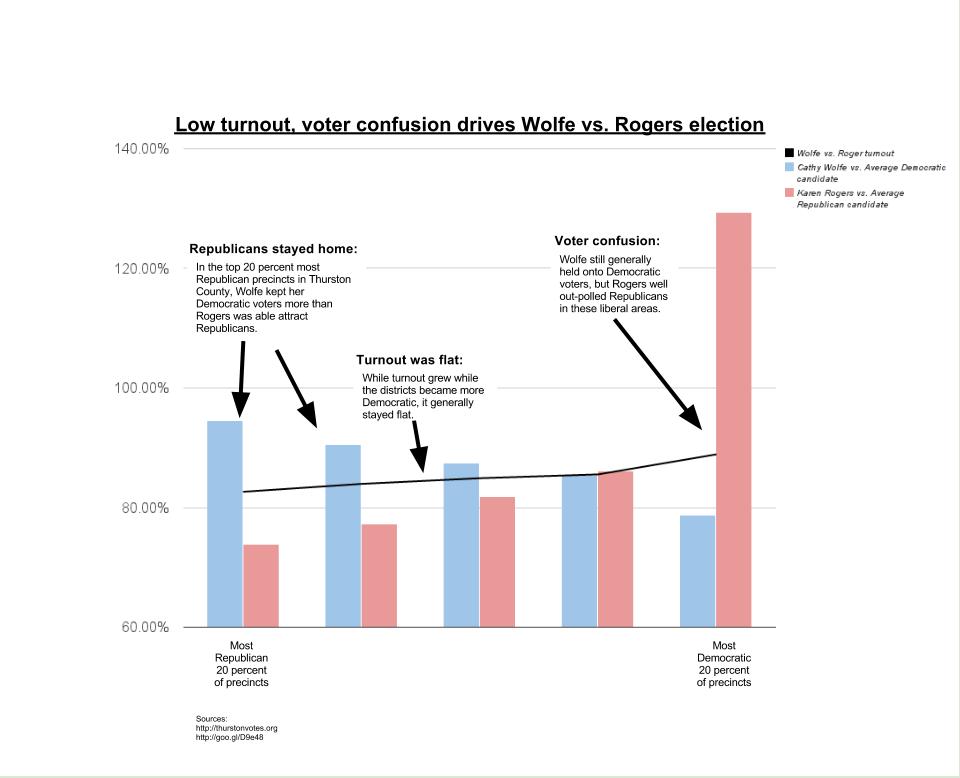
Low turnout, voter confusion drove the Wolfe vs. Rogers election result

You can find the data here.

If you look at the basic results of the county commission race between Democrat Cathy Wolfe and Democrat Karen Rogers, you can see a huge difference in the vote totals compared to other county races. About 7,000 voters did not vote in this contest between candidates from the same party.

What I did was look at how Wolfe and Rogers did compared to a composite Democratic and Republican candidate in five groups of precincts. I made the composite from the results of the Thurston county level presidential and gubernatorial elections and the results of the other county commission race. I then ranked the precinct groups from most Republican to most Democratic.

Here are two lessons I toook from this race:

1. Republicans won’t vote for a Democrat, no matter how conservative they are. Rogers made some waves by getting endorsements from traditionally Republican allies and by taking some conservative stands, especially on land use. That didn’t garner her Republican votes though.

2. Democrats got confused. When the race moved into more liberal areas, Rogers well outperformed a composite Republican, indicating she was taking otherwise Democratic votes away from Wolfe.

From things I don’t get to things I really like (Olyblogosphere roundup for October 13, 2012)

1. I don’t get the bead thing and I don’t get decorating skulls. Though, I suppose its a thing for Halloween. That said, Shipwreck Beads must be the capital of things I don’t get.

2. Arts Walk link #1:


 3. Arts Walk link #2: Thad’s Things I like at Arts Walk.

4. This is the sort of thing I do this link roundup for, Janine’s recent writing on the county commissioner race is the best things out there right now on local politics.

The Pig War and Olympia baseball

I’m working on something longer about Olympia baseball, this is a portion of that longer thing.

Olympia’s baseball history probably starts just a bit earlier than than the summer of 1872. Baseball clubs had exploded between Vancouver and Portland five years before, but the following in the first refernce I can find to a baseball team in Olympia (Blankenship):

Olympia, in early days, was not without its baseball team, in which it took great pride in the days of underhand pitching.  Several match games were played with Victoria, and Olympia was victor each time.  The English knew more of their national game of cricket, and had not perfected themselves in America’s favorite sport.  About the time these games were being played the matter of the San Juan controversy was on, involving Uncle Sam and Great Britain.  The dispute was in the hands of Emperor William of Germany for arbitration.  On the day the first game was to be played there was conspicuously posted at the post office a telegram in proper form on a Western Union blank, reading as follows:

Washington D.C.,  July 16

Governor Washington Territory:
Emperor William, having in hand the matter of the San Juan controversy, has concluded to base his decision on the result of the baseball contest between Olympia and Victoria.

Secretary of State.

Thus inspired the Olympia boys went in and won.  It is barely possible that the illustrious grandsire of a degenerate grandson never heard of the game, but the victorious Olympians came from the field with breasts distended like pouter pigeons, plainly conscious of having won an empire for their Uncle.

Just a bit of background, the maritime border between Canada and the states at this point had not been set. Both sides claimed the San Juan Islands, and at some point someone shot someone else’s pig. And, both British and American soldiers were based on the San Juans. Hence a war with only one casualty.

So, the game would have been in the summer of 1872. The German led committee set to settle the Pig War made their decision in October 1872, the British withdrew a month later.

It was also at the exact same time that the mysterious Ira B. Thomas was in town, buying land for a possible terminus for the Northern Pacific railway. Its almost odd that the fact real world wager for this game was over the San Juans and not the terminus. It would’ve been just as believable (maybe more believable) if the game was to be played against Port Townsend or Seattle and the prize was the Northern Pacific terminus.

But, of course the opponent was the opposite capital and the prize was the lonely old San Juans, almost a footnote to history compared to the terminus.

These were the days of formal invitations sent between clubs. And, clubs were not synonims for teams or businesses in the economic venture of making money from sport. They were actual clubs as in having elections and officers and bylaws.

Olympia base ball club would hold a meeting. Who do we invite? Let’s invite Victoria! The next day, a telegraph is sent.

At their next meeting, Victoria considers the invitation and accepts.

Terms would be set, travel would be arranged and in a month or so, Victoria would travel down by steamer. This is the era before even leagues when a club (again, and actual club, as in an organization of men wanting to play baseball) would know before each season (such as spring, summer and fall) who they would play. No yearly champions, just invitations and games. But, they did keep score.

If you’ve ever read W.P. Kinsella, especially the Iowa Baseball Confederacy, you recognize the elements of a great baseball story here, if only the German challenge were true.

In the Kinsella-esque version, a German official would be on hand, because the game would really have been the deciding game in the Pig War. Ira Thomas would be there too. Thomas’ wife back in New York state, unaware that her husband had but months to life.

Just for fun, even though the historian puts down a date of July 16, I’ll put the game on July 4. That enhances the patriotic aura of the game.

Both the German official, maybe an American from the state Department and a British foreign office official come in on the same boat as Ira B. Thomas. The British official thinks the game is a joke, the American thinks its great and the German is just happpy they decided to settle the fight over empty islands somehow.

Ira B. Thomas has a secret, but can’t talk enough about all the stuff he’s heard about Olympia (but not really why he’s there).

I’m not sure how the rest of the story unfolds, but obviously the game goes into extra innings.

Where would have the Northern Pacific met Budd Inlet?

In most local histories that cover the era of the Pacific Northern Railway terminus chase, there is a retelling of this particular episode (this telling from Newell’s “So Fair a Dwelling Place“):

The Puget Sound Land Company, a subsidiary of the Northern Pacific and bought
up large tracts of land on Budd’s Inlet in the name of one Ira Bradley Thomas. Before the rails reached Olympia, Thomas died.

Rather than face the legal delays of probating his estate, the company quickly
bought up new land near Old Tacoma and told the Northern Pacific to change its terminus
to that location.

Had an obscure business man, Ira Thomas, lived just a little longer, Olympia would
undoubtedly have become the western terminus of the first northern transcontinental
railway and the site of the present city of Tacoma might still be a comparative wilderness.

Can you imagine  how Olympia could have ended up differently had we, and not Tacoma, ended up the first industrial metropolis on the sound? I can imagine deepwater dredging all the way to Tumwater and down Swantown Slough. Possibly fill all the way out to Priest Point. Certainly a larger and more developed city.

But, the exact extent of our growth would’ve been determined by exactly where on Budd Inlet the terminus was meant for. I think I’ve come up with a general location of where the Pacific Northern Railroad would’ve met the Puget Sound had they chosen Olympia.


1. First, I wanted to find out if Ira B. Thomas really did come to Olympia in the 1870s to buy land for the Northern Pacific. It wasn’t uncommon for land purchases to be made in the name of the Northern Pacific back then. But, what sometimes seem too good to be true and fanciful stories that get repeated in local history, just really are too good to be true.

That doesn’t seem to be the case for Ira Thomas, though. According to at least this federal case, his estate was still being fought over 20 years later. Since probating the case took over 20 years, the Northern Pacific was pretty smart to move onto Tacoma.

2. So, Ira Thomas was in Olympia and he did buy land for a railroad terminus, where was that terminus? Apparently, the name North Olympia Land Company can still be found in some legal descriptions of property around here. At least this real estate database (BackPlant Tract Book by Titlepoint) lists the company as a search parameter for Thurston County.

3. So, where are the lots with North Olympia in their legal description on Budd Inlet? From what I can find plugging around on Thurston County’s Geodata, right here.

4. So, finally, what does this tell us? Maybe nothing, it is possible that Ira Thomas’ mission in Olympia was just a ruse. Possibly like other land buys in King County, Thomas might’ve been trying to divert attention from the mostly empty property along Commencement Bay. Compared to Olympia with 1,200 people, only 200 lived in Tacoma. The Northern Pacific possibly wanted all the land riches for themselves.

Or, maybe, Thomas’ death really did put the dream of Olympia as major west coast city or at least major western Washington to bed. Maybe in addition to being the state capitol, we would’ve had a mighty metropolis to go along with it. I like to imagine what could’ve been.

Update (11/21/12): Just realized that this map (which I’ve looked at dozens of times) gives a pretty great idea of where the Olympia Land Company property was.

Snippet:

Overlay with current Olympia:

Secrets and vagueness (Olyblogosphere for October 1, 2012)

1. The Man With No Change at Old School:

2. Someone just had an 11 year blogiversary!

3. Alec Clayton talks about the books he’s written and focuses on their autobiographical aspects:

There’s a reason these first three books were set in locales where I have lived and a reason that the main characters were all about my age. Both were to create a palpable sense of place and authenticity. Write what you know is the old axiom. I made the main characters my age so it would be easier to get facts right: getting the popular songs, books, movies at any given time right and ditto for hair styles, fashions and automobiles.

4.  Long video, featuring Steven Willis of Morty the Dog, on Comics at Evergreen:

5. And, secrets.

6. And, even though I try to do only five links, this sixth is extra and not really Olympia related. Yelm History Project blog is great.

A data-based perspective on racism in Gonzalez v. Danielson

My historic look didn’t drill down very far, just looked back in time a bit. But, if you do look down into the voting precincts, as this paper does very well, you find racism present in the vote:

The Yakima and Grant County results indicate that racially polarized voting exists in Central Washington and crosses party and ideological lines. While voters in these counties have consistently voted for more conservative candidates in most recent elections, Danielson outperformed all other candidates, and by very large margins. This is remarkable considering he did not campaign at all. In a similar Supreme Court election, conservative candidate Douglas McQuaid, who also did not campaign at all, received only 28 percent of the vote in Yakima, compared to 64 percent going for Danielson. Not only did Danielson significantly outperform McQuaid, but he also won more votes than the leading Republican candidates for U.S. Senate and Washington Governor who both campaigned vigorously during the election. The data show that Danielson received votes from the same precincts who preferred Cantwell to Baumgartner and Inslee to McKenna. This is in spite of Danielson raising no money, holding no campaign events, making no public statements, and receiving no meaningful endorsements. Voters in Central Washington, who were not provided a voter’s pamphlet, preferred Danielson to González in a party-neutral contest. This patterns revealed here a are textbook definition of racially polarized voting.

Southern California taste for sale on Johnson Point

Holy freaking best kept secrets of Thurston County! Can you believe this even exists around here?

And, that at least according to the public information on the house, it was built in 1911? Well, not this house really. It probably looked a lot different back then.

The story of how this house came to be apparently begins in the early 1990s when California entertainment executive Charles Brack (who died in 2010) bought the house. Because Brack had some legal issues with his neighbors involving his bulkhead, we’re able to read a little bit about what changes the house underwent:

The Bracks purchased the property at the tip of Johnson Point, immediately adjacent to Grundy’s property, in 1991.

The Bracks extensively renovated and expanded the existing house on their property between 1993 and 1998.

Calvin Brack’s son-in-law, Keith Gibson, testified that the Bracks have invested approximately $8 million in remodeling the home and structures on their property. 

The Bracks’ property included four separate tax parcels when they purchased it. Grundy asserts the Bracks raised the bulkhead to create dry land for building sites. 

The Bracks contend it was necessary to raise the bulkhead in order to complete planned landscaping.

What I was most interested in was what the house looked like before the Californians got their crack at it. From the state Department of Ecology’s shoreline photography program, I was able to find these two shots (from 1992 and 1970):

Here’s a zoom of the 1992 image:

Significantly different than the post-Californian version.
And, in terms of the owners (the Bracks), they seem to be pretty interesting themselves. Charles Brack, until 2006, was involved in running KDOC, an independent television station in Orange County. He was listed as CEO of the station when it was sold.

Lacey’s new fiasco fishing pier

Way back last spring, people were spitting mad that the new Carpenter Road along Lake Lois had walls to it, blocking the view of the lake. From Ken:

Put me in the camp of those who think the City of Lacey made a mistake when it built the new Carpenter Road and put a wall between the drivers and Lake Lois.

Those driving on the new Carpenter Road can no longer see Lake Lois because the wall separating the roadbed from the lake is too high.

That’s what happens when engineers design a bridge and leave out the public in the review process, although I’m not certain a novice would even have understood the wall design even if they had seen the plans.

I drive that part of Carpenter almost every weekday, and since the construction finished, I’ve noticed a lot more people taking advantage of the new wall (as you can see above) as a defacto fishing pier.

« Older posts Newer posts »

© 2026 Olympia Time

Theme by Anders NorenUp ↑