History, politics, people of Oly WA

Author: Emmett O'Connell (Page 35 of 176)

A back of the napkins sketch of why Cascadia religion is the way it is

Cascadian religion is pretty unique. Compared to other parts of the country, religions up here are fairly diverse overall and we have the highest percentage of people that don’t claim any particular religion at all.

There is some debate whether that means we’re godless up here, but it is at least one of the things that makes us unique.

I’ve also pointed out that this isn’t a recent development. At least since just before World War I we’ve had this tendency of not going to church.

So, where does this come from. How did Cascadians become the least churched region?

It has to do with Cascadia’s joint Appalachian and New England roots. Modern Cascadian culture is the joining of New England and Appalachian cultures cooked over 150 years in the cool rain of the west coast.

Those impacts, from personal freedom to friendly business politics, had a deep impact on religion. At, least from what I can see.

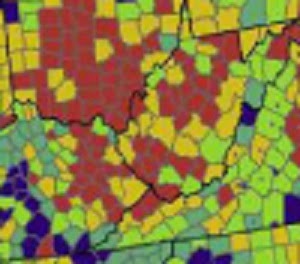
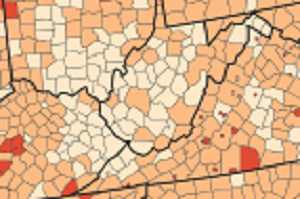
In my first Cascadian religion post I pointed to two maps, one on religious diversity, the other on religious adherence. Cascadia was one region that was high in the former and low in the later. There was one other region (actually a subset of a region) that showed the same trends, the upper Ohio Valley of Appalachia:

High in diversity:

Low in adherence:

Now, this can be a bit misleading and may only relate to Cascadia from a high altitude. This region likely is much more religious than Cascadia in a going to church sense. But, because there are simply so many religions here, they can sometimes be under counted.
…the southern areas with the highest numbers of unaffiliated and uncounted people are in the Appalachian counties of West Virginia, Virginia and eastern Kentucky — home to countless evangelical Protestant churches that are part of no denomination.

 And, here:

Appalachian religion is often associated with fiercely independent  Holiness sects and their rejection of educated clergy. This is but part of a pattern of persistent forms of rejection of the authority of educated professionals…

So, compared to other regions that were more homogenized and church going, Appalachia, in particular the upper Ohio Valley where many early Cascadians came from, was a rebellious soup of religion.

Compare that to New England, which by the 1840s (when migration to Cascadia had first begun) had just gone through a massive religious upheval. The Second Great Awakening was well into recession by this time, leaving behind its impact on other religious communities and New England in general:

Outside the evangelical churches there were also problems. In the
early stages of revivals, Episcopalians, Universalists, and Unitarians
were tolerant and sometimes mildly supportive. However, as passions
heated, denominational bigotry and a doctrinaire attitude was manifested
by many revivalists who denounced all who were not “born again.” Often
these were socially prominent people. This behavior alienated religious
liberals as well as non-Christians who resented the self-righteous
presumption of authority displayed by some revivalists.
In and out of
churches, it often became a question of power and control.

For the New England businessmen that moved to Cascadia, what they thought of religion was likely colored by cultural attitudes of the conflict after the Second Great Awakening. One New England founded frontier area (eastern New York) that predates Cascadia by a few decades was so impacted by the Awaking that it was eventually called “the burned-over district.”

The number of new sects (from proto-Mormons, to Shakers and straight up utopians) rivals the home spun religion of Appalachia.

Cascadia wasn’t founded by groups of godless settlers. But, it also wasn’t founded by a monolithic group that subscribed to one religion. Rather, both the Appalachians and Yankees that settled Cascadia came from fractured religious cultures where individual freedom and personal attachment to belief was valued over discipline.

It is also no wonder that the impacts of the Second Great Awakening, which in addition to utopians also produced social activists pushing towards feminism and anti-slavery would grow into Cascadia’s political liberals.

Too much capitol stuff and Lacey holds secrets (Olyblogosphere for February 10, 2014)

1. Did you know that freshwater clams are all over Capitol Lake? Now you do.

2. Did Freemasons have a hand in the landscaping of the Capitol Campus? Why should you care? Find out here in what is easily the best post over at Olyblog in a long time. And, bring a hat. Fez or tinfoil will do.

And, there’s a follow up post here.

3. It must be the energy of the legislative session. But, Heather posts about something up on the hill too. This time, George Washington’s face.

4. And, talk about hidden secrets: Panorama City has a thrift store. Damn.

“The air … seemed too rare for prayer” The long history of non-religious folks in Cascadia. We’ve always been godless sorts up here

It is sometimes implied that what makes Cascadia so darn Cascadian is a product of post Big Sort social impacts. Despite @ancientportland, you can often assume that the most blue and green parts of what makes us us are post World War II developments. But, certainly post 1960s.

Before that, Cascadia was a land of tree cutting, aluminum smelting Republicans bent on damming every river that could give a gigawatt, right?

Well, like the Cascadia Calm (ahem aka Seattle Freeze), how Cascadians approach religion has a much longer history, much longer than you’d assume.

In short, compared to other parts of the country, we don’t go to church that much. Not that we aren’t spiritual, we just as a region don’t go into churches. And, we haven’t for a very long time.

We’ve been the least churched part of the country since at least 1951, the date of the oldest survey data I could find. Both Oregon and Washington topped the list of least churched that year, with 27 and 30 percent respectively claiming membership in a church.

And, the non-pew sitting Cascadia goes further back than that even. In 1915, several church leaders put out their views on religion in the region(h/t Patricia O’Connell Killen).

Floyd Daggett:

The great problem, to my mind, in the Pacific Northwest is lack of religious life. Many causes contribute to this. The newness of the country, its people coming here from all parts of the world, strangers to each other, without the family and home connections; the population is cosmopolitan, with nearly every nationality represented, with a large proportion of Southern Europeans and Orientals, who have no religious life nor Sunday observance.

E.J. Klemme:

The people that builded this empire were compelled to push ahead or be pushed aside. They accepted the challenge and began crowding those in front with the same energy that they were being crowded by those behind. They knew no limit and recognized no master. Science was their handmaiden, and to succeed was the goal of their ambition.

This condition forced them to leave the Golden Rule beyond the Rockies, and they proceeded to do others before others could do them. In the East they were faithful church members; now they are not even church tenders. The ascent of the Great Divide seemed too steep for church letters. The air of the Northwest seemed too rare for prayer.

And, finally M.M. Higley. This fellow, instead of blaming the mountains and the air, might be hitting on something:

Another stumbling-block to a great many is the multiplicity of churches and creeds.

So, we know that the complaint of the unchurched Cascadia goes pretty far back. It would seem realistic that if it was true in 1915 and 1951 that it was also true in 1854 and won’t likely change for the near future.

I have a pretty good reason (better than blaming the hills) why Cascadia doesn’t go to church, but I’ll save it for next time. What’s your theory?

The isthmus if Wilder and White had gotten their way

This is a strange sentence to me (from the Capitol Vista Park website):

There is a continuity in the evolution of this vision from 1911, through
the development of Heritage Park and the Fountain Block, to this next
phase which will be the Capitol Olympic Vista Park.

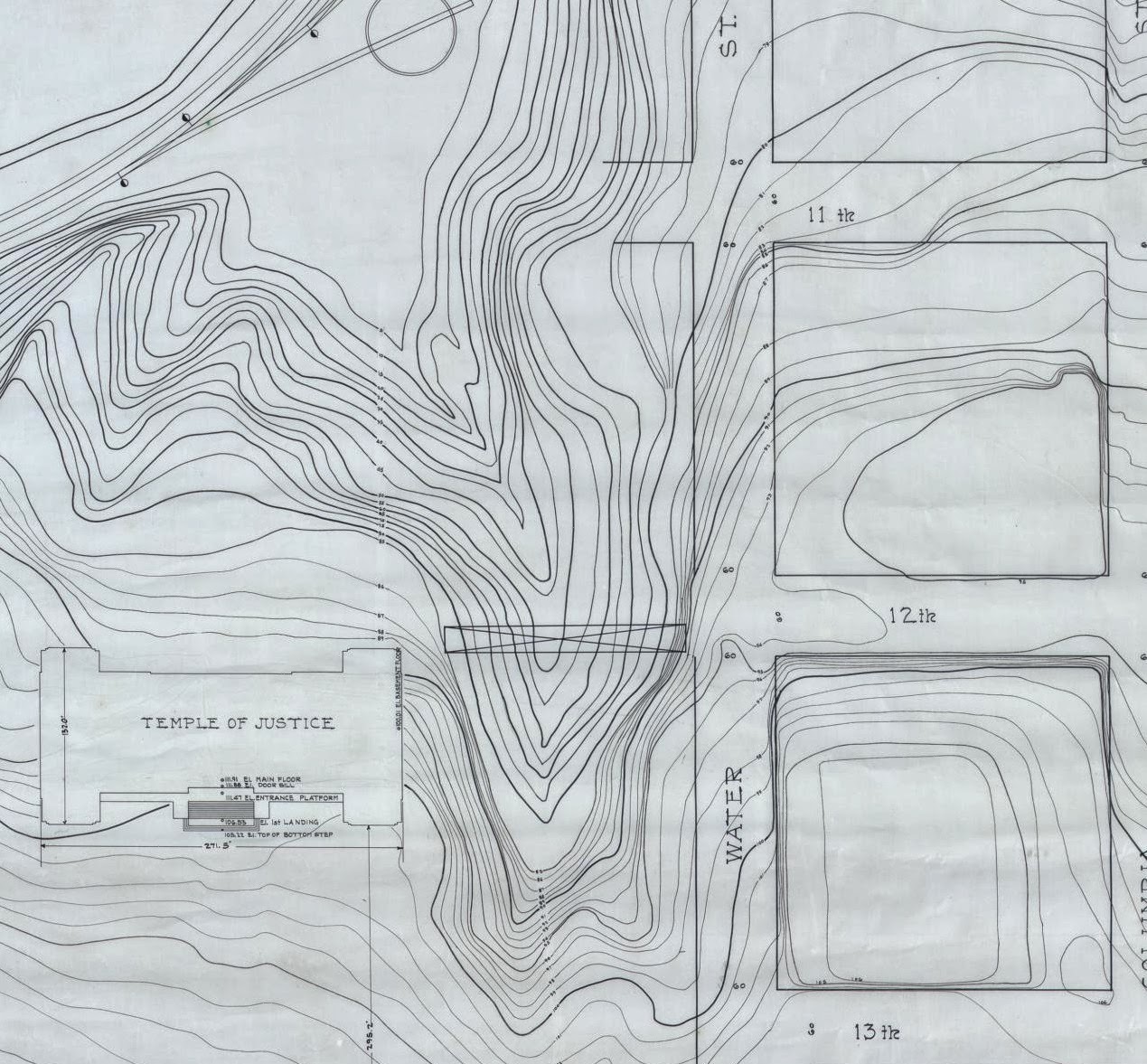
What’s being talked about here is the plan for a new park across the street from Heritage Park on what is common called the isthmus in downtown Olympia. Really, its one big earthen dam. But, what the writer here is referring to is a 1911 proposal for how that part of downtown should look.

Here’s a representation of what those early 20th century architects (Walter Wilder and Harry White) wanted:

What you’re seeing is something totally different than this:

Now, let’s take another look at the Wilder and White isthmus, this time with their blocks overlaid onto modern Olympia:
Now, let’s loop back to that first sentence again. Or, the phrases and emphasized: a continuity in the evolution of this vision. Evolution of this vision, which I suppose can also mean, this is something completely different.

Wilder and White did not propose a park across the isthmus, they proposed a few block of at least three or four story buildings.

This vision evolved, it evolved pretty darn far.
It is one thing to use a historic vision to argue for a change in how we lay out our city. It is something else to say the vision “evolved.” But, I think we’re owed a bit of honesty to how far that evolution has gone. In this case, from an urban neighborhood to parks.

Where is Cascadia?

Generally speaking, Cascadia is understood to be the “Pacific Northwest.” I don’t like that PNW term, mostly because it is inelegant, but also because it is a bad description. Seriously, northwest of what exactly. I live in the center of the universe.

But, this discussion of the geography of Cascadia, what is inside the region and what is not, is pretty vital to every other discussion about Cascadia. Where you draw the borders defines what politics, culture and social structures belong inside Cascadia.

There are three major lines of thinking in terms of defining what is Cascadia.

1. Oregon and Washington, maybe some of B.C.  


This is the
simplest map and the worst of all three. Basically take the state and
provincial boundaries for the three existing subdivisions and there you
go.

I’m not even going to bother trying to show you this map. What, don’t you know where Washington and Oregon are?

It lacks the elegance or real world common sense of both of the maps below. It ignores any similarity the Alaska or California might
allow parts of them to be included. Bad map.


2. Biogregionalism


This is definition of the region bases its definition on natural features. This is a strictly accurate definition based on the original concept of Cascadia from the 1970s. The original Cascadian thinkers brought a lot of ecology into their definition, so a bioregion made absolute sense to them.

Especially when you look a map of the “Salmon Nation,” it looks surprisingly similar to the Cascadian bioregion.


3. West of the mountains.

The limitations of the bioregion map is that it includes so many human communities that are different from the population core of Cascadia. In short, there is very little cultural, social or political connections between Moses Lake and Seattle. 

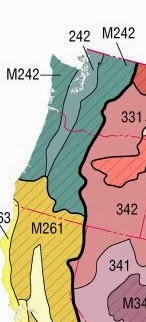
The best map of this region is from Colin Woodard’s “American Nations,” basically showing a Chile shaped country hugging the Pacific Coast.

While is may seem too small to be real, this strip of coast is densely populated with a consistent climate, culture and politics. Even going back to the formation of California, Oregon and Washington, this region has a common origin and settlement pattern.

Even when places like the interior of Washington and Oregon were attached to the Willamette Valley and Puget Sound, it didn’t take long for them to want to leave. In a much larger, bioregional nation, the interior communities would constantly be at odds with the urban coastal cities. While geographically close to Seattle, Portland and Vancouver, they are culturally and politically closer to the broader interior west.
 
May favorite map, if you were wondering, is #3. And, I know I’m well in the minority here. Most people it seems want to include some portion east of the Cascades. While I think there is some parts of Cascadia that are leaking across the mountains (Cle Elum and Hood River), more often than not, those dry side places have more to do with Wyoming or Idaho than Edmonds.

In a recent discussion on the Cacadia subreddit, the bioregional map by default chosen as the better map (and with percentages). Though, the coastal areas scored the highest overall, much of the interior was still included in the final map. Strangely (to me at least) the Bay Area scored very low.

Four answers to what makes Olympia different (Olyblogosphere for January 27, 2013)

1. Over at Olyblog, we have the question: What is there about Olympia that makes it different than any other city?

2. Answer one: A refreshingly honest blog and a great idea (Olympia as a place to call home on vacation as you explore western Washington).

3. Answer two: Have you ever met Berd? Interesting fellow. If you don’t appreciate his time lapse of lower Budd Inlet, there’s something wrong with you.

4. Answer three: People make things in Olympia, and sometimes they make a Queen Bee Scarf. I can’t really appreciate it, but I can see how people would.

5. Answer four: Jim Anderson is blogging again. Enough said.

Of
course this site is primarily here to help drive bookings to our
Olympia B&B. – See more at:
http://basecampolympia.com/updating-basecamp-olympia-yet-again/#sthash.4lOLVWTR.dpuf
Of
course this site is primarily here to help drive bookings to our
Olympia B&B. – See more at:
http://basecampolympia.com/updating-basecamp-olympia-yet-again/#sthash.4lOLVWTR.dpuf
Of
course this site is primarily here to help drive bookings to our
Olympia B&B. – See more at:
http://basecampolympia.com/updating-basecamp-olympia-yet-again/#sthash.4lOLVWTR.dpuf
Of
course this site is primarily here to help drive bookings to our
Olympia B&B. – See more at:
http://basecampolympia.com/updating-basecamp-olympia-yet-again/#sthash.4lOLVWTR.dpuf
Of
course this site is primarily here to help drive bookings to our
Olympia B&B. – See more at:
http://basecampolympia.com/updating-basecamp-olympia-yet-again/#sthash.4lOLVWTR.dpuf
Of
course this site is primarily here to help drive bookings to our
Olympia B&B. – See more at:
http://basecampolympia.com/updating-basecamp-olympia-yet-again/#sthash.4lOLVWTR.dpuf

Of
course this site is primarily here to help drive bookings to our
Olympia B&B. – See more at:
http://basecampolympia.com/updating-basecamp-olympia-yet-again/#sthash.4lOLVWTR.dpuf
Of
course this site is primarily here to help drive bookings to our
Olympia B&B. – See more at:
http://basecampolympia.com/updating-basecamp-olympia-yet-again/#sthash.4lOLVWTR.dpuf
Of
course this site is primarily here to help drive bookings to our
Olympia B&B. – See more at:
http://basecampolympia.com/updating-basecamp-olympia-yet-again/#sthash.4lOLVWTR.dpuf
Of
course this site is primarily here to help drive bookings to our
Olympia B&B. – See more at:
http://basecampolympia.com/updating-basecamp-olympia-yet-again/#sthash.4lOLVWTR.dpuf

What I got wrong with the history of the Deschutes Estuary

When I wrote up a longish history of the Deschutes River estuary, I summarized the late 1920s like this:

In the late 20s, Wilder and White and the Olmsted firm participated in a back and forth over the landscaping plan, with the state capitol committee in the middle. In one telling, the result was that all waterfront improvements (including Capitol Lake) were written out of the landscaping plan (Johnston, 91).

According to another Capitol Campus historian, Mark Epstein, Capitol Lake was retained in the 1920s landscaping plan, but in the form of Olmsted’s modest saltwater tidal pond rather than an aggressively dammed estuary (Epstein, 67).

Also, ten years after he first proposed it, damming the Deschutes apparently was not in the front of Carlyon’s mind. As Wilder, White and the Olmsted firm debated landscaping plans that could have included a lake, Carlyon wrote an essay about the vision and construction of the capitol group. Lacking from the essay is a single mention of a lake (Carylon, 1928).

Even though it was rejected in 1916 and was an afterthought in Carlyon’s mind by 1928, the lake project did not go away.

The late 1920s was an interesting time in the creation of Capitol Lake. The central part of the current campus was coming into form. And, the final push for the lake was about five or six years away from starting.

So, in the three versions I could find at the time, the lake was either totally gone from the plans, changed into a saltwater lagoon or just an afterthought.

But, I recently came across a piece in the Seattle Times that contradicts this. There was still some discussion in 1929 of a possible lake.

From April, 1929 in the Seattle Times about the need for plants for capitol landscaping:

It will be almost impossible to get too many plants, flowers and shrubs, for when the land strictly within the Capitol grounds is improved, there will remain the long stretch of shore land and overhanging cliff that some day will be included when the proposed fresh water lake is created by damming the waters of the Des Chutes River at the head of Budd Inlet.

 To me, this is a small corner of the lake and estuary history. The idea of the lake was already rejected in 1915. Tumwater wouldn’t agree to damming the river’s mouth and it wasn’t until 1941 that Tumwater citizens changed their minds. And, it wasn’t until the Little Hollywood shantytown took over underneath the capitol that Olympia residents seriously made a push for the lake.

But, still, I was wrong about 1929, so I thought I’d correct the record.

Your “Thurston County wasn’t always a liberal haven” reminder for Martin Luther King Day 2014

Update 8/22/2021: Given a few years learning more about Olympia’s past in this era, I am less surprised that Olympia was pretty racist in the 1960s or that Mike Layton himself was even more racist. Thanks to Robin in the comment below for spurring this update.

I’m going to leave this post in place, but I want to add a few thoughts up on the top to sand off the edges a bit. Specifically, the word “ghetto” is used in a way that may have had more nuance for Layton that I realized. Now I have come to understand that it was meant to imply the negative economic result of segregation. That if kept separate, one race would economically suffer, creating a housing ghetto of less desirable neighborhoods. The “happy situation” he was referring to could have meant integrated neighborhoods. I’m willing to give him the benefit of the doubt there.  

That said, the implication that black residents would be happier if they didn’t advocate for change is heavy in this piece. I’m not sure if Layton is writing for himself or pointing out the obviously wrong white point of view here. But that part still troubles me.

Read this crap (full size version here):

Let it soak over you.

Present happy situation could deteriorate into ghetto

Think about it.


…Negroes here are well educated, affluent and aware of their rights without being what whites think is “uppity” about insisting upon them.

This was published in the Seattle Argus in April 12, 1968. Martin Luther King had literally just been assassinated the week before. I have no idea about the weekly Argus‘ news cycle, but it seems at least in bad taste to publish something like this a week after the civil right’s leaders death.

At worst, the Argus editors and Mike Layton deliberately chose the week after King’s death for this. “Hey Layton! King’s death sure is leading the news, let’s do up a piece about how Olympia is being ruined by his sort!”

And, let’s get this straight. This was main stream thinking for our community. The Argus, while not a major daily like the Times or PI, was a serious Seattle newspaper. From what I’ve read about it, it would be close to what we’d consider the Weekly to be. Old time and storied reporters like Shelby Scates and Mike Layton passed through the Argus at different points.

And, let’s get back to Layton, who wrote this piece. When he passed away in 2011, there was a lot of good things said about him. “He bluntly spoke truth to power,” “a fierce reporter” and “could spot B.S. at a hundred paces.”

Well, that’s a funny way to put it, because the level of bull shit in Layton’s Argus piece the week after King’s death is amazing.

Olympia has obviously changed. Thurston County used to vote for Republicans (and Reagan specifically) and used to put up with this kind of racist crap. I’m not saying we should go back and absolutely revise Layton’s reputation, but we need to remember that this used to happen. And, we weren’t always nice, friendly liberal people.

How much does the Thurston County economy benefit from the legislative session

I suppose the best I can say is that it seems to take the edge off.

What I wanted to find out was what kind of impact the legislative session (hundreds of lawmakers, staffers and policy wonks coming to Olympia and Thurston County for at least two months every year) has on our economy. You could easily assume that it has some.

When people are in town for session, they have to eat, pay rent, entertain themselves and (I suppose) shop. Even just the work of lobbying, taking lawmakers out to eat, has to produce some economic benefit.

So, the best indicator I could find for economic activity by date was retail sales tax paid in each quarter. You can find the data I used here. Here are the spreadsheets I used.

First, I took all retail sales tax paid in the four quarters between 2005 and 2012 averaged out. I compared Olympia, Lacey and Tumwater with Bellingham. I used Bellingham as a stand in for a similar community to Olympia that doesn’t have a seasonal political population.

You can see a similar curve across both communities. Economic activity rises through the year, dropping back down each first quarter.

The curve from low activity first quarter to higher activity through the fourth seems to indicate that in terms of the broader economy, the legislative session doesn’t have much impact in Olympia. Despite the people visiting and temporarily living here for a few months, the economy here (which is still supported by the broader government) is too large to really for use to really see the impact of session.

But, if you take a closer look at just one aspect of the economy here, say food and lodging, you start to see some sort of impact. The chart below shows just the sales taxable activity in places like restaurants and hotels.

Again, you see a similar curve in both urban Thurston and Whatcom counties. But, the Olympia, Lacey and Tumwater curve is less pronounced, especially in terms of the first quarter. You could almost say the session (which would increase spending in the first quarter) takes the edge off lower first quarter spending on food and overnight rooms in Olympia.

Still though, even this kind of spending in the average first quarter isn’t as high as the third quarter. So, while there’s some benefit, it still seems smaller than what people often imply it to be.

The state of the amazing hills and the blogs in them (Olyblogosphere for January 13, 2013)

1. I’ve been up to this spot before. I wish I’d had thought to take a picture like this one. Amazing.

2.  Good idea:

I am planning to make my windows less reflective so other birds don’t attempt to fly through them. It
doesn’t make sense to create an environment that enhances our
bird-watching pleasure if it is fatal to the birds we are attempting to
attract.

 3. There’s a lot to be said about the King Tides this last week. Here’s Mojourner up at Mission Creek.

4. And, here’s the state of some wonderful blog up there in McCleary looking down upon us from the hills. Here’s to you Steve.

« Older posts Newer posts »

© 2026 Olympia Time

Theme by Anders NorenUp ↑