History, politics, people of Oly WA

Author: Emmett O'Connell (Page 23 of 176)

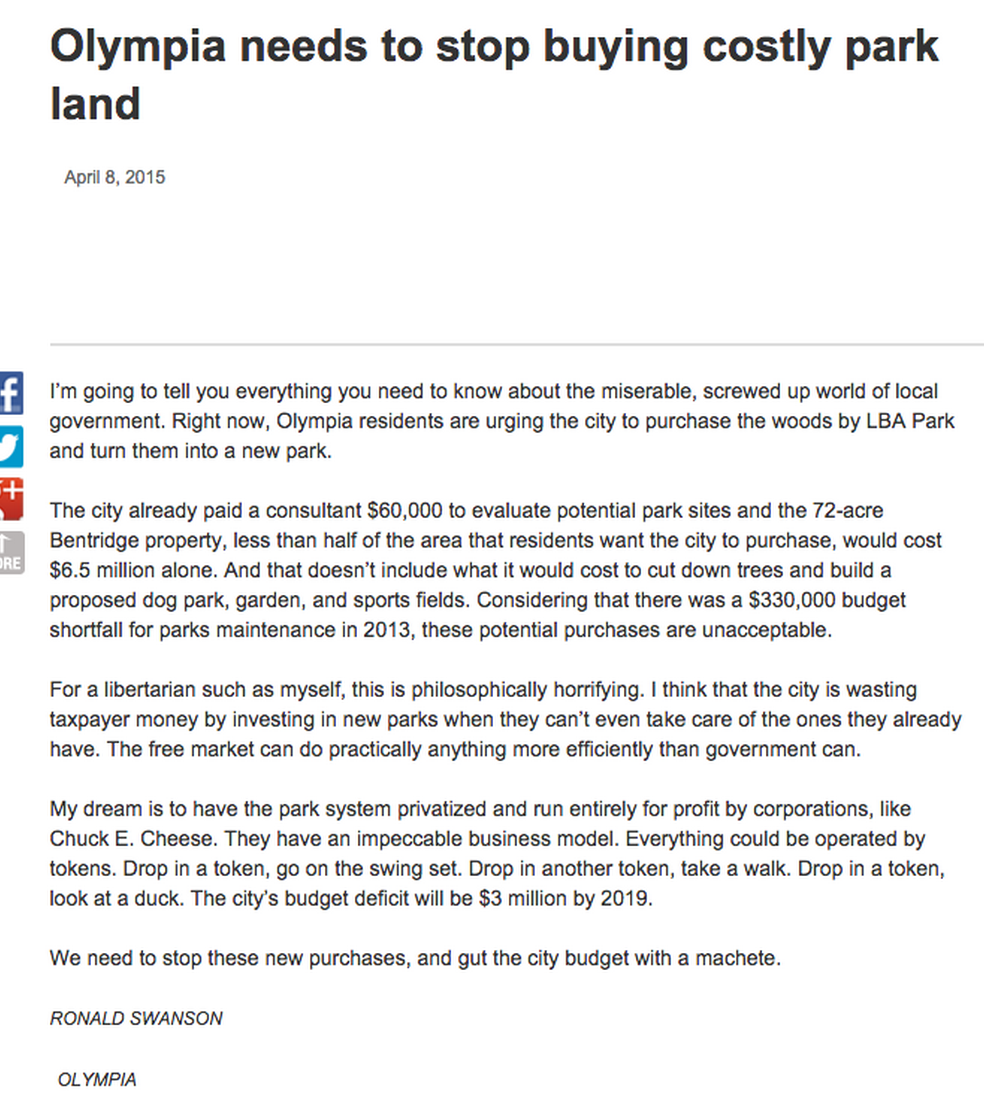
Someone got a fake letter published in the Olympian yesterday under the name of a t.v. character. But, that’s not even the worst thing

Yesterday, the Olympian published a letter to the editor written under the name of Ronald Swanson (google cache version is still up). On reflection, it was a pretty blatant joke that I should’ve gotten at first blush. I watched Parks and Recreation, but the entire Chuck E Cheese token joke I forgot.

When I read it first thing in the morning yesterday, I didn’t pause. Dumb letter, I thought, then moved on. It wasn’t until later in the day when I saw other people reacting to joke that it dawned on me.

So, that it got past the few people left at the Olympian doesn’t surprise me. People complaining about parks is pretty common chatter here, as I assume it is in most cities like us.

Meta took a tour of the empty newsroom at the Olympian recently:

The bad news becomes apparent as one walks past the front desk and down the main hallway to reach the newsroom. First, there is a large nook with two desks, facing into the hallway as if to welcome visitors into a major customer service hub, but now abandoned. Then behind those desks is another room with row after row of cubicles, about 30 or more, containing nothing but some cleaning supplies, folding tables, recycle bins, and other bric-a-brac in need of a storage space.

That’s the top floor. The bottom floor was once the print shop, but it sits empty too, as all the printing is now done in Tacoma.

At the end of that main hallway, a sign on the wall offers directions to passersby. Three of the arrows on the sign point toward the empty room on the top floor (“advertising,” “production,” and “online”), two point to the empty bottom floor (“circulation” and “production center”), and only one to an occupied space (“newsroom”).

Clearly, while The Olympian has more local staff than some outsiders might realize, they have many fewer than they had in their heyday.

So, what I’m saying is that its understandable. But, not the worst part.

The worst part is that the joke letter (harmless) ran alongside a letter to the editor from a former Secretary of State. He was writing in to counter a previous letter to the editor that had run in previous weeks.

Sam Reed’s letter didn’t just argue against the opinion of the previous letter, it had to clean up at least one factual error. That error was an election result in a nearby county just last November. I admit it wasn’t regional news that Clark County passed a charter last November along the lines of a sensational murder.

But, it was a result that most civically inclined people I know noted. And, it was also a fact that would’ve taken less than five minutes to check.

We need to debate our own important issues here. A letter to the editor column is a bit of a ham-handed forum anymore, but it is still a vital one. And, the value of that public forum is lessened when we can’t believe what is written there.

I’m rooting for the staff at the Olympian, but mostly I’m rooting for Olympia.

3 editors and an amazing photo. Just amazing. I’m not often amazed. (Olyblogosphere for April 6, 2015)

1. Did you know that Ken Balsley used to edit the Lacey Leader? Ken still covers Lacey and grades his mayor: B-.

2. Did you know the former publisher of the Olympian had a blog? Here you are.

3. This photo. Don’t go your day without seeing this photo. Very much. I mean, the way he’s laying there, still straddled. I also assume not awake. With his bag over his shoulder.

I’m just saying, photos don’t take my breath away, almost as a rule. This one does.

4. Alec Clayton, editor at Mudflat Press, blogs about the latest exhibit at SPSCC. Which also features one of the above editors. Guess which one!

State Capitol Museum on the chopping block. How much should I care?

No one seems to have noticed, but the state house budget (this one written by Democrats) puts the State Capitol Museum on the chopping block. Neither the senate budget nor the governor’s puts the museum to the ax.

This isn’t what I’d consider to be our local museum, that would be the Bigelow House. But, it is the most prominent museum in our city. And, so at least one part of the state government wants to close it.

But, I’m wondering how much I should care about that.

Mostly because it is for one Olympia and not the other. The museum is for Olympia-as-state-capitol and not as Olympia-as-community.

Obviously there are overlaps. There are people who live here that have had a significant impact on state government simply because they lived here. But, that isn’t what Olympia is, mostly.

And, so, this is whey I expect in Olympia, we’re not going to complain very much if they end up closing the museum down. It simply speaks too narrowly to our history and culture here.

Yes, the Lord Mansion is very pretty. And, it would be a shame to cut off public access to it. I remember biking over there when I was a kid in the summer, just to walk around. But, the museum now doesn’t speak to me much.

The best part of the museum is its small community room, the Carriage House. At least for me it is. Its the only part of the State Capitol Museum I’ve been to in the last 10 years, because it is where local historians hold talks.

But, those talks probably still might take place there. The house budget calls for the building to be passed over to another part of the state government, which leads me to believe it’ll still be available for rent.

The last thing that amazes me is the incredibly low budget line item we’re even talking about here. Apparently, the state provides only $242,000 a year to the state historical society to run the State Capitol Museum.

So really, is there a big reason that I’m missing that I would want to keep this incarnation of the museum open?

After the US Open this summer, Pierce County will still be $17 million in debt over the golf course

About a year ago, I took a crack at figuring out how much economic sense the US Open at Chambers Bay this summer made.

Overall, the academic research, finds little evidence that large tournaments (like the Olympics) make economic sense to local communities. They’re a loss leader. You pay to have them to bolster your reputation, not because you’re going to make money.

But, golf tournaments are different apparently. This is because golf tournaments don’t usually mean a community had to build a brand new golf tournament to host a major tournament.

In the case of Pierce County, Chambers Bay and the US Open, this is not what happened.

In fact, the Chambers Bay course was built specifically for the US Open:

The golfing world was stunned in 2008, when the United States Golf Association (USGA) made Chambers Bay the host of the U.S. Open. It just didn’t make sense. Only the most prestigious and hallowed courses were picked to host the national championship.

No course built in the previous 45 years had hosted an Open, yet Chambers Bay was picked after being open for about eight months.  

This was no fluke, though. It was years in the making…

This makes the Chambers Bay course more like an Olympic Stadium, leaving the county saddled with debt for the foreseeable future. It was only in the last few years that the course started paying for itself.

But, despite running in the black, the course still built up a fairly massive debt that it is yet to pay off.

The chart on page 44 of this document shows the various ways Piece County has built up debt throughout its budget.

Even after paying off more than half a million in Chambers Bay Golf Course debt this year, the county will still be in the hole $17 million on the course.

And, even from the county’s own (self proclaimed conservative) model, the county budget will only see a $600,000 bump in taxes this year because of the U.S. Open. The vast majority of the additional taxes paid here because of the U.S. Open will go to other counties and the state:

  • The State of Washington: nearly $6.5 million 
  • King County: $2 million
  • City of Tacoma: more than $440,000 
  • The cities of DuPont, Lakewood, Puyallup, Fife and Gig Harbor: a
    combined $153,000

Our man Joey DiJulio of Burien, the bachelor party and wedding in Philadelphia and the Cascadian Calm (among other regional personalities)

If you were paying attention last week, you saw this story:

For weeks, the man from the Seattle suburbs found himself getting emails from people he didn’t know about a bachelor party and a groom he’s never met. 

He saw names of Philadelphia landmarks like Reading Terminal Market thrown around in the emails but couldn’t put his finger on where they were located until he searched the names online.

“I had no idea what any of these places are,” said DiJulio, 31, who’s never been to the Northeast. 

“After Googling them, everything was pointing to Philadelphia.”

It turns out DiJulio, an information technology worker and a married father of one in Burien, Washington, had been mistaken for a friend of the groom with a similar last name. He sat as a “fly on the wall” for much of the email chain until Monday, when he broke the news after the groom’s brother wanted a headcount of people attending the party.

But it didn’t end there. Groom Jeff Minetti, 34, figured: Why not still invite him?

Well, why not indeed?

To me, the reason why not is obvious. You don’t know this person. He could ruin your entire wedding. He’s a stranger and you don’t invite strangers to your wedding.

But, that’s the Cascadian talking, and we’re not talking about a Cascadian who invited DiJulio to the wedding. In fact, the Cascadian DiJulio was the one who quietly watched as strangers talked around him. He didn’t chime in, he just waited.

This is the Cascadian Calm, the laid back, open and quiet regional personality that often gets described as the Seattle Freeze.

And, this is almost the polar opposite of the regional personality that DiJulio was dropped right in the middle of. In fact, Philadelphia is dead center inside a regional personality that has been described as “temperamental and uninhibited.”

Here’s another version of the same map, which shows the entire country in the same context.

Uninhibited makes sense here. It made total sense to the groom to invite the interloping and eavesdropping stranger.

Temperamental makes sense too. We usually think as temperamental as moody. As in “bad mood.” But, in this case, it means almost unreasonably good mood. “Hey, you’re a stranger that’s just been listening in?? Yeah! You’re invited too!”

But, it also means for that DiJulio, in contrast to the Cascadian Calm (which is very not temperamental), that there’s another side of the coin. People get angry man. Just saying.

Solar, the clown and food are real. Cop humor and zombies are not (Olyblogosphere for March 23, 2015)

1.The Sky Like A Scallop Shell loves. I mean LOVES! Solarpunk. So, come as no surprise, Procession is Solarpunk.

2. Yeah sure, they were cute. But the who Zombie thing up at the campus was totally overblown. Style over substance and no, they did not take over “Olympia.” Just the legislative building. And, they were lobbying for a tax cut. So boo.

3. Gale Hemmann writes up a neat post over at Thurston Talk. Seriously, the ethnic markets of Olympia and thereabouts.

4. I appreciate the effort. But, that’s an embarrassing effort. I can imagine what you were going for, but not good.

5. And, this is worth linking to just because Jusby posted something. Our favorite clown!

Merging Smith Troy and Enoch Bagshaw

About exactly a year back I wrote about how Enoch Bagshaw, legendary Husky football coach, collapsed and died in my own city.

It turns out my favorite Olympia politician had his own had in forcing Bagshaw to Olympia. Smith Troy, who eventually was Thurston County prosecutor, and then state Attorney General, and savior of Olympia (in both senses), had a hand to play in Bagshaw’s departure.

In the late 1920s Troy was student body president up at the University of Washington. There was apparently some sort of track team cabal that ran the student government back then, and they had it out for the football head coach.

It wasn’t just a student uprising either, or at least not in the sense that it was students pressuring the school’s leadership to do something. Bagshaw worked (in a sense) for the students. The student government funded the football team, and to a degree, they controlled Bagshaw’s employment. It wasn’t until the late 1930s when the student association reformed and the 1950s when they furthered themselves even more.

But, in the 1920s, Bagshaw was being forced out by the students, led by Smith Troy.

I don’t know the subtext of the fight. Just that Troy was in the front of the student body as they fought to remove Bagshaw.

Now, while Troy conspired against Bagshaw in Seattle, Governor Roland Hartley was fighting a running battle with the Commissioner, the State Attorney General, the Thurston County Prosecutor and the various arms of his own transportation department. And, the courts. The courts got involved too.

To put thing in perspective, Hartley is our Hoover. On meth. A Republican fiddling while the state’s economy comes crashing down around his ears. The last Republican in a long line of GOP dominance in our state, ushering in Democratic and centrist Republican rule for decades.

Hartley was mean, incredibly conservative and the battle between the other branches of government had turned into a turf war, each side trying to tear down the other’s offices. To the point that Hartley had a hard time staffing his transportation office.

Hartley, an Everett conservative capitalist, had brought in Everett logger Fred Baker to run the show. He resigned, so Hartley went back to the Everett well and brought up Bagshaw, the former Everett High School football coach.

Bagshaw (and this is apparently not a lie) was also a civil engineer in his previous life before becoming a full time college coach.

Its likely Bagshaw would’ve died no matter what. He was probably already sick when he finally resigned from the U.

Smith Troy was just starting his life. He was wrapping up school about the same time Bagshaw wrapped up his gridiron career. A year after his death, Troy was getting married and starting his legal life under his brother, Thurston County prosecutor Harold Troy.

When did downtown (or rather old town) Olympia stop being a place where people lived?

We don’t call downtown Olympia “old town,” even though that’s where the city grew from.

I’m not sure to what extent, but at a certain point in our history, the nature of downtown was much more residential than it is now. This is simply because no one in Olympia lived anywhere else. But, now downtown is the hole in Olympia’s population donut.

If you take a look at historic views of the older parts of town, they sure do seem a lot more residential than they currently are. Downright suburban even. Single family homes dotting well laid out streets. But, now those blocks are mostly commercial or retails spaces, with a handful of high density housing.

I suppose now that I think about it, I’m not absolutely sure that if you compared raw numbers, there’d be more people in downtown in 1910 than right now. What residential housing we do have is high density.

But, what we did have back then in terms of residential use downtown was much closer and interwoven with commercial and even industrial uses.

I suppose that’s my point: residential and commercial/industrial uses weren’t terribly separated. We were still pretty far off from the point when an entire street would be dominated by just houses. Or, just stores. You couldn’t drive anywhere, so if you couldn’t walk, it was inconvenient.

I want to take a closer look at this. You can see from the Sanborn overlays I linked to above that this is generally true. I’ve emailed Brian Hovis, who put the maps together, and I want to see if I can play around with a version of his work to see if I can mark residential vs. non-residential and try to compare it to the current day.

Real estate of Kurt Cobain’s life

If at least one of the houses that Kurt Cobain grew up in in Aberdeen won’t sell, but is still priced above the average for the neighborhood, what do you assume the selling power of Cobain to be?

A house out on Delphi and still owned by Courtney Love, and the likely most local last resting place of Kurt Cobain,  has been off an on the market for years now. And, it still hasn’t sold.

People know where Kurt Cobain lived and slept. But, it doesn’t seem like we’re at the point yet where that means anything extra. Other than noting that someone is trying to make a little bit more off of his name but can’t.

Maybe we’ll never reach that point of any historic value of the real estate.

« Older posts Newer posts »

© 2026 Olympia Time

Theme by Anders NorenUp ↑