History, politics, people of Oly WA

Author: Emmett O'Connell (Page 22 of 176)

A US Open Cup blowout and a dream of one big league around here

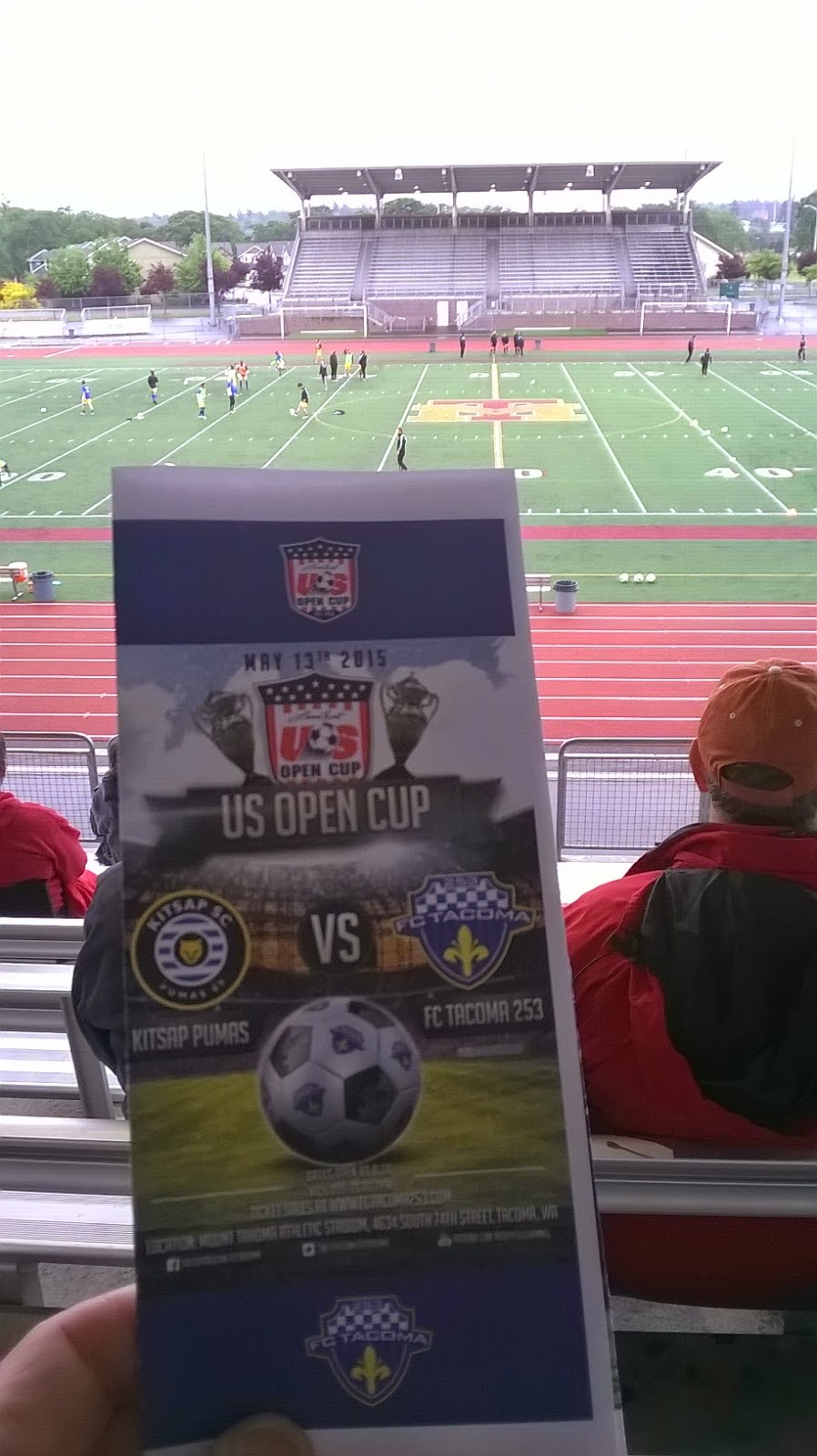
I was on hand for about 65 minutes of the 5-2 blowout of FC Tacoma 253 by the much better organized Kitsap Pumas. Enough about the US Open Cup being the real US Open.

What I want to talk about is the one big league.

I sat in the back of the stands at Mt. Tahoma High School. To the far right, at the other end of the stands, most of the Kitsap Pumas fans gathered. I was surrounded by a dozen or so folks obviously connected to the FC Tacoma organization. Then, way down the other end of my row sat a lonely fellow with yet a third team, standing out in his South Sound FC Shock track suit.

None of these three teams, though representing roughly the same level of American soccer, play in the same regional league. The Pumas play in the Premier Development League, where youngish and collegians play during the summer. And, both SSFC and Tacoma 253 play in different leagues that represent the high level end of things, the Evergreen Premier League and the National Premiere Soccer Leagues. The EPL(WA) has a more independent and homegrown flavor.

This is a lot of complexity in what should be a pretty simple thing. Back in the day, like in the 1960s and 70s, there was only one big high level amatuer/semipro soccer league in Western Washington.

Just like the formation of an independent indoor soccer league and the machinations of various soccer teams indoors, the existence of three outdoor leagues covering the same geography speaks to something. It points to internal league politics that were settled by simply breaking up into different leagues. Because we aren’t forced to live in a unified league system here, we can create whatever leagues we want.

This obviously serves the politics of each owners, they can align themselves with whichever other owners they like or get along with. But, it doesn’t serve the fans. Nineteen or so clubs across three leagues should be able to get together and hammer out some sort of unified league system.

Whether by promotion or relegation or splitting into north/south or east/west divisions, it would be very possible to create some sort of local April to August league around here.

I happen to prefer the home cooked flavor of the ELP(WA), mostly because I don’t honestly know why we need national non US Soccer organizations running low-level leagues.

Maybe that’s what needs to happen. Maybe these national groups, the NPSL and the PDL need to step away, or US Soccer needs to provide an alternative structure that leagues like the ELPWA could roll into. Something that allows for automatic births into the US Open Cup and the National Amatuer Cup.

But, something that brings these teams together and serves the interest of fans is much needed. Even though Kitsap thrashed Tacoma, there is simply not enough difference between the teams to justify totally different league systems between them.

Local Treasures (Olyblogosphere for May 11, 2015)

1. Man, you want to talk about local treasures? Your Daily Hour With Me is a local treasure.

2. David Raffin is pretty awesome. For a local treasure. I really like his books. But, I didn’t notice recently he’s been upping the post count on his blog. And, this is a recent one.

3. Common theme going on here. Local Treasures, David Scher Water is one as well. He’s also raising money (and knowledge) for a new book.

4. Lastly. Olymega. Man, what a treasure. These folks are also coincidently raising money.

When was the last gray wolf shot in Thurston County?

Wolves are on their way back in Western Washington.

At one point in our past, wolves roamed the place we now call home. Certainly Thurston County was on the edge of where these big dogs roamed, but obviously there were some that roamed down the Black Hills from the Olympics.

The last wolf pair was shot in the Olympics in 1938. That was the absolute end of wolfs in Washington until very recently.

But, as far as I can tell, wolfs came to an end in Thurston County maybe a few decades before. The last record I can find of a wolf being shot here was in 1909:

Joe Easterday came back home from a hunting trip that year, ranging from the Black Hills down to Oyster Bay. Among the dozens of animals he and his friends shot was a “timber wolf.” He pointed out that he likely would have stayed out longer, but the number of animals he had bagged was just too many to lug around.

Plus, Joe’s body had literally given out:

He says he would have been still in the woods if it was not for the fact that has shot so much that his arm is swollen and his fingers have increased to such a size that he can no longer pull the trigger. He visited a doctor to have his arm and hand attended to and while here will have his clothes padded so that his shoulder and side will not get black and blue in the future from the recoil of the weapon.

The expanding human footprint, plus “varmint hunts” and other likewise less than nice ways to say predator extermination programs, did the wolves in.

A notice for a varmint hunt in the 1911 Olympian listed the points given out by the Thurston County Association for the Protection and Propagation of Game and Game Fish. Two teams worked from May 1911 to February of the next year. The top hunter of either group would get $20, with lesser prizes for second and third. The losing team would throw a party for the winning side.

If you shot a cougar, your team would get 1,000 points. A wolf, 750 and likewise for a coyote. A fisher would get 500 points. And, last on the list of a dozen animals and their corresponding points, was the blue jay. That would get you 75 points for your team.

From the Morning Olympian, October 1909:

Just in case you’re wondering, I’m very pro-hunting. Very pro-killing animals for food. And, sport for that matter. Food is a higher moral calling though.
That said, I’m also pro-eating chocolate cake. But, no one should eat so much cake, or hunt so many animals, they literally have to go see a doctor about it.

Quick survey of a possible book: Cascadia Rising, how the far corner of the United States is actually taking over America (in response to Dixie Rising)

I should probably buckle down and read Dixie Rising, which seems to be a pretty interesting book. If only because it struck me as a political artifact of the pre-9/11 political writing in America. That stuff that wanted to drag the new Republicanism against the New Leftism, Clinton vs. Gingrich, that kind of stuff that crescendoed with Bush v. Gore, but seems so out of place today.

Anyway, the book (from what I can tell from skimming it a half dozen times) picks apart Southernism and looks at how it was infecting the U.S. back in the mid-90s. To get what I’m getting at, this survey of the book seems like a decent enough look.

Of course, in Dixie Rising, the author uses locations to illustrate his larger regional and national points, so I’ll try to do the same thing here.

1. South Lake Union and the Big Sort

This is the cutting edge of the technological wave that has crested and crashed along the west coast for years. New cancer research, new tech centers deep in urban Seattle bring yet again another wave of tech immigrants to Cascadia. This isn’t just a new decade, new well-educated immigrant rush to our region, this is the next wave of the Big Sort. The Big Sort has been the defining political and demographic trend in the last 50 years and its razors edge right now is South Lake Union in Seattle.

2. Crescent City and the Nones

Crescent City isn’t the least religious community in the United States. That award goes to Seneca Falls, NY (According to the 2010 US Religion Census. But, this small city on the far southern edge of Cascadia, isolated against the Pacific is the least religious community in the least religious part of the country. The Cascadians have never had much need for religion, and this trend is starting to creep across America.

3. Grants Pass and Scientific Denialism


Ugh. This is literally a dumb trend that I wish would go away. But, anti-vaccination activists are at a high tide in Grants Pass. But, it is more than anti-vaccine. It is an anti-science thing, anti-authority is more like it. From this one place, we can look at how science, government and authority is challenged in Cascadia.

4. Portland and the Sport of the Internet

As a passionate Sounders fan, I hate to highlight the Portscum Timbers in any way. But, for this narrative, I’ll have you know I am nothing but fair. But, the Sport of the Internet must be highlighted. From what is literally the third level of hell, we can see how American soccer fans found each other before old style media even took the sport seriously. That nowadays it isn’t about the media letting you know something is good, its about you knowing something is good and finding other people who think the same way.

5. Olympia and the DIY Platinum Record

DIY culture is a massive part of what makes Olympia itself to most people who don’t live here. Ben Haggerty is from Seattle, but he went to school at Evergreen. Likewise, for Kurt Cobain, I’d argue Olympia was much more important than Seattle. So, much like soccer making itself big and religion making itself small. Culture in Olympia and Cascadia finds itself, and sometimes doesn’t do shit. Other times it spawns The Heist.

Its all about procession, one way or another (Olyblogosphere for April 27, 2015)

1. Procession of the Species isn’t just the procession. Its almost everyone holding up their recording devices. Like everyone. This is an Andy Rooney thing for me folks. Let your brain record it, you know?

I’m not against recording, but does everyone need to do it?

2. Procession is slow! And this year is was chilly. No one was going to overheat, corset or not.

3. I remarked to someone during Procession that this particular image could become a logo for Olympia.

Really, and what I said under the first entry was really stupid. Don’t listen to me. Record what you want. Upload it, share it, keep it to yourself. I’m dumb.

4. In non-Arts Walk/Procession news, Olympia’s best blog covers local to statewide public transportation funding.

5. I kept on forgetting to mention this particular episode of Olympia Pop Rocks. I may eventually write an entire blog post about it (very likely now that I type that sentence). The episode is a thing of beauty. It flows between the art Olympia and the progressive politics in a lovely smooth way through the life of work of Meg Martin.

Excellent stuff.

Here’s a reddit thread on the episode, just for kicks.

When Cascadia lost to Washington in a poll in the Post-Intelligencer. And, are we named after Martha Washington?

As the long history of the Washington Territory was being rolled up, and statehood was on the horizon, a few people wondered whether it was a good time to change the name of the political organization. As long as we’re changing the nature of the organization itself, right?

So in May 1888, the Seattle Post-Intelligencer ran a poll, asking readers to suggest a new name. We’ve already read about how a few years earlier, our territorial representative suggested the name Cascadia for the possible new state.

From the PI:

The main cause of the desire for a change seems to arise from the fact that giving of the name Washington to the new state would lead to confusion, and that endless trouble and annoyance would arise from the confounding of the national capital and the political division on the northwest Pacific coast.

Washington not only won, but dominated:

Out to of 695 replies, 564 were in favor or Washington and these were scattered evenly over all parts of the territory. 

Interesting fact:

Another fact worthy of note is that there was an entire absence of any local prejudice. Yakima was favored by more non-residents of the valley of that name. Tacoma was the choice of more people in King county than the people in Pierce county, while nearly all of the expressions favorable of Rainier  were outside of Seattle.

Columbia finished second with 21, Tacoma 19 and Olympia 14. Cascadia was seventh overall, beating out variations of Washington and Idaho.
Towards the end of the story, the names relating to the Grays expedition was cited as a reason that Washington is so important and vital to our region. Just weeks after the constitutional convention was wrapped up in Philadelphia, Robert Gray left for the Northwest with his ships the Columbia and Washington.
Of course, now we have Grays Harbor, the Columbia River and obviously Washington State. Except the ship Washington’s full name was Lady Washington. Martha Washington.

Smith Troy and his long leave of absence that is so unlike Troy Kelley’s, but it still interesting

This is so unlike Troy Kelley’s leave of absence, that I almost can’t mention it.

But, Auditor Kelley’s leave put me on the trail, so we’ll start in 1941, when apparently war looked so likely that the legislature passed a law allowing elected officials to take long military leaves. The crux was that the governor was also the given permission to appoint a temporary stand-in.

I wrote a bit about Smith Troy’s leave earlier here. And, I’m not proud to report, I’m apparently wrong about a few details.

For Democrat Smith Troy, as he left Olympia for Fort Lewis, and then North Carolina, this meant Republican Arthur Langlie would be able to appoint his stand-in. But, that never happened. Troy stayed away, serving as a military lawyer in the 30th Infantry Division, advancing from captain to lieutenant colonel.

For most of that time, Fred E. Lewis, a deputy appointed by Smith in 1940, led the office. And, during those war years, “the office” of attorney general meant a great deal more than it had in the past.

Soon after being appointed (and then quickly elected) attorney general in 1940, Smith went to work consolidating his power. During the 1941 session, he pressed for a law bringing in all of the state’s legal work under his office. This move more than doubled the budget of his office, and obviously expanded the power of the state attorney general.

Lewis fought off attempts in 1943 to pull back that law, leaving the office in tact until Smith came back.

Langlie didn’t last through the 1944 election, and that’s when things changed for Lewis. Walgreen either caught on that Smith in absentia didn’t actually support him for the Democratic nomination. Or he just thought that governors, not absent attorneys general should appoint temporary office fillers.

Either way, by early spring 1945, Lewis resigned and Walgreen’s man Gerald Hile took control of the office. Hile had been as assistant US Attorney when he was called down to Olympia to serve as Walgreen’s in-office lawyer. It didn’t take long for the governor to place Hile as at least a temporary attorney general.

This is the scene that Troy returned to in the summer of 1945, literally sneaking back into town to take the oath of office. He’d been returned to the office months earlier, winning re-election while overseas in 1945. By September, he was officially released from the army, and Hile was released from his service too.

Here is that meta blog open thread you’ve been waiting for

Well, maybe I’ve been waiting for.

Either way, I think its about time to take a pause in the blog and let you tell me what you think about what’s going on here.

It has been about five years since I changed the tone of this blog and just over two years since I’ve really been trying hard to blog twice a week.

And, to be honest the last few weeks, I’ve been very close to missing that twice a week deadline more than once. Mostly, I think, I’ve not been feeling inspired by what I what I’ve written about and I need to touch base.

So, please, tell me what you think. What do you think of the blog lately?

The best US Open to be held in Pierce County this year isn’t even that US Open. And, it is because it isn’t big and expensive.

People getting kicked out of their homes so landlords can make a windfall.

The county that spent millions of dollars on the venue is giving a tax windfall to their more metropolitan neighbors.

And, when it all comes down later this summer, Piece County will still be in debt over their new golf course.

The US Open Golf tournament, though the most laudable of golf’s big tournaments because of its open format, is really just another television sporting event. The last time an amatuer won the US Open was 1933.

Sure, you may really like golf. This tournament in particular might excite you. I can’t argue about that. And, I’ve argued in favor of government spending on sporting venues when I know in my brain that they don’t make a return to taxpayers or the economy.

Mostly because I think team sports is important in setting a civic identity (so this golf stuff is something totally different for me).

But, people should know there is another US Open kicking off in Pierce County. The US Open Cup is a soccer tournament founded less than two decades after the first US Open golf tournament. And, like the US Open golf tournament (and dozens of other similar soccer tournaments worldwide) is open to any and all.

And, unlike the US Open golf thing, the US Open Cup operates in near obscurity.

On May 13, Tacoma 253 (a brand new team) will face off with the Kitsap Pumas at Mt. Tahoma High School in the first round of the Open Cup. The winner will face off against the Sounders 2 in Tukwila a week later.

I’ve made a habit of trying to get to as many US Open Cup matches as possible. I’ve been to Sumner, when Dox Italia lost to the Sounders U-23s. I was in Bremerton when the old USL Timbers beat the Kitsap Pumas. I’ve been up at the tiny Starfire Stadium in Tukwila to watch the Sounders beat everyone there. And, I’ve been to two finals in Seattle.

Every year during the first few rounds of the Open Cup, soccer pundits seems to fuss around about how we finally make the US Open Cup matter. While I think this is an important discussion, I think it isn’t the fault of the tournament. Its more of a function of how adult club soccer works on the lower levels than the tournament.

Tacoma 253 is literally a brand new team in Pierce County and (as far as I can tell) won’t even play more than two games near Tacoma this year. And, this doesn’t seem to be a rare thing in lower level adult soccer. There’s a lot of flux right now. What the tournament, and possible fans of lower level teams, is stability.

Once we’ve gotten attachments to these clubs, the tournament that involves so many of them, will grow.

And, grow the right way. Because I’m absolutely fine with it the way it is. And, what it is is something totally different than the US Open golf tournament. The games aren’t televised (except for usually the final). I love jamming through and early round night, flipping from internet stream to internet stream, following the action across the country.

I remember one particular night, when I watched the Atlanta Silverbacks play Georgia Revolution being webcast by someone literally holding up a cell phone in the stands. That same night Cal FC (an amatuer team from southern California) blasted the professional (but minor league) Wilmington Hammerheads 4-0. The next round Cal FC upended Portland Timbers 1-0 for a legendary upset.

And, it was all watched by hardcore soccer fans via internet stream.

This is what is beautiful about the US Open Cup. Small high school stadiums, shaky internet streams, live tweeting games not on the internet, rockus upsets by amateurs. Let’s not make this real US Open different, bigger, more televised. Let’s keep it small and dirty. If it gets bigger, its because the teams are more connected, not because there is more sponsorship money.

« Older posts Newer posts »

© 2026 Olympia Time

Theme by Anders NorenUp ↑