History, politics, people of Oly WA

Author: Emmett O'Connell (Page 157 of 177)

Wifi in Everett, why not Oly (Tumwater, and Lacey)?

Everett, our former mill-town brother to the north (aren’t all Puget Sound cities above a certain age “former mill towns?) is thinking about wifi. Specifically about this company.

Everett Herald:

City Councilman Drew Nielsen, who sparked a discussion of the possibility at the council’s annual retreat early this month, said the city could decide whether to pursue municipal Wi-Fi, or wireless fidelity, within 30 days.

“This would tell people something they may not realize: that Everett is very technologically capable,” Nielsen said.

By year’s end, everyone with a wireless-enabled computer in the city could have access to high-speed Internet service – completely free.

Everett residents who currently pay anywhere from $10 for dial-up Internet service to $50 or more for broadband service could use MetroFi’s Wi-Fi service for free. Those who frequent local hot spots, or wireless access points, as an alternative to residential Internet service could surf the Web at home.

Knowing what he knows about what MetroFi could do for Everett, Nieslen believes that if the city acted quickly, it could be part of a new wave in technology.

I’ll be interested in keeping up with the discussion up there because setting up a wifi network would be similar in Everett as it would be to in Olympia/Lacey/Tumwater. If you compare the total landspace and population of OLT (116 square km, 86,000 folks) and Everett (126 and 91,000) they’re pretty similar. If it could happen in Everett, it can happen here.

Plus, we have the benefit of being the state capital. What kind of company wouldn’t want to wifi the state capital?

UPDATE: When I first read the article above, I got this 1999 internet bubble sort of feeling about MetroFi, the company that Everett wanted to bring to town. But, looks like I might be wrong. They just dropped their for cost version and are going totally “free” because they’re making enough money from ads.
For full time public servants (and public financing)

As much as I hate to praise any Republican, Dan Swecker’s HB 6659 is worthy of half-praise. It helps solve a problem that is inherent with our legislature: only people who can afford to serve ever actually do.

The Washington leg is known as a hybrid: representatives and senators are paid salaries, instead of being totally unpaid or just paid a stipend, but they aren’t considered full time. Not only do you need a second job to serve, but you need a second job that allows you to take off for a few months every year, and a few days every so often for committee work.

There is no wonder why there are more than a few legislators who already work “political jobs” (see Swecker’s district mate Richard Debolt). A full time legislature will allow more “regular folks” (for lack of a better term) to serve.

That said, full-time legislators is only half the battle. The other half would be full public funding of legislative elections, as in Maine:

In two states, Arizona and Maine, campaign finance reform is opening the election process to newcomers and helping to break the lock wealthy special interests have on the legislative process. In both states, candidates for state offices win public financing on condition that they raise and spend no private money (including their own) and abide by stringent spending limits. To qualify, these “Clean Elections” candidates have to raise a large number of $5 contributions from voters in their district (the opposite of the system in most states, where candidates raise a small number of large contributions from a tiny, wealthy elite). Candidates who choose to run clean get public funds, and, if they are outspent by a privately financed opponent, additional matching funds are available.

In 2000, both states had maiden runs of Clean Elections, with promising results. A third of Maine’s legislators were elected running “clean,” as were about one-fifth of Arizona’s legislators.

Thinking about libraries and schools

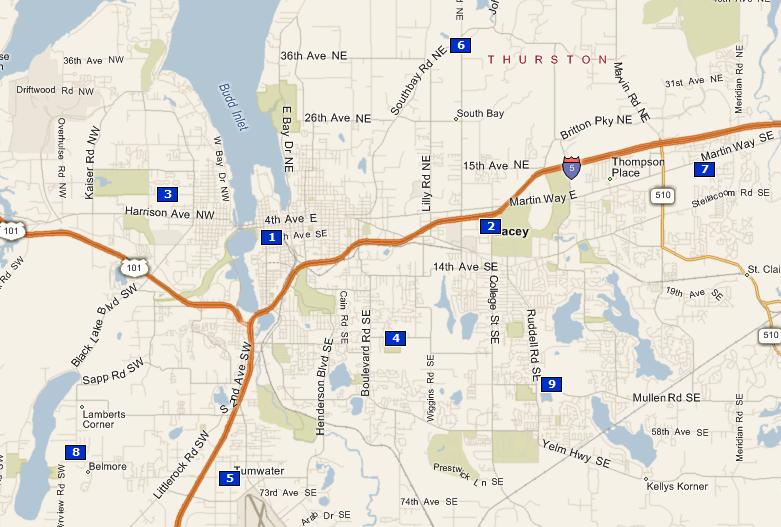
Two things are coming together for me, but I’m not so sure how far I would want to go with it. But, first, look at this map:


The numbers 1, 2 and 5 are the current locations of the Timberland Libraries in northern Thurston County. The other numbers include several schools in all three districts (Olympia, North Thurston and Tumwater), including Capital (#3), Timberline (#9), and River Ridge (#7) high schools and a few elementary schools (including McKenney [#4] down in my neighborhood).

I’ve been reading about libraries and schools a lot lately. Mostly about how libraries can become “centers of civic life.” I’ve also gone over some interesting stuff about how schools can serve the same role simply by staying open longer and becoming informal “Third Places.”

Anway, the Timberland system in the last few years has opened several “Cooperative Library Centers,” which are public libraries in school buildings. Combining the public space of a school with public library services builds on the mission of both organizations of public education. It also creates a more vibrant civic space in a building, that in many rural communities, is already the center of the community.

In Timberland’s more urban communities, especially Olympia, we’ve had trouble building new facilities. The last library bond, for a new downtown Olympia library, was voted down back in the mid-90s. But, the Olympia school district has a very good track record of passing levies.

Why not team library service with school buildings? Expand the current space for library services (even if its limited to one Westside Olympia school), expand community involvement in schools, and expand civic space.

Catholics not understood well by the religious right

I wasn’t going to write about this earlier today, because it didn’t surprise me that of the “Top 50 Most Influential Christians in America,” only two were Catholics and only one was a Catholic actually living in the United States (which is what I assume America is to the publishers of The Church Report. Rome not being in the United States).

Coming in at #44 is, of course, his holiness, Pope Bennie. I’ll let them slide on the entire Rome not in the US, because, being the religious leader of 25 percent of Americans, he is pretty influential. The archbishop of DC, Cardinal Theodore McCarrcik comes in at #47, right below Rick Santorum, and some guy who runs church Growth Today.

It doesn’t surprise me that only two Catholics made the list, but it still pisses me off. Instead of rambling out ten odd years of frustration, I’ll just say that I guess if you don’t have some really good t.v. and fall right in line with their Southern based political view of the world, you just don’t count.

I said earlier that I wasn’t going to write about this, not until I read my SoJo mail today:

Are Catholics and Evangelicals cut from the same cloth?

In the church of my childhood – a staunch evangelical church in central Illinois, just a few hours drive from Wheaton – Catholics were not considered to be Christians. I was taught in Sunday School that Catholics did not read the Bible and elevated Mary the mother of Jesus into a fourth place in the Trinity. Worse yet, we learned that Catholics did not believe Jesus died once and for all for our sins; he had to repeat the act every time the Catholics took Holy Communion.

My understanding of Catholics changed when I began working in ministry in poor communities first in the United States, and then Latin America. I met Catholics who loved to read the Bible and faithfully explore its message for their lives. On many occasions, I was humbled by their sacrificial quest to follow the path of Jesus.

Of course, over the years I discovered that there are all kinds of Catholics, just as there are all kinds of Protestants. Some Catholics are happy to go through the motions and find shelter in the security of orthodoxy. Other Catholics desire a living, breathing faith that fills them with wonder and purpose.

The article is about a faculty at a Protestant college that was fired after converting to Catholicism. In addition to again refreshing my memory of how my faith is viewed by greater American Christianity, it reminded me how some view anything around here.

Whether or not we can come to a common ground really isn’t important, because some of us aren’t going to let us even get that far. We are different, we think different things and we believe in different Gods, and some of us may not even believe in God. Either way, the lesson seems to be that “it’s not worth talking to anyone that you don’t already agree with,” which is sad.

the president of South Korea has three blogs

We sometimes talk about how cool it is that some county commissioners or congressmen blog (Oh how hip!), but President Roh Moo Hyuan has three blogs, and none of them on his official website. Rather, they are all hosted on (from what I can tell) are commercial, free, blog communities.

Oranckay doesn’t think very much of this:

Some have said one of Roh’s biggest problems is that he’s got his head buried in the internet. You know, instead of just governing without constantly trying to be best buddies with The Netizens all the time. I wonder if he is going to be able to sleep at night without wondering what kind of comments he’s been getting. (He’s been known to leave a few himself here and there.)

It goes on from there is the same direction, that it’s a bit unbecoming for a leader of such a high stature to lower himself. I typically transpose “citizen” when I see the word “blogger” or “netizen” these types of comments come off to me as a bit high falootin’.

Why is Oregon different regarding the primary question?


I would normally want to make this a longer post, and I might later on some other blog, but in case I have any regular readers, maybe someone would want to clear this up for me.

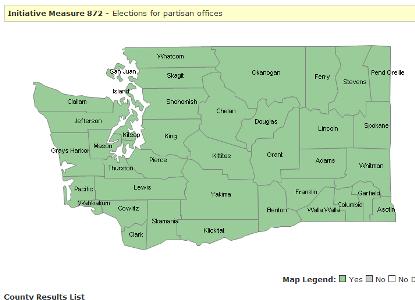
In Washington, despite winning popularly across the entire state, I-872 is almost totally panned by party activists. I’ve only seen myself and Tim Copeland from Blue Washington come out against the lawsuit by our party to overturn the new voting system. Not much debate among progressives, or among the politically engaged at all.

Yet, in Oregon, where the One Ballot Oregon initiative, there is lively debate among progressives. What’s the deal?

Brian Baird “Town Hall Shocker”

Apparently, the Republican house majority can keep a congressman from visiting citizen soldiers from his district (thanks Olyblog).

One Pissed Off Veteran (and probably more pissed off now):

I just got home from a “town hall” type of meeting with my congressman, Brian Baird (Washington 3rd)…

…he told an absolutely appalling story about what happened when he and his wife attempted to travel to Kuwait to make a personal visit to a group of National Guard troops from right here in this district who had been deployed to Kuwait and were on the verge of going into Iraq.

He contacted the commanding general of Task Force Olympia and was told that they would not allow him to make an official visit as a congressman and not be able to ask questions of the troops because — get this — That fat bastard, the Squeaker of the Hose, one Denny Fat-boy Clogged-arteries Supersize-me Make-that-three-triple- cheeseburgers Hastert issued an edict that no Democratic congressman could speak to the troops without a Repugnican sewer rat being present.

And people still wonder why we need to get that slavering pack of corrupt GOP bastards out of there.

Watch Unity Coalition forum online

UPDATE: Watch it here. I didn’t realize until just now, but Thurston County own’s Sam Garst moderated the forum. And, he did a good job.

The Unity Coalition forum will be online at TVW and on the tv (via email):

Yesterday, the caucuses of the Washington State Democrats gathered the candidates for State Party Chair – Jean Brooks, Bill Harrington, Mark Hintz, Dwight Pelz and Laura Ruderman – for the Unity Coalition forum. The candidates answered questions posed by each caucus and described their vision for the Party.

TVW, Washington State’s Public Affairs Network, taped the forum. They will be broadcasting the forum on Wednesday at 10 pm and Saturday at 7 pm. After Wednesday, you can also watch the forum on the Internet by going to TVW’s Web site, http://www.tvw.org.

Thank you for the caucuses of the Washington State Democrats for organizing this forum!

Open source county party platform

Cross posted at Betterdonkey.org:

Maybe open-source is an exaggeration, every party platform is usually pretty democratic. But, there is a point to where people don’t get involved or engaged in writing the platform of the party they identify with.

This year, the Thurston County Democratic Party is holding a series of open, public forums ahead of the precinct caucuses to start the conversation about what our platform should say.

Each in-person forum will also have a parallel online forum. While most of the topics have already been lined up, one of the in-person forums will have its topic determined by online comments.

Usually, folks show up to the caucuses and talk, over a few hours, about what the platform should include. Every four years, we also talk about who should be President, but this isn’t one of those years, so all we’re talking about is the platform.

This year, we’re getting a kick start on that conversation.

Each of the five forums (except one) will cover a section of the previous platform (such as healthcare or the economy). So instead showing up on a Saturday morning with a few ideas, we’re going to be talking together over, hopefully, a couple months to publicly brainstorm a platform.

The one open topic forum is in Bucoda, a small community in south Thurston County. Instead of limiting the topic of that forum, we wanted people to feel as welcome as possible to discuss any part of the platform they’d like.

My hope is that folks that wouldn’t ordinarily go to a weekend caucus would come to a public forum offering the opportunity to talk about what we should be fighting for. Or, others might feel more open to do the same thing online. Either way, the ideas generated online and in the forums will be forwarded to each of the caucuses for consideration. They have to be approved there, and then they’ll proceed through the traditional platform process.

Open source county party platform

Maybe open-source is an exaggeration, every party platform is usually pretty democratic. But, there is a point to where people don’t get involved or engaged in writing the platform of the party they identify with.

This year, the Thurston County Democratic Party is holding a series of open, public forums ahead of the precinct caucuses to start the conversation about what our platform should say.

Each in-person forum will also have a parallel online forum. While most of the topics have already been lined up, one of the in-person forums will have its topic determined by online comments.

Usually, folks show up to the caucuses and talk, over a few hours, about what the platform should include. Every four years, we also talk about who should be President, but this isn’t one of those years, so all we’re talking about is the platform.

This year, we’re getting a kick start on that conversation.

Each of the five forums (except one) will cover a section of the previous platform (such as healthcare or the economy). So instead showing up on a Saturday morning with a few ideas, we’re going to be talking together over, hopefully, a couple months to publicly brainstorm a platform.

The one open topic forum is in Bucoda, a small community in south Thurston County. Instead of limiting the topic of that forum, we wanted people to feel as welcome as possible to discuss any part of the platform they’d like.

My hope is that folks that wouldn’t ordinarily go to a weekend caucus would come to a public forum offering the opportunity to talk about what we should be fighting for. Or, others might feel more open to do the same thing online. Either way, the ideas generated online and in the forums will be forwarded to each of the caucuses for consideration. They have to be approved there, and then they’ll proceed through the traditional platform process.

« Older posts Newer posts »

© 2026 Olympia Time

Theme by Anders NorenUp ↑