History, politics, people of Oly WA

Category: thurston county Republicans (Page 1 of 3)

Move fast, break things: The life and times of Washington’s first black, female prosecutor

In the history of Washington state politics, some figures are remembered for their scandals, and others are remembered for their longevity. Then there is Bernardean Broadous.

In 1994, Broadous did not just win an election. She shattered a glass ceiling that had remained untouched since Washington State was founded. She was the first Black woman elected to a county office in the history of Washington, and the first African American to hold an executive county position in Thurston County.

Today, her tenure is largely a footnote. It is often treated as a failed experiment in management. Meanwhile, the man who replaced her, Edward Holm, oversaw an office that cost taxpayers millions of dollars because of his documented behavior. Looking closely at the years between 1994 and 2002 in Thurston County reveals a stark hypocrisy. We see a woman of color judged by the noise of change she was trying to force, while her white male successor was given a pass for actual, adjudicated damage to the public.

The 1994 campaign for Thurston County Prosecuting Attorney was a masterclass in grassroots disruption. Broadous was a Republican with only three years of legal experience. She ran against John Bumford, a veteran Democrat who was the hand-picked successor of the retiring 20-year incumbent, Patrick Sutherland.

On paper, Broadous was a long shot. Bumford had fifteen years in the office and the public endorsement of 26 of the 28 deputy prosecutors in the department. The institutional resistance was immediate. Before the first ballot was cast, her future subordinates called her incompetent in the local press. Bumford focused his campaign on experience. Broadous flipped that argument. She did not say she had more years in a courtroom. She said those years were spent perfecting a broken status quo. She accused the office of being too quick to settle cases and claimed that, as a deputy, cases were taken away from her when she refused to reduce charges.

Broadous used a specialized team of volunteers to bridge the funding gap. Bumford outraised her two-to-one, with the vast majority of his funds coming from his own pocket. Her campaign used a fleet of painted vans to counter the expensive bus advertisements of her opponent. They filmed Broadous in living rooms answering questions to show her forthright nature. This was a sophisticated data operation, too. Her team analyzed precinct numbers to find winnable areas in the suburbs. They timed their mailers to hit exactly when ballots arrived. This strategy worked.

Broadous pulled off a stunning upset and won by 867 votes. And, in the broader sweep of history here, it was the last stand for Republican institutional power in Thurston County before it became a Democratic stronghold. 1994 was the last high-water mark for Republicans in Washington State and Thurston County, before falling reliably into today’s pattern.

Broadous entered office in 1995 with a mandate for change. She inherited an office that had functioned under one man for two decades. She brought a focus on accountability and efficiency. Her most significant achievement was the Juvenile Diversion Reform. Before Broadous, the juvenile system was slow and lacked direction. She started a program that required offenders to face sanctions or charges within 12 days of an arrest. She used Community Accountability Boards made of local volunteers to determine punishments. This program resulted in a 50 percent reduction in felony recidivism. Broadous was also a founding architect of the Thurston County Drug Court. She pushed for a system that offered non-violent offenders treatment and testing as an alternative to jail. She believed the message of the law was lost if punishment was not swift and sure.

Just looking at the raw numbers, prosecutions in Thurston County went from around 1,000 each year before Broadous to nearly double that during her tenure.

However, we cannot ignore that these reforms created internal conflict. Broadous was a demanding manager. She restricted plea bargains to prevent deal shopping. This stripped deputy prosecutors of their autonomy. To Broadous, this was accountability. To her staff, it was a lack of trust.

In her first 19 months, 18 deputy prosecutors left the office. This high turnover became the main criticism against her. Critics claimed the remaining staff were overworked. Defense attorneys complained that her refusal to negotiate was clogging the court system. Broadous did not back down.

By 1998, Ed Holm saw the turnover in the office as a political weapon. He campaigned on a platform of restoring stability. The narrative against Broadous was cemented by two legal actions filed just weeks before the primary election. In July 1998, a former employee named Betty Benefiel filed a lawsuit alleging Broadous treated her unfairly. In August 1998, a secretary named Sheila Kirby filed a claim for emotional distress. Broadous called these attacks politically motivated. The timing was certainly suspicious, but the damage was done. Holm used the lawsuits to argue that Broadous could not lead. Broadous lost the election and received less than 40 percent of the vote.

Holm was hailed as a stabilizer.

But the stability he promised was a myth. By 2001, three female deputy prosecutors sued Holm and his management team for sexual discrimination and a hostile work environment.

The details revealed in the Holm trial were far worse than anything alleged against Broadous. The plaintiffs alleged that women were given lower pay and less desirable assignments. They described the office as a boys’ club. The lawsuit detailed inappropriate sexual comments and lewd jokes. The jury eventually found that Holm and his office retaliated against the women after they complained about the discrimination. In 2006, a jury ruled in favor of the women. They found that the county had discriminated against them based on their gender. They also found that the office had created a hostile work environment.

The most telling part of this story is the final cost to the public. The lawsuits against Broadous that dominated the news in 1998 went nowhere. They stayed in the court system for four years. In 2002, after Broadous was out of office and Holm himself decided not to run again, the parties signed an agreement to drop the cases. No money was paid to the plaintiffs. No wrongdoing was ever proven. The cost to the taxpayers for these lawsuits was zero dollars. These claims were dismissed with prejudice, meaning they could never be brought again.

Compare that to the Ed Holm settlement. The jury awarded the three women $1.52 million for the discrimination and retaliation they endured. The judge then added $1.45 million in attorney fees. By the time the case was fully settled and the appeals were finished in 2011, the total cost reached nearly $6 million. When you weigh the two administrations, the Broadous years were characterized by administrative friction and turnover that cost the public nothing in court. The Holm years were characterized by systemic misconduct that left the county with a multi-million dollar bill.

The historical memory of Thurston County should take another at Bernardean Broadous. She was a historic first who tried to modernize a stagnant system. She was a Black woman who walked into a white male-dominated field and demanded high standards. She was punished for it. We remember her for the turnover and the noise of lawsuits that ended in nothing.

If you’re a Republican in Thurston County, shouldn’t all these Independents bother you?

If things go a certain way, it is possible that come January Thurston County will have three commissioners that are not Democrats for the first time in my memory.

But, none of them would be Republicans either.

Admittedly Bud Blake (elected two years ago), Gary Edwards (who was a Republican in the past and might be elected this year) and John Hutchings (also might be elected this year) could easily be Republicans. But, this year they’re all Independents. And I don’t think I’ve heard a good explanation as to why.

As much as I’d like to ask Edwards why he ditched the Republican Party, I think I know the cynical answer. Blake showed that a conservative could be elected countywide if they ran without the Republican name.

But, mostly I want to hear from Republicans. And, I know how hard it will be for me in particular to get answers from Republicans given my point of view, but I’m honestly interested. I’ve spent the last few weeks poking around various online forums and communities for local Republicans and have come up short.

Shouldn’t conservative candidates run as Republicans? Even if they disagree with 20 percent of the Republican platform, there is enough “big tent” in the party to contain them right?

If you are a Republican, and feel so inclined, fill out this short survey (LINK).

EDIT: Emmett, do more research. Gary Edwards should tell the truth about who is responsible for the Tyson Seafood plant purchase

Well, when I’m wrong, I’m wrong. I was wrong about this one.

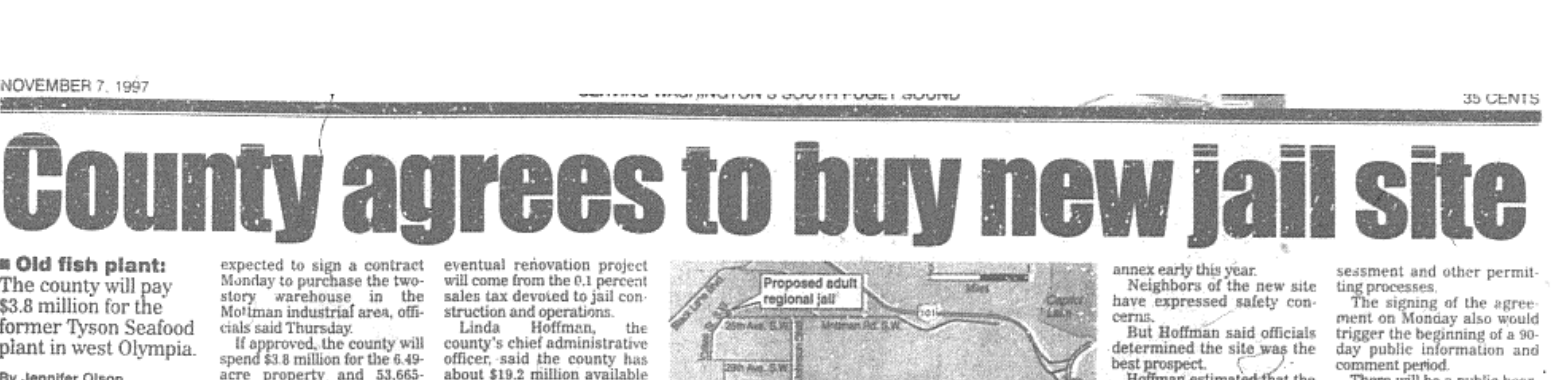
From the Olympian in 1999.

My research stopped in 1998 soon after the purchase of the property when Oberquell and O’Sullivan both made steps to move forward and Edwards was largely silent. If I took one more step into 1999, I would have seen organized and vocal opposition by both commissioner O’Sullivan and Sheriff Edwards.
I still think there’s a point to Commissioner Oberquell being involved in the original purchase of the old seafood plant. And, I think Edward’s implies too heavily that the plant was purchased under the leadership of the current commission. But, that said, I was wrong.

Gary Edwards, now candidate for county commission, gives a long-winded interview to a local conspiracy theorist. It includes this small little gem about a listless county commission, stumbling into a multi-million dollar problem:


Gary, you’re so smart. Only if we’d listen to you then. Or your supporters.


But, it turns out that not only was Edward’s complicit in the purchase of the Tyson Seafood plant in the late 1990s, but two of his supporters help guide the purchase and early development.


First though, I should back up and say that Edwards glosses over the legal situation the county was in at the time, by simply saying “I was running an overcrowded jail.”


Back in the late 90s, the Thurston County jail wasn’t just overcrowded. It was beyond that, it was inhumane. To the point that the ACLU was pressuring the county to improve the conditions in the jail. Edwards was running a bad jail.


In a letter from that era from the ACLU:

As long ago as 1996, we reported to you some of the complaints that inmates relayed to us. These included:

  • severe overcrowding, with many inmates forced to sleep so close to toilets that they were stepped on or urinated on by other inmates
  • poor sanitation and lack of access to hygiene supplies
  • infrequent changes of clothing and linen
  • denial of prescribed medications and lack of treatment for health care
  • limited indoor or outdoor exercise areas
  • lack of access to a law library
  • inmate kites or grievances not answered
  • broken plumbing and poor ventilation

Most of these problems were directly attributable to overcrowding. We received complaints from corrections officers as well as inmates, who also expressed their concerns that the dangerously overcrowded situation made their jobs unreasonably dangerous due to the enhanced risk of injury from assault, fire, and communicable disease.

So, as a way to push back against overcrowding, the county commissioners spent $3.8 million to buy an old fish processing plant only a few miles from the current county jail.


So, who was on the county commission then? Diane Oberquell, who is listed as an Edwards supporter, Judy Wilson and Dick Nichols (both Republicans). When Edwards was serving as county sheriff at this point, he was also a Republican.


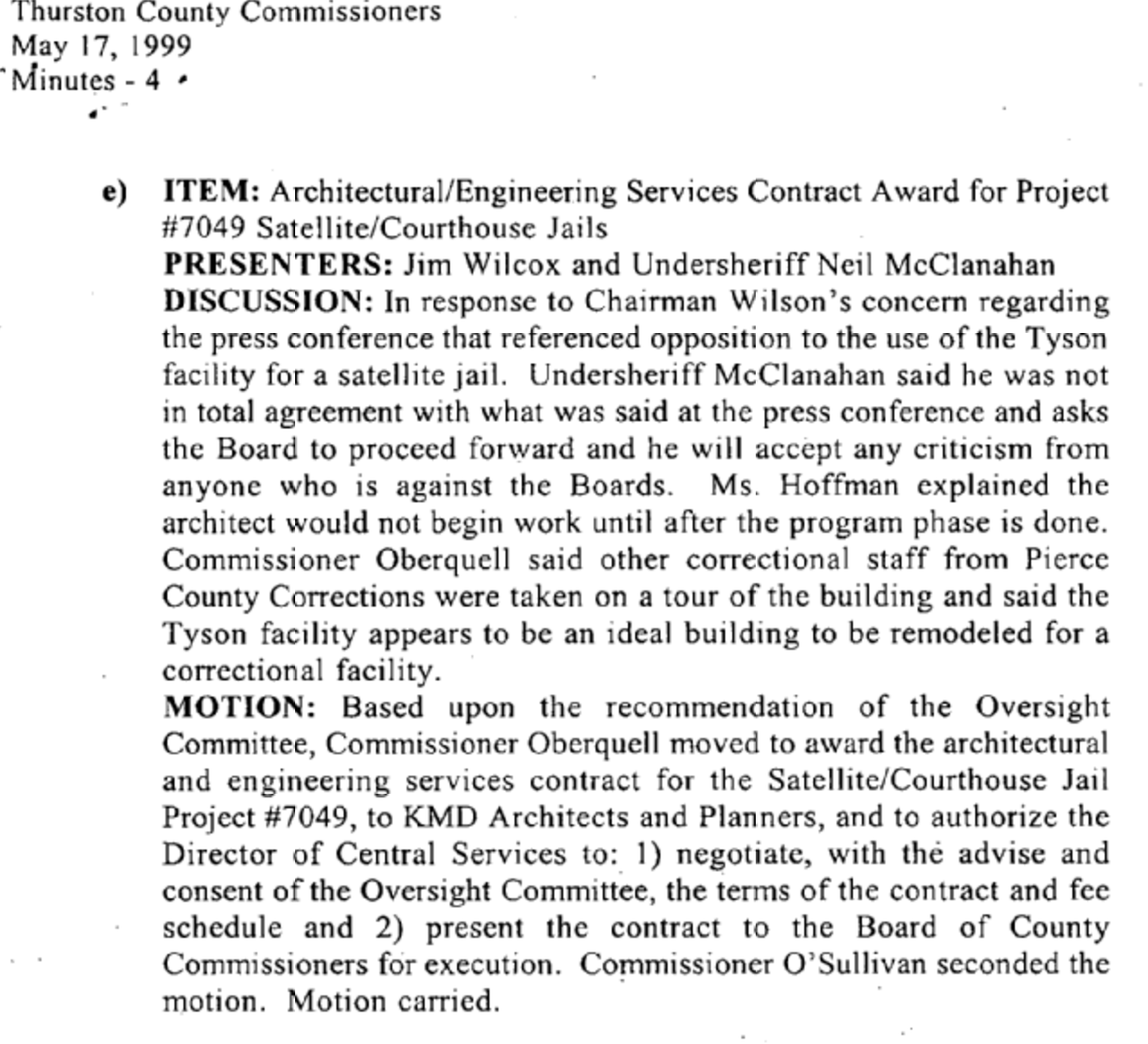
And, since even satellite jails take time to develop, the Tyson plant (though purchased by this point) was still a topic in 1999. By this time Nichols had retired from the commission and had been replaced by Kevin O’Sullivan. Commissioner O’Sullivan was part of the county commission (along with Wilson and Oberquell) that continued to push for the use of the Tyson plant as a jail. O’Sullivan also currently endorses Edwards.


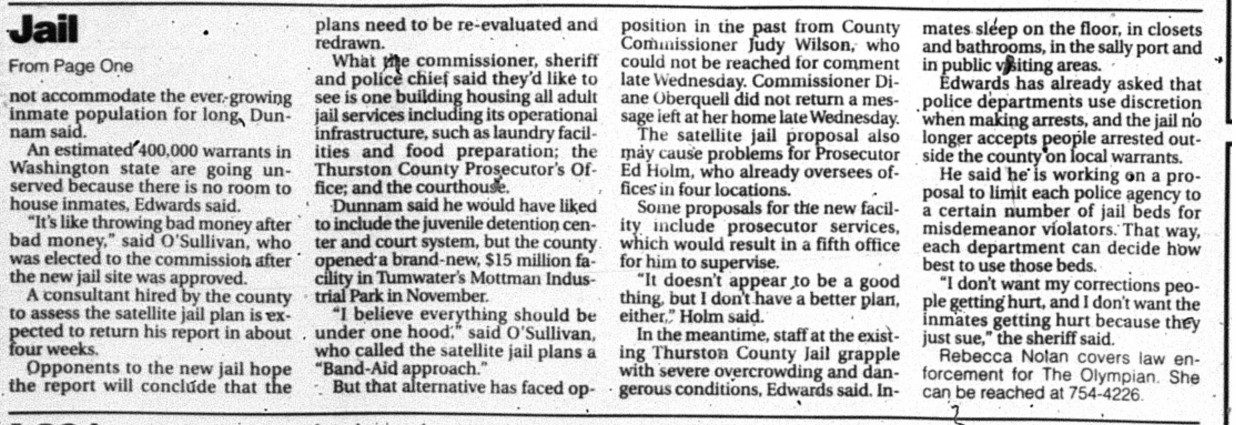
I can’t find anything in the record during those years Edwards speaking up against the Tyson plant purchase. In fact, what I did find was advice by the sheriff’s office to move forward despite growing public opposition to the plan.


Here is a portion of county commission minutes that show not only one of Edwards’ undersheriffs pushing for the Tyson plant, but also Oberquell.


When it came time to decide whether to purchase the seafood plant that Edward’s now criticizes, it was his supporters and employees were at the helm. Also, as county sheriff, he was in a choice position to publicly call out what he says now was a horrible waste of money.


By being vague about it now Edwards seems to hint that the current commission (the longest tenure of which didn’t begin serving until 2000) is at fault. But, when you scratch the surface just a little bit, the people now surrounding Gary Edwards first dug the Tyson Seafood plant money pit.

Improving Gary Edwards’ math

A few weeks ago I took a shot at Gary Edwards’ fuzzy math on population change in Thurston County. In this post I wanted to take a closer look at the deeper assumptions in what he’s trying to get at.

His point (basically) was that although the population has increased in Thurston County, the number of deputies has stayed the same. The problem was that the population has increased (in unincorporated Thurston County) only half the amount he claimed. Which is okay, from his point of view, I suppose because population still went up while the number of deputies stayed flat.

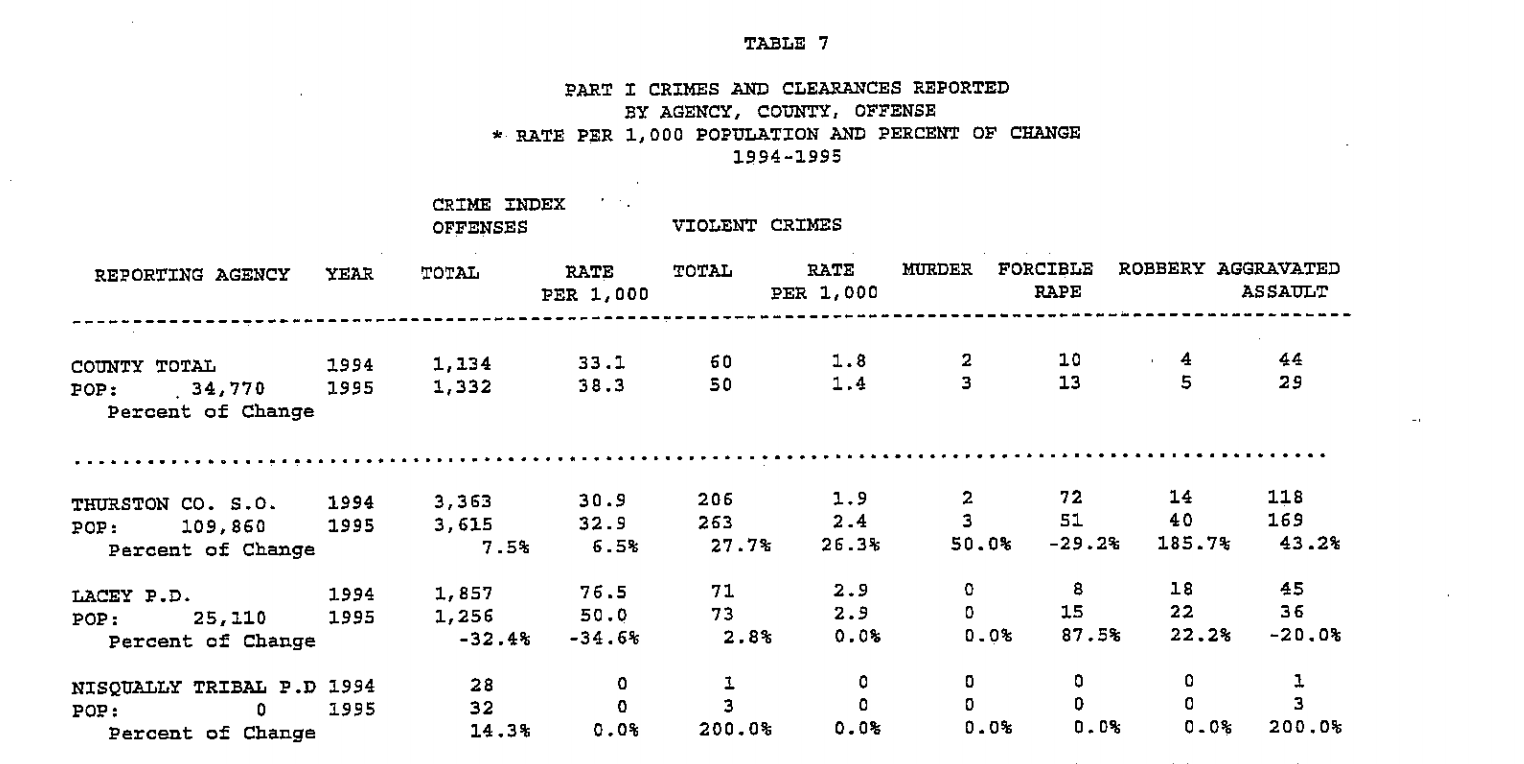
But, that statement seems to assume a result, such as an increase in crime. So, let’s take a look.

1995 Most recent Difference
Lacey 50.00 64.60 14.60
Olympia 67.80 86.30 18.50
Yelm 75.90 78.00 2.10
Tenino 86.00 42.00 -44.00
Tumwater 75.30 84.20 8.90
Thurston unincorporated 32.90 36.30 3.40

So, what it looks like here is that the crime rate did go up in Thurston County, but not nearly the rate that it increased in Lacey and Olympia. If we have a problem with an increase in crime, its in the urban areas, not in rural Thurston County with its stable level of policing.

Also, let’s take a look at another metric, the total number of police in each Thurston County city and the ratio of police to population:

1995 total 2015 total Change 1995 ratio 2015 ratio Change
Lacey 38 50 12 1.51 1.08 -0.43
Olympia 67 68 1 1.8 1.33 -0.47
Yelm 9 12 3 4.3 1.47 -2.83
Tenino 5 2 -3 2.38 0.87 -1.51
Rainier 4 0 -4 2.78 0 -2.78
Tumwater 20 22 2 1.93 1.41 -0.52
Thurston unincorporated 79 80 1 0.72 0.57 -0.15

Every police department has seen a decrease in the number of police on patrol compared to the population. By this metric, the ratio of police per person has dropped the least in the Thurston County sheriff’s office than anywhere else locally.

So, while Edwards is still right that population went up and the level of policing stayed stable, he’s implying a connection that really isn’t there. The Thurston County sheriff’s department saw a stable cop to resident ratio (compared to other local law enforcement departments) and this did not result in an increase in crime. 


Also, here’s the spreadsheet (plus references) I was working from all along, just in case you want to check my math.

Checking Gary Edwards’ Math

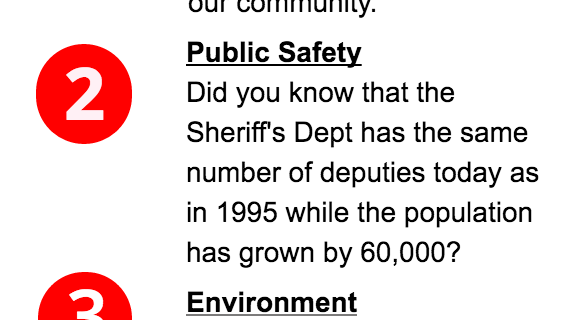
Former Thurston County Sheriff Gary Edwards is running for county commissioner. So, it would make a lot of sense that he’s making public safety (more cops on the streets, or deputies on the road) a campaign priority.

Number two in fact:

I can’t disagree with his statement that the number of deputies hasn’t increased in over 20 years, but I thought I’d check his population numbers.

As I’ve been reminded, the Thurston County Sheriff only works in the unincorporated parts of the county. So, “the population” that his statement refers to must be the unincorporated population. Otherwise, the statement wouldn’t be unnecessarily inflated.

But, either way, he’s wrong.

1995 Most recent Difference
Thurston 192,013 262,388 70,375
Lacey 26,419 44,919
Olympia 39,292 48,338
Yelm 2,242 8,223
Tenino 1,299 1709
Rainier 1,350 1,923
Tumwater 11,534 18,820
Incorporated subtotal 82,136 123,932
Thurston unincorporated 109,877 138,456 28,579

He could use the top number, the total difference between Thurston County in 1995 and right now and be closer to his 60,000 number. But lumping in the populations of cities covered by their own police forces would be misleading.
Or, he could cut his number in half and be more accurate. But, the number would seem less impressive, especially against a six figure total population figure.
What really impacts me is that this table took me all of ten minutes to put together. Getting the accurate number wasn’t hard for me, Edwards should have bothered to do the same work. Not doing so make it seem like to me that this is more along the lines of something he heard somewhere and decided to make a campaign platform.
It is also worth noting that a total population is not a very good standard for judging the effectiveness of policing. What would be a better standard would be comparing crime rates in 1995 and 2016, right?

How Bud Blake won in Thurston County

By basically beating the Grand Old Party in every precinct in the county. Basically.

Republicans tend to lose in this county. Up until now we had a all-Democratic commission and every other elected official was Democratic, save an Independent sheriff.  I assumed going into this race that Blake would do better than Republicans in general, and it turns out he did well enough to win.

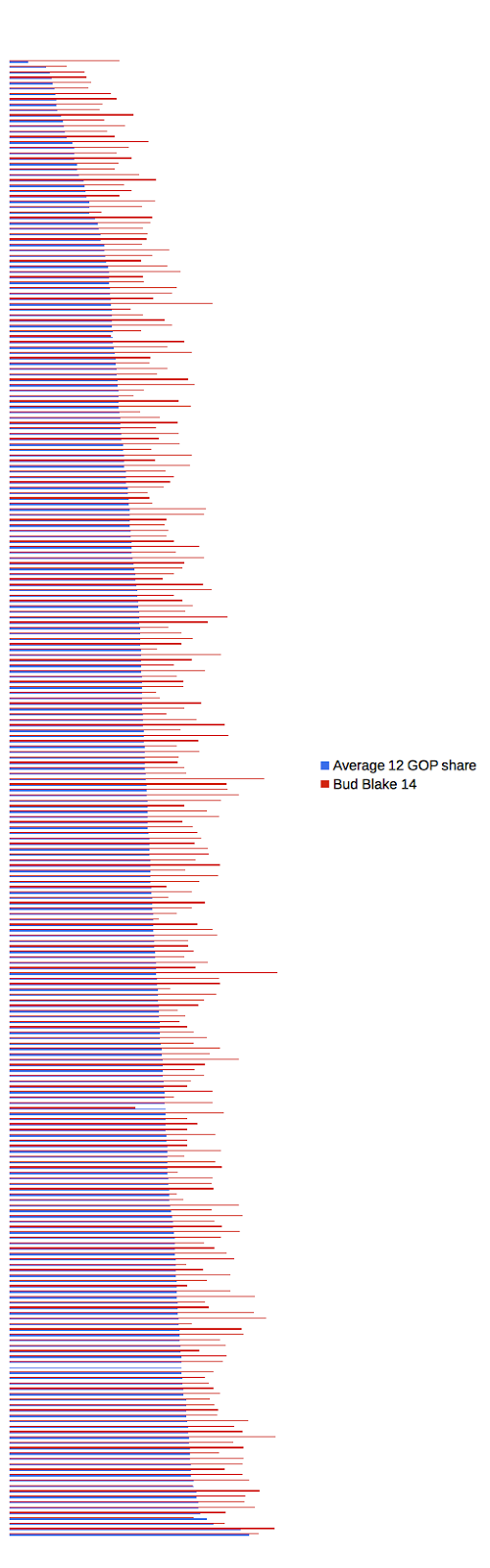
Here’s the data I’ve been playing with. I took the three Republican results from 2012 (Senate, governor and President) and averaged them. Then I compared Bud Blake’s performance.

Here’s a chart to illustrate my point:

Basically, what you’re seeing here is Blake beating the GOP turnout everywhere. Even in places where Republicans do horribly, Blake kept a consistent advantage over the GOP performance.
I’m not sure what to chalk this up to. Whether Blake really did perform better as a candidate, so his party label meant little. Or, that the Republican brand in Thurston County that you could take a standard business friendly candidate, strip him of his party label, and he’d win.
But, where exactly was he strongest?

The deeper the red dot, the more votes Blake got against the Republican average.

Basically, again, Blake did better than the average Republican candidate in Thurston County literally everywhere. But, if you were to pick out hot spots, it would be in the outer reaches of Lacey, out towards Fort Lewis.  This would fit the story line that Blake is a veteran. While somewhat new to Thurston County, this is something understood my military families who live close to Fort Lewis.

He didn’t do as well as I would have thought in the northern Hawks Prairie area (assuming military and retired people) but did much better around older southern Hawks Prairie and deeper Lacey. He also did well against the average Republican vote in west and eastern Olympia. Not many actual votes there, but still picking up against the conservative average.

Good old R. Scott, still not being able to read and such

R. Scott, chair of the local loyal minor party, is mad at Karen Valenzuela and a copy editor at the Olympian because he can’t read. He’s mad because he thinks the commissioner’s campaign used incorrect language in a fundraising notice to the Olympian.

In the top part of a notice in the Olympian (also in R. Scott’s own complaint in pdf here), not paid for or written by Commissioner Valenzuela’s campaign, the word “re-elect” is used.
Late in the same notice, the words “Valenzuela, an appointee…” are also used. Can R. Scott read? Does he care?

Shocked! Shocked! Lewis County Republicans would never call anyone a Nazi!

Unless it was like last year.

In response to Rep. Brian Baird’s unfortunate, yet seemingly accurate, “brown shirt” comment, Lewis County GOPer gets all huffy:

The reference to Nazism and the equating of his constituents to Brown Shirts is very offensive, not only to the brave veterans in our state who have fought in wars from Europe to Iraq and Afghanistan, but to all freedom-loving citizens who value their right to express their personal opinions about the actions being taken by their elected representatives – whether or not they agree with them.

Of course, its certainly not offensive when the Lewis County Republicans call you a Nazi.

R. Scott, ILLITERATE

R. Scott (birther and Thurston County Republican chair) can’t read. Or, when reading, can’t process information.

When he reads this
:

Mah also urged the audience to consider the timing of his proposal and said that because of the slower economy, “property (for purchase) will never be cheaper.”

Thurston County Commissioner Karen Valenzuela disputed that.

Valenzuela, who attended the forum with other elected officials such as Olympia City Council members Joan Machlis, Rhenda Strub and Karen Messmer, said there might be no need to rush because the Port of Tacoma, for example, is having difficulty selling a $22 million parcel in south Thurston County’s Maytown.

Conjures up this:

…then why is Karen Valenzuela trying to purchase more parks? And why in the hell does she want to purchase them for the City of Olympia [read about it here]? She thinks they can get it cheaper, but wants to participate in the purchase.

Saying that anyone who is interested in developing an isthmus park should take their time means she wants the county to participate?

Seems more likely that she’s attended the forum because she’s a local political leader, not because she wants the county to dive into a park purchase.

On the other hand, if R. Scott had bothered to link anywhere else than the Olympian (other blogs?!?), he would have come up with something far more convincing, but still vague enough for him to twist. From Janine Gates’s Litle Hollywood:

Audience member Marie Cameron spoke next, saying she has been a resident for over 30 years and served on the Olympia Planning Commission for six years in the 1970’s and served in a variety of planning positions until her retirement. She now lives in the county, outside the city limits, and feels disenfranchised from the process, and urged the county to step up and be a partner in the portion of property tax it collects.

Thurston County Commissioner Karen Valenzuela thanked Cameron for her productive suggestion. “The problem with Mah’s proposal is that there’s only one player at the table.”

Now, you’d have to assume that Valenzuela meant the county as another player, but I’d safely assume she meant the state. But, R. Scott can believe anything he wants, especially since he can just make most of it up.

Will Stakeline, Pat Beehler benefiting from government largess

At least their campaigns are.

It is a sad situation for conservative local candidates. They want to be against big government, but when it comes to finding places for their campaign signs in a town where hardly anyone will put one in their front yard, options are short.

So, instead of depending on their landlord buddies who put campaign signs in front of rundown rental houses, Beehler and Stakelin are putting up plenty of signs on government property. Right-of-ways, that kind of things.

And, the old McKinley Elementary School site near my home at Boulevard and 15th, has four signs between Beehler and Stakelin.

« Older posts

© 2026 Olympia Time

Theme by Anders NorenUp ↑