Olympia Time

History, politics, people of Oly WA

Page 52 of 179

New project: history of the Washington State Precinct Committee Officer

Someday soon, the sun may set on the precinct committee officer in Washington State. Stemming from various lawsuits connected to primary elections, the PCO seems to be an endangered species. The two major parties are suing the save the PCO-as-is.

So, it seems like a good time to start reviewing where exactly the PCO came from and how it has evolved in Washington State.

First, I want to explore the evolution of the PCO from creation to today. At minimum, I want to track the interest in the PCO position by looking at historic election results. The data I’ll look at is the only historic archive of county level election results I could find from a major Puget Sound county.

Snohomish County election results, 1892 to present

I’ll use this spreadsheet to parse out the PCO results by the number of people who filed compared to the total number of PCO positions and also the number of races that had more than one candidate (so were actually competitive). I suspect we’ll find a steady decline in participation and interest in PCO elections between 1908 and today. Feel free to dive right into the data and help out.

Secondly, I want to track the origin of the PCO in policy. So far, I’ve come up with this speech which explains the impact and origin of the “direct primary” in Washington State. The creation of the direct primary was a direct cause of the PCO, so I hope it’ll help out.

I have my own history with the PCO position. Here’s a peak at how I actually feel about the PCO. One blog post from 2007 where I blast the PCO as “undemocratic” (Undemocratic nature of PCO elections and how it could impact the state central committee). Also, an archive of posts from earlier in the year in chronicling an effort I helped with to create a membership-based county Democratic organization (Olympia Time: PCO label). Some might say I wanted to dilute the power of the PCO, and some might be right.

But, we did build the Hotel Olympia

A couple of months ago, I ironically pointed out the Wenatchee’s bad policy process was something Olympia avoided almost ten years ago now.

The Hotel Olympia, from the UW Library.

But, if we go back over 120 years to right about the time of statehood when the city was desperately trying to hold onto the capitol, we see a much different decision from Olympians.

Not only did we build that thing (in this case, the Hotel Olympia) but we avoided using public money. Over 70 percent of the cost of the hotel (over $2.5 million today) came from local investors in the Olympia Hotel Corporation. The other 30 percent came from a loan taken out by the corporation.

From Rogues, Buffoons and Statesmen:

Another short coming of the hopeful state capital was correct in a much grander manner. For years the legislators had been complaining that Olympia didn’t have a really first class hotel. Most of them took the cheapest available quarters in third-rate rooming houses and private homes…

The shortcoming’s of Olympia (and Thurston County) of not having a true conference center was, if I recall correctly, one of the driving arguments in 2003, and again recently.

The hotel was located just south of today’s Governor Hotel on Capitol Way between 7th and 8th, with its back up to the old Deschutes waterway (or Deschutes River estuary) which had not been filled in yet.

And, not unlike Wenatchee’s Toyota Center, the Hotel Olympia, quickly fell upon hard times. According to Newell in Rogues (again) by 1894 the city forgave the hotel its tax burden in order for it to stay afloat. A year later, the mortgage on the last 30 percent came due and the Olympia Hotel Corporation went bankrupt, closing the hotel’s doors.

At this point, city officials went hat in hand (Wenatchee style) to the governor. In the case of 1890s, Olympia’s city leaders didn’t want a straight bailout, but rather a jump start of the local economy by finishing the incomplete Flagg capitol.

Olyblogosphere links for January 14 (Sunrise, sunset)

1. From our corner brings us a sunrise over the FLOD. Grsshpprkm bring us a sweet sunset:

2. Another great local webshow is “Around Thurston County.” Its also on local cable, but the creator is posting his shows online as well. Here’s Olympia’s new mayor.

3. Here’s a post from the Yelm Highway Project blog on what the what is with the signals at Rich Road. Which, for people heading west every morning (to me it seems as I pass them heading east) is a big deal. Its a nice reminder of a good local government blog, but also because I now know that Setina is that business at that corner. They build bumbers, which is pretty cool.

4. Erica’s Garden writes about sun tracking, with a pretty smashing graphic she made herself.

5. I feel bad linking to this one, but you have to know that the county spent money on a video about our bridges.

(The greater) Olympia (area, well Tumwater) has a (semi) pro (indoor) soccer team (for now)

Boy, how did this one get by me? The Sound Sound FC Shock, an indoor soccer team that plays in the Nortwest Division of the PASL, will play their home schedule in Tumwater:

South Sound Shock FC has received an offer that was too good to refuse from Tumwater Indoor Sports Center and Marian Bowers, owner of Tacoma Stars Pro-PASL team and NW PASL Premier League manager, to play at her new facility in Tumwater. Her brand new facility and field are available to SSFC on Saturday nights, this was a huge drawback to us at Gig Harbor because we were told a month ago that we would have to move our games to Sundays. The other teams that will have to travel to play SSFC will appreciate the opportunity to play on Saturdays as it works better for everyone. Saturdays are also more convenient and fun for both our sponsors and players. 

Tumwater Indoor Sports Center has a brand new field and set of boards, the field is a little larger than Gig Harbor so it will provide a better environment for high level PASL play. We believe we can get more fans into this arena and we also have the possibility to serve beer at this facility.

I was about three minutes from bundling everyone up and making the 10 minutes drive to the arena. You can’t beat $5 for a game and I’ll be at least making the next game.

Planning commissioner blogging from Olympia and Lacey

Both Olympia and Lacey have at least one planning commissioner blogging about public issues. That’s where similarities diverge. For example, take the posts from each on December 5, 2011.

Lacey’s Raymond Payne: Politicians Should Be Honest About New Norm:

Our politicians continue to sock it to us with higher taxes and fees, then still expect us to go out and spend. Spend what? We saw that during the LFD 3 levy lid lift request. Supporters said, “you can give up that latte to pay for this added tax.” Maybe they drinking a Latte a day, but most people don’t.

Olympia’s Mark Derricott: OPC: December 5, 2011 Regular Meeting Agenda:

The major item is the Shoreline Master Program with the setbacks and potentially heights along the shoreline as presribed in the draft chapters of 5 and 6 of the SMP. Most of the deliberation will be comprise a vote on setback limits that did not result in consensus in the previous SMP Subcommittee meetings.<

Whereas both cover public issues, Derricott’s posts almost rabidly focus solely on his role as a planning commissioner (sometimes in very deep detail). Payne has almost never talked about the planning commission, and as of tonight, never actually talked about the business of the Lacey planning commission.

Just on the face, Derricott is the planning commissioner who blogs while Payne is the local political blogger who is also a planning commissioner.

Welcome to Olympia! (kicking off metonymy of Olympia for 2012)

Welcome to Olympia kind legislature, crafty lobbyist, wise reporter, diligent blogger and temporary Olympia-area resident during legislative session,

Here is your handy guide to keeping me calm for the next 60 days or so. First, here’s your new word of the day: metonymy.

You’ve seen metonymy used before, even if you are unfamiliar with the term. Here’s a short definition:

Metonymy is a figure of speech used in rhetoric in which a thing or concept is not called by its own name, but by the name of something intimately associated with that thing or concept.

More on the actual mechanics of the word metonymy later, but first just a simple request. While you’re here in town, please do not say or write “Olympia,” when what you really mean is “state government,” “the state legislature,” “governor’s office,” or “legislative leadership.”

1. Why this is a bad idea (for liberals, conservatives and reporters)


I understand metonymy, probably more than most people should. I understand the purpose of using a specific term for a broad topic, like “press” for the “news media,” especially in a time when there are fewer and fewer “presses” in the “news media.”

But, the use of Olympia for “state government” or “state legislature” is a hugely inaccurate and damaging
metonymy, because it misstates the nature of our government.

Because we elect our representatives from proportional districts, most of the people who serve in the state
legislature come from the urban Puget Sound (not unlike the makeup of the Senate Transportation Committee). So in this example, its more like the urban Puget Sound telling Seattle to “drop dead.”

I don’t have a problem with language short cuts. I have a problem with language short cuts that are dangerous.

You see, I read a lot of political stuff and I keep an eye out for metonnymic uses of Olympia (or people
who I know do so for me now). And, I’ve seen a lot more liberals use Olympia to mean the state government or the state legislature than conservatives.

Might just speak to my reading list which has a lot more liberal outlets than conservative, but I don’t avoid right wing blogs and sources by any means. It just surprises me any time I hear a liberal use the metonymic Olympia.

And, this is why it surprises me and I think its dangerous: It gets back to the othering of government. That if your state government is “Olympia,” some distant crap-ass place where crazy people make decisions for you, you really aren’t to blame for what’s going on.

But, if Olympia is just another town, and the state legislature is made up of locally elected folks and the governor is elected by a statewide popular election, then we’re all to blame for what goes on inside our government.

Conservatives like othering government because they don’t trust government and don’t want it to work. You’d think liberals would be of a different mind.

But, it isn’t “those in Olympia” and it isn’t “Olympia’s” anything. Legislators are elected from communities all over Washington State.

While they may work in Olympia from time to time, they still come from places not near Olympia.

Calling the state legislator down the road from you as being “from Olympia” or part of “Olympia” makes
them a distant other that has little connection to you or your community. Which isn’t true.

2. You think I care about Olympia? Look what happens when you try to use Oly as a world to mean “state government”

I get all Oly-er than though:

Olympia is the capital of the state of Washington, identifiable on maps in classrooms and travel lodges nationwide. It is a city that every elementary school kid memorizes (do they still do that?) as a state capital of a state near the end of the list of states. It was the first state capital and through a hard fight with Yakima and Ellensburg, stayed the state capital. Now we have fancy greek type buildings on a hill. It is home to state agencies, even the ones that are in Tacoma. And, for a couple months or so every winter, we’re home to folks like Josh Feit, though we actually try hard to ignore them.

3. So Emmett, I agree with you. Your minor pet peeve is a horrible, horrible thing. How can I reform myself?

You’re in luck. Here are some tips on how to say Olympia in the context of Washington State government without being a bad person.

There are ways to the use of Olympia in regards to state government that is not metonymy.

Basically, the rule is you’re safe if you are saying “in Olympia” and not “Olympia did this.” So, if you’re making a geographic distinction, you’re fine.

For example, Sen. Steve Hobbs (of some place up north I guess):

I fought hard to carry out the wishes of my district,” Hobbs said. “When we come to a consensus as a community, I am able to carry our message to Olympia and work for the necessary results.

Sen. Hobbs’ example is great because he even cites “my district” and “to Olympia,” making the obvious point that although he works “in Olympia” for a few months a year, he is actually from somewhere else in Washington. This is often something missed or fuzzed over when Olympia is metonymized.

And, an update from Rep.Reuven Carlyle at MyBallard. The headline states “from Olympia.” The report
itself says things like “in Olympia” and “visitors to Olympia.”

Of course the trains leaves the tracks in the comment thread below when a commenter says “people in Ballard are compassionate and will enjoy giving their money to Olympia.”

God, don’t I wish.

Not so sure about the “Denny Heck” district either

In the business, they’ve called the new 10th CD the Denny Heck district, but I’m thinking Alex Hays might be more right. It could also be the Dick Muri district:

Muri is a Pierce County Council member who lost handily to Smith last year, but his campaign chairman Alex Hays said the 10th – which ranges from Shelton to Olympia, Lacey, Tumwater and then north to Lakewood, Sumner and University Place – favors Muri.  

“They think they’ve drawn a Denny Heck district but they’ve accidentally drawn the perfect Dick Muri district. It’s roughly two-thirds in Pierce County and he’s a Pierce County councilman …” Hays said by telephone. “Even against Adam Smith who outspent Dick by [five] to one, he prevailed in Pierce County … The voters in the county have a really positive view of Dick Muri.’’

Last time around, Muri actually beat Adam Smith in the Pierce County portions of the old 9th CD.

On the Thurston County side both Democrats (Smith and Heck) did much better, but there are fewer votes to share on that side of the map. Also, there are some precincts that were in play in 2010 that won’t be in play this year. I’d be interested in seeing a precinct by precinct breakdown, comparing 2010 Heck with 2010 Muri in the new 10 CD districts.

Forget centered on Parkland or Olympia, the 10th CD will be centered on JBLM

Months ago I read “Patchwork Nation,” one of those books that takes a long swipe at American Politics and creates an alternative to the Red vs. Blue model. I think it did a pretty good job, until I flipped forward to where it put Thurston County.

Instead of putting my home county in Campus and Careers (state capitol, four year college, Arts Walk, Procession, come on!) the authors put us in Military Bastions. Fort Lewis is nextdoor and militarily folks do live around here, but it just didn’t resonate with me.

Huh, I thought. Well, they’re model falls apart there, I’ll quit reading this book

But, now that I take a closer look at the map of our new congressional district, I think they might have hit something I didn’t see until now. Earlier I said that the new 10th CD will center on the Pierce County suburbs. But, now I think it’ll center on Joint Base Fort Lewis McCord.

While the early scuttlebut is that the district is centered on Olympia, the nature of the district will be that of a military base town. Let’s take a closer look.

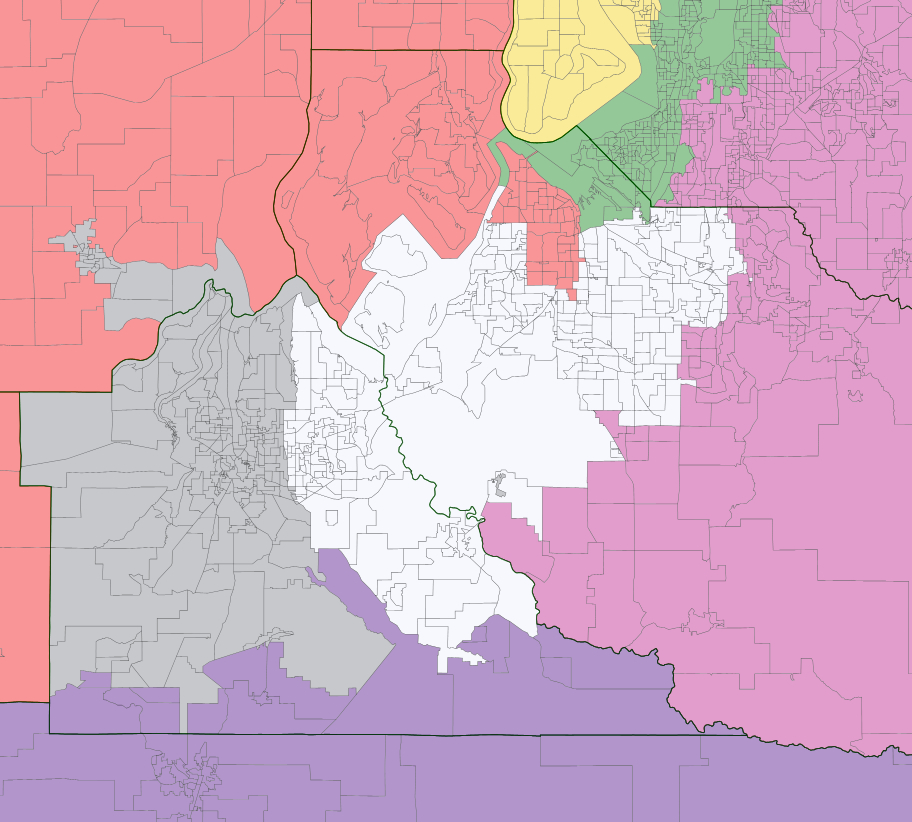
Here’s a map where I split the district into two parts.

Basically, the gray area is the Olympia influenced side (hippies, state government). The white side is the Fort Lewis influenced side. I did allow for a lot of cross over into Thurston County, but I’m pretty sure that’s accurate.

The Olympia influenced side is 59.4 Democratic (from the 2010 Senate race) and is pretty small, only 148,000 of the more than 600,000 in the district.

The JBLM side is much much larger (521k) and only barely Democratic at 50.3 percent.

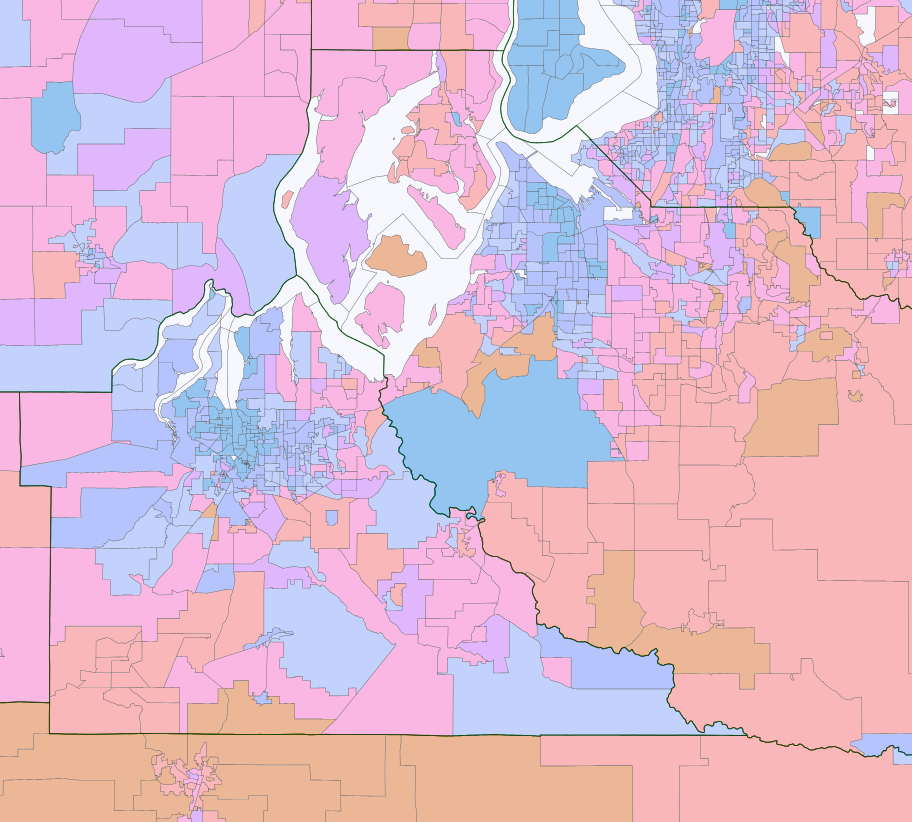
Here’s a map of the district by how it voted in the last Senate election. The deeper the blue, more Democratic, the more red, Republican.

You can clearly see the heart of Olympia in the middle left is pretty blue. But, as you go out toward Lacey (especially the new Hawks Prairie neighborhoods) and into the suburbs around Lakewood and Parkland, the district gets pretty red. 
The district as a whole still leans Democratic, but it’ll be interesting to see the politics that can shaped by the politics of a base community. What are the issues that specifically impact these sorts of towns?

The old south South Capitol neigborhood (the corner of Capitol Way and Capitol Boulevard)

As you go down Capitol Way, before it turns slightly to the left into Tumwater is renamed Capitol Boulevard, it almost seems like it could continue straight. That little spur of a very wide street is actually a continuation of Capitol Way. It continues for just over a block and then just stops.

I’ve wondered why that road was as wide and significant seeming as the main drag, if it just served a few homes and ended. It was possible that at one point, that had been the main drag.

Here’s the intersection I’m talking about:


View Larger Map

In the 1930s, the Capitol Way to Tumwater route was significantly different. In the Sanborn Map below (via TRL) you can see how the old neighborhood was configured, with one of the numbered cross streets jogging over further south and connecting with Tumwater.

Here you can see it in greater detail with the current arrangement.

While it doesn’t specifically address the alignment change, this document from the city includes a pretty interesting history of the street.

« Older posts Newer posts »

© 2026 Olympia Time

Theme by Anders Noren — Up ↑