Olympia Time

History, politics, people of Oly WA

Page 29 of 177

Aunt Alicia (Olyblogosphere for October 13, 2014)

1. Alicia Elliott will save Olympia.

New investment opportunity. Threaten development of something, raise the hackles of your neighbors, Alicia Elliott will buy you out.

Its the modern Olympia Aunt Sally.

2. Support Zinefest!

3. The best Olympia blog ever reads my mind. What if! What IF!!!!!

4. Yeah, big surprise here. Every place in the world is more nuanced than it seems at first.

If you came here from New York, Austin and then Portland and moved to Olympia “because you liked its look” and then were disappointed.

You deserve that disappointment. It isn’t our fault. Grow up.

5. I don’t mind the debate on the LBA Woods. Let’s debate parks! I’m against spending money on it now. And, I actually like the proposal for development (because it was better than the straight up burbs that had been built in that area).

But, this is annoying:

LBA Woods are a true gem–an old-fashioned Commons of sorts in that the property is privately owned, though it is neither gated nor posted with no-trespassing signs or welcome signs.

Because it isn’t even true:

…the developer (D.R. Horton, a nationwide company headquartered in Delaware) has chosen to fence users of LBA Park out of the trails.

We can debate whether it should become a park, but the owner wants you to stay off their property. That’s their right man.

3 reasons why I wish I could tell you to vote for none of the above in the Clerk race, but I won’t

1. For the love of Pete, would someone return a damn email?

I know I’m not anyone that important, it isn’t like I contribute money to that many (if any campaigns). But, I emailed both campaigns months ago about what I consider to be a pretty big issue. And nothing. Not even an “I got your email, I’ll get back to you later” or a “No, this isn’t that big of a deal.”

Just silence.

2. Could you make the race any less relevant to voters?

This race is so damn insular, the one time (one time!) I ever received any communication about this race from anyone connected to the campaigns, it highlighted an issue so low and degrading, that I would never repeat it here. Suffice to say, this race has been issue free.

Even the one difference that the campaigns bring up publicly is about an internal court system. Really? An internal office data management system? Wow. Killer stuff.

Here’s a better issue to chew over.

3. I feel like I shouldn’t even be voting in this election.

This post is starting to become a trip around my own favorite issue, but be patient with me. Yes, I feel that public access to court records should be easier than it is and that county clerks should serve the public in this regard.

And, when I poked around, the Whatcom County clerk provided the best answer to why he makes court records free and searchable online:


We wouldn’t charge for someone to come into the office
to look at a file. If they chose to make copies, there would be a cost
and staff time. I believe it actually saves money by freeing up staff
time to do more important tasks. We have had significant reductions in
force over the past several years. Further, it provides equal access
regardless of financial resources.

The difference here is that the clerk in Whatcom county is appointed, while the clerks here are elected. I’m not sure it makes sense, but that means an appointed clerk is more willing to provide for the public than an elected one.

The only reason this makes sense to me is that an appointed clerk would possibly see their role as providing services to the public and the county as a whole. While, an independent, elected clerk would be interested in protecting their own budget and the structural power of their office. So, a creaking and old document management system that doesn’t serve the public, but rather charges them for public documents, possibly makes sense.

So, I suggest you vote in this election and vote for Linda Enlow. At the very least, she seems like she’s willing to change the office.

But, what we really need is a clerk that is willing to go out on a limb like the Whatcom County Clerk. And, we need to change the law that allows clerks to charge crazy fees for public documents.

But, in the end, support a Home Rule effort for Thurston County. This would allow us to rewrite how Thurston County government operates. And, if we decided to change the clerk position to an appointed one, we could do that.

Smith Troy once arrested the man that was running against him for county prosecutor

Smith Troy, the 1930s era Thurston County prosecutor, is one of the most fascinating historic figures, must have had brass balls. Seriously, he could not have lacked for guts.

I’d  certainly not argue that he was always on the angel side of things. But, when he acted, he seemed to act with no consideration of alternatives. Full forward.

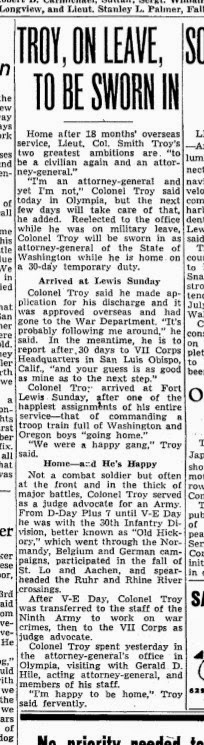
Like the time in fall of 1938 he arrested the person who was running against him for prosecutor for campaign against him:

Sure, Gruhlke might have stretched the truth. But, it is hardly a lie to say the prosecutor should have arrested more prostitutes. And, no matter how he phrased it, that is pretty much all that Gruhlke said.

And, even if Gruhlke said “I know for a fact that Troy decided not to arrest women of the night!” it is a strange image of a prosecutor running for office arresting his opponent.

Gruhlke quickly and phased Troy down:

  
But, then months later, after Smith won another term, the parties kissed and made up. Smith was only just over a year away from being appointed state Attorney General. He had just prosecuted a high profile attempted murder case and he had empanelled a grand jury looking into misuse of state funds. And, he arrested someone for campaigning against him.
And, in the end, he got an apology from the man he arrested.

Thomas Brents and Cascadia

Its a fairly old trope in Washington State history and civic life that the name Washington State is pretty horrible. Our own state and territorial founders wanted Columbia as a state name, but eastern politicians hung the name Washington around our neck as a way to avoid confusion with the other Columbia.

I hope I don’t have to tell you how well that lack of confusion thing worked out.

But, along the way, there were a handful of other suggestions for names, including (you guessed it) Cascadia. Our territorial representative, Thomas Brents, suggested in 1885 that a new name accompany the territory when it gained statehood:


Cascadia, in allusion to its many grand waterfalls and to the name of its principal range of mountains, the cascades (sic).

Brents was a bit early in his urging for statehood, and he also suggested that we bring in the northern part of Idaho along with the rest of the state. This was an obvious suggestion by the Walla Wallan Brents, as it would have tipped the balance of power in the new State of Cascadia to the east (given Idaho’s mining industry and eastern Washington’s agriculture).

Future historians rejoice! (Olyblogosphere for September 29, 2014)

1. There are fake bees. Nothing to be scared of, Janet Partlow blogs. They aren’t even the scarier of bugs. Just flies that want to be left alone.

2. Like the first rain calling coho back to the freshwater, they call Mojourner back to the blog. Or, something like that.

3. Rebels By Bus is just a cool idea and a cool blog. Some day I’m going to make the public transportation trip to this one state park in Grays Harbor. And, I’ll blog about it, in honor of the Rebels. Until then, read their recent updates.

4. I’ve been piecing together historic storylines the last couple of years. I’ve often thought how easy it would be if the less famous had some ways to easily translate their thoughts. Some people have their collected notes and letters boxed up and kept at libraries. But, if you didn’t publish your collected thoughts and put them in your community library, you’re out of luck. Elaine Nelson made me think that I’m glad we live now, Facebook, twitter, and other things will be a boon for historians.

5. Rignall, Washington is a place. I have to learn more now. Thanks.

Smith Troy project. This guy is facinating

I’ve been poking around for the last few years, learning everything I can about Smith Troy, one of Olympia’s most infamous politicians. This is one fascinating guy. I’m going to write way more about him as I start to bring focus on my own thoughts about him. But, just to get started, here are some Smith Troy facts:

1. He was appointed Washington Attorney general when he was 33 years old. And, this is after years as the Thurston County prosecuting attorney. So, he started really young.

2. At one point in the 1930s, Smith was both the prosecutor and the
coroner. Also, the sheriff was taking some time off, so he filled in
there too. He was the law.

3. His wife committed suicide when she jumped out of a window at the old St. Peter’s Hospital on the westside.

4. After he lost reelection in 1952 for AG, he was the lawyer behind Lemon v. Langley, which brought back dozens of state agencies that had moved from Olympia to Seattle.

5. In addition to being a track star at the University of Washington, he was a student leader in the effort to fire long time and legendary Husky football coach Enoch Bagshaw.

6. After 20 years of political retirement, Troy came back in the 1970s and served as the Thurston County prosecutor again.

Two big things from the Scottish independence vote for Cascadia to think about

I am pretty reluctant to get anywhere near the Cascadian Independence movement. I know they’re serious people, thinking hard about a really true independent country. I’m not one of them, but I appreciate Cascadia (obviously) and I appreciate they’re work, but only as a venue to sharpen our concept of Cascadia. Whatever political system we’re using, there is plenty of work in the near term to get done.

And, I think, in the jet wash of the recent Scottish Independence vote, there are some lessons for Cascadians (seeking independence or not).

1. Rural vs. Urban divide doesn’t need to divide us. 

Whether you’re like me and drawn the line at the Cascades, or draw in a much larger swath of the interior west, there’s a sharp divide between rural and urban up here.

There was a similar urban/rural split in the Scottish vote. Essentially, poorer urban areas went for the breakup, while richer rural areas voted for union. This is ironic because the political party that sparked independence originally had support in rural areas.

In Cascadia the rural urban divide is based on a non-Cascadian Republican/Democratic political divide. But, as we’ve seen in some local election results, rural and urban voters can get together to elect particularly Cascadian politicians. 

2. Changing politics will change politics.

In the short term, the people who want an independent Cascadia should focus on just making Cascadia better. More people voting, more people engaged, a better politics. If, once we get more people involved at all areas of politics and government, we still want out? Then cross that bridge them.

The Scots began to see themselves differently, as representing a different sort of politics:

In the meantime, pro-independence activists have managed to capture the
hearts and imaginations on many voters in Scotland in a way that the
unionist camp has not. Drawing inspiration from what are considered to
be the fairer and more prosperous Nordic countries with high levels of
democratic participation, many in Scotland became involved in the
campaign at the grassroots level.

Scotland Independence vote was built on the back of a new sort of politics:

The idea of the public as passive,
inert spectators and with it the notion of politics as a minority
report pastime, no longer holds. Instead, across the country a new
energetic, dynamic political culture emerged which reshaped public
debate and conversations.

It could be seen in the massive
turnouts which saw poorer and disadvantaged communities turn out in
record numbers. What I called ‘the missing Scotland’ – the
voters who haven’t voted in a generation or more – re-emerged as
a potent political force which has the potential to reshape long term
politics. It was also seen in the re-imagination of public spaces,
the emergence of flash mobs and protest, and a culture of celebration
and carnival on the Yes side.

The other dimension found expression in
‘the third Scotland’ – the self-organised, independent minded
supporters of independence – who have had a very different and
distinct politics from the SNP. These groups: Radical Independence
Campaign, National Collective, Common Weal, Women for Independence
and several others, saw independence not as an end in itself, but as
a means to an end.

They brought DIY culture, network
politics, flat organisations and part of a new generation of young
people into public life. They did things which were messy, fuzzy,
creative and fun. They staged happenings, art installations, and
national tours across Scotland, and in the case of Radical
Independence they door stepped and challenged Nigel Farage when he
came to Edinburgh last year. All of this contributed to a different
kind and feel of politics which circumvented the ‘official’
version which was a high bound to command and control as any part of
Westminster.

All a place (Olympia in my case) needs to be is No. 1 in your own heart

Olympia is Americ’a’s #3 Friendliest Small City!

Olympia is America’s #55 Most Liveable City, and #3 in allllll of Washington!

Ugh.

Olympia is the town I love best, but seeing these lists being spread around always leaves me empty.

The problem with these rankings, is that they’re subjective in the mix. Sure, they’re usually pretty clear about what criteria they use to make up their rankings. But, the conclusions to me seem a stretch.

At least a stretch in that they should matter to any particular person. That friendly list up there especially. What makes a person friendly in Olympia is totally different that Grapevine, TX. We have a different history, different social structure and different culture. So, how can you really determine if we’re any more of less friendly?

You really can’t. People come up here from the deep South and find us off putting and cold. We go down there and find people overbearing and rude. But, both are considered friendly in their own context.

Or exciting. Someone considered Olympia exciting.

Its interesting to look back at this cottage industry of place rankings. David Savageau and Richard Boyer wrote the first “Places Rated Almanac” in 1983. The Almanac marked nearly the 20 year anniversary of the beginning of the Big Sort, a large demographic change.

According to the great book, Big Sort, Americans began unhinging themselves from diverse and deep rooted communities in the 1960s. They would find new homes in politically and socially homogenous communities.

It makes sense that book suggesting The Best Places, creating an idea that divergent communities could be objectivity ranked (and ranked and ranked) is a centerpiece of the idea of demographic sort. People who began shifting back and forth across the country began looking for rational reasons to pick one place over another. But, this rational sorting of communities lacks a coherence of place.

Toronto found itself on this lists regularly, and a local committee there decided to take a close look at what it takes to put these lists together. The committee (which focused on economic development) wrote a report that poked holes in how these reports are written.

Are they comparing apples to apples?

Is the data old? Has it been massaged?

Is the ranking consistent? Meaning, is #1 really one spot away from #2. Or is #2 really #432?

The lists really try to make what is a series of complicated and human topics clean and easy. We should never do that. It is too subjective.

So, as long as we’re talking subjective, we might as well go all the way. What determines what is the best place should be inside of you. You might as well rank cities in America by “Top Cities Where My Friends Live” or “Top Cities Where My Kids Are Growing Up.”

Doc “Moonlight” Graham in Field of Dreams put it best:

“This is my favorite place in the whole world,” Doc says quietly. “I don’t think I have to tell you what that means. You look like the kind of fellow who has a favorite place. Once the land touches you, the wind never blows so cold again. You feel the land like it was your child. When that happens to you, you can’t be bought.”

A place may be a good place based on a series of what look like objective criteria, but these can all end up being baloney if a place doesn’t mean anything to you.

Your regular fortnightly blog links. At least something is fortnightly anymore. Wink. (Olyblogosphere for September 15, 2014)

1. Best blog at Olyblog in a long time: Olympia Then & Now. Awesome.

2. They’re working to put Old Main on the list of national places of historic importance. I would’ve assumed it was on that list already, but there you go.

3. Sort of a meta post from the Plum Palate. But, it is important to keep up with your local bloggers.

4. Big News for the People’s House. Which isn’t a new proposed location to fight about, by the way.

5. I think the Percival just realized the Weekly Volcano died.

Why I’m really excited about the Oly Town FC Artesians. Even if I don’t like indoor soccer

Sure, I’m not the biggest fan of indoor soccer. Sure, its fun. Its no futsal.

That said, I couldn’t be more excited for the Oly Town FC Artesians this year.

First off, Brandon Sparks is pretty awesome. He’s the hard worker behind Olysports, a very worth your time local sports blog that does all of the little things right.

So, secondly, if you remember the Tumwater Pioneers, then (in my opinion) everything good associated with that team had something to do with Brandon. He didn’t run that team the way he’s been put in charge of the Artesians, so we can expect to see more of the good with this new effort.

But, yes. Brandon is a good thing.

Otherwise, its great to see organized semi-pro soccer of any sort back in Olympia or Tumwater or Lacey. Especially, this sort of league. I love that we’re coming into the Western Indoor Soccer League, and mostly because it has a home-brew feel to it. The league was formed by a group of owners that were upset by the politics involved in a more national league.

A lot of these same owners just got done with their first season in a sister outdoor league called the Evergreen Premier League. This is another home-brew league born out of frustration with national systems. And, for me, this is the real target: a semi-pro outdoor soccer team in northern Thurston County (hopefully Olympia).

I’m not too picky about where an Olympia soccer team should land, but if its a bunch of local Cascadian soccer entrepreneurs going their own way. Then that’s the way for me too.

There are of course some other considerations too. The Artesians indoor have their own very nice facility. But, an outdoor team would have to play in a high school stadium for the time being. Or, a recreational soccer field. We don’t have a soccer specific facility in Thurston County that could support crowds of more than a few dozen.

We should address that (possibly build stands next too one of the fields out at the Thurston RAC), but in the short term the Oly Town FC Artesians sound like a great idea. I can’t wait.

« Older posts Newer posts »

© 2026 Olympia Time

Theme by Anders NorenUp ↑