History, politics, people of Oly WA

Author: Emmett O'Connell (Page 27 of 176)

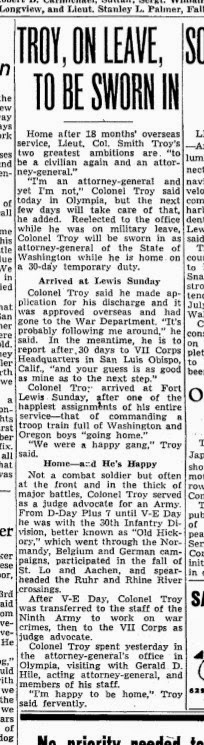
Look at how Smith Troy is smiling

Note: (April 20, 2015) I got a load of details wrong writing this post. I’ve corrected them in this updated post. But, I’ll leave them here for you to read and enjoy. Just not facts though, just an Emmett story.

He literally snuck back into town to take the oath of office.

He looks like he just ate the bird.

Or, he’s just really super happy to be home after years at war. So, there should be some of that. But, I think there’s a healthy dose of having gotten one over on room full of befuddled old men who would have like to replace him while he was gone.

From the AG’s official history:

From 1943 to 1945, General Troy served in the Army in Europe as
Lieutenant Colonel Troy and earned five battle stars. During this time,
Troy’s deputy served as acting Attorney General.

This apparently was quit the coup for Troy. If normal process had been followed, Troy would have resigned and the governor would have appointed a replacement. But, Troy was able to write an opinion that his deputy serve for him and run for office in 1944 while serving.

The other people in the room look kind of surprised to be at a swearing in ceremony:

 Seems like Troy was actually in town for a month or so before he was sworn in at the end of August. He didn’t end up taking charge of the office again until the middle of September.

But, in the end, he was able to pull of nearly two years, AG in the war theatre, and settle back in to his seat of power, befuddled old guys on his shoulders.

What do you see in this chart? Mason County changing?

This is a chart tracking partisan returns in the 35th legislative district between 1992 and 2014. The lines track the two house seats and the dark dots, the senate. What I’m tracking here is how successful Democratic branded candidates have done over the past 20 years.

An important note before you look any further. For 2014, I switched Sen. Tim Sheldon for his challenger Irene Bowling. In you own consideration, feel free to totally ignore that, but for the sake of argument, and to make an interesting chart, I did that.

So, here’s what I see: Throwing out two uncontested years, the Democratic brand in the 35th (greater Mason County) has been eroding.

Mason County always struck me as an interesting place, the furthest inland outpost of the “Coastal Caucus” political type. I sort of wrote about this, the most non-partisan of Washington’s political regions, here.

I’ve also been thinking a lot about two other rural western Washington counties, Lewis and Grays Harbor. These two places share a river (the Chehalis), but party speaking, one is very Democratic, the other is very Republican. I’ve been wondering (baring very few other differences) why Lewis votes almost always Republican and Grays Harbor even more often Democratic.

And, I think we might be seeing that difference in action in Mason County. In the past, it seems that Shelton was very much like Grays Harbor. But now, as we move through several elections, Mason County is becoming more dependably Republican. This is the first time since at least 1992 that the 35th have returned three state legislators that won’t caucus with the Democrats.

But, what are the factors behind this label change? You can argue that the Democrats Mason County sent to the legislator were always more conservative. Sure, I can take that. Other coastal Democrats were always different than King County Democrats. At least in the modern sense.

But, why the label change? Here’s on theory: one other thing has happened in the last 10 years, urban Democrats have been focussing energy on Mason County and Tim Sheldon.

Sheldon’s break with urban Dems has been at least ten years in the making, since he chaired Democrats for Bush in 2004. He also led a rebellion against a Democratic budged in a few years ago and then famously caucused with Republicans during the last two legislative sessions. And, since then, Democrats in other parts of Puget Sound have been taking a harder and harder aim at him. The high point was this year when a traditionally funded Democrat faced off with Sheldon in the general, and lost.

So, maybe this really isn’t an act of Mason County voters changing their stripes, but a slow-motion erosion of the old-style coastal Dem with a modern conservative Republican.

Low voter turnout and why aren’t we celebrating Washington’s 135th anniversary?

Two big surprises this week. Well, they aren’t big surprises at all. Washington State turned 125. Also, voter turnout during this off year election in the second term of a Democratic president was really low in the same state.

These two things are actually connected in a very interesting way. The reason we’re not celebrating the 135th anniversary of Washington is the same reason voter turnout is down to historic levels this year in Washington.

It was political division and apathy that kept Washington out of the union in the late 1870s, ten years before their successful 1889 effort.

Robert Fricken in Washington Territory:

Washington Territory was divided, rather than united, upon the question of statehood. Longtime, often bitter, points of contention remained paramount, setting westerners against easterners, Republicans against Democrats, and Portland influence against the challenge of Puget Sound.

Fricken is the bomb, by the way. Everyone should read every one of his books.

Washington remained a state in uretero for so long, because it wasn’t a single cogent state. As Fricken points out, the Puget Sound was an economic colony of San Francisco and Eastern Washington was controlled by the Willamette. Also, decades and decades of rule by the east compounded on themselves, and the political culture that would grow with the promise of self rule never flourished.

Voter participation also dropped off significantly from areas that supported statehood at the time (Puget Sound) to places where it wasn’t supported (east of the mountains). In places where there was little engagement for the goal, voters overall failed to answer the question.

It wasn’t until the 1880s when Washington’s population went from 75,000 to over 300,000 did the question come up again. Also, because of a rail connection through Washington to the rest of the country, the territory was at last united.

That 1870s apathy towards statehood, driven by disunion and apathy, is the same sort of thing we face today.

While we lacked a railroad to throw off the shackles of Portland and San Francisco, today we shackle ourselves away from each other. Our redisticting process, at both the legislative and Congressional level, has shifted partisans into seperate districts. If we ask voters to vote in races that don’t matter, they won’t vote.

Jim Bruner in the Seattle Times back in 2012:

In an interview, Milem said the commission’s priority of protecting
incumbents was evident in the new maps, as incumbents of both parties
got safer seats.

Milem is correct on that point.

Just look U.S. Rep. Dave Reichert’s 8th Congressional District.
Previously a suburban swing district, the 8th was redrawn by the
commission to become solidly Republican. The new district lost its
Bellevue and Mercer Island portions and now crosses the Cascades to pick
up Wenatchee and Ellensburg.

Similarly, the 2nd and 9th Districts were redrawn to be safer for their Democratic incumbents, Rick Larsen and Adam Smith.

“We’ve lost electoral competition in those districts as a result of the plan,” said Milem.

That holds true for many state legislative districts too. Milem says
partisan considerations trumped the goal of drawing logical district
boundaries, leading to some strange contortions.

For example, Milem describes the shape of the 18th legislative district near Vancouver as “one arm short of a swastika.”

Sure, we’re also sorting ourselves out in a larger sesnse. But, in the least, creating as interesting and compelling political boundaries in the first place would help.

Well. Hello to you too (Olyblogosphere for November 10, 2014)

1. Only one of the best things ever I’ve watched.

2. rebotco is the bomb. Here’s the Second Part of Olympia Now and Then. Even better than the first.

3. Thurston Talk keeps us up to date on what Aunt Alicia is up to. OMG. I just realized. Maybe she’ll buy the LBA woods for us!

4. The man who brought us Motherhood on Percival Landing and the World War II Memorial (wheat stalks) has students. Go see their art. You’ll forgive me for not mentioning the horrible Parkland institution that houses that art.

5. I have nothing else. Except this awesome Olympia music that you can own for a price that you name.

How Bud Blake won in Thurston County

By basically beating the Grand Old Party in every precinct in the county. Basically.

Republicans tend to lose in this county. Up until now we had a all-Democratic commission and every other elected official was Democratic, save an Independent sheriff.  I assumed going into this race that Blake would do better than Republicans in general, and it turns out he did well enough to win.

Here’s the data I’ve been playing with. I took the three Republican results from 2012 (Senate, governor and President) and averaged them. Then I compared Bud Blake’s performance.

Here’s a chart to illustrate my point:

Basically, what you’re seeing here is Blake beating the GOP turnout everywhere. Even in places where Republicans do horribly, Blake kept a consistent advantage over the GOP performance.
I’m not sure what to chalk this up to. Whether Blake really did perform better as a candidate, so his party label meant little. Or, that the Republican brand in Thurston County that you could take a standard business friendly candidate, strip him of his party label, and he’d win.
But, where exactly was he strongest?

The deeper the red dot, the more votes Blake got against the Republican average.

Basically, again, Blake did better than the average Republican candidate in Thurston County literally everywhere. But, if you were to pick out hot spots, it would be in the outer reaches of Lacey, out towards Fort Lewis.  This would fit the story line that Blake is a veteran. While somewhat new to Thurston County, this is something understood my military families who live close to Fort Lewis.

He didn’t do as well as I would have thought in the northern Hawks Prairie area (assuming military and retired people) but did much better around older southern Hawks Prairie and deeper Lacey. He also did well against the average Republican vote in west and eastern Olympia. Not many actual votes there, but still picking up against the conservative average.

Washington Poll, “rest of Washington” and their lack of Partyism

In the most recent episode of the Slate Political Gabfest, the hosts discussed the recent phenomena of Partyism.

This would be a sort of prejudice or bigotry based on the political affiliation of someone. I assume this has been around for awhile (seeing how people didn’t like Socialists or Communists going back 100 years or so), but apparently this has recently crept into mainstream politics. Republicans being partyist towards Democrats and vice versa.

David Plotz (at some point I think it was David) wondered where exactly this phenomena hasn’t taken hold in American communities. Where the parties and partisanship hasn’t warped politics and public discourse. Taking a look at the recent “Washington Poll,” I think I have a local example.

The Washington Poll divided the state into three parts: Eastern Washington (beyond the Cascades), Puget Sound (self explanatory) and the rest of Washington. It is this “rest of Washington) category that I found fascinating. In most cases, Eastern Washington presented itself as the furtherest right wing, while Puget Sound served as its liberal foil. You’d assume “rest of Washington” would be somewhere stuck in the middle. And, you’d be right, for the most part.

While the poll isn’t very clear, it seems like the “rest of state” category includes the counties on the west side that don’t border Puget Sound. Basically the Olympic Peninsula and the Lower Columbia. Except for a few traditionally conservative and Republican counties towards the Oregon border on I-5, most of these counties are old-style Democrat timber communities.

They have voted Democratic since the Depression, while at the same time aren’t pulled into the gravitational pull of liberal Seattle. They are Democratic on their own.

So, to start, these “rest of state” counties have a higher voter participation and seemingly deeper culture of civic engagement.

For just voter registration, we see better than average for the rest of state: 92.2 ROS compared to  88.0 for Puget Sound and   87.2  for Eastern Washington.

The same pattern holds for turning in your ballot this year: 20 percent compared to 17.7 or 16.5 for Puget Sound and Eastern Washington.

And, in terms of health of the community, rest of state was the only group over 50 percent on the question of right track/wrong track. Even though many of these places have unemployment higher than Puget Sound,  voters here still have faith in the future.

Also, they also have more faith in the process. Compared to Puget Sound and Eastern Washington, which neither could get above 38 percent favourably rating for the state legislature, rest of Washington rated their locally elected legislators at almost 50 percent very or somewhat favourable.

In terms of partisan ID, these communities are almost evenly split. While Democrats dominate Republicans by 20 percent in Puget Sound, and Republicans by 10 points in Eastern Washington, Republicans lead Dems by only about 3 percent in these other counties. And, the highest number of voters describe themselves as moderates in rest of Washington (a plurality).

And, lastly, even more than conservative Eastern Washington, rest of Washington is rooted in its present. It doesn’t face the future, it faces the now. Question 34 “The America that you know and love isn’t changing too fast, and will never change” (as badly phrased as that is) illustrates this. Eastern Washington and Puget Sound both strongly or somewhat disagreed with this statement 65 percent of the time, while “rest of Washington” got over 70 percent.

While you’d assume “rest of Washington” would fall somewhere along the same lines as the other two, it actually showed itself to be more conservative. Or, at least, more rooted in what is going on their now.

“Rest of Washington” falls outside the right/left dualism that Puget Sound and Eastern Washington represent. It has higher civic participation, more faith in the process and thinks of itself as more moderate. It also isn’t looking to the future for either doom or success. Right now, the way things are and the people who are here now as neighbours will have the answers.

There are a few reasons why this is the way things are out there:

1. These areas (except the Republican/conservative counties like Lewis and Clark along I-5) are out of the way counties. Counties like Pacific, Grays Harbor and Wahkiakum counties are literally geographically split off from anywhere else in Washington.

2. They represent a “way it used to be.” While the decline of the logging industry overall has hit these counties hard, there is still a core element here that depend on resource extraction (anything like logging or fishing). And, this is the way it used to be in all of Washington. But, times have changed in places like Puget Sound, and the regional culture that you can still see in Aberdeen or Raymond is hard to find in Seattle or Everett.

3. We call them Democrats, but they’re much more conservative than that. That label is pretty flexible. Take Tim Sheldon, a Democrat from Shelton in Mason County. He even went as far as caucusing with Republicans, but it isn’t that uncommon for Democrats from the coast to vote against their Puget Sound party-mates. That still said, Democrats still dominate politics out there, it is hard for a Republican to get elected in any local office.

Thurston County Democratic Central Committee, Answer These Questions (in 1938)

This is a more things change, more they say the same sort of thing for the week coming into election day.

This is an a full page ad that the Thurston County Republican party ran in the Olympian in the weeks leading up to the 1938 election. It is full of amazing statements (amazing!), mostly either rehashing parochial battles or drastically weird statements about socialism and communism.
They really get going in the middle of a list of questions:
Is is not true that many of your leaders were also sponsors of the dictatorial scheme for Zoning Thurston County.

Is it not true that your program is fundamentally socialistic to take over private business? With more taxes?

Is is not true that some of your politicians aspire to offices under a socialistic dictatorship?

The first question in that list seems to echo to our current debates (at least over the last 20 years in the era of growth management and endangered species) over land use. I don’t know enough about what was going on in Thurston County in 1938 over zoning. But, it smacks of a rural control by urban interest sort of thing.

And, after all this huffing and puffing, the Republicans were smacked down in Thurston County in 1938. Only winning a close race for clerk, the Republicans failed to capitalize on what was a fairly good year for Republicans nationwide. Not in Washington though. Or in Thurston County.

Go directly to 5 and take the survey! Then reverse and review your blog links! (Olyblogosphere for October 27, 2014)

1.Over at MT, more reading as the days get shorter.

2. I’m a young pup. I’m involved, but I didn’t show. Mostly because young pups have young families.

3. “Recent donation stirs up controversy over bookstore Jelly Belly machine” is such a perfect college newpaper headline. But, the issue at stake here is actually worth reading the article for.

4. Apparently, the city council has been skating around the edges with money raised specifically for sidewalks and parks (here and here).

5. Did I tell you to take the LBA survey? Take the LBA Survey from Olympia’s Best Damn Blog!!

More crime in Thurston county between 1990 and 2011 results in even more prison sentences

I’m sure my dad is going to have something to say about this post, but I found some interesting statistics while looking for something else this week. I was poking around, looking for county level statistics to create a Washington level “general happiness index.” I wasn’t planning on tracking it across time, just finding some quick list of the happiest of the counties.

So, crime rates in Thurston County, take a look:

What’s going on here is while reported crimes grew at a slow rate between the early 1990 to a few years ago, the total number of criminal sentences by our county courts went way up. What explains this?

Stiffer mandatory sentences? This phenomena may have led to courts imposing stiffer criminal penalties over the last 20 years.

“We’ve now got TONS of houses and nowhere to walk”

Read the results of the new Olyspeak.org survey. It is fascinating to read people chatting about what kind of things they like to see in a “community center” in their neighborhood.

Hopefully, the new comprehensive plan moves our neighborhoods into creating more of these vibrant areas. Think of the Wildwood building on Captiol Way, the Co-op on the west side or the San Francisco Bakery on the Northeast.

Or the desert of any sort of walkable community on the Southeast side.

At least on my side of town, there has been some serious real politics dealing bad news to this sort of thing. In my neighborhood, Briggs Village, the developer seriously dialed back what on paper was supposed to be a pretty impressive urban village. Some apartments over commercial. Some multistory commercial. Maybe even parking basements. But, now we’re likely going to get a shiny strip mall sort of thing.

Hopefully, it turns out okay. But, in the long term at least, it was supposed to be a move to develop the area quicker. For now, we have no movement on those lots yet.

A few miles away, the LBA area was supposed to see a similar development with a nice walkable commercial/community area. But, neighbors to the proposed development rose up and stopped it.

Ironically, those very neighbors live a massive wasteland of walkable community areas. Between the Pit Stop Market (on 18th) and the Chevron on Yelm Highway, there is literally no place to buy a gallon of milk on foot for thousands of Olympians.

We want community. We want places to walk. We want to have tight neighborhoods that are forward facing and nice. We want character.

But, developers dial back grand plans and suburban car house dwellers defend trees in the face of new diverse neighborhoods.

However we advocate for neighborhood centers needs to realize the real politics that have created acres and acres of houses with nowhere to walk.

« Older posts Newer posts »

© 2026 Olympia Time

Theme by Anders NorenUp ↑