History, politics, people of Oly WA

Author: Emmett O'Connell (Page 26 of 177)

Welcome to Olympia 2015

Welcome to Olympia legislators, reporters, lobbyists, staffers and other hangers-on! Here are just a few simple rules. We’ll get through the next few months, just:

1. When you’re talking about the state legislator, the governor’s office, the governor himself or a state agency (of any sort), don’t say Olympia. 


This is metonymy (press as media, etc). I know what it is. I don’t like it and you shouldn’t do it.

2. Its okay to say “down in Olympia” or “I went to Olympia to…” but I’d still rather you not. They’re so darn close to “Olympia wants to raise our taxes” that its better just to be more specific.

Why is this a bad thing? Just to recap:

1. State legislators are elected by people all over the state. They happen to come to Olympia. Pretty simple. Lay the blame (or credit) on the feet of who deserves it. The people who vote, from all over the state.

From the Metonymy of Olympia Archives:

Welcome to Olympia 2014 graphic

The Welcome to Olympia zine

The very first Metonymy and Olympia post from 2007 (!)

Holy crap, I just realized I’ve been on this kick for eight years! Man, I am pretty insufferable, aren’t I?

I suppose it begs the question as to why this sort of thing bugs me so much. Why does a random political headline writer going all “Olympia to Seattle: Pay Your Own Bills” bugs me so much. Probably because I don’t see Olympia as a particularly political town. That we’re anything special in regards to government.

Sure, obviously, I know a lot of people who work for state agencies, the legislature or something else related. But to me, that’s more like everyone in town working for just the one big employer in town. Its where we work, not how we live.

Also, it isn’t like the way we live here is as some cabal looking to screw the rest of the state. The people who make the actual decisions (guess what) are elected every two or four years and come from out of town.

So, welcome to Olympia. Don’t say Olympia.

How we’ve biked and walked around Olympia since 1990 has changed

I love the different ways you can poke around census data anymore. One of the coolest of these little tools is the commuter edition of the Census Explorer.

Take a few screen shots from the tool, and you get a clear look at how our ways of getting to work and around town has changed since 1990.

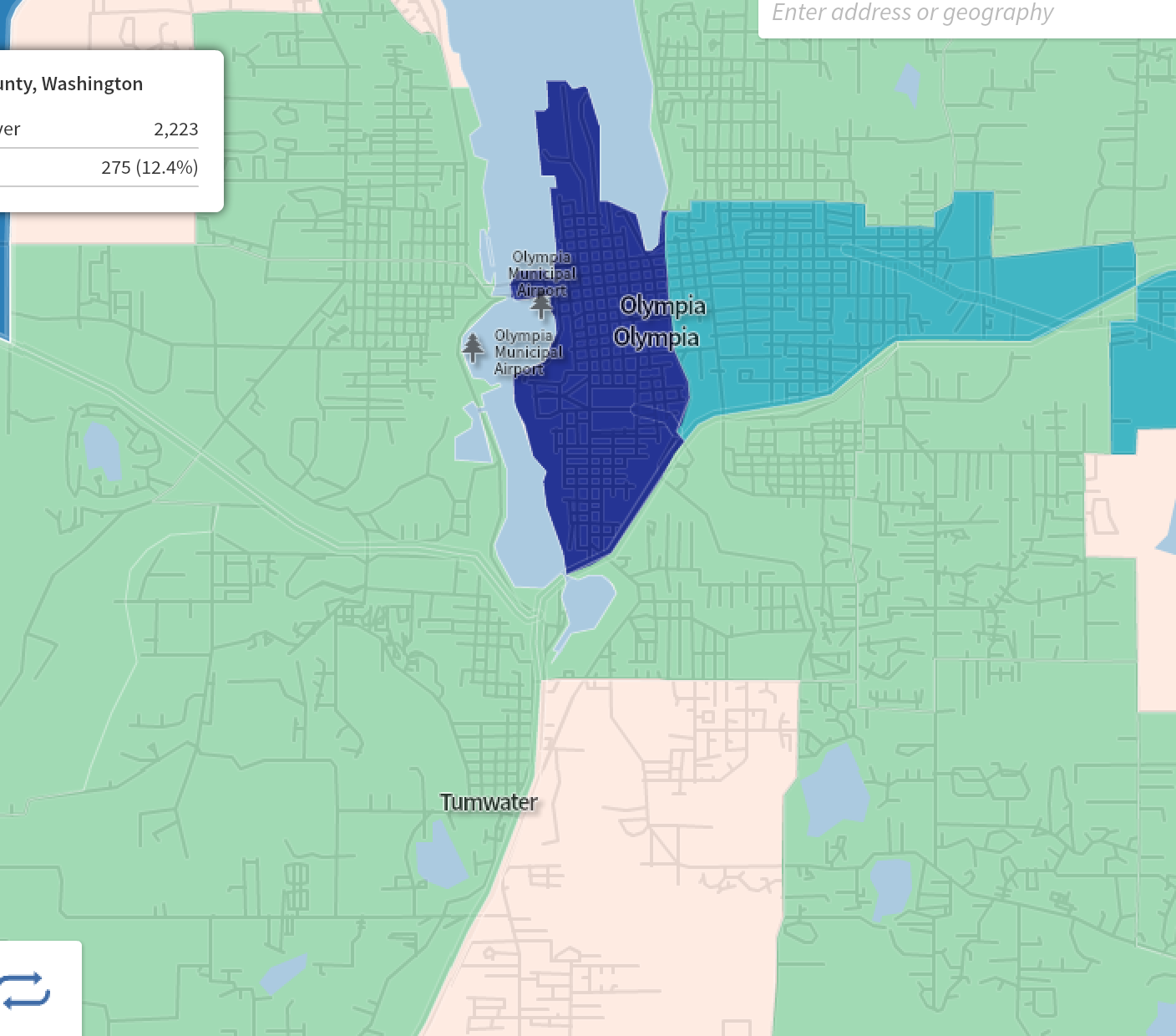
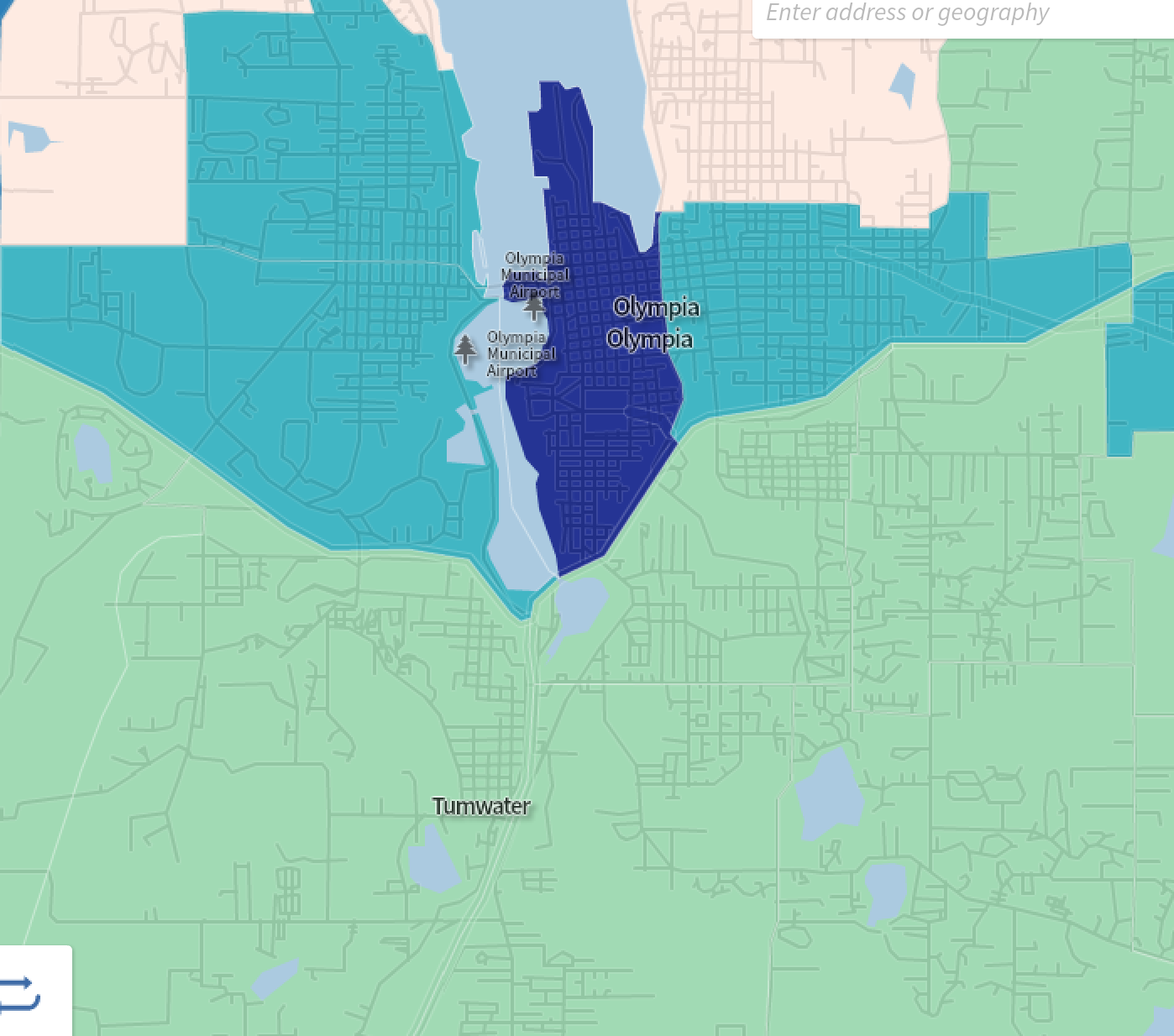
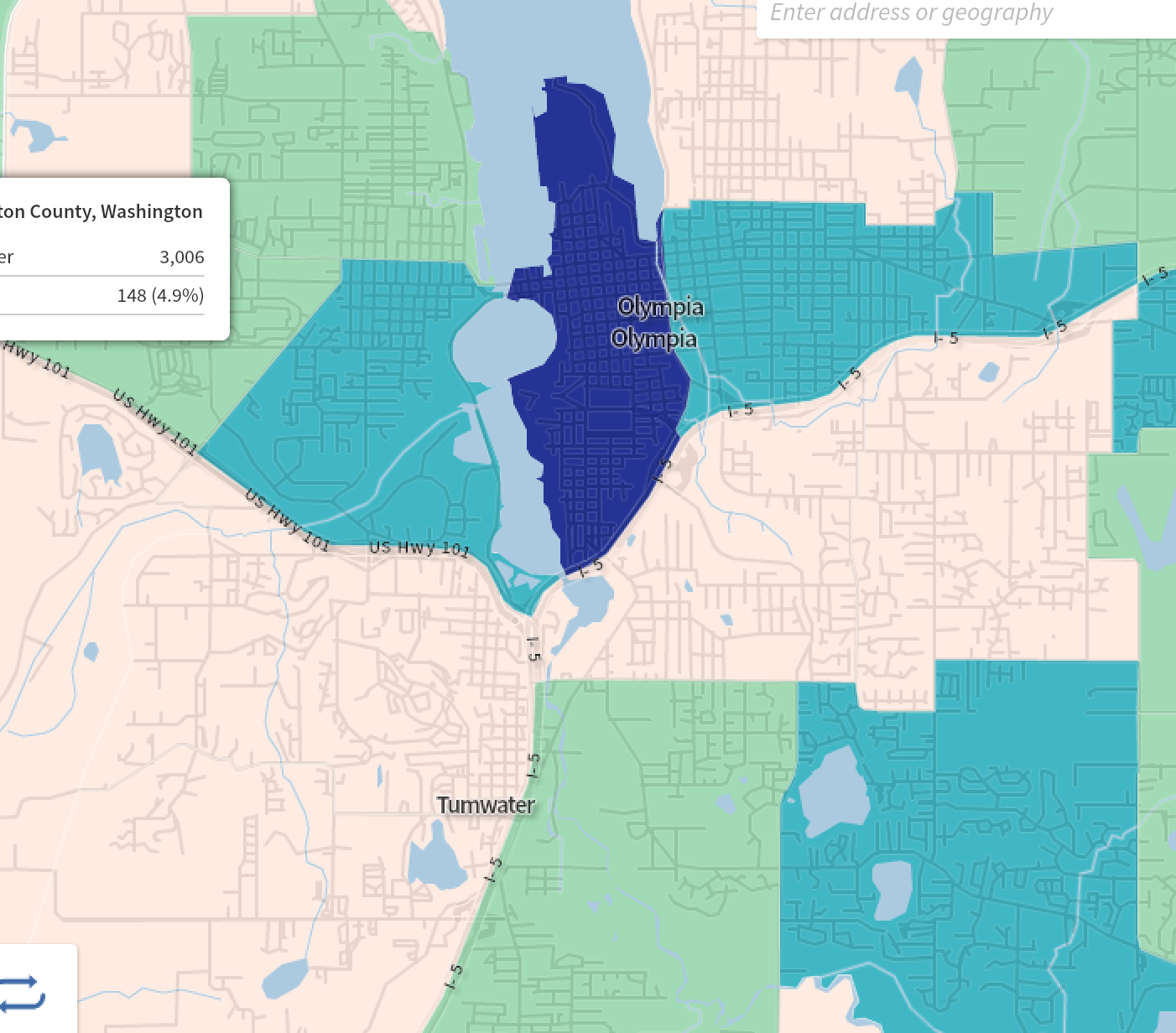
Take walking around town.

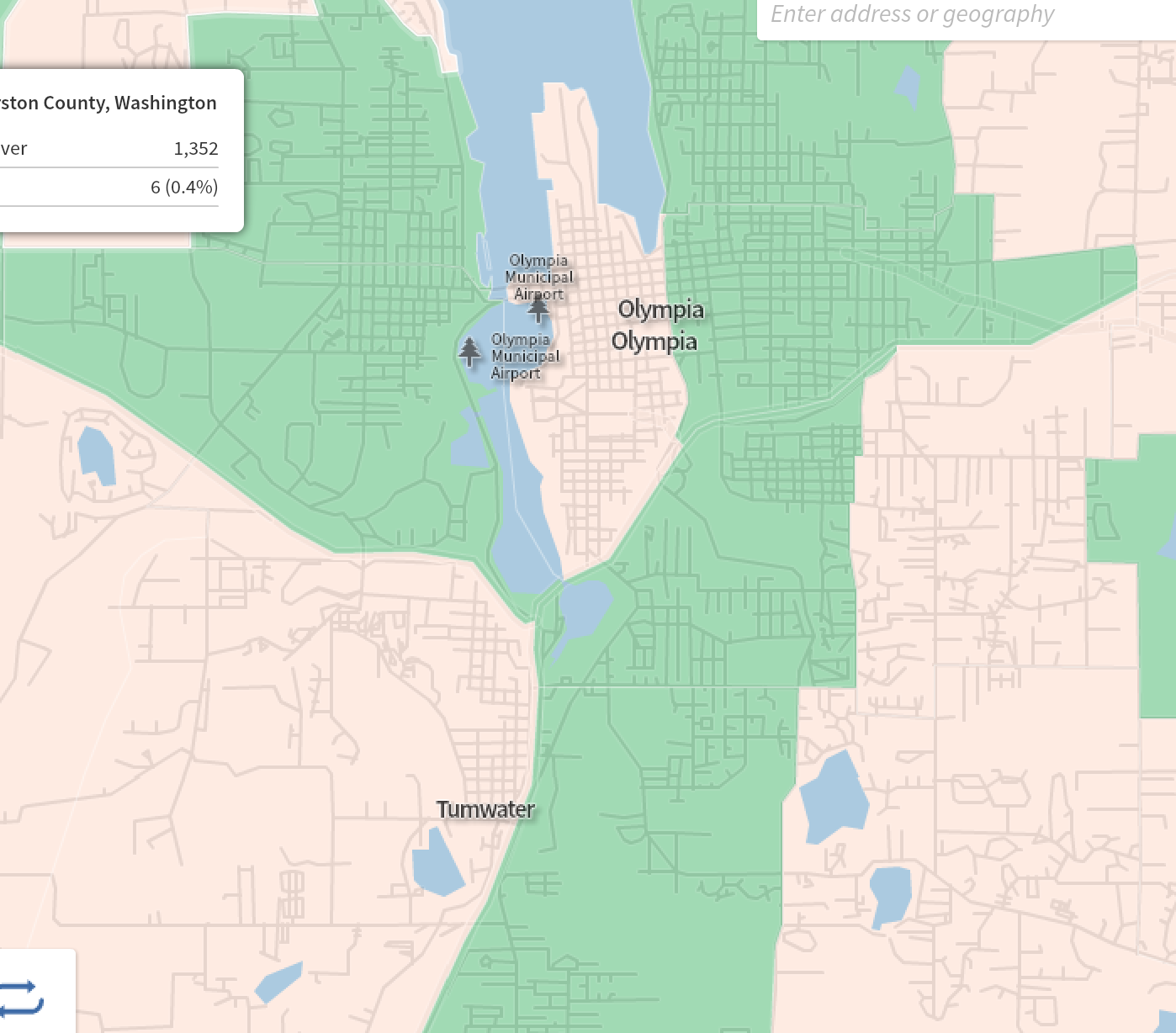
1990:

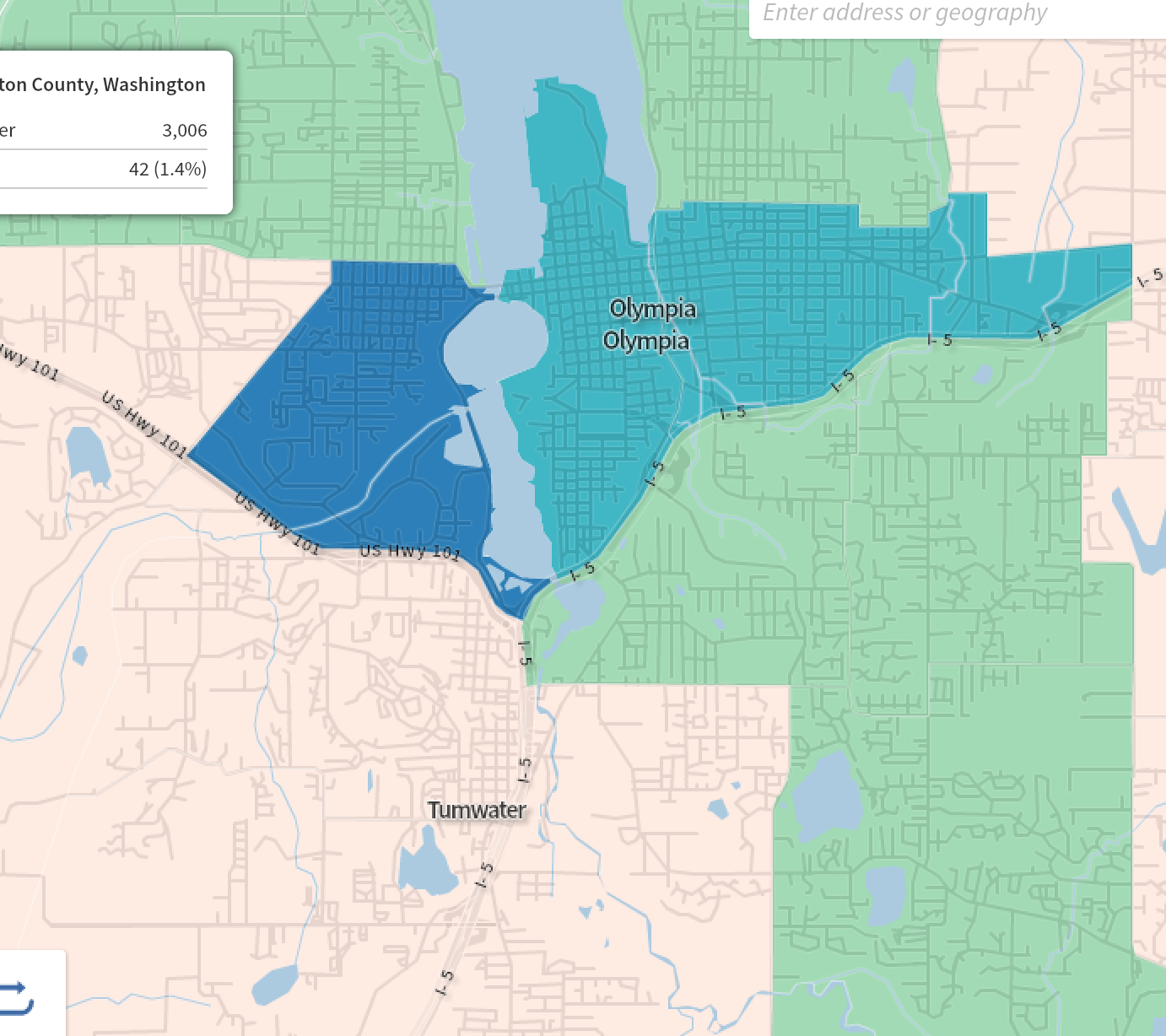
2000:

2000:

The darker the color, the more people who walk, the highest concentration being in the central part of town, where over the decades about a quarter of people walk to work. But, over time in the outlying areas, fewer people walk. This is except for a couple of neighborhoods (far Southwest and nearby Westside) where a few more are walking.

For me, walking to commute means that over time we’re building walkable neighborhoods, places where people can find what they need on foot. While downtown and South Capitol seem to be a stronghold like this, the rest of town seems to be getting worse.

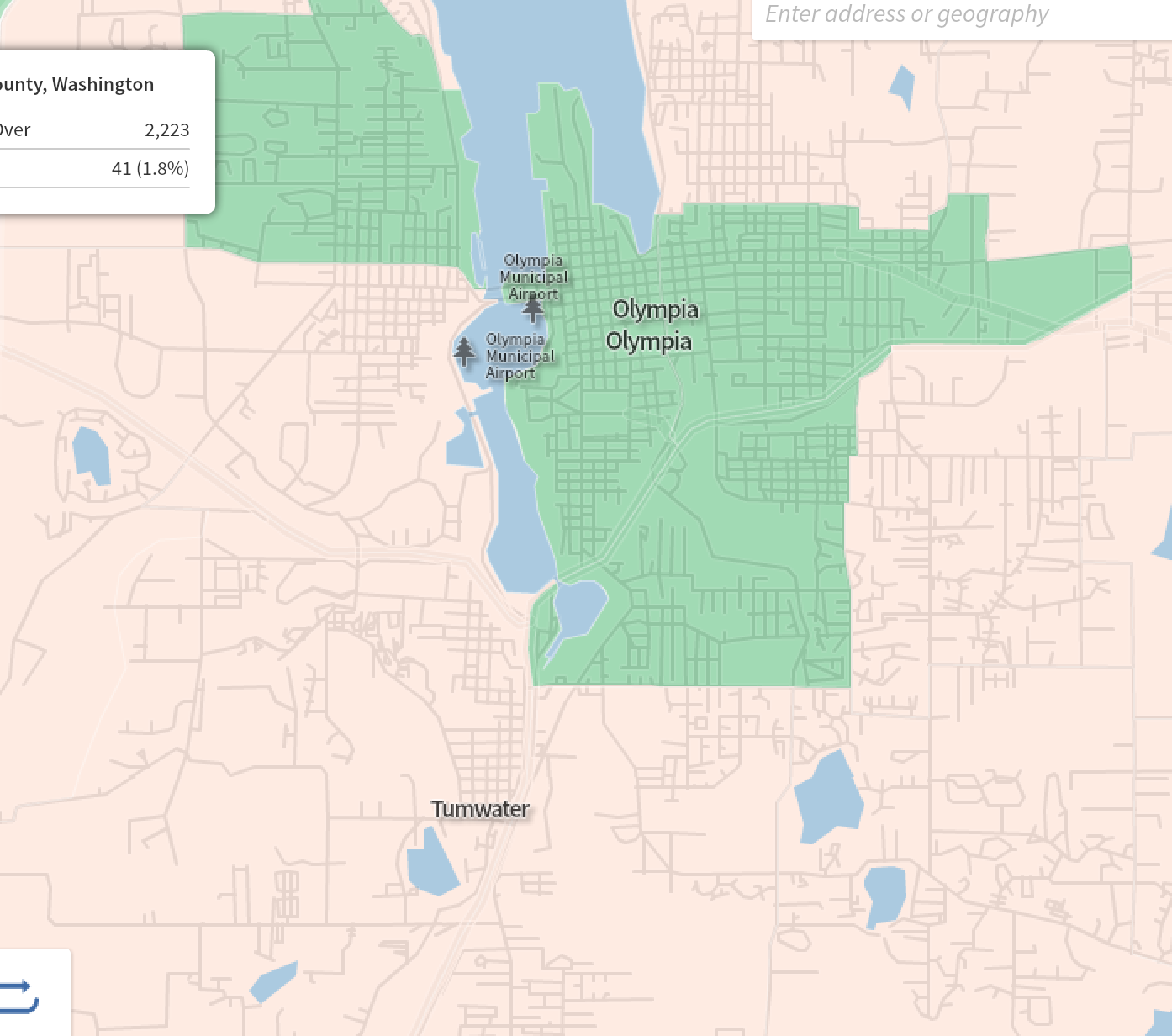
Now, for bikes, the story is different.

1990, starts out very slow, hardly anyone bikes (light green is less than 5 percent, tan less than 1 percent):

2000, not much better. Actually, kind of worse:

2012 shows a real marked increase. A full 10 percent of Westsiders bike commute, while 5 percent of downtown and 7 percent in the near Eastside bike.

So, while we seem to be going backwards in terms of promoting walking, biking seems to be getting a boost from public policies around bicycles.

I didn’t realize this, but Olympia has a fairly short history in carving out space for bikes, the first bike lane was up East Bay Drive in 1984. Today, there are more than 30 miles of bike lanes. And, almost every single major plan developed by the city in terms of city growth and capital spending has included a bike component.

Bikes at least on the surface, seem to be a replacement for cars. At least for people who would be driving themselves. Biking can be encouraged through infrastructure changes it seems. But, walking is a different beast. You have to have someplace to walk (in addition to a nice sidewalk) somewhere near you. So, we need to encourage bigger things, like putting businesses near homes, services near where the people are. Which seems different than adding bikes lanes.

Plenty of sound (Olyblogosphere for January 5, 2015)

1. The first item isn’t even an item, but an entire podcast. Rutledge Radio! If that name isn’t familiar to you, just live here a few more months and it’ll come to you.

2. The second item is not even an item, but (yet another) entire podcast. Out of the Fridge! Holy Crap. Two hours of podcast in one episode? Really guys?

3. All eyes on the old brewery from Janine.

4. This post from Olympia’s best blog makes me feel all warm inside. Merry Christmas to me!

Because of Sue Gunn (not Bud Blake), maybe an independent can win in the 22nd LD

When Budd Blake won a county commission seat in Thurston County after running without a party label, it got me thinking again about political labelling and political organizations. From what I can tell, Blake wasn’t a true independent. He won with the backing of what really is the conservative organization in Thurston County, nominally Republican, pro-growth (building industry) and pro-property rights.

On the other hand, in a non-partisan race recently, another sort of independent won. Sue Gunn was pretty much an antiestablishment candidate. From what I found when I looked at her returns was a candidate that spanned both traditionally very liberal and very conservative voters.

Just some background reading before we get into the meat of this post:

Sue Gunn won uniting the non-establishment middle in Thurston County, traditional Republican voters who didn’t like public subsidies for private business and traditional Democrats who felt the same.

This is pretty different than the type of voter that I see going for Budd Blake. Granted, there were a few traditional Democrats, but they were further in the establishment middle, the ones who were comfortable voting for a business friendly centrist against an environmentalist liberal.

But, now look at Sue Gunn’s returns in 2013 when you narrow them down to the 22nd LD. Its a given that Gunn was running in a local only election in 2013, there was very little on the ballot that drove partisan leanings. But, she did eke out an 51 percent victory in the precincts that make up the 22nd LD.

And, if you assume that the current seat-holders in the 22nd are more like Jeff Davis (who lost to Gunn), you could see a roadmap of how a Gunn-like independent could win.

There’s probably a lot more I could do with the data, finding out exactly how Gunn won how she did in the 22nd. Did she win over both traditional Republican and Democratic voters? Or did all of her support in the 22nd come from traditional Democrats? I’d assume if it was the latter, it would be harder to pull enough support in a partisan race.

Portland and Seattle, Uber, and the history of ambition in Cascadia

For two cities basically in the same spot on earth, Portland and Seattle do have significantly different civic personalities.

Think of Seattle’s Demons of Ambition. Or, in this case, Portland’s Demons of Provincialism.

The differences are real.

Take how the two cities dealt with Uber (and other ride sharing companies).

Seattle took a long road to compromise. They never cracked down, they accepted the newcomers and then crafted a legislative package to create space for innovation:

“I believe Seattle once again will lead the nation in showing how what appears to be conflicting interests can actually come together,” Murray said after announcing the agreement. “We have deregulated a highly regulated monopoly, allowing taxis and for-hires to become far more competitive than they are in the current situation. We are recognizing that a technology exists that is rapidly changing the marketplace.”

Portland cracked the whip:

“Our main concern is public health and safety, because the state invested in the cities the responsibility to do that,” Portland’s mayor Charlie Hales said in a statement. “Beyond that, though, is the issue of fairness. Taxi cab companies follow rules on public health and safety. So do hotels and restaurants and construction companies and scores of other service providers. Because everyone agrees: good regulations make for a safer community. Uber disagrees, so we’re seeking a court injunction.”

Seattle as a center of innovation, accepting newcomers with new ideas. Portland, keeping a clean house, a wary at the horizon. I tell ya, it might as well be 1893.

From (the great) historian Robert Ficken: 

(In its ability to access money from outside the region) Washington possessed important advantages of its “web-footed” friends south of the Columbia, advantages credited by any analysts to the new state’s 1890 census lead. Oregonians themselves admitted that “mossbackism,” defined as a tendency of long entrenched Portland interests to impede new-coming rivals, diverted outside money to more energetic points. “The laws of Washington,” the bi-monthly West Shore magazine noted in reference to a more substantive difference, “favor investment of capital, while the laws of Oregon practically forbid it.”

At this point, Oregon had been a state for decades, its cultural, economic and political institutions had already laid track, while Washington was just getting underway. In fact, Washington was not even made whole until just before statehood. Because of the way railroads were laid across Cascadia back then, eastern Washington Territory was an economic outpost of Portland, while Seattle and Puget Sound were in the orbit of San Francisco.
Not until railroads crossed the Cascades did Washington become something other than a name of a map.
It was a this point in time, united as a state in 1889 with railroads, Washington and Puget Sound (led by Seattle) threw open the gates to growth. This culture of open economics still shows through today.
While Washington rushed ahead, Oregon stayed behind. This mossback Oregon wasn’t new, wasn’t born out of decades of stability. But, rather, is the founding attitude of the Willamette Valley.
From David Johnson’s “Founding of the Far West,” we see how little the California Gold Rush (despite massive possible economic benefits) went to the head of Willamette farmers:

(Willamette farmers’) response to the California (gold rush) market — their enterprise — was motivated by as much by a modest desire to improve their landholdings, assure their households’ self-sufficiency, and enhance their families’ material comfort as by a drive to command greater market share or increase production as an end in itself.

Given the chance to bulldoze their way to greatness, Oregonians on their founding moment decided on a “cautious and conservative” and “cash on delivery” way of doing business.
The large Willamette farms ignoring greater gains in California led to a conservative business culture in Oregon in general. Seattle was given the chance to leap ahead fifty years later, and they took it. 
Today, Uber tries to create a new way of doing business and finds a friend in Seattle and a legal challenge in Portland.

Clarence Boggie’s Christmas (I’m sorry I couldn’t tell it better, Boggie)

Oregon wanted Boggie back.

Instead of just opening up the prison doors for Clarence G. Boggie, the Oregon parole board wanted Washington to drive him down to the Columbia River and hand him over to Oregon authorities. Since over a decade earlier, Boggie had been serving a life sentence for a murder he didn’t commit.

I’m not telling this story well. This really does deserve a better telling than I’m giving it here. I suppose this is the double edged sword of coming up with a holiday topical post. I didn’t get to it until too late into the season, and now I am too distracted to really put my heart into it.

Not that Boggie wasn’t the cleanest of men. He had committed crimes in Oregon, and on the day after he release from prison in 1948 (pardoned by Washington’s governor after a Seattle Times investigation) Oregon wanted him back.

Washington’s Warden Tom Smith:

“if they want Boggie,” (Oregon officials) should have followed regular procedure and had “someone waiting for him as he walked through the gates instead of just “pooping off” on Christmas Eve.”

I mean, this story is insane. He was in jail for over a decade, and he was just rotting there. It was the Seattle Times that really sprung him. Over three days they laid out an evidence of his innocence. It was so strong, the state literally threw the doors open to him.

Attorney General Smith Troy (Olympia’s own):

It would be a tragedy not to give Boggie a chance now. I hope Oregon officials will straighten out the technicalities involved and give Boggie a chance to be rehabilitated.

Boggie had been caught up in the historic context of Spokane in the 1930s. Officially, the capitol of the Inland Empire was not a fun place. It was extremely corrupt. Moritz Peterson was beat to death in 1933, and two years later, based on shaky testimony from witnesses, he was convicted.

Among other angles on this story, the Seattle vs. Spokane angle, the Blethens of the Seattle Times taking on their eastern neighbors, is really interesting to me. If I had the time. 


I’ll be honest. I was shopping around for a Christmas post and happened upon this. Literally I was searching “Smith Troy” and Christmas, hoping to find some episode that showed Troy (my favorite politician of all time) in some festive light. 


I even mistook the warden Smith’s quote above with Smith Troy’s. Boggie deserves much better than some dumb Smith Troy angle.

Oregon never got him back. At least behind bars. Boggie died in Lebanon in 1949.

Sigh. Boy. Remember when? (Olyblogosphere for December 22, 2014)

1. The Sky Like A Scallop Shell is a pretty good blog. But, this particular post of this pretty good blog is very epic. In an Olympia sort of way.

She was about 10 years his junior and kept mentioning her husband, but stayed consistently polite as he told her about his opinions on just about every restaurant in town, the important projects he’d worked on, how he liked to go dancing, and how he was single at the moment but usually had a lady friend.

Read read read. Read the entire thing. Do your job and read it.

2. Its this time of year, so here’s Heather Lockman’s 2012 post on Christmas Island (which was tweeted recently by the Olympia Historical Society).

3. Local writer Ryan M. Williams has a podcast. Which is totally in its 10th Episode. Listen!

4. Looking back in the memory of Olympia blogs, does anyone remember Crack Hole? Man. Talk about some meadows goodness out there.

5. Walking across mudflats: Please don’t f*****g do that. You will die. It will be terrible.

Gross Happiness Index of Washington: Thurston County is only just above average happy

Happiness Indexes are pretty interesting. They try to reach back beyond sterile, single factor indices (like Gross National Product) and give you a clearer picture of the health or happiness of a place.

So, obviously, I wanted to do one for Washington State.

I took some indicators that I could find data on the county level for across the GNH scale (economics, education, health, violence and democracy) and came up with a Gross Happiness Index of Washington Counties.

Certainly, there is a massive back of the napkin warning here, I’m not an economist or a statistician, but here are the general rankings:

County Overall rank Average rank
San Juan 1 4.20
Whitman 2 6.67
Garfield 3 11.60
Lincoln 4 11.80
Island 5 12.00
Douglas 6 12.80
Jefferson 7 13.00
Walla Walla 8 14.17
Whatcom 9 14.67
Kitsap 10 15.17
Klickitat 11 15.60
Wahkiakum 12 15.80
Ferry 13 16.20
King 14 16.50
Chelan 15 16.67
Snohomish 16 17.33
Thurston 17 18.17
Kittitas 18 19.00
Columbia 19 19.00
Clark 20 19.17
Benton 21 19.83
Skagit 22 19.83
Skamania 23 21.60
Pend Oreille 24 21.60
Adams 25 21.83
Lewis 26 22.17
Okanogan 27 22.33
Grant 28 23.00
Spokane 29 23.33
Franklin 30 23.50
Asotin 31 23.50
Clallam 32 23.67
Mason 33 24.00
Stevens 34 24.83
Pierce 35 27.00
Pacific 36 27.60
Grays Harbor 37 28.33
Cowlitz 38 28.50
Yakima 39 30.17

Digging down into the Thurston County, it is interesting to see what shapes our ranking.

We do pretty well in Health (9th) and Pollution (10th) and average in Economic (17th), Education (18th) and Crime (21st).

But, our worst index is voter turnout. Out of 39 counties, we are 34th in voter turnout. Which, if you think of the symbolism of us being the home of the state capitol (totally crap symbolism) is pretty sad.

I think its also interesting that in terms of our neighborhood, we’re the shining freaking star. Practically all four counties that border Thurston are in the basement of the GHI. Lewis (26th) Mason (33rd), Pierce (35th), and Grays Harbor (37th) all fall well below Thurston County in happiness.

Yeah us! We’re above average!

John Rambo, John Tornow and Appalachians in Cascadia

The very first Rambo movie (First Blood) is set in Washington State, in a fake town called Hope. Filmed in the actual Hope, British Columbia, the setting is descended from a fictional town in Kentucky in the original First Blood book, which in turn is based on a Pennsylvania town.

Both the fictional Kentucky town and actual Pennsylvania town are deep in Appalachia. Which, given the deep Appalachian roots in rural western Washington, Hope fits.

It also fits in the parallel I draw between the Rambo character and John Tornow. There is so much written about Tornow (some very recently), I’ve always wondered what the fascination was. Tornow, at least on the surface, doesn’t reveal any greater truth. Unbalanced man either murders or is accused of murder. People chase him down, a few deaths later, he gets killed.

But, if you look at Tornow through the lens of Rambo, you see something deeper. It lets you look back on the society that is turning its violence onto these men. For Rambo, he’s a recently returned Vietnam veteran targeted as a vagrant by an evil small town cop.

I’ve heard enough from small town cops to know that giving a vagrant a ride to the county line or a bus ticket out of town is at least within the realm of reality. And, Tornow shows us that a massive manhunt against Rambo was also in the realm of reality.

For the Appalachians in Grays Harbor in the early 1900s, for the Appalachians at every step in First Blood, the wild men are too far gone from society to live. They murdered, they are outside the bounds of even the libertarian Appalachian societal rules. Every man has liberty, but there is only so much liberty.

Both Tornow and Rambo are also both experts. Rambo is a highly trained commando, the cops that come after him are hopeless against his killing skills. He seeks to come back into society, but he falls back onto his training and the war.

Tornow was an actual outdoorsman, more at home (according to biographers) than in a town or among society. He was able to live off the land while being hunted for over a year and a half, feeding himself with what he had around him in the deep woods.

And, that is what I think is the larger truth about Tornow. If the Scots-Irish, the genetic base of the Appalachian DNA had finally run out of new territory to conquer in Cascadia (also explored in Sometimes a Great Notion), then they were almost ready to run down the last Wilderness. Tornow was a representative of that wilderness.

Sure, Appalachians are much more libertarian, every-man-for-himself than other sorts of North American society. Rules don’t necessarily work for them, but they are also the shock troops of a larger society against the wilderness, or agains the native inhabitants.

So, in dramatic stories about Appalachian outcasts, John Tornow and John Rambo must be hunted down.

Boy, they really scraped the heck out of old Tono

I’ve written a few times about Tono, here at this blog and over at Thurston Talk.

The thing that surprises me every time I run into details about that old town is how total the destruction was. The town doesn’t just not exist anymore, it was decimated. The very soil that it was on was moved away.

For the uninitiated, Tono was a small coal town just south of Bucoda and Tenino. From my Thurston Talk piece:

In 1932, as the Union Pacific was shifting from coal to diesel engines, the rail line sold the mines and the town to the Bucoda Mining Company. By the 1950s, most of the old town had disappeared and the mines closed down. Some of the old buildings were moved into neighboring towns. Only one couple, residing in the old superintendent’s house, stayed on the site through the 1970s. 

In 1969 coal mining in the fields around to the Tono site was revived when the Pacific Power and Light company bought the land and built a new steam plant to produce power. It was during this era that the Tono site saw its largest change. The ground on which the town had sat was scraped up, in order to get to the coal beneath it. The coal mining terraforming was so severe that the town site is currently dominated by two massive ponds.

I’ve done overlays of old Tono before, using aerial photos from the USGS, but recently I ran into some coal maps that are published online by state DNR. These are just fascinating. Two hand drawn maps from the middle part of the century add a new level of detail to the Tono site that I wasn’t able to see with the USGS aerials.

Take a look at this one in particular overlayed in Google Earth:

You can see that originally Tono was located in a small valley. But, in the 1960s, that valley was deepened and widened to locate the last coal deposits below the old townsite. And, if I’m correct in reading the map, the original coal field serviced by Tono was located south and east of town.
Lastly, the single structure I’ve seen out there (not up close) certainly is in the wrong spot to be part of the old townsite. If it is of the same vintage, it is likely connected to the mine operation itself.

« Older posts Newer posts »

© 2026 Olympia Time

Theme by Anders NorenUp ↑