History, politics, people of Oly WA

Author: Emmett O'Connell (Page 12 of 177)

Tract 105 in Olympia. Or a story of how the nodes argument of density is racist

Last week I wrote about how on the macro-level, Olympia’s neighborhoods are racially segregated along density lines. The more single-family homes in a neighborhood, the higher percentage of white people that live there. And now I’ve found an example of how adding high-density housing in one neighborhood, and preserving single-family housing in the neighborhood next door, has a predictable impact on racial make-up.
 
Up until the 2010 Census, Tract 105 on Olympia’s westside was one tract. But, since then it has been split into two tracts, 105.10 on the west and 105.20 on the east.
 
 
The two new tracts are split by Black Lake Boulevard. They range from the older residential neighborhood on a bluff over Capitol Lake to newer neighborhoods around Capital Medical Center and Yauger Park.
 
And, their journeys since their 2010 schism show how our current housing policy, especially the “nodes” approach, results in more white, single-family neighborhoods. While our intention hasn’t been to create zoning that segregates on racial lines, that is what we’ve done.
 
The nodes approach to growth and density argues that we should build extremely high density near Capital Mall, the far Eastside and downtown. Then we won’t have to allow for more reasonable increased density in exclusive single-family neighborhoods.
 
105.20 has been fairly static for the last 10 years in terms of available housing. It includes many older, largely single-family blocks. Before the 1980s, these blocks would have slowly densified as older single-family houses were replaced by duplexes, quadplexes, and small apartment buildings. This was the trend that was stopped forty years ago when we downzoned many near-downtown residential neighborhoods. 
 
 
105.10 started the decade as a mostly commercial tract with a mobile home park and a few apartment buildings. Also, several undeveloped green zones. Since then, it has added a couple of new apartment complexes along either side of Capital Mall Boulevard where trees once stood.
A major portion of 105.1 in 2010:


2018:
 
 
Both tracts also began the decade in significantly different spots, racially speaking. 105.20 was comprised of just a hair less than 80 percent white people, a lower percentage than a city on the whole. 105.1 started as an extremely white neighborhood, clocking in at almost 94 percent. 
 
  105.1 total 105.1 % white 105.1 white 105.1 nonwhite 105.2 total 105.2 % white 105.2 white 105.2 nonwhite
2010 1447 93.99% 1360 87 5853 79.57% 4657 1196
2017 1887 81.40% 1536 351 6547 85.75% 5614 933
Change 440 -12.59% 176 264 694 6.18% 957 -263


Since then, they’ve gone in completely different directions. 105.1 became strikingly more diverse in seven years, with its white population dropping to 81 percent. 105.2 went in the opposite direction, with its white population growing to almost 86 percent.
 
It looks even worse for 105.2 when you look at the raw numbers. The total number of non-white people living in 105.2 dropped by over 200 people between 2010 and 2017. At the same time, 150.1 went up by almost the same amount. 
 
This has all happened as Olympia as a whole has slowly become more diverse, going from 85 percent white in 2000 to 83.6 percent white in 2010 to 82.5 percent white in 2017.
 
One neighborhood built high-density housing (in a node) and became less white. The other followed the node approach by protect existing single-family homes and became more white.
 
It is also worth noting, that while 105.2 got whiter in the last decade, it also includes a significantly sized apartment complexes. These are mostly concentrated along Black Lake Boulevard and Evergreen Park Drive. But, if you look back at the block-by-block data available from the 2010 Census, you see a stark racial breakdown even within 105.2.
 
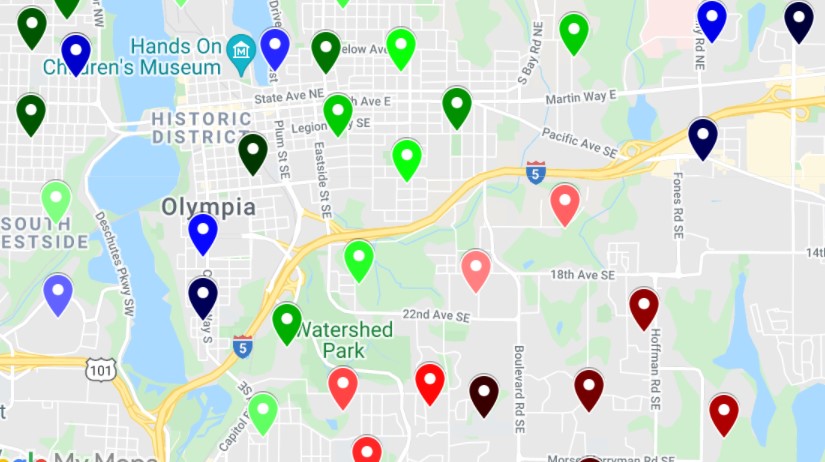
The blocks zoned single-family are much more likely to be whiter.
 
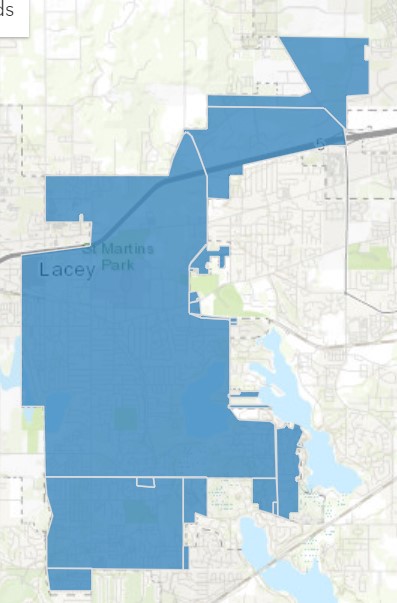
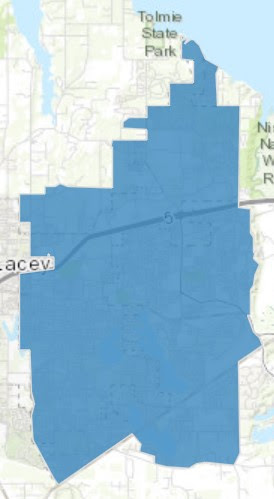
From JusticeMap, darker blocks are more white:
 
 
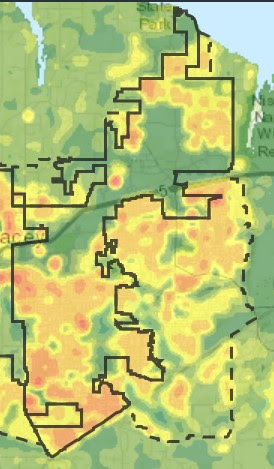
From Thurston Geodata, the red are single-family homes:
 
 
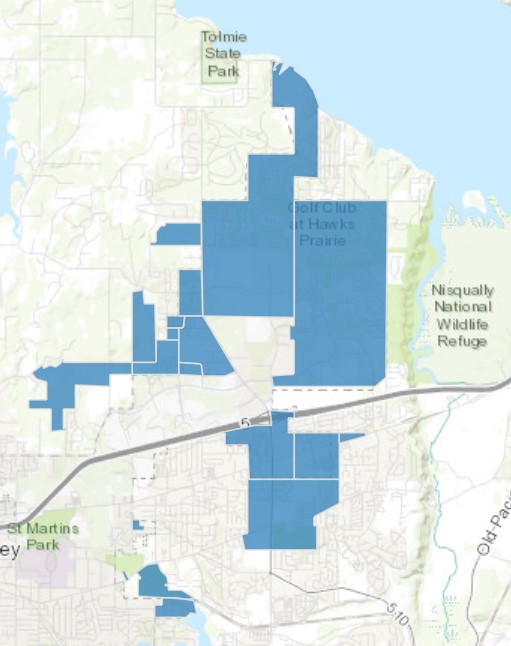
And further south:
 
 
The further you get in the single-family home portions of 105.2, but especially north of 9th Avenue, the more likely blocks are going to be white.
 
So, if you got this far, it’s clear that as we build denser housing outside of single-family neighborhoods (and in an environmental lense, in what used to be a forest), we are also keeping single-family neighborhoods white.
 
There is no law in Olympia that some neighborhoods are reserved for white people. But, by focussing building higher density housing outside of these exclusive single-family zones, this is what we’re doing. This is the current “nodes” strategy, or has some have called it “density done right.”
 
And, this is the intention vs. impact this when we talk about racism (here and here). 
 
I think it’s helpful to quote Rachel Cargle here in her frame on racism:
 

Recognize that even when your good intentions are truly good, that’s totally meaningless. Try this on for size: when you accidentally step on somebody else’s foot, you do not make your good intentions the focus of the episode. Instead, you check to make sure the other person is OK, you apologize, and you watch where you’re going. You don’t get annoyed with the person you stepped on because you caused her pain or declare that she is too sensitive or defend yourself by explaining that you meant to step to the left of her foot… But I’m a nice person does not cancel out the fact that you’ve silenced, marginalized or used your privilege to further disenfranchise black and brown people, whether you intended to do it or not.

 
We don’t build neighborhoods with racially exclusive covenants (but we did once). There is nothing in our Comprehensive Plan that says it’s our intention to build super white neighborhoods. But by not allowing even modest high-density housing throughout our city, we are doing a lot of damage.
 
Building more affordable housing types (literally anything other than single-family homes) would allow a more diverse population to grow. And, in conclusion, I’m just going to leave this here: being able to live in a walkable, liveable (non-node) neighborhood is good for everyone.

Zoning and race in Olympia, WA

Last November I posted about the history of race and housing in Olympia. I tracked local ordinances to outlaw racial discrimination in housing. I also wrote about some housing developments that have racially-based covenants. 

One of the things I noticed in these racially-restrictive covenants is that they always came with another requirement, that the neighborhood also be exclusively single-family homes. Not every restrictive covenant I found had a racial component, but every one with a racial component also required single-family homes. 
In fact, in Strattford Place near where I live, they put the single-family requirement at the top of the list:
Thankfully, racially restrictive covenants are illegal. But, since the 1930s (when racially restrictive covenants were en vogue in Thurston County) single-family zoning has increased in popularity. 
Over the years, we have created zoning laws that restrict housing to (largely) only one type: single-family homes. I want to back up and reiterate this point. In the past, housing in Olympia was much more diverse. But, in the 1970s and 80s, we downzoned much of the city to outlaw anything that wasn’t a single-family home.
So, think about this next phase in three steps:
  • We build much of our city in the most expensive housing type.
  • Single-family homes are the most expensive housing type. Do I need to give you a link to back that up?
  • And, in the Pacific Northwest, income is a proxy for race.
So, what happens when you compare race with housing type in Olympia?
This may seem obvious, but the more single-family homes there are in a neighborhood in Olympia, the whiter that neighborhood is. 

Here is my spreadsheet. I took the date from the American Community Survey, specifically tables B25024 and B02001.
Olympia is a massively white city that is slowly growing more diverse over time. But even as the city grows, the white population is concentrated in largely single-family neighborhoods.
Recently, we have tried to allow for more housing types (like duplexes, quadplexes or small apartment buildings) in white, single-family neighborhoods. Fighting these policies is the same thing as saying you would like to preserve the racial nature of single-family neighborhoods.

Black Lake Way, old Black Lake Road and how history could have been

One of the most interesting, long-term and simmering debates in Olympia, is how several dozen blocks in SW Olympia are connected to the rest of the city.

Southwest Olympia south of Division and east of the mall is an interesting place. Unlike anywhere else in the city, they are unusually cut off from the rest of the city. Other than 9th Avenue and 4th Avenue, there is really no way to access much of the Southwest side neighborhood.

But, like a lot of things you’ll read on my blog anymore, it wasn’t always that way.

It turns out that the weirdest little street on the westside, Caton Way, which juts northeast from near 9th and Lee street for half a block is actually the last portion of an old county road that had connected the westside with the rest of the county.

Black Lake Way can be seen plainly here in this 1945 plat map:

In the 1937 version of the westside map, Blake Lake Way is the primary route out of west Olympia.

In this era, there is no Black Lake Boulevard further west, Black Lake Way was it.
Fast forward to 1951:
And you can see the map hardening and stretching. The northern portion is renamed Caton Way already, Decatur in the middle and the last stretch is “Old Black Lake Road.”
What happens next is pretty clear to figure out. Here is the 1959 USGS topographic map:
In the 1950s, the interstate highway system came to town and reshaped our communities in ways we’re still feeling now. Old neighborhoods in Tumwater (not the downtown or main commercial area) were sacrificed to interstate 5, Lacey was given the seed it needed to be transformed from a sleepy rural neighborhood to a suburban city and west Olympia was given its trajectory. 
Whoever made the decision to site the interchange at Mottman (later Black Lake Boulevard) instead of old Blake Lake Road, created the conditions for the westside we have now. At least according to this document, one of the options when they laid out 101 in the 1950s was to connect what had been Black Lake Way to the new highway.  Like an unused limb atrophying, Black Way Way retreated up into the neighborhood, being covered over by new development and becoming the stub of Decatur. When the current Auto Mall neighborhood was platted in the early 1980s, one portion of the old road was reclaimed and named Caton, acknowledging its historic connection to its severed relative less than a mile north.
It certainly didn’t help that the development that resulted surrounding the Southwest neighborhood was focussed towards the Blake Lake Boulevard exit and was autofocussed. The 1980 replats of the historically square blocks favored windy, care friendly designs with little thought to connect to the older neighborhoods.
So, what’s the bottom line? First thing, I’m pretty bored. If you look at the date stamp of this post, this is maybe week three of the COVID Stay at Home Order. I’ve got a lot of time on my weekends to read technical reports and download old maps.
Second, people get very excited about protecting their neighborhoods. This isn’t breaking news. No one is surprised by me saying NIMBYs are going to NIMBY. People who live up on the Southwest side just don’t want to be connected to the rest of the city. 
But, what is interesting to me is that how history really could have played out differently. We could have seen a history where the Auto Mall never happened and West Olympia sprouted a traditional commercial center on the end of Decatur that is now a dead end. Had the decision been made differently in the 1950s to connect Primary State Route 9 (now Highway 101) to west Olympia by the Old Blake Lake Road instead of Mottman (Blake Lake Boulevard), we would have likely seen a different development pattern emerge. 

Who was Karen Frazier?

Not Karen Fraser, but Karen Frazier.

Because the name of a street in Southeast Olympia resembles the name of a longtime local politician, I’ve always wondered who the Karen Frazier (not Fraser) of the street actually was. Who had been well-known or important enough in Olympia decades ago to name a dog-legged street after?

Well, it turns out, no one at all. Karen Frazier never existed.

What the name signifies is the overlapping plans of how housing developments used to be planned and then abandoned. One of the vital steps before building a neighborhood is to subdivide a larger property, plan where the streets are going to go and then name them. This plan is called the plat and is submitted to the local government.

Here is a portion of Squires plat in 1890:

You can barely see the current day Olympia on this map. The current Boulevard Road is identified as “County Road.” on the far left-hand side. Also, in addition to (Karen) Frazier, the current Van Epps, Humphrey, and Allen streets were also platted. The rest of the plat was never built and is lost to time. 
Van Epps, Frazier, Ellis were all names of Olympia in those days. So, in this case, Frazier likely refers to either Andrew, Katherin or Washington P. Frazier. 

There is a series of small notations you can find if you look up the Squires plat here, that the county commission officially abandoned this plat in the 1960s.  
So we can see that in the 1890s, there was a Frazier street platted where the north end of Karen Frazier street meets the current 18th Avenue.
So, where did the “Karen” come from? Sixty years after Squires plat was laid out, Kenneth and Allegra Boone laid out “Boone’s Addition,” overlaying some of the old Squires plat.

Here is Boone’s plat in 1950:

In constructing the plat, they joined Karen Avenue with Frazier Street. Eventually, either through an official act or just recognition of common use, the name of both shifted to Karen Frazier Road Southeast. 

There is a worse fate for the Olympian than our present and a future without the Olympian

1. I got into a discussion this afternoon with a local, talking about the state of the Olympian and whether it would be worthy of support if it changed its corporate structure to a non-profit. Here’s the original argument:

I don’t disagree about local news being produced by non-profits. Great idea.

The Olympian is the only professional organization covering the news in the city I love. Let’s just not call them names while they’re doing it is all I’m saying.

Also, I think we’re missing a lot of nuance on the current state of the Olympian’s corporate owners, the McClatchy company. I’ve been reading a lot about them lately, so I wanted to write down what I’ve learned.

2. I’m not sure how many of us realize how quickly the fate of the Olympian could turn. And turn so quickly and quietly that we’d have no reason to notice. Right now, the paper’s parent company is in the process of trying to negotiate a deal on $124 million in pensions it is due to pay. After spending the better part of the last decade paying down $4 billion in debt it took on to buy up Knight Ridder (of which the Olympian was part), McClatchy seems to face this one additional hurdle to start making forward progress.

While this is happening, the stock price of the company tanked, going now for only pennies per share. That gives the managers of the company very little room to move as they try to chart a path forward. The immediate risk from my point of view had been just that McClatchy would declare bankruptcy. Maybe, I thought, they would just shut the Olympian down, maybe just fold it directly into the Tacoma News Tribune.

But there is a fate worse than death. And a fate that because McClatchy almost killed itself buying our paper (along with dozens other) we’ve avoided as the company tries to get itself back on its feet. Hedge funds, like the one described here, are ripping through the carcasses of struggling newspapers, feeding investments with the goodwill of subscribers:

It is no secret that the newspaper business is in decline. So it’s hardly surprising that Freeman would feel the need to shrink the head count at his newspapers, just as almost every other newspaper owner has had to do for years. 

But what sets Freeman apart is that he seems to have a rather unique view of a newspaper’s purpose. In this view, his papers are intended not so much to inform the public or hold officialdom to account, but to supply cash for Freeman to use elsewhere. His layoffs aren’t just painful. They are savage. 

… 

Last year, Digital First Media’s chief executive, Steve Rossi, sent a company-wide email saying that the company was “solidly profitable,” and that “advertising revenue has been significantly better” than competitors. Yet the layoffs have not let up. Just last week, Alden Global imposed another round of layoffs, including a third of the staff at the Denver Post. As recently as 2009, Denver had two competing newspapers; it is now down to 66 journalists in one demoralized newsroom.

And, this is a fate we’re avoiding in Olympia because our newspaper was luckily bought by a company that is still interested in being a newspaper company.

Meanwhile, in August, the New Media Investment Group announced that it was buying Gannett Co. and combining it with its GateHouse Media subsidiary, which instantly created the largest newspaper chain in the country. New Media is controlled by Fortress Investment Group, and its approach is not terribly different from Alden Global’s. People are starting to call papers owned by hedge funds “ghost papers” — defined by the New York Times as “thin versions of once robust publications put out by bare-bones staffs.” 

Although they’ve had their share of layoffs, McClatchy’s 30 media properties… are not ghost papers. A little more than a year ago, Julie K. Brown, a journalist at the Miami Herald, published an extraordinary expose of the convicted sex offender Jeffrey Epstein; that series sparked an outcry that led to Epstein’s arrest in July. In October, the well-regarded McClatchy Washington bureau documented a disturbing rise in the rate of cancer treatments at Veterans Affairs hospitals. And just a few weeks ago, the Kansas City Star published a powerful examination of Missouri’s public defender system

I’ve pulled a lot of quotes from Bloomberg’s coverage of McClatchy, but Joe Norcero’s “McClatchy Goes Digital to Ward Off ‘Ghost Papers’” article is a good discussion as any of McClatchy’s current situation. The most telling part of the article to me is where I learned that the actual McClatchy family hasn’t taken a dividend in a decade. This is not a company that is trying to squeeze blood from a stone.

3. The Sacramento News and Review is an alt-weekly that does a great job skewering the Sacramento Bee, the McClatchy mother paper. But even they point to the Bee as an irreplaceable local asset. Whenever I feel sad about the state of local papers, I remind myself that people of goodwill exist by reading Eric Johnson’s “Support the Bee Anyway” and “Save the Bee.”

For the record, I’m all for the non-profit, locally controlled Olympian. I’m all for the web-based non-profit locally owned web-based, podcast heavy local news organization. I’m all for all of that.

But this is a bus stop, not UberX. I need to pay the fare for the bus that gets me closest to my destination. So I support the Olympian anyway.

How did our housing practices shape Olympia’s racial makeup?

Amanda Smith, the former mayor of Olympia, sat in a suddenly silent city council meeting in the spring of 1968. She had been mayor in the 1950s and had come back to city hall to speak out in favor of an ordinance to prevent housing discrimination.
Duke Stockton had just stopped speaking against the ordinance and had pieced together a speech that shocked the crowd to silence.
“A man should have the right to do what he wants with his own property.”
“We don’t want them living in Olympia, but if they do live here, let them stay in their own communities and leave us alone.”
“It leads to intermarriage…”
Mayor Smith was the first to break the silence: “I wonder if everyone’s heart was beating as hard as mine was as I sat and listened to that. I have never heard a more ignorant talk in my life!”

Given what we know about the world back then, I can hardly believe that to be literally true. But it is possible that the debate over open housing only brought such attitudes to the surface.
Olympia along with Thurston County, Lacey, and Tumwater, would end up passing Open Housing ordinances in 1968. The effort here was part of a longer effort nationally and statewide to break apart racist housing practices.
Back up a little first: It is fairly well known that as a local rule that currently Lacey is more racially diverse than Olympia. The vast majority of Olympia’s neighborhoods are still over 85 percent white, with only a few outlying neighborhoods below 80 percent at all. The most racially diverse neighborhood in Olympia is about 65 percent white and is the section between the Martin Pacific split and Interstate 5 where it crosses Pacific.
Lacey, on the other hand, has more racial diversity in general. Specifically, Lacey has more neighborhoods with higher concentrations of non-white residents. 
When housing activists were lobbying our local governments for open housing rules, Lacey held back at first because the leaders of the new city (only founded in 1966) were under the impression that Lacey already was open to all races. They passed the open housing rules anyway.

The housing practices that Amanda Smith and other Olympians were trying to prevent by adopting Open Housing rules in the 1960s were in reaction to decades of racist practices. It seems that at least on the surface, we’re still seeing the impact of these practices decades later.
Here is a deeper dive into these practices and how they worked:

1. Olympia real estate agents as late as the 1960s actively steered African American home-buyers away from certain neighborhoods.

From the Olympian in 1968:

(African American residents) put the blame for the trend toward a (racially segregated) ghetto squarely onto the practices of some real estate businessmen… 

What is happening, they say, is that real estate salesmen are trying to steer Negroes into certain areas while at the same time urging whites not to buy there “because Negroes are moving in.” A check with some whites who are hunting houses confirms this. 

According to at least one Lacey city councilmember in the 1990s, Lacey was one of the places where real estate agents would steer minority customers.

2. There were certain neighborhoods in Olympia that as late as the 1940s were officially off-limits to anyone who was not white.  


This is by no means a comprehensive list, but while it didn’t seem to be common practice, there were a few neighborhoods in Thurston County that has racial covenants. Two of these were in Olympia, and a third I found was Beachcrest, north of Lacey. 

Stratford Place, one such neighborhood just north of Olympia High School, had these racial covenants baked in.

Another neighborhood just up from the end of West Bay Drive, also advertized homes based on racially exclusive covenants.
When you look at how widespread this practice was in King County, I was a little surprised I could easily find more examples in Thurston. There is a lot of history behind racial covenants, and this paper is a great long walk through their use and eventual rejection.
Moving on from the 1960s, we continued to have housing debates in Olympia. But as they continued, they had more to do with density and liveability than they had to do with (one the surface) race.
Less than 10 years after Olympia, Tumwater and Thurston County passed Open Housing ordinances, Olympia began a long debate about multi-family zoning throughout the city. While this debate mostly centered upon income (and sometimes crime), it certainly had the same structure that the debate around anti-discrimination fight had in the late 1960s.
The 1970s saw the largest influx of new residents in Thurston County’s history. It changed the nature of our communities and it drove a historic increase in higher density housing types in Olympia. The historic nature is true because after this influx we made most of these housing types (duplexes, quadplexes) illegal through most of the city. 
One term that got thrown around during the housing debate in the 70s and 80s was also “ghetto.” While the term in the 1960s obviously meant a neighborhood with a large non-white population, what did it mean in the 1980s? Were our anti-density rules stemming from that era racially motivated? Obviously, on a certain level, they were motivated out of a fear of crime and nearby poverty. But how far did we grow in just over 10 years?

Olympia housing post in two parts: Answering a question on Ron Rants and asking a question on Samuel Stein

Both of these came up at the same time, so I’m doing them in one post.

1. Answering Steve Salmi’s question here first:

…Dan Leahy was right to “follow the money” regarding tax breaks for developers – including Ron Rants. Olympia would do well to display greater transparency in its decision making if it wishes to build the credibility of Missing Middle initiatives. 

For the sake of historical honesty, it would also be helpful to know if Ron Rants is now being subsidized to undo the very problems he helped to create – both as an elected official and a development industry leader.

On the first go around on this post, I actually noticed a few places where Ron Rants, in fact, sounded like a 2010s era urbanist.

First from May 1980:

Fellow commissioner Ron Rants said the existing policy didn’t mesh with his personal view. The city should be encouraging mixed housing, he remarked. Mix housing includes having duplexes in single-family neighborhoods.

Then in September 1980:

Rants said the city, in fact, should encourage denser living patterns within city limits, to put an end to what he called rapid leap-frog growth to the county.

I will say that Steve’s point that the city commission, which was on its way out in the early 80s, was certainly the body that laid the groundwork for a series of downzoning in the 80s and 90s, they didn’t seem to be enthusiastic about putting on the density brakes. In fact, to me, it seems like the same populist dynamics that put in the city council form of government where the same dynamics that were also arguing for exclusive single-family zoning throughout the city.

2. In the past few months, the opponents of denser and less expensive housing in Olympia have started using Sam Stein’s “Capital City” like a cudgel. Without really explaining how Stein’s arguments about how the modern real estate industry works in regards to single-family zoning, they simply state that more options for buildings (for-profit, non-profit or government) would just allow for more building and builders are bad.

While this behavior does fall into the broader “why NIMBYs just hate developers” thing, it doesn’t really center Stein’s arguments in Olympia’s history of downzoning. I poked around Stein’s book for discussion on downzoning on a broader scale, like what happened in Olympia or Los Angeles in the last 50 years. 

A historic district, a contextual rezoning––which means changing the zoning rules to match what’s there right now––or a downzoning, which means in the future people will only be able to build smaller than what’s here right now. So it wasn’t even, I said neighborhood before, but it’s really block by block, block by block by race, so white blocks––predominantly white blocks––got protected, predominantly African American, Latino, and Asian blocks were subject to big, new development. And so, the result of that ends up looking like integration. If you look at those prior, mostly Black, Latino, and Asian blocks, and you see there was this luxury development that was built and suddenly all these white people moved in, now something else is happening. But at the same time, they cut off the ability to build out low-income and mixed-race development on those white blocks. And so, they were channeling integration in one way and cutting it off in the other. It’s like a one-way street that’s going––there’s a one way street and you’re moving in the wrong direction. If we want to do integration, we need to unsegregate those white spaces. The problem is not the concentration of people of color in neighborhoods that they built up over a long period of segregation and disinvestment. So that in many cities the integration that’s happening is the exact wrong way to do it.

In context to Olympia and the Northwest, this brings up a few things for me.

One, we’ve seen how the debate over changing single-family neighborhoods into “ghettos” has affected the course of Olympia housing policy. Calling people racists in historic terms is not fun, but I’m just going to leave that there.

Two, people who trot out Stein are also unironically talking about “nodes” of high-density growth in Olympia. There are places where added density that could take place in single-family neighborhoods should more appropriately go. And, unsurprisingly, when you poke around a block group map of white distribution around Olympia, places with a lot of apartments (existing “nodes”) also have the fewest white people.

So, to my question: how is Stein’s discussion of protecting white neighborhoods not like what happened and is happening in Olympia?

How much did cutting the middle out of our housing stock cost Olympia in the last forty years?

Or, Olympia’s spreading tax-subsidized single-family neighborhoods. 


I’ve pointed to this chart oftentimes as an illustration of how we changed directions back in the 1980s.

I’ve recently been rethinking this graph, mostly due to new perspectives on a fairly old policy tool to encourage apartment construction in downtown Olympia. Dan Leahy has been writing in Works in Progress about the multi-family tax exemption and how the rest of us are subsidizing new construction downtown.

While the discussion around the multi-family exemption does not reveal anything new (someone pays taxes if someone else is exempt), it does give a new ax to grind to people who would rather stay the course with how Olympia has been developing in the last forty years. Car-dominated suburban developments get a pass, while any sort of development downtown that is not a parking lot is given a side-eye or actually challenged legally.

But, the discussion did open an opportunity to examine how exactly our spreading suburban development pattern has cost the city’s bottom line.

As a background, I used the Thurston County Assessor’s parcel data provided by Geodata. This dataset gave me locations and construction dates (important for that chart), but also lot sizes and total values.


Also, I wanted to point out that only in the broadest sense am I talking about “denser” housing. Leahy is mostly discussing downtown Olympia apartment buildings, while I’m discussing anything from a duplex to a quadplex. While we oftentimes conflate these when we discuss housing and zoning, I want to make sure we know I’m talking about different types of housing. 

Now, let’s get to the data!

At some point in the early 1980s, the construction of duplex to quadplex sized homes became disconnected from population. I chose 1981 as my splitting point because it seemed to make sense to me.

Between 1960 and 1981 Olympia averaged 6.2 two to four-unit buildings per thousand of population increase.

After 1981, that rate fell to 1.23 units per thousand new residents. Building non-apartment/non-single family home dwellings went through the floor after the early 80s.

What happened in the early 1980s? Go back and see the policy changes we made to favor single-family homes and the hateful political ecosystem that created it.

And because we know how many people have either been born or moved here, we can calculate how many du/tri/quadplexes we lost because we changed the rules. If we built at the same rate we did before 1981, we would have built 723 more du/tri/quadplexes. We currently have 786.

That on its own is shocking. That means we outlawed between 1,500 and 3,000 living spaces since the early 80s. If we continued building duplexes, triplexes, and quadplexes in Olympia, we would have nearly doubled the number of these more affordable units.


But, let us not stop there, this is about the public subsidy, not affordable homes removed from the market by bad laws. Because we know how much single-family home properties are worth and how much du/tri/quadplexes are also worth, we can calculate roughly how much each type pays per acre.

It should surprise no one, but the more dense housing types subsidize single-family homes.

Du/tri/quadplexes cover just over 216 acres of Olympia and they are valued at an average of $1,159,413 per acre.

Single-family homes cover over 4,528 acres of the city and those are valued at an average of $1,035,155 per acre.

This is not taking into consideration the added value du/tri/quadplexes would have brought to single-family homes.

So, when you lay out what we lost (at least 1,446 affordable units) against their higher value, you can get an idea of what our historic single-family home favoring policies has cost our city.

Doing a back of the napkin calculation based on last year’s levy rate, the lost taxes (not just to the city, but to everyone who collects property tax in the city) was $3 million per year.

To put this into perspective, in his post that I linked to above, Dan Leahy points out that across of all the multi-family exemption projects, the loss in total government revenue is $3.4 million over eight years.

What we lose per year because we made a decision forty years ago to favor single-family homes is the same amount we lose over eight years for encouraging more dense development. This calculus also ignores the higher tax receipts that an apartment building will produce as opposed to a parking lot once the exemption is over. And, also (obviously) that the tax exemption is temporary, while single-family zoning is a bit harder to budge.

The Indian Shaker Church and the Lewis Family totem pole

Surprisingly terrible people.
And, by way of making this re-telling of these incongruent stories even weirder, they both originally were written about in the same edition of the Daily Olympian on July 5, 1970. 
The Indian Shaker Church on Mud Bay needed to be rebuilt. 
It had burned down in the winter before. And, in the summer of 1969, Indian Shaker adherents had noticed the roof had begun to cave in because of snow anyway. 
The original church structure had been only been built in 1910, the same year the Indian Shaker church was formalized.
So, the community of this particular fairly new faith got together to rebuild. They also reached out to seek help. A Seattle architect sent down plans and Simpson Timber company gave and delivered all the wood they needed. 

On July 4, 1970, Indian Shaker faithful from all across the region came to celebrate the reopening of the church. Because this church wasn’t just an Indian Shaker Church, but the Indian Shaker Church. The mother church.

I’m not a tribal member nor a person of this particular faith, so I won’t go into the history of the Indian Shaker religion. But, only to say that the religion was only founded in the late 1880s and for years was a robust expression of tribal culture. One white people even feared.

So, let’s leave that there for a second and move to a week earlier, on Cooper Point, when something else entirely happened.

While Indians from all over the region were planning their visit to their newly rebuilt mother church, a white family on the other side of the bay was dressing up as Indians and unveiling a brand new totem pole they’d just bought.

And, in only the way that white people being totally unaware of the way they look or how they would be judged almost 50 years later, the Lewis family and their friends not only dressed up as Indians and played recorded “musical Indian chants, alternatively soft and loud…” but they called themselves by terribly derogatory Indian names that I won’t recount here.

I should let you read the story yourself, and you really should, but the Lewis family should be judged. And judged harshly. The way they acted is not respectful. If their plan was to honor tribes and tribal history, treating it like a dress-up party is especially tasteless. I don’t need to tell you that, though.

Where did they even get the idea to buy a totem pole?

Three years before the party and unveiling (I’m not going to use the term they use, but read the story) one of Dick Lewis’ friends needed help moving his own totem pole. Being a nice friend, Dick came through with a truck and was smitten.

“Mrs. Lewis reported that ‘totem fever infested the Lewis tribe” and they determined to have one for themselves.” 

Dedicated as “unfolding a bit of Pacific Coast history, reminding all of us our precious heritage and need to preserve our God-given rights and freedoms,” it provides “a tangible link between past and present” to the Lewises and the many people who are received as guests in their hospitable home.

This talk of freedom and God-given rights is a double serving of irony if you head back across the water to Mud Bay.

I mean, why were Indian Shaker adherents gathering on July 4?

Jeremiah George (Squaxin) wrote a bit in 2010:

When we practiced our culture in secrecy
(for our European conquerors were quick to label
us as hostile savages, disposing of us as such) tribes
came from miles and miles away to a potlatch we
called the 4th of July Celebration at Squaxin Island.
That celebration must have had an impact, because
an elder from Canada in his 70’s-80’s recalled when
he was young an “old” elder claimed his favorite
place was Squaxin Island. Culture got us through
hard times and the assimilation that keeps us distant from culture and the apocalyptic measures of
genocide that will continually go unaccounted for. 

They had to celebrate on the fourth of July because they didn’t have the freedom to celebrate otherwise. In the early years of the Indian Shaker church, its members were arrested.

At the same time, the Lewis family was appropriating and pounding their chests about heritage and freedom, tribal members were being arrested and prosecuted all over western Washington for fishing. A right not reserved by God, but by treaty.

It would take only a little over three weeks for the fall chinook season to start and for two Puyallup tribal members, Bob Satiucum and Charles Cantrell, to be arrested for fishing. Just as illegal as it had been to be an Indian Shaker, it was still illegal to be an Indian fisherman in 1970. The Lewis family had the freedom to buy a totem pole and dress up like Indians, but actual Indians didn’t have the freedom to be Indians.

Ghettos and lost quadplexes at Nut Tree Loop: Our conversations 40 years ago around multifamily housing and how we got here

If you go up Eastside Street from downtown, it will eventually curve to the east and become 22nd Avenue. As 22nd Avenue approaches Boulevard, there is a small neighborhood on the left-hand side of the road called Nut Tree Loop.

This area around 22nd, Cain Road and Boulevard was the neighborhood I grew up in. I was born in 1976, so in my mind’s eye, I kind of remember Nut Tree Loop being built in the late 70s. And, I’ve always thought about it as a much nicer neighborhood surrounded by blocks of split-level ranch homes and older craftsmen. I think if you take a walk through Nut Tree now, that impression by Kid Emmett still holds true. Two homes recently sold in there for over $700,000 (in 2017) and $800,000 (last May).

So then, I was startled to find out when Dan Beuhler first envisioned Nut Tree Loop in 1976, he sketched out a neighborhood of 21 fourplexes “across one section of landscaped grounds.” Beuhler had already built a smaller development of apartments around the corner from Nut Tree. At the time called Eidleweiss, they are currently known at the Chateau Townhomes.

 Where 40 or so nicer single-family homes now sit, 84 multi-family units would have been built, if Beuhler got his way. But instead, the Nut Tree fourplexes kicked off several years of debate in Olympia around multi-family housing, the results of which are still felt today.

And the nature of those conversations tells us a lot about why Olympia shut down the development of smaller multi-family housing since the 1980s.

I’ve written about this period of history in Olympia before. First I tracked the sharp decline in small multifamily housing in Olympia since an explosion in the mid-70s. Second, I took a look at zoning maps since the 1960s to the current day and found a declining area that allowed anything but single-family homes. Lastly, I charted the sprawl of single-family homes that resulted since Olympia downzoned.

In this look, I want to explore how we were talking about the change in the city that at one point allowed duplexes and small apartments and then outlawed them.

Beuhler’s proposal set off a series of contentious public meetings where the city planning commission (on which Beuhler inexplicably sat)  decided the fate of the Nut Tree quadplexes. Over 500 individual Olympian’s testified to the city planning commission and the city commission itself (Olympia was not yet governed by a city council).

Times were tense when the city commission finally took up the Nut Tree fourplexes. When one city commissioner pointed out that in the late 70s incomes were not increasing at the same rate as the price of a single-family home and therefore it made sense to allow for denser, more affordable options in new construction, an audience member shouted: “Why don’t you move to New York?”

New York in the 1970s not necessarily being an example of a humming urban community. This fear of the urban, the denser and poorer community coming into newer single-family neighborhoods underlined the public debate around Nut Tree. While most of the top-line conversation was simply about the power of zoning and the expectations of homeowners that their newer neighbors would have the same zoning, when you dug down, you go the fear of the urban.

Facing that level of fire over one development was not something the city commission had experienced before, and they quickly put the Nut Tree quadplexes on the shelf.

After Nut Tree Loop, the city took a step back and began to examine multifamily housing across the city. The Citizen’s Multi-Family Housing Taskforce began meeting in January 1978 and worked throughout the spring and summer to deliver a zoning package to the city council.

But, like Nut Tree along 22nd, this proposal met with fierce opposition across the city.

As the city considered a plan that would expand multifamily housing throughout the city (even further than the citizen’s taskforce had intended), an unsigned editorial in the Olympian captured the mood of those opposed to denser housing: It isn’t our job to look after anyone but families and experts that disagree with us are bad.

Those who participated in seven months of hearings by the task force evidently want nothing of the philosophy that holds a community responsible for providing the kinds mixed housing needed by today’s mixed lifestyles — the singles, the elderly and the divorced for instance. 

The planners are coming at the problem as theoreticians, as we see it, and they’re not handling the grassroots thinking very well at all… The latest effort to insert recommendations into a citizens report had too much of the smell of “we know what’s best for you” thinking about it.

The commission approved plans that would, on the one hand, allow multi-family housing, but, on the other, only after it was approved on a case-by-case basis. Even then, the economic class of the folks sitting on the Task Force was brought up.

From the city commission minutes in August 1978:

Paul Sparks said his concern is that we would be isolating the lower income families to certain areas away from services and from the city center. The people who are most affected by (the multi-family plan) were not involved on the Task Force. 

Two unidentified women then entered into a heated discussion about the makeup of the Task Force, one asking how come low income people had not been considered and involved; the other replying the Planning Commission has asked for volunteers to serve on the Task Force and all this was in the papers and the radio.

The city commission passed a version of the Task Force recommendations, but they failed to turn on the spigot of multi-family housing.

By 1980, the planning commission had again passed a package that would expand multi-family housing across the city.  The idea would have been in the early 80s to allow multifamily housing in all areas of Olympia, essentially banning single-family zoning.

And, again the residents of single-family neighborhoods stood up.

Multi-family housing in otherwise single-family neighborhoods will foster “the diverse kind of community that makes this community interesting and makes it rich,” (Raven Lidman) said.  

She said when it comes to the good points of living in single-family neighborhoods, “tenants have those same desires.” 

But Virginia Baxter, speaking after Lidman, said “The existing inviting neighborhoods will be destroyed, and there will be an exodus of homeowners” if multi-family housing comes to neighborhoods. 

… 

But Susan Hirst, protesting the proposal, said that multi-family renters will not gain much by being located inside single-family neighborhoods. 

They will still be living in apartments, she said, and “you will simply be placing them into a neighborhood where other people have” the style of life the renters want.

But you have to look no further than Bill Grout to find the dark corner of the urbanism discussion in 1980 Olympia. In one article on the 1980 multi-family plan:

“You have increased police activity, increased crime, increased vandalism,” with multi-family housing, said Bill Grout.

Later that summer, as the city commission itself considered the plan, Grout crossed swords with a county leader in a discussion that might as well come out of our current conversation about Missing Middle housing:

Bill Grout, who said he represents Olympia’s homeowners, labeled the proposal one which “would turn Olympia into a ghetto.”  

… 

(County Commissioner George Barner) said the measure would build up the dwindling rental housing market and would enable low income and young persons to afford a place to live. 

He said such housing should be encouraged in the urban areas because most conveniences are located there. He added it would also prevent urban housing sprawl. 

Grout contradicted Barner, saying out that multi-family housing would drive down property values in single-family residential areas because renters generally do not take care of their property.

And, so the city turned the proposal down. Not actually turned it down, but rather just put it back on the shelf. A year later the city would approve a townhome ordinance that would allow a certain kind of multifamily housing throughout the city, though one that seemingly favored homeowners.

But, the time of multi-family housing tracking with population increase was over. Olympia would go through several incremental downzones to tighten up single-family zoning areas through the 80s and 90s

« Older posts Newer posts »

© 2026 Olympia Time

Theme by Anders NorenUp ↑