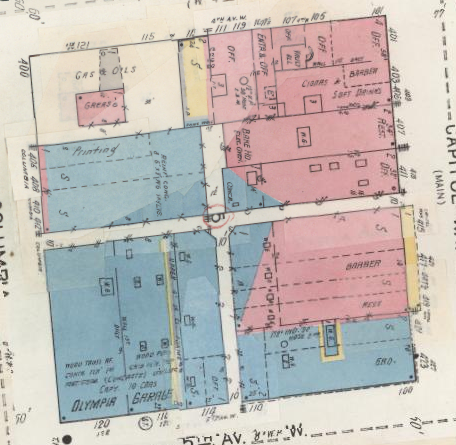
The first time a local newspaper used the words “parking lot” to describe something in Olympia was in April 1935. It was talking about part of the Olympia Garage at Fifth and Columbia. Before then, people used phrases like “parking station” or “auto storage.” The very first reference to any sort of off-street parking at all in Olympia was in 1919 at State and Washington. But it was Fifth and Columbia where “parking lot” and Olympia’s identity first came together.
If you moved to Olympia in the last decade, you know this corner as a modern apartment building. Ground-floor storefronts sit mostly empty below several floors of structured parking. Above that garage, several stories of apartments house hundreds of downtown residents.
From the early 1960s into the 2010s, that half-block was downtown Olympia’s primary surface parking lot. It stretched down Columbia to Fourth Street. Set just off Capitol Way, it sat outside the immediate business center, was still pretty close to Capitol Lake, while remaining a bit too far from the state capitol campus to serve daily commuters well.
To understand this site, we have to look back at what sat here before it became a parking lot. In 1884, the remaining natural shoreline of Budd Inlet hit the southwest corner of the block. The Union Brewery anchored the corner alongside a bookbinder and a row of Chinese washrooms. This was also the early center of Olympia’s Chinatown. While Chinatown moved around downtown over the years, it stayed rooted right here during that era. I’ll come back to that.
By 1891, the block held a dense row of single-family homes, an ice house, and a combined boat shop and carpentry workspace. A secondhand store sat on the block, right next to a small marble shop. Meanwhile, the shoreline had moved slightly west, reaching where Fifth Avenue meets the intersection with Columbia today..
By 1908, new businesses filled the space. A bicycle and plumbing shop sat next to a restaurant on the north end. A few homes remained scattered across the block, anchored by a carpenter shop on the southern edge.
By the 1920s, the Olympia Garage took over the entire site for roughly forty years. Under new management in November 1921, the fireproof building offered repairs, gas, lubricants, parts, and daily or monthly parking. By the 1930s, the facility held 200 cars and validated parking for shoppers at Bettman’s Men’s Shop, J.C. Penney, and the National Bank of Commerce.
Henry “Hank” W. Bolender ran the place for years. He moved to Olympia in 1904 and sold Oakland and Chandler-King cars out of the garage. During his life, he also served as a Thurston County Commissioner, sat on the Olympia school board, belonged to the Elks, caught for their softball team, and bowled on the garage’s championship team. In September 1941, his teammate Joe Lalone rolled Olympia’s first perfect 300 league game.
Bolender’s garage provided key parking for shoppers and visitors. During the annual Pagan Frolic, a predecessor to Lakefair, he offered free parking to festivalgoers. His open approach made the garage a real community hub.
Hank Bolender died in February 1958. His passing closed an important chapter for early car sales downtown. Soon after, the property began its shift toward city ownership.
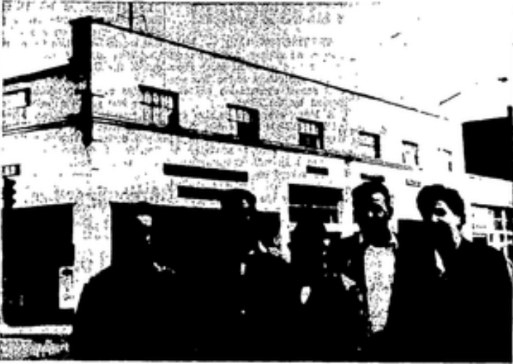
In May 1960, Capital Savings bought the building and partnered with Capitol Chevrolet to reopen it. The updated garage offered tune-ups, steam cleaning, car washes, brake work, battery service, and vehicle pickup. New managers also took over sponsorship of the bowling team in the local league.
Less than two years later, city leaders stepped in. The city council voted to buy the property for public redevelopment, providing the vital service of surface parking.
When Neil McKay became mayor in 1961, the former garage caught the eye of city leaders looking to update downtown. McKay set up the “Committee of the Sixties” to study long-term construction needs. The group backed projects for a new City Hall, a main library, the Capitol Lake swim park, street upgrades, and the nine-story Capitol Center Building (our eventual “mistake by the lake”).
Parking strategy was a main focus for the committee. In July 1961, its business group released a report calling off-street parking essential to keep shoppers in town. By December, the City Commission approved funds to buy and tear down the east half-block between Columbia, Fourth, and Fifth for a new municipal parking lot.
The city bought the land from Capital Savings and Loan for $150,000, quickly tearing down the garage, the Ship Tavern, and the Will Realty building. Funded by city bonds paid back through parking meters, the plan got strong support from Chamber of Commerce president Dick Lewis. The committee urged the city to keep going, calling for two more downtown lots right away.
The lot sat there for fifty years as a classic surface lot. While many downtown lots were unpaved gravel or simple asphalt patches without drainage, this facility was built with care. It held up well as municipal infrastructure through decades of urban change.
The layout used angled one-way spaces with turnarounds at each end, so drivers could loop for open spots without pulling back onto Fourth or Fifth. Trees and concrete curbing gave it a neat look, similar to a suburban office park right in the middle of downtown. Placed next to the mid-century office of Olympia Federal Savings, the lot looked permanent.
From the 1980s through the 2000s, this spot anchored the longest row of public parking downtown. Drivers could use a few lots near the Olympia Center on State Street, drive south by lots along Columbia, and end up at this main half-block lot.
This parcel was the first spot tied to the phrase “parking lot” in Olympia, back when cars were still stored inside a garage. Decades later, it became the first big city lot cleared for housing as our priorities changed. Its rewrite showed a shift in how the city valued downtown space.
By the mid-2000s, city planners wanted to bring housing back to downtown. In August 2007, the city council agreed to sell the land to Colpitts Development Co. for $270,000. Soil tests soon revealed leftover oil contamination from the garage days, pushing cleanup estimates to $716,000. In January 2008, council members agreed to split extra cleanup costs with the developer up to $223,000 each. Colpitts closed on the purchase in December 2008, right as the global financial crisis slowed project funding.
Once credit markets settled down, crews dug up the site and cleaned the soil. The replacement building opened in May 2016 as the 123 4th Apartments. The seven-story building holds 138 market-rate apartments, ground-floor retail, and internal parking (of course). It was downtown Olympia’s first major market-rate housing build in decades.
Today, the finished 123 4th building looks like a permanent fixture of downtown. But back in 2015, when it was just a concrete frame with a tower crane, locals were far less sure about it. The project sparked real debate across town.
Writing for the Cooper Point Journal that spring, student reporter Isaac Scott described a community caught between economic doubts and cultural concerns. City Hall was pushing a plan to triple downtown’s population, leading critics to worry that Olympia would lose its local identity to Seattle-style growth. Even planning officials hesitated. Planning Commission chair Max Brown noted that modest government wage growth made large real estate booms unlikely.
That cautious forecast missed the mark. Demand grew faster than city leaders expected. Within a few years, new housing altered the surrounding streets.
When explaining why 123 4th felt out of place in 2015, Scott noted that the build relied on money from “Chinese investors.” Focusing on foreign capital tapped into an old regional habit of treating Asian presence as an outside threat. That view overlooked how Chinese immigrants had built the neighborhood’s original commercial hub a century earlier, a detail largely left out of how we talked about rebuilding downtown.
By 2015, Olympia reached a major turning point after fifty years of clearing shops, churches, and affordable homes for parking. The city had prioritized car access for visitors over local living space. The success of 123 4th showed real demand, leading developers to build more apartment complexes on former parking lots across downtown.
We often misread history in both directions. Looking back, we flatten complex local history into simple stories of progress. Looking forward, we assume current stagnation is permanent until a new skyline rises right where we used to park.


Leave a Reply