Maytown was flooded before it had a name. Around 16,500 years ago an ice dam gave way, releasing a wall of meltwater that tore south across what would become southern Thurston County. This was the Tanwax Flood, one of the last violent acts of the Vashon Stade, and it did more than carve the ground. It wrote a script that everything afterward would follow.
The flood arrived at the tail end of the Fraser Glaciation, after the Puget Lobe had pushed as far south as Tenino and buried the site under some 200 meters of ice. When the ice began retreating and the climate warmed, the meltwater had nowhere easy to go, with the northern outlets still choked with ice. So the water was forced south instead, funneling through what is now the Chehalis River valley like water through a pinched hose. When the Tanwax dam broke, that pressure let go all at once. The surge swept across Rocky and Maytown prairies, dropping massive loads of sand, gravel, and boulders as it lost energy and spread out across the flats.
That single event set up the next 16,000 years. The flood left behind a rare glacial outwash prairie, flat and porous, resting on an estimated 20.6 million cubic yards of high-quality gravel. It carved broad paleochannels through the landscape too, the same low, open paths that railroads would later follow when they crisscrossed the county. The land was flat, well-drained, and full of raw material. That combination made it a target long before anyone thought to develop it. The flood didn’t just shape Maytown’s geology. It built the site’s entire future resume: a place suited for transit, for extraction, for anything that needed wide open space and didn’t mind a little distance from town.
For millennia, that resume sat as grass and gravel under an open sky. Then, in the 1940s, the tide came back in, this time manmade.
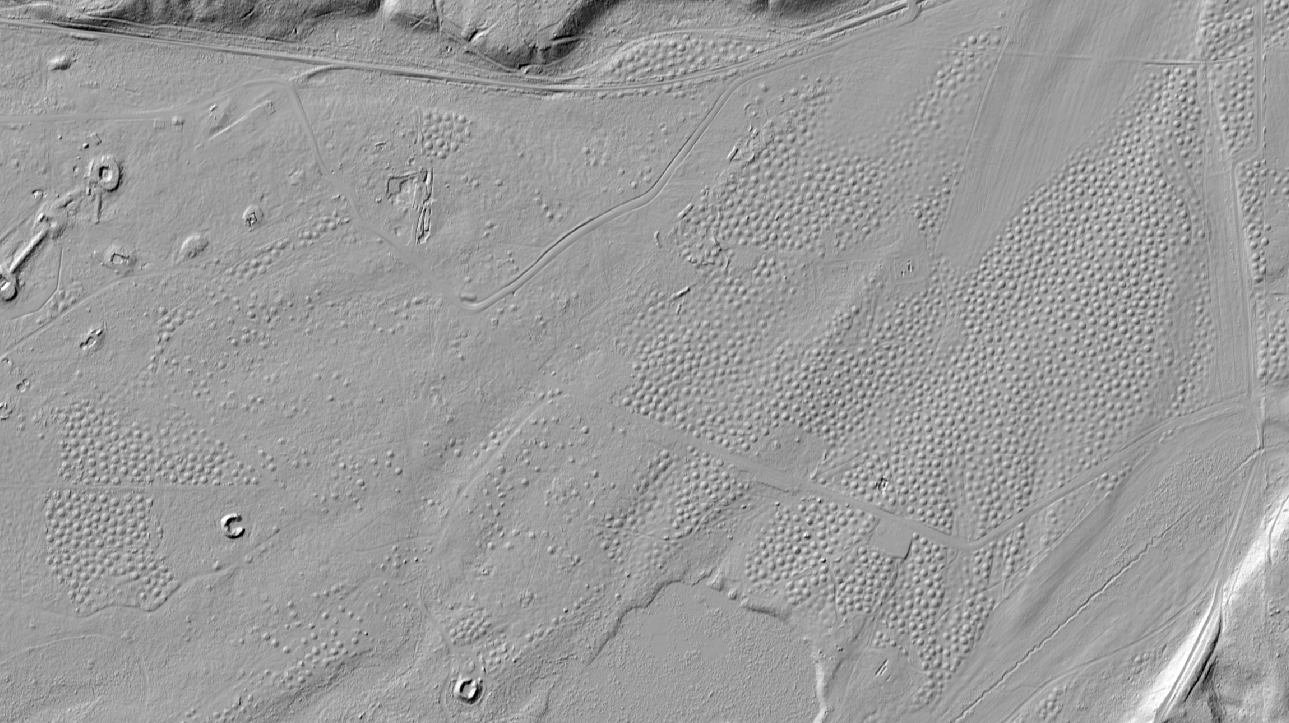
The Pacific Powder Co. began acquiring and leasing land at Maytown in the 1940s to manufacture dynamite, drawn by the same flatness and isolation that had once channeled glacial meltwater. By 1964 the operation had grown enough that the Hercules Powder Co. bought the property outright, expanding it to roughly 1,625 acres. For the next several decades, the plant was one of the region’s main suppliers of explosives for the roads, tunnels, and dams going up across the Pacific Northwest. Workers handled nitroglycerin, gun cotton, and ammonium nitrate with sparkless tools, dressed in specialized clothing, working to the sound of music piped in to mask the tension of the place.
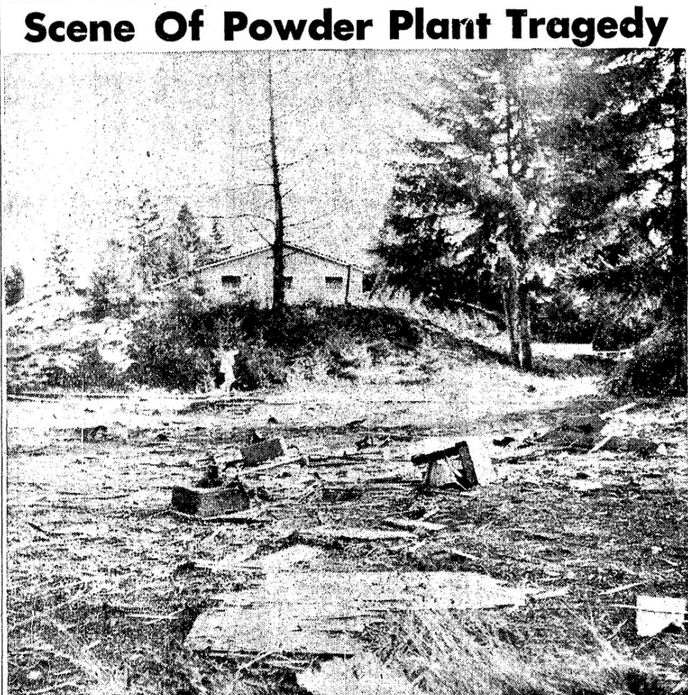
That tension broke loose more than once. An explosion leveled a gun cotton storage house in January 1954, killing a workman named Amos George Owens. Three years later, in January 1957, a blast at the nitro facility killed 31-year-old Earl Thomas Riggs. The danger wasn’t contained to the plant grounds either. One of the company’s trucks exploded in Roseburg, Oregon, in 1959, killing 13 people and leading to an indictment of Pacific Powder Co. for involuntary manslaughter. Even after Hercules took over, the risk didn’t disappear. A 1967 explosion in a spent acid line did enough damage to shut the whole plant down for repairs.
By the time the operation wound down, the plant had left more than memories behind. Decades of manufacturing had worked lead, asbestos, petroleum products, and the carcinogen dinitrotoluene into the soil and groundwater, a kind of silt that stayed long after the industrial tide had gone out. Citifor removed more than 9,000 tons of contaminated soil in 2006 alone, and the Port of Tacoma later excavated 20 million tons more. Even with all that work, the Department of Ecology still ranked the property a high-risk hazardous waste site in the early 2000s. The powder works was gone. Its residue had settled in for good.
Before the water fully receded from the industrial era, one more wave broke over Maytown, and this one had nothing to do with commerce.
In late August 1969, the Sky River Rock Festival and Lighter Than Air Fair took over the Rainier Hereford Ranch next door to the powder works, close enough to share its dust. Nearly 30,000 people showed up for a lineup that included Steve Miller and Country Joe and the Fish, modeled loosely on the original Sky River festival and on Woodstock. It was a rogue wave, sudden and enormous, cresting over a cattle ranch for a few days before pulling back out just as fast.
The surge met resistance almost immediately. Local residents organized as the Stop the Rock Festival Committee, led by a member of the John Birch Society. Their objections went well past noise. They worried openly about the organizers’ sympathies with the Black Panthers and what they called the glorification of communist movements. Legal challenges even argued that the music itself would cause nearby cattle to lose flesh from the stress. Once the festival was underway, open nudity and drug use gave the opposition more to point at, and the Catholic Archdiocese ran newspaper ads with photos of topless attendees, hoping to shock the public into demanding prosecutions.
The backlash outlasted the festival by years. The Thurston County Commission responded with strict new ordinances that effectively banned festival camping, building a legal dike meant to keep that particular kind of flood from ever rising again. It worked. Nothing like Sky River has happened at Maytown since.
The Thurston County Commission wasn’t done caring about what happened on that stretch of glacial outwash prairie.
What followed instead was a slower, more bureaucratic kind of tide, rising and falling in ambition rather than water.
In 2006, the Port of Tacoma bought 745 acres of the old munitions site for $21.25 million, aiming to build the South Sound Logistics Center, a rail-served depot that would let cargo skip past I-5 gridlock. This was a sort of realization of the vision of the nearby Maytown townsite, founded as a community on the confluence of railroads.
Because a port can’t operate inside another port’s territory without permission, Tacoma entered an interlocal agreement with the Port of Olympia to develop it jointly. That agreement collapsed in 2008, after pressure from local residents and the group Friends of Rocky Prairie pushed Olympia to withdraw.
The Port tried again in 2010, agreeing to sell the land to Maytown Sand and Gravel. Thurston County officials were accused of deliberately stalling the permits needed to close that sale. The resulting lawsuit worked its way to the Washington State Supreme Court by 2018. The court found that the county had violated the company’s due process rights, and the evidence suggested commissioners had pressured staff to manufacture an emergency just to slow the project down. A jury had already awarded $12 million in damages, split between the Port and the gravel company.
Even with that ruling in hand, the current kept shifting. NorthPoint Development offered $24.8 million in 2018 for a 2.9-million-square-foot logistics complex, only to see the deal collapse in 2021 when Thurston County denied the zoning change it needed. Each attempt followed the same pattern: ambition rising, hitting the wall of local opposition or legal obstruction, then receding again, leaving the land untouched but the fight a little more scarred.
The most recent agreement, a purchase deal with Miles Sand & Gravel signed in 2026 for $17.25 million, marks the lowest water mark yet. There’s no warehouse complex in this version, no attempt to reroute regional cargo through the prairie. The plan now is simpler and, in a way, more honest about what the land has always been for: extract the 20.6 million cubic yards of gravel the Tanwax Flood left behind 16,500 years ago. Before settling on Miles, the Port gave the Washington Department of Fish and Wildlife first chance to buy the property and fold it into the adjacent wildlife area. The two sides couldn’t agree on a price. Friends of Rocky Prairie is left hoping the new owners honor the reclamation plans already on the books, which call for eventually turning the mined land into ponds and wildlife habitat.
Maytown isn’t a ghost town in the usual sense. It never had enough of a boom to leave behind the kind of emptiness that label implies. What it has instead is a long record of being processed, first by ice, then by dynamite, then by rock music and public outrage, then by lawsuits and zoning boards. Each wave has left its own layer of sediment on top of the last: some of it gravel, some of it legal precedent, some of it toxic residue still being dug out of the ground.
The current plan is to mine the very material the original flood put there, then hand the emptied land back to the prairie it once buried. Whether that actually happens is still an open question. Given the site’s history, the safest bet is that it’s less an ending than another recession, and that somewhere downstream, another wave of ambition is already gathering.


Emmett- Great story. I love the use of geological and ocean currents to describe the settler community experience and use of the South Sound Prairies. What’s next for the Maytown “tidal pool”? Based on a 2026 decision by TC Commissioners that provided one gravel miner an escape from their reclamation obligations, my guess is this site will get rezoned to some “industrial” zoning. Future use of the land is a key criteria for WDNR reclamation requirements. Instead of a rural low density future use Miles can get a sweet heart deal to simply grade the site flat for some regional distribution center or cannabis processing facility. Read on for more about recent County Commissioner deal for a quarry that borders the Black River Refuge…
The Maytown experience resonated with my own experiences in the 1980 and 90s with that area and other gravely prairies in TC.
At that time briefings with County Commissioners were accompanied with USGS and County geologists and hydrologists assessments of the various resources in these prairies. Chief among them was drinking water aquifers and major inflow to nearby lakes, rivers and streams. Most of the rural low income residents and others relied on wells in these aquifers. County geologist at the time described it as a “bath tub full of gravel full of water”. Lots of water unprotected from stuff spilled in the prairie. 1960 and 1970s federal and state low income housing put multi family housing in a rural ring around the towns and cities. It was cheaper land.
When gravel mines went in, these residents did not have much impact on their questions of impacts like noise, dust, and their well water. Then the GMA tide came in that placed some restrictions on where mines could locate yet also provided for mining in any place with significant deposits. Importantly GMA and DNR required post mine rehabilitation plans have financial bonds to insure the landscape could return to pre-mine status.
Also in the early 90’s over a thousand acres of prairie were purchased by mining companies from King and Pierce County. They were planning for their future and the expansion of gravel needy highway and street projects. Plus it was a good time get vested at the project level. Before vesting occurred the County Commission enacted a one year moratorium on new mines to allow and in-depth assessment of impacts to groundwater.
Rural residents of all incomes got active and pushed for a ban or at least a moratorium which the Commission gave them. Pressure also came from Maytown and North of Lacey landowners and existing miners who saw a potential for mining and so pushed against banning mining.
The assessment identified specific potential impacts to aquifers that did not have, at the time, any management practices for preventing pollution from
mine operations. TC Commissioners adopted best practices to protect quality and left open the impact to supply for another day.
Then just recently the County Commissioners voted to rezone to industrial an existing mine in a rural residential conservation zone on the Black River Corridor. Two major problems were glanced over by the Commission’s majority: 1) the change to industrial uses means the mine’s rehabilitation can get readjusted to fit an industrial setting rather than the ecological values of the conservation zoning; and 2)they wrongly assumed that the mine could dig into the aquifer ignoring the Special Use Permit requiring additional studies before opening a hole into the aquifer. The Board majority ignored these facts and voted 4-1 to Rezone to industrial. That’s how the the next tide could flow for Maytown Rocky Prairie and perhaps the many other mines in TC and across the state.