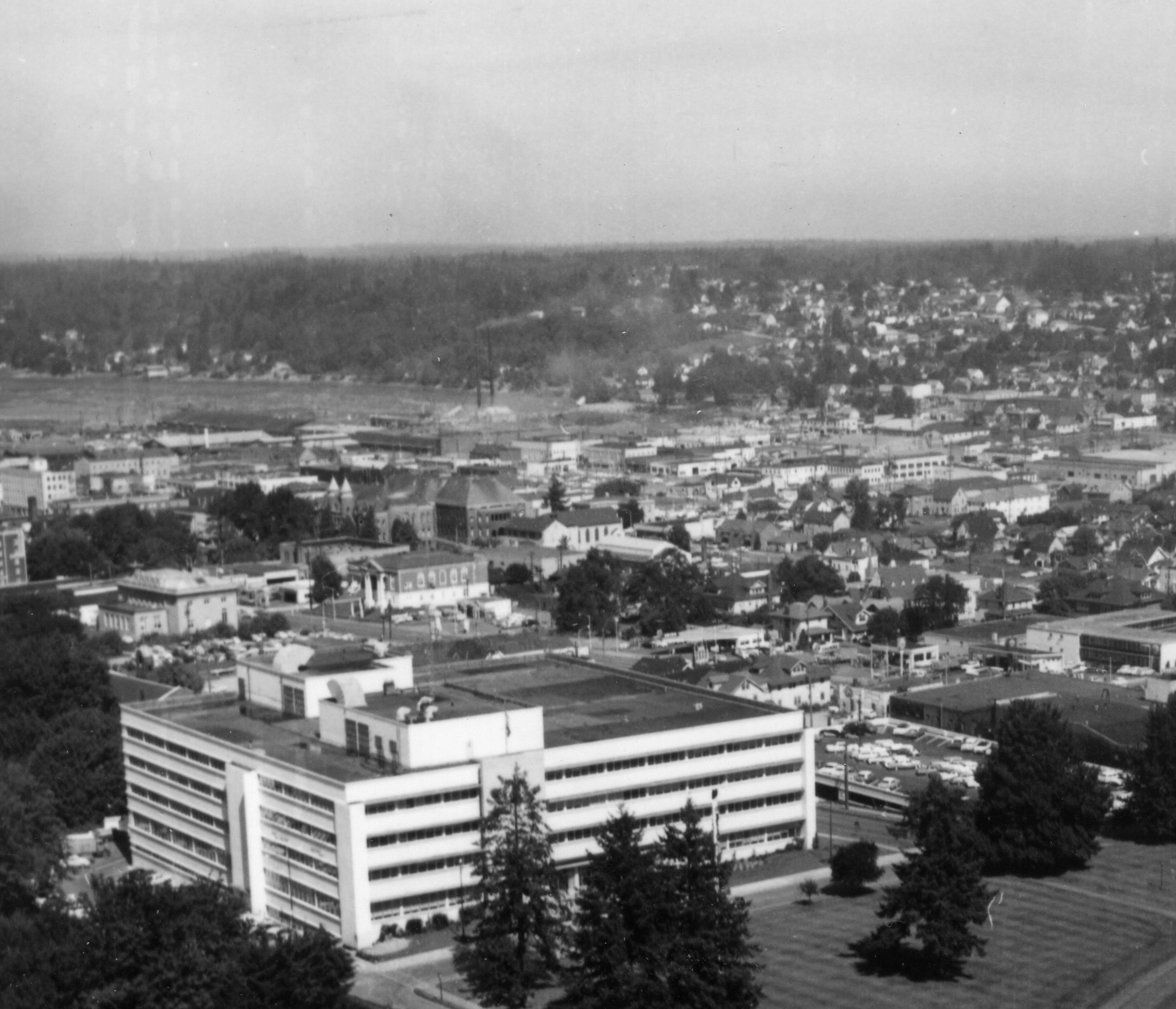
The General Administration Building is being torn down. This is despite it being perhaps the most important building in Olympia’s history. And this is exactly as it should be.
We should know our history, know where we came from, know why we do the things we do. But preserving a structure that no longer serves our needs ties our hands at precisely the moment we need both arms free. There’s a difference between honoring the past and being imprisoned by it. A community that can’t tell the difference will eventually find itself curating ruins while its living members go unhoused and unserved.
Like much of Puget Sound history, Olympia’s story divides into distinct chapters: the territorial age, post-statehood through the Second World War, and the postwar decades that carried us to today. The great shift, from a community shaped by resource extraction to one shaped by the machinery of governance, happened in the years after the war. The GA Building is the hinge on which that transformation turned. And still, it should go. That age is over, the building costs too much, and we need the land more than we need the structure. The unque mosiac was moved, and I’m glad of that.
The legal conflict that produced the GA Building began in March 1954, when Thurston County Superior Court Judge Charles T. Wright ordered thirteen state agencies to move their headquarters from Seattle back to Olympia. His ruling rested on a constitutional requirement that the executive branch reside at the seat of government. Wright worried that allowing agencies to drift toward the larger city would reduce Olympia to little more than a name on a map. Governor Langlie and Attorney General Eastvold pushed back, arguing for a more flexible reading of the law. The local victory held anyway.
In August 1954, the Washington State Supreme Court upheld the lower court in a five-to-four ruling, with Justice Donworth holding for the majority that the framers of the State Constitution intended the entire executive department to be physically located at the seat of government. The court rejected the state’s argument for a modern, logistically convenient interpretation. Thirteen agencies, from the Department of Health to the Horse Racing Commission, were ordered to relocate to Olympia.
The people who drove this weren’t state officials. They were a small group of Olympia residents and business owners, determined to make their city the capital in fact and not just in name, represented by attorneys Smith Troy and John Spiller. Gerry Lemon and the Mottman family led the effort. They won, and it stuck.
The ruling triggered an immediate and massive expansion of Olympia’s built landscape. The GA Building, completed in 1956 at a cost of $4.3 million, was bulging at the seams almost from the day it opened, the first major structure built to house the returning agencies, already overwhelmed by the surge it was meant to contain. Decades of campus planning followed: the State Library, parking facilities, and more office blocks over on the East Campus. It was a major economic victory for Olympia, but it permanently changed the city’s character. The dense, monumental government core we have today is a direct result.
It was decided by a single vote. Think about that.
If Justice Hill’s dissent had carried, Washington’s agencies might have spread across the state, their headquarters placed in Seattle, Spokane, and Vancouver, closer to the populations they actually served. Olympia might have remained a smaller, seasonal hub, shaped by the rhythms of the legislative session rather than the weight of a permanent government campus. Historic neighborhoods that were later demolished for office blocks and parking garages might still be standing. The city might feel more like a town. But that’s not what happened. The GA Building is what happened, and it deserves to be remembered. It does not need to be kept.
The same argument is playing out right now in Seattle, though the stakes there involve catwalks and ladder cages rather than office buildings. Gas Works Park, on the north shore of Lake Union, started in 1906 as a coal gasification plant, supplying synthetic gas to the city for fifty years before closing in 1956. When Seattle began purchasing the land in 1962, the site was heavily contaminated with coal tar and heavy metals. Landscape architect Richard Haag had a different idea than demolition: he preserved the industrial ruins as sculpture, using bioremediation to treat the soil and incorporating the old machinery into the life of the park. It was a genuinely imaginative act, seeing the past as something to be lived with rather than erased.
The park is now on the National Register of Historic Places. It’s also become a serious problem. People have died after climbing and falling from the old structures, and deferred maintenance costs have grown untenable. Seattle Parks and Recreation sought approval to remove catwalks and ladder cages that couldn’t be made safe, while preservation groups and the Landmarks Preservation Board pushed back, accusing the city of demolition by neglect. As of early 2026, the city is moving to address the safety issues, but the Landmarks Board has repeatedly denied demolition proposals, insisting instead on a comprehensive preservation plan.
There’s an irony worth sitting with. What began as a public health hazard, a gasification plant poisoning land and air, was preserved in place and has continued to be a hazard in a different form. The commitment to honoring the past extended even to its dangers.
The Gas Works debate illustrates something that’s gone wrong in the preservation movement more broadly, a tendency to become transfixed like Narcissus by a fixed image of the past, unable to look away from the reflection long enough to notice the living world around it. Landmarking, which started as a reasonable tool for protecting genuinely significant places, has increasingly been turned to other purposes. In cities across Washington, it’s been used to block housing density and freeze neighborhoods in forms that suit current residents at the expense of those who need to live there. The practical effect, often though not always intentional, was exclusion, preserving the character of a neighborhood in ways that served the comfortable while denying shelter to those who needed it most.
The consequences aren’t abstractions. Washington has significant and persistent racial homeownership gaps. Black residents are substantially overrepresented among the homeless relative to their share of the general population. A large portion of renters statewide pay more than a third of their income toward housing. When we talk about protecting neighborhood character, it’s worth asking plainly whose character we mean, and at whose expense we’re protecting it.
History isn’t a museum. It’s a conversation between the dead and the living, and the living carry obligations too, not only to remember, but to act, to build, to provide for those who come after. Neighborhoods changed organically for generations, large homes subdivided to house more families, commercial buildings adapted to new uses, waterfronts reimagined as economies shifted. That’s not the destruction of history. That is history. When we use preservation law to stop that process, we’re not saving anything. We’re embalming it.
Gerry Lemon understood this. The same man who led the legal fight to make Olympia a real capital also gave the city something else entirely, donating the land and mosaic viewpoint overlooking the harbor from Fourth Avenue near Water Street, the gift that became the seed of Percival Landing. Where the 1954 legal victory filled Olympia with government buildings, Lemon’s waterfront gift pointed somewhere different, toward a place of public life, a boardwalk, a gathering place, a shoreline returned to the people who live near it.
It’s hard now to imagine downtown Olympia without Percival Landing. It seems inevitable. But it was a choice, and the alternative is visible in places like Coos Bay or Aberdeen, cities that held onto the industrial character of their waterfronts and found that character had little use for the people who remained. That’s what Olympia replaced.
Lemon was a boating enthusiast and former commodore of the Olympia Yacht Club, a man who understood that the health of a place depended on its usefulness to the people living in it. He also knew his contributions would outlast him not because they’d be preserved unchanged, but because they made possible something that could continue to grow. The GA Building was probably the great civic achievement of his public life. We can honor what it represents without keeping it standing.
We need to know our history, need to understand what brought us here and why. But history isn’t given to us so we can carry it around like a millstone, growing heavier with each year while the people around us go without shelter. It’s given to us so we can learn what it actually means to build something that lasts. And what lasts isn’t the building. What lasts is the act of making a place where people can live well, now and after we’re gone. We should remember. And then we should get back to work.


Leave a Reply