Olympia Time

History, politics, people of Oly WA

Page 47 of 179

Low turnout, voter confusion drove the Wolfe vs. Rogers election result

You can find the data here.

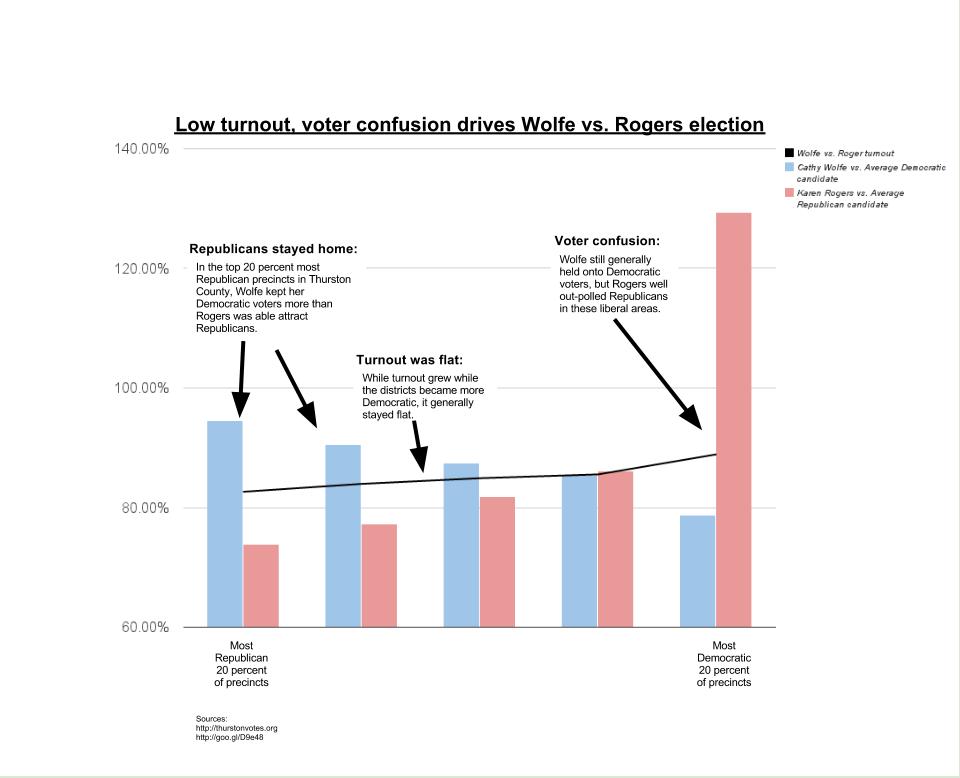
If you look at the basic results of the county commission race between Democrat Cathy Wolfe and Democrat Karen Rogers, you can see a huge difference in the vote totals compared to other county races. About 7,000 voters did not vote in this contest between candidates from the same party.

What I did was look at how Wolfe and Rogers did compared to a composite Democratic and Republican candidate in five groups of precincts. I made the composite from the results of the Thurston county level presidential and gubernatorial elections and the results of the other county commission race. I then ranked the precinct groups from most Republican to most Democratic.

Here are two lessons I toook from this race:

1. Republicans won’t vote for a Democrat, no matter how conservative they are. Rogers made some waves by getting endorsements from traditionally Republican allies and by taking some conservative stands, especially on land use. That didn’t garner her Republican votes though.

2. Democrats got confused. When the race moved into more liberal areas, Rogers well outperformed a composite Republican, indicating she was taking otherwise Democratic votes away from Wolfe.

From things I don’t get to things I really like (Olyblogosphere roundup for October 13, 2012)

1. I don’t get the bead thing and I don’t get decorating skulls. Though, I suppose its a thing for Halloween. That said, Shipwreck Beads must be the capital of things I don’t get.

2. Arts Walk link #1:


 3. Arts Walk link #2: Thad’s Things I like at Arts Walk.

4. This is the sort of thing I do this link roundup for, Janine’s recent writing on the county commissioner race is the best things out there right now on local politics.

The Pig War and Olympia baseball

I’m working on something longer about Olympia baseball, this is a portion of that longer thing.

Olympia’s baseball history probably starts just a bit earlier than than the summer of 1872. Baseball clubs had exploded between Vancouver and Portland five years before, but the following in the first refernce I can find to a baseball team in Olympia (Blankenship):

Olympia, in early days, was not without its baseball team, in which it took great pride in the days of underhand pitching.  Several match games were played with Victoria, and Olympia was victor each time.  The English knew more of their national game of cricket, and had not perfected themselves in America’s favorite sport.  About the time these games were being played the matter of the San Juan controversy was on, involving Uncle Sam and Great Britain.  The dispute was in the hands of Emperor William of Germany for arbitration.  On the day the first game was to be played there was conspicuously posted at the post office a telegram in proper form on a Western Union blank, reading as follows:

Washington D.C.,  July 16

Governor Washington Territory:
Emperor William, having in hand the matter of the San Juan controversy, has concluded to base his decision on the result of the baseball contest between Olympia and Victoria.

Secretary of State.

Thus inspired the Olympia boys went in and won.  It is barely possible that the illustrious grandsire of a degenerate grandson never heard of the game, but the victorious Olympians came from the field with breasts distended like pouter pigeons, plainly conscious of having won an empire for their Uncle.

Just a bit of background, the maritime border between Canada and the states at this point had not been set. Both sides claimed the San Juan Islands, and at some point someone shot someone else’s pig. And, both British and American soldiers were based on the San Juans. Hence a war with only one casualty.

So, the game would have been in the summer of 1872. The German led committee set to settle the Pig War made their decision in October 1872, the British withdrew a month later.

It was also at the exact same time that the mysterious Ira B. Thomas was in town, buying land for a possible terminus for the Northern Pacific railway. Its almost odd that the fact real world wager for this game was over the San Juans and not the terminus. It would’ve been just as believable (maybe more believable) if the game was to be played against Port Townsend or Seattle and the prize was the Northern Pacific terminus.

But, of course the opponent was the opposite capital and the prize was the lonely old San Juans, almost a footnote to history compared to the terminus.

These were the days of formal invitations sent between clubs. And, clubs were not synonims for teams or businesses in the economic venture of making money from sport. They were actual clubs as in having elections and officers and bylaws.

Olympia base ball club would hold a meeting. Who do we invite? Let’s invite Victoria! The next day, a telegraph is sent.

At their next meeting, Victoria considers the invitation and accepts.

Terms would be set, travel would be arranged and in a month or so, Victoria would travel down by steamer. This is the era before even leagues when a club (again, and actual club, as in an organization of men wanting to play baseball) would know before each season (such as spring, summer and fall) who they would play. No yearly champions, just invitations and games. But, they did keep score.

If you’ve ever read W.P. Kinsella, especially the Iowa Baseball Confederacy, you recognize the elements of a great baseball story here, if only the German challenge were true.

In the Kinsella-esque version, a German official would be on hand, because the game would really have been the deciding game in the Pig War. Ira Thomas would be there too. Thomas’ wife back in New York state, unaware that her husband had but months to life.

Just for fun, even though the historian puts down a date of July 16, I’ll put the game on July 4. That enhances the patriotic aura of the game.

Both the German official, maybe an American from the state Department and a British foreign office official come in on the same boat as Ira B. Thomas. The British official thinks the game is a joke, the American thinks its great and the German is just happpy they decided to settle the fight over empty islands somehow.

Ira B. Thomas has a secret, but can’t talk enough about all the stuff he’s heard about Olympia (but not really why he’s there).

I’m not sure how the rest of the story unfolds, but obviously the game goes into extra innings.
Where would have the Northern Pacific met Budd Inlet?

In most local histories that cover the era of the Pacific Northern Railway terminus chase, there is a retelling of this particular episode (this telling from Newell’s “So Fair a Dwelling Place“):

The Puget Sound Land Company, a subsidiary of the Northern Pacific and bought
up large tracts of land on Budd’s Inlet in the name of one Ira Bradley Thomas. Before the rails reached Olympia, Thomas died.

Rather than face the legal delays of probating his estate, the company quickly
bought up new land near Old Tacoma and told the Northern Pacific to change its terminus
to that location.

Had an obscure business man, Ira Thomas, lived just a little longer, Olympia would
undoubtedly have become the western terminus of the first northern transcontinental
railway and the site of the present city of Tacoma might still be a comparative wilderness.

Can you imagine  how Olympia could have ended up differently had we, and not Tacoma, ended up the first industrial metropolis on the sound? I can imagine deepwater dredging all the way to Tumwater and down Swantown Slough. Possibly fill all the way out to Priest Point. Certainly a larger and more developed city.

But, the exact extent of our growth would’ve been determined by exactly where on Budd Inlet the terminus was meant for. I think I’ve come up with a general location of where the Pacific Northern Railroad would’ve met the Puget Sound had they chosen Olympia.


1. First, I wanted to find out if Ira B. Thomas really did come to Olympia in the 1870s to buy land for the Northern Pacific. It wasn’t uncommon for land purchases to be made in the name of the Northern Pacific back then. But, what sometimes seem too good to be true and fanciful stories that get repeated in local history, just really are too good to be true.

That doesn’t seem to be the case for Ira Thomas, though. According to at least this federal case, his estate was still being fought over 20 years later. Since probating the case took over 20 years, the Northern Pacific was pretty smart to move onto Tacoma.

2. So, Ira Thomas was in Olympia and he did buy land for a railroad terminus, where was that terminus? Apparently, the name North Olympia Land Company can still be found in some legal descriptions of property around here. At least this real estate database (BackPlant Tract Book by Titlepoint) lists the company as a search parameter for Thurston County.

3. So, where are the lots with North Olympia in their legal description on Budd Inlet? From what I can find plugging around on Thurston County’s Geodata, right here.

4. So, finally, what does this tell us? Maybe nothing, it is possible that Ira Thomas’ mission in Olympia was just a ruse. Possibly like other land buys in King County, Thomas might’ve been trying to divert attention from the mostly empty property along Commencement Bay. Compared to Olympia with 1,200 people, only 200 lived in Tacoma. The Northern Pacific possibly wanted all the land riches for themselves.

Or, maybe, Thomas’ death really did put the dream of Olympia as major west coast city or at least major western Washington to bed. Maybe in addition to being the state capitol, we would’ve had a mighty metropolis to go along with it. I like to imagine what could’ve been.

Update (11/21/12): Just realized that this map (which I’ve looked at dozens of times) gives a pretty great idea of where the Olympia Land Company property was.

Snippet:

Overlay with current Olympia:

Secrets and vagueness (Olyblogosphere for October 1, 2012)

1. The Man With No Change at Old School:

2. Someone just had an 11 year blogiversary!

3. Alec Clayton talks about the books he’s written and focuses on their autobiographical aspects:

There’s a reason these first three books were set in locales where I have lived and a reason that the main characters were all about my age. Both were to create a palpable sense of place and authenticity. Write what you know is the old axiom. I made the main characters my age so it would be easier to get facts right: getting the popular songs, books, movies at any given time right and ditto for hair styles, fashions and automobiles.

4.  Long video, featuring Steven Willis of Morty the Dog, on Comics at Evergreen:

5. And, secrets.

6. And, even though I try to do only five links, this sixth is extra and not really Olympia related. Yelm History Project blog is great.

A data-based perspective on racism in Gonzalez v. Danielson

My historic look didn’t drill down very far, just looked back in time a bit. But, if you do look down into the voting precincts, as this paper does very well, you find racism present in the vote:

The Yakima and Grant County results indicate that racially polarized voting exists in Central Washington and crosses party and ideological lines. While voters in these counties have consistently voted for more conservative candidates in most recent elections, Danielson outperformed all other candidates, and by very large margins. This is remarkable considering he did not campaign at all. In a similar Supreme Court election, conservative candidate Douglas McQuaid, who also did not campaign at all, received only 28 percent of the vote in Yakima, compared to 64 percent going for Danielson. Not only did Danielson significantly outperform McQuaid, but he also won more votes than the leading Republican candidates for U.S. Senate and Washington Governor who both campaigned vigorously during the election. The data show that Danielson received votes from the same precincts who preferred Cantwell to Baumgartner and Inslee to McKenna. This is in spite of Danielson raising no money, holding no campaign events, making no public statements, and receiving no meaningful endorsements. Voters in Central Washington, who were not provided a voter’s pamphlet, preferred Danielson to González in a party-neutral contest. This patterns revealed here a are textbook definition of racially polarized voting.

Southern California taste for sale on Johnson Point

Holy freaking best kept secrets of Thurston County! Can you believe this even exists around here?

And, that at least according to the public information on the house, it was built in 1911? Well, not this house really. It probably looked a lot different back then.

The story of how this house came to be apparently begins in the early 1990s when California entertainment executive Charles Brack (who died in 2010) bought the house. Because Brack had some legal issues with his neighbors involving his bulkhead, we’re able to read a little bit about what changes the house underwent:

The Bracks purchased the property at the tip of Johnson Point, immediately adjacent to Grundy’s property, in 1991.

…

The Bracks extensively renovated and expanded the existing house on their property between 1993 and 1998.

Calvin Brack’s son-in-law, Keith Gibson, testified that the Bracks have invested approximately $8 million in remodeling the home and structures on their property. 

The Bracks’ property included four separate tax parcels when they purchased it. Grundy asserts the Bracks raised the bulkhead to create dry land for building sites. 

…

The Bracks contend it was necessary to raise the bulkhead in order to complete planned landscaping.

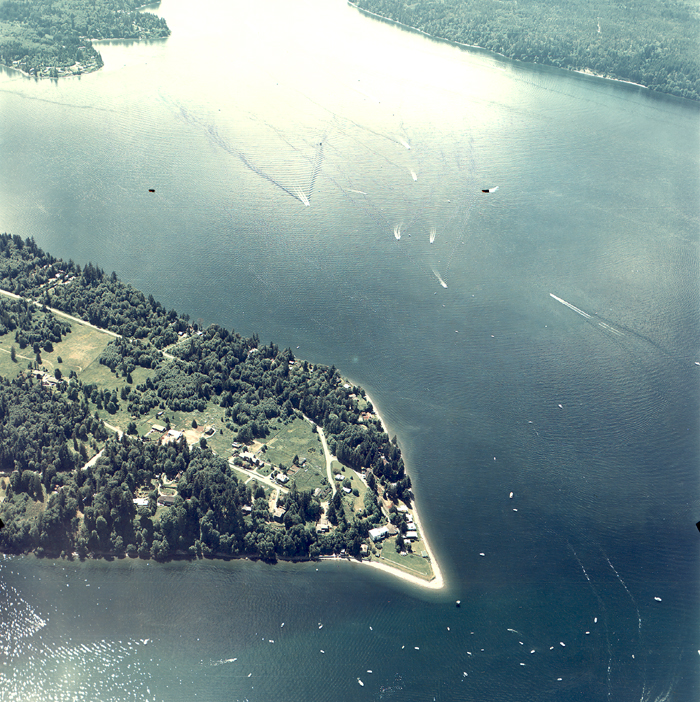
What I was most interested in was what the house looked like before the Californians got their crack at it. From the state Department of Ecology’s shoreline photography program, I was able to find these two shots (from 1992 and 1970):

Here’s a zoom of the 1992 image:

Significantly different than the post-Californian version.
And, in terms of the owners (the Bracks), they seem to be pretty interesting themselves. Charles Brack, until 2006, was involved in running KDOC, an independent television station in Orange County. He was listed as CEO of the station when it was sold.

Lacey’s new fiasco fishing pier

Way back last spring, people were spitting mad that the new Carpenter Road along Lake Lois had walls to it, blocking the view of the lake. From Ken:

Put me in the camp of those who think the City of Lacey made a mistake when it built the new Carpenter Road and put a wall between the drivers and Lake Lois.

Those driving on the new Carpenter Road can no longer see Lake Lois because the wall separating the roadbed from the lake is too high.

That’s what happens when engineers design a bridge and leave out the public in the review process, although I’m not certain a novice would even have understood the wall design even if they had seen the plans.

I drive that part of Carpenter almost every weekday, and since the construction finished, I’ve noticed a lot more people taking advantage of the new wall (as you can see above) as a defacto fishing pier.

Historic perspective on the Gonzalez-Danielson race

UPDATE 9/29/12: A few smart folks took a close at the precinct level numbers and came up with some pretty solid evidence about race based voting patterns. I stand by my take below, but this research is much more significant and relevant to the election.

Since State Supreme Court Justice Steve Gonzalez won a full term last week, there have been questions about how Bruce Danielson — who didn’t raise or spend any money in a campaign — was able to get more than 40 percent of the vote.

Initially mentioned by Eli Sanders, there have been claims that Gonzalez didn’t get more of the vote because of racist tendencies of rural Washington voters against candidates of Hispanic background. Here are clips from Tacoma News Tribune, Seattle Times and the Everett Herald that show some of the discussion.

It may very well be true that a certain percentage of people voted against Gonzalez because they don’t like minorities, but this doesn’t necessarily bear out against historical context. In two other state Supreme Court races in 2000, candidates that spent no money at all got at least 38 percent of the vote.

Here is a spreadsheet that puts these three races (two in 2000 and Gonzales vs. Danielson this year) in terms of vote percentages and campaign expenditures. Just a side note, these two 2000 races were the only two when one literally unfunded candidate opposed a well funded candidate in a state Supreme Court race.

One of the 2000 races, Jim Foley lost to Tom Chambers, but received over 43 percent of the vote in the November general election.. Similar to Danielson, Foley was ranked as not qualified to serve on the bench. But, in a sort of opposite name phenomena of Gonzalez-Danielson, the scuttlebut in 2000 was that Foley did so well because voters confused him with former Spokane congressman and Speaker of the House Tom Foley:

Chambers, 57, who raised more money, $355,947, than any of the other candidates, said he at times found himself hard-pressed to compete with Foley’s familiar name. 

Although he beat Foley by a wide margin, he said he wished the margin had been even greater.
“It would give me greater comfort,” he said. 

When Foley ran unsuccessfully against Faith Ireland in 1998, he said he had a “million-dollar name” because voters mistakenly link it with former U.S. House Speaker Tom Foley, to whom Jim Foley is not related.

Here is another Seattle Times story that discuss the dynamics of that race.

In the other race (the deciding vote took place in the September primary), Bobbe Bridge defeated a Tacoma lawyer Scott Schweiger. Like Gonzalez, Bridge has earlier been appointed and had already been serving on the court when she won. She also spent $153,000 in a race that ended months before November because she was able to knock off her only opponent in the primary. But, despite her opponent not raising or spending any campaign funds, Schweiger received 38 percent of the vote, very close to Danielson’s total. This article indicates that there was little, if any, discussion at the time how Danielson finished so well against a well-funded candidate.

A significant difference between the 2000 races and Gonzalez-Danielson is the lack of a statewide voters pamphlet. It is hard to gauge the impact of the lack of this information had on voters this year, but you also can’t discount information available now more readily available from the internet and from newspapers.

What we should be able to take from this information is that there seems to be a floor that literally unfunded state Supreme Court candidates won’t fall below. And, Danielson performed within the normal range of similar candidates in recent years.

« Older posts Newer posts »

© 2026 Olympia Time

Theme by Anders Noren — Up ↑