History, politics, people of Oly WA

Category: Uncategorized (Page 24 of 49)

Website colors: wa-democrats.org and McGavick/Safeco


It was strange today, I was going to write two blog posts which basically came down to what I thought about color choices, so I figure its better to do them all at once than spitting them up.

First, what is going on with the new wa-democrats.org. I take Dwight seriously when he says “is a work in progress . We will add features so that it continues to meet your needs,” so I can not be disapointed when I realize they took the RSS feed down and didn’t do much of anything new at all. Suffice to say, not cluetrain.

(At least it isn’t a cut and paste of the national party’s website.)

Worst of all, they seemed to have added a strange shade of green. Very strange shade. Reminds me of… some kind of soup. Anyway, the colors were better on the old site.

Despite lacking any interactive features, such as a blog or a calendar with tags that anyone can contribute to, there are some entertaining parts of the site.

For example, since I’m not using a Microsoft browser, it takes me a bit longer to navigate the site. When I mouse over one of the drop down menus on top, the menu appears half way down the page, and disapears before I can reach it.

There is also a what-we-need list for all of the coordinated campaign offices. Some are very specific about food:

* Food
o Snacks
o Bulk Pretzels and Trail Mix
o Dried Fruit
o Nuts
o Sweets of any kin
* Drinks
o Coffee
o Soda
o Juice
o Bottled Water
o Energy Drinks
o Creamer

On to McGavick: Why do you think the McGavick campaign chose the Safeco corporate colors? Seems a bit odd.

I didn’t realize this until I was in Oregon for the holiday and we drove by a Safeco corporate office and in the corner of my eye I thought I saw a McGavick sign. “In Oregon??” I thought, but no, just Safeco.

Are they hoping to evoke some kind of connection between Washington’s deep love for their home grown insurance company? Becuase, I’m not sure we have a deep love. Are they simply Mike!’s favorite colors?

Edwards seems to get it, or he might just know to say the right thing

At Gnomedex in Seattle, Edwards says what other 2008 donkeys should all be saying, knowing and putting into practice. It isn’t about the technology, it is what the technology does to the conversation. It opens it up, calls for more acoutability, accesability and authenticity.

Seattle PI:

“I’m trying to retrain and recondition myself when I get asked question to actually answer it — to not say what I’ve been trained to say, to not say what’s careful and cautious,” said the former U.S. senator from North Carolina

One recurring theme mixed the two areas. Several in the audience stressed the importance of authenticity in politics, and the potential for blogs and other technology to give Americans a more accurate view of campaigns and the legislative process by getting closer to what’s really going on.

Edwards and his wife, Elizabeth, are already blogging, offering digital videos and using text messages as part of the anti-poverty initiatives they’re now leading. Other politicians and campaigns also have embraced blogs, following Howard Dean’s early success with that strategy in the 2004 presidential primaries.

But one Gnomedex attendee pointed out that the human voice so fundamental to blogs contrasts with the practiced messages delivered by many politicians.

Edwards agreed, and acknowledged his own shortcomings in that regard, saying that he can often sense when he is slipping into that mode.

“The problem is that we’re so trained and so conditioned over a long period of time that being normal and real and authentic requires you to shed that conditioning,” Edwards said of politicians. “It is not an easy thing to do.”
What even happened to protecting communities?


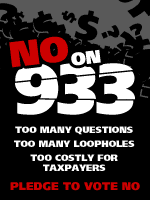
In the last few weeks the Protect Communities Coalition has evolved into the No on 933 campaign, which was bound to happen, but I wish it didn’t have to when it comes to their message. It seems like the No on 933 folks are taking too close of a look at the old messages from the Take Another Look Oregon folks, the No on Measure 37 campaign.

Measure 37 was the ballot initiative on which Washington’s I-933 is based.

The problem with No on 37′s campaign was that its argument was not taking into consideration the voter’s best self interest. By boiling down their stand to “It is complex, it will cost too much money,” and putting that up against the oppositions “It is fair,” they were bound to lose. Sure, it will cost the government money, but they essentially let Yes on 37 make the case that is was money owed to land owners anyway. And, they let the Yes campaign portray voters as the main beneficiaries of the initiative.

In Washington, though, we seemed to be taking another tack, shooting straight for the “this initiative will screw your neighborhood, your community, so far up… well, you won’t know what to do. And, they’re giving money away to developers.”

But, now with the new No on campaign up and running, they seem to be going back to the old no on Measure 37 message:

Cost taxpayers hundreds of millions of dollars
Create a “pay or waive” system that makes local communities decide whether to waive laws for special interests or force taxpayers to pay them to follow the rules
Cause loopholes for special interests that lead to irresponsible development and more traffic congestion

The above image, which is being used as a blog button, is even worse. It makes no mention of protecting neighborhoods or communities.

The deeper you go into the No on 933 website, the more they mention the Protection angle, but they need to move it front and center.

Dori Monson on taxes, what an ass

I usually leave the talk radio blather watching to the experts, but I went on a hunch hunting trip this morning and had to share. Yesterday afternoon Dori was railing about how even though he liked Ron Sims’ idea for transportation in King County, he wouldn’t actually vote for a tax increase to support it.

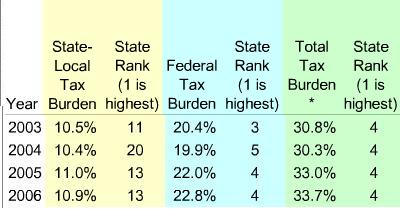
His reasoning was, that according to the Tax Foundation Washington state has the fourth highest tax burden in the country, taking into consideration all sources of taxes, state local federal.

(Fourth highest! FOURTH Highest! He kept repeating, as if every time it became even more true.)

The implication is that while everyone in every state pays an equal share of the federal burden, our state and local burden is so freaking high, that how can we be expected to pay more? Actually, the opposit is true. Our local/state tax burden is lower than our federal burden, way lower.

Our local tax burden is 13th, and 20th in the year the Dori kept on yelling about (2004). Our federal burden is much higher and actually brings out total tax burden way up.

And, when you look at per-capita state and local collections in 2004, we’re even lower at 18th. Not only that, but Washington state government, in terms of per capita spending, puts more money out there than most other states, putting us at 6th in the nation in that category.

On average, Washington citizens put $3,452 into state and local government, and then those governments put over $8,000 of that back as investments in education, roads, etc. I don’t know where they come up with the other $5,000 per head, but it sounds like a pretty good deal to me.

Civic republican platform: participatory budgeting

Cross posted at Better Donkey

In a response to Michael Tomasky’s essay on civic republicanism as a voice for Democrats, Brad Carson writes that we need to move beyond just rhetoric:

The “common interest” is fine as a rhetorical ploy. Tomasky’s “common good” won’t be the Democrats’ grand narrative, though. Because, its linguistic utility notwithstanding, the “common good” lacks any real substance and is incapable of doing the important work of prioritizing among (and adjudicating between) competing ideas. In the first 100 days of a new Democratic president, does the “common interest” dictate that we should first do universal health care, welfare reform, or gays in the military? We’ve been down that road before, and we know the baleful destination already.

I’ve been thinking about this, and I agree, that is as much as putting though into action. So, what would be the political policies of a civic republican agenda?

One idea is the concept of participatory budgeting, or as I like to call it, the Tim Eyman anti-body we should give all our cities and counties. One of the reasons that folks tend to vote themselves tax cuts and demand more service is that there isn’t a connection between them and how their local governments spend money.

Which totally makes sense because local government budgets are written over multiple months, and come to a head during the holiday season.

Participatory budgeting is the opposite of the typical way of developing budgets. It brings citizens close to how decision are made. It opens wide the most basic part of government, and the part that people trust the least.

participatory budgeting has its origins in the radical-left politics of South America. It was first proposed by a political party as part of a platform in the late 80s in Brazil, and first practiced in Porto Algre, Brazil in 1989. The purpose there was to break the lock upper and middle class elites had on the budgeting process.

Here it would be to bring people back into a murky process that we have handed over to elected officials and hired professionals. In Washington there are at least two small examples being played out now in Olympia and Tacoma. Both are limited in scope but have expanded the public dialogue and engagement in budgets.

Another argument for civic republicanism

Washington Post:

A quarter of Americans say they have no one with whom they can discuss personal troubles, more than double the number who were similarly isolated in 1985. Overall, the number of people Americans have in their closest circle of confidants has dropped from around three to about two.

The comprehensive new study paints a sobering picture of an increasingly fragmented America, where intimate social ties — once seen as an integral part of daily life and associated with a host of psychological and civic benefits — are shrinking or nonexistent. In bad times, far more people appear to suffer alone.

I’m not saying that the government should go out and find friends for everybody, but in a country like this, what kind of message is more attractive and hopeful?

“No, seriously, you really are on your own. Screw your neighbor, look out for yourself.”

“Trust. We’re all in this together.”

McGavick, Locke and the golden parachute

David’s question this afternoon about whether Safeco Shareholders are pissed about Mike(!) McGavick’s Golden Parachute reminded me of something that I noticed a couple of weeks ago. Gary Locke, our former Democratic governor… (you remember him, right?) has been on the Safeco board of directors since early 2005:

Safeco’s board of directors has appointed former Washington State Governor Gary Locke as director, effective immediately. Gov. Locke will be included with the class of directors standing for election at the company’s annual shareholders meeting on May 4, 2005.

“We are delighted to welcome Governor Locke to the Safeco board,” said Mike McGavick, Safeco chairman and CEO. “The governor’s long-standing reputation for thoughtfulness and leadership will serve the board and our company well as we work to take Safeco to an even greater level of success.”

“It’s an honor to join the board of one of the nation’s leading property and casualty insurance companies, headquartered in Washington,” said Gov. Locke. “I’m proud to be associated with Safeco’s history of service and community involvement as well as its strong commitment to diversity.”

So, was Locke in on the decision to give McGavick his golden ‘chute? Did he care? What does he think of it?

The initiative process isn’t the problem, Dunmire is the problem

Cross posted at Printer Democracy

That the initiative process has been used in Washington in the past ten years to run rough-shod over state government’s finances isn’t evidence that the initiative system is broken, it is evidence that initiatives are the territory of the rich. Regular people, folks not like Michael Dunmire, don’t get their ideas (or ideas they like) on the ballot.

Since the beginnig of Tim Eyman career, Dunmire has donated $1 million, almost totally to the Eyman initiatives blowing holes in the state’s taxing authority.

David Goldstein:

It should also be noted that Eyman’s scandals have finally caught up with him, at least in terms of his so-called “grass roots” support. Of the $593,000 he raised for Initiative 900, over $514,000 can from a single source: investment banker Michael Dunmire of Woodinville. All it takes to qualify for the ballot is a half million dollars worth of paid signatures, and with a deep pocketed sugar daddy like Dunmire, Eyman is virtually assured ballot access. But that won’t mean his latest $30 car tab initiative has popular support.

That initiatives supported by Dunmire make it on the ballot is not a reflection on the public will.

It is a cynical reflection that if you have enough money, you can get your idea on the ballot and control the debate. While it is impossible, even unconstitutional, to stop guys like Dunmire from supporting ideas with all the money in the world, you can allow the rest of us to shoulder up to him.

By making the bar of participation so high in the initiattive process (for example, large sized initiative petitions) that state is benefiting people who can pay the price over folks who can’t write $25,000 checks.

I’m always going to read Don Brunell’s column at the Vancouver Columbian

Because they allow comments immedialty following opinion pieces. And, not those cheapo haloscan comments either in a pop up window, but real in line comments.

Don recently wrote a lame brain piece on how local communities should stand aside while telecoms lay down tracks. He used the Ashland, OR example to build up his straw man and then knock it right down. None doing though from the mighty comment:

Ask Californians and Portlanders how they feel about the power copmanies. Ask yourself how you feel about your cable company. Now, ask who is in the best position to ensure that high-speed internet? AFN currently offers 3-5 Mbps at $40 per month in Ashland. Next year, that will be 10 Mbps. The losses on the system (now almost 10 years old) have pretty much all stemmed from the cable TV side. Why? Because the city tried to do a good deed by charging a ridiculously low monthly fee ($24) for cable TV. No other market in the country is at that price. Even with the low cost, Charter Cable decided to compete in Ashland for cable customers. They do this by offering Charter cable services below market and below their own cost. (That’s probably illegal, but the FCC has never bothered to investigate it. I wonder why?)

I was going to write a post replacing the words “Ashland” with “Tacoma Power” or “Grays Harbor PUD,” to point out how laughable it is to argue that cities shouldn’t provide telecom while they do provide power, but this is way better.

« Older posts Newer posts »

© 2026 Olympia Time

Theme by Anders NorenUp ↑