History, politics, people of Oly WA

Category: Thurston Conservation District

State conservation commission: Johnson and Mankmeyer should be removed from Thurston Conservation District board

Eric Johnson and Richard Mankmeyer should be removed from the Thurston Conservation District Board, according to a recommendation by the state conservation commission staff.

Their recommendation is outlined in the final report of a months-long investigation by the conservation commission into the last few years at the Thurston Conservation District. The report to state commission executive director Mark Clark and the commission members recommends Johnson’s and Mankmeyer’s removal based on multiple counts of neglect of duty and malfeasance.

For now, I’m simply reading the report itself and adding in details I find important. Basically, anything above the background links won’t change (unless I note it) but any additional information below that may likely grow. I’m setting this to post automatically publish just after 10:30 p.m. on Wednesday, July 18. But I’ll be adding more information to this and posting additional separate posts later on.

Also as usual with how I’m writing this, I’m trying to take care and clean up typos as I go along. But if you find some, just let me know on the sly and I’ll fix them. Thanks!

You can read the entire report here.

According to the report, the specific counts against Johnson are:

Exhibited Neglect in Duty by: 

1. Utilizing his position as District Supervisor to obtain special privileges or
exemptions for himself;
2. Not maintaining timely and accurate records of District business;
3. Not responding to public disclosure requests promptly,
4. Delaying the signing of District checks, and
5. Inappropriate conduct toward staff. 

Exhibited Malfeasance: 

1. By wrongful conduct in failing to participate in a scheduled hearing;
2. Inappropriate conduct toward staff creating potential liabilities for the district;
3. Failure to comply laws and rules of the state; and
4. Not allowing a supervisor to perform their duties.

And against Mankmeyer:

Exhibited Neglect in Duty by: 

1. Not maintaining timely and accurate records of District business,
2. Not responding to public disclosure requests promptly,
3. Delaying the signing of District checks and timesheets, and
4. Inappropriate conduct toward staff. 

Exhibited Malfeasance: 

1. By wrongful conduct in exhibiting inappropriate conduct toward staff creating potential liabilities for the district; and
2. Inappropriate conduct toward staff.

So, that’s is the basics of it but there is a ton to unpack here. For now, I’m going to let the above stand as a summary of what has been concluded by the staff. But I’m going to keep on writing below, adding stuff as I go along and see how far I can get.

First off, here’s a few links for background reading and listening.

Where it all started for me with this post: It’s time to acknowledge how messed up the Thurston Conservation District is and you should vote to change that.

My podcast partner and I did a great episode of The Olympia Standard that summarized what was going on out at the conservation district as of mid-February. You can listen to that here.
The Olympian joined in on the fun (here, here, here and later here). Hand to God, someone owes Abby Spegman a beer or something for getting this quote: “Joel and the bureaucratic bootlickers may not appreciate that, but that is my commitment to taxpayers. As a farmer, I’m used to dealing with manure and manure spreaders.”
As you might have surmised through clicking on some links and reading further, there was eventually an election that crystallized how people felt about the current leadership of the conservation district.

It turned out like this: Folks, how do you feel? Oh, you elected the candidate most opposed to Johnson and Mankmeyer? Like with record turnout? Despite a super messed up election system? (Another blog post I have about that) Wow, that’s great!

So, let’s keep going and circle back to the report itself. So, how bad are things out at the conservation district, really? Oh my god, so super bad. There are a lot of things that have gone bad at the district lately, but here are a few the pop out to me.

1. Johnson knows all about the manure spreaders. For this we know is true.

Remember back a few paragraphs when I said that I really loved the quote “As a farmer, I’m used to dealing with manure and manure spreaders.” I mean, Johnson was implying a whistleblower (Joel Hansen) was full of bullshit.

So, that makes this part of the report really super interesting to read:

The cost-share agreement requires implementation certification by District staff prior to a landowner receiving cost-share funds. Implementation certification requirement include a site inspection by District staff to verify completion and the project meeting required standards.  

When arriving at Johnson’s dairy farm he was unable to verify if the piping installed met the required standards as the pipe had already been covered. Johnson stated to Nygard the piping did meet the required standards and requested he approve the project so he could receive the funding. Nygard was hesitant to approve the project without being able to see how and what type of piping was installed. Nygard stated he felt pressured by Johnson to go ahead and approve the project. Nygard stated previously that Johnson had spoken negatively of other District staff to him. Since Nygard was close to retirement, he did not want to cause trouble with Johnson. Out of concern for possible retaliation from Johnson, Nygard went ahead and approved the project so Johnson could receive the funding. 

District Executive Director Kathleen Whalen stated in her interview Johnson approached her during the time he was installing the manure transfer system and requested of her to petition the Commission for additional funds to cover the costs of his project. Mr. Johnson had been approved to receive $38,000 in cost-share funds. She stated he continued to request of her to seek additional funds for his project. Eventually, she did approach the Commission and was able to receive an additional $4,296 for Johnson’s project. In the end, Johnson received $42,296 in cost-share funds for his project on his personal dairy farm.

2. Yeah, geez the timesheets and checks. Or, the gang who couldn’t approve minutes decided they wanted to start signing checks.

One of the most interesting wrinkles for me about this entire drama has been the story about how one of the board members wouldn’t sign checks. It has always been a fascinating part of government board membership to me that governing boards (city councils, trustees) actually approve all spending above a certain level on a check-by-check level by a government agency. In most cases this is done so quickly it is on a section of the meeting agenda called the consent calendar. Basically, it acts as a clearinghouse on the agenda to take care of regular boring business like what checks the agency needs to pay its day-to-day bills.

Real financial discussion happens when you put together an agency budget. Lots of discussion on the consent agenda means either a board member doesn’t understand the agency they’re leading or there is a lack of trust.

But for the Thurston Conservation District, it went somewhere deeper. I mean, obviously.

From the report:

Supervisor Mankamyer has refused for up to two months to sign District checks since his appointment as District Board Auditor during the November 1, 2017 District Supervisor meeting. Many of these checks were for reoccurring payments (rent, leased vehicles, utilities, etc.) already approved in the District’s annual budget. This has resulted in late fees assessed to the District and the District not following established fiscal procedures previously approved by the Board. 

Additionally, since Mankamyer has been appointed to sign Acting Executive Director Moorehead’s timesheets, timesheets have gone unsigned for over two months. Because timesheets must be submitted to various funders, the failure to sign the timesheets has created delays in billings to grants and payments back to the District.

Up until very recently, an accountant would actually sign checks approved by the conservation district board. But that changed: “On November 1, 2017, the board voted 3 to 1 (Johnson, Mankamyer, and Powell for and Fleischner against) to appoint Mankamyer as board auditor. Rushton was not in attendance and Fleischner expressed concerns to the chair on making appointments without the full board (Rushton) not being present.”

So, how did that turn out? Well, despite an insistence that the board needed to take direct control of the district’s finances and that he would train up, apparently Mankmeyer didn’t do so well.

From the report again:

Emails and statements from District staff established Mankamyer has been given ample opportunity to receive training, ask questions and be provided resources needed to fulfill his duties as appointed District Board Auditor. His actions resulted in the delay in payment of on-going expenses in violations of District policy.
A short history of why conservation districts hold elections the way they do

One of the oft-repeated observations over the last few weeks as the drama surrounding the Thurston Conservation District has unfolded is that conservation districts are weird in how they run their elections.

It is head scratching that conservation districts, unlike every other form of government (including major parties who elect precinct committee officers), run their own elections. This results in seemingly low-rent affairs that include needing to drive to Tumwater to old school drop a ballot in a ballot box.

The history behind why conservation districts hold their own elections goes back to the formation of the districts in the late 1930s. This is when the Dust Bowl spurred Washington state to first allow their establishment.

Conservation districts aren’t the only special districts in Washington, they’re just the type that we’re currently worried about. And, it turns out, they aren’t the only ones exempt from the general election laws, but those other districts (like drainage and diking districts) still require that a voter also be a landowner (therefore a property taxpayer) in the district).

Sidenote: Someone can correct me on this, but it seems like most of the special districts are rural in nature. I mean, they seem like they’re created to address some specific aspect of rural life or commerce.

Conservation districts strayed from that landowner provision throughout the years, it seems almost by mistake. The best way to explain it would be to understand how landowners in a neighborhood pay for a new sidewalk or sewer line if the city can’t or won’t pay for it. They petition for and form a local improvement district, and tax themselves for the improvement.

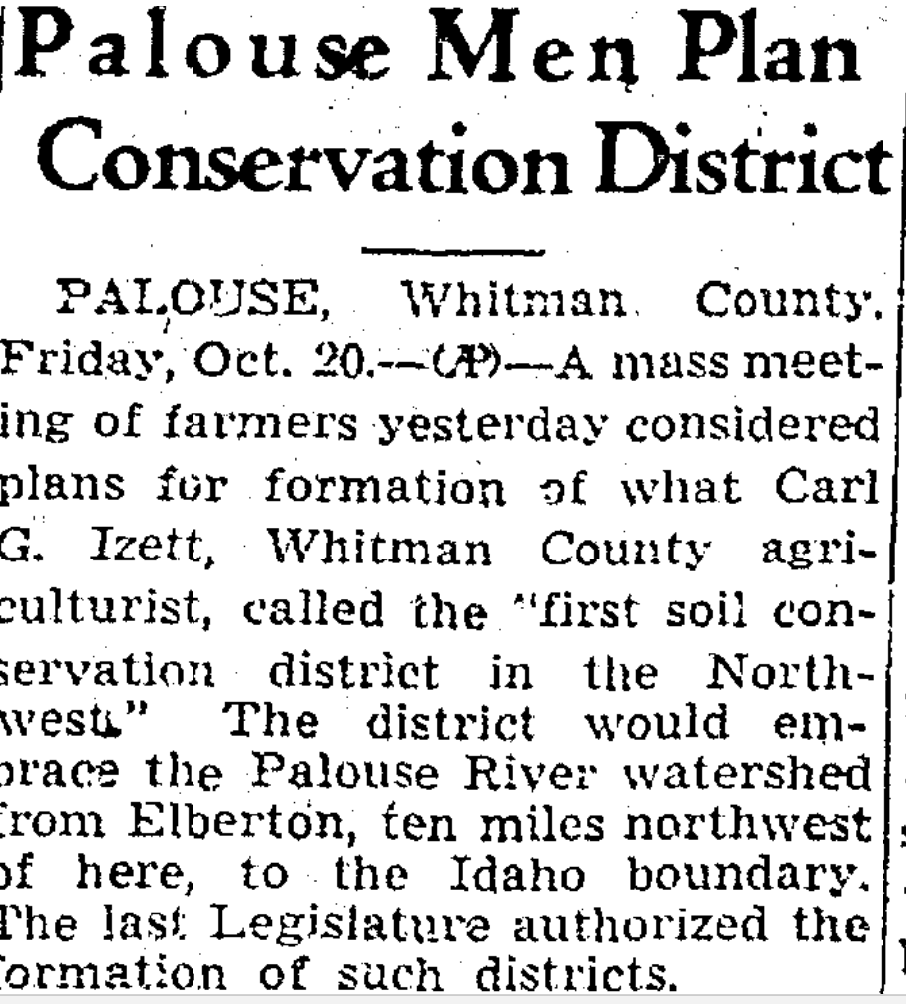
When conservation districts were first formed in 1939 only landowners could vote in their elections.  The federal government sent down a model state soil conservation act in 1937, and after Washington adopted ours, the Palouse took no time to form their first district in October 1939.

The mood of this article pretty much gives you what you need to know.

“Palouse men.”

Conservation districts were not general governments. They were somewhere between all the other sort of special districts that had and were already allowed that provided services to specific needs (irrigation districts, diking districts) and general purpose rural organizations like granges.

The law changed in 1973 to allow “land occupiers” to vote, seemingly to allow people who were leasing land or otherwise using it to also vote.

And then in 1999, the law changed again to allow for any registered voter to vote for conservation district supervisor. It is important to point out that according to the legislative record, this was totally by accident. HB 1747 was passed in 1999 to create a way for cities to leave conservation district boundaries. There were concerns about overlapping programs, so cities wanted a way out. To shoehorn in the petition process that a city would use, they put in a reference into the conservation district laws to “registered voters” instead of “land occupiers.”

 And this is when it all got very janky in regards to all registered voters.

For a hot second, the Attorney general said that those references meant that conservation districts were covered under the general election law.  The conservation district elections in 2001 were handled by county auditors, like most other government elections. Because local governments have to pay a prorated amount for their participation in an election, if conservation districts didn’t hold their elections with a lot of other jurisdictions, it became very cost prohibitive.

So, with the support of a lot of organized agricultural interests in 2002 (Farm Bureau and the Dairy and Cattlemen’s associations), the legislature voted to leave in the part where they allowed any registered voter to participate. But they also clearly reverted to the old rules of conservation districts being able to run their own elections without the county auditor.

In 2002, this wasn’t so transparently a big difference because Washington had not yet changed over to an all-mail system. But it seems very odd now.

So, in short, it has always been that way, but the rules changed over time to allow for more participation, but also not deliberately. It costs less to do it this way and at a point when the legislature could have made conservation districst play by the same rules, they decided not to.

It’s time to acknowledge how messed up the Thurston Conservation District is and you should vote to change that

This is not the blog post you were looking for if you’re looking for the entire story behind what’s going on at the Thurston Conservation District.

I’ve been hearing about this on-going train wreck of a story through second-hand accounts and snippets I could find in the official record for months. And there is totally enough here for a real reporter to dig into. And I’ve been hoping for the adults in the room to take over.

But, in the last few weeks, the district dumped a bunch of draft meeting minutes onto their website, giving a more complete picture of the dysfunction over at the TCD. So, I’m going to take a shot at giving you a picture of what’s going on.

Also, Dani Madrone and I will interview Joel Hansen, an associate (non-voting) board member of TCD, on The Olympia Standard at the end of this week.

Lastly, while there is some diagonal overlap between my professional work and this topic, this blog post in no way represents the opinions of anyone I work for. It’s all me.

Here is the too long, didn’t read of the situation: somewhere in the last year, the board of the TCD decided they wanted to change how they funded most of the functions of the district. This is a complicated process in the best of times. But in the meantime, they decided to not re-up the method of funding they did not prefer (as assessment) while they prepared the new method (fees and charges system). Actually, the new system wouldn’t even be submitted to Thurston County until May of this year, at best. So, as of January 1, the district lost 40 percent of its funding. Additionally, the dysfunction on the board (which you can read about below) has further slowed the process. Because these obviously aren’t the best of times for TCD.

Some state-level organizations have taken notice of what is going on. The state Recreation and Conservation Office (which works with TCD on salmon recovery projects) shot off a letter basically telling TCD to stay in their lane.

The state Conservation Commission, which oversees all local conservation commissions, began threatening consequences in November if the dysfunction didn’t tamp down.

So, what dysfunction?

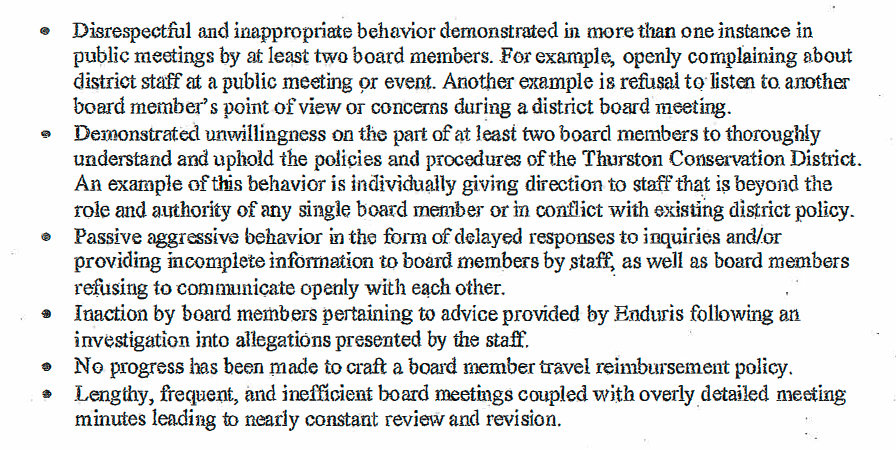
Here’s the bullet list put together by the state conservation commission in the letter linked to above:

The state Conservation Commission has the power to remove board members of local conservation districts and will at least start considering removing board members from TCD soon. The state commission recently gave their executive director the authority to “issue a notice of a hearing to each supervisor of the Thurston Conservation District regarding removal of supervisors under RCW 89.08.200.”

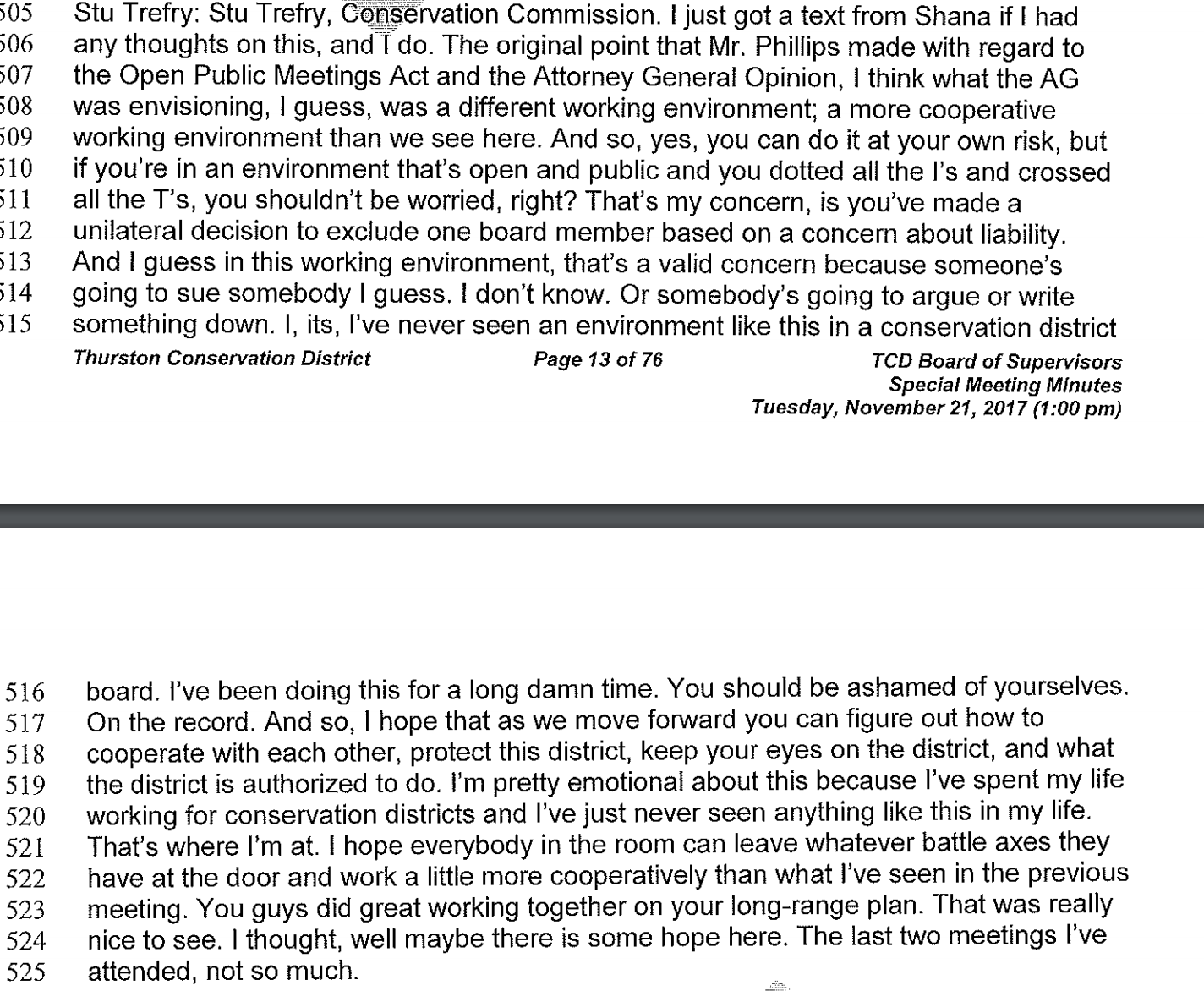
One example of board members behaving badly is described by  one of the staff members from the State Conservation Commission when he laid into the board during the November 21 meeting:

Another is a how the board has been limiting public comment, seemingly to people they like. 
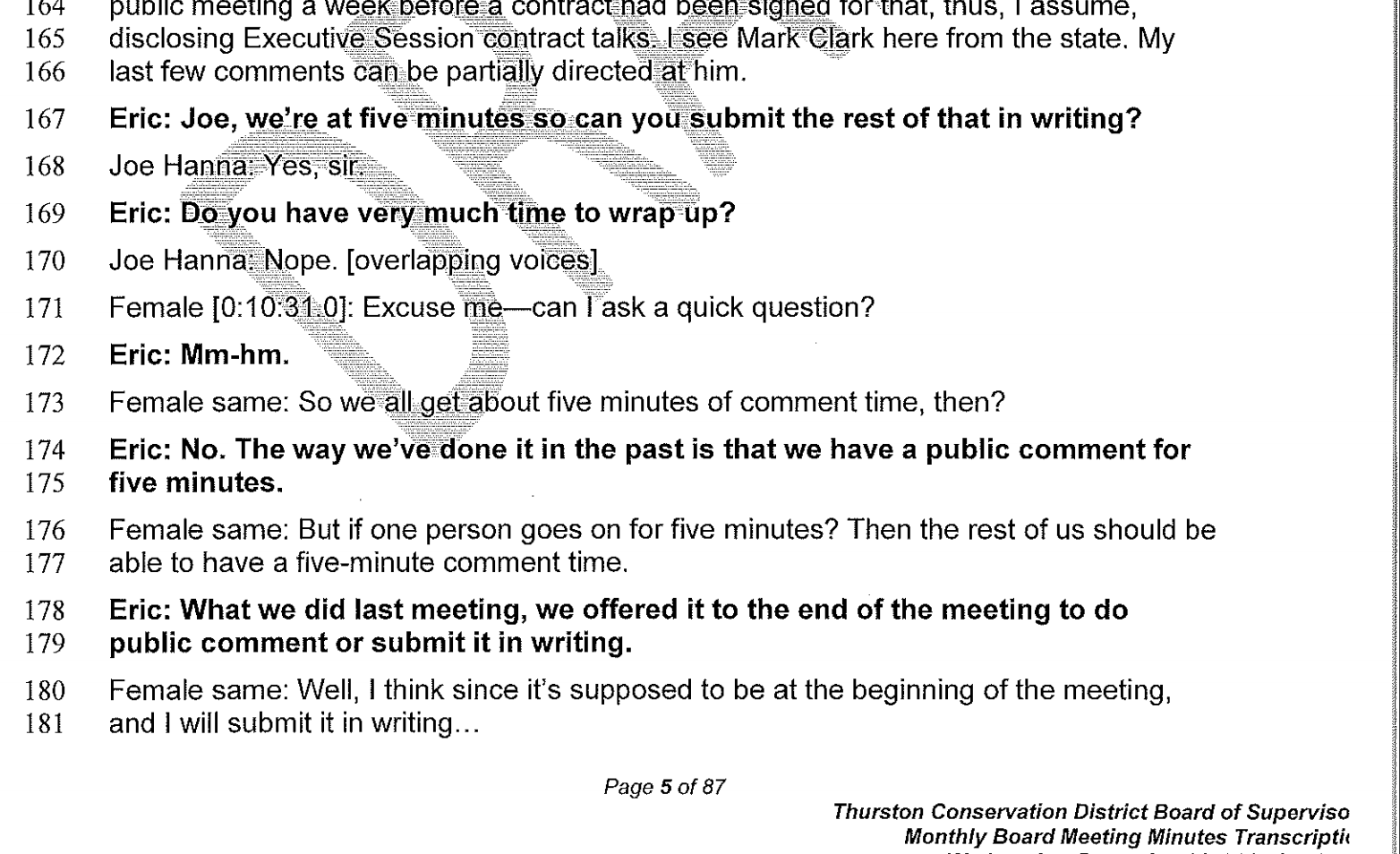
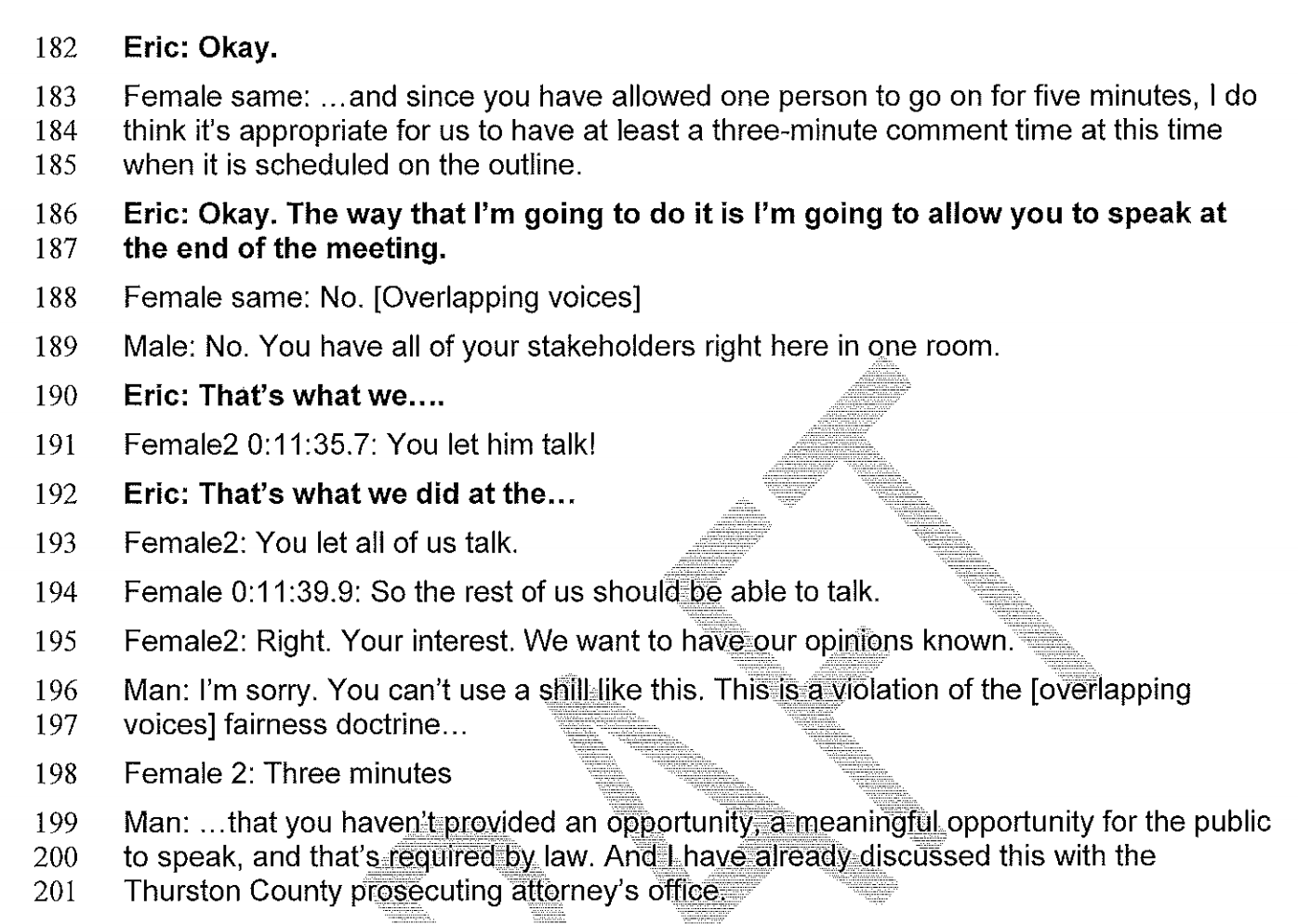
During their December meeting, the board allowed one member of the public to take up all five minutes of public comment. That’s all they had allotted, five minutes. And, if one person took it all up, then everyone else would have to give it in writing. Now, it really is up to a board of a commission how they handle public comment. But there’s an issue of fairness here. If you only have five minutes, then why let one person take it all? And, if you’re going to let one person talk, then why not let other people get up and talk? Most local boards I’ve either served on or witnesses allow anyone to come and speak, but they’ve put a limit on the individual speakers’ time. Anyway, as you can see from below, this didn’t go over well.
From the December board meeting minutes:
In this particular meeting, the board ended up relenting, but it still looks pretty bad that people from the audience had to essentially shame them into letting everyone talk. It is worth pointing out that the one person they did allow to step up and speak (Joe Hanna) has had at different times interjected into board discussions during the meeting. Also in my experience, this isn’t a normal practice either.
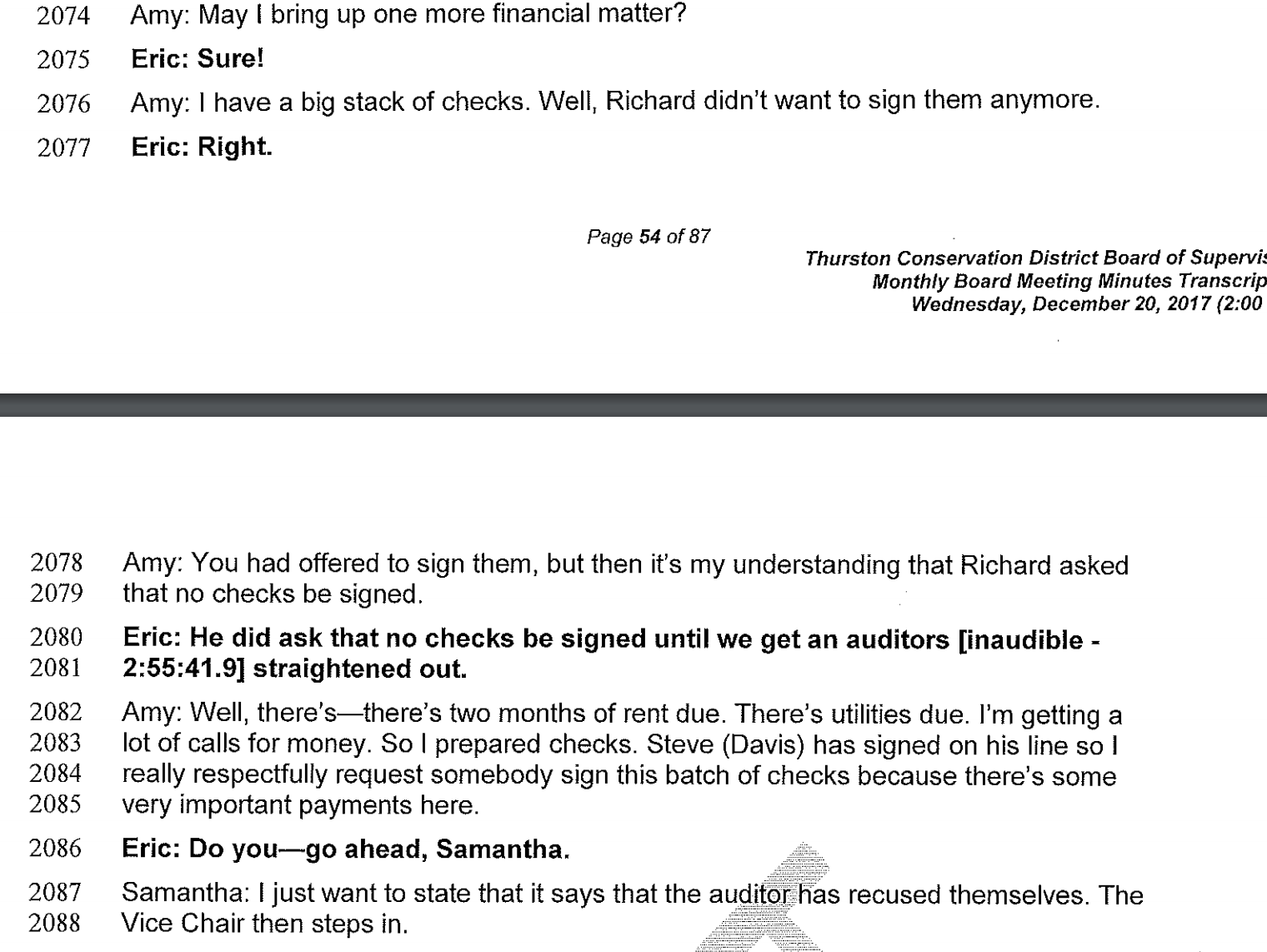
Also, apparently, no one at the conservation district was signing checks so they weren’t even paying rent (again from the December meeting):

So what you can do right now to voice your desire for change at the conservation district is vote before March 3. The last day to request an absentee ballot is February 28.

There’s an open seat on the board which is being filled by probably the weirdest election you’ll ever vote in. There’s no mail-in ballot, you have to work directly with the conservation district to vote. It used to be that you had to go to the district office, but now you can go online and directly request an absentee ballot.

The League of Women Voters are also holding a forum tonight on Tuesday, February 13 for several of the candidates.

© 2026 Olympia Time

Theme by Anders NorenUp ↑