History, politics, people of Oly WA

Category: Olympia history (Page 8 of 10)

Better Bob Bunting

Joseph Bunting is largely believed to have killed Quiemuth in Olympia in 1856. It’s assumed Bunting killed the Quiemuth because he believed the Nisqually had a hand in his father-in-law’s death. More than 20 years later, Bunting’s daughter Blanche and son-in-law Lorenzo Perkins were killed. His son Bob Bunting brought the last of the murderer to justice.

The most interesting thing about the death of Blanche (Bunting) Perkins and Lorenzo Perkins is that when several rounds of of white men went out to look for their killers, Blanche’s dad wasn’t among them. Her older brother Bob eventually put the entire episode to bed. Her uncle John was part of one of the early groups that went looking for her murders. But her dad, Joseph Bunting, is never mentioned in the aftermath of her death.

Bluntly, the death of Blanche and Lorenzo was an unfortunate, incredibly violent and insignificant detail in the history of the greater West. They were literally in the wrong place at the wrong time when a group of Indians bent on killing any white person found found them.

Just one day before the Perkins murder, Lt. Mellville C. Wilkinson commanded the gunboat Northwest as he and his crew patrolled the Columbia River. Wilkinson’s mission was to prevent a tribe from the Oregon side from crossing to Washington.

What he ended up doing was to commit one of the countless under-recorded massacres of Indians by American soldiers.


Michael McKenzie writing in the Columbia magazine in 2008:

Steaming down from Wallula, he fired his artillery and Gatling gun without the slightest provocation into a group of peaceful natives camped there, killing at least two men and one woman, wounding others, and laying waste to the entire camp. Even some of the settlers of the period reacted to his action with distaste, (A.D.) Pambrun calling it a “massacre” and stating flatly that “there was no excuse” for what Wilkinson had done. The following month the Walla Walla Union heaped scorn on the lieutenant’s action…

Jim Soh-yowit in 1917 told his story to historian L. V. McWhorter

…a band of Indians crossed the Columbia at Oom-i-tal-lum and pitched camp on the Washington shore. There were women and children in this camp, all peaceable, the men not having many arms. A steamboat came down the river, and without any warning opened fire on us with what seemed a machine gun. A man named Wah-la-lowie, belonging at La-qwe on the Columbia, was shot in the belly and killed. He was a middle-aged man. A middle aged women named Wah-lul-mi from Ti-che-chim, on the Columbia, was shot in the forehead, and fell dead. The Indians scattered and hid.

I had a single breech-loading rifle which I grabbed and ran among the rocks and lay so they could not see me. A few horses were killed. They fired at where I lay hid but did not reach me. Finally the boat went away without landing. Indians lost a lot of things, for they did not try to gather up their belongings.

Shaw-ou-way-coot-shy-ah to McWhorter:

The white people from The Dalles, they all organized and got guns and got a steamboat and went up to the village and they killed all the old people, [who] don’t do nothing, all the old ladies and all the old men and before these Indians got back to their home they were all dead so part of them went up to the Umatilla River and then part of them went up the Columbia River and crossed the Columbia River…and they came there to a white man and his wife and some of the Indians says, “Here the white people have killed our fathers and mothers and they were not doing any harm, now I am going to kill this white man to make even.”

Wilkinson and his crew murdered Indians on Monday, July 8. Chuck-Chuck, Moos-tonie, Wi-ah-ne-cat, Shu-lu-skin, Te-won-ne, Kipe, and Ta-mah-hop-tow-ne met up with the Perkins’ couple on Tuesday, July 9.

Compared to the gunboat Northwest massacre, the story of the Perkins’ murder is well known and well detailed. This is because the story was literally told by an Indian who was there and white authorities repeated his story often. In the aftermath, Shu-lu-skin gave 17 pages of testimony to prosecutors.


He talked about how the group that killed the Perkins were made up of two groups of Indians. One group were the survivors of the gunboat attack, the other a group they’d met later in the day. After the survivors shared the story of the massacre, all seven planned to kill the next white people they found as vengeance.

Shu-lu-skin talked about how they waited by Rattlesnake Spring, an important way station for travelers, because someone would show up eventually.

They let the Perkins couple dismount, Lorenzo took care of the horses while Blanche cooked. They both at while they went for a walk.

The Indians thought far enough ahead to come up with a cover story. They planned on saying that the Perkins couple had attacked them and they’d only defended themselves.

A.J. Splawn, who wrote history and had acted as interpreter during the trials, recounts details that made the revenge mission sound much less organized:

When they found the man and his wife at the springs, they said, Wi-ah-ne-cat suggested that they kill them. Ta-mah-hop-tow-ne said that two of their own people had been killed by the gunboat, one of them a friend of his, and that he wanted revenge. During their argument Perkins and his wife, no doubt becoming alarmed, began to saddle their horses. Wi-ah-ne-cat and Ta- mah-hop-tow-ne drew their guns and ordered Perkins to stop. He had his own horse saddled by this time and mounted. Mrs. Perkins, who was a splendid horsewoman, did not wait to saddle, but mounted her mare bareback, and with only a rope around her neck to guide her, they started on the run. A shot from Ta-mah-hop-tow-ne’s gun wounded Perkins, but he kept on till a shot from Wi-ah-ne-cat reached him. when he fell from his horse and soon died.

Mrs. Perkins’ mount now began to run and was outdistancing her pursuers, when a deep ravine appeared, which the brave little mare failed to clear. The animal fell, throwing her rider, who lay stunned until the Indians came up. She raised her hands, they said, as if in prayer, then begged them, if they must kill someone, to let it be her. and to save her husband, she not knowing that he was already dead. While the Indians who had come up with Mrs. Perkins sat upon their horses, undecided. Wi-ah-ne-cat rode up and asked why they sat there like women, instead of killing her. He promptly drew his gun and fired.

From gunboat attack to murders, this is a story told by Indians. No white soldier on the gunboat ever faced trial and had to retell exactly what happened. Instead of being hunted down, these men worked their way through history.

On the other hand, the white response to the Perkins murder was drawn out and intense. At its highest point it included over a 100 person posse standing off with Indians before the majority of the accused were brought in. One of the accused committed suicide, several escaped at different points and only two out of the seven eventually faced the gallows.

The last mention of the Rattlesnake Springs murderers was in 1881 when Blanche’s older brother Bob brought in Ta-mah-hop-tow-ne.

Similar to McAllister, Riley and his father over 20 years earlier, Bob Bunting decided that tricking his target would be the best. After hearing where Ta-mah-hop-tow-ne was living, Bunting went to find him, bringing a friend along.

The rouse was that Bunting and his partner were looking to buy horses.

While discussing exactly which horses he wanted from Ta-mah-hop-tow-ne Bob Bunting bent down to scratch a brand design in the dirt. Ta-mah-hop-tow-ne bent down to all fours to take a closer look and that’s when Bunting and his friend tackled him, trying to tie him up to bring him back to Yakima.

Ta-mah-hop-tow-ne yelled out to his wife to bring him a gun while he wrestled with the two white men. Two other Indians joined the fray. It was probably Bunting or his friend that fired first, but both Ta-mah-hop-tow-ne and his wife ended up with gunshot wounds. The retelling of the story in the newspapers that covered the capture don’t mention if she survived, but Ta-mah-hop-tow-ne was brought in. It took over a month for the authorities to hang him.

Ta-mah-hop-tow-ne was the subject of some coverage before his death. In one story, he gives his point of view:

Since my confinement I have been thinking of all the good words I have spoken and the good deeds I have done. I believe in the law of the land and the law of God. I know that those who sin against God should be punished. The Lord guards over both the Indians and the whites.

When I was brought before the court, I expected to have a talk, but the whites did all the talking.

In fact, Ta-mah-hop-tow-ne was tried and convicted two months before his capture.

I had no chance to say anything. I want to say that while growing up from my boyhood I missed the trail, the good trail and by doing so I fell over the bank. I told the judge I was very sorry. I knew that I did wrong, I am now sorry for my soul after death.

On the day of his death, speaking from the gallows, he was much more hopeful about the prospects for his soul:

You all see me, I have your brother. I hope you have no ill feelings toward me. I love you all and I am ready to die this day. I shall go to heaven and I hope to meet you all there.

Three geologic features in Thurston County that are more awesome than Mima Mounds

Mima Mounds? Over rated! They aren’t special!

Much of Thurston County’s landscape was shaped by glaciers, melting or otherwise. So, while the Mima Mounds may be cool, there are other totally awesome features that you should take notice of.

1. For example, did you even see before that southeast Olympia is basically full of small lakes that were created by massive chunks of broken off piece of glacier? Lakes, created by massive pieces of ice.

Some Kettles from Southeast Olympia (from Geodata):

Can you imagine the block of ice that created Ward Lake?

How Kettles form:

2. So, in addition to dropping massive pieces of ice making massive holes in the ground, melting glaciers also created rivers that don’t exist anymore. And, if you look closely, you can find out where these old river channels are. Probably the easiest to spot is Spurgeon Creek just south of Lacey.

You can see exactly what I’m talking about on Spurgeon Creek Road, just south of the intersection with Fox Ridge Lane. To the west, you can see the Spurgeon Creek valley. But modern Spurgeon Creek is much too small for its creek valley. After the last time glaciers retreated from here, they created a massive meltwater river that carved the valley, eventually meeting up with the glacier swollen Chehalis River.

This detail of this map show exactly how the water flowed in the ancient Spurgeon Creek.

The Washington Landscape Blog has a great explanation of how these glacier meltwater rivers were different than today’s:

One is the lower Chehalis occupies a valley that it did not carve. The Chehalis follows the former valley of a much larger river. During the maximum ice extent during the last glacial period melt water from the Puget lobe ice sheet drained to the ocean via what is now the Chehalis River. The river that carved that valley was a much bigger river than the Chehalis.

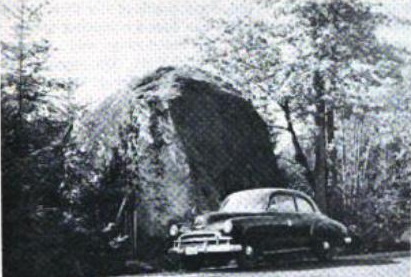
3. Lastly, there is at least one massive rock that was brought to Thurston County by a freaking massive sheet of ice. Glacial erratics are pretty awesome on their own, and there seems to be plenty in the Puget Sound area.

So, I don’t know if it’s just me, but I think it’s pretty cool that we have one here.

The massive rock brought here by a sheet of ice is pretty far out of town on 153rd Avenue off of Vail Road.

It’s a Massive Rock brought here by a Massive Sheet of Ice!
An old photo of the erratic from “ The Natural History of Puget Sound Country”  by Arthur R. Kruckeberg
One last shot of the erratic, from “Ground Water in the Yelm Area Thurston and Pierce Counties Washington,” USGS, 1955.

And, here, as an extra special bonus is a tour of the three geologic features that are more awesome that Mima Mounds.

My big questions about Big Mike

Just over two decades after following the same trail up from the Columbia River to Puget Sound, the body of “Big Mike” Simmons entered the county that almost bore his name. Simmons died on November 15, 1867 at the land claim farm he took after failing at being a timber man in Mason County.

Michael Troutman Simmons is certainly one of the giants of Thurston County history. Leader of the first group of Americans to settle in Puget Sound, delegate to the territorial convention, Indian agent and businessman. Yet, he died poor and almost anonymous in Lewis County.

We seem to know everything about Michael Troutman Simmons. But, for me, there are as many questions as facts about Simmons that I need answered before I get a true image of him.

First off, what is it about Clanrick Crosby?


Soon after this other founder of Thurston County and Tumwater arrived in 1851 (some would say the founder of Tumwater, since he did more to move New Market to Tumwater than Simmons) the two men filed suit against each other. Both men claimed ownership of the land around the Deschutes falls, which would prove to be the economic heart of Tumwater. According to at least one source, the first lawsuit spawned additional lawsuits that lasted beyond Simmons’ death.

Why did he leave Olympia?


His first venture out of Olympia and Tumwater was a mill on Skookum Bay in Mason County he started in 1853 with Wes Gosnell. A newspaper article announcing to Simmons’ new mill, also noted that the valuable land near Tumwater was “no longer entangled in vexatious chancery.” The courts had apparently settled in Crosby’s favor by 1853 (for the moment), and Simmons had taken his enterprises north.

By 1857 he is listed as a property owner in Sawamish (before it was called Mason) County.

For a man whose legacy is tied so closely to Tumwater, he spent more of his time in Washington away from Tumwater then in it.

What about his race for congress?


Is there more to know about Simmons’ failed campaign in 1854 for territorial delegate? He ran in the general election as an Independent and lost by a landslide.

The nomination of Columbia Lancaster as the Democratic candidate in 1854 was one of territorial unity over sectionalism, according to the papers. Lancaster was a resident of the Columbia portion of the new territory. The newspaper in 1854 writes about the state having two centers, one on Puget Sound, the other on the Columbia. Lancaster brings those two together. “The first blow of union and democracy of the territory has been struck”

Simmons wasn’t nominated (or possibly even present) at the Democratic convention that chose Lancaster. James Patton Anderson of Tennessee (who later served in the Confederacy) was the strong runner up in four ballots. Anderson would be elected delegate a year later and serve until Issac Stevens himself was elected in 1857.

Yet, a letter written arguing for Simmons’ independent candidacy pointed out that five of the six who had been nominated were new to the territory and all were lukewarm for the recent split from Oregon. On the other hand, Simmons had lived on Puget Sound for almost a decade by that point and was an early advocate for a split from Oregon.

There’s not a shred of irony from Simmons or his supporters when he mentioned that newcomers were taking over territorial politics.His ten years (compared to the centuries of the Indian tribes) were apparently to him, the most important ten years.

This feud with the Democrats in 1854 would eventually spill into other contests when Simmons apparently even supported the growing Republican party in the territory (as noted in “Confederacy of Ambition”). Political pressure was put to local civic leaders to force Simmons out as Indian agent because of his partisan disloyalty.

Was their economic pressure put together with political pressure to keep Simmons from finding success in the territorial capital? He apparently outlasted all that pressure though, and was only replaced when Lincoln’s administration replaced him with a loyal Republican.

Earl Newell Steele comes to Olympia, 1903

Doan’s Cafe, Olympia, WA 1906 (UW Digital Collections)

From a longer piece I’m working on about E.N. Steele, Olympia lawyer, civic leader, oyster booster and treaty rights activist:

Earl Newell was born outside of Des Moines, Iowa in 1881. After graduating from State University of Iowa, he made a short tour of the west. Once in Olympia, he sat down for a dinner of oysters. That meal sealed Olympia for Newell.

Steele tells the story in his unpublished manuscript, “Letters to Grandpa” about a chance meeting with an old friend and an oyster lunch kept Steele in Olympia:

I again met people from Seattle who strongly advised me to locate in Seattle. Two of my classmates in college had located. But again some thing told me “No, see Olympia first.” So I listened, but I had to change at Centralia to get to Olympia. And that proved to be the most fortunate decision of all. We arrived there about noon. Not knowing where I was going I started toward what appeared to be the business district. I had not gone more than a couple of blocks till I met a young man. We took a good look at each other.

Then he stopped facing each other and he almost shouted at me “Pete Steele, where did you come from?” “Roy MacRenalds, where did you come from?” I then recognized him, for he said “Pete”, and I had not heard that since I left school in Perry, Iowa, We had been friends in school. We had both lost track of the other. After a little chatter he said he was on his way to lunch and asked me to go with him. We went to Doan’s Oyster House. He ordered Doan’s oyster pan roast. As they served it he said, “Pete, after you eat this you will never want to leave Olympia.” He had spoken more than he knew. I had never eaten any thing I enjoyed so much.

So Steele stayed. He started out as a teacher in Tenino, but eventually entered the law practice in Olympia in 1903.

Steele’s love for Olympia is obvious in his writing. He was either a great salesman for Olympia or the rest of his Iowa-based family (four brothers, sister and mom and dad) had tenuous ties to Iowa. Within months of Earl settling in Puget Sound, all seven of them made the trek west to Washington State.


May 1, 2000: A look back at my first and only go as an online reporter

Thank you, Internet Archive. You Rock.

Olympia Today: May Day Marchers Head to Westside Streets 

I wrote this piece when I was running the above Olympia Time website. At the time, the site was actually owned by a small web design firm that I approached as part of an independent contact at Evergreen. Ah, the independent contract… boy, those were the days.

My idea was to add regular content to a site that was already sort of useful (with a perl weather script and a series of interesting maps) and watch what happened. I think I called the project an online community newspaper.

The run up to May Day 2000 in Olympia was stressful. It would come only five months after the WTO protests paralyzed Seattle and no one knew if these sort of things were rising to some crescendo. In the end, I think it would be remembered as a big and long, if otherwise uneventful and typical Olympia protest. Traffic was tied up, but no lasting impact.

May Day 2000 turned out to be (as I remember it) the high water mark for the site under my control. It was certainly the most interesting day for me and the highest web traffic day too.

My goal was to head over to the west side, watch May Day unfold, take notes and pictures, and then go home and put everything online. My ultimate goal was to beat the Olympian online with a final report, and I think I really did do that.

Obviously, I tried to strike a straight up newsy tone:
Celebrants and protestors marched
this afternoon from the Value Village at Division and Harrison to the corner
of Black Lake and Cooper Point. The marchers took the intersection in what
they call an act against global capitalism. 
 

I was also more interested in the other people not taking part of the march (like me), but were there to watch in some official capacity:

No local politicians were
recognized, but Olympia’s Police Chief Gary Michel was present, standing
with other senior officers north of the intersection on Black Lake.


I love my third person reference, no politicians were recognized, instead of “I didn’t see anyone I recognized.”

I was also fascinated by the media response:

The march attracted
much of the regional media, including Olympia bureau chief for the Seattle
Times David Postman (who also brought a photographer), an AP photographer,
KING 5, KOMO 4, KGY’s Doug Adamson, the Olympian, and helicopters from
KIRO 7 and Fox’s Q13.

KGY was the most active among
the media, interrupting their regular broadcast to bring updates. Adamson
road shotgun on a specially outfitted truck in which he broadcasted updates
and followed the march. The Olympian also did their first midday update
on their website to cover the story.

Doug Adamnson really did do a massive job that day, I mean check him out.

And, I suppose I really didn’t “beat” the Olympian, they did do a midday update. But, it is worth noting that if I read myself right, it was their first midday website update ever. That’s certainly something.

What I left unsaid about baseball, ambition and community


I recently submitted a rough outline of Olympia’s minor league baseball history to the local historical society newsletter. It was based on a longer piece that I really hadn’t put finishing touches on, so I took out some thoughts that strayed off the historically cite-able path. They were mostly thoughts on the communities that made up the well defunct Southwest Washington League.

Here’s the piece in the Olympia Historical Society Newsletter: Olympia in Minor League Baseball.

Here are my extended editorial thoughts, in rough form:

(League organizer John P.) Fink first reached out to organizers of local teams in the timber towns early in 1903, asking them if their communities had it in them to step up to professional baseball. First on his list were Olympia, Chehalis, Centralia, Montesano, Aberdeen and Hoquiam. 

These six cities were at the time very similar. Today, they stand apart culturally and demographically, Olympia in particular. In more than a century, Olympia has gone from a timber town in the same classification as Aberdeen and Chehalis (with a state capitol) to a city on the southern edge of the Puget Sound metroplex. Olympia grew from just under 4,000 to more than 10 times that size. Today, you can put Olympia together with neighboring Lacey and Tumwater and get more than 100,000 people living in and around Olympia. This is more people in either of the individual county’s that also made up the Southwest Washington League in 1903.

The 1903 cities of the old league almost seems like ghosts now. Olympia has grown outside its 1903 version, practically leaving nothing behind of its former self. The other cities have grown, seeing high times after World War II. Through the 1930s and World War II Olympia lagged behind cities like Aberdeen and Hoquiam. It wasn’t until 1960 that Olympia was the largest in population. It was the 1980s that Olympia started putting real distance between itself and its former league-mates.

While state government grew and Olympia took advantage of its connection to the urban centers of Washington, the other cities in the old Southwest League suffered from the decline of the timber and other resource industries.

Olympia became even more distant as it got more liberal relative to its neighbors. Being the home of state government and the politically and culturally liberal Evergreen State College, the old Southwest League towns turn their ire at Olympia. The infamous “Uncle Sam” highway billboard in Chehalis has included many anti-Olympia messages over the years, including “Evergreen State College – Home of Environmental Terrorists and Homos?”

But, as Fink sent out his inquiries in early 1903, these really were cities of the same league.

Draft: Midsummer curse and Olympia minor league baseball

John P. Fink, a newspaper man and promoter, had an idea for a baseball league.

Fink seems to a jack of all trades sort of promoter in the era. Mostly mentioned in that gray area between public relations and newspapering. He covered sports, worked for newspapers, but also ran teams and leagues. In 1903 he is also noted in the first ever mention of the Southwest Washington League as “the manager of the Tacoma druggists” baseball team.

This is the same era that saw the consolidation of the Pacific Coast League between California and Pacific Northwest teams. The highest level of baseball on the west coast to that point had been split between Pacific Northwest and California. In 1903 the two warring baseball regions joined together, in an outlaw league.

Was it because of the attention being paid to the Portland Browns, Tacoma Tigers and Seattle Siwashes in the press that Fink saw opportunity in a baseball circuit throughout timber towns in bottom left hand corner of Washington?

The Pacific Coast League was no small undertaking.

Baseball had been growing along the west coast since after the civil war, with Portland teams playing since the late 1860s. It slowly expanded from a game played between clubs and soldiers to a game of semi-pros and pros, business patrons and fans paying gate.

The new regional league from Los Angeles to Seattle was outside the bounds of baseball law, but Fink sought to toe the line.

1903 was also the first year of the National Association, the agreement major league baseball on the East and midwest and minor leagues throughout the country. This agreement gave certainty to players and owners (mostly owners) that contracts would be recognized across professional leagues and that poached players could not re-enter organized baseball without outlaw teams paying.

This was also the agreement that Pacific Coast League ignored, if only for a year or so. But, the smaller (class D) Southwest Washington League was inside the law from the beginning.

This was even fact trumpeted by the the league in “The Reach Official American League Base Ball Guide.”

The Southwest Washington League, under the protection of the National Association, enjoyed a most successful season, financially and artistically, under the able administration of President John P. Fink, of Olympia. The season opened May 10, 1903, and closed September 6, with Aberdeen and Hoquiam tied for the pennant. Hoquiam refused to play a post-season series to decide the tie, and the league directors awarded the pennant to Aberdeen.

Fink first reached out to organizers of local teams in the timber towns early in 1903, asking them if their communities had it in them to step up to professional baseball. First on his list were Olympia, Chehalis, Centralia, Montesano, Aberdeen and Hoquiam.

These six cities were at the time very similar.

Today, they stand apart culturally and demographically, Olympia in particular. In more than a century, Olympia has gone from a timber town in the same classification as Aberdeen and Chehalis (with a state capitol) to a city on the southern edge of the Puget Sound metroplex. Olympia grew from just under 4,000 to more than 10 times that size. Today, you can put together neighboring Lacey and Tumwater and more than 100,000 people live in and around Olympia. This is more people in either of the individual county’s that also made up the Southwest Washington League.

The cities of the old league almost seems like ghosts to me now. Olympia has grown outside its 1903 version, practically leaving nothing behind of its former self. The other cities have grown, seeing high times after World War II. Through the 1930s and World War II Olympia lagged behind cities like Aberdeen and Hoquiam. It wasn’t until 1960 that Olympia was the largest. It was the 1980s that Olympia started putting real distance between itself and its former league-mates.

While state government grew and Olympia took advantage of its connection to the urban centers of Washington, the other cities in the old Southwest League suffered from the decline of the timber and other resource industries.

Olympia became even more distant as it got more liberal relative to its neighbors. Being the home of state government and the politically and culturally liberal Evergreen State College, the old Southwest League towns turn their ire at Olympia. The infamous “Uncle Sam” highway billboard in Chehalis has included many anti-Olympia messages over the years, including “Evergreen State College – Home of Environmental Terrorists and Homos?”

But, as Fink sent out his inquiries in early 1903, these really were cities of the same league.

The $250 that Fink and other organizers wanted in 1903 to enter the league is about $6,000 today.  By February 1903 almost 20 Olympia businessmen had lined up behind the team, putting up the nearly the entire sum needed to enter the league. Gathering investors, officially forming the league, putting together a board of directors were early steps for the Olympia team in the Southwest League. By mid-February the local electric utility — Olympia Light and Power — promised to rip down a defunct veladrome — a bike track — on the bluff above their powerhouse. The plan was to use the timbers to build a grandstand and bleachers on the stadium site, which also coincidentally was along the OLP’s streetcar line.

In April, Olympia baseball me were calling the home field “Electric Park” but it was not yet fit to practice on. Process on the park is going slow, despite the effort of the OP&L company.

When the Olympia Maroons opened in a exhibition on April 19, 1903 against the Tacoma Athletes, an amateur team, Olympia won 4-1. Six hundred Olympians support the Maroons with “lusty yells.”

The board of directors meetings for the Olympia Maroons are public in 1903 and covered like local government meetings. For example, a decision to charge admission is discussed in a regular news column. It’ll cost 25 cents to get into the park, and additional 25 cents to get into the grandstands. Ladies get into the grandstands for free.

 And, by May 10 the Southwest Washington League was in action.

The first really big event of the baseball schedule is on May 22 when President Roosevelt comes to town and Aberdeen plays a “President Day” special the same afternoon. A train full of Harborites come into town with their ball team to see the bull moose. Their team loses to the Maroons.

Turns out, Olympia was a pretty bad team.

By August, the Morning Olympian was advising against betting on the Maroons. Or, at least during league games, during which the Maroons were apparently snake bit:

Any man will tell you, provided he has money on the game, that he is willing to back the Maroons against any team in the Pacific National or the Outlaw leagues, on exhibition, but when it comes to Southwest Washington league games he will hereafter save his money to buy bread… 

 That’s a difference between today and then. While teams like Olympia would play throughout the week against teams in and out of their league, only weekend games played against other SWWL teams counted towards the standings. Apparently Olympia was a weekday team.

By August things are getting worse for the league on a much larger scale. Hoquiam was threatening to leave the league. They seemed to have sarcasm back then as the Hoquiam Perfect Gentlemen were apparently not perfect or gentlemen. Well, if you assumed that amateur ball players who worked mill jobs during the week and in the SWWL on the weekend, aren’t Gentlemen. The amateur team from Hoquiam was leading the league in August against teams made up of a mix of professional and amateurs.

This apparently led to a decision by the owners of the other teams to expand the number of league games, which ate into Hoquiam’s small league lead.

Hoquiam stayed in the league, but not without dragging arguments through organizational meetings and letters.

At the end of the first season, half the league had 11 wins, the other 7.

Aberdeen Pippins 11-7 .611
Hoquiam Perfect Gentlemen 11-7 .611
Centralia Midgets 7-11 .389
Olympia Maroons 7-11 .389

In September the Maroons needed financial help. The Elks and Foresters clubs held a charity baseball game to support the town’s professional ball team, the Maroons. This is an auspicious end to Olympia pro-baseball in 1903. Two amateur ball teams were raising funds for the pro team.

The league would play three years before breaking apart. In 1904 the Maroons became the Senators and in 1905 Centralia is replaced by Montesano Farmers.

In early May 1905, the Morning Olympian introduces the players as if they’re elected officials: Senator Cook, Senator Christian, Senator Almost Stubavor Dye. “A newly elected member who represents the Solid South is Senator Autray.”

I know why the Olympian was practically begging Olympians to come out to support the Senators in 1905. Its the same reason Mayor P.H. Carlyon was deciding whether to declare a half civic holiday for their home opener. Just like in the 1903 season, the hope of a warm Olympia May was smashed by the the heat of August and the league was in trouble.

In 1903, August featured a dust up between Hoquiam and the league, in 1905 it was the very fate of the league.

In early August the owners came together in an Aberdeen hotel. At the urging of Montesano and Aberdeen, they decided to press on, despite very real financial concerns for the rest of the league.

Then two days later, the Olympian carries this passage in a otherwise typical homestand preview:

The Kids (the team’s nickname in the paper is not the Panama Kids for some dumb reason) have played good ball all season, and have been a good advertisement for Olympia all the way. They have not received the support at home that they deserved. The league this year has been faster than ever before and a team that at this time is in second position with a chance still left for the pennant is worth of support of any city in this state. Turn out today, and tardy though you are, be there with the big boost and help the team out, not only with your presence, but encourage them with your two-bit piece. That’s where they need your help most. It costs money to run a team and every citizen should help defray this expense. Olympia needs a team and should be glad to pay for it when she has a team like the present one. 

They need your two-bit the most, your fandom second. The team is an advertisement for the city. Costs money to run a team, Olympia needs a team, every citizen should pitch in. Seems more like a road or a school.

By the way, Olympia at this point did not have a high school building. That came a year later.

But, Olympia, is in inferior headspace after statehood in 1889. An economic depression was brought on in part by national recession and local over-extension to retain the capitol after statehood. It would be decades before finally a permanent capitol was built and Olympia felt comfortably away from fears of losing the capitol.

With the SWWL collapsing in late summer 1905, Olympia needed baseball to be a real city.

And, unfortunately, the Senators and what they mean for Olympia are in deep trouble as 1905 ends and the baseball men look to 1906. 

1905 SW Washington League Standings
Montesano 25-10 (.705)
Olympia 20-16 (.555)
Aberdeen 17-17 (.500)
Hoquiam 9-27 (.250)

Senators finish well behind the Farmers and in late winter in 1906 the ground is being laid for a pro-baseball free Southwest Washington. A league may not come around, but the possibility of an independent team in Olympia is brought up. The increased interest in baseball from amateur clubs is also mentioned as a bright spot.

A local league between Hoquiam and Aberdeen clubs (with the support of the streetcar company between the towns) is promised, but no one knows if they want to start a league between other cities.

While parlaying Olympia interest in reviving the D-level SWWL, the Grays Harbor towns (Cosmopolis, in addition to Hoquiam and Aberdeen) jump up into the B level Northwestern League.

The class A Pacific Coast League (by now not an outlaw, but a law-abiding member of Organized Baseball) includes Seattle and Portland along with California cities. The combined Harbor cities join other also-ran cities in the region, such as Spokane, Tacoma and Butte, Montana.

Surviving as the Grays Harbor Lumberman and Grays, and the Aberdeen Black Cats, the Harbor super team survives in the Northwestern League until 1910 when the league drops them. The Northwestern League exists in those years somewhere in the historic backwash of the legendary (and sometimes considered major league) Pacific Coast League. Cities like Seattle, Portland and Spokane would fall out of the PCL and into the Northwest League and then back up again.

The Grays Harbor consolidated cities tried to play in that league, but were eventually bounced out by their bigger siblings.

In 1910 they tried to put back the old SWWL relationship to salvage organized baseball on the Harbor. Olympia had fielded an independent team in 1909 and felt up to the task.

But, only if things would be different in 1910.

Olympia only wanted games on the weekend. No expanding the league schedule (like what happened under-handily to Hoquiam in 1903) to shoo out smaller clubs. Between 1903 and 1905 the number of league games had expanded, stretching the baseball resources of Olympia. A strict salary cap. “What we are planning on is a league run in such a manner that there will be no danger of it getting along nicely until the Fourth of July and then going to pieces.”

While Olympia wanted a ball team in 1910, they wanted it under more humble standards.

In addition to the old SWWL towns (Olympia, Centralia, Chehalis, Hoquiam and Aberdeen), Elma, South Bend and two Tacoma teams are also considered. But, the 1910 Class D Washington State League did not end up including Olympia. The cost of travel, keeping players and drawing fans drove Olympia’s interest away from the league.

Olympia ended up fielding semi-pro, unaffiliated with Organized Baseball teams through the 1920s. Eventually even interest in that level of baseball lagged in the capital city.

Gordon Newell describes the final death of semi-pro Olympia Senators in Rogues, Buffoons and Statesmen. The midsummer curse did the baseball Senators in again:

The coming of electronic home entertainment media may have provided the final straw which, added to the summer mobility of the family motor car, broke the back of paid admission baseball in the capital city. The sport itself was popular enough. The local merchants organized a twilight league and the sawmills fielded amateur teams in the sawdust league. The Olympia Senators even began the season bravely under the leadership of ex-major leaguer Ham Hyatt, but by the end of July the lakc of patronage caused the semi-pro players to give up in disgust and turn the new Stevens Field over to high school and amateur teams.

The Pig War and Olympia baseball

I’m working on something longer about Olympia baseball, this is a portion of that longer thing.

Olympia’s baseball history probably starts just a bit earlier than than the summer of 1872. Baseball clubs had exploded between Vancouver and Portland five years before, but the following in the first refernce I can find to a baseball team in Olympia (Blankenship):

Olympia, in early days, was not without its baseball team, in which it took great pride in the days of underhand pitching.  Several match games were played with Victoria, and Olympia was victor each time.  The English knew more of their national game of cricket, and had not perfected themselves in America’s favorite sport.  About the time these games were being played the matter of the San Juan controversy was on, involving Uncle Sam and Great Britain.  The dispute was in the hands of Emperor William of Germany for arbitration.  On the day the first game was to be played there was conspicuously posted at the post office a telegram in proper form on a Western Union blank, reading as follows:

Washington D.C.,  July 16

Governor Washington Territory:
Emperor William, having in hand the matter of the San Juan controversy, has concluded to base his decision on the result of the baseball contest between Olympia and Victoria.

Secretary of State.

Thus inspired the Olympia boys went in and won.  It is barely possible that the illustrious grandsire of a degenerate grandson never heard of the game, but the victorious Olympians came from the field with breasts distended like pouter pigeons, plainly conscious of having won an empire for their Uncle.

Just a bit of background, the maritime border between Canada and the states at this point had not been set. Both sides claimed the San Juan Islands, and at some point someone shot someone else’s pig. And, both British and American soldiers were based on the San Juans. Hence a war with only one casualty.

So, the game would have been in the summer of 1872. The German led committee set to settle the Pig War made their decision in October 1872, the British withdrew a month later.

It was also at the exact same time that the mysterious Ira B. Thomas was in town, buying land for a possible terminus for the Northern Pacific railway. Its almost odd that the fact real world wager for this game was over the San Juans and not the terminus. It would’ve been just as believable (maybe more believable) if the game was to be played against Port Townsend or Seattle and the prize was the Northern Pacific terminus.

But, of course the opponent was the opposite capital and the prize was the lonely old San Juans, almost a footnote to history compared to the terminus.

These were the days of formal invitations sent between clubs. And, clubs were not synonims for teams or businesses in the economic venture of making money from sport. They were actual clubs as in having elections and officers and bylaws.

Olympia base ball club would hold a meeting. Who do we invite? Let’s invite Victoria! The next day, a telegraph is sent.

At their next meeting, Victoria considers the invitation and accepts.

Terms would be set, travel would be arranged and in a month or so, Victoria would travel down by steamer. This is the era before even leagues when a club (again, and actual club, as in an organization of men wanting to play baseball) would know before each season (such as spring, summer and fall) who they would play. No yearly champions, just invitations and games. But, they did keep score.

If you’ve ever read W.P. Kinsella, especially the Iowa Baseball Confederacy, you recognize the elements of a great baseball story here, if only the German challenge were true.

In the Kinsella-esque version, a German official would be on hand, because the game would really have been the deciding game in the Pig War. Ira Thomas would be there too. Thomas’ wife back in New York state, unaware that her husband had but months to life.

Just for fun, even though the historian puts down a date of July 16, I’ll put the game on July 4. That enhances the patriotic aura of the game.

Both the German official, maybe an American from the state Department and a British foreign office official come in on the same boat as Ira B. Thomas. The British official thinks the game is a joke, the American thinks its great and the German is just happpy they decided to settle the fight over empty islands somehow.

Ira B. Thomas has a secret, but can’t talk enough about all the stuff he’s heard about Olympia (but not really why he’s there).

I’m not sure how the rest of the story unfolds, but obviously the game goes into extra innings.

Where would have the Northern Pacific met Budd Inlet?

In most local histories that cover the era of the Pacific Northern Railway terminus chase, there is a retelling of this particular episode (this telling from Newell’s “So Fair a Dwelling Place“):

The Puget Sound Land Company, a subsidiary of the Northern Pacific and bought
up large tracts of land on Budd’s Inlet in the name of one Ira Bradley Thomas. Before the rails reached Olympia, Thomas died.

Rather than face the legal delays of probating his estate, the company quickly
bought up new land near Old Tacoma and told the Northern Pacific to change its terminus
to that location.

Had an obscure business man, Ira Thomas, lived just a little longer, Olympia would
undoubtedly have become the western terminus of the first northern transcontinental
railway and the site of the present city of Tacoma might still be a comparative wilderness.

Can you imagine  how Olympia could have ended up differently had we, and not Tacoma, ended up the first industrial metropolis on the sound? I can imagine deepwater dredging all the way to Tumwater and down Swantown Slough. Possibly fill all the way out to Priest Point. Certainly a larger and more developed city.

But, the exact extent of our growth would’ve been determined by exactly where on Budd Inlet the terminus was meant for. I think I’ve come up with a general location of where the Pacific Northern Railroad would’ve met the Puget Sound had they chosen Olympia.


1. First, I wanted to find out if Ira B. Thomas really did come to Olympia in the 1870s to buy land for the Northern Pacific. It wasn’t uncommon for land purchases to be made in the name of the Northern Pacific back then. But, what sometimes seem too good to be true and fanciful stories that get repeated in local history, just really are too good to be true.

That doesn’t seem to be the case for Ira Thomas, though. According to at least this federal case, his estate was still being fought over 20 years later. Since probating the case took over 20 years, the Northern Pacific was pretty smart to move onto Tacoma.

2. So, Ira Thomas was in Olympia and he did buy land for a railroad terminus, where was that terminus? Apparently, the name North Olympia Land Company can still be found in some legal descriptions of property around here. At least this real estate database (BackPlant Tract Book by Titlepoint) lists the company as a search parameter for Thurston County.

3. So, where are the lots with North Olympia in their legal description on Budd Inlet? From what I can find plugging around on Thurston County’s Geodata, right here.

4. So, finally, what does this tell us? Maybe nothing, it is possible that Ira Thomas’ mission in Olympia was just a ruse. Possibly like other land buys in King County, Thomas might’ve been trying to divert attention from the mostly empty property along Commencement Bay. Compared to Olympia with 1,200 people, only 200 lived in Tacoma. The Northern Pacific possibly wanted all the land riches for themselves.

Or, maybe, Thomas’ death really did put the dream of Olympia as major west coast city or at least major western Washington to bed. Maybe in addition to being the state capitol, we would’ve had a mighty metropolis to go along with it. I like to imagine what could’ve been.

Update (11/21/12): Just realized that this map (which I’ve looked at dozens of times) gives a pretty great idea of where the Olympia Land Company property was.

Snippet:

Overlay with current Olympia:

Athletic Park: Olympia’s minor league ball park 1903-1921

If you’re a serious baseball nerd and a serious local history nerd, you probably know that Olympia was a member of the national minor league system from 1903-1906. Sadly, you’re also misinformed, as the Southwest Washington League didn’t make it into 1906, but current records (incorrectly) indicate otherwise.
But, most important to me isn’t really how the team played, but where exactly they played.
The above image shows the best guess of where at least the grandstands for the baseball field were. The map (from a great history on the Thurston County Fair) is a failed proposal for expanded county fair grounds on the site of Carlyon Park, where the baseball field was housed. The black triangle in the middle of the image indicates the grandstands of Athletic Park.
This article from the 1903 Morning Olympian points to a stop on the trolley line between Olympia and Tumwater run by the Olympia Light and Power Company. This piece in 1920 chronicles the end of life of “Athletic Park” right before it was torn down for the current residential neighborhood and replaced by what would become Stevens Field.
After the Olympia Senators (or Maroons, I’m not really sure) folded after 1905, Athletic Park played home to several semi-pro town team, industrial league teams and local school teams. The image below from the 1920 Olympia High School Annual, towards the end of Athletic Park.
Throughout 1903-1920, the grandstands of Athletic Park are almost totally absent from the pages of the Olympus (except for here), but these images show clearly the outfield wall and bleachers added to the park to round it out. The best image of the looming grandstands can be found here.
By the way, I was already working towards this conclusion a week or so ago, but a great discussion over at the Olympia Historical Society’s Facebook page pushed me over the top.
« Older posts Newer posts »

© 2026 Olympia Time

Theme by Anders NorenUp ↑