History, politics, people of Oly WA

Category: Olympia history (Page 6 of 10)

Why one issue elections are the dark side of local politics

Karen Veldheer signed to put R-71 on the ballot, to overturn same sex domestic partnerships in Washington State. But, when talking about equal rights during her city council campaign, she failed to mention this.

I was thinking about five years ago in Olympia recently. At the time I was posting a lot about Karen Veldheer’s candidacy, and some other folks were responding:

I hope you can look past a candidate’s religion, and not stereotype
conservative Christians as a people unable to accept or respect
homosexuals, or uphold legislation or benefits that aid others who hold
differing beliefs.

During campaign, Veldheer clarified in a closley phrased manner that even then seemed to contradic. someone that signed an R-71 petition:

I support the city policy for equal benefits for same sex domestic
partners.  I am a member of the orthodox Presbyterian church and my
religious faith will have no bearing on the decisions I will make as a
civic leader on the Olympia city council.  I believe in a separation of
Church and State.  Further, the state of Washington provides over 200
civil rights, many of which are very important to the Gay, Lesbian,
Bisexual and Transgendered communities, and I support these laws as
well. 

 But, she was willing to work towards overturning one of those rights.

Anyway, Veldeer lost that November to Karen Rogers who maybe even better embodies what I’m actually trying to write about. That when politics of a community are narrowed down to a single issue, you get really crappy politics.

2009 in Olympia politics was all about development on a strip of land downtown called the isthmus (its really an urbanized earthen dam, but who’s really counting?). Even the secondary issue of council relations with the public was also about the isthmus, because some in the public thought they weren’t being listened to.

Both Karen Rogers and Karen Veldheer came from the side of town politics that were hard against the isthmus development and thought the council was being pretty tin-eared. But, Veldheer would have been an odd fit in Olympia politics had she won or continued being involved. And, Karen Rogers really did end up being an odd fit.

As she settled into her seat, Rogers eventually became the lone vote against any sort of government activism. Its hard to think that Olympia had elected a small government, fiscal conservative, but there she was. The fog of the isthmus issue had obscured Rogers’ politics.

Too the point that when she ran for county commissioner, Rogers sometimes acted more conservative than the Republican:

Her initial campaign spin for county commission builds common cause with conservatives and south county residents. In an interview with Janine Unsoeld,
Rogers even played up how STOP Thurston organizers thanked her for a
city council vote. While this may disturb lefties who supported her
mayoral run, pivoting to the right makes electoral sense because that
could discourage a Republican candidate from entering the race. Rogers’
chances increase from iffy to decent if she doesn’t have to run against
both Wolfe and a Republican candidate in a primary.

Then again, some described Rogers  then (where libertarian left and right meet) the same way I described Sue Gunn here. And, Gunn did pretty well in Olympia against a typical business friendly Democrat.

That said, I still think local elections are better when they’re broader than one issue, one building or what we should do on one single block. We elected local politicians to do a lot of things. And, with the collapse of the economy in 2008 and the quick council action, it didn’t take long for any development in downtown to disappear.  We still expect these people to govern well outside of hot button issues.

Enoch Bagshaw collapsed and died in Olympia, the state and region collapsed around him

It was a strange road that led Enoch Bagshaw, the legendary Husky football coach, to Olympia in 1930. But, it was specifically and literally a road.

Bagshaw had been a young public works man in Snohomish County before his life’s vocation found him taking up the position as Everett High School’s gridiron football coach. His success at Everett led him to succeed the four coaches in four years that had attempted to replace UW’s first great coach, Gil Dobie.

Welsh born Bagshaw was not friendly. He won games, and led the high powered Husky offense to two Rose Bowls (tying one, losing the other).

Washington as a state was flying high through the 20s. And, if Bagshaw was the symbol of Washington’s sporting accent throughout the decade, Gov. Roland Hartley was the political embodiment. Laissez-faire to Hartley would be putting it mildly. Hartley wanted to cut down government to a size in which it would not interfere with timber men like himself, or any other capitalist.

And, like Baghaw’s Huskies, Hartley played rough and tumble, ignoring the polite insider politics that often made things happen in the state.

Hartley would also turn out to be Bagshaw’s last benefactor. Both men hailed from Everett (though both were born elsewhere). After Bagshaw finally left the Huskies, Hartley brought him down to Olympia to serve as a transportation administrator.

The Enoch Bagshaw that moved from Seattle to Olympia in the spring of 1930 was not a well man. The 1920s had been hard on his body. He probably didn’t know it, but his road was a short one.

As Seattle progressed towards the Great Depression in the summer and fall of 1930, there was a lot of doubt that Cascadia couldn’t keep on growing as it had in the 1920s.

Seattle Times in July:

“Seattle looks very good, said Mr. Oakes. “Your shops and stores and your industrial activity indicates that your people are not paying much attention to the toalk of business depression that is so much the topic of conversation in other centers at this time. You seem to go serenely on your way…”

And, in in November:

As in all depressions, much of this depression is psychological. People in Seattle are unduly depressed because they hear exaggerated rumors that people elsewhere are depressed. What people really ened is to know the facts. When these facts sink in, our people will realize that things are, as Mr. Coue said, “getting better and better” — and then, they, too, will feel better and better.

 By 1931 only 62 percent of those employed in Washington two years before still had jobs. Timber exports in 1933 were half of what they were in 1929.

Neither Bagshaw nor Washington may not have realized its heart was ready to go out.

It is ironic that the building in which Bagshaw died (today where the Office of the Superintendent of Public Instruction is located), then called the “Old Capitol Building” was also a symbol of our own economic over exuberance here in Thurston County.

Its its first life, the Chuckanut stone building was the Thurston County Courthouse. Built in the high flying days following statehood, Thurston County soon ran out of money, and sold it to the state, which was looking for decent quarters.

And, a final note, Hartley, who lost in 1932 to Clarence Martin, was fond of tearing down portions of state government. 1932 would be a highwater year for Democrats in Washington State. Both Hartley and the U.S. Senate seat would be turned over to Democrats that year. To give you a good sense of the how much 1932 change politics in Washington State, there were 41 Republicans in the legislature to one Democrat. In 1933 there were 21 Republicans and 25 Democrats. A couple of years later there were 41 Democrats and five Republicans (the total number of seats had gone up).

Last, what is one of the agencies that Hartley went after in his high tide days in the mid 1920s? OSPI.

The mystery of the capitol gulch, a surprise stadium and what it means to be a capital city

Sometimes I think about what it means to Olympia to be a Capitol City. I’m not sure how many times in history it has happened, but I’m sure at least once a city has lost that status. Throughout the early history of Olympia, that tension, the possibility that Walla Walla or Yakima or Tacoma might snatch the seat of government seems to be overpowering.

It has been decades since anyone has thought about moving the capitol or even a good amount of state employees out of northern Thurston County. But, we still make civic decisions based on our status as the seat of government. The debates about issues like restoring Budd Inlet or downtown development are influenced by the gravitational pull of the state government.

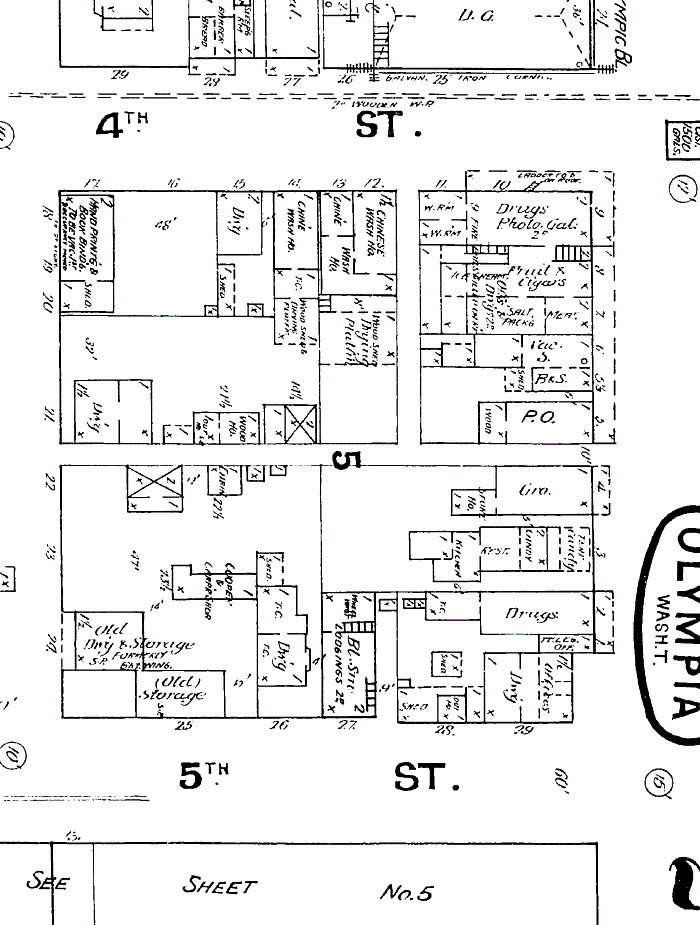
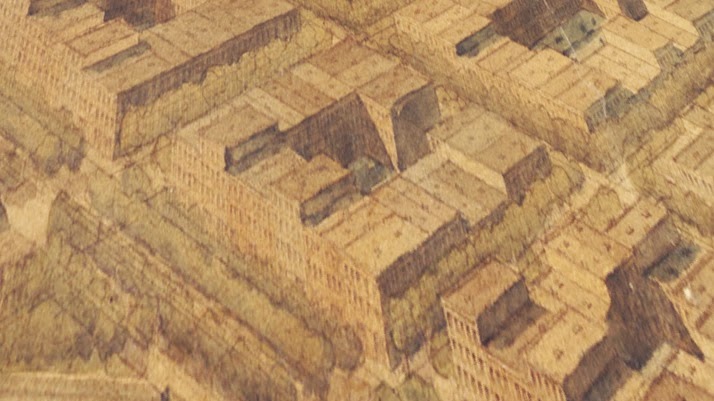
If I haven’t changed the header of this  blog by the time you read this post, you’ll see the graphic is a detail of a Sanborn map of Olympia. You’ll notice a gulch that no longer exists running through what is now the capitol campus.

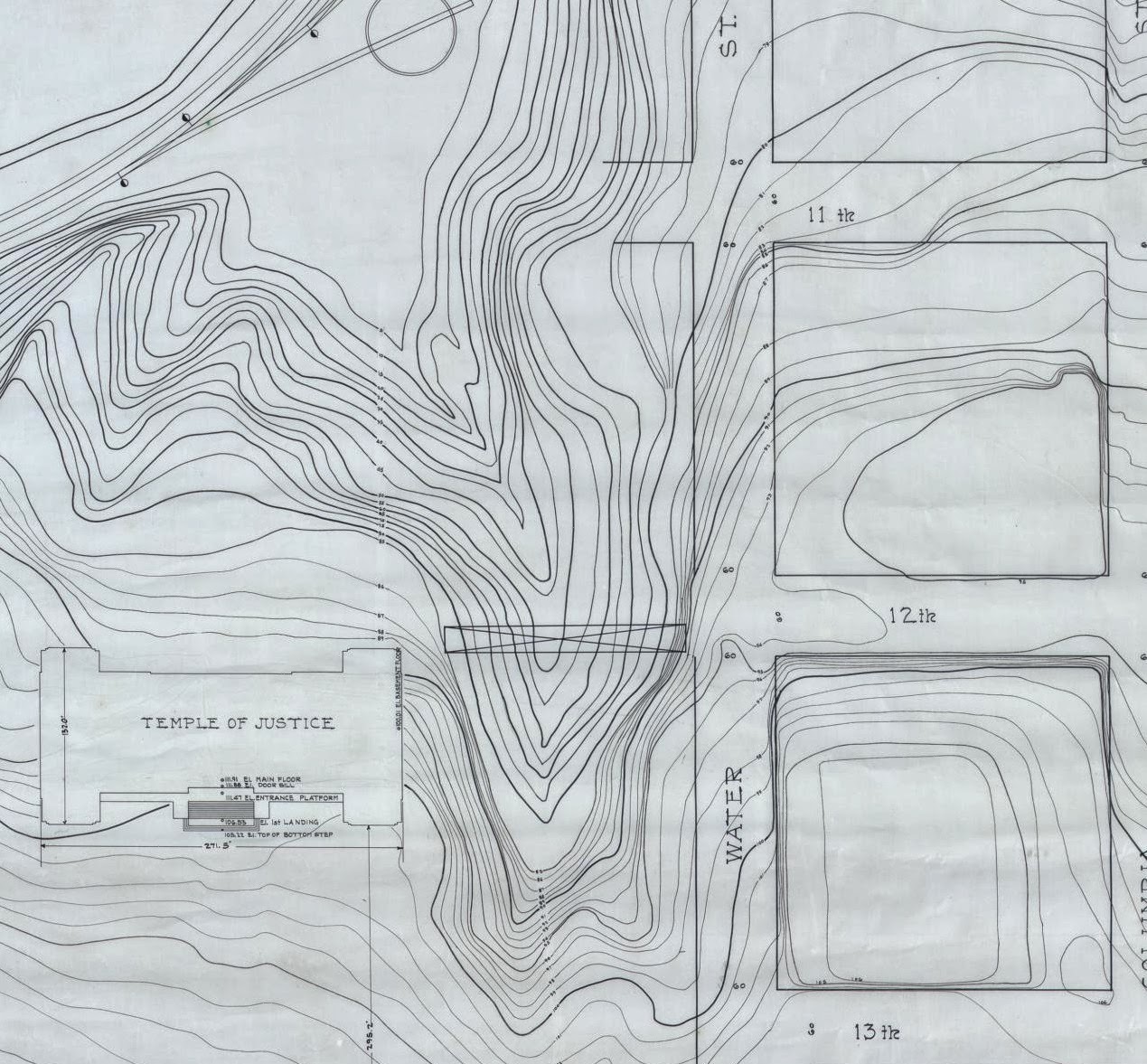
Here’s another map from 1919 that show it in much better detail (via Washington State Digital Archives):

The history of this gulch has always fascinated me. I’ve always wondered where it went, who decided to fill it in. It seems pretty straight forward given the context of history. In the early 1920s the campus was being developed. The gulch was in impediment to that development, so it was filled in.

But, I could never find a record of when or how it was filled.

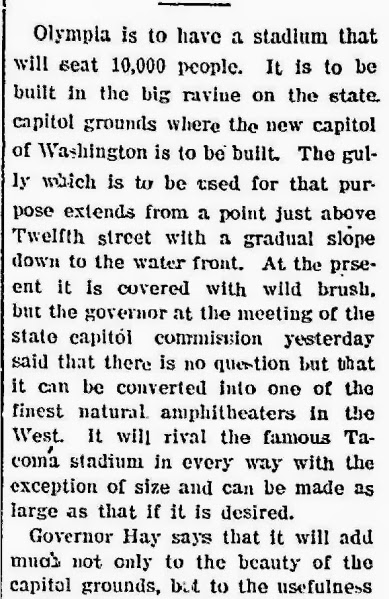
Recently I learned the gulch had a bit more interesting of a history than just a former ditch in the way of a beautiful campus. As state leaders were gathering ideas for the layout of the modern campus in 1911, they decided a stadium would be built inside the gulch

The Olympian, April 1911:


The Stadium Bowl had just been finished in Tacoma inside a similar Puget Sound gulch, and local leaders imagined the Olympia Bowl as a smaller version.

But, as the capitol plans were slowly rolled out over the years, no stadium was ever included.

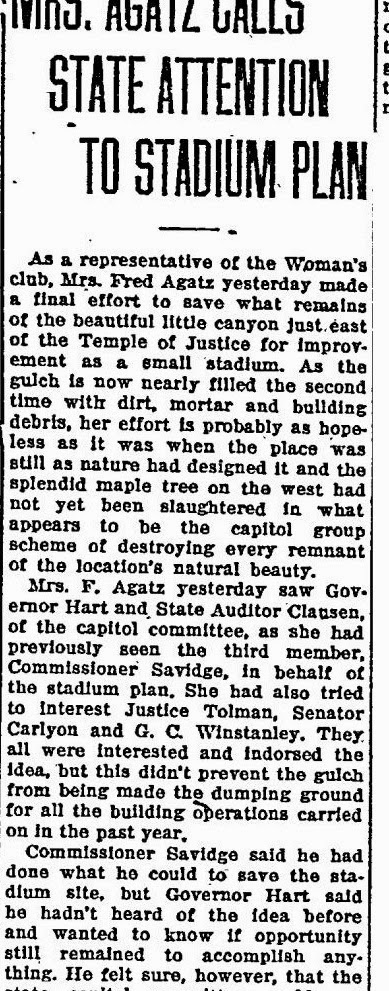
The proposed stadium was almost totally forgotten until local leaders tried to bring it back up in 1921. They not only wanted a stadium, but to save what was left of the gulch itself, which had been used as the trash bin for the capitol builders.

The Olympian, September 1921:

But, obviously the gully was filled and the stadium was never built. In 1922 30,000 yards of dirt were hauled to the gulch by the contractor who was grading the campus, finishing off the gulch for good.

Now, obviously the gulch still haunts us. All that fill is slowly working its way downhill, to the point that the beautiful greenhouse that sites right on the crest of the fill closed six years ago.

Filling the gulch to create a even lawn running up to the campus and not building a stadium is the type of choice that capitol cities make. Olympia did need a stadium. The old Athletic Park  wasn’t much. And, even Stevens Field (new in the early 1920s), when compared to a possible Stadium Bowl on Budd Inlet, doesn’t exactly shine in comparison.

A nice clean campus is good for state government, it just looks nice.

A utilitarian and centrally located stadium would’ve been good for Olympia. These are the things we give up when we decide to fight to be state capitol.

The isthmus if Wilder and White had gotten their way

This is a strange sentence to me (from the Capitol Vista Park website):

There is a continuity in the evolution of this vision from 1911, through
the development of Heritage Park and the Fountain Block, to this next
phase which will be the Capitol Olympic Vista Park.

What’s being talked about here is the plan for a new park across the street from Heritage Park on what is common called the isthmus in downtown Olympia. Really, its one big earthen dam. But, what the writer here is referring to is a 1911 proposal for how that part of downtown should look.

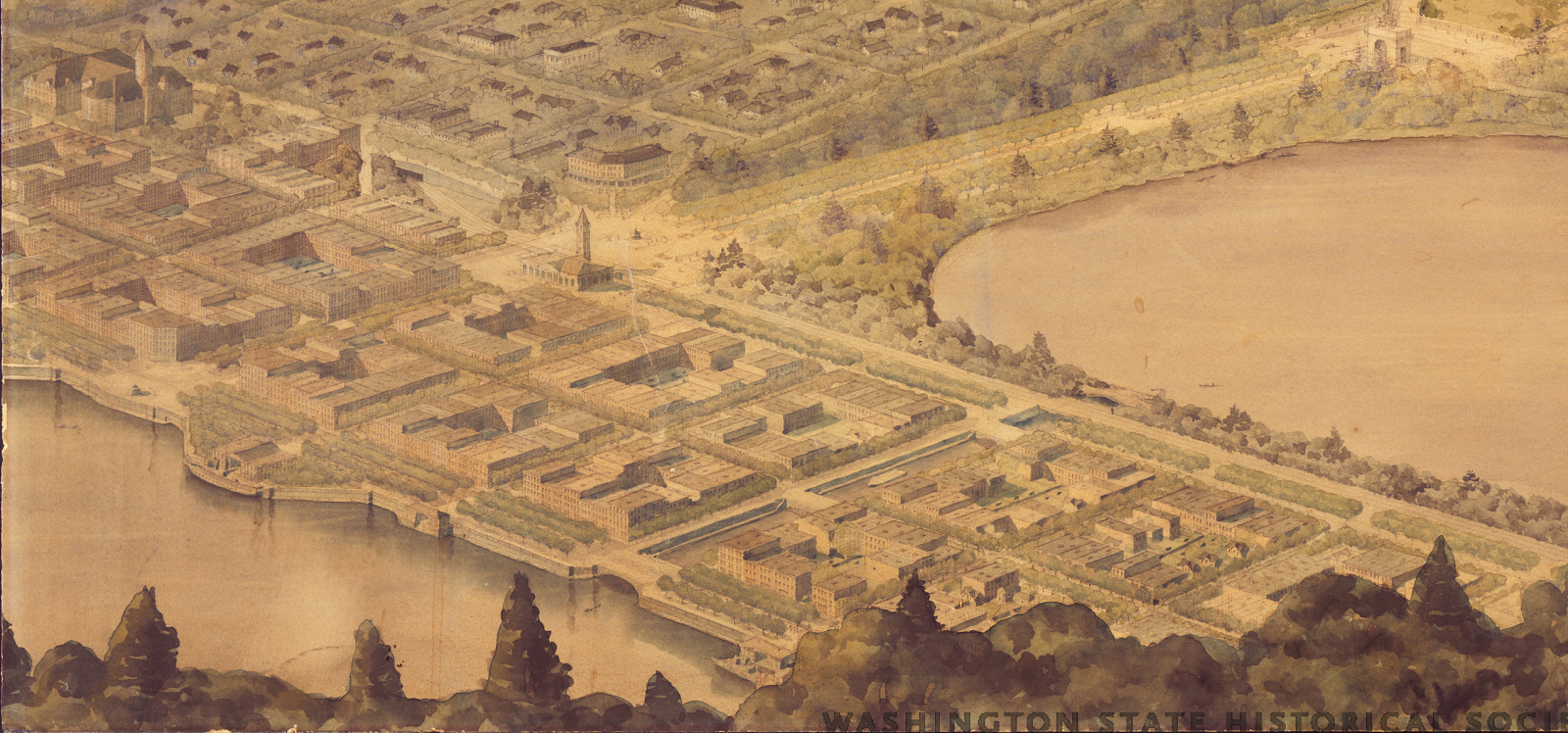
Here’s a representation of what those early 20th century architects (Walter Wilder and Harry White) wanted:

What you’re seeing is something totally different than this:

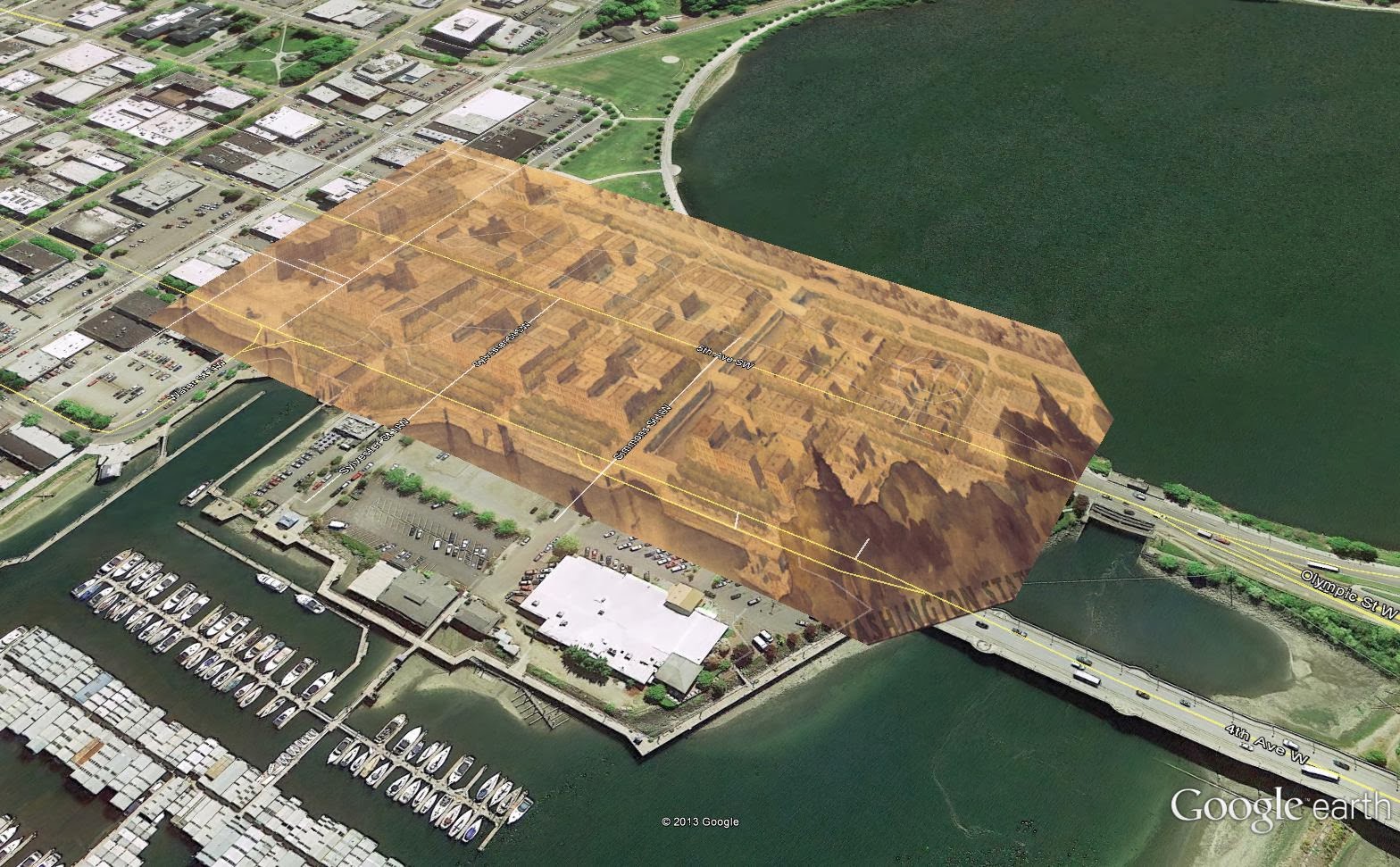
Now, let’s take another look at the Wilder and White isthmus, this time with their blocks overlaid onto modern Olympia:
Now, let’s loop back to that first sentence again. Or, the phrases and emphasized: a continuity in the evolution of this vision. Evolution of this vision, which I suppose can also mean, this is something completely different.

Wilder and White did not propose a park across the isthmus, they proposed a few block of at least three or four story buildings.

This vision evolved, it evolved pretty darn far.
It is one thing to use a historic vision to argue for a change in how we lay out our city. It is something else to say the vision “evolved.” But, I think we’re owed a bit of honesty to how far that evolution has gone. In this case, from an urban neighborhood to parks.

What I got wrong with the history of the Deschutes Estuary

When I wrote up a longish history of the Deschutes River estuary, I summarized the late 1920s like this:

In the late 20s, Wilder and White and the Olmsted firm participated in a back and forth over the landscaping plan, with the state capitol committee in the middle. In one telling, the result was that all waterfront improvements (including Capitol Lake) were written out of the landscaping plan (Johnston, 91).

According to another Capitol Campus historian, Mark Epstein, Capitol Lake was retained in the 1920s landscaping plan, but in the form of Olmsted’s modest saltwater tidal pond rather than an aggressively dammed estuary (Epstein, 67).

Also, ten years after he first proposed it, damming the Deschutes apparently was not in the front of Carlyon’s mind. As Wilder, White and the Olmsted firm debated landscaping plans that could have included a lake, Carlyon wrote an essay about the vision and construction of the capitol group. Lacking from the essay is a single mention of a lake (Carylon, 1928).

Even though it was rejected in 1916 and was an afterthought in Carlyon’s mind by 1928, the lake project did not go away.

The late 1920s was an interesting time in the creation of Capitol Lake. The central part of the current campus was coming into form. And, the final push for the lake was about five or six years away from starting.

So, in the three versions I could find at the time, the lake was either totally gone from the plans, changed into a saltwater lagoon or just an afterthought.

But, I recently came across a piece in the Seattle Times that contradicts this. There was still some discussion in 1929 of a possible lake.

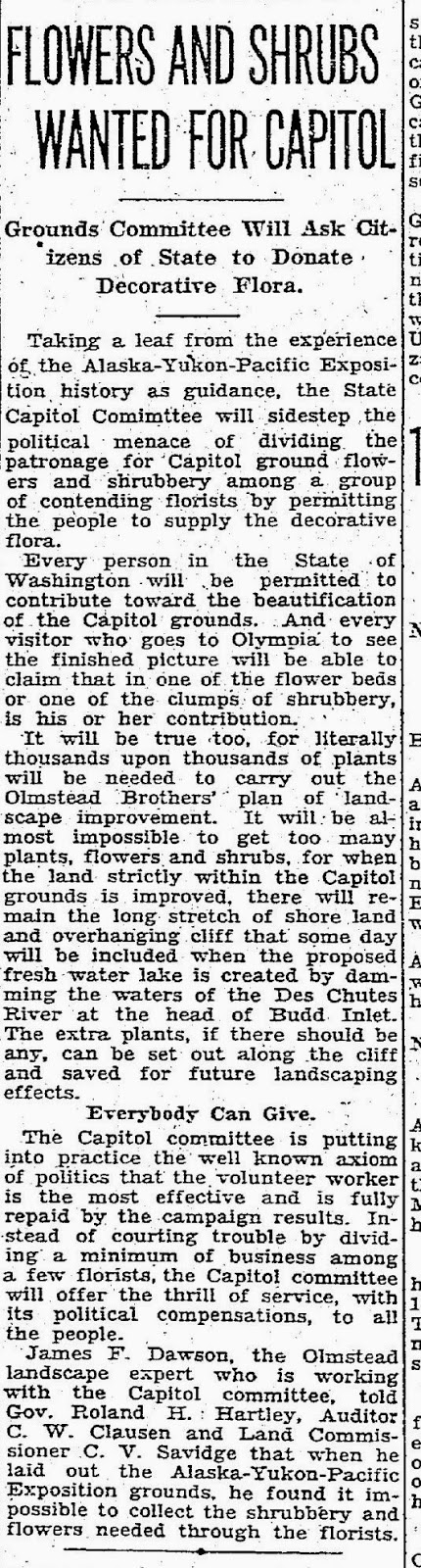
From April, 1929 in the Seattle Times about the need for plants for capitol landscaping:

It will be almost impossible to get too many plants, flowers and shrubs, for when the land strictly within the Capitol grounds is improved, there will remain the long stretch of shore land and overhanging cliff that some day will be included when the proposed fresh water lake is created by damming the waters of the Des Chutes River at the head of Budd Inlet.

 To me, this is a small corner of the lake and estuary history. The idea of the lake was already rejected in 1915. Tumwater wouldn’t agree to damming the river’s mouth and it wasn’t until 1941 that Tumwater citizens changed their minds. And, it wasn’t until the Little Hollywood shantytown took over underneath the capitol that Olympia residents seriously made a push for the lake.

But, still, I was wrong about 1929, so I thought I’d correct the record.

Your “Thurston County wasn’t always a liberal haven” reminder for Martin Luther King Day 2014

Update 8/22/2021: Given a few years learning more about Olympia’s past in this era, I am less surprised that Olympia was pretty racist in the 1960s or that Mike Layton himself was even more racist. Thanks to Robin in the comment below for spurring this update.

I’m going to leave this post in place, but I want to add a few thoughts up on the top to sand off the edges a bit. Specifically, the word “ghetto” is used in a way that may have had more nuance for Layton that I realized. Now I have come to understand that it was meant to imply the negative economic result of segregation. That if kept separate, one race would economically suffer, creating a housing ghetto of less desirable neighborhoods. The “happy situation” he was referring to could have meant integrated neighborhoods. I’m willing to give him the benefit of the doubt there.  

That said, the implication that black residents would be happier if they didn’t advocate for change is heavy in this piece. I’m not sure if Layton is writing for himself or pointing out the obviously wrong white point of view here. But that part still troubles me.

Read this crap (full size version here):

Let it soak over you.

Present happy situation could deteriorate into ghetto

Think about it.


…Negroes here are well educated, affluent and aware of their rights without being what whites think is “uppity” about insisting upon them.

This was published in the Seattle Argus in April 12, 1968. Martin Luther King had literally just been assassinated the week before. I have no idea about the weekly Argus‘ news cycle, but it seems at least in bad taste to publish something like this a week after the civil right’s leaders death.

At worst, the Argus editors and Mike Layton deliberately chose the week after King’s death for this. “Hey Layton! King’s death sure is leading the news, let’s do up a piece about how Olympia is being ruined by his sort!”

And, let’s get this straight. This was main stream thinking for our community. The Argus, while not a major daily like the Times or PI, was a serious Seattle newspaper. From what I’ve read about it, it would be close to what we’d consider the Weekly to be. Old time and storied reporters like Shelby Scates and Mike Layton passed through the Argus at different points.

And, let’s get back to Layton, who wrote this piece. When he passed away in 2011, there was a lot of good things said about him. “He bluntly spoke truth to power,” “a fierce reporter” and “could spot B.S. at a hundred paces.”

Well, that’s a funny way to put it, because the level of bull shit in Layton’s Argus piece the week after King’s death is amazing.

Olympia has obviously changed. Thurston County used to vote for Republicans (and Reagan specifically) and used to put up with this kind of racist crap. I’m not saying we should go back and absolutely revise Layton’s reputation, but we need to remember that this used to happen. And, we weren’t always nice, friendly liberal people.

Olympia’s first collegiate soccer team and why I don’t like PLU

This is some sort of sports team, from the Washington State Historical Society:

But, I really doubt it is a basketball team, as labelled by the WSHS. Mostly because it labelled as being taken in 1885 and James Naismith didn’t create the game until six years later. I think its much more likely that what we have here is an actual soccer team.

For one thing, the year is pretty good for the spread of the game. The first nationwide soccer association launched in 1884, the first national cup in 1885 along with the first international friendly. While all three of these events occurred inside the New York/New Jersey area, soccer obviously existed while basketball did not.

You can find some trace evidence of soccer in Washington State in the same era. This 1891 newsclip from Yakima mentions soccer being played.

Now, here’s some funny history about the Olympia Collegiate Institute. At different times, appently both the Methodists and Lutherans ran the old OCI, but merged them with Tacoma-area schools at different times. The Methodists absorbed OCI into the University of Puget Sound in the 1880s. The Lutherans restarted OCI (Later the Pacific Lutheran Seminary), absorbing it into Pacific Luthern University in the 1910s.

While Tacoma couldn’t end up stealing the capital from Olympia, they did make away with two colleges.

The Olympia Yacht Club is getting their Capitol Lake History wrong

Big surprise, right? Because remember these signs that tried to connect a brackish estuary with bugs that are prevalent in stagnant freshwater?

Anyway, if you head to the section of Percival Landing that crosses the access to the yacht club, you find this sign.

The middle panel confusingly refers to the period of time in Olympia of the “long wharf,” when Olympia business interests were trying to defeat the mudflats north of downtown to find access to deeper waters for shipping. Eventually, through a combination of building the port peninsula with fill and dredging a basin, those mudflats were defeated by the 1930s.

It is pretty spurious to connect this era of filling tidelands and building the long pier to building Capitol Lake in the late 1940s.

This is really a story of two parts of Olympia, the section facing north trying to find shipping routes and the part facing south, looking at the capitol. These are really two different discussions. It took until the mudflats north of downtown were defeated in the 1930s for the discussion to build Capitol Lake to really his its stride. The Port of Olympia had been created, a channel and basin had been dug, and downtown Olympia had been filled out to meet it.

Ironically, it was keeping shipping lanes open to Tumwater that slowed down Capitol Lake for a few years. Tumwater city fathers (including the Schmitds of the brewery) didn’t think it was a good idea to dam the Deschutes to stop boats from getting to their city. They were eventually won over, but trying to connect shipping concerns with the origins of Capitol Lake is wrong.


But, that isn’t to say that the idea of creating a freshwater lake out of part of Budd Inlet didn’t have a shipping connection at one point. Strangely enough, in the long tale of where Capitol Lake came from, there was once a freshwater lake solution to the port’s mudflat problem.

Back in 1903 (eight years before Wilder and White) W.R. Brown put together a small group to try to create a freshwater harbor in Olympia, along the lines of Lake Union in Seattle. Instead of damming the Deschutes estuary at 4th or 5th Avenue, they would go out to Priest Point and build a massive berm there from shore to shore.

Morning Olympian, January 10, 1903:

Like nearly all pre-Wilder and White damming the Deschutes ideas, they were actually to facilitate commerce. The Schmidts of Olympia Beer actually dreamed a plan near to what the yacht club sign describes in 1895. The beer family thought that by creating a lake, they could ensure steady boat traffic to their brewery. But, those plans faded and by the 1910s, Tumwater and the Schmidts were opposed to any sort of damming, up to the point of roadblocking a 1915 plan.

Anyway, that’s a lot of history to unpack. You can read most of the story here at the Deschutes Estuary history page.

Why won’t those damn kids just obey the will of our Grecian columns?

The most hilarious part of the otherwise troubling piece about street culture downtown by Austin Jenkins was this passage:

On Washington’s Capitol campus in Olympia, sandstone buildings stand as
monuments to the rule of law. But just a few blocks away you can find a
street culture where young adults and teenagers live by their own
rules—sometimes with tragic consequences. 

I mean, for Pete’s sake! This is the state capital! While you’re within site of our capitol building, please remind yourself not to fall into criminality!

Jenkins eventually reminds us that “It isn’t just Olympia,” that many other Cascadian cities have the same problems. But, the implication from his lede is that somehow, because of our sandstone buildings, Olympia should have less crime.

As silly as that sounds, it is actually true. Or, at least true from the point of view of the people that originally designed the campus. It is practically impossible to utter a phrase in Olympia about the campus without being reminded of its city beautiful origins.

The city beautiful movement in architecture began in the 1890s as a reaction to the quick and messy growth of American cities during the industrial revolution. When the city beautiful movement came to Olympia in the 1910s, it was hardly a booming metropolis. It was still a fairly common timber town just being carved away from the forest. It wasn’t until the 1950s that Olympia would reach its industrial peak, and the campus was well settled by then.

The thinking behind the city beautiful movement was that it would not only literally reform cities themselves, but it would change citizens.

From an essay by architect Pierre De Angelis:

The Cities Beautiful movement exists as an insignificant footnote in the current discourse on urban planning. It stands as a relatively short lived movement which flourished in the 1890’s; a genuine attempt to reform the wretched conditions of inner city poverty. 

However the upper and middle classes continued to travel into the city, to attend to their businesses and participate in leisure activities. Whether out of genuine concern or simply fear for their own safety and the continued viability of their businesses, middle and upper class reformers attempted to relieve the malaise of the city and lower classes. They did so by embracing the concept of beauty as an “effective social control device”… Reformers had no interest in beauty for its own sake but in its ameliorative power which could inspire civic pride and moral rectitude amongst the impoverished and poverty stricken. It is on these principals that the cities beautiful movement was born and on which much of our contemporary thinking on urbanity finds its ancestry.

There are some interesting parallels here between this description and the city beautiful and the Olympia downtown discussion. “(S)imply a fear for their own safety and the continued viability of their businesses…” is attached to the present time with people scared too come downtown. “(I)nspire civic pride and moral rectitude amongst the impoverished and poverty stricken” attached to ending homelessness and getting people off the streets.

We’re still having the urban discussions now that we had at the dawn of the “architecture will convince the poor to be good people” ideas behind city beautiful. We’re obviously moved beyond the point that we think nice looking buildings will make people better citizen. What Jenkins did was a device to put his particular story in the place he was writing about.

So, if we do end up getting around the corner on how bad downtown really has gotten, it won’t be with building nice looking buildings.

When the world economy came crashing down on Olympia, WA

Did the world end? Has our economy crashed? If you can read this, leave me a comment below to tell me how it all ended. I’m writing this on Tuesday night, so I’m not sure if we breached the debt limit and America’s credit crunch killed the world economic system.

Anyway, if it is alright, let’s take another look back at one of the earlier times we crashed into a failing world economy in 1933. I wrote about that last hunger march here, but that remembering was from a pro-marcher point of view.

Lora Weed’s retelling here speaks of “*(the marchers’) attackers used broom handles to beat the marchers into ending their march.” But, this telling by former Olympia mayor E.N. Steele (in his self-published memoir) tells of a more patient and then flabbergasted response to the marchers:

I shall never forget watching them come in. Police met them at the city limits and escorted them to the park. It seemed as though the end would never come. They came in every kind of a conveyance; cars old and new of every vintage, and trucks of all makes and kinds. Many had tents. Those who did not were able to provide in someway. They came in January so it was rather cold, but they soon had fires going.

These people were for the most part good citizens who needed food and comfort. Hunger makes men desperate. Part of them were farmers, but most of them were from Seattle, Tacoma, or other cities where industries had closed down, throwing them out of work. There was no social security in those days, but there are always radicals and at a time like this they stir things up and really make trouble. We did all we could to make them happy.

But, negotiations with the state legislature for some sort of economic relief were slow going and conditions at the park went downhill.

Sanitary conditions were especially bad. As mayor of the city it was up to me to get them out of town. I submitted the matter to the Director for the State Department of Health. He directed a letter to me, stating that they must move at once, in the interests of their own health as well as the entire city, should an epidemic break out. I wrote a letter fixing a date for their departure. It was sent out and served on the leaders. Copies were posted on the trees.

They sent word they would not leave. Some of the most radical made speeches trying to stir them to fight. Rumors were whispered around town indicating real trouble. I called a meeting of the businessmen and others. After advising them of the entire situation, I asked for volunteers to be sworn in as deputy police. Those present volunteered almost to a man. The new police were organized. None were to carry guns. Each of these hundred men were to assemble at 8:00 A.M., at the Chief’s office, each wearing a badge. Each of them was given a short club to be used only in emergency. By 8:30 each was at his assigned post. There was a string of men on each side of the road the trespassers were to follow. At that time the Chief of Police entered the Park. The men and women were standing around in groups but showed no signs of moving out.

They indicated that they were not leaving and tried to get the Chief into an argument. His only comment was that he had a hundred deputies and the State Police at his disposal and that unless they were on the way by nine o’clock he had instructions from higher up to place them all under arrest. Some grumbled but some began to pack, others followed and at the appointed time they were on their way.

I failed to tell you that after a meeting about midnight a State Police Officer came to me and said there might be trouble as several of the visitors had been hanging around all evening. He took me by the arm and we went down a back way that I did not know was in existence, to the garage which is in the basement where I had my car. He rode home with me and to my surprise I found a shadow police had been on guard for the protection of my family.

That was the only time in my life that I have had to be guarded by secret police.

It is striking the difference in tone and perspective between Weed and Steele. Obviously, both are coming at it from different perspectives. But, today, I keep on coming back to the “Lord of the Flies” story on KPLU this week.

It is interesting how perspective is skewing our conversations about the sitting ordinance, the lower barrier shelter and the current nature of downtown. Either the city is too accepting or the city is criminalizing the poor. We can look back into history and find strains of the same debate throughout our history.

« Older posts Newer posts »

© 2026 Olympia Time

Theme by Anders NorenUp ↑