History, politics, people of Oly WA

Category: Cascadia exists (Page 4 of 5)

Mars Hill, other entrepreneurial Christians and the Cascadian religious landscape (Cascadia Exists)

The seemingly manufactured debate between the Mars Hill Church and Sound Transit on who should own some property in Bellevue seems out of place. When you dig into the debate, it leaves you scratching your head. Why would any organization (a church or whatever) seem to have any case when the rightful owner of a property doesn’t want to sell it to them.

But, once you take a step back and see the debate from the point of view of the religious landscape of Cascadia, it makes a bit more sense. Not much, but it helps to understand how churches like Mars Hill fit into the religious world and the broader social landscape in Cascadia.

While Catholics make up the largest single religion, there are almost actually a footnote when you see the larger religious picture here. There are two things to keep in mind when thinking about religion in Cascadia:

1. There is no more universally diverse region in the United States. That means there are more different sorts of active churches or other houses of worship in our region that any other place.

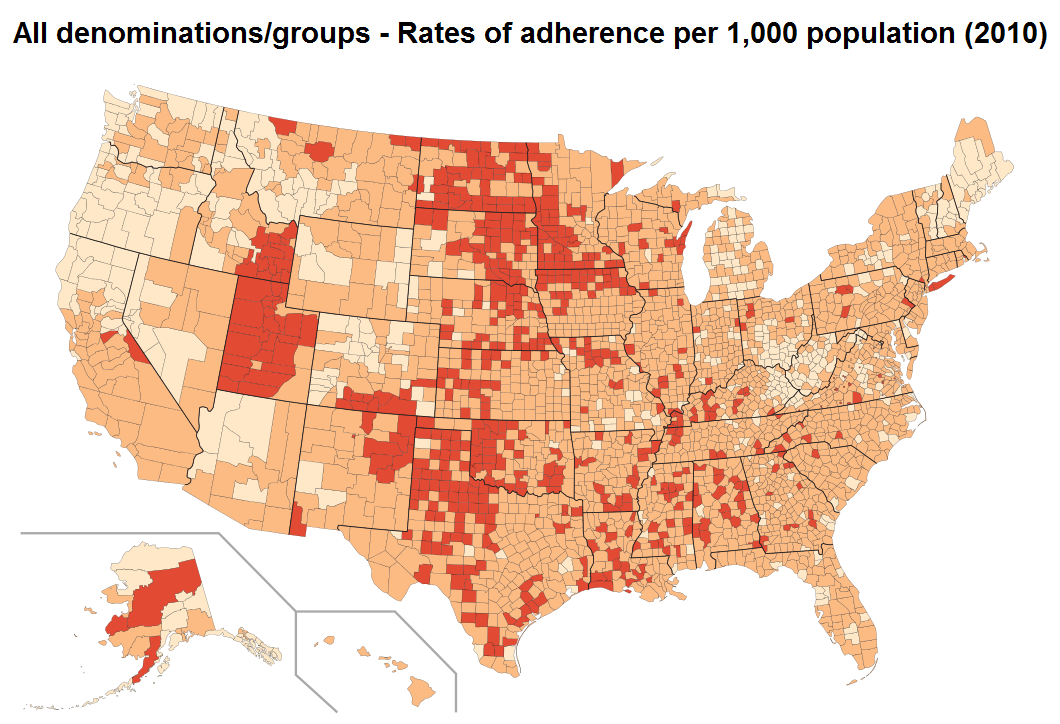
2. The most dominant sort of religious is actually the non-religious. There are more non-adherents in Cascadia than any other part of the country. And, this isn’t a new phenomena. It has been noted for at least a century that fewer people attend or are active in churches here.

You can see these trends in my first post on Cascadian religion here.

But, how does that help explain the situation with the Mars Hill Church?

Well, because Cascadia is so unchurched and so religiously diverse at the same time, it is possible for active and growing segments of religion up here (like so called entrepreneurial Christians) to become self sufficient enclaves inside the broader culture. To the point that places like Mars Hill are even more conservative than similar churches in more churches areas (like the South).

In “The None Zone” Patricia Killen explains that instead of bending towards the center left that is Cascadian social life, entrepreneurial Christians around here bend ride. In almost all political scales (aside from gay rights) they are far more conservative than there counterparts outside the unchurched Cascadia.

Because Cascadia is so religiously diverse, it doesn’t force small communities of faith to adapt to a larger religious culture. They are allowed to live and let live in their own communities. So, Mars Hill church is left alone among a sea of left leaning, non church going Cascadians, they separate themselves, and become more conservative against against the sea of let-live liberalism.

So, when it comes to a simple debate about a church wanting to buy a piece of land after a public agency buys it a few months before, there is plenty of room for each side talking past each other. Communities like Mars Hill probably and simply don’t see eye to eye with the local civic culture. So they’re way of trying to buy a piece of property for seem pretty tone deaf.

Cascadia Exists: Dipping my toe into Cascadian religion

Religion seems to potentially be a deep and rich topic for defining how Cascadia exists. Like many other regions (Methodists in the Midlands and Baptists in Dixie) religion seems to have a defining pull on Cascadia.

But, in a unique way, different (seemingly) than another other region.

But, for now, just a couple of maps to get us going.

Cascadia has the highest level of regional diversity of religion:

Meaning, the marketplace for religion is stronger in Cascadia than any other region. There’s more competition here than anywhere else.
Also, like upper New England and the upper Ohio Valley, Cascadia has the lowest rate of adherents of any region.
This is the so-called None Zone.
So, as an opening. Cascadian religious culture is diverse, and in large part, unattached to any particular sect.

Draft of Call it Cascadia Manifesto

Don’t call us the Northwest. When you talk about the upper left hand corner of the United States (and possibly the lower left of Canada), go ahead and call us Cascadia.

Here are a few reasons why:

1. The current alternative is “Northwest” or the redundant “Pacific Northwest” (as if we need to distance ourselves from the Northwest of the Midwest) is colorless. It is a direction, not a region.

2. Also, the “direction from where” question is troubling. Northwest of what? Denver? What we call our region should be centered on this place, not on some other part of the world.

3. Cascadia is just a better name. Cascadia is actually where we are. It doesn’t look over its shoulder to some other place.

So, what am I missing here?

People outside of Cascadia don’t think about Cascadia. Is that a bad thing? (Cascadia exists #6)

This map series in the Business Insider is fascinating. It is a series of graphic answers to questions asked to Americans about what they think about other states.

What state is the rudest, has the best food, best or worst sports fans and that sort of thing. California, the South in general and New York seem to engender the most opinions. But, one thing I found consistent is that Cascadia (in this case Oregon and Washington) are generally out of the collective conscious.

Washington does rate fairly well as a “smart” state (thanks Bill Gates!) but not at the top. What we do rate the highest in is being under-rated. The last map of the series highlights Cascadia in deep blue, the most underrated place in the country.

Well, at least folks know they’re not thinking about us.

This sort of back of the mindness to the rest of the country is either a good thing or bad thing. You can either seek to solve it or seek to accept it. Or, actually encourage it.

It is a fact that we don’t really have a regional narrative to tell the rest of the country, at least in a historic sense. Much of our history never played out here, since we’re so newly established (I’d even call us a post-WWII region). We aren’t California, we aren’t the Rocky Mountain states, we don’t have much a pronounced presence.

You could take a look at this and hope to tell our region’s story to the rest of the country. But, I’m going to cut you off right. Seriously, why bother?

The attitude of Oregon governor Tom McCall (of enjoy your visit, but don’t stay fame) I think rules this point. We should create our own story, our own narrative for our region and not worry about aggressively presenting it to anyone else.

I don’t have a totally formed though here, but it just seems that we should focus this energy within our region. I keep on coming back to Jim Lynch’s book Truth Like the Sun, which is probably one of the best pieces of fiction (historic or otherwise). I especially appreciate how it focused my thinking about our region and the important transition period that was the 1960s.

But, how important is the story of Truth Like the Sun to someone in Kansas? The 1960s and the World Fair and what it represented was important to our region, but it hardly informs the story of the larger America, beyond the obviously well written human story.

Back to my main point. We know what Cascadia means, we need to keep on telling that story to ourselves and grow it. Maybe people who answer poll questions to business websites will get it, but that will be secondary to what we find out for ourselves.

On Southern Charm vs. Cascadia Calm and social capital (Cascadia exists #5.5)

One thing that bugged me about some of the comments from the Cascadia Calm post was the treatment of some regional personalities as normal, while others abnormal. But, Kim brings up Southern Charm indirectly, so I’ll take a look at Southern Charm.

The idea behind Southern Charm as the polite normal is pretty straight forward. As Kim points out, Southerners (especially Dixie Southerners) introduce themselves, use terms like sir and ma’am, make polite conversation and share stories about their lives, relations and friends.

Now, if someone (without a Southern accent) came up to me and started behaving this way, I’d be just a bit put off. But, that’s me, that’s my region, that’s how we see politeness.

But, let’s get back to Southern Charm and its origins. Or, at least its dark side:

Scott Huler:

Southern hospitality is all it’s chalked up to be: It’s 12-molar,
190-proof distilled essence of welcome, and aren’t you sweet? But at the
restaurant where you can’t leave until they bring you a bill, and they
won’t bring it until they’re good and done with you, it’s about control,
not welcome. It’s a little bit more like Grandma’s insistence on red
velvet cake and seven-layer cake and chocolate cake after Sunday dinner —
but everybody has to make one and bring it, and don’t even think about
getting up from the table until you’ve tried all three, and, meanwhile,
greens turn to glop on the stove and dressing dries out in the oven and
Grandma accidentally lays the potatoes down on the settee, a case of
nerves brought on by the strain of all these guests that she demanded
come over. I have endured this kind of hospitality in the family of my
beloved wife, a native of this state, and I have seen the toll it takes
on host and guest alike. “A tyrannical Southern insistence on
hospitality” is how David Denby described it in a recent New Yorker
review. “Graciousness,” he concluded, “is both armor and a weapon.” 

Denby is far from the first to note that Southern hospitality has its
dark side. Roy Blount Jr. discussed it in his famous essay “The Lowdown
on Southern Hospitality.” “The truth is, irritation is involved in
Southern hospitality,” Blount writes. “Nothing … is sweeter than
mounting irritation prolongedly held close to the bosom.”

Why does the South, in particular, need this sort of personality to survive. It is because, Huler notes, of the way the South developed:

In A History of the South, Francis Butler Simkins and
Charles Pierce Roland say “the cult of Southern hospitality” expressed
“a means of relieving the loneliness of those living far from each
other.”
A new friend once pressed hospitality on me on Malta, the island
at the belly button of the Mediterranean. When I suggested I could not
possibly be as welcome a guest as he made me seem, he explained: “We
live on an island. We wait for people like you.” Loneliness powerfully
motivates hospitality. On a more basic level, when it took half a day to
get to the neighbors, you’d better get more than a ladle of water and a
nod from the porch when you rode up.

 Large farms, a largely rural population spread across several states. It is no wonder that the regional personality was focused on being so damn polite. If you weren’t if you lost a few friends, they were likely the only friends you’d have a chance to make in awhile.

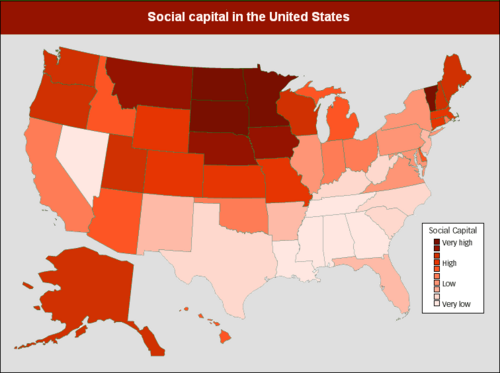
And, I’ll just make the leap here to another topic that I think is pretty striking given this conversation. Take a look at the social capital map of the United States:

  
And, this quote from Democracy in America:
The more we descend towards the South,
the less active does the business of the township or parish become; the
number of magistrates, of functions, and of rights decreases; the
population exercises a less immediate influence on affairs; town
meetings are less frequent, and the subjects of debate less numerous.
The power of the elected magistrate is augmented and that of the elector
diminished, whilst the public spirit of the local communities is less
awakened and less influential.

The map shows you that the De Tocqueville quote carries through to today. The institutions built up by citizens acting in concert with each other simply don’t exist in the same ways that they exist elsewhere (especially New England, the upper Midwest and Cascadia).

If you don’t think about it too hard, it seems strange that the region best known for its social graces rates the lowest in social capital, the actual verifiable ties that bind community’s together.

Unless you thought that social politeness was a cover for actual social ties that bind. If you know you have support from your community, that things will go well because people are generally nice and will back you up, that your local government is there to help, I don’t think you’ll need to be overlly polite to everyone you meet.

But, if you lack social cohesion, the support groups and social capital just isn’t there, you’re region might develop an overly polite personality to make up for it.

You’ll never change us, outsiders! (Cascadia exists #5)

On the Cascadian Calm post, there are a handful of comments worth responding to. Here’s my first shot, which is mostly just a bunch of adding and subtracting.

First, from Anonymous:

…people are becoming aware of the “Seattle Freeze”, and as out-of-towners slowly take over the NW area.

Second, from Kim Bannerman:

There are far more transplanted people here in the Seattle area than
ever before. We’re not going away, Seattleites. Time to embrace the
change/different people and see that as a positive thing that makes your
life richer! We all have gifts and bring different things to share,
after all.

So, the claim is that all the outsiders coming in will eventually overwhelm natives (and people that have acclimated) to make us more open to your Southern charmy or otherwise not Cascadian Calm ways.

But, the number just don’t add up.

First, in Washington, a state with a population of just less than 7 million, here is a chart showing natural growth (births) versus migrants:

Second, the same sort of graph, but for Oregon, a state of about four million.

Certainly there have been eras of massive migration into both states. The 90s were very good to us in terms of getting new people here. But, The chart overall is pretty volatile and in the last few years in Washington have been some of the worst for migrants compared to natural births.

I’ll refer you back to the general population numbers. Even in the days of 50,000 plus migrants a year coming into Washington, they were hardly a drop in the bucket compared to our overall population. You may come here, but in terms of you getting together with your migrant friends and changing our culture? The numbers just don’t add up.

Let’s get back to one of my points in the original post, that the so-called Seattle Freeze (Cascadian Calm) is really a eye of the immigrant sort of thing. It really only exists in the eye of the new comer. That you start to see references to the Freeze in the 1990s (when post Boeing Bust migration peaked) certainly backs this up.

Also, Kim’s point about “embracing change” is well heard. We do embrace change, we are (along with Georgia) one of the most open regions, personality wise. We just don’t get all up in your face about it.

The Football Game that Changed Cascadia (Cascadia Exists #4)

For the South, there’s a very and bright line clear line of when the era following the Civil War ended. Unfortunately for me, it is when the Alabama Crimson Tide beat the University of Washington Huskies in the 1926 Rose Bowl.

I kid you not, Southerners take this story very seriously:

It was more than a football game. It was the chance to avenge the
South, to reclaim the valor and honor of the Lost Cause. No longer would
this land be known for its hookworm and illiteracy. It would be the
home of the best damn football in the nation!

“The 1926 Rose Bowl
was without a doubt the most important game before or since in Southern
football history,” says Birmingham News sportswriter Clyde Bolton.

The 1926 Rose Bowl was a regionally defining event for Dixie (if not the broader south). It showed a way back to regional pride. And, no one can argue that college football is still very much top dog in terms of major sports in Dixie.

So, was there and equal reaction in Cascadia, turning us back when the South lurched foward? Taking a simple look at our history, it seems that the Husky’s performances in Rose Bowls  does seem to correlate with the region’s economic well-being.

The 1926 Rose Bowl in fact marked the high mark of the region since Washington statehood and the recession that followed. Since the 1890s, Cascadia had slowly begun transforming itself from frontier to a real region.

In the case of Seattle, the landscape was literally remade to make room for the city itself:

As the city matured, it sought to make further refinements to itself,
thus launching a campaign of civic improvement devoted to mastering
nature locally as well. One set of improvements revolved around leveling
the steep hills that encircled the downtown. Between 1900 and 1930 the
city re-engineered its natural setting by regrading the slopes around
the central business district. The hills were seen as an impediment to
real estate development; city officials assumed that by lowering the
hills they would facilitate the outward growth of the central business
district and accelerate the rise in property values. As workmen washed
and shoveled and hauled the hills away, they also straightened the lower
Duwamish River in order to facilitate shipping on that stream; created
Harbor Island, which added to the city’s waterfront; and filled in some
of the tideflats in the area just south of Pioneer Square (the spot
occupied by the Kingdome between 1976 and 1999).

 But, following the 1926 Rose Bowl (not immediately after, but soon) all that came to a crashing halt.

The economic depression through the 1930s dragged the entire country down, but it hurt Cascadia even more than the national average. Unemployment in our region was far above the national average throughout the depression. Investment stopped and the growth that our region had expected halted.

By 1933, lumber exports stood at about half what they had been in 1929.
Many agricultural products brought prices so low that they were not
worth shipping to market; some apple and prune growers uprooted their
trees and burned them for fuel. Mining output in Idaho dropped from $32
million in 1929 to $9 million in 1933. By 1933 income levels across the
three states had declined to about 55% of what they had been four years
earlier. Rates of tax delinquency and business failure, of course, had
climbed greatly. The surest sign of an interruption in the normal course
of things was that, for the first time since the 1840s, mainstream
society was united in trying to discourage migration to the region from
back east—for fear that newcomers would only add to already overburdened
welfare rolls. In fact, the population of the area did not stop growing
during the 1930s; it actually increased by about 10%, largely because
so many people from the Midwest moved to the region seeking work.

 But, unlike Dixie, Cascadia didn’t see the Rose Bowl in terms of regional identity. The Seattle Times coverage on January 2, 1926 was typical of a losing city.  A few paragraphs on the front page and then full page coverage in the sports section. While the Crimson Tide were being great by brass bands and crowds on their train trip home through Dixie, the Huskies were greeted with shrugs and “I guess we’ll get’em next year fellas” attitude.

And, it didn’t seem that unrealistic that the Huskies would be back soon. They tied Navy two years earlier in their first visit to the bowl game and had won conference titles twice more in ten years.

But, as Cascadia entered the Depression, the Huskies would have a long road back to the Rose Bowl. Their coach in 1926, Enoch Bagshaw resigned after a losing season in 1929 and died the following fall.

Huskies would lose in 1937 and 1944 without scoring a point.

In fact, the next (and scoring at all) in the Rose Bowl for the University of Washington would be in 1960 when the fate of Puget Sound and broader Cascadia seemed bright again. The Huskies would face off against Wisconsin and beat them 44 to 8. Later that summer, the Seattle World’s Fair was announced.

The Huskies would  repeat in the Rose Bowl, beating Minnesota this time 44 to 8. When the fair was held in 1962 it crystallized the hope and audacity of the region that had dragged itself back from the depths of the Depression.

By 1964, the Huskies were back to losing the game and entering a 14 year Rose Bowl drought. In the middle of that Rose Bowl desert, the Boeing Bust hit Puget Sound, taking the spirit of the 1962 World’s Fair with it.

The Huskies returns to the Rose Bowl from 1978 through 1982 buck my nice neat trend. The Huskies were 2-1 in these years, but Cascadia and Puget Sound were going through some roller coaster years. The economy in the late 70s was pretty good, but had dropped off by the time the Huskies beat Iowa in 1982.

In the early 1990s, the Huskies again went 2-1 in Rose Bowls, winning a national championship and finishing undefeated in 1992 against Michigan. This game could very well mark the high point in Husky football history and the high mark of Cascadia’s economy and cultural influence.

While the Huskies were making their way through national football powers, Grunge was happening, Seattle was becoming the most livable city.

Yes, Cascadia changed in the 1990s and the Huskies were there in Pasadena.

Explaining better with maps and what are Cascadian politics? (Cascadia exists #4)

A few weeks ago, I wrote a post trying to connect how Appalachian and New England settlers have shaped Cascadia. I used a map to shortly show how some things (like legalizing marijuana) cuts across the usual political barriers in at least one part of Cascadia, Washington State.

Muto_krang on a reddit thread about the post questioned the conclusion I’d drawn, so I’ll try to explain it a bit better here.

This is a fairly typical statewide result map for an election in Washington State:

  
This is the 2012 governor’s race. Most of the territory is red (Republican) except for the Puget Sound, where most people in the state live. You see the same pattern in the 2008 governor’s race and the 2010 senate race.

Democrats win the urbanized Puget Sound and some traditional Democratic holdouts on the coast. Republicans win the rest. But, this is only when the race follows traditional (and typically national) lines of debate. Republican and Democratic candidates in Washington typically discuss things like taxes and abortion, things that the different parties argue about everywhere.

But, when the debate becomes about something neither party really lays claim to (say marijuana) we can see the real regional personality of our Cascadian politics come through. And, that is where you get a map like this:

You still have the traditional liberal base of Puget Sound voting to legalize marijuana, as you would expect. Even borderline liberal counties like Pierce County join in. 
But then the political spectrum loops all the way around and the libertarian (from our Appalachian roots) comes around and holds hands. Places like Ferry, Skamania and Clallam counties (which don’t often vote for Democratic candidates) each voted the saem way King and Thurston County.
So, that is what I meant when I said ” In (Cascadia) you find a drastic description of how the two divergent cultures come up with consistent political philosophy.” In this case, when you ask the question that neither party is asking (should we legalize marijuana) you find a geographically diverse majority in favor of it.
My next question is, what are these legalizing marijuana like questions that we aren’t asking that can be answered with a Cascadian political philosophy?

Towards Cascadian Food (Cascadia exists #3)

Some people are thinking about what food makes Cascadia:

The northwest corner of the USA/southwest
corner of Canada region has a lot of wonderful food and drink but it’s
difficult for people outside this region to articulate what the region’s
food and drink actually are. Many simply don’t know. The term “Pacific
Northwest” doesn’t mean a lot in the food world, and it’s also
geographically incorrect when you consider southwestern Canada.

A lot of this does ring true for me. Cascadia (including parts of Canada, but maybe not as far east as Idaho) really does have a regional food culture. Like a lot of aspects of Cascadia (politics, literature), we need to do a better job putting focus on this portion of our culture.

From there, we can take two directions to take this, I think. Either we have a regional food identity (we just have to recognize it) or we have yet to develop a real one.

For the simpler later position, you have delano‘s comment on a reddit thread on Cascadian food:


But it’s still the early days. It takes a long time to develop strong,
regional identities. If you look at the older parts of North America,
you can get an idea of the various stages of food identity. From cajun
to creole in the south to the several specific types of BBQ sauce from
the Carolinas to the eponymous hot wings from Buffalo).

For the former, Cascadia may seem very new compared to Dixie or New England, but in a lot of ways, it is very very old. Take one of the common threads in the regional food discussion on reddit linked above. A lot of people mentioned salmon or a particular species of salmon as a regional food.

But, when you take a look around, it just isn’t salmon as a food that we have available. Another regional food someone mentioned was the geoduck clam.

But, if you take a look at the work of

Elise Krohn and Valerie Segrest, you can see really how deep our food culture can go. Both Krohn and Segrest recently took on nettles, for example.

Krohn:

This year my hunger for nettles is acute.  After having been sick for
weeks with the sinus and lung crud, I need some lively plant medicine to
help rebuild my strength.  An elder once told me that if you drink
about 3 cups of nettle tea per day for two weeks it will change your
blood chemistry.  I believe it.  Spinach is considered the most
nutritious green on the market – but pales in comparison to nettles.
  Nettles are 29 times higher in calcium, 8 times higher in magnesium, 3
times higher in potassium, and almost double in their potassium
content!  Nettles are also exceptionally high in the trace minerals
chromium, cobalt, zinc, and manganese.  They are a super food and a
potent medicine.  Nettles support our liver and kidneys so they can
flush waste products and function at an optimal level.

Segrest:

I began to visit nettle in the woods near my house, at school, in the
park.  I read everything I could on the plant, I drew it, I sat with it,
I stung myself with it, I harvested and ate it, bathed and washed my
hair with its juices.  I had never felt so strong, energized, and
healthy.  And then I thought of all the other plants right outside the
door and wondered what edifying teachings they had to offer.  Once
again, I was hungry for more.  My work is now guided by the plants.
 They are my teachers, companions, friends and all due to this
enlightening experience.

Nettles are almost a perfect metaphor for this sort of Cascadian food thought. They are very simple to find this time of year, literally everywhere. They’re so easy to find that in fact they’re easy to miss. And, in turn, you miss their application in a regional diet or food. It may feel like someone is suggesting you eat a weed, but they are as crucial to our regional food thinking as steelhead or geoduck.

Cascadia’s Appalachian Roots (Cascadia Exists Post #2)

Hey, Kari, you don’t know how right you are: Appalachia in Oregon. Of course, he’s making the point that rural counties in Oregon are doing so poorly, they risk becoming like poor and poorly governed communities in Appalachia. 

The funny thing is though, that these Cascadian communities share a heritage with our Appalachian cousins. In fact, Cascadia is a direct descendant of Appalachia, along with some New England Puritanism. In American Nations, Colin Woodward describes this way:

The coast blended the moral, intellectual, and utopian impulses of a Yankee elite with the self-sufficient individualism of its Appalachian and immigrant majority. The culture that formed—idealistic but individualistic—was unlike that of the gold-digging lands in the interior but very similar to those in western Oregon and Washington. It would take nearly a century for its people to recognize it, but it was a new regional culture, one that would ally with Yankeedom to change the federation.

In Olympia and Thurston County Washington (where I am most familiar) this molding together of two extremely divergent cultural traditions is seen early on. Arguably, the two most significant families in Tumwater (the first permanent non-tribal community on Puget Sound) represented both New England — the family of Clanrick Crosby — and greater Appalachia — Michael Troutman Simmons.

A quick examination of the birth states named in the 1870 Thurston County census illustrates the strong mix between Appalachia and New Englanders.

New Englanders came to the Northwest with business on their mind, but came with traditions of religion, universal education and a general “for the good of all of us” attitude. Appalachians, as Woodward describes them, were nearly the opposite. While they also meant business, their social code was individualistic.

For example, while Simmons was one of the first to lay down roots in Tumwater, he moved on by the mid 1850s. It was up to the Crosby family to plat early Tumwater and incorporate the city. The Crosby clan would build Tumwater and Thurston County in a very real sense. Simmons would continue jumping from venture to venture. His most significant contribution to our heritage would end up being the secession from the Oregon Territory and a quixotic run for Congressional delegate as an independent in 1854.

How does this mix of New England organized capitalism mesh with Appalachian libertarianism in Cascadia? For one thing, as Woodward points out, eventually the religious portion of New Englandism is stripped out and replaced with another moral code. This time it is more humanistic, and comes in the form of environmentalism, human justice and peace movements.

Jarrett Walker’s recent look-back piece on Ecotopia actually gives a good explanation of how this mix occurs. Even though Ecotopia is fantasy, it draws from some very real considerations of Cascadian politics and culture:

The most profound Ecotopian innovation, however, is the rule of the local. Taxes are paid to your town or region, which then forwards some of the revenue to the nation. Decisions are made as locally as possible, and all things giant – both corporations and governments – have been banned or minimized. The national government is small: a coordinator and inspirer rather than a ruler, making decisions only on the few things that must be done at national scale. National defense seems to be based mostly on bluffing, but the Second Amendment’s “well-regulated militias” are a key part of it; people own guns for that purpose as well as for hunting. There are ideas here to excite a Tea Partier, not just an ecologist.

Ecotopians love competition but they want all companies to be worker-owned and no bigger than 300 employees. Government should not do anything that the private sector can do better with correct incentives, but they reach surprising conclusions about which functions are which. Mass transit, intercity and urban, is a government function because of the efficiency that arises from integrated networks and the need to manage big environmental impacts. Education, on the other hand, has been fully privatized into teacher-owned cooperative schools with tuition grants for low-income kids. Local schools compete vigorously for the parental dollar, with outcomes controlled by just a few standardized tests. Ecotopians figure out what works regardless of whether we would call their solution “liberal” or “conservative.” Buzzwords rarely constrain their thinking, perhaps the most utopian of all their ideals.

“There are ideas here to excite a Tea Partier, not just an ecologist.” In Ecotopia you find a drastic description of how the two divergent cultures come up with consistent political philosopy. Yet, not one that conforms with the right-left duopoly of the rest of the country.

Which is how you can explain the map below and these election results.

Marijuana legalization passes in Washington State, but not in the typical “win Puget Sound” way. It won in some odd places, such as Ferry and Mason counties. This counties drew from their libertarian Appalachian roots to vote for a law that would arguably be good for personal liberty
It is also why a state that consistently elects Democrats to statewide office also votes consistently to constrain taxes. And, we voted broadly to liberalize liquor sales.
At least two of these measures (marijuana and alcohol) find the sweet spot between liberalism that New England has become and libertarianism that we’ve important to Cascadia. While these results aren’t a tidy political ruling philosophy written out in Ecotopia, they are at least tentpoles to show us where exactly our political heritage came from.
« Older posts Newer posts »

© 2026 Olympia Time

Theme by Anders NorenUp ↑