History, politics, people of Oly WA

Author: Emmett O'Connell (Page 1 of 175)

Unpacking the Cascadian Calm

Twelve years ago, I wrote a blog post attempting to provide a historical context for our regional personality. I wanted to push back against the “Seattle Freeze,” that ubiquitous, slightly whiny framing of Pacific Northwest social life and replace it with something more accurate: Cascadian Calm.

Recently, the “Freeze” discourse bubbled up again in the Stranger, this time through the lens of dog-walking etiquette. A writer recounted an encounter with a “Gen-X white lady” who, upon seeing another dog approaching, ducked into the street to avoid a greeting. The writer’s takeaway was a scorched-earth anonymous rant: “Are you too socially anxious and screen-addicted to acknowledge the existence of your neighbors?”

There is a lot to unpack there, but the most important thing is the perspective shift, which is not something I would have done 12 years ago. To the writer, the woman was antisocial. To the woman, she was likely practicing responsible dog ownership: proactively avoiding a potential conflict between two leashed animals. While the writer sounded angry, they were likely just lonely. But asking “What the fuck is wrong with you?” is rarely the key that unlocks a neighbor’s front door.

This interaction is the “Freeze” in a microcosm. It isn’t a social disease; it is a clash of metabolic rates.

The Myth of the Freeze

What we call the “Seattle Freeze” is actually a reaction inside the Cascadian Calm. It is a mechanism to avoid negative friction. In the Northwest, we practice “assent by silence” or the “dirty yes.” We remove ourselves from situations to prevent the temperature from rising.

The “Freeze” as a brand surfaced around 2005, a period of moderate population growth following the Dot-Com bust. But the grievance is much older.

Knute Berger points to post-World War I when civic promoters attempted to make the entire city friendly. I like to point to the post-World War II era. In my original post, I wrote about a July 1946 letter to the editor by a veteran named D.K. He described himself as a “strange outsider” unable to break into Seattle’s “charmed circle.” This is the Freeze.

Other residents wrote back (this is when letters to the editor were the comment thread), and D.K. eventually agreed that if he worked hard enough, he’d make friends. But, he pointed out, it still was different here.

But, here the context was important. Seattle in 1946 was going through jarring transition as a region. Seattle was pivoting from a resource-extraction outpost to a global tech hub. After the war, Boeing slashed its workforce from 50,000 to 9,000 almost overnight. Thousands of African Americans who arrived for defense jobs were finding their place in a shifting social hierarchy, while the Japanese American community returned from internment to find their neighborhood effectively erased. In this era of high turnover and economic “post-war blues,” the “Freeze” was the friction of a city trying to redefine its boundaries while new residents hammered on the glass.

The Science of the “Sane”

If we look at the academic data regarding regional personality, the Pacific Northwest is defined by High Openness and Low Neuroticism.

The academic study of “Regional Personality” is a relatively young but robust field, led by psychologists. Research suggests that personality traits aren’t just randomly distributed; they “cluster” geographically through a process called selective migration. People don’t just move for jobs; they move toward “psychological fit.”

The “Cascadian Calm” is placed squarely within the “Open and Creative” profile of regional personalities. Researchers found that the Northwest consistently ranks among the highest in the nation for Openness to Experience. This isn’t just about trying new foods; it’s a psychological marker for curiosity, non-traditional thinking, and a high tolerance for ambiguity. We are a region of people who are comfortable with “not knowing,” which allows for a certain social looseness that outsiders often mistake for a lack of structure or care.

Crucially, this high openness is paired with consistently low Extraversion. This is the scientific bedrock of the “Freeze.” The region skews heavily toward introversion, recharging through solitude, the “middle of nowhere,” or quiet intellectualism rather than social performance. While a transplant from a “Friendly and Conventional” region (like the Midwest) might view a quiet sidewalk as a social failure, the data suggests that for the Cascadian, that silence is a sign of high emotional stability. We aren’t panicking in the quiet.

This creates what academics call a Cognitive Resilience factor. Because we also score low on Neuroticism, we tend to be less rattled by emotional swings. This produces a “stable” atmosphere that can feel “robotic” to someone from a high-stress, high-energy urban center. You see a neighbor in distress and think, “I should respect their privacy so they can process this,” while the newcomer thinks, “Why isn’t anyone rushing over to help?”

Furthermore, the PNW is part of the “None Zone,” the most secular region in the country. In the South or the Midwest, the “charmed circle” D.K. wrote about in 1946 is often held together by the glue of the church or civic clubs. In the Northwest, those institutions are historically weak. Without these pre-packaged social on-ramps, our natural introversion becomes a walled garden. You aren’t being excluded because of a lack of manners; you’re being excluded because there is no formal onboarding process for the neighborhood. We are a society of high-trust individuals who simply lack the performative rituals to show it.

Think of the Pacific Northwest as a peaceful library. The environment values quiet, respects your personal space, and offers a sympathetic nod if you drop your books, but it won’t necessarily rush over to help you pick them up. This isn’t rudeness; it’s a “live and let live” philosophy that assumes you value your autonomy as much as we value ours.

DK and Kim’s Journey

The most fascinating part of this 12-year conversation has been the comment section of my original post. Specifically, the evolution of a commenter named Kim. There are specific echoes with Kim’s journey as there were with DK when he was integrating into Seattle in 1946.

In 2013, Kim arrived from Atlanta in a state of “culture shock.” Her early comments were vitriolic: “It’s called MANNERS. It should be taught during childhood.” She viewed the Cascadian Calm as a moral failing.

But by 2020, after moving to Southern California and San Francisco, Kim returned to Seattle by choice. Her perspective had undergone a radical shift. She realized that while other regions might offer more “performative” hospitality, they didn’t offer the “fit” she required. She stopped demanding the city change for her and started navigating it, joining meetups, volunteering, and “pushing through.” She moved from cultural combat to cultural integration. The “Freeze” didn’t melt; she just learned how to dress for the weather.

Looking back at D. K.’s 1946 grievance is to see the “Freeze” in its ancestral form: a raw, post-war loneliness that felt like a moral indictment of the city. D. K. was a man beating his fists against a “charmed circle,” interpreting Seattle’s lack of immediate, back-slapping hospitality as a sign that he was an “intruder” in his own country. His evolution, however, was stunted by the era; he viewed the responsibility of “community spirit” as a debt the city owed him, a service to be rendered to the returning veteran. While he eventually expressed gratitude for the few who reached out, his letters remained anchored in a sense of exclusion. Unlike the modern Kim, who eventually realized that the city is a landscape to be navigated rather than a wall to be climbed, D. K. represents the tragic first stage of the transplant’s journey: the belief that a quiet city is a dead city, and that a neighbor’s silence is a locked door rather than a boundary of respect.

The Social Capital Paradox

Critics call our behavior “passive-aggressive” or “cliquish.” They argue that the regional culture is a “monoculture” that forces extroverts to “tone down.”

However, there is a paradox at play. While regions like the South rank high in “social graces” (the “Southern Charm” model), they often rank lower in verifiable social capital, institutional trust, and actual community engagement. The Pacific Northwest ranks higher in these metrics. We may not say “hello” on the sidewalk, but we trust the library system, we show up for the public hearing, and we maintain the trail.

Our “Calm” may be the byproduct of a society that feels socially secure enough that it doesn’t require performative politeness to maintain order.

The New Friction

The complaints about the “Freeze” always peak during eras of high migration: the post-WWI era, the post-WWII era, the 90s tech boom, and the post-Great Recession surge.

The angry dog-walker from the Stranger was right about one thing: “Community takes a little effort.” But empathy is a two-way street. Assuming the worst intentions of your neighbor, assuming they are “screen-addicted” rather than simply “dog-cautious,” is the very energy that keeps the “Freeze” intact.

The regional personality isn’t going to change. The Cascadian Calm is a feature of the landscape. We aren’t unfriendly; we are just waiting for you to realize that in this library, silence is a sign of respect.

The “Cascadian Calm” is a sturdy psychological chassis, but even the most resilient systems have a breaking point. Since the “Seattle Freeze” moniker was minted in 2005, the region has been battered by the curse of living in interesting times. We have endured the Great Recession, the social fracture of the Trump eras, the global pandemic, and a housing crisis that finally saw the dam break on affordability. The civic trust that once allowed us to be “quiet but kind” is fraying. In Seattle itself, the political pendulum swings wildly from progressive experimentation to reactionary moderation, a symptom of a city that has lost its steady hand on the tiller.

When our larger systems (zoning, housing, and the mayor’s office) seem to fail us, our reliance on that old tradition of social capital is shaken. In this high-anxiety environment, the “Freeze” stops being a respectful boundary and starts looking like a defensive crouch. We are leaning into the withdrawal aspect of our personality because we are tired, but as our angry dog-walker from The Stranger proves, leaning into the Freeze doesn’t do us any favors. It only deepens the isolation.

We are, as a region and a people, imperfect. We cannot reach back into 1946 and fix D.K.’s loneliness, nor can we undo the administrative erasures of the last century. We can only do better today by refusing to let our “Calm” turn into coldness.

I will say that living in and writing from Olympia seems to be calmer water than I described above. We tend to vote towards the middle of our choices. Not necessarily progressive or moderate, but definitely not reactionary in either way. The recent election results since 2021 have solidified this belief for me. There is a bare minimum of progressive politics that any candidate needs to pass, but the other requirement is both engagement with the community and a seriousness in their approach that rejects reactionary politics. This reminds me that while Seattle may get all the attention and attempts to drag the region around, the rest of Cascadia still exists and may be a better example of what we strive for.

The work of community is surprisingly simple, though not easy: it requires us to do exactly what the anonymous ranter failed to do: assume the best of the person standing next to you. Whether they are ducking into the street to manage a nervous dog or simply keeping their head down in the rain, they aren’t your enemy. They are just another Cascadian, navigating the same landscape, waiting for someone to prove that the circle isn’t quite as “charmed” (or as closed) as it looks.

Olympia as Ghost Town

When I wrote last week about Tono, I was thinking about all the non-Tono ghost towns we don’t think about, the ones lost to inaccessibility, or those that never managed to keep their ruins standing. Lewis County has a dozen or so of these across the timber and coal industries (Hurn, Mendota, and others): towns that simply ran out of reason to be.

Tono taught us that history survives the physical. It was a place erased by corporate action and resource exhaustion, its memory surviving in old maps and the stubborn curiosity of GIS layers. I argued that the built environment is not the memory. The detailed records (what we can piece together) are the memory.

But what I’ve always wondered about is a ghost town lost in plain sight. What if Puget City, north of Lacey, had grown during the resource era, died, been forgotten, and then completely paved over in the name of urban progress?

While not a perfect example of growth, decline, and erasure by suburbia, the East Capitol Campus in Olympia is a lost, ghosted city. And it explains a lot about what went wrong in Olympia’s growth after the 1950s.

The Lost City

Tono was a company town that faded out. This Olympia neighborhood was healthy, dense, and killed.

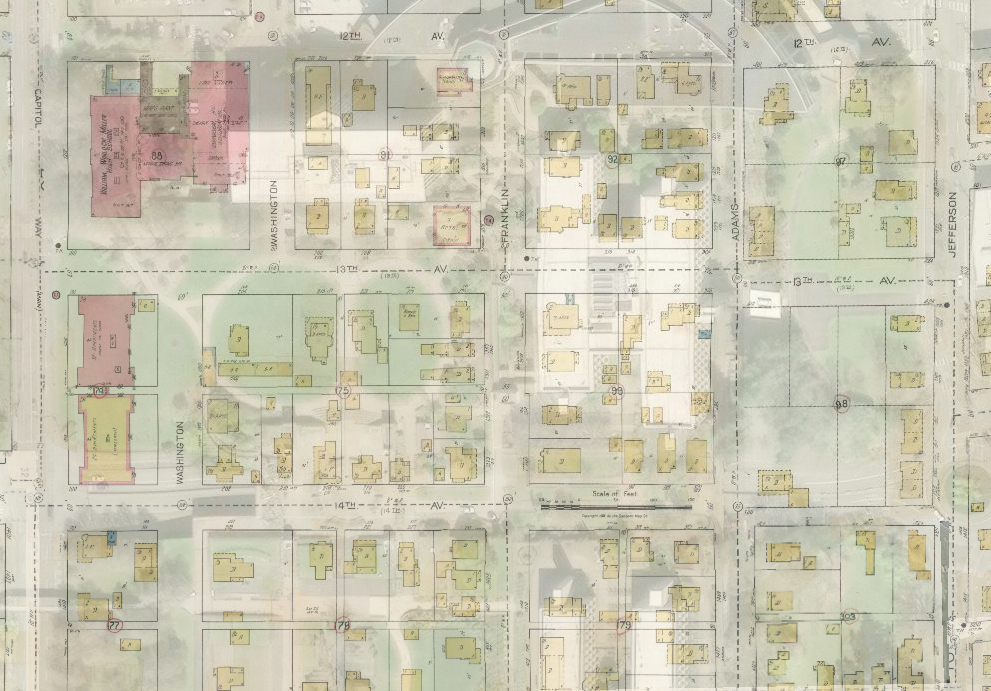
The destruction spanned 18 blocks, bounded by Capitol Way on the west, Jefferson on the east, 11th on the north, and Maple Park on the south. This is now the collection of state office buildings across from the Capitol Campus proper. The neighborhood included a rich tapestry of density that Olympia today desperately tries to rebuild: no fewer than six apartment buildings (two with over 30 units), duplexes, the Girl Scouts clubhouse, and at least one store.

It was also the second location of William Winlock Miller (aka Olympia) High School. The state’s appetite for land here was so great that this was the second time the expanded Capitol Campus displaced Olympia High School. The original Olympia HS was on Water Street, a location that no longer exists but was roughly between the diagonal drive and the big old oak by the Sunken Gardens.

The catalyst for this violence was not a coal vein running out, but a court case: State ex rel. Lemon v. Langlie (1954). The ruling, which forced state executive offices to maintain their main offices in Olympia, solidified the city as the seat of government, and in doing so, condemned this residential district.

The Bureaucratic Weapon

The killing wasn’t a sudden demolition; it was a long, cold administrative death. The original buildings: Highway Licensing (1961), Employment Security (1961), and Archives (1964) came first. But the real destruction happened in the 1970s, after the city eliminated the historic cross-streets by vacating rights-of-way in the mid-1960s.

This is the big deal. You can build around a neighborhood; you can’t sustain a community once its streets have been wiped off the map. Ironically, the original right-of-way for 12th Avenue still exists, running straight through the 1991 Natural Resources Building. The built environment was literally erased.

In the 1960s, the state set out to take over 75 properties. The struggle put a human face on the process through the saga of Roy H. Bergh, 77, and his wife Leila, 72. The Berghs resisted the state’s efforts for about 13 years, leading to a prolonged legal battle involving condemnation and, ultimately, their eviction and jailing in 1973. They felt the state had “stolen” their property. The land they went to jail for is now part of the northern flank of the Natural Resources Building, at what used to be the corner of 12th and Franklin.

This ideological erasure was compounded by massive infrastructure projects that completed the destruction. Interstate 5 was constructed along the back edge of the neighborhood, and Plum Street was expanded via Henderson Boulevard into Southeast Olympia. We can’t overstate how radically this shifted access, suddenly, getting into that end of town by car mattered more than moving through the old city grid. While citizens voted to save Watershed Park in 1955, just five years later we were putting a road through it on the way to the third Olympia (William Winlock Miller) High School.

The Brutalist Betrayal

The final product, designed in the 1970s, was a monument to the state’s ambitions, and it failed to provide value to Olympia.

What we have now was designed in the Brutalist tradition, characterized by austere, monolithic concrete forms and monumental scale. This architecture prioritizes power and control over human-scale interaction and community. The new East Campus, most notably the manically vaguely named “Office Building 2” (1975) and the massive underground garage (1975), which famously began leaking almost immediately, was a policy failure if the goal was to create a human-scaled, useful addition to the city.

The creation of the East Campus shifted the center of civic life (the high school) to a contested border with another city (Tumwater) and promoted the development of car-centric districts, reinforced by millions of dollars in bonds for parking facilities.

The result is a landscape largely divorced from human use or utility: massive, useless expanses of lawn that no one occupies; a long stretch of Capitol Way with no sidewalk on its east side; and the bizarre arrangement of walkways threading around the buildings.

This is a space most often transited rather than enjoyed. Protests happen across the street at the Legislative Building. Community events take place downtown or around Capitol Lake. This is a broad civic space that no one uses, or even thinks about, unless they’re forced to inconveniently walk through it because they parked somewhere else.

Around OB2 and the Natural Resources Building, paths curve toward nowhere. A grand staircase ends in grass. Rounded walkways circle a vestigial OB2 entrance along Jefferson.

This area was supposed to be the beginning of “Ceremonial Drive,” a road that would have snaked around the buildings near where the Natural Resources Building now stands and where the old courthouse (now Capitol Court) remains.

What did we lose for that odd arrangement of nothing on Jefferson? Five houses and four duplex units. The East Campus is the grandly designed version of a exclusively zoned single family neighborhood. Nothing in walking distance, so if you leave your house on foot (or accidentally walk through East Campus) it is only for the act of walking, not going anywhere there.

Tono taught me that losing physical structures isn’t the same as losing history, you can reconstruct the past from afar. But the East Campus teaches something else entirely: some change is an ideological act of violence against history.

I’m not arguing the neighborhood should have been frozen in time, or that the state shouldn’t have expanded. But this neighborhood was never allowed to evolve. Today, state offices are at least expected to weave into neighborhoods, imperfect as that system is. The East Campus, by contrast, was simply killed, wiped off the face of the city.

And I point this out without irony as residents of the South Capitol Neighborhood fight a pitched battle against legislative-centric businesses expanding into residential homes, that they were the original target of campus planners’ expansionist ambitions.

Before heading east, the proposal envisioned a southern expansion of the campus. More than 20 acres of the South Capitol neighborhood would have been razed and replaced with new government buildings, along with a rounded road system that would have largely replaced the existing street grid.

But we all know how this ended. The campus expanded east, not south. Instead of annexing a more affluent neighborhood, the state razed a more middle-class community on its eastern flank.

You can’t stand today in the middle of this vast, empty expanse and pretend the past is intact. But because the architecture and landscaping are so empty and silent, the history still exists, in the sad story of the Berghs, the memories of the high schoolers, and the ghosted street grid beneath our feet. The built environment is not the memory. And thank goodness, because in this case, the builders made sure the built environment was a lie.

Tono, actually

One of the historic rabbit holes I’m prone to falling down is the lost cities in Washington State. I don’t mean ghost towns, because some of them, like Tono in southern Thurston County, don’t exist at all anymore.

Over the years, I’ve tried to pinpoint exactly where Tono was located. Recently, I was looking at the parcel layer (the map showing property boundaries) in southern Thurston County (as I’m sure we all do from time to time), just below Bucoda. And, I noticed a long, skinny parcel that, to me, indicated a road or a railroad was once there.

So, I went back and found a fairly decent map of Tono that included a train line. The train line’s contour matched the parcel’s shape, and it lined up nearly perfectly.

This is the best I’ve been able to produce of how Tono was laid out.

This is significant because the landscape of Tono disappeared when mining techniques changed after the town itself was abandoned.

In 1969 coal mining in the fields around the Tono site was revived when the Pacific Power and Light company bought the land and built a new steam plant to produce power. It was during this era that the Tono site saw its largest change. The ground on which the town had sat was scraped up in order to get to the coal beneath it. The coal mining terraforming was so severe that the town site is currently dominated by two massive ponds.

For decades, Tono had been a fairly significant town in Thurston County, on par with Yelm, Tenino, and Tumwater. But because it was a company town, when the resource ran out, the town itself ran out of reasons to exist.

What I keep coming back to is how completely Tono was erased. There was no fight over historic districts, no argument about “character,” no committee meeting where someone insisted their grandfather once lived in a particular house and demanded the coal company spare the building. The ground was literally peeled back; the past scraped away to get at what the land still had left to give. What’s left now are ponds big enough to swallow the entire town grid.

And yet, somehow, Tono survives.

Tono survives in census tables, photos, mining reports, and the stubborn curiosity of anyone who has ever tried, like I have, to find the ghost of a town that isn’t even a ghost.

It’s funny: we spend so much energy today trying to keep the past standing upright. We landmark houses whose only real significance is their ability to slow down a duplex development. We wrap ourselves around “character” as if it were a fragile antique rather than something living communities constantly renegotiate.

Tono is a lesson in impermanence so complete I can’t help but be amazed. An entire town, just gone.

Two ponds where families once lived. You couldn’t “preserve” Tono if you tried; the coal company settled the question half a century ago. And yet, that doesn’t make it any less historical. If anything, it makes it more so. Tono forces you to engage with history as a process, not a museum exhibit. You can’t stand in the middle of a preserved streetscape and pretend the past is still intact, because the flow from the past to today is change. Change even includes the scraping of an entire landscape until there is nothing left.

You have to reconstruct it. You have to work for it. And there’s something freeing in that.

The lesson of Tono, the one that historians, preservationists, and anyone who loves their community ought to sit with, is that losing the physical stuff isn’t the same as losing the history. The built environment is not the memory. The map I matched by lining up an old railroad grade with a weirdly long modern parcel tells me more about Tono’s rise and fall than any building would. The ponds tell a truth the hardware store never could: the town’s existence was always dependent on what lay beneath it.

We forget that history is supposed to breathe. Towns grow, plateau, disappear, reappear in footnotes, and get rediscovered in GIS layers. Some places make it. Some fade. And sometimes the fading is the story.

Tono reminds me that you can lose every house, every street, every trace of a community’s physical presence, and still have history worth knowing. You don’t need to encase it in glass to make it matter. You don’t need to keep a structure standing to let the story breathe.

From Wheelmen to Highways to Bike Lanes: Olympia’s 130-Year Loop

On more than one muddy Saturday in the 1890s, groups of Tacoma bicyclists pedaled south toward Olympia, only to turn back in frustration. The road between Nisqually and the capital was a slog, a stretch so notorious that “weekend wheelmen” abandoned their plans rather than push their gleaming new safety bicycles through miles of muck.

For decades, Olympia had already endured the political humiliation of defending its status as the state capital against the ambition of cities Tacoma. So to have Tacoma cyclists literally turn up their noses at the condition of the road to Olympia? For men like Dr. P.H. Carlyon, that was simply too much. If the state capital was going to command respect, it needed passable routes. If the county wasn’t going to build them, Olympia’s elite would do it themselves.

Thus began the first organized effort to construct bicycle paths in Thurston County.

The Bicycle Craze Reaches Olympia

The 1890s bicycle boom wasn’t unique to this region; it was a national mania. The safety bicycle, with two equal wheels, a chain, and pneumatic tires, transformed cycling into a middle-class pastime. By 1897 the U.S. was producing up to two million bicycles a year; by 1900, as many as five million Americans owned one.

As crazes sometimes take a while longer to reach us, Olympia’s residents were still no exception. While the nationwide fascination of bikes crested in 1896, in 1897 we formed the Olympia Bicycle Path Association, which grew into the Thurston County Bicycle Path Association by 1899. The membership rolls read like the social directory of the era: physicians, businessmen, former territorial officials. This was not a club of hobbyists, it was a political organization capable of getting things done.

Building the First Bike Network

The Association’s work didn’t focus primarily on city streets. Olympia’s dirt roads were rough but rideable. Most of their work was on the countryside. The challenge wasn’t commuting; it was leisure. Riders wanted smooth, scenic routes to Woodland (now Lacey), to South Bay, to Tumwater, to Little Rock, and even toward Nisqually, where a connection to Tacoma awaited.

Several projects stand out:

  • Franklin Street Path (1899): Construction began in May and marked one of the first formal, graded bike facilities in Olympia.
  • Little Rock Path (1899): Completed by July and praised as a “splendid path,” it demonstrated the Association’s ability to finish large, coordinated works.
  • Olympia–Tumwater Route: Following Cleveland Avenue to Custer, this corridor provided one of the most useful regional connections.
  • Olympia–Nisqually Path: A bold link aimed at stitching Thurston County into the broader Puget Sound biking network.

In a sense, these paths were the 1890s equivalent of mountain bike trails or ski slopes, recreational amenities more than transportation necessities. Their funding and maintenance depended entirely on public enthusiasm to pay a fee toward the path association. So when the bicycle craze collapsed around the turn of the century, the paths faded too. By 1901, the association was effectively defunct.

But for former association president P.H. Carlyon, his few years of advocating for bike path construction set him up for his career defining task.

Carlyon’s Next Act: From Wheelmen to Earthmovers

Dr. P.H. Carlyon had been the president of the Bicycle Path Association in 1898. Just over a decade later, he would become mayor of Olympia. And from 1910–1911, he oversaw one of the largest landscape transformations in city history: the Carlyon Fill, which used more than two million cubic yards of dredged material to reshape what is now downtown Olympia.

In 1913, Carlyon was elected to the state legislature, where he became one of the driving forces behind Washington’s early highway system. Long before the interstate system, Washington built an ambitious network of paved highways connecting cities, routes like Martin Way and Capitol Boulevard that we now take for granted.

It was Carlyon, the former bicycle-path enthusiast, who championed the funding, engineering, and political will for this transformation.

The irony is almost too perfect: the man who once built bike paths so Tacoma riders wouldn’t mock Olympia eventually built the paved roads that would help bicycles vanish from everyday use.

Why the Early Highways Stuck—and the Bike Paths Didn’t

The bicycle paths of the 1890s died because they were built for fun. Highways, on the other hand, were built for commerce, growth, and a modern identity. People had traveled between cities by boat or train. Paved highways were a radical new form of freedom and a new type of economic infrastructure.

Once the state invested in roads, every subsequent decision reinforced the automobile’s dominance. Land was platted for cars. Businesses oriented their entrances around them. Neighborhoods sprawled out to follow them. By the mid-20th century, the original bicycle network was not just forgotten, it was unimaginable.

Today, we can’t picture tearing up paved streets and going back to gravel. The world Carlyon helped build is so complete, so normalized, that even questioning it feels disruptive.

Now, more than a century later, Olympia is again working to expand bike infrastructure. But today’s bike lanes aren’t recreational corridors stretching into the countryside. They’re transportation, intended to help people move within the city, through the very corridors Carlyon and his peers carved out for cars.

Confusion wins

This is a second blog post reflecting on some of the meta-lessons that came out of local elections in Thurston County this year.

The New York Times recently ran a story about how The Stranger sets the tone in Seattle politics. This is not breaking news for anyone who has watched Seattle politics for the last two decades.

The secret is simple: The Stranger shows up. It is consistently present, consistently relevant, and consistently part of the political conversation.

On a recent episode of The Olympia Standard, campaign consultant Rob Richards talked about the failure of the Workers’ Bill of Rights and how the yes campaign faced an uphill battle from the start. The opposition narrative was already circulating almost a year before the campaign really got rolling. And he’s right. The first public attention the idea got wasn’t from the campaign; it was from a flare-up of misinformation about a possible minimum wage increase more than a year earlier.

The campaign eventually launched with a petition drive last spring, but real messaging didn’t start until August. And in a town with fewer than half a dozen full-time local reporters, what earned media campaign can you realistically run? There simply aren’t enough people covering local government closely or consistently to help counter a false narrative once it takes hold.

We saw this same dynamic in the Regional Fire Authority vote a few years ago. The JOLT, in particular, published a lot of stories leading up to the election that, while not necessarily inaccurate, clearly shaped the public conversation. The RFA election became a turnout election. The precincts that voted “no” were the ones where people just didn’t vote at all. Many voters were confused, caught between the campaigns’ messaging and the churn of coverage and commentary on social media. Faced with confusion, they defaulted to the “safe” choice: not voting or voting no.

I’ve heard some fair criticism that JOLT’s model (reporters overseas watching meetings remotely and writing from the recordings) made it difficult to provide the broader context of why the RFA mattered. That coverage tended to highlight debate and points of disagreement, because that was what stood out in public meetings. Without interviews, on-the-ground sourcing, or deeper reporting, the coverage didn’t really capture the larger picture of why the RFA might be beneficial. That isn’t a slam on the reporters; they were doing the best they could with limited resources and time.

Could the cities or RFA supporters have engaged more with JOLT? Absolutely. But it’s also fair to say that the resulting coverage skewed toward highlighting the questions and the drama, not the underlying case for the proposal. That imbalance, born from limited capacity, not ill intent, helped create confusion.

And that’s the common thread between Proposition 1 and the RFA: a negative discussion, powered by limited local reporting and social media algorithms that amplify emotional scepticism, grew in the absence of steady, contextual information. Confusion became the common voter experience, and in low-turnout elections, confusion is fatal.

What we need is clarity.

I generally appreciate news coverage. I’m not someone who gets angry every time a reporter writes something that makes a campaign uncomfortable. But we have to be honest about something: in a community with shrinking traditional media, campaigns still spend money on mailers and consultants and ads. But aren’t investing in the thing that makes campaigns possible in the first place: local media.

There’s been a lot of talk about how much the Prop 1 campaign spent on signature collection and basic campaign work. But how can complex, structural policy changes succeed when there isn’t a consistent media presence helping the public understand them? A community cannot hold informed elections without informed voters, and voters don’t have the time or energy to attend every meeting, read through every governing document, or fact-check every post on Facebook. That’s what journalism is for.

Which brings us back to The Stranger. It is only one outlet in a city that still has a relatively healthy Seattle Times. KUOW spends a significant amount of airtime on Seattle politics. Smaller niche outlets like PubliCola and The Urbanist also contribute to the political conversation. But for capturing the mood and narrative arc of Seattle politics, The Stranger is uniquely powerful, not because it is perfectly neutral, but because it is present, consistent, and willing to frame debates with a point of view.

In Thurston County, with so few journalists, coverage is often reactive. Journalism focuses on the easiest available material: summaries of meetings, recaps of official statements, and the occasional story on a high-profile incident. There isn’t enough capacity for the proactive, explanatory reporting necessary to unpack something like a Workers Bill of Rights. And when a reporter tries to be fair in that environment, “balance” can easily look like “There’s a real debate here,” even when one side is working with a year-long head start fueled by fear, confusion, and online misinformation.

Without sustained reporting, balance becomes ambiguity. And ambiguity becomes a “No” vote.

The absence of robust journalism means our community lacks the civic infrastructure necessary for democratic decision-making. The cost of a policy failing, of housing going unaddressed, fire services going unfunded, worker protections never advancing, is far higher than the cost of supporting journalism that helps voters understand what’s at stake in the first place.

If campaigns can’t count on local media to provide that clarity, then some of that investment needs to shift. Local media is not optional. It is foundational civic infrastructure. Until we treat it that way, we will keep re-running the same story: big ideas, complex policies, passionate campaigns, and a confused electorate that never gets the chance to truly understand the choice.

It matters how we talk to each other, but it matter more where we talk to each other

Recently, I came across three interesting, overlapping stories about how government communicates with us. Each highlights tensions between joy, seriousness, and the incentives built into social media.

1. During the 2025 legislative session, the House Democratic Caucus (HDC) developed content described as having a “man on the street” perspective. The Legislative Ethics Board recently ruled against it.

Examples include:

  • March 17, 2025: A post featuring Rep. Zahn asked, “What music pumps you up?”
  • January 24, 2025: A post directed to Rep. Leavitt asked, “What is your go-to coffee order or snack during session?”
  • January 24, 2025: The caucus asked several legislators, “Describe your district in three words.”

These posts, along with others highlighting personal journeys, were criticized in a complaint suggesting these “puff pieces” were more appropriate for campaign materials than official social media posts. The Board concluded that the posts violated state rules on the use of public resources for campaign purposes because they lacked a legislative nexus.

Here we see a small example of harmless, joyful content being shut down simply because it was in the wrong bucket.

2. Meanwhile, the Center Square took a highly critical, detail-heavy approach toward similar content developed by the state Attorney General’s office. At first glance, the video was actually fun. Yet the criticism focused on the AG “wasting time” on a light-hearted video while other office issues demanded attention. It’s almost like the NFL cracking down on harmless end-zone celebrations: nobody is hurt, it’s just joy.

The broader lesson is that on official government channels, we’re expected to be serious and not have fun. This expectation exists despite the consistently creative, people-focused work the Department of Transportation produces every week.

3. By contrast, other officials use the cloak of “unofficial” channels to abandon even the pretense of harmless fun. State Representative Joel McEntire’s Facebook activity illustrates this clearly. While he previously claimed an unauthorized party ran a Twitter account in his name, he now openly manages his personal Facebook page.

Occasionally, he posts serious political content, but more often he engages in highly partisan and aggressive behavior, echoing the divisive rhetoric seen at the federal level. This includes ad hominem attacks, inflammatory comments (like suggesting a political opponent “needs to burn”), and calls for a boycott of a community activist’s business. One target, local activist and business owner Kyle Wheeler, recalled McEntire calling him a “pansy boy” and “delicate flower boy” in 2024—even while acknowledging Wheeler’s community work.

McEntire’s self-proclaimed “unofficial” page status, along with his title of “Chief of Mischief,” has allowed ethics complaints to be dismissed, since the Legislative Ethics Board lacks jurisdiction over personal accounts. Yet his behavior has drawn public criticism, including from a self-identified Republican who called it “childish insults” and an “embarrassment.”

How do we let ourselves be free?

These are small examples in Washington State, but they illustrate a broader trend: social media algorithms giving us different social incentives, and our institutions are not equipped to respond. The decline of local journalism, combined with attention-maximizing algorithms, means our online environments amplify the worst content.

As much as I respect the Project on Civic Health’s efforts to encourage civility, it’s not enough to ask people to control their own behavior. Smoking cessation is one thing; addressing the industry that created the addiction is something else entirely. Social media is designed to maximize attention, often at the expense of civility and community. People like McEntire are using these platforms exactly as intended: stoking outrage, drawing attention, and triggering the emotional rewards built into the system.

Real-world communities thrive on politeness, modesty, and small gestures of mutual care. Online platforms operate in almost the opposite way: they reward conflict, outrage, and self-promotion, which amplifies hate and division. This environment contributes to rising loneliness, anxiety, and mental distress, especially among young people.

Social media can be addictive, much like tobacco, and increased use correlates with worse mental health. Platforms are designed to keep users engaged, making regulation and conscious limits essential to prevent long-term harm.

I’ve been critical of school districts that adopt phone-free policies under the guise of student mental health when the real goal is classroom control. If schools were serious about the impacts of social media, they would ensure their own communications teams weren’t actively posting on spaces that are demonstrably harmful. They have not.

And there’s a reason for this: that is where the people are. We are trapped in a system where some people are finger-wagged for being “not serious” on official channels, while others are incentivized to be the worst versions of themselves on unofficial channels because it works. Meanwhile, serious communicators are stuck posting on platforms that reward outrage.

Kelly Stonelake captures this trap very well here.

The network effects are real. We can’t leave until enough of our actual friends, people we love, leave first. I’ve experienced this myself. I put Meta platforms on pause earlier this year, but returned because of the deaths of two men in my life and the need to connect with people during my mourning period. I could not fulfill my duties as a friend without the platform and the network. And now, I’m even raising money for Movember there because I couldn’t find another way to do it.

A step forward

One thing government could do is explore self-hosted, ActivityPub-powered social media. This idea had some momentum but seems to have stalled. Technically, it’s straightforward, and a handful of governments have experimented with it.

The first step in countering harmful network effects is to build a new network. Putting official government communication on a platform that no corporation can ever own is a vital first step toward reclaiming civility, community, and public trust.

Because yes, it really does matter how we talk to each other.

All Politics Is Local, All Politics Is Complicated

It’s the Saturday after Election Day, and I’ve been thinking about why people don’t vote in local elections. The answer, I think, is baked right into how local politics works, and how we talk about it.

Earlier this week, KUOW aired a “Sound Politics” episode that tried to untangle one piece of that puzzle: why school board elections in Washington are so confusing. It was a fascinating conversation about how state law allows school districts to run elections differently, but it got tangled up in language, using “city” and “school district” as if they were the same thing.

In Seattle, for example, school board candidates must live in specific “director districts,” but every registered voter citywide gets to vote for all of them in the general election. This unusual system exists only because Seattle’s population tops 400,000, a threshold that triggers a special rule in state law. Smaller districts like Highline and Tacoma operate differently.

It’s a great civics lesson, but also a perfect example of how confusing our systems can be. One of my broader theories about elections is simple: if people don’t understand the choices in front of them, they often just don’t vote. When confusion is built into the very structure of our elections, turnout doesn’t just sag, it sinks.

What bothered me about the KUOW piece wasn’t the reporting, but the terminology. Mixing up “school district” and “city” only deepens the public’s misunderstanding. I’ve seen this confusion play out locally in Olympia, where the city, the school district, and the port district all share the same name but have completely different boundaries. In Seattle, it’s even more complicated: the school district’s governance depends on the city’s population, even though the two are technically separate entities.

This is a microcosm of a much larger problem: state law makes local government more complicated than it needs to be. And that complexity collides with how we communicate about elections, especially in odd-numbered years when only local offices are on the ballot.

Another Sound Politics episode this week encouraged listeners to send it to “procrastinating voters.” It was a nice idea. Except that, unless you lived in the 26th Legislative District, Seattle, or King County, only one segment of the show actually applied to you. Even within those areas, it covered just a fraction of what was on people’s ballots.

That’s not a dig at the reporters, though they might have oversold it a bit (“Send this to someone who hasn’t voted in Western Washington, or, you know, anywhere in Washington…”). The truth is, no local NPR station (even in Seattle) could possibly cover the hundreds of races happening across dozens of cities, school districts, and special districts.

Think of it this way: Bellevue, Kent, Renton, Federal Way, Kirkland, Redmond, and Auburn together have about the same population as Seattle. If election coverage were proportional, those cities together would get the same attention as Seattle. But they don’t. There are simply too many races, so coverage outside Seattle gets rounded down to zero. The result: even more focus on Seattle, even less on everyone else.

And as local print newspapers and radio newsrooms continue their slow decline, the information gap just keeps widening.

The biggest reason people don’t vote locally isn’t apathy (which would be an internal flaw) it’s confusion (caused externally). Don’t blame voters for not turning in ballots, blame the system we’ve created. The system is hard to understand, and the information needed to make sense of it is vanishing.

The Texting Election

This year, I’ve had more friends than ever ask why they’re being bombarded with campaign texts. The short answer: vote, and they’ll stop. If your name is not on a list of people who voted, the campaigns are going to keep on bugging you.

Anecdotally, it seems that local campaign texting is way up. It makes sense. Texting is personal and intrusive, but it’s also cheap. In a low-turnout year, every vote is precious, and traditional media reach is limited. When you’re voting for everyone from park commissioners to city council members, odds are you haven’t heard much about any of them through your normal news sources. So campaigns reach past the media and straight into your phone. It’s not elegant, but it’s effective.

What “All Politics Is Local” Really Means

All of a sudden, there is a popular saying now that “all politics is national.” It reflects how the presidency and federal politics loom over everything. That’s true, to a degree. Since the television era, local election turnout has steadily declined compared to national races.

But when Rep. Tip O’Neill said “all politics is local,” he wasn’t talking about turnout rates. He meant that good politics starts with understanding your community, and connecting those local needs to national decisions.

Rep. Marie Gluesenkamp Perez captured that spirit recently when she said she “just refused to let this race be nationalized. It’s not about the message. It’s about my loyalty to my community.” 

And if you zoom out and look at this week’s results from New Jersey, Virginia, and New York City, you can see that dynamic playing out. Each place faces the same national currents, but each community came up with its own answer.

Simplify the System, Raise the Turnout

If we want better turnout in Washington, we should start by making local government simpler. I don’t have a perfect fix, but I know that when voters look at their ballots and think, *“What the hell am I even voting for?”* those ballots are more likely to end up in the kitchen recycling bin.

All politics is local. But if we keep making “local” this complicated, we shouldn’t be surprised when fewer people show up to participate.

Why Is Eastside Street Like This? A Small History of Olympia’s Streets

Ever wonder why some streets in Olympia seem to stop for no reason, why vacant lots sit untouched, or why a neighborhood feels like it’s divided by invisible walls? These quirks aren’t random, they’re history frozen in asphalt and parcel lines. Take Eastside Street: a road that almost, but never quite, connects southeast and northeast Olympia. Its story is a window into the city’s past, when rapid development, economic booms, and hurried platting shaped the streets we navigate today.

Inspired by Daniel Garcia’s essay, What Do You Think Olympia Should Look Like?, I’ve been thinking a lot about the questions he raises:

Why did that restaurant close? What is that smell? Why hasn’t anything been built on that vacant lot? Why isn’t downtown more bikeable? Why do so many places close by 8 p.m.? Why was the Artesian Well abandoned?

These are questions that local media might usually tackle. But as we’ve seen, between The Olympian and the JOLT, so many of these questions go unanswered. For me, there are tons of them.

I also want to note Daniel’s massive assistance in taking on hosting duties for the city council races this year on the Olympia Standard podcast.

Why isn’t Eastside the main street on… the Eastside?

One of my longest-standing questions has been: Why doesn’t Eastside Street connect the neighborhoods north of the 4th and State corridor with those to the north?

Eastside effectively ends at State Avenue (even though it technically continues north for another block). Puget Street picks up the role of main drive through the northeast neighborhood, a block east of where Eastside stops. So if you want to go from southeast Olympia to northeast Olympia (or vice versa) you have to dogleg down either 4th or State to get from one quarter of the city to another.

It seems like Eastside could have continued north at some point. But it doesn’t. So why not? The answer lies in the plats that make up Eastside along the corridor.

Eastside Street first appears as part of Swan’s Addition to Olympia in 1871, a significant part of the city that lay east of the Swantown Slough, which partially cut off this side of town from downtown Olympia.

As Washington transitioned from territory to full-fledged statehood in 1889–1890, there was a massive surge in development, anticipating population growth and economic benefits of statehood. This boom lasted until the economic crash of 1893. We can trace this history in the explosion of plats filed with the Auditor’s Office between 1889 and 1891.

This is where the heart of the stunted Eastside Street lies. In early 1889, still months before statehood, the Van Epps and Wiman plat cut off the corridor that Eastside Street in Swan’s plat would have used to connect neighborhoods. Quince Street was recognized in this plat, but Eastside was not.

Months later, the Terrace plat recognized Eastside again — but only partially. An oddly oversized parcel on the south side of this plat (now the site of an apartment complex) disrupted continuity.

Then, just a few weeks later, the College Heights plat north of Terrace included an Eastside Street, but slightly off-center from Terrace’s. , So, even if Eastside had connected through Van Epps and Terrace, it would include the strangely inconvenient dogleg. I suspect this was a result of the rapid pace of development in the year following statehood: planners simply didn’t coordinate across plats.

It is also worth noting that, Swan’s Addition in 1871 also didn’t connect directly to Van Epps; it ended at the current Legion Way. It wasn’t until the McLenndan (1905) and Pattison (1901) plats were laid out that Eastside finally met Van Epps.

This detail of an 1890 map of Olympia during the post statehood boom gives you the proper context of the Eastside route and the land it. Lying right in the middle is Van Epps.

Addressing the possible punch through?

But what if nothing had ever been built where Eastside terminated at Van Epps? Why didn’t later planners just punch a road through to Terrace?

Looking at the current parcel map, it seems like there’s an opportunity to “punch through” Eastside. The current house at 1032 Olympia Ave NE, was built in 1940, might give the impression that we had decades to finish the street. But that home replaced an earlier one, meaning the corridor was never fully clear. The most convincing evidence is from Brian Hovis’ presentation of the Sanborn maps at OlympiaHistory.org. There you see a residential house on the 1908 map.

Lessons from Eastside Street

So what do we take from the story of Eastside, in a “why is Olympia the way it is” point of view?

People weren’t paying attention in the pivotal year of 1890. While Eastside shows up in some plats, it doesn’t appear in all, making continuous construction impossible.

Rapid development and platting ignored overall city planning, in this case. What might seem like an odd street today is the product of historical accidents, economic cycles, and fragmented decision-making. Many of the plats you see before the invention of car-centered, cul-de-sac development took into consideration the square block alignment of the city, to ensure an orderly development of the city. But this time it didn’t.

Civic apologies and understanding you have a problem

Move your feet

When you’re playing defense in soccer and find yourself reaching to poke the ball away from an attacker, it’s a good sign you’re standing in the wrong spot. It’s time to move your feet.

A few years back, I was reminded of the three parts of a good apology because of the falling down the stairs act Lakefair was performing.

It basically goes like this:

Acknowledge and express your feelings: State what you did and how you feel about it. Go beyond a simple “I’m sorry” to show that you’re truly sorry, horrified, or disappointed in yourself.

Validate the harm you caused: Name the damage and explain how you understand it affected the other person. This shows you were listening and gives them a chance to correct your understanding. Don’t police their reaction.

Offer a plan for change: Explain how you’ll make sure it doesn’t happen again with real, concrete steps. Instead of saying, “It won’t happen again,” say what you’ll do differently next time.

The Capital Lakefair organization was stuck at Step 1 of a true apology because their public defenses focused on rules and blame-shifting, not on acknowledging the public’s pain or anger.

For this situation to turn around, the leadership needed first to listen, not just to those who were “yelling,” but to the broader perspectives around them. They needed to realize this was about what they did, not how they were being talked about. To quote Aaron Sorkin in The Newsroom, they had a PR problem because they had a real problem.

As predicted by the “Markets are Conversations” principle, public outrage demands a two-way dialogue. If everyone is yelling, the organization is in the wrong place in that conversation and needs to move its stance (and its actions) to move forward.

I was reminded again of these principles when I read “The Ritual of Civic Apology.”

It’s a great read. In short, Beth Lew-Williams explores the recent trend of Western U.S. cities offering belated formal apologies for the historical expulsion and mistreatment of their Chinese residents. She questions the sincerity, effectiveness, and intended audience of these gestures. After visiting Tacoma and a couple of California cities, she concludes that these civic apologies don’t reach full reconciliation. Whatever wound was left hasn’t been healed by performative apologies. Most barely make it past Step 1 (acknowledging the wrongdoing) without fully naming the harm or committing to real repair.

And what are reparations, if not repair work?

That’s why I’m glad the City of Olympia is studying reparations. I sat down with Mayor Dontae Payne recently to talk about the work Olympia is exploring. One of the things we discussed was the basis of Washington’s Covenant Homeownership Program.

Washington State, like many places, used racially restrictive covenants to exclude nonwhite residents from certain neighborhoods well into the 1960s. Even after they were ruled unenforceable in the late 1940s, new covenants were still being filed in Thurston County right up until open housing laws were passed following the assassination of Martin Luther King Jr. According to the University of Washington, covenants in Thurston County featured harsher-than-normal language, seemingly to make a point.

The Washington Covenant Homeownership Program was created to help repair the damage caused by decades of racist housing policies like restrictive covenants. It helps first-time homebuyers from communities historically shut out of homeownership by offering zero-interest loans for down payments and closing costs. To qualify, buyers must have moderate incomes and be descendants of people who lived in Washington before 1968 and were harmed by those racist housing rules.

Unsurprisingly, a lawsuit was filed to overturn the program by a conservative organization arguing that it’s discriminatory because it limits eligibility by race, calling it “using racism to fix racism.”

And this is where the ritual of civic apology meets the real world of government finance, legal interpretation, and political will. The harm caused by restrictive covenants (and by zoning choices, biased policing, and other forms of institutional racism) continues to ripple outward. Acknowledging the harm is only the first step. We still struggle to unpack and address the deep, systemic causes.

We always have to be ready to move our feet. Because even as Lew-Williams rightly wonders who these civic apologies are really for, it’s clear to me who should be doing the Sisyphean work of building complete ones. It’s us, those of us here now, who benefited from decades of racist systems.

A framework for approaching racial reparations here should begin with the commitment to give people what they are due and to repair harm done to the broader human community. Justice, rightly understood, is not about assigning guilt to individuals but about restoring balance where it has been lost. The frame for us should be, when one part of the community suffers, the whole is diminished. Addressing historical wrongs, then, is not an act of division but of maintenance.

Sound policy must be grounded in reason and clear-eyed understanding. This is why the work Lew-Williams describes is important, but incomplete. Repairing deep, generational harm isn’t about emotional performance or political convenience. It needs patient study, honesty about causes, and deliberate, thoughtful action. The goal is to act rightly moving forward. To understand we’re in the wrong spot and move our feet.

Smith Troy, Trump and Telling the Truth

We’ve all heard President Donald Trump call the press “the enemy of the people.” Over the course of his terms, he repeatedly attacked news organizations as “fake,” “corrupt,” and even suggested some were engaged in illegal activity.

Beyond insults, he openly questioned the constitutional protections that shield journalists, including the landmark New York Times v. Sullivan precedent, and proposed “opening up our libel laws” so politicians could sue and “win lots of money.”

His rhetoric and actions exemplify a long-standing tension in American democracy: the fragile balance between government power and press freedom. Yet this struggle is far from new, and it is not new here at home. Nearly a century ago, in Thurston County, local politics intersected with criminal libel laws in a way that foreshadows today’s conflicts.

The story begins in November 1938, when Thurston County Prosecuting Attorney Smith Troy filed criminal charges against three men: Ray Gruhlke, Lester Main, and George Johnson. He accused the defendants of distributing handbills that allegedly defamed Troy and his brother Harold, who was an assistant county prosecutor. The charges contended that the statements were malicious and intended to expose the Troys to “hatred, contempt, ridicule, and obloquy,” depriving them of public confidence, consistent with the criminal libel statutes of the time.

Almost immediately, questions arose about the integrity and motives of the public officials involved. The circumstances of the arrests suggested potential overreach, and critics argued that the case may have been politically motivated to protect the interests of Smith Troy while undermining his opponents. Affidavits from law enforcement contained conflicting accounts of the arrests, raising doubts about the accuracy and impartiality of the official record. The court initially denied motions to appoint independent attorneys to investigate the charges, further highlighting the potential for bias. The case only began to take a more credible direction once a Special Deputy Prosecuting Attorney, Harry Ellsworth Foster, was appointed to replace Smith Troy, whose personal involvement as the alleged victim created an obvious conflict of interest.

Over the next several months, the Special Prosecutor’s investigation revealed that the alleged libel stemmed largely from confusion over incomplete court records. The handbills pointed to cases that the Troys were apparently prosecuting improperly, but the cases referenced in the pamphlets had been transferred, and the inconsistencies were clerical rather than malicious.

The defendants admitted their errors, tendered apologies, and Troy accepted them. By May 27, 1939, the court dismissed the case, noting that the controversy had prompted reforms to ensure future records were clearer and less prone to misinterpretation.

The Thurston County case cannot be fully understood without situating it within the broader legal context. Smith Troy would not have been able to pursue charges without statutes defining libel broadly as any malicious publication exposing living or deceased persons to hatred or contempt, or injuring any person in business or occupation. A person could be prosecuted even if the statements were true, unless published with “good motives” and “for justifiable ends.”

By the 1930s, criminal libel prosecutions had become rare, yet the statutes remained on the books through 2009, offering public officials like Troy a tool—however rarely used, to protect reputations through criminal law.

The law’s overreach and constitutional vulnerabilities became clear in 2008, when the Washington Court of Appeals struck down the criminal libel statute as facially unconstitutional. The court held that it violated the First Amendment because it punished false statements without requiring proof of actual malice and, paradoxically, could punish true statements lacking “good motives.” The legislature formally repealed the law in 2009. Modern statutes surrounding protection orders have partially revived criminalized libel in limited circumstances, primarily to address harassment and repeated false statements made with malice.

The Smith Troy case illustrates how criminal libel statutes historically empowered officials to suppress criticism, a temptation not lost on modern politicians. Trump’s attacks on the press echo the same impulse: using legal threats, regulatory power, and public shaming to undermine journalists and chill reporting. Unlike Thurston County in 1938, Trump operates on a national stage, with the ability to influence federal agencies, control access to government events, and challenge the judiciary’s interpretation of defamation law.

Yet the comparison also highlights both the fragility and resilience of press freedom. In Thurston County, the appointment of an unbiased Special Prosecutor and the eventual dismissal showed that legal checks, due process, and transparency can constrain abuses of power. Today, protections like New York Times v. Sullivan perform a similar role, ensuring that even powerful political actors cannot easily weaponize libel law against the press. Without these safeguards, the line between legitimate critique and suppression of dissent blurs, leaving citizens less informed and democracy weaker.

The trajectory from Smith Troy to Trump underscores that the press is both a target and a guardian in any democracy. Laws may criminalize speech, but misuse or selective enforcement erodes trust in both institutions and government itself. Meanwhile, as local news declines and national outlets consolidate, the onus falls more heavily on government to act transparently. A free press alone cannot ensure accountability; officials must make accurate information accessible, clear, and timely, or risk leaving the public in the dark.

History reminds us that power will always test the boundaries of scrutiny. The Thurston County libel case offers a microcosmic lesson: fair process, independent oversight, and transparent government are essential to maintaining the balance between authority and the public’s right to know. Today, as political leaders attack media and propose changes to defamation law, the stakes have moved from local to national. The core principle remains unchanged: the press must remain free to speak, investigate, and hold power accountable, and government must meet its own obligation to be transparent in a media environment that can no longer do it alone.

« Older posts

© 2025 Olympia Time

Theme by Anders NorenUp ↑