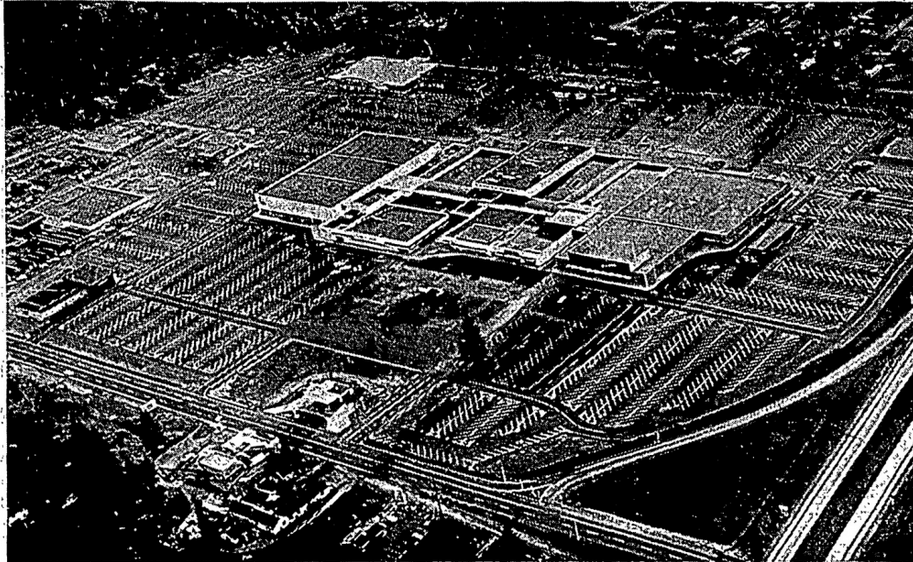
When Bob Blume wanted to build a shopping center on rural land east of Olympia, he knew he’d have to give something away. The interstate had already cut through from Olympia up to Tacoma, and the era of car-based, off-the-cloverleaf retail was here. There was no city off the Sleater-Kinney exit to support a large-scale retail development, but Blume dreamed the mall could one day be the downtown of a new one.
We can forgive Blume for using “downtown” to mean any commercial development surrounded by houses, because Olympia’s actual downtown was being carved up with parking lots at the time.
This week, the old South Sound Center was sold by the family of Bob Blume to a San Diego real estate developer. Blume himself passed away almost 20 years ago, but his legacy transformed Olympia by pulling at the frayed strings of our historic development patterns, tugging us further and further east into an annexation war that would eventually mean the creation of the City of Lacey.
But let’s take a step back 70 years before Blume to the first time anyone thought of building here.
The Ghost Plats and the Railroad
Long before the first shovel struck ground for a department store, the land was known as the New State Addition to Olympia. This massive 34-block neighborhood was laid out in a traditional right-angle grid, with long rectangular blocks, an optimistic monument to the get-rich-quick fever that gripped Washington in the 1890s. These “paper plats” were often sold to distant investors who never realized their property was frequently nothing more than open land. Decades before cars changed how we think of land and distance, there was a dream of Olympia’s blocks stretching east into what is now Lacey.
But when the Panic of 1893 hit, the imaginary wealth and city evaporated, leaving behind ghost plats” streets that existed only in local government records.
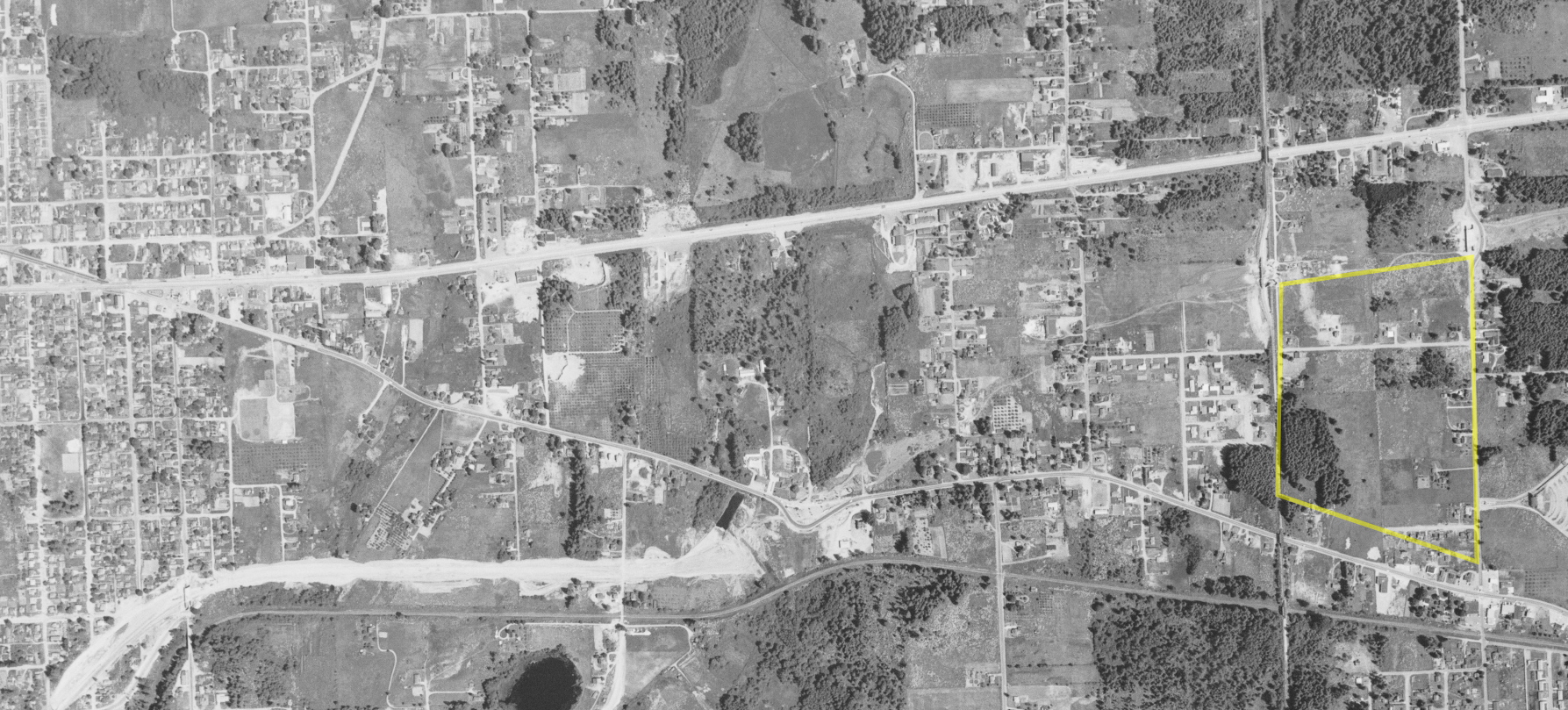
The grid was eventually interrupted in 1936 when Weyerhaeuser constructed the Chehalis Western Railroad, bisecting the New State plat and creating the industrial line that would eventually serve as the western border of the South Sound Center. By the 1960s, these residential blocks were slowly being developed but were still mostly empty, ripe for consolidation. Blume, sensing the shift toward a car-centric society, because we’d literally built an interstate through the northern half of the New State Addition, began buying up and consolidating the old parcels, requesting vacations of roads that would never be built, to construct what he envisioned as a modern downtown for a new community.
The “Father of Lacey” and the Risk of the Big Box
The history of the center is really the personal story of Blume, a man often called the “Father of Lacey.” Born the son of a janitor in 1928, he quit school after the 8th grade to help his family, working jobs that included shoveling coal into boilers. He arrived in the South Sound as a soldier stationed at Fort Lewis and decided to stay after his discharge in the 1950s to sell real estate.
Blume’s vision wasn’t unconventional for the time. Like all other mall developers, he viewed the newly constructed Interstate as a “river of commerce,” where every off-ramp acted as a port for business.
That observation, though, was oddly lost on local financing. When he approached Olympia bankers for a loan, they legendarily laughed at him, dismissing the idea that anyone would drive out to the unincorporated fields of Lacey to shop. Undeterred, Blume secured funding in New York City and set his sights on a major anchor tenant to make the mall viable: Sears, Roebuck & Co.
The corporation’s policy required developers to donate the land for their stores as a condition of building. To secure the anchor he needed, Blume was forced to donate a full third of his land to the company, a sacrifice that made the shopping center viable, drawing in major tenants like Peoples and F.W. Woolworth.
That donation, and the eventual sale of what would become Target, carved up the parcel so the piece sold this week looks more like a jigsaw puzzle.
It was also a direct strike on downtown Olympia. Sears’ move to Lacey was a loss for the city, a sign of the change that would keep transforming downtown as larger national retailers left for Lacey and the Westside, chasing modern buildings surrounded by parking. Downtown adapted, narrowing its focus to smaller local retailers. But the decades of downtown doomerism started with Sears taking free land from Blume.
A Mall as the Mother of a City
The South Sound Center was the final reason for Lacey’s creation, the economic center-of-gravity that physically and politically birthed the city. In the early 1960s, the area was unincorporated and lacked basic municipal infrastructure.
The 1960s were marked by a fierce border war between Olympia and Lacey, triggered by Olympia’s aggressive use of assessed value annexations that moved its boundary east to Lilly Road by 1964. Olympia wanted to protect its retail base after Sears left for Lacey and began eating up land to do it. Lacey leaders resisted, claiming it was because the annexation process often bypassed a popular vote of the affected residents.
Realizing they couldn’t afford to build infrastructure privately, Blume and other local leaders, including A.G. Homann, the South Sound Center’s general contractor, pushed for incorporation, looking to leverage a city’s power to issue bonds for the infrastructure the new mall required. After a failed attempt in 1964, the incorporation effort succeeded in 1966, by a narrow margin of only 240 votes. Homann was sworn in as the city’s first Mayor, the moment the mall’s needs were finally codified into a new municipality.
Lacey’s original successful incorporation actually stretched further west than the current city, pushing past Boulevard Road. Olympia struck back by utilizing an archaic 1890 law that allowed the entire City of Olympia to vote on annexing Lacey’s western neighborhoods. Olympia voters agreed, and lopped that land back into the city. Lacey challenged the move, but the Washington Supreme Court upheld it, permanently shifting Olympia’s border east to its current orientation.
The decade of tension culminated in 1969 with a failed proposal to consolidate the two cities into one, a measure defeated by only 30 votes in Olympia and rejected by a 3-to-1 margin in Lacey.
Surviving
The South Sound Center’s reign as the largest retail area in Thurston County lasted just over ten years. The 1978 opening of the Capital Mall on Olympia’s Westside kicked off what local observers called a “retailing Grand Prix,” and the competition with national shopping center owners who had deep pockets threatened the center’s dominance.
The South Sound Center survived through constant adaptation, including the sale of the middle portion of the parcel to Target and the closure of the mall’s central walkway.
One of the stranger running failures of the commercial community around the mall was the decades-long campaign to rename Sleater-Kinney Road to South Sound Boulevard. It was driven by local businessmen who believed the historic name was hard to spell, hard to pronounce, and irrelevant to the area’s commercial identity. As early as 1967, Blume himself requested the change, a move later backed by the South Sound National Bank and other merchants who wanted the stretch between Martin Way and Pacific Avenue renamed. Jack Lewis, president of the Panorama Corporation, simultaneously proposed renaming the portion south of Pacific Avenue to Panorama Boulevard, dismissing the pioneer name as a “drab” title with no connection to anything in Lacey. \
The proposal met fierce opposition from residents and descendants of the Sleater and Kinney families, who’d homesteaded the land in 1880 and helped clear the original road. The Lacey City Council voted unanimously in January 1981 to keep the original name, and the proponents eventually gave up.
The End of the Blume Era
Bob Blume died in 2007, leaving behind a legacy that had turned a ghost plat into a new kind of city. In a final note on the decline of big box retail, Sears, the anchor that had cost Blume a third of his land but made his vision viable, left the center in 2020, thirteen years after his death.
With the Blume family’s sale of the rest of the property this week, the land where the South Sound Center sits falls out of family ownership for the first time in over 60 years.
The border wars between Olympia and Lacey were fought over neighborhoods that hadn’t been built yet. Southeast Olympia was mostly rural then, Douglas fir stands and open fields. Lacey’s pull toward car-centric commercial space shaped how that land eventually developed, and when we did build houses out here, we built suburbs.
One of the most precise definitions of Lacey I’ve ever heard is that it’s “whatever Olympia isn’t,” and that rings true.
If Olympia is defined by its downtown, then Lacey is the big-box brother, defined by its birth by Blume. The gravity well of Lacey’s car-based commercial development warped the expansion east of Olympia, and what grew out of that is probably our biggest planning mistake.


thank you for this wonderful news story! I love learning about the local history here
Well done as usual ☘️
What a great article. So good to read our history. Lacey resident.