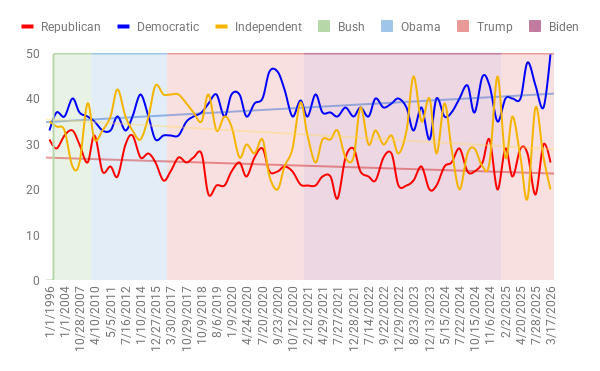
Democratic Party identification in Washington State has hit 50 percent. That’s the highest number I’ve found in over thirty years of polling data.
Because voter registration in Washington carries no partisan label, party identification floats. The only way to track it is through the demographic crosstabs buried in statewide polls, which I’ve been compiling in a spreadsheet. The numbers tell a consistent story: each spike of national tension pulls voters off the independent shelf and drops them, at least temporarily, into one of the two major parties.
Since the start of the current Trump era, Republican identification has ticked up roughly 1.5 percent on average across available polls. Democratic identification has surged approximately 7.5 percent, drawn almost entirely from independents, whose share has contracted by a corresponding 7 points.
We’ve seen this before. At the end of the first Trump administration, Democratic ID jumped 8.25 percent, Republican ID fell 1.2 percent, and independent ID collapsed 14 points. The Biden era ran the current in the other direction, lifting Republican ID by 3.3 percent and Democratic ID by nearly 2, while independents dipped modestly. Independent identification surged during the late Obama years and again after the 2022 midterms, but under conditions of sharp national polarization, that middle ground gets absorbed.
The data itself is thinning out. The Northwest Progressive Institute and Future 42 both release topline results without demographic breakdowns, which limits how useful they are. The Elway Poll, for decades the most reliable regular tracker of Washington opinion, has ended. SurveyUSA drifted out of the market when KING TV stopped paying for polling. DHM Research now appears to be the last pollster doing regular statewide surveys in Washington.
Two things explain what the numbers show. One is the outsized pull of national politics on a state that might otherwise develop its own distinct political character. The other is the internal fracturing that tends to hit any party dominant enough to have no serious external opposition.
How Ireland Explains the Gravitational Pull of the Center
To understand the first one, it helps to zoom out, well out, to late 19th-century and early 20th-century Ireland. I know that sounds like a stretch. Stay with me.
Think of Washington not simply as a blue state but as a distinct political ecosystem caught in the gravitational field of a distant center. When the Conservative Party held power in London, Irish nationalist identity hardened, drawing together urban constitutionalists and rural agrarians, moderate Home Rulers and more radical nationalists, bound by shared resistance to a government they couldn’t control.
Washington Democrats work the same way. The coalition’s internal disagreements over housing density, tax structure, and the pace of reform are real. But under a right-leaning federal administration, those disagreements get pushed aside by a more urgent question: who controls the shield? The state’s 50 percent Democratic identification is a defensive posture built by voters who see state government as their primary buffer against what’s coming out of Washington, D.C.
The British Tories understood this consolidation well enough to try to dissolve it. Their strategy of Constructive Unionism poured infrastructure investment into Ireland and passed local land reforms, betting that solving material problems would defuse nationalist sentiment. It failed completely, because in a highly charged political environment, the practical argument gets swallowed by the symbolic one.
Washington Republicans face the same trap. Campaigns built on local material issues, highway funding, gas taxes, public safety, struggle to gain traction because a vote for a local Republican reads to most voters as an endorsement of the national party. The local argument can’t escape the national frame.
The deeper warning in this parallel is what happened when the moderate Irish Parliamentary Party ran out of credibility. The IPP spent decades telling voters it was their only realistic shield against London, while failing to deliver structural change at home. After 1916, a frustrated electorate abandoned it for the more radical Sinn Féin. Washington Democrats holding a supermajority built on oppositional energy face a structurally similar problem. If the resistance framing outlasts its usefulness without being replaced by durable accomplishment, the coalition fractures from the left.
Mark Reed and the Dominant 1920s Washington Republicans
That fracturing brings us to a closer historical analogue, not Ireland but Washington State itself, a century ago, when Republicans held the dominant position in Olympia and the contradictions of one-party rule were playing out across the legislature.
The parallels are uncomfortable. Then, as now, the fault line ran between institutional consolidators and ideological insurgents. Speaker Mark Reed built his power on a pragmatic economic vision, state-funded infrastructure and modest worker safety nets, that reflected the timber industry’s long-term interest in a stable, functional state. Governor Roland Hartley represented the Old Guard’s hardline fiscal reaction, contemptuous of what he saw as creeping progressivism in Reed’s program. They weren’t fighting over whether Republicans should govern. That was settled. They were fighting over what governing in a one-party state actually required them to do.
Today Jinkins plays the Reed role. Under her speakership the Democratic majority has grown from 57 to 59 seats, and her argument for keeping the gavel is essentially electoral: protect the coalition, don’t hand swing-district members a vote they can’t defend in November. Berg is doing something different. She’s using her position as House Finance Chair as an ideological launching point, championing House Bill 2100’s millionaire’s tax, posting caucus-facing FAQs about it directly on the caucus website, signaling to the party’s progressive base that there’s a leadership path willing to push the supermajority’s power to its limits, whatever the institutional cost.
The geographic echo is hard to miss. Hartley’s factional base was rooted in Snohomish County, where he’d been Mayor of Everett and where the county’s GOP delegation served as the center of insurgent resistance to the Seattle and timber-coast establishment. Berg represents the 44th Legislative District, anchored in Mill Creek and Snohomish. A century later, a challenge to the incumbent legislative leadership is rising out of Snohomish County again.
The immediate timeline mirrors the old primary dynamics. Both Jinkins and Berg are deferring the real fight until after November, each needing first to survive and, if possible, expand in the August primaries. If progressive challengers unseat moderate Democrats this summer, Berg’s path widens. If moderates hold, Jinkins retains the leverage.
The Dominant Party’s Dilemma
What the polling data, the Irish parallel, and the Jinkins-Berg contest all point to is a single underlying condition. In Washington State in 2026, the most consequential political battles aren’t happening between the two parties on the ballot. They’re happening inside one of them.
The Democratic Party’s 50 percent identification reflects real voter consolidation against a hostile federal administration. But consolidation built on opposition is temporary. It depends on the threat remaining vivid, the alternative remaining unacceptable, and the dominant party delivering enough at home that its internal factions have more to lose from breaking ranks than from holding together. None of those conditions is guaranteed.
History is pretty consistent on this point. The Irish Parliamentary Party learned it after 1916. Washington Republicans learned it in the Depression. The question for Washington Democrats is whether the current leadership, whichever faction wins in November, understands that while Democratic Party ID has been growing consistently, 50 percent is the highest it has ever been, not an average. And things are bound to change in unpredictable ways.


Leave a Reply