This is the latest post in a series tracking how downtown Olympia’s pervasive parking lots replaced historically dense, walkable blocks. These older, pre-car structures are actually the city’s economic engine, generating far more tax revenue per acre than suburban sprawl. Ironically, as car-driven climate change threatens to submerge 370 acres of low-lying downtown by 2095, costing over $600 million in our most productive land, we risk preserving car-dependent zones while losing the very core that funds our local government. To solve our structural deficits, we must look at our physical structures.
It is strange for an essay about a parking lot to start with a boy rowing a boat.
But imagine the sound of an oar in oarlocks, clunking up Eld Inlet and then down Budd. Now imagine what it took for a kid to get a snack: row five miles, store the boat, grab the dog, walk through downtown Olympia to wherever they sold licorice, buy the licorice, and row back home. Maybe stop by his grandmother’s hotel on the way.
That’s not how we live now.
Jerry Knox’s childhood was shaped by a slow, physically demanding relationship with Olympia’s landscape, long before he became one of the people negotiating the region’s freeway system into existence. The same system that remade Olympia, and eventually tore down his family’s legacy.
Jerry spent his early boyhood in a rowboat on Eld Inlet. His most famous family story is the five-mile row into downtown Olympia for a ten-cent piece of licorice, his dog Gyp sitting in the bow the whole way.
Throughout his life, Jerry owned various vessels: outboards, inboards, a double-ender called the Hunky Dory. At 18, his connection to the water reached a lot further than Eld Inlet. He worked as an engine room boiler tender on a voyage through the Panama Canal.
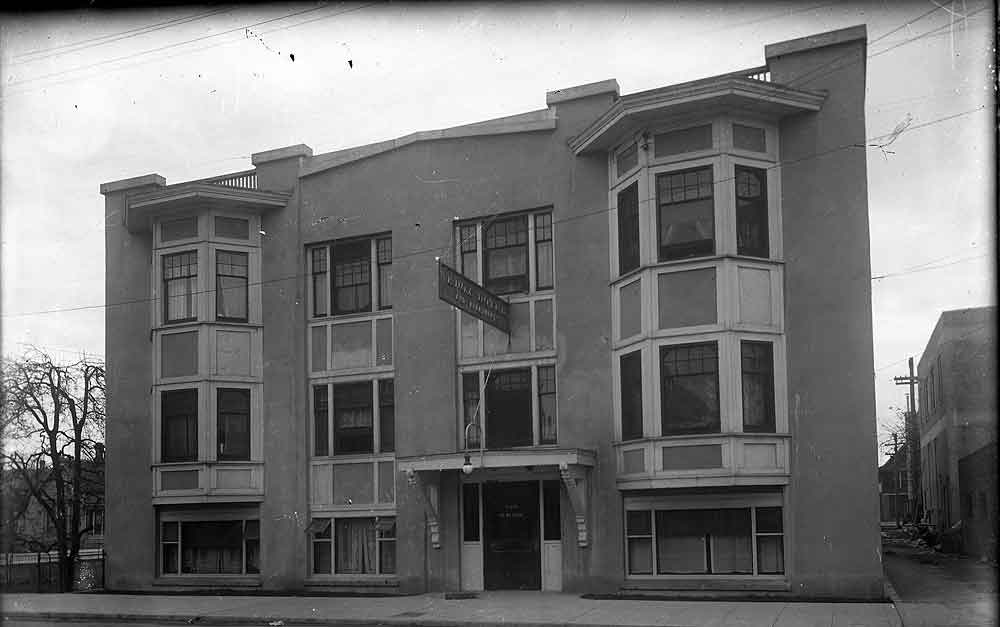
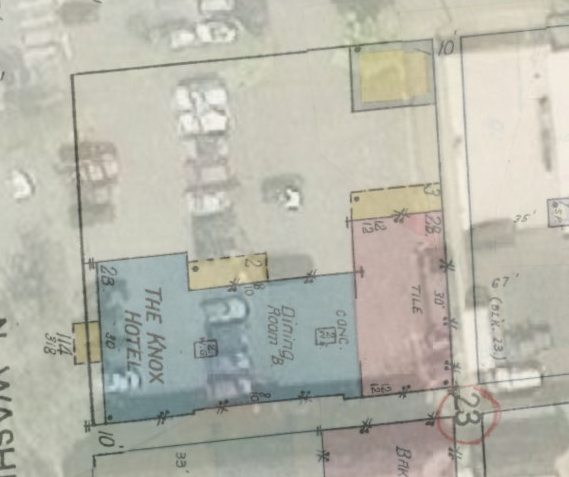
Jerry’s grandmother, Frances Knox, went by Aunty Frank. She built the Knox Hotel and ran it for decades, sitting at the lobby desk, hosting community events, making the building a center of civic life in downtown Olympia for almost fifty years. It’s now a small parking lot behind the State Theatre. While the Knox was one of many community gravity wells in downtown Olympia, today the spot holds no one in orbit.
Before Olympia, the Knox family farmed in Kansas. When their farm burned down, they loaded everything onto a chartered train car, family and belongings alike, horses included, and headed for Washington State.
In Hoquiam, Frances Knox’s brother-in-law, N.T. Loomis, met them and helped move their possessions from the train to a boat.
Then it all went wrong. Their boat capsized in the Hoquiam River before they could reach the end of tidewater. A whole season’s worth of supplies went into the current, leaving them nearly destitute, discouraged, at the edge of the wilderness they’d come so far to reach.
They survived on whatever they could salvage from the woods and streams. The image that stuck in the family’s memory is Frances at the table, serving her children dried carrots when nothing else was available. She had a fortitude that fit the frontier exactly.
The early years in Washington brought further tragedy. John Knox died in 1885, only a few years after their arrival, leaving Frances to raise six children on her own. She moved the family to Olympia. By the time she was looking for backing to build a hotel, her reputation for surviving hardship was so well established that she never had trouble getting it.
Before it became an apartment building, the hotel was a hotel first, obviously. It hosted travelers, and their comings and goings got noted in the paper.
When soldiers of the 91st Division stayed at the Knox before shipping off to the Great War, Aunty Frank took them for rides in her car. When they came back from the mud of Europe, they brought her a bronze statue.
It also had a kitchen. And in the first half of the 20th century, the Knox Hotel made space for all kinds of community events.
Thirty members of the Thurston County Women’s Educational Club gathered here at one point. You could hear them talking about things that matter. They’re talking about wealth. They’re debating whether it’s found in the bank or in the heart.
Mrs. Theodore Young spoke about school teachers who give themselves for the betterment of the community.
There were discussions on the necessity of legitimate rural gossip. They believe that women need to get together and talk just as much as men do. They believe in the helpfulness of social intercourse.
There was a violin solo by Miss Florence Holbrook. There was a song.
The residents had a tradition of placing joke gifts under the branches of the lobby Christmas tree.
The Knox was what we’d now call a Third Place.
Jerry’s grandmother and his aunt ran the Knox. Jerry was involved in a different branch of the family business.
Jerry’s aunt Charlotte, Frances’s daughter, took over the burden of management and held it for half a century. She was helped for a time by her niece Gertrude, Jerry’s sister.
Jerry’s father Clinton had built a garage beyond the hotel. After college, Jerry joined the family business, working in the garage, not the hotel. The family had been early adopters of the automobile, and that’s where the work was.
Jerry eventually left the family business and took his experience into a long career with the Department of Highways. He spent those years as a right-of-way purchaser for the I-5 freeway, the project that would contribute to the decline of downtown hotels like the one his grandmother had built.
The same boy who once measured distance by the pull of oars grew up to purchase the right-of-way for the interstate.
His job was to acquire the land for the new freeway, clearing the path for the infrastructure that will bypass the downtown core, buying the property that will become pavement. He was a diplomat of the very speed that makes the slow hospitality of his grandmother’s hotel unnecessary. The rowboat is gone. The physical connection to the inlet was replaced by the high-speed interstate.
This is the same highway that let Lacey grow, that some say destroyed Tumwater’s historic downtown, and that changed our community forever. It made the human scale of a boy rowing into town impossible to imagine in everyday life.
It’s a shift you can trace in Olympia’s own history: from a city where five miles was a significant physical journey by water, where people could walk or bike to a community gathering at the Knox, to one where that same distance is a few minutes on a concrete artery.
Before Interstate 5, the Knox Hotel was sold in April 1945 to W. M. Tompkins of Tacoma.
The Knox family had already made the transition to a full-time apartment building. Charlotte Knox had stepped away. Aunty Franky passed in 1943. The buyers, the Tompkins, were themselves a signal of what was coming. Before buying the downtown hotel, they’d spent three years running Auto Courts, the roadside lodging that would eventually replace the traditional urban hotel.
In its last twenty years, the newspaper mentions of the hotel shift from clubs holding meetings and Christmas parties to untimely deaths of elderly residents and crimes. Like the Carlton a couple of blocks over, the Knox had become naturally occurring affordable housing.
A place like the Knox gets affordable when the original family that treated it like a community institution is gone, and the building just gets older and cheaper. People need a place to live, and some can’t afford much. Places stay affordable because they’re old and nobody’s investing in them. They’re rare now because modern codes outlawed the features that made them work: shared bathrooms, tiny rooms. When these buildings sell, the cost of bringing them up to code forces rents up and out of reach for the people who need them most.
Then comes January of 1966. It’s a time of stormy protests at City Hall. Residents won a fight against the widening of Carlyon Avenue. They’re worried about their property. They’re worried about losing their neighborhood. And they’re able to defend it, or what they think it is. But the momentum of the car is too strong for the Knox. City engineers are focused on arterial improvements and right-of-way problems.
In the middle of all this, the Knox Hotel is razed. The sturdy three-story concrete structure meets the machinery of Franz Schlottman. The building that stood for over half a century is reduced to rubble. The Daily Olympian calls it being “mauled with kindness.”
There’s no kindness in a wrecking ball. There’s only the need for more space.
The site is prepared. It’s cleared of its history. It’s flattened. It becomes a parking lot.


Leave a Reply