History, politics, people of Oly WA

Category: Seattle (Page 1 of 2)

Seattle Doesn’t Play Itself

For a city obsessed with moviemaking and modern narrative, the documentary Los Angeles Plays Itself works as a surprisingly effective local history of Los Angeles and Southern California. Much of how we understand Southern California arrives through the lens of filmmakers.

The core thesis of the documentary Los Angeles Plays Itself (or at least the one that rings truest to me) is that Los Angeles is constantly captured while being denied the ability to express itself. Even calling Los Angeles “LA” flattens the city, stripping away its complexity. It’s the cinematic equivalent of a typecast actor trying to communicate something real about themselves while trapped in someone else’s script.

My favorite thread in the film is its discussion of mid-century modern Southern California homes, so often repurposed as villainous lairs. Filmmakers turn a distinct and beautiful regional architecture into something cold, cruel, and hostile, warping the meaning of the place itself.

This is the inverse of the problem Seattle (and the broader Pacific Northwest) faces.

Just a note before I go any further: I acknowledge “Seattle” isn’t synonymous with “the Pacific Northwest.” I use it as a stand-in for the urban Northwest, which also includes Portland, parts of Tacoma, Bellingham, and Olympia. There is a broad spectrum of society that is centered deeply in the Seattle experience. There isn’t a moat around the city, so what happens there matters elsewhere. I just wanted to acknowledge that there are missing pieces to what I’m writing about today. Which is sort of the meta-point of the essay anyway.

So, moving on.

Unlike Los Angeles, which plays every city or no city at all, other cities almost always play Seattle. And what this does is it keeps us from approaching our own story. The story necessary for film keeps our own story to one side.

Films set in Seattle routinely shoot somewhere else. Fifty Shades of Grey was filmed in Vancouver, the most common “not Seattle.” More cruelly, The Boys in the Boat was filmed mostly in England, where a historic England market town and a primary school stood in for the Depression-era University of Washington and Seattle.

The first question is whether we can forgive Vancouver as it stands in for Seattle. Both belong to the proto-nation of Cascadia, sibling cities separated by an inconvenient international border. That logic almost works, except Vancouver suffers from its own Los Angeles Plays Itself problem. It plays everyone.

Vancouver has appeared as San Francisco (Rise of the Planet of the Apes), New York (Life or Something Like It), Chicago (I, Robot), Tokyo (Godzilla), and Shanghai (Code 46). It has even played fictional cities like Metropolis (Smallville) and Gotham (Batwoman).

Seattle, by contrast, rarely gets to play itself. When it appears on screen, it matters more as an idea than as a physical place.

Seattle functions cinematically as a concept rather than a geography or community.

The city became shorthand for the foggy shape created when you pull together grunge, Starbucks, and Tech: cultural exports that transformed Seattle into a symbol of urban aspiration and fantasy. As James Lyons explains in Selling Seattle, the city’s rise in film and television accelerated in the early 1990s as it shed its identity as a “rough diamond” lumber town (itself very limiting) and rebranded itself as a center of technology and culture.

One reason filmmakers gravitated toward Seattle was its portrayal as a “safe haven” and “white oasis” for middle-class professionals, especially when contrasted with the media narratives of urban decay and racial unrest that defined Los Angeles in the same era.

Nora Ephron’s Sleepless in Seattle (1993) cemented this version of the city: sentimental, romantic, and largely frictionless. Young-ish professionals move through a city unburdened by history, class, or social constraint, living urban-adjacent lives without consequence.

The grunge subculture added a layer of “novel edginess” that appealed to filmmakers without pushing into our actual history or non-white communities. Coffee shops and music venues signaled bohemian credibility while remaining safely contained. Seattle became a metropolitan sanctuary, a cool, mist-covered stage balancing high-tech ambition with rugged natural isolation.

This mythology formed the mental backdrop for stories set in Seattle, but not of Seattle.

Half Steps in Popular Film

The films that do get Seattle and the Pacific Northwest better, if not correct (Singles, Grassroots, The Ring, and the very recent Train Dreams), do so largely because they were filmed here. They often show a different city and region than the friendly, white, urban unicorn of popular imagination.

The Seattle of Singles is jaded and two-faced. In Grassroots, the city turns up its nose at dreamers, favoring politically “serious” projects like light rail over visionary but impractical ideas like the monorail. The Ring forces viewers to confront how dark it gets here (literally and metaphorically) and how much remains unseen. Train Dreams expands the frame beyond the city entirely, emphasizing the overwhelming scale of Pacific Northwest nature, the nature of transitory communities, and asking viewers to sit with uncertainty until the very end.

These films start to reveal what we lose when Seattle doesn’t get to play itself. Nowhere is that loss clearer than in the limitations of Grassroots.

Grassroots feels faithful in spirit, but only if you squint. Adapting Phil Campbell’s memoir, Zioncheck for President, required sanding down something far darker and more unstable. The resulting film is earnest and encouraging, the kind of story that makes local politics feel charming.

Campbell tells the story of Marion Zioncheck, a brilliant,  erratic, and tragic 1930s Seattle congressman. He weaves Zioncheck’s life through the 2001 monorail campaign, framing it as a ghost story about Seattle radicalism and its costs. The memoir isn’t really about a monorail or a doomed campaign; it’s about the thin, dangerous line between political idealism and clinical instability.

Removing Zioncheck loses the story’s historical ballast and its most unsettling question: whether Grant’s obsession represents visionary persistence or the modern echo of a tragic mental break, and how Pacific Northwest political culture absorbs and romanticizes both.

The book also lingers on the unease beneath the framing of two white, slacker-intellectuals trying to unseat one of the city’s few Black political leaders. Campbell confronts the ugliness of that tension, questioning how grassroots movements often remain blind to their own privilege and moral certainty. The film acknowledges this dynamic, then quickly retreats to the cleaner abstraction of monorail versus light rail, choosing policy debate over racial and class friction.

Grassroots reads as a love letter to civic engagement in Seattle. Zioncheck for President feels messier and truer, a beautiful, sometimes horrifying autopsy of a midlife crisis unfolding in public. Both love the city, but only one sits with what that love costs and what it reveals about Seattle itself.

This may simply reflect the limits of film versus books, something a smarter person could explain more elegantly. Books allow for nuance that even a three-hour movie struggles to sustain. Film demands loss. A loss that text can afford to keep. 

So maybe we’re stuck if we focus only on film.

Broader Narratives

Supersonic and West of Here are two sweeping novels that attempt to wrap in more faithfully the missing context that a true narrative of the Pacific Northwest brings to the table.

But books like Survival Math by Mitchell S. Jackson and No-No Boy by John Okada cut deeper, peeling back the familiar Pacific Northwest mythology of tech, evergreen cutaway shots, and coffee-fueled progressivism in a white space. They reveal a regional story shaped instead by displacement, survival, and the hard geometry of who gets to belong.

Supersonic and West of Here gesture toward these realities, but they stop short of plunging into the disphotic zone of regional narrative.

No-No Boy’s Seattle looks nothing like the Emerald City of boosterism and nostalgia. The postwar International District barely breathes. Streets like Jackson become psychological checkpoints rather than simple routes. The protagonist moves through the city as an intruder, hyper-aware of his body, his history, and his perceived betrayal. The city doesn’t welcome him back; it watches him, measures him, reminds him that reintegration is conditional.

Jackson’s Portland in Survival Math stands as the inverse of the Portlandia fantasy. It isn’t quirky, gentle, or ironic. It is a city designed, architecturally and socially, to contain, monitor, and discard Black residents.

If the cinematic Seattle of the 90s was a “white oasis,” Zia Mohajerjasbi’s Know Your Place gives us the irrigation system, the grueling, uphill labor required to sustain a life in the cracks of the “urban aspiration.” Telling the story of an Eritrean-American teenager on an odyssey across the hills of the Central District to deliver a suitcase of medicine, the film allows the physical geography of the city to sync with the lived experience of marginalized inhabitants. Know Your Place doesn’t settle for the postcard views of the Space Needle that serve Grey’s Anatomy. Seattle is not a “safe haven” but a labyrinth of disappearing landmarks and a society that doesn’t serve everyone.

In Know Your Place, Survival Math’s displacement becomes visual. We see historic Black and immigrant-owned spaces not as footnotes, but as a vibrant, fragile reality being physically overwritten by the expanding white footprint. Like No-No Boy, the film uses the city’s verticality to illustrate social friction. Every hill climbed in Know Your Place is a reminder of the economic and systemic weight carried by the main character. By centering the East African community, the movie moves past the novel edginess of grunge to find the actual city, a complex, multi-layered heritage waiting for a lens.

Seattle Knows Itself

So, in a genre I know better (local history),  this is Megan Asaka’s Seattle from the Margins as compared to Murray Morgan’s Skid Road. The quirky, mostly white, working-class history of Morgan’s Seattle presents the anti-Chinese 1886 riots as a dramatic, chaotic, and shameful moment of civic breakdown. Morgan uses his wit to describe the “vigilante” committees and the “horrible friendliness” of the mob herding people onto ships. However, he treats the event as a temporary fever, a singular eruption of “hate” in an otherwise colorful, rough-and-tumble town.

The deeper truth, explained by Asaka, is that the riots were a symptom of a deeper design of Seattle that kept non-white communities in Seattle on the margins.

The difficulty Seattle faces in cultural representation is still the inverse of Los Angeles’s problem: while LA is constantly filmed but denied self-expression, Seattle rarely gets to play itself. Instead, Seattle serves as a cinematic concept that erases our deeper understanding of our own place and our own history. The baggage that white people carry from across the country lands on our regional narrative when they use Seattle to tell stories or to move here.

This preference for the abstraction of grunge, Starbucks, and tech aspiration over geography warps the city’s narrative, overlooking its historical complexity and marginalized communities. But recently, we are seeing films that sync the city’s physical and social terrain with the lived experience of those on the margins.
Happy Irish Day, Seattle Celtic were local champs 99 years ago

Back in the dark forgotten history of Cascadia, soccer used to be a pretty big thing around here. In the first decades of the 20th century, there was a thriving local soccer culture. There were several clubs in Seattle and the surrounding towns, especially logging or coal towns dotted around the cities.

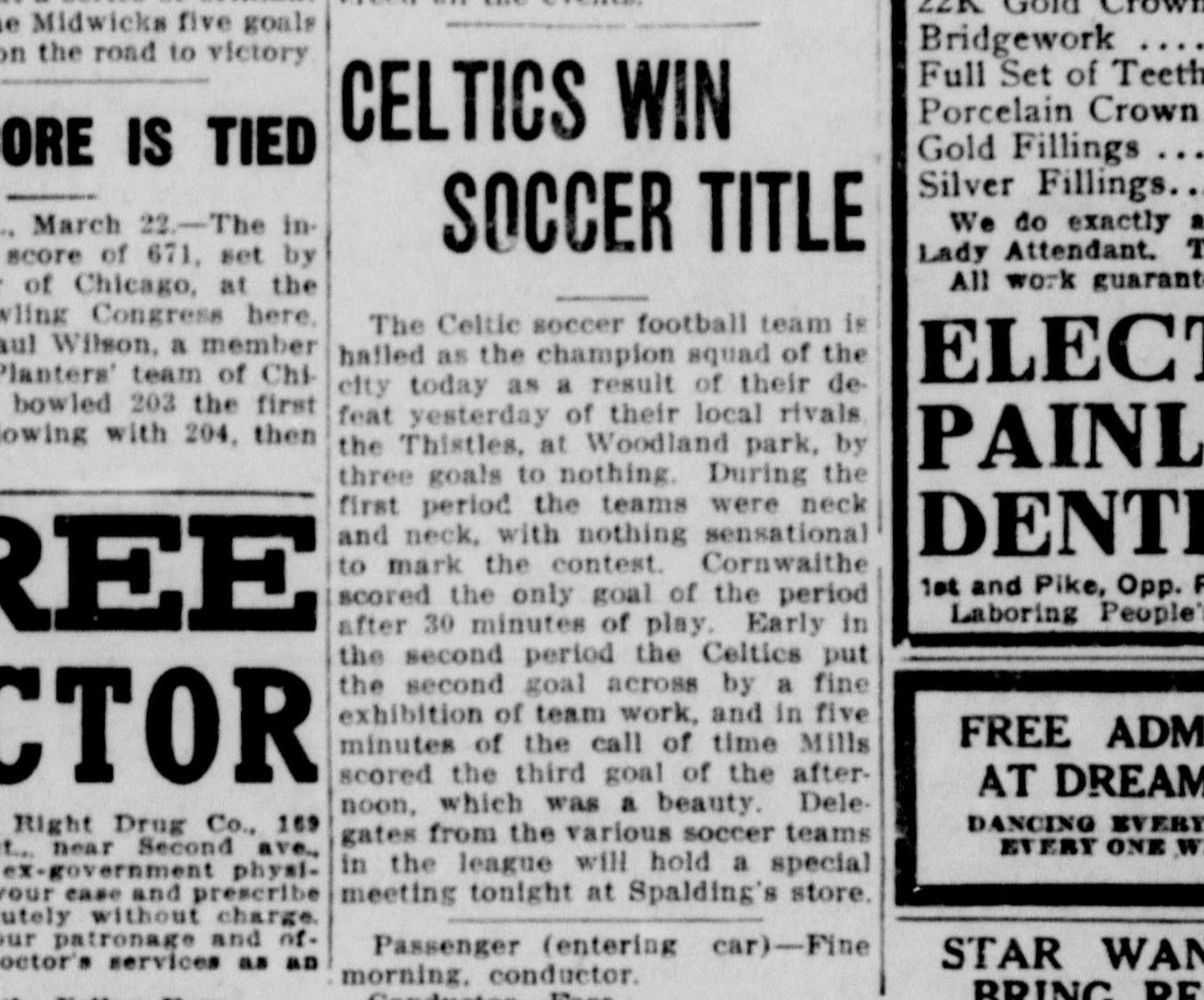
Seattle Celtic lifted the cup in March of 1915:

You can read my much longer birds-eye-view piece about the early history of Puget Sound soccer over at GoalWa. Here is a peak into the period of the Celtic club’s championship run:

The Post-Intelligencer Cup was won by the Seattle Celtics; Tacoma
was second, Carbonado third, and Black Diamond fourth and last. These
teams and the Seattle Rangers and Woodland Park clubs competed for the
McMilan Cup. Both cups are played for in the league system.

The McMilan Cup competition was a seesaw affair from the
beginning to the end, and the winner was only decided after the last
game had been played. The Tacoma team finished ahead of the Celtics by
one point ; Black Diamond, Carbonado, Rangers and Woodland Park followed
in the order.

Boy, lifting the knockout tournament cup, but missing the league title by one point to Tacoma? Ugh. I feel for the Irish today.

Mostly because I assume the Celtic brand is a powerful one (that goes way further than the borders of Glasgow), there is a Seattle Celtic club still.

The time when the King County Arts Commission complained about the cultural insensitivity of the Seahawks logo

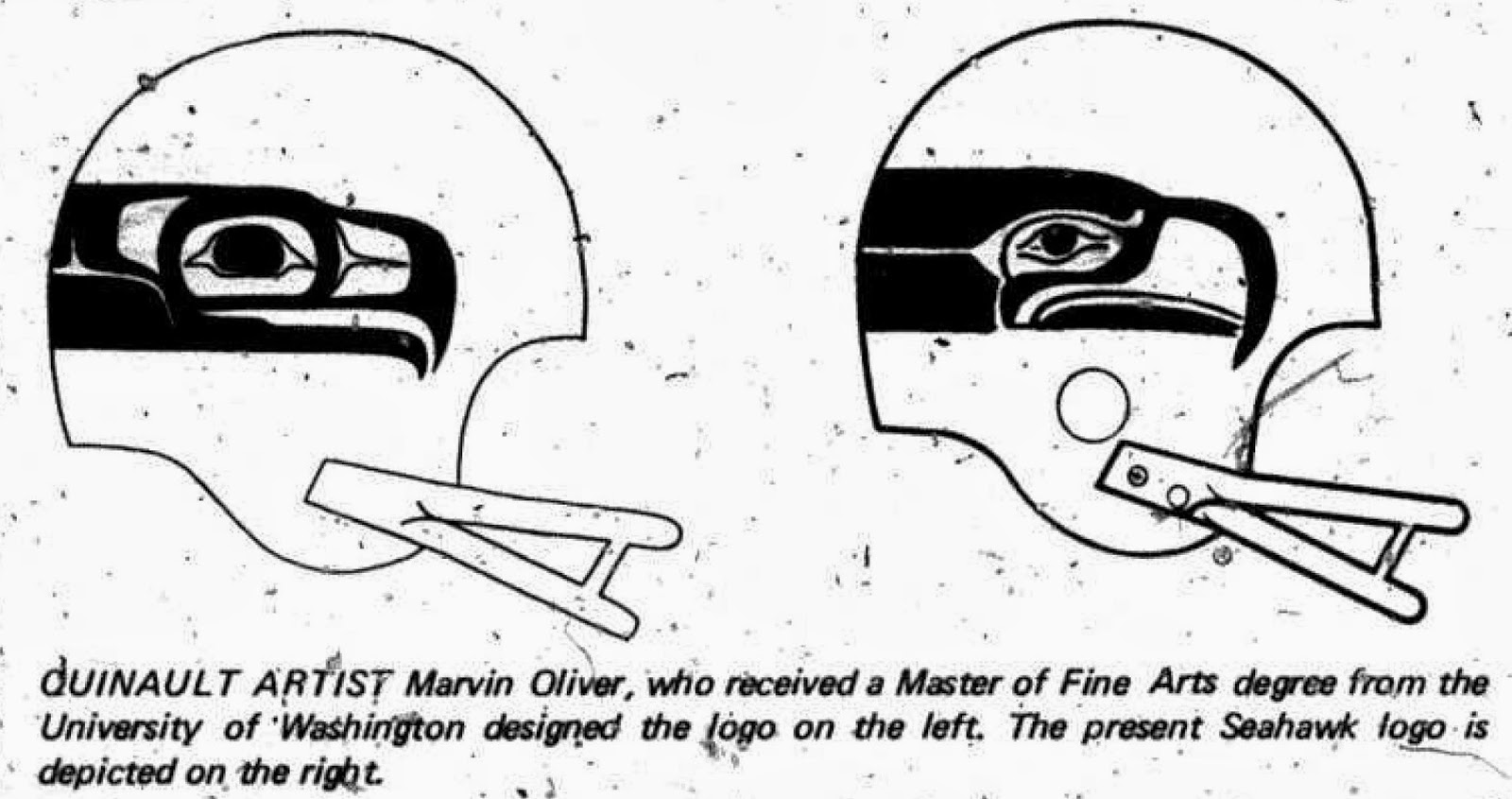
Just about a year before the Seahawks finally took the field, they were in a somewhat similar position as the Washington NFL franchise is now. The logo the Seahawks had been handed by NFL designers didn’t directly borrow from local tribal design standards. The King County Arts Commission complained that it “fails to accurately depict the art principles of Northwest coastal Indians.”

From the Northwest Indian News (a newspaper) in September 1975:

Among the differences found to be inaccurate is the characteristic eye form. The Commission enclosed a suggested correction by Marvin Oliver, Quinault… Oliver depicted regional art principles in the design.

It shouldn’t surprise me at all, but the original Seahawks design came from people working out of Los Angeles. I kid you not. I can just imagine the designers in the LA spring, cracking some books on Pacific Coast tribes, copying down ideas.


(Seahawks general manager) Thompson said the NFL firm did refer to some books on Northwest Indian culture. “Our intent was to follow the Northwest Indian culture, but there was no condition placed on them (NFL) in designing.”

The Arts Commission further stated, “As with all great art, a full understanding and appreciation does not come quickly. Hence it is not surprising that the new logo fails to depict with adequate sensitivity the arts principles of the Northwest coast Indian peoples.”

Since that first season, and the back-and-forth between the commission and the team, the logo (especially in the eyes) has strayed even further from Oliver’s suggestions (from From Rain to Shine).

Native Appropriations brings us to the today, nearly 30 years into the Seahawks design. The blogger, a tribal member and law student, is writing about a particular use of the Seahawks logo that incorporates even more tribal designs. She like it, but examines where it fits in culture:

…I question my endorsement after my analysis naturally evolves into
larger questions about art, identity, acceptance, and what happens when
Native cultures live harmoniously (or at least not so adversely) with
others?

Where we start to move away from imagery of a fan’s foam head towards a
fan’s headdress or mask is the face: the two green paint lines on the
cheek suggest the 12th Man is wearing “war paint” instead of mimicking
the black grease or tape the players use on their cheeks to cut down on
glare. Now it’s starting to look more like a hipster appropriation and
misinterpretation and I wonder – was the inspiration for this design a
transformation mask?

I’ll link again, because it is worth reading this entire post.

The Los Angeles Sonics and the lies of legacy

1.

When the Supersonics first came to Seattle in the late 1960s expansion of high level basketball, they were the first major professional team in Seattle. Sure, I suppose the Seattle Metropolitans count, as they won the Stanley Cup in 1917. But, for the growth of modern Seattle, the Sonics are the first team that really matters.

Soon after the the Sonics came the Pilots (which quickly moved to Milwaukee) and then ten years later the Mariners and Seahawks. But, by the time professional baseball and football were getting their feet set in Seattle, the Sonics had already built a championship team by 1979.

As seems to be tradition in Seattle sports, a rich Californian was behind it all. Sam Schulman bought into the NBA in the late 60s and ended up with the Seattle franchise. Schulman made most of his money making movies (though he himself was rarely listed in credits). He was also part of a group that bought the San Diego Chargers in 1966. When you look for him now, he’s most well known for his early ownership and stewardship of the Sonics and his impact on professional basketball.

And, it was Schulman, not Clay Bennett, that first threatened the move the Sonics out of Seattle.

While Schulman was eager to buy into the NBA, he seemingly had no particular love for the institution. His early years as a professional basketball executive were spent trying to reform the game. His struggle to bring together the NBA and the rival American Basketball Association and change how player contracts were handled.

Schulman’s primary battle with the NBA (over player contracts) culminated in the 1971 Supreme Court decision in Haywood vs. National Basketball Association, which ended up allowing teams to sign players with less than two years of college experience. Schulman had signed Spencer Haywood, who had left college after less than two years. The NBA sanctioned the Sonics, and Schulman took it to court.

Schulman’s primary antagonist throughout the Haywood saga and the effort to bring ABA teams into the NBA fold was Jack Kent Cooke, who owned the Los Angeles Lakers. it was in this context in the early 70s that Schulman threatened to move the Sonics.

Steve Pluto quoted Dick Tinkham’s telling of the threat in his history of the ABA:

There were a lot of crazy things going on. (Seattle owners) Sam Schulman and I were on a merger committee and Sam told me that if the NBA teams wouldn’t support our merger agreement, he was going to sign Haywood, move his franchise to Los Angeles and join the ABA! He told Jack Kent Cooke that his was what he planned to do. He said he would move right into Cooke’s backyard if Cooke didn’t back him. But, like everything else that was talked about and threatened, nothing came of it.

This threat was made in private as it was not reported in the Seattle media, as far as I can tell. But, if Tinkham’s retelling is correct, it says a lot about Schulman, who has been remembered as one of Seattle’s most important and loyal sports executives. We can’t doubt his California roots, he had already had interest in the Chargers before he came up to Seattle.

The story also fits the geography of sports at the times. The ABA’s franchise in Southern California, the Los Angeles Stars, had moved to Utah in 1970. Their new San Diego team wasn’t established until 1972. The NBA’s San Diego Rockets has also moved to Houston in 1971. And the Buffalo Braves wouldn’t move to San Diego as the Clippers until 1978 and Los Angeles until 1984.

If Haywood had lost in the Supreme Court and Cooke had worked successfully to keep the ABA at arm’s length, Schulman moving the Sonics to Los Angeles seems much more likely. But, history turned out differently. Haywood won his case and most of the ABA came into the NBA in 1976.

And, three years later, the Sonics beat the Washington Bullets in five games and the commuting owner of the Sonics enshrined into Seattle sports history.

Wrote Steve Kelly of the Seattle Times:

For the 16 years he owned the Sonics, Schulman turned sports ownership into a thrilling high-wire act. 

He took chances. He made headlines. When he failed, it was colossal. But when he succeeded, it stirred this city like nothing Seattle sports has seen. 

Schulman was a showman. He came to Seattle with all the elan and marketing chutzpah of a Hollywood pitchman. He knew how to win games, win hearts and fill seats.

Sam Schulman was also the first person to threaten to take the Sonics away, if only in private. If he’d been driven to it, the Sonics would’ve been the second professional team to leave in a few years. After only one season on Major League Baseball, the Seattle Pilots left to become the Brewers. Losing the Sonics would have been a major sporting crisis in Seattle.

With the Sonics seemingly secure in Seattle, civic leaders battled with professional baseball to eventually bring the Mariners. They also brought together the community to fund a multi purpose stadium for football and baseball before a major league franchise was secured in either sport.

It certainly wasn’t easy going for sports boosters during the Boeing Bust era:

By 1971, many people had had enough. Although community activists like Frank Ruano continued to lob complaints at the County Council, bids for the new stadium on the King Street site went out. Despite disapproval and concerns from International District groups, the commissioners stuck to the findings of an environmental impact study which claimed minimal damage to the Asian enclave lying to the east of the proposed site.

During the Kingdome’s official groundbreaking ceremonies on November 2, 1972, some 25 young Asian protesters hurled mudballs at the dignitaries in attendance. Several hundred spectators watched as County Executive Spellman’s speech drew chants — “Stop the Stadium!” — from agitators. Dissenters booed other speakers, including a Seattle Kings representative seeking to attract a professional football franchise. Spellman hastily planted the gold home plate on the field, but the ceremony was a bust.

In this climate, jobs walking out of Seattle as Boeing shrank for seemingly the first time ever, and vocal opposition to a new stadium, the Sonics skipping town would’ve been a death blow. It isn’t likely we would have ever ended up with the King Dome, the Mariners, Seahawks or the modern Sounders.

2.

Where Sacramento sits now — about to lose their only major league sports franchise in their history — is almost a perfect bookend to the history of Seattle sports and the city’s self image. In the late 1960s and early 1970s, Seattle was ten years off the World’s Fair when city leaders made a strong argument to the world that Seattle mattered. Sports teams are a major part of that argument. Simply put, towns with teams matter.

In the 40 years since Schulman made the threat in private to move the sonics and mudballs were launched at people for suggesting even more major league sports, Seattle is well established. Sacramento is hanging on by a thread. If we end up getting the Sacramento Kings and turning them back into the Sonics, we’ll put Sacremento back in the place Seattle was in 1966.

The hopes for Sacramento in 2014 would be a lot less bright than for Seattle in 1966. The sports scene is a lot less fluid now. Rival national leagues just aren’t founded anymore and the current leagues don’t expand all that often. And, its not often you can beat a city like Seattle in a struggle for a team.

Clay Bennett and the OKC Thunder notwithstanding, Seattle has come a long way since 1966. The Sonics leaving hurts so much maybe because it has been one of the city’s’ few civic failures in recent years. The Pilots leaving certainly hurt the city’s pride, but it wasn’t treated like the mortal sin like the creation of the Thunder.

The fact is, Seattle has become a city secure with major league sports. If Seattle’s civic leaders want a NBA team enough, they’ll get it. Seattle has become that kind of city. If not Sacramento, then maybe New Orleans. Some other lesser city will give up its franchise to us eventually. And, in doing so, we’ll drop that other city back into the sports franchise oblivion Seattle last saw almost 50 years ago.

Why I hope “the 206” fails and Local Brew wins

I have nothing but love for Almost Live and John Keister in general. In my childhood memory, I recall the original Ross Schafer talk show version. And, one of my happiest memories was my first July 4 back in western Washington in 1997. I had been back in the state for only a few days and found myself in an apartment over lake Union waiting for the fireworks, and a rerun of Almost Live was on. It is pretty cliche, but I felt more at home in that moment.

All that said, I really hope The 206 doesn’t last long. For years I had pined for John Keister and other Almost Live cast members to make it back somehow. I always thought the show was cancelled unfairly and I really did like the first comeback effort with the John Report with Bob. But, it is hard to imagine that if Almost Live had evolved over the past 14 years, it would’ve ended up like the 206.

The promos so far seem far too self-knowing that people like Keister and Pat Cashman have been off television locally for the past decade. They seem to reference a need for local comedy that hadn’t existed since they were canned. That’s not acknowledging the local internet comedy that has sprung up since then. Local Brew is one obvious example (I’ll get back to them), and Seattle Untimely was another healthy effort worth pointing to.

I’d be lying if I didn’t admit that Keister’s ad for Renton still hurts a bit. Its hard for me to know that exists and to be able to hear Keister make fun of another town, if that’s still part of his schtick. There’s a certain level of authenticity needed to be funny in the way that Keister is funny. And, by making that ad, he lost some of that.

There’s also this: Keister has grown out of being the the 90s era local hero and has become an icon 20 years later. You just take icons seriously. We took Emmett Watson seriously and he was funny from time to time. But, we also didn’t think he was funny in a way that a clown or local television comedian is funny.

I wish I could find an example to link to, but the KCTS commentaries Keister did about five years or so back (somewhat serious, still funny) were more fitting the back on the heals and wise stature that he has earned.

Now, it all needs to be 1990 again, but it can’t be 1990 again.

If you want it to be 1990 (or the year when you were young and funny) you have to go to some place like Local Brew. Instead of putting up vague (and obviously shilling for Cadillac) promos, Ross Asdourian of Local Brew just now successfully raising $10,000 on Kickstarter for the show’s second season. That on its face shows the understanding and social connection it needs to produce local and funny content.

But, the best argument for Local Brew and against The 206 comes from the cast of Almost Live:

The city has lost its oddball manner and its regional distinction, he said, in ways that have muted much of “Live’s” local flavor. Former “Live” cast member Nancy Guppy agreed.
“I don’t know if it could exist now,” she said.  

Everything is becoming more homogeneous, with condos stacked on Subways, luxury markets, Pottery Barns. Said Guppy: “I’m not sure who cares about the local thing — the Seattle thing.”
Or as Keister put it: “Ballard was old Scandinavians. Fremont was hippies. Capitol Hill was gay. Kent was where whites of modest means moved to escape Seattle school busing. Bellevue was the same for the rich.

“Today, you can make a joke about Ballard but it’s a bunch of wealthy people who work in the information industry. You make a joke about Wallingford and it’s a bunch of wealthy people who work in the information industry. 

Fremont? That would be a bunch of wealthy people who work in the information industry.
“And Belltown is a bunch of wealthy people who live in luxury condos … who work in the information industry.”

Obviously, Keister think there’s enough there to make a comeback. But, his comment speaks to a certain element of comedy of living in the moment. Being able to see the authenticity of a place right in front of you and knowing how to make fun of it. Keister mocking Ballard was funny because he obviously loved Seattle and loved Ballard. Keister making fun of the new “information industry” Seattle would be sad.

Keister’s assesment of Seattle is spot on. But, he’s also the wrong person to make fun of it. Transplants and folks who grew up in that new Seattle certainly can and do mock it.


Local comedy is dead. Long live local comedy.

I always knew the “Seattle chill” was bull shit

Depending on how you want to view it, Eric at Sightline’s piece about the “Northwest Personality” will either reaffirm your belief in the Seattle Chill or convince you still it doesn’t exist.

From Eric:

Northwest states are among the most open and least neurotic places you can find, but we are also among the least extraverted. Not surprisingly, Oregon and Washington perform almost identically on every measure. More interesting, perhaps, is that Alaska, Idaho, and Montana are also very similar in some respects (though quite different in some others).

The good news is that the Northwest is not a neurotic place. Washington is the 46th least neurotic state in the union, followed by Alaska at 47th, and Oregon at 48th. (Idaho and Montana rank 32rd and 39th, respectively.) To get any less neurotic, you’d have to move to South Dakota (49th), Colorado (50th), or Utah (51st).

The other nice thing about the Northwest is our openness. Oregon is the 3rd most open state in the nation while Washington is 5th. (Only New York, Massachusetts, and DC are comparably open.) But move away from the urban Northwest and the openness appears to fall off: Montana is 16th; Idaho is 30th; and Alaska is 49th.

What do you call a region that is neither neurotic nor extroverted? Totally sane. Yeah, say you take a state that ranks both high in neuroticism and extroversion (like Pennsylvania) I guess you could say they weren’t as chill(y) as us. I’d also say they were also totally unhinged.

What outsiders say is our tendency to be on the surface nice but total dicks in action, I say we’re just not as freaking crazy as you are, so can you please get a grip of our sanity?

Also, another note that Eric makes is that as a region, the Northwest flows pretty well as a group through the personality traits, except for openness. As Oregon and Washington rank pretty high the more conservative northwest states are lower down (Montana 16th, Idaho 30th and Alaska 50th). Northwest conservative, in that regard, means you are less open.

“Emmett Watson selling condos for Paul Allen”

I feel so sad for John Keister, because now even Knute Berger is making fun of him for the Renton thing:

A sure sign that something is going on is the new TV ad from Renton which aired during the Seahawks playoff game last week, featuring former Almost Live! comedian John Keister shilling for the town which, we’re told, is “ahead of the curve.” John Keister selling Renton? What’s next, the ghost of Emmett Watson selling condos for Paul Allen?

The only way for Keister to redeem himself at this point is to go on Seattle Untimely and explain himself.

Don’t bring back John Keister: Seattle Untimely Lives!

For awhile now, I’ve been grinding in the back of my head about the fate of Almost Live! and that John Keister was unfairly off the air.

I even posted a little while ago saying that someone could easily to an Almost Live! on the internet.

Well, hell ya: someone is.


John Keister has sold out to Renton and Almost Live! re-runs are impossible to watch. Long live Seattle Untimely!

Seattle PI Blog: “Seattle Untimely:” Local comedy takes to the Web
Have Bat Will Travel: Seattle Untimely
Citizen Rain: ‘Seattle Untimely’ jokes about the news

Here is their vodcast feed.
Here are their forums. Thank them.

John Keister sells out to Renton

Ok, maybe that’s a bit too harsh, but that was my immediate reaction to John Keister pimping Renton during the Seahawks’ game on Saturday. It was a good ad, especially for people who actually remember almost ten years ago when Almost Live! was making fun of Renton.

People who’ve moved here since 2000 probably have no idea who John Keister is or why making fun of Renton still might be fun.

The one reason why I’d say Keister was totally selling out was that the content of the ad really gave no reason why Renton is ahead of the curve. Most of the ad could have been stock footage of any “I want to be a great suburb” town: kids playing with soccer balls, a pool.

The two concrete reasons, The Landing and the new Seahawks headquarters, are still future projects. The images of the Boeing plant, well that hearkens back to the blue collar residents that Keister and gang were actually making fun of.

Ok, everyone has to make money and if Keister feels like cashing in on Almost Live!, more power to him. But, this puts even more distance between reality and Almost Live! ever coming back.

Seattle no longer most literate. I blame Jeff Shaw

Seattle fell to second place behind that city that was in about the middle of Fargo. You know, I think it was the one with the bar where the creepy guy tried to hit on Francis what’s her name.

Blame can be spread widely, but I blame this fall from grace, and the rocket accent of that yet unnamed upper Midwest city on Jeff Shaw, who moved from the “Seattle area” (Bellingham) to there earlier this year.

His reading power is so… uhmm… powerful that the Twin of this city moved from 11th to third, when I have good information that Jeff’s never stepped out of his car in St. Paul (there I’ve said it). Crap, we’re surrounded!

Not that Jeff would let something like this go to his head:

Verily, I think I speak for all us learned and sagacious denizens of these dual metropolises when I say: Suck it, Seattle. I hereby challenge Seattle Weekly‘s talented and debonair web editor, Chris Kornelis, to a read-off. Alternative weeklies at 10 paces.

Jeff is either smart in challenging his corporate sister paper, or smart to not challenge the Stranger’s Amy Kate Horn, who everyone knows is a much better reader than Chris Kornelis.

« Older posts

© 2026 Olympia Time

Theme by Anders NorenUp ↑