One of the historic rabbit holes I’m prone to falling down is the lost cities in Washington State. I don’t mean ghost towns, because some of them, like Tono in southern Thurston County, don’t exist at all anymore.
Over the years, I’ve tried to pinpoint exactly where Tono was located. Recently, I was looking at the parcel layer (the map showing property boundaries) in southern Thurston County (as I’m sure we all do from time to time), just below Bucoda. And, I noticed a long, skinny parcel that, to me, indicated a road or a railroad was once there.
So, I went back and found a fairly decent map of Tono that included a train line. The train line’s contour matched the parcel’s shape, and it lined up nearly perfectly.
This is the best I’ve been able to produce of how Tono was laid out.
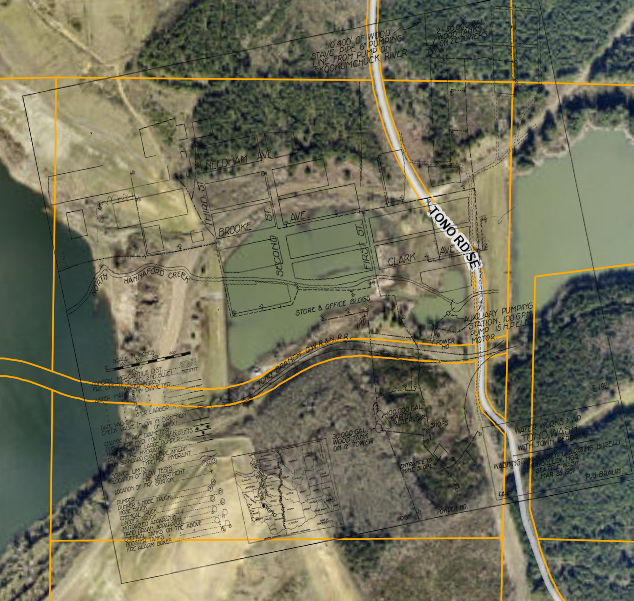
This is significant because the landscape of Tono disappeared when mining techniques changed after the town itself was abandoned.
In 1969 coal mining in the fields around the Tono site was revived when the Pacific Power and Light company bought the land and built a new steam plant to produce power. It was during this era that the Tono site saw its largest change. The ground on which the town had sat was scraped up in order to get to the coal beneath it. The coal mining terraforming was so severe that the town site is currently dominated by two massive ponds.
For decades, Tono had been a fairly significant town in Thurston County, on par with Yelm, Tenino, and Tumwater. But because it was a company town, when the resource ran out, the town itself ran out of reasons to exist.
What I keep coming back to is how completely Tono was erased. There was no fight over historic districts, no argument about “character,” no committee meeting where someone insisted their grandfather once lived in a particular house and demanded the coal company spare the building. The ground was literally peeled back; the past scraped away to get at what the land still had left to give. What’s left now are ponds big enough to swallow the entire town grid.
And yet, somehow, Tono survives.
Tono survives in census tables, photos, mining reports, and the stubborn curiosity of anyone who has ever tried, like I have, to find the ghost of a town that isn’t even a ghost.
It’s funny: we spend so much energy today trying to keep the past standing upright. We landmark houses whose only real significance is their ability to slow down a duplex development. We wrap ourselves around “character” as if it were a fragile antique rather than something living communities constantly renegotiate.
Tono is a lesson in impermanence so complete I can’t help but be amazed. An entire town, just gone.
Two ponds where families once lived. You couldn’t “preserve” Tono if you tried; the coal company settled the question half a century ago. And yet, that doesn’t make it any less historical. If anything, it makes it more so. Tono forces you to engage with history as a process, not a museum exhibit. You can’t stand in the middle of a preserved streetscape and pretend the past is still intact, because the flow from the past to today is change. Change even includes the scraping of an entire landscape until there is nothing left.
You have to reconstruct it. You have to work for it. And there’s something freeing in that.
The lesson of Tono, the one that historians, preservationists, and anyone who loves their community ought to sit with, is that losing the physical stuff isn’t the same as losing the history. The built environment is not the memory. The map I matched by lining up an old railroad grade with a weirdly long modern parcel tells me more about Tono’s rise and fall than any building would. The ponds tell a truth the hardware store never could: the town’s existence was always dependent on what lay beneath it.
We forget that history is supposed to breathe. Towns grow, plateau, disappear, reappear in footnotes, and get rediscovered in GIS layers. Some places make it. Some fade. And sometimes the fading is the story.
Tono reminds me that you can lose every house, every street, every trace of a community’s physical presence, and still have history worth knowing. You don’t need to encase it in glass to make it matter. You don’t need to keep a structure standing to let the story breathe.


@emmettoconnell Thanks for the history! I got curious and looked and it turns out Tono is on the 1930 USGS Topo. (It’s available as a layer in Gaia and maybe also CalTopo.)
Remote Reply
Original Comment URL
Your Profile
Why do I need to enter my profile?
This site is part of the ⁂ open social web, a network of interconnected social platforms (like Mastodon, Pixelfed, Friendica, and others). Unlike centralized social media, your account lives on a platform of your choice, and you can interact with people across different platforms.
By entering your profile, we can send you to your account where you can complete this action.
@emmettoconnell yes, preservation standards on private property in Washington in 1969 were functionally non-existent
this resulted in the outright destruction of quite a few things more precious than a recently-abandoned mining town
including precontact and burial sites dating back millennia, which were irreplaceable and largely undocumented — because of govt campaigns to destroy traditional knowledge
cultural resource management law is civil rights law, and not all history is written down
Remote Reply
Original Comment URL
Your Profile
Why do I need to enter my profile?
This site is part of the ⁂ open social web, a network of interconnected social platforms (like Mastodon, Pixelfed, Friendica, and others). Unlike centralized social media, your account lives on a platform of your choice, and you can interact with people across different platforms.
By entering your profile, we can send you to your account where you can complete this action.
I too search for lost places and try to document them.
Mine is Cedar Mountain WA. It is in King county between Renton and Maple Valley. Hwy 169 runs right over where she used to be.
The coal mines that supported her lasted longer than she did.
Insult to injury because of road configuration changes even old timers have her location wrong.
So…good work keeping these places alive!
Really cool article. I also see Tono, WA on this 1916 USGS topo map and it is aligned exactly where you located it on the parcel map as well. The accompanying LiDAR layer unfortunately confirms that basically all remnants of the town were blown away by the mining activity (except for the northern road out of town which might still be there): https://pastmaps.com/map/chehalis-lewis-county-wa-usgs-topo-1916#12.95/46.77158/-122.82159 (full transparency: I run Pastmaps, history and historical site research is my fulltime passion)
Really cool, thank you for sharing!
This is very well written from a rhetorical perspective, so good job making me think. There are several things that are bothering me though.
For one thing, the analogy between Tono and present-day debates over housing and development-related policy makes very little sense from the perspective of good land use policies. Is this the logic: Tono, a company town, gets erased because its founding company no longer needs it. Cast aside, and forgotten. And from that the conclusion is… modern cities should emulate this capitalistic neglect, more forcefully rebuilding our cities as they see fit?
In all seriousness, I do understand the point that you’re trying to make, but I don’t like it. And I see a lot of reasons here to back up my dislike.
The claim that more can be learned from historical maps, and research from afar, than by actually visiting and investigating a place seems easily refuted. I suppose value can differ from person to person, though. I am admittedly not a(n?) historian. So, I can’t rightly determine the exact merits of these differing methods. It just seems that, as an overall defense of leaving sites of potential historical interest unprotected, this doesn’t really hold up.
Moving forward, maybe the argument will be that virtual reality can recreate places where people have fond memories. But, there is a reality and security that is missing in that, one which actual historical sites and historic places have. I love imagining things and picturing sites based on my research. It’s just that I wouldn’t want it to take the place of actual places that truly can be felt on a sensory level.
The greater point that history is present whether or not places are preserved and cared for is valid; I do think we’ve become a bit too preoccupied with history. Equating living history to a museum exhibit is deeply flawed though, no matter how you slice it. There’s a big difference between seeing the tanks at the Puget Sound Estuarium and actually visiting tide pools and estuarine habitats.
I’m sympathetic to the mindset behind the idea that it doesn’t make sense for increasingly large swaths of urban landscapes to be fixed in their current structures and landscapes. But as to the idea itself, there’s an air of empty ‘progress.’ If it is truly demonstrable that a community-altering development project will improve said community then it should be allowed to move forward. However, if it does not show that—and the burden should truly be on the individual developer to so demonstrate—then the city or other jurisdiction should hold out for better. It’s not like older neighborhoods don’t change based on the people that live in them. Each successive generation or influx of people puts their own spin on it. But the constancy and equilibrium that underlies that slow change is valuable, I think. I’m not coming on here as an envoy from any neighborhood groups, by the way, this is just my perspective as a resident of an older Olympia neighborhood.
As for the history itself, it’s cool that one can dig up this history and I appreciate your passion for unearthing the past, and gaining lessons from it. Even if I don’t especially like the lessons you’ve taken from it.
Hi Jasper, I appreciate your thoughtful reply. And to follow your model, I don’t think there is a good answer either way. This is definitely something that stands in the middle of two extremes, and my example of Tono and letting go was more emotional than factual. I am working on a piece right now that moves the frame I put on Tono to Olympia, and what it means when we lose an entire neighborhood to what now seems like senseless and meaningless development. I do feel that we over emphasize the value of visiting a historic place rather than finding out what we can through other methods. We can only exist in the time we are now, so I tend to prefer voices rather than architecture or built environment because words and observations are closer to our own language.
Hi Emmett, thanks for your reply, and I look forward to reading your next piece. I see how architecture and physical history could be seen as the more functional aspect, while words and ideas are more deeply relevant to our historical, emotional connection. I guess my bigger issue with the erasure of historic places is when it’s an abrupt transition at the cost of those currently residing wherever it may occur. In Toronto (the major city I’ve visited the most), the construction boom of skyscrapers has made the little historic neighborhoods feel all the more valuable, because they retain personality and human scale. I don’t know if that helps or hurts my argument, actually.
Either way, in the places where historic buildings are getting razed to be turned into soaring towers, I can assume that the demolished buildings were appreciated more strongly by the select few people who used them than the newly constructed skyscraper will be by basically anyone, except for whoever is making bank off of them. And I do see how the benefit of all of those new dwelling units is very tangible as well, but it’s a philosophical dilemma I haven’t fully wrapped my head around yet. Is the city better because aesthetic and ‘taste’ has been lost in favor of (perceived) functionality? My thought is that it almost certainly isn’t improved on a case by case basis, but it could differ over the larger scale of many projects.